Saved Bookmarks
This section includes 7 InterviewSolutions, each offering curated multiple-choice questions to sharpen your Current Affairs knowledge and support exam preparation. Choose a topic below to get started.
| 1. |
Consider the decomposition of solid NH_(4)HS in a flask containing NH_(3)(g) at a pressure of 2 atm. What will be the partial pressure of NH_(3)(g) "and" H_(2)S(g) after the equilibrium has been attained? K_(p) for the reaction is 3. |
|
Answer» `P_(NH_(3))=4 "atm", P_(H_(2))s=2` atm |
|
| 2. |
Consider the compounds (I) R-I, (II) R-Br, (III) R-Cl, (IV) R-F. The rate of S_(N)1 reaction is |
|
Answer» `I GT II gt III gt IV ` |
|
| 3. |
Consider thecompounds, BCl_(3) and "CCl"_(4). How will they behave with water ? Justify . |
|
Answer» Solution :The B atom in `BCl_(3)` has only six electronsin the valence shell and hence isan electron-deficientmolecule. It easily acceptsa pair of electrons donated by waterand hence `BCl_(3)`undergoeshydrolysis to form boric acid`(H_(3)BO_(3))` and HCl. `BCl_(3) rarr + 3H_(2)O rarr H_(3)BO_(3) + 3HCl` In contrast,C atom is`"CCl"_(4)` has 8 electrons in the valenceshell.Therefore, it isan electron-precisemolecule and henceneither accepts nor donates a pair ofelectrons. In other words , it does not accept apair of electronsfrom `H_(2)O`molecule and hence `"CCl"_(4)` does not under go HYDROLYSIS in WATER. |
|
| 4. |
Consider the compounds, BCl_(3)" and "C"C"l_(4). How will they behave with water ? Justify. |
|
Answer» Solution :B ATOM in `BCl_3` has only six electrons. Thus, `BCl_3` is an electron-deficient MOLECULE and ACCEPTS a pair of electrons DONATED by water. Therefore, when treated with water, `BCl_3` undergoes hydrolysis to form boric acid and HCI. `BCl_3 + 3H_2 O to H_3 BO_3 + 3HCL` On the other hand, C atom in `C Cl_4` possesses an octet and has no tendency to accept or donate a pair of electrons. Hence, it does not react with water. |
|
| 5. |
Consider the compounds, BCl_3 and C Cl_4. How will they behave with water ? Justify. |
|
Answer» Solution :Being a Lewis ACID, `BCl_3` readily UNDERGOES hydrolysis. Boric acid is FORMED as a result. `BCl_3 + 2H_2O to 3HCl + B(OH)_3` `C Cl_4` completely resists hydrolysis. Carbon does not have any vacant orbital. Hence, it can not accept electrons from water to form an intermediate. When `C Cl_4` and water are MIXED, they form separate layers. `C Cl_4 + H_2O to` No Reaction |
|
| 6. |
Consider the compound (A) given below: a. Give the total number of stereoisomers possible for (A). b. If the stereochemistry about the double bond in (A) is cis, give the number of enantiomers possible for (A). c. If the stereochemistry about the double bond (A) is trans, give the number of enantiomers possible for (A). d. Give the total number of diastereomers possible for (A). e. Give some examples of the types of (A). |
Answer» Solution :a. The compound `(A)` contains two asymmetric `C` atoms with the same terminal group. 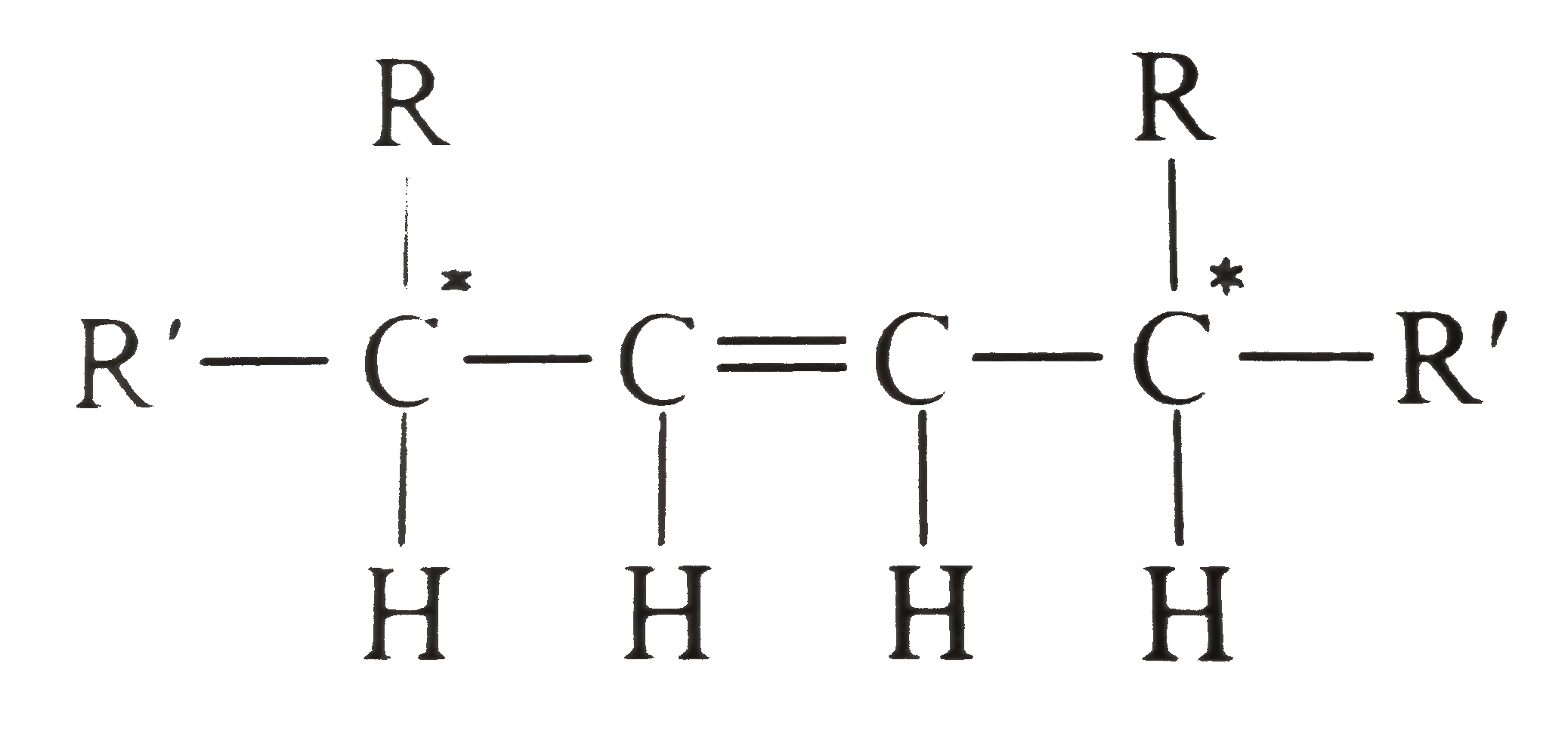 Number of optically active isomers `(O.I.A)= 2^(n-1)=2^(2-1)=2` (where `n` is the number of asymmetric `C` atoms). Number of meso from`=2^((n-2)//2)=2^(0)-1` TOTAL optical isomers `=2+1=3` Due to one double bond, the number of geometrical isomers `=2` The number of stereoisomers `=3xx2=6` b. If the stereochemistry about `(C=C)` bond is `cis`, then two pairs of diastereomers (II) and (III) are possible. (II) is meso `(O.I.A)` due ot the presence of plane of symmerty . (III) is optically active `(O.A)` and two enantiomers are possible. Therefore, in total there are three diastereomers. 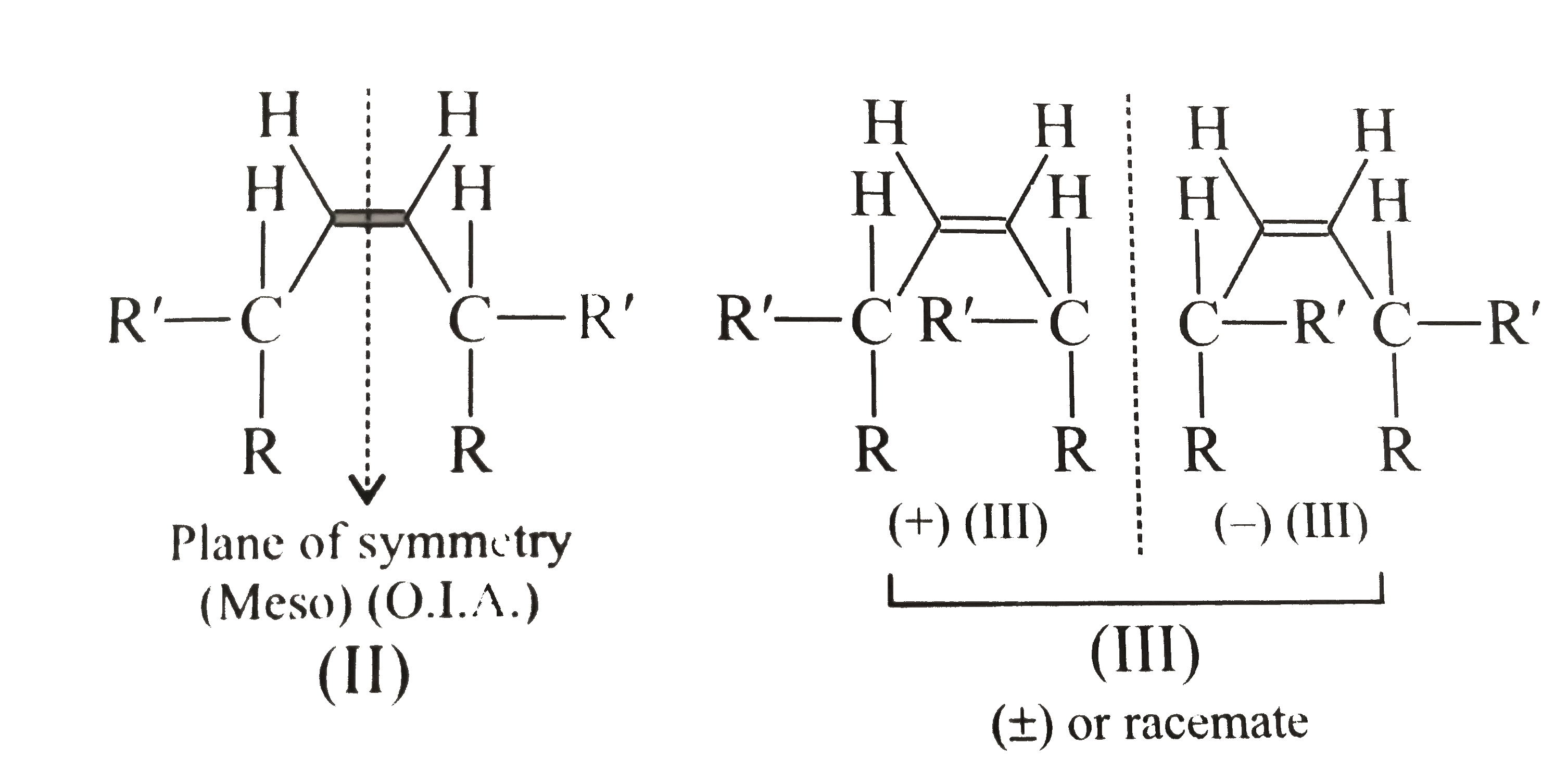 II and `(+) III, II` and `(-)III` are diastereomers, wheras `(+)III` and `(-)III` are enantiomers. c. If the stereochemistry about `(C=C)` bond is trans, two pairs of diastereomers (IV) and (V) are possible. (IV) is meso `(O.I.A)`, due to the presence of centre of symmerty. (V) is `O.A` and two enantiomers are possible. Therefore, the in total there are three diastereomers. 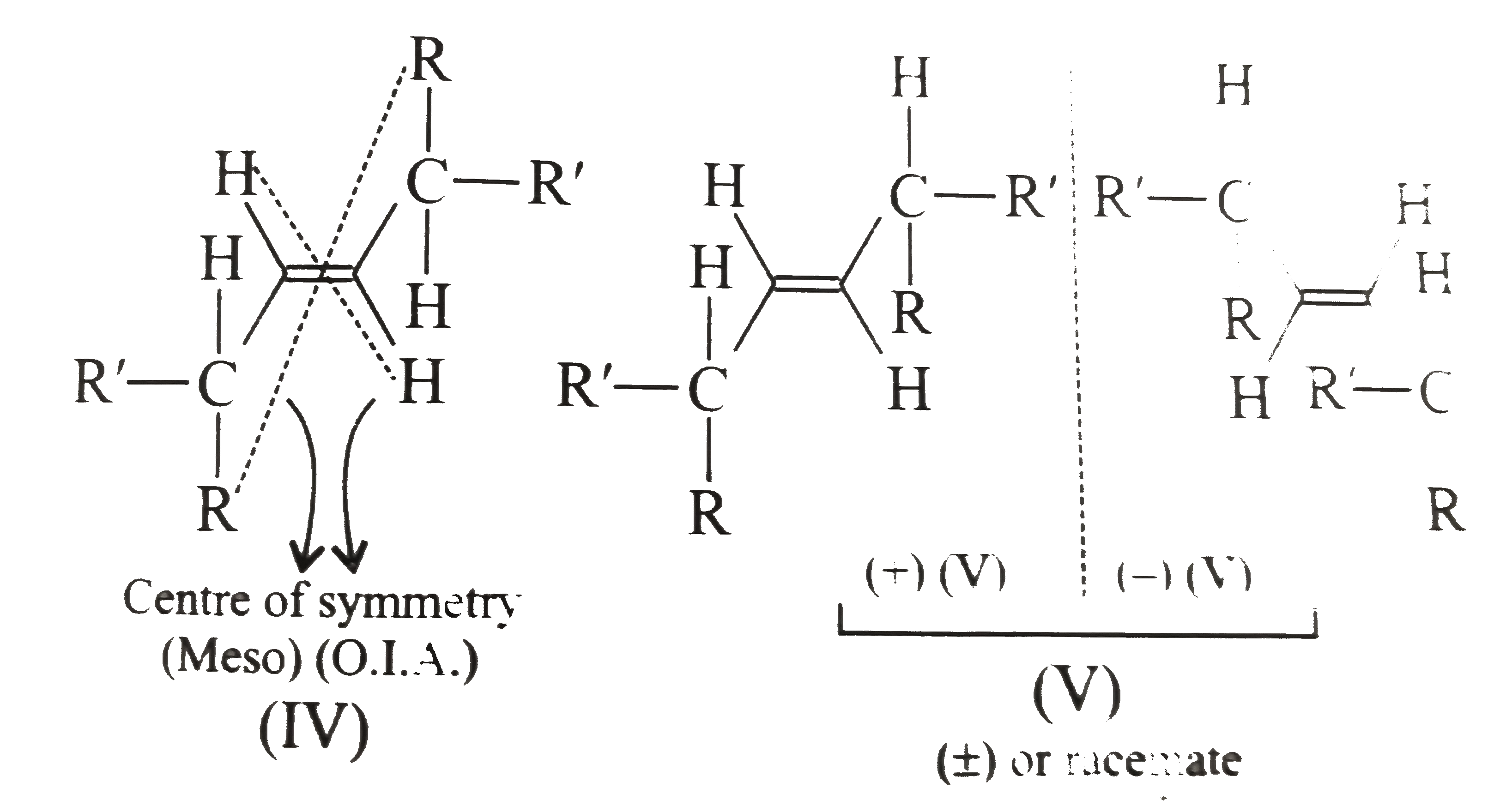 [`IV` and `(+)V]` and `(-)V`] are diastereomers, whereas `(+V)` and `(-V)` are enantiomers. d. Therefore, the total number of diastereomers from (b) and (c ) is six. e. Examples: 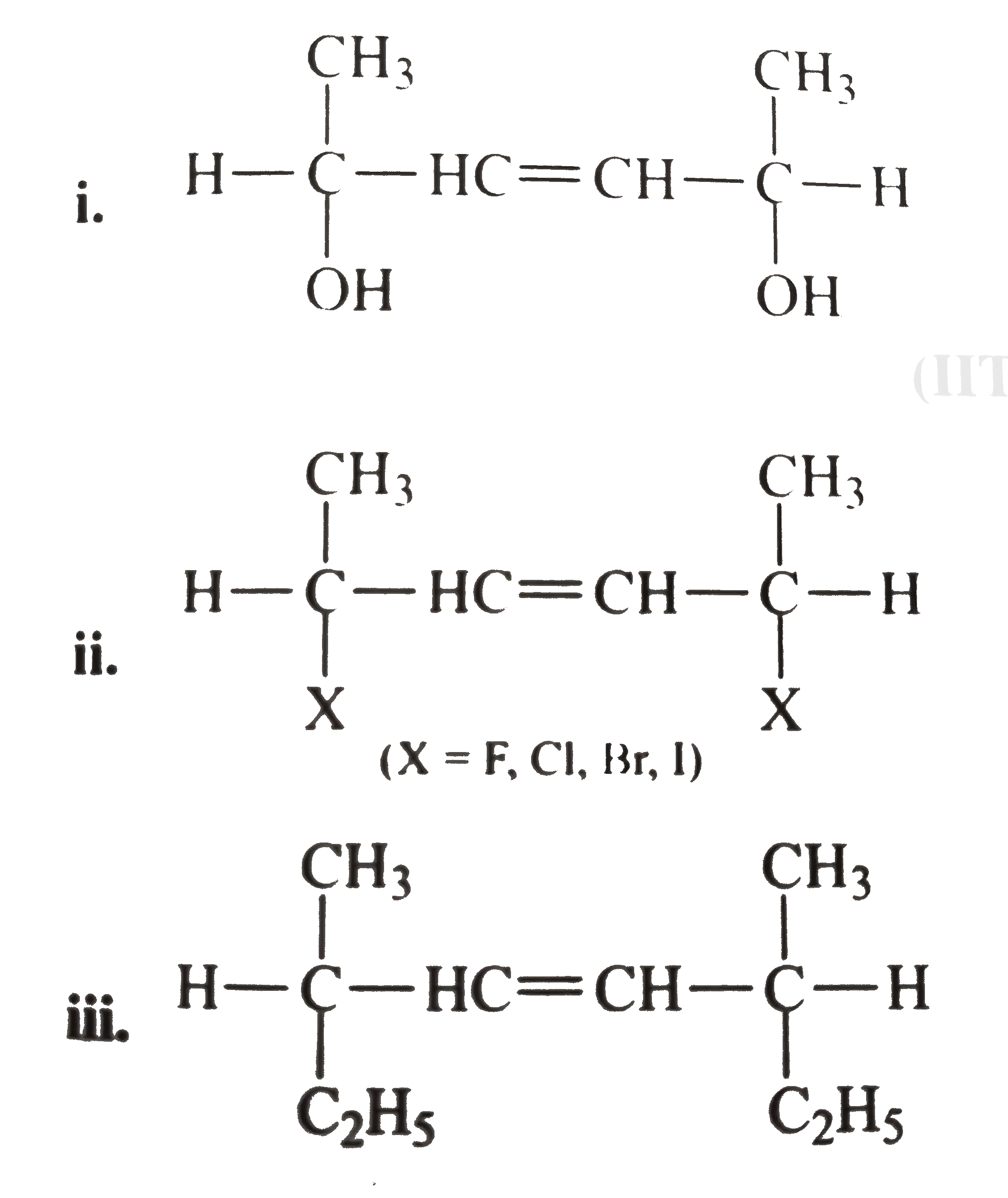
|
|
| 7. |
Consider the basicity of the following aromatic amines: (I) aniline ""(II) p-nitroaniline ""(III) p-methoxyaniline ""(IV) p-methylaniline The correct order of decreasing basicity is: |
|
Answer» `III GT IV gt I gt II` |
|
| 8. |
Consider the acidity of the carboxylic acids I. PhCOOH II. O - NO_(2)C_(6)H_(4)COOH III. pNO_(2)C_(6)H_(4)COOH IV. m-NO_(2)C_(6)H_(4)COOH Which of the following order is correct |
|
Answer» `I gt II gt III gt IV` 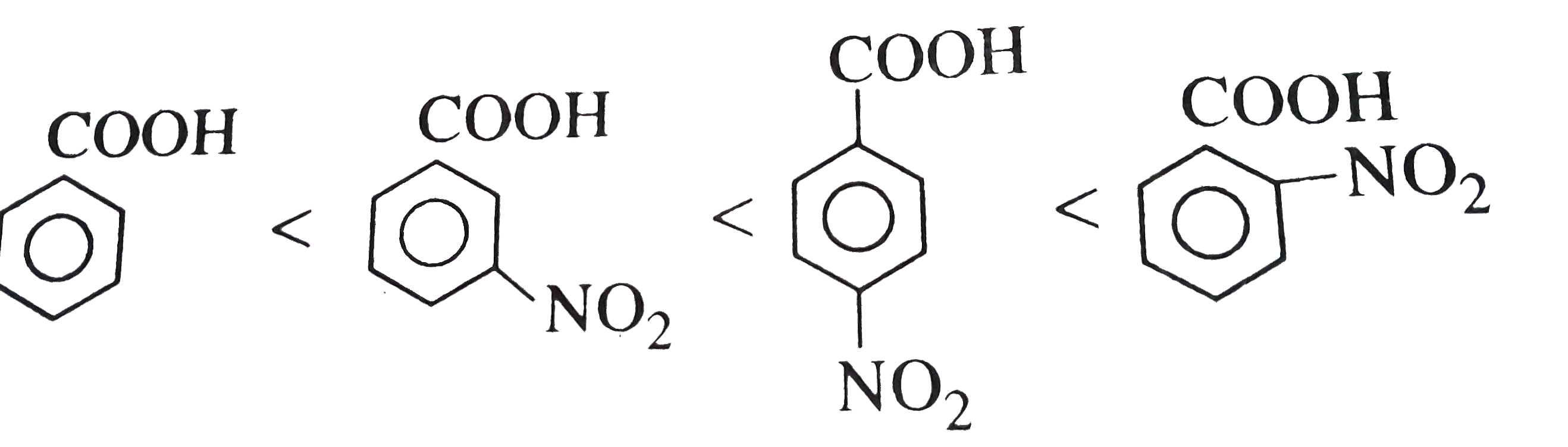
|
|
| 9. |
Consider the acidity of the carboxylic acids : (i) PHCOOH""(ii) o-NO_(2)C_(6)H_(4)COOH""(iii) p-NO_(2)C_(6)H_(4)COOH""(iv) m-NO_(2)C_(6)H_(4)COOH |
|
Answer» `I GT II gt III gt iv` |
|
| 10. |
Consider the acidity of the carboxylic acids : (a) PhCOOH (b) o-NO_(2)C_(6)H_(4)COOH (c) p-NO_(2)C_(6)H_(4)COOH (d) m-NO_(2)C_(6)H_(4)COOH Which of the following order is correct ? |
|
Answer» `a GT B gt c gt d` |
|
| 11. |
Consider rotation about the C-3-C-4 bond of 2-methylhexane: Draw the Newman projection of the most stable confomer. (b) Draw the Newman projection of the least stable confomer. |
|
Answer» |
|
| 12. |
Consider reduction of 2-butanone. A , B and C are respectively |
|
Answer» `CH_(3)UNDERSET(OH)underset(|" ")(CH)CH_(2)CH_(3)` in all CASES |
|
| 13. |
Consider of the following molecules: |
|
Answer» `IIIgtIIgtIVgtI` |
|
| 14. |
Consider metal (X) and non-metal (Y) react to form ionic compound. Given that metal X room temperature and non-metal exists as diatomic gaseous molecule. In which of the following cases lattice energy of resulting product will be highest ? |
|
Answer» `-q=DeltaH_f^@(X_2Y)-SE-IP_1-(BE)/2+EGE_1-EGE_2` |
|
| 15. |
Consider metal (X) and non-metal (Y) react to form ionic compound. Given that metal X room temperature and non-metal exists as diatomic gaseous molecule. What is the formula of ionic compound if electronic configurations of outermost shell of X =ns^2 and Y=ns^2 np^3 ? |
|
Answer» `X_2Y_2` |
|
| 16. |
Consider (i) C(s)+O_(2)hArrCO_(2)(g) K_(P_(2)=(7)/(8) (ii) 2C(s)+O_(2)hArr2CO(g) K_(P_(2)=12.5atm As 100 L of air (80% N_(2),20% O_(2) by volume) is pased over excess heated coke to establish these equilibrium the equilibrium mixture is found to measure 105 L at constnat temperature & pressure (105atm). Assuming no other reaction, find the sum of partial pressure of CO "and" CO_(2) in the final equilibrium mixture. |
|
Answer» `therefore V(CO)`finally`=10L` `P(O)` finally`=((10)/(105))xx105=10L` `therefore P(O_(2))=P_(CO)^(2)//K_(P_(2))=(10^(2)atm^(2))/(125atm)=`SOLUTIONS Also, `K_(P_(1))=(P_(CO_(2)))/(P_(O_(2))) therefore P(CO_(2))=KP_(1.)P(O_(2))` `=(7)/(8)xx"solution"=7atm` `therefore P(CO)+P(CO_(2))` finally is `8+7=15atm` |
|
| 17. |
Consider (i)CH_(3) - undersetunderset(CH_(3))(|)oversetoverset(CH_(3))(|)C-Br, (ii) CH_(3) - undersetunderset(CH_(3))(|)CH-Br, (iii) CH_(3) -CH_(2)-CH_(2)Br The order of reactivity toward E2 reaction is |
|
Answer» `(i) GT (II) gt (III)` |
|
| 18. |
Consider (I) CH_(3) - undersetunderset(CH_(3))(|)oversetoverset(CH_(3))(|)C-Br, (II) CH_(3) - undersetunderset(CH_(3))(|)CH-Br, (III) CH_(3)-CH_(2)-CH_(2)Br The order of reactivity toward S_(N)l reaction is |
|
Answer» `I GT II gt III` |
|
| 19. |
Consider gases confined by a liquid, as shown below. Density of the liquid = d."gmL"^(-1) h_(1)and h_(3)in mm and p_(1), p_(2)and p_(3)in mm Hg. Select correct relation for pressure p_(3) |
|
Answer» <P>`p_3 = p_("ATM") + 0.1 h_3d` `(h_3 dg)_(CGS) + P_3 = P_("atm") IMPLIES P_3 = P_("atm") - 0.1 h_3d`. |
|
| 20. |
Consider gases confined by a liquid, as shown below. Density of the liquid = d.gmL^(-1) h_1 and h_3in mm and p_1 , p_2 and p_3 in mm Hg. In terms of barometric pressure (P_(atm))is |
|
Answer» <P>`p_(ATM) + 0.1 h_1d` `P_1= P_("atm") + h_1 xx d/1000 xx 100 = P_("atm") + 0.1 h_1d` . |
|
| 21. |
Consider gases confined by a liquid, as shown below. Density of the liquid = d.gmL^(-1) h_1 and h_3in mm and p_1 , p_2 and p_3 in mm Hg. Barometric pressure is equal to |
|
Answer» `p_1` |
|
| 22. |
Consider following vessel of given dimensions Cubical vessel is filled completely with 2M H_(2)SO_(4) solution , whereas spherical and cylindrical vessels are empty (Tale pi=3 ) (Atomic mass of Br =80) Now total content of cuylindrical container is placed in a spherical container and if it is further filled completely with 32.4 %w/v HBrsolution. Molarity of H^(+)in final solution will be: |
| Answer» Answer :B | |
| 23. |
Consider following vessel of given dimensions Cubical vessel is filled completely with 2M H_(2)SO_(4) solution , whereas spherical and cylindrical vessels are empty (Tale pi=3 ) (Atomic mass of Br =80) The acid left in cylindrical container and its molarity will be : |
|
Answer» `H_(2)SO_(4), 2M` |
|
| 24. |
Consider following vessel of given dimensions Cubical vessel is filled completely with 2M H_(2)SO_(4) solution , whereas spherical and cylindrical vessels are empty (Tale pi=3 ) (Atomic mass of Br =80) Total centent of cubical vessel is placed in cylindrical vessel and it is further filled completely with 1 M BaCl_(2)solution. Molarity of SO_(4)^(2-)ions in aqueous solutionwill be : |
|
Answer» 1 M |
|
| 25. |
Consider following statements : (A): The gas whose critical temperature is above room temperature can be liquified by applying sufficient pressure to the gas. (B): The gas whose critical temperature is below room temperature can be liquified by the temperature below T_c. Select correct statement |
| Answer» ANSWER :C | |
| 26. |
Consider folllowing reaction at 300 K : N_(2)O_(5)(g)hArrN_(2)O_(5)(g)+O_(2)(g)K_(c)=5 N_(2)O_(5)(g)hArrN_(2)O(g)+O_(2)(g) If 4 moles N_(2)O_(5) is kept in 1 L, Container to attain equilibrium and at equilibrium 5 moles of O_(2) are produced, then at equilibrium 5 moles of O_(2) are produced, then at equilibrium moles of N_(2)O_(3) will be : |
|
Answer» 1 |
|
| 27. |
Consider folllowing reaction at 300 K : N_(2)O_(5)(g)hArrN_(2)O_(5)(g)+O_(2)(g)K_(c)=5 N_(2)O_(5)(g)hArrN_(2)O(g)+O_(2)(g). For second reaction, if energy of activation of forward and backward reaction are respectively 85 and 42KJ//"mole", then at 400K, K_(c) for the second reaction is : |
|
Answer» 10 |
|
| 28. |
Consider experimental data shown in the table : Rate of electrophilic addition on isobutylene is significantly higher than cis or trans-2-Butene chiefly due to - |
|
Answer»
|
|
| 29. |
Consider experimental data shown in the table : Which of the following would be expected to have highest rate of electrophilic addition of Br_2 ? |
|
Answer» `Ph-CH=CH_2` |
|
| 30. |
Consider eight small spheres , radius = r_(s) arranged at the corner of the cube , they are small enough so that they are not in contact . Now place a larger sphere , radius = r_(l) at the centre of the cube . This sphere is just large enough so that it is in contact with the eight small sphere . Now let the radius of the large sphere shrink , but keep the small sphere in contact with it . what is the radius ratio r_(s)//r_(l), when the small spheres at the cube corners come in to contact with each other . |
|
Answer» `1.24` |
|
| 31. |
Consider equilibrium H_(2)O(l)hArrH_(2)O(g). Choose the correct direction of shifting of equilibrium with relative humidity. |
|
Answer» `R.H.gt1`,RIGHTWARD `RARR QgtKrArr` leftward SHIFT `R.H.lt1rArr P_(H_(2)oltV.P.` `rArr QltKrArr` Rightward shift |
|
| 32. |
Consider the compounds, BCI_3 and C Cl_4. How will they behave with water? |
|
Answer» `BCl_3 + 3H_2O rarr H_3O_3 + 3HCl`. HOWEVER, `CCl_4` is not hydrolysed by water because carbon in `CCl_4` has eight electrons and it does not have d orbitals to acept electrons from water. |
|
| 33. |
Consider an ionic solid that dissolves in water according to the equation: M_(n)X_(m(s)) nM_(aq)^(m+)n + mX_(aq)^(n-) . The equilibrium constant for this reaction, K _(sp)=[M^(m+)]^(n) [X^(n-)]^(m)is known as the solubility product of M_(n), X_(m). The form of this euquilibrium is important in understanding effects such as the influence of pH, complex fomation and common ion cffect. Equilibrium constant in solution should be written correctly using activities and not concentrations. The difference between thesc quantities is large in concentrated ionic solutions and K_(sp) is quantitatively reliable as a guide of solubilities only for very dilute solutions, If solubility product of AB type salt is 4xx 10^(-10) at 18^(@)C, and M.W of AB is 143.5 g/mol. The solubility in g/lit of AB is |
|
Answer» `14.35 gm// "LIT"` ` S = 2 xx 10 ^(-5) ` WEIGHT ` = 2 xx 10 ^(-5)xx 143. 5 = 2.87xx 10 ^(-3)g // lit ` |
|
| 34. |
Consideran ionic solid MX with NaCl structure . Construct a new structure (Z) whose unit cell is constructed from the unit cell of MX following the sequential instructions given below. Neglect the charge balance . (i)Remove all the anions (X) except the central one. (ii)Replace all the face-centred cations (M) by anions (X) (iii)Remove all the corner cations (M) (iv)Replace the central anion (X) with cation (M) The value of ("number of anions"/"number of cations") in Z is ........ |
|
Answer» Anions `(X^-)=UNDERSET"(edge centres)"(12xx1/4)+underset"(body centre)"(1)=3+1=4` Cations`(M^+)`=`underset"(corners)"(8xx1/8)+underset"(face centres)"(6xx1/2)=1+3=4` After step (i), anions `(X^-)` LEFT =4-3=1 After step (ii), cations `(M^+)` left=4-3=1 anions `(X^-)`=1+3=4 After step(iii), cations `(M^+)` left =1-1=0 After step (iv), anions `(X^-)` left =4-1=3, cations `(M^+`) =0+1=1 Hence ratio `"NUMBER of anions "/"number of cations"` in Z=`3/1`=3 Alternatively, Anions `(X^-)=underset"edge centres""12"+underset"body centre""1"` Cations `(M^+)=underset"corners""8"+underset"face centres""6"` After step (i), anions `(X^-)` = `underset"body centre"1` , cations `(M^+)= underset"corners""8"+underset"face centres"6` After step (ii) ,anions `(X^-)=underset"body centre"1 + underset"face centres"6, cations `(M^+)=underset"corners""8"+underset"face-centre"0` After step (iii), anions `(X^-)=underset"body centre"1+underset"face centres"6` , cations `(M^+)=underset"corner"0+underset"face centre"0` After step (iv), anions `(X^-)=underset"body centre"0+underset"face centres"6`, cations `(M^+)=underset"body centre"1` As anion at the face centre has contribution =`1/2` towards the unit cell `therefore` Anions `(X^-)` PER unit cell in Z =`6xx1/2=3` As cation at the body centre has contribution =1 `therefore` Cations `(M^+)` per unit cell in Z=1 `therefore` Ratio `"number of anions"/"number of cations "` in Z =`3/1`=3 |
|
| 35. |
Consider an ionic solid that dissolves in water according to the equation: M_(n)X_(m(s)) nM_(aq)^(m+)n + mX_(aq)^(n-) . The equilibrium constant for this reaction, K _(sp)=[M^(m+)]^(n) [X^(n-)]^(m)is known as the solubility product of M_(n), X_(m). The form of this euquilibrium is important in understanding effects such as the influence of pH, complex fomation and common ion cffect. Equilibrium constant in solution should be written correctly using activities and not concentrations. The difference between thesc quantities is large in concentrated ionic solutions and K_(sp) is quantitatively reliable as a guide of solubilities only for very dilute solutions, If solubility product of AB type salt is 4xx 10^(-10) at 18^(@)C, and M.W of AB is 143.5 g/mol. If ppt. of AB is washed with 5 lit water, loss in wt. of ppt. of AB is |
|
Answer» `10^(-4)mol// "lit"` Moles dissolved = ` ( 287 xx 10 ^(-5))/( 143. 5) ` ` "" = 2xx 10 ^(-5)` moles = per lit ` 2xx 10 ^(-5)` moles - 1 lit `x ""5" lit " ` ` x= 10 ^(-4)" moles " ` |
|
| 36. |
Consider an ionic solid MX with NaCl structure. Construct a new structure (Z) whose unit cell is constructed from the unit cell of MX following the sequential instructure given below. Neglect the charge balance. (i) Remove all the anions (X) except the central one (ii) Replace all the face-centred cations (M) by anions (X) (iii) Remove all the corner cations (M) (iv) Replace the central anion (X) with cation (M) The value of (("number of anions")/("number of cations")) in Z is ............. |
Answer» Solution :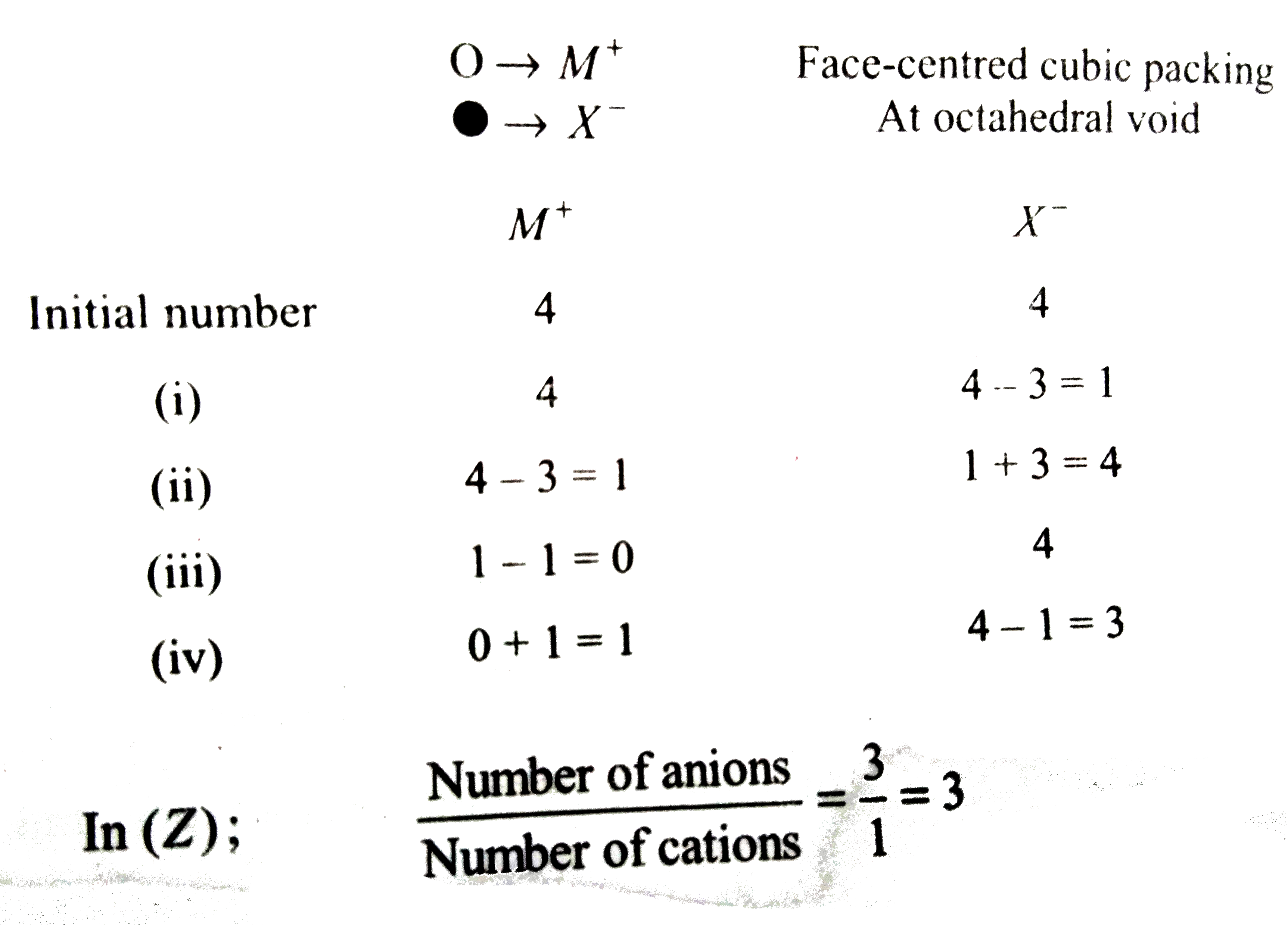 `{:("Initial number"," "4,4),((i)," "4,4-3=1),((i),4-3=1,1+3=4),((iii),1-1=0,""4),((iv),0+1=1,4-1=3):}` In (Z) , `("Number of ANIONS")/"(Number of cations")=(3)/(1)=3` |
|
| 37. |
Consider an ionic solid MX with NaCl structure. Construct a new structure (Z) whose unit cell is constructed from the unit cell of MX following the sequential instructions given below. Neglect the charge balance. (i) Remove all the anions (X) except the central one (ii) Replace all the face centered cations (M) by anions (X) (iii) Remove all the corner cations (M) (iv) Replace the central anion (X) with cation (M) The value of (("number of anions")/("number of catons")) in Z is ____ |
|
Answer» |
|
| 38. |
Consider all possible isomeric ketones, including stereoisomers of MW = 100. All these isomers are idependently reacted with NaBH_(4) (Note: stereiosomers are also reacted separately). The total number of ketones that give a racemic product (s) is/are |
|
Answer» |
|
| 39. |
Consider a titration of potassium dichromate solution with acidified Mohr.s salt. The number of moles of Mohr.s salt required per mole of dichromate is: |
|
Answer» `6e+(CR^(6+))_2rarr2Cr^(3+)` |
|
| 40. |
Consider a reaction : A(g)+B(g)hArrC(g)+D(g) A(g), B(g) and C(g) are taken in a container at 1 bar partial pressure each and adequate amount of liquid D is added. From the data give below calculate four digit number abcd. Givin : DeltaG_(f)^(@)A(g)=30kJ//"mole", DeltaG_(f)^(@)B(g)=20kJ//"mole", DeltaG_(f)^(@)C(g)=50kJ//"mole", DeltaG_(f)^(@)D(g)=100kJ//"mole", Vapour pressure of G (l) at 300K=(1)/(6)"bar" (All data at 300K) where Equilibrium constant of reaction (i) Twice the partial pressure of B at equilibrium Twice the partial pressure of B at equilibrium Twice the partial pressure of C at equilibrium |
|
Answer» |
|
| 41. |
Consider a cube containing 'n' unit cell of a cubic system . A plane ABCD obtained by joining the mid point of the edges on one of its identical faces had atoms arranged as shown . Let p be the paking fraction . Choose the correct option : |
|
Answer» N = 1 , p = `(22)/(21sqrt2)` |
|
| 42. |
Consider a corner atom of Ist layer of an HCP unit cell showing alternate AA layers. Find (i) Find identical atoms (III layer) with respect to the distnaces from the atom 1 (ii) Arrange the distances in ascending order. |
|
Answer» |
|
| 43. |
Consider a cube 1 of Body Centered Cubic unit cell of edge length a now atom at the body center can be viewed to be lying on the corner of another cube2. Find the volume common to cube 1 and cube 2 |
|
Answer» `(a^(3))/(27)` |
|
| 44. |
Consider a corner atom of Ist layer of an HCP unit cell showing alternate . A A layers . Arrange the distances in ascending order . |
|
Answer» `d_(a) lt d_(B) = d_(f) = d_(g) lt d_(d)` |
|
| 45. |
Consider a collision between oxygen molecule and hydrogen molecule in a mixture of oxygen and hydrogen kept at room temperature. Which of the following are possible |
|
Answer» The KINETIC energies of both the MOLECULES increase |
|
| 46. |
Consider a buffe of CH_(3)COOH and CH_(3)COONa of maximum buffer-capacity and match and following: |
|
Answer» |
|
| 47. |
Consider (1) Sodium dissolves in ammonia to give a blue coloured solution (2) Sodium dies nto from amalgam with mercury (3) Sodium can be cut with a knife (4) Density of Na is more than that of Li Of the given statements, the correct are |
|
Answer» 1 and 2 |
|
| 48. |
Consdier the following energy level diagram: The quantity y is equal to |
|
Answer» `Delta H_("combustion "C(s)) + Delta H_("combustion"H_(2)(g))` |
|
| 49. |
Consdier the following energy level diagram: The heat of formation of glucose is |
|
Answer» `-X` `6C + 6H_(2) + 9O_(2) rarr 6CO_(2) + 6H_(2)O, Delta H= -y` |
|