

Saved Bookmarks
This section includes 7 InterviewSolutions, each offering curated multiple-choice questions to sharpen your Current Affairs knowledge and support exam preparation. Choose a topic below to get started.
| 1. |
Define lattice enthalphy . How is it related to the stability of an ionic compound ? |
| Answer» Solution : GREATER the lattice ENTHALPY of an ionic COMPOUND , greater is the STABILITY | |
| 2. |
Define "lattice energy" of crystals. Calculate the number of sodium ions and chloride ions per unit cell of NaCl. |
|
Answer» |
|
| 3. |
Define lattice energy. |
| Answer» SOLUTION :The ENERGY associated when are MOLE of ionic crystal is formed from its GASEOUS ions. | |
| 4. |
define Kelvin temperature scale. |
| Answer» SOLUTION :KELVIN is a SI unit of temeprature . The zero point on kelvin scale in equal to LOWEST possible temperature `(-273.15^(@)C) (or) :. (0+273)=273K` | |
| 5. |
Define isomerism. Give example. |
|
Answer» SOLUTION :ISOMERISM represents the existence of two or more compounds with the same molecular formula but different structure and properties. Compounds exhibiting this isomerism are called isomers. e.g., `C_(2)H_(6),O`: (i) `CH_(3)-CH_(2)OH` Ethanol (II) `CH_(3)-O-CH_(3)` Methoxymethane |
|
| 6. |
Define Irreversible reaction with an example. |
|
Answer» Solution :A chemical reaction in which the product can not give back the REACTANTS is called an IRREVERSIBLE reaction. Example : `C(s)+O_(2)(g)toCO_(2)(g)`. |
|
| 7. |
Define ionization energy. The first ionization energy of Nitrogen is greater than that of Oxygen - give appropriate reason. |
|
Answer» Solution :IONISATION energy is DEFINED as ''The minimum amount of energy required to remove the most loosely bound electron from the valence shell of the isolated neutralgaseous atoms in its ground state''. Nitrogen `(1s^(2), 2s^(2),2p^(3)) (1402 "kJ mol"^(-1))` has higher ionisation energy that Oxygen `(1s^(2), 2s^(2), 2p^(3)) (1314 "kJ mol"^(-1))`. Since the half - filled ELECTRONIC configuration is more stable, it requires higher energy to remove an electron from 2p orbital of nitrogen. Whereaas the removal one 2p electron from oxygen atoms leads to a stable half - filled configuration. This makes comparatively easier to remove 2p electron from oxygen. |
|
| 8. |
Define ionisation enthalpy. Discuss the factors affecting ionisation enthalpy of the elements and its trends in teh periodic table. |
|
Answer» <P> Factors affectingn ionsation enthalpy of the elements. Ionisation enthlpy depends upon the following factors. i) Nuclear charge the ionisation enthalpy increases with increase in nuclear charge. This is due to the fact that with increase in nuclear charge, the electrons of the outer shell are more firmly held by the nucleus and thus greater energy is required to pull out and electron from the atom. e.g. the ionisation enthalpy increases as we move along a period from LEFT to right due to increased nuclear charge.  ii) Atomic size or radius: Ionisation enthalpy decreases as the atomic size increases. As the distance of the outer electrons from the nucleus increases with increases in atomic radius, the attractive force on the outer electron decreases. As a result, outer electrons are held lesss firmly and HENCE lesser amount of enery is required to knock them out. thus, ionisation enthalpy decreases with increase in atomic size. Ionisation enthalpy is found to decrease on moving down a group. 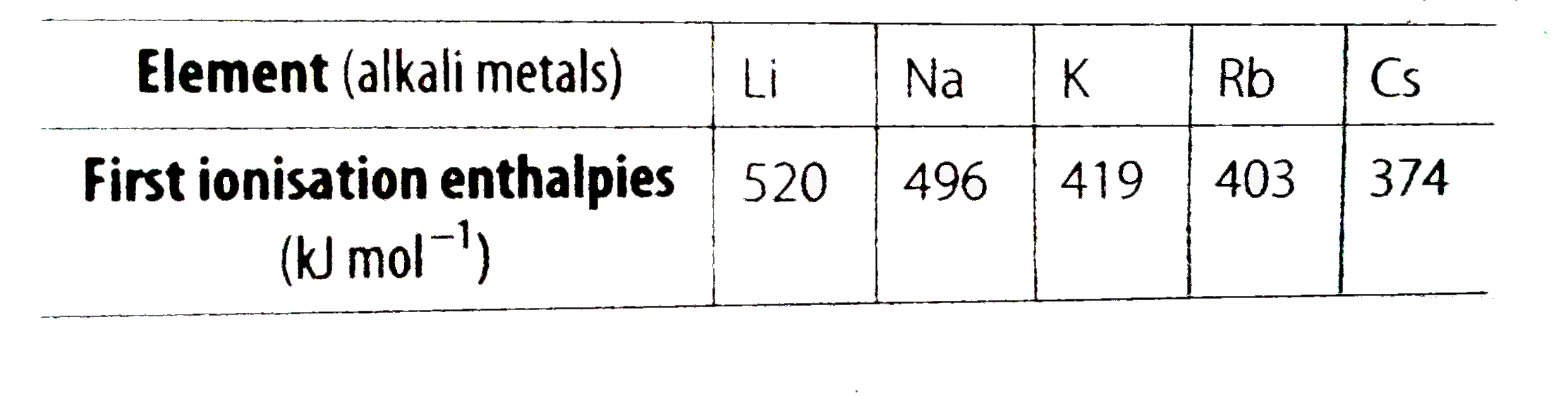 iii) Penetration effect of the electrons: Ionisation enthalpy increases as the penetratioin effect of the electrons increases. It is well known fact that in case of multielectron atoms. the electrons of the s-orbital has the maximum probability of bieng found near the nucleus and this probability goes on decreasing in case of p, d and f-orbitals of the same shell. In other words, s-electrons of any shell are more penetrating towards the nucleus than p-electron the same shell. Thus, when the same shell, the penetration effect decreases in the order `sgtpgtdgtf`. e.g. First ionisation enthalpy of aluminium is lower than that of magnesium. This is due to the fact that in case of aluminium `(1s^(2) 2s^(2) 2p^(6)3s^(2)3p_(x)^(1))`, we have to pull out a p-electron to form `Al^(+)` ion WHEREAS in case of magnesium `(1s^(2)2s^(2)2p^(6)3s^(2))` we have to remove an s-electron of HTE same energy shell to produce `Mg^(+)` ion. v) Shielding or screening effect of inner shell electrons: As the shielding or the screening effect of theinner electrons increases, the ionisation enthalpy decreases. Consequently, the force of attraction by the nucleus for the valence shell electrons decreases and hence the ionisation enthalpy decreases. Effect of arrangement of electrons: If an atom contains exactly half filled or completely filled orbitals then such an arrangement has extra stability, the removal of an electron from such an atom requires more energy than expected. e.g. Be `(1s^(2)2s^(2))` has higher ionisationi enthalpy than B `(1s^(2)2s^(2)2p^(1))` and `N(1s^(2)2s^(2)2p_(x)^(6)2p_(y)^(1)2p_(z)^(1))` has higher ionisation enthalpy than O `(1s^(2)2s^(2)2p_(x)^(2)2p_(y)^(1)2p_(z)^(1))`. In general, as we move from left to right in a period, the ionisation enthalpy increases with increasing atomic numbers. The ionisation enthalpies keep on decreasing regularly as we move down a group from one element to the other. 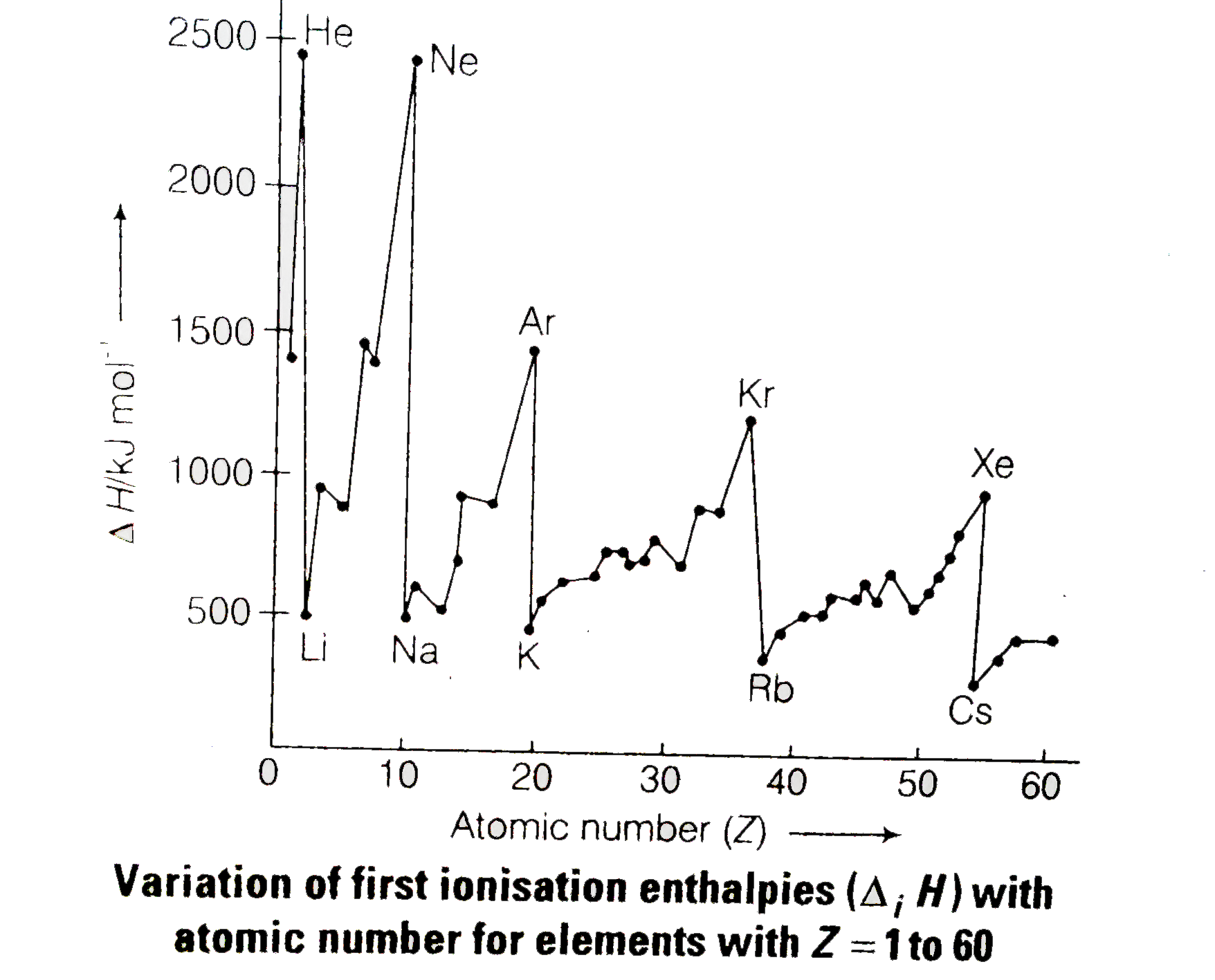
|
|
| 9. |
Define ionisation enthalpy. Discuss the factors affecting ionisation enthalpy of the elements and its trends in the periodic table. |
|
Answer» Solution :Ionisation enthalpy: The minimum amount of energy required to remove the most loosely bound electron from an isolated gaseous ATOM so as to CONVERT it into a gaseous cation is called its ionisation enthalpy. It is represented by `DeltaH`. Factors affecting ionisation enthalpy of the elements: It depends upon the following factors: (1) NUCLEAR charge : As Nuclear charge increases ionization enthalpy increases. This due to the fact as with increase in nuclear charge, the electrons of the outer shell are more tightly bonded by the nucleus and thus more amount of energy is required to taken out that electron from atom. e.g., The ionisation enthalpy increases as we go from left to right due to increase in nuclear charge.  (ii) Atomic size or radius : As the size of atom increases, ionisation enthalpy decreases. Distance between outer electron and nucleus increases with increase in atomic radius, the attractive force on the outer electron decreases. As a result, outer electron are held less bonded and hence less amount of energy is required to to TAKE off that electron. Thus, ionisation enthalpy decreases with increase in atomic size. Ionisation enthalpy is found to decrease on moving from top to bottom in a group.  (iii) Penetration effect of the electrons : As penetration effect of the electrons increases the ionisation enthalpy increases. It is well known fact that in case of multi electron atoms, the s-orbital electrons possibility are maximum found near the nucleus and this probability goes on decreasing in case of p, d and f-orbitals of the same shell. s-electrons of any shell are more nearer to the nucleus than p-electrons. The order of penitration effect decreases in the order `s gt p gt d gt f`. e.g., First ionisation enthalpy of aluminium is lower than that of magnesium. This is due to the fact that in case of aluminium `(1s^(2)2s^(2)2p^(6)3s^(2)3p_(x)^(1))`, we have to pull out a p-electron to form `Al^(+)` ion whereas in case of magnesium `(1s^(2)2s^(2) 2p^(6) 3s^(2))` we have to remove an s-electron of the same energy shell to produce `Mg^(+)` ion. (iv) Shielding or screening effect of inner shell electrons : Ionisation enthalpy decreases when their is shielding or the screening effect of the inner electrons increases. Attraction between nucleus and valence shell electrons decreases and hence the ionisation enthalpy decreases. (v) Effect of arrangement of electrons : If an atom contains exactly halfly filled orbitals or fully filled orbitals then such an arrangement has extra stability. Therefore, the removal of electron from such an atom requires more energy than expected. e.g., Be `(1s^(2)2s^(2))` has higher ionisation enthalpy than B `(1s^(2)2s^(2)) and N(1s^(2)2s^(2) 2p_(x)^(6) 2p_(y)^(6) 2p_(y)^(1)2p_(z)^(1))` has higher ionisation enthalpy than O `(1s^(2)2s^(2)2p_(x)^(2)2p_(y)^(1)2p_(z)^(1))`. In general, as we move from left to right in a period, the ionisation enthalpy increases withncreasing atomic numbers. The ionisation enthalpies keep on decreasing regularly as we move down a group from ONE element to the other.  Variation of first ionisation enthalpies `(Delta_(i)H)` with atomic number for elements with Z = 1 to 60 |
|
| 10. |
Define ionic bond. Givesuitable examples and distinguish between covalent bond and ionic bond. |
|
Answer» Solution :Ionic bond : The ELECTROSTATIC force of ATTRACTION exixting between the cation and ANION produced by electron TRANSFER from ONE atom to other is known as the ionic bond. 
|
|
| 11. |
Define internal energy [U]. |
| Answer» Solution :Internal energy is the TOTAL energy possessed by a system DUE to its NATURE, chemical composition and thermodynamic STATE. | |
| 12. |
Define intensive properties. |
| Answer» Solution :INTENSIVE PROPERTY of a sysem is that property of the system which does not depend on the QUANTITY of the substance present in the system. EG : DENSITY, Viscosity. | |
| 13. |
Define inversion temperature. |
| Answer» SOLUTION :The TEMPERATURE beloow which a GAS obey Joule - THOMSON EFFECT is called inversion temperature `(T_(1)). Ti=(2a)/(Rb)` | |
| 14. |
Define intensive properties? |
| Answer» Solution :Those PROPERTIES which DEPEND only on the NATURE of the substance and not on the AMOUNT of the substance taken are called intensive properties. | |
| 15. |
Define - Inductive effect. |
|
Answer» Solution :It is defined as the CHANGE in the polarization of a covalent bond due to the presence of adjacent bonded atoms or groups in the molecule. It is denoted as I-effect. (i) Atoms or groups which lose electron TOWARDS a carbon ATOM are said to have a +1 effect Example, `CH_(3)`-,`(CH_(3))_(2)CH-`,`(CH_(3))_(2)C-`etc (III) Atoms or groups which draw electrons away from a carbon atom are said to have a -I effect. Example, `-NO_(2)`-I, -Br, OH, `C_(6)H_(5)`H, etc. |
|
| 16. |
Define (i) System (ii) Surroundings. |
|
Answer» Solution :(i) System: A system is defined as any PORTION of matter under thermodynamic consideration, which is separated from the REST of the universe by real or imaginary boundaries. eg. Water taken in a BEAKER, BALLOON filled with air, seed, plant, flower and bird. (II) Surroundings: Everything in the universe that is not the part of system and can interact with system is called as surroundings. |
|
| 17. |
Define ideal gas. Derive ideal gas equation by using gas laws. |
| Answer» SOLUTION :It is the Gas which obeys all the gas LAWS at all TEMPERATURE and PRESSURE. | |
| 18. |
Write short note an freezing point depression in freezing point and cryoscopic constant. |
|
Answer» SOLUTION :(i) FREEZING POINT is difined as the temperature at which the solid and the liquid states of the substances have the same vapour PRESSURE. (ii) When a non volatile solute is added to water at its freezing point, the freezing point of water is lowered from `0^(@)C.` The lowering of freezing point of the solvent when a soute is added is called depression in freezing point `Delta T_(f).` (iii) `Delta T_(f) = T_(f)^(@) - T_(f)` 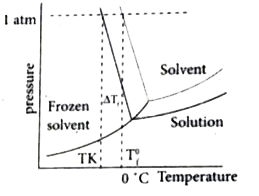
|
|
| 19. |
Which of the following processes add water vapour to the atmosphere? (i) Transpiration (ii) Precipitation (iii) Condensation (iv) Evaporation |
|
Answer» Solution :(i) EVAPORATION: If the kinetic energy of MOLECULES in the liquid state overcomes the INTERMOLECULAR force of attraction between then, then the molecules will escape from the liquid state. This process in called evaporation. (ii) Condensation: The vapour molecules are in random motion during whihc they collide with each other and also with the walls of the CONTAINER. As the collision is inelastic, they lose their energy and as a RESULT the vapour returns back to liquid state. This process is called as condensation. |
|
| 20. |
Define (i) Molality (ii) Normality |
|
Answer» Solution :(i) Molality (m): It is DEFINED as the number of moles of the solute present in 1 kg of the solvent `m = ("Number of moles of solute")/("Mass of the solvent (in kg)")` (ii) Normality (N): It is defined as the number of GRAM equivalents of solute in 1 litre of the solution. `N= ("Number of gram EQUIVALENT of solute")/("Volume of solution (in L)")` |
|
| 21. |
Define (i) cryoscopic constant (ii) ebullioscopic constant |
|
Answer» Solution :(i) `Delta T_(f) = k _(f) . M,` where `k _(f)=` cryscopic constant If `m =1,` then `Delta T_(f) = k _(f)` `k_(f)` is defined as depression in freezing POINT for 1 molar solution. (ii) `Delta T_(b)= k _(b) .` m where `k _(b)` = EBULLIOSCOPIC CONSTNAT If `m =1,` then `Delta T_(b)= k _(b)` `k _(b)` is defined as elevation in bliling point for 1 molar solution. |
|
| 22. |
Define hypperconjugation by taking an example of propene. |
|
Answer» Necessary Condition : Presence of at one hydrogen at SATURATED carbon which is `ALPHA` with respect to alkene, alkene, alkynes, CARBOCATION, free radical, benzene NUCLEUS. `(##RES_CHM_GOC_I_E01_010_A01##)` |
|
| 23. |
Define (i) Boyle temperature (ii) Critical Volume (V_(C)) |
|
Answer» (ii) VOLUME of one mole of the gas at CRITICAL temperature. |
|
| 24. |
Define hydrogen hond : Is it weaker or stronger than the van der Waals forces ? |
|
Answer» Solution :Definition : Nitrogen, oxygen an fluorine are the HIGHLY electonegative elements. When they are attached to hydrogen ATOM to form covalent bond the ELECTRONS for the covalent bond are shifted towards the more electronegative atom. "This partially positively charged hydrogen atom `(H^(+ delta))`forms a bond with the other more electronegative atom. This bond is known as hydrogen bond." In short : Hydrogen bond`H^(+ delta) .... X^(- delta)` (where, X = N , O , F , Cl etc. ) it is represented by a dotted line. Definition : Hydrogen bond can be defined as the attractive force which binds hydrogen atom of one molecule with the electronegative atom (F, O, N or Cl) of another molecule. Normally van der Waals FORCES are weak than hydrogen bond. Bond energy of Hydrogen bond is 40 kJ `mol^(-1)` while van der Waals forces are less strong than 10 kJ `mol^(-1)` . |
|
| 25. |
Define Hydrogen Bond ? Explain its type with example. |
|
Answer» Solution :Electrostatic force of attraction that exists between atom of one MOLECULE electronegative atom of same of other molecules is called hydrogen bond. Type of hydrogen bond : i. INTERMOLECULAR hydrogen bond. II. Intermolecular hydrogen bond. i. Intermolecular hydrogen bond : Eelectrostatic force of attraction that exists between hydrogen of one molecule and electronegative atom of ANOTHER molecule is called intermolecular hydrogen atom. 1 `H_(2)O`  ii. Intermolecular Hydrogen bond : Electrostatic force of attraction that exists between hydrogen atom of one molecule electronegative atom of the same molecule. Example: Salicylic acid `C_(6)H_(4) COOH(OH)` 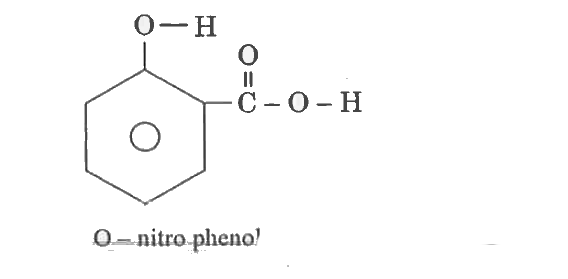
|
|
| 26. |
Define hydrogen bond and its types . |
|
Answer» When a hydrogen atom (H) is covalently bonded to a highly electronegative atom (F or O or N) , the bond is polarized in such a way that the hydrogen atom is able to FORM a weak bond (electrostatic attraction) between the hydrogen atom of a molecule and the electronegative atom a second molecule. The bond thus formed is called a hydrogen bond (ii)Intermolecular Hydrogen: Intermolecular hydrogen bonds occur between two separate molecules. They can occur between any numbers of like or unlike molecules as LONG as hydrogen DONORS and acceptors are present an in positions in which they can INTERACT. Eg: Water , HF, ect,. (iii) Intramolecular Hydrogen: Thistype of bond is formed between hydrogen atom and N, O or F atom of the same molecule. This type of hydrogen bonding is commonly called chelation and is more frequently found in organic compound . Eg:o-nitrophenol,salicylic acid, etc,. |
|
| 27. |
Define hydrogen bonding. What are the types of H-bonding? Which of them is stronger. |
| Answer» SOLUTION :SEE TEXTBOOK | |
| 28. |
Define hybridization ? Explain the hybridization in Methane molecule. |
|
Answer» Solution :`CH_(4)`- METHANE MOLECULE. The Molecular fomula of Methane is `CH_(4)` Electronic configuration of C is ground state `1s^(2)2s^(2)2p^(2)` Electronic configuration of C in excited state -`1s^(2)2s^(1)2p^(3)` Valance orbital representation 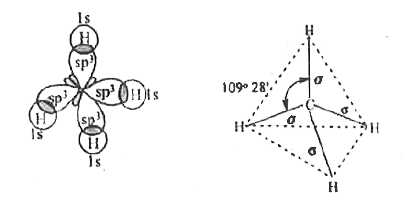 The VALENCE orbital contains unpaired electron. Hence `SP^(3)` hybridized carbon combine with 4 hydrogen atom forms methane molecule. |
|
| 29. |
Define hybridisation. What are the characteristics of hybridisation ? |
|
Answer» |
|
| 30. |
Define Hess's law of constant heat summation. |
Answer» SOLUTION :Hess.s LAW: The enthalpy change of a reaction EITHER at constant volume or constant PRESSURE is the same whether it takes place in a single or MULTIPLE steps. 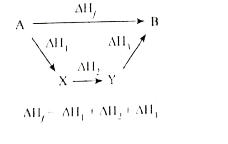
|
|
| 31. |
Define heat of solution. |
| Answer» Solution :The HEAT of solution is DEFINED as "the change in ENTHALPY of the SYSTEM when one mole of a substance is dissolved in a specified quantity of solvent at a given temperature". | |
| 32. |
Define heat of transition? |
| Answer» Solution :The heat of transition is defined as the change in ENTHALPY when one mole of an element CHANGES from one allotropic FORM to ANOTHER. | |
| 33. |
Define heat of enthalpy of a solution. |
| Answer» SOLUTION :HEAT of enthalpy of a solution is the CHANGE in enthalpy produced when one mole of the solute is dissolved in EXCESS solvent, so that further DILUTION does not produce any heat exchange. | |
| 34. |
Define greenhouse etfect. |
| Answer» Solution : Greenhouse eflect is DEFINED as the HEATING up of the earth.s surface due to trapping of infrared radiations reflected by carth.s surface by the `CO_(2)` LAYER in the ATMOSPHERE | |
| 35. |
Define Grahm's Law of diffusion ? |
|
Answer» Solution :Gase have a tendency to occupy all the available space. When two non-reactive gases are allowed to mix, the gas molecules migrate from region of higher CONECTRATION to a regionof lower concentration. This propery of gas which involves the movement of the gas molecules through another gases is CALLED diffusion. Effusion is another process in which a gas escapes from a CONTAINER through a very small hole. the rate of diffusion of effusion is inversely proportional to thsi square root of molar mass. This statement is called Graham's law of diffusion/effusion. Mathmatically, rate of diffusion `alpha=(1)/(sqrt(M))` Otherwise `(r_(A))/(r_(B))= sqrt((M_(B))/(M_(A)))` When diffusig gases are at different pressures, `(P_(A),P_(B))` `(r_(A))/(r_(B))=(P_(A))/(P_(B)) sqrt((M_(B))/(M_(A)))` where `r_(A) and r_(B)`are the rates of diffusion of A and B and the `M_(A) and M_(B)` are their respective molar masses. |
|
| 36. |
Define – Graham's law of diffusion. |
|
Answer» Solution :Graham.s law of diffuison : The rate of diffusion or effusion is INVERSELY PROPORTIONAL to the square root of molecular mass of a gas through an ORIFICE. `(r_A)/(r_B) = sqrt((M_B)/(M_A))` `r_A, r_B`= rate of diffusion of GASES A, B `M_A , M_B` = Molecular mass of gases A,B |
|
| 37. |
Define Gibb's free energy . |
|
Answer» Solution :Gibbs free ENERGY is defined as the part of total energy of a system that can be CONVERTED (or) available for CONVERSION into work. G=H-TS, where G=Gibb.s free energy H = ENTHALPY T=temperature S=entropy |
|
| 38. |
Define Gibbs energy. |
|
Answer» Solution :Gibbs energy is defined as the amount of energy available from a system at a given set of conditions, that can be put into USEFUL work. i.e., `G = H - TS`. |
|
| 39. |
Describe optical isomerism with suitable example. |
Answer» SOLUTION :Geometrical isomers are the stereoisomers which have different arrangement of GROUPS or atoms around a rigid FRAMEWORK of double bonds. This type of isomerism OCCURS DUE to restricted rotation of double bonds or about single bonds in cyclic compounds. 
|
|
| 40. |
Define frequency of light. |
| Answer» Solution :The number of WAVES which pass through a given point in one SECOND is called frequency of LIGHT. | |
| 41. |
Define formality. |
|
Answer» SOLUTION :FORMALITY (F) is defined as the number of formula weight of SOLUTE present in 1 litre of the solution. Formaility `(F) = ("Number of formula weight of solute")/("Cvolume of the solution (in L)")` |
|
| 42. |
Define formal charge. |
| Answer» Solution :The formal charge on an atom is the DIFFERENCE between the NUMBER of valcnce electrons in an isolated atom/ FREE atom and the number of electrons assigned to that atom in a lewis STRUCTURE. | |
| 43. |
Define extensive properties. |
| Answer» Solution :EXTENSIVE PROPERTIES are those which DEPEND UPON theamount of the substance TAKEN. | |
| 44. |
Define equivalent mass of an reducing agent. How would you determine the equivalent mass of Ferrous sulphate? |
|
Answer» Solution :The EQUIVALENT mass of a reducing agent is the number of parts by mass of the reducing agent which is COMPLETELY oxidised by 8 parts by mass of oxygen or one equivalent of any oxidising agent. Ferrous sulphate is a reducing agent. `2FeSO_(4)+H_(2)SO_(4)+[O]rarrFe_(2)(SO_(4))_(3)+H_(2)O` 16 parts by mass of oxygen oxidised 304 parts by mass of `FeSO_(4)` `:.` 8 parts by mass of oxygen will oxidise `316/80 xx8`parts by mass of ferrous sulphate = 152 The equivalent mass of ferrous sulphate (anhydrous) = 152. The equivalent mass of CRYSTALLINE ferrous sulphate is `(FeSO_(4)*7H_(2)O)`=152+156=278 The equivalent mass of crystalline ferrous sulphate = 278. |
|
| 45. |
Define equivalent mass of an oxidising agent How would you calculate the equivalent mass of potassium permanganate? |
|
Answer» SOLUTION :The equivalent mass of an oxidizing agent is the number of PARTS by mass which can furnish 8 parts by mass of oxygen for oxidation Potassium permanganate is an oxidizing agent. `2KMNO_(4)+3H_(2)SO_(4)rarrK_(2)SO_(4)+2MnSO_(4)+3H_(2)O+5[O]` 80 parts by mass of oxygen are given by 316 g of `KMnO_(4)` 8 parts by mass of oxygen will be FURNISHED by `316/80 XX 8=31.6` Equivalent mass of `KMnO_(4)=31.6 g eq^(-1)` |
|
| 46. |
Define - equivalent mass. |
| Answer» Solution :The equivalent mass of an element is the NUMBER of parts of the mass of an element which combines with or DISPLACES 1.008 parts of hydrogen or 8 parts of OXYGEN or 35.5 parts ofchlorine. | |
| 47. |
Define equivalent mass |
|
Answer» Solution :Equivalent mass of an ELEMENT , compound or ion is the mass that COMBINES or displaces 1.008g hydrogen or 8G oxygen or 35.5 G chlorine . Equivalent mass has no unit . |
|
| 48. |
Define equivalent mass. |
| Answer» Solution :The equivalent mass of an element,COMPOUND of ion is the number of parts ofmass of an element which combines with or displaces 1 . 008 parts of hydrogen or 8 PARTSOF OXYGEN or 35.5 partsof chlorine . | |
| 49. |
Define equilibrium constant of reaction. |
| Answer» Solution :"Is the ratio of the velocity CONSTANT of the FORWARD reaction to the velocity constant of the BACKWARD reaction". It is ALSO defined as, "It is the ratio of PRODUCT to molar concentration of product to the product of molar concentration of the reactants". | |
| 50. |
Define equilibrium constant. Given any one application of equilibrium constant. |
|
Answer» Solution :At a GIVEN temperature, the ratio of the product of active masses of reaction products RAISED to the respective stoichiometric COEFFICIENTS in the balanced chemical equation to that of the reactants is a constant, known as equilibrium constant. For any general equilibrium reaction `xA+yB hArr lC+mD` equilibrium constant `K_(C )=([C]^(l)[D]^(m))/([A]^(x)[B]^(y))` (in terms of active masses) Uses of equilibrium constant : 1. It predicts the direction in which the NET reaction will take place. 2. It predicts the extent of the reaction. 3. It is used to calculate the equilibrium CONCENTRATIONS of the reactants and products. |
|