

Saved Bookmarks
This section includes 7 InterviewSolutions, each offering curated multiple-choice questions to sharpen your Current Affairs knowledge and support exam preparation. Choose a topic below to get started.
| 1. |
Give atomic number and symbol of Unu and Unb. |
| Answer» Answer :a | |
| 2. |
Give Assumptions or postulates of the kinetic molecular theory. |
| Answer» Solution :These postulates are RELATED to ATOMS & MOLECULES which can.y be SEEN hence. It is said to provide a microscopic MODEL of gases. | |
| 3. |
Give any two uses of washing soda. |
| Answer» Solution :(i) for softening of hard WATER and (II) in paper, colour and TEXTILE INDUSTRIES. | |
| 4. |
Give any two uses of sodium chloride. |
| Answer» Solution :It is used in TANNING and textile industry. In manufacture of NAOH, `Na_(2) CO_(3)` etc | |
| 5. |
Give any two uses of calcium oixde. |
| Answer» Solution :(a) Inpreparation of CEMENT, glass (b) USED for DRYING alcohols and as a flux in METALLURGY. | |
| 6. |
Give any two factors which favours ionic bond. |
| Answer» Solution :Low IONIZATION ENERGY for METALS and HIGH electron affinity of non-metals. | |
| 7. |
Give any two differences between strong and weak electrolytes. |
Answer» SOLUTION :
|
|
| 8. |
Give any two effects of depletion of the ozone layer. |
|
Answer» |
|
| 9. |
Write any two differences between sigma-bond and Pi-bond. |
Answer» SOLUTION :
|
|
| 10. |
Give any two differences between ideal and real gas. |
Answer» SOLUTION :
|
|
| 11. |
Give any two difference between sigmaandpi bond. |
Answer» SOLUTION :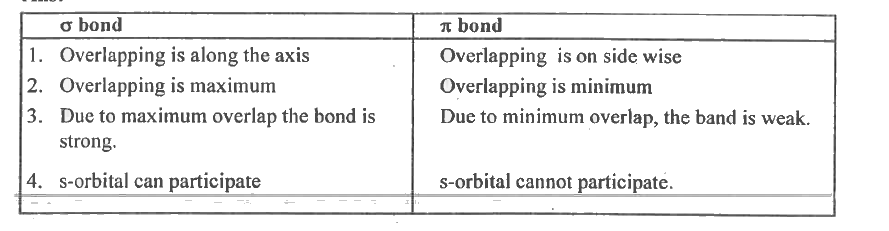
|
|
| 12. |
Write any three postulates of VSEPR theory. |
|
Answer» Solution :POSTULATES of vsepr theory. The shape of the MOLECULE depends upon the number of VALANCE shell electron pair [bonded and non bonded] Around the central atom. Valence shell electron pair repel one another as they are negatively charged. To overcome the repulsion the electron pairs arrange themselves in space such a WAY that they are far away from one another as possible. A multiple BOND (double or triple) is treated as single electron pair. |
|
| 13. |
Give answer of following questions. (i) Give molecular orbitals and type form byLCAO from 2s, 2p_(x), 2p_(y) and 2p_(z) (ii) Li_(2), Be_(2), C_(2), N_(2), O_(2), F_(2)for the these molecule give energy other. |
Answer» SOLUTION : (ii)ENERGY order of orbitals: (ii)ENERGY order of orbitals:The increasing order of energy of MO for `Li_(2) , Be_(2) , B_(2), C_(2), ` are so under `sigma 1s LT sigma^(**) 1s lt sigma 2s lt sigma^(**) 2s lt [pi 2p_(x) = pi 2p_(y) ] lt sigma 2p_(z) lt [ pi^(**) 2p_(x) = pi^(**) 2p_(y) ]lt sigma^(**) 2p_(z)` The increasing order of energies of MO for `O_(2) and F_(2)` is given below. `sigma 1s lt sigma^(**) 1s lt sigma 2s lt sigma^(**) 2s lt sigma 2p_(z) lt [ pi 2p_(x) = pi 2p_(y) ] lt [ pi^(**) 2p_(x)pi^(**) 2p_(y) ] lt sigma^(**) 2p_(z)` REMEMBER : In `O_(2)` and `F_(2)` only the position of `sigma 2pi_(z)` is change in energy order because the energy of `sigma 2p_(z) ` is less than `pi` in `O_(2) " &" F_(2)`. |
|
| 14. |
Give anomalous properties of lithium. or Why lithium is differ from other alkali metals ? |
|
Answer» Solution :(i) Lithium is much harder. Its m.p. and b.p. are higher than the other alkali metals. (II) Lithium is least reactive but the strongest reducing agent among all the alkali metals. On combustion in air it forms mainly monoxide, `Li_(2)O` and the nitride, `Li_(3)N` unlike other alkali metals. (iii) LiCl is deliquescent and crystallises as a HYDRATE, `(LiCl * 2H_(2)O)` whereas other alkali metal chlorides do not form hydrates. (iv) Lithium hydrogen carbonate is not obtained in the solid form while all other ELEMENTS form solid hydrogen CARBONATES. (v) Lithium unlike other alkali metals forms no ethynide on reaction with ethyne. (vi) Lithium nitrate when heated gives lithium oxide `(Li_(2)O)` whereas other alkali metal nitrates decompose to give the corresponding nitrite. `4LiNO_(3) to 2Li_(2)O+4NO_(2)+O_(2)` `2NaNO_(3) to 2NaNO_(2)+O_(2)` (vii) LiF and `Li_(2)O`are comparatively much less soluble in water than the corresponding compounds of other alkali metals. |
|
| 15. |
Give an example to show the effect of conecntration of nitric onthe formation of oxidation product. |
|
Answer» Solution :DEPENDING upon the CONCENTRATION, `HNO_(3)` reacts with METALS to give different OXIDATION products. With dil. `HNO_(3),NO` is formed while with conc. `HNO_(3),NO_(2)` is formed. For example, `3Cu+8HNO_(3)(DILL.)to3Cu(NO_(3))_(2)+2NO+4H_(2)O` `Cu+4HNO_(3)(conc. )toCu(NO_(3))_(2)toCu(NO_(3))_(2)+2NO_(2)+2H_(2)O` |
|
| 16. |
Give an example of heterogeneous equilibrium. |
|
Answer» |
|
| 17. |
Give an example of electron deficient covalent hydride. |
|
Answer» |
|
| 18. |
Give an example of an anion which is isostructural with BF_(3). |
| Answer» SOLUTION :`[BeF_(3)]^(-)` | |
| 19. |
Give an example of a reaction where K_(p)neK_(c). |
| Answer» Solution :`PCl_(5(g))hArrPCl_(3(g))+Cl_(2(g))` | |
| 20. |
Give an example for the relation between Delta H and Delta U. |
|
Answer» Solution :EXAMPLE : `C_((s)) + O_(2(g)) rarr CO_(2(g))` `Delta N = 1-1 = 0, Delta H = Delta U + RT Delta n = Delta U + RT(0)` `:. Delta H = Delta U`. |
|
| 22. |
Give an example for a reversible reaction in which K_(p)=K_(c)RT. |
| Answer» SOLUTION :`PCl_(5(g))hArrPCl_(3(g))+Cl_(2(g))` | |
| 23. |
Give an example each of an ionichydride and a covalent hydride. |
|
Answer» Solution :IONIC: NaH or `CaH_(2)` Covalent : `H_(2)O, B_(2)H_(6), CH_(4)`, etc. |
|
| 24. |
Give actual proportion energy having wavelength of 3000A and 6000A respectively. |
|
Answer» `2:1` |
|
| 25. |
Give addition reactions of benzene with chemical reactions. |
|
Answer» Solution :Benzene possess unique stability , though in strong condition benzene shows addition reactions. In this reaction 3 molecules of reactant react with 1 mole of benzene, which shows benzene structure shows THREE double bonds `(PI)`. (i) Hydrogenation of benzene : Under vigorous conditions, i.e., at high temperature and/or pressure in the presence of nickel catalyst, hydrogenation of benzene gives cyclohexane.  (ii) Halogenation of benzene : Benzene does not react with bromine and does not give unsaturation test. `"Benzene" + Br_(2) OVERSET(C Cl_(4))rarr` No reaction. Chlorination of benzene : Under ultra-violet light, three chlorine molecules add to benzene to produce benzene hexachloride, `C_(6)H_(6)Cl_(6)` which is also CALLED gammaxane.  Initially Gammaxane is used as domestic INSECTICIDES. Nowdays, it is banned. |
|
| 26. |
Give abundancy of calcium and magnesium in earth crust. |
| Answer» Answer :A | |
| 27. |
Give a test to detect the presence of water. |
|
Answer» Solution :When water or moisture comes in contact with anhydrous COPPER sulphate (white), the latter IMMEDIATELY BECOMES blue. `underset("White")(CuSO_(4))+5H_(2)O to underset("Blue")(CuSO_(4).5H_(2)O)` |
|
| 28. |
Give a statement which includes the main ideas of the first law and second law of the thermodynamics. |
| Answer» Solution :The ENERGYOF the universe is constant whereas the ENTROPY of the universe is continuously increasing and TENDS to a MAXIMUM. | |
| 29. |
Give a detailed accounte on compressbility factor. |
|
Answer» Solution :The deviation of real GASES from ideal behaviour is meausred in terms of a ratio of PV to nRT. This is termed as compression factor. MATHEMATICALLY, `Z=(PV)/(nRT)` For ideal gases `Z=1` at all temperatures and pressure, because `PV=nRT` (II) When a gas deviates from ideal behaviour, its Z value deviates from unity. (iii) At high pressure thesegases have `Z gt 1` and are difficult to compress. At intermediate pressures, `Z lt 1`. (iv) Above the Boyal POINT `Z gt 1` for real gases, ie., the real gases show positive deviation. (v) Below the Boyle point, the raal gases first show a decreases for, Zreaches a minimum and then increases with the increases in pressure. (vi) Hence, the compressbility factor Zcan be rwritten as `Z=(PV_("real"))/(nRT)""(a)` `V_("ideal")=(nRT)/(P)""(b)` Substituting (b) in (a) `Z=(V_("real"))/(V_("ideal'')` (vi) Where `V_("real")` is the molar volumne of the real gas and `v_("ideal")`is the molar volume of it when it behaves ideal. |
|
| 30. |
Give a detailed account on the different mechanisms followed in elimination reaction. |
Answer» Solution :Elimination reactions may proceed through two different mechanisms namely `E_(1) and E_(2)`.  (i) The rate of `E_(2)` reaction depends on the concentration of alkyl halide and base Rate=k[alkyl halide][base] (ii) It is therefore, a SECOND order reaction. GENERALLY primary alkyl halide undergoes this reaction in the presence of ALCOHOLIC KOH. it is a one step process in which the abstraction of the proton from the `BETA` carobna nd expulsion of halide from the `alpha` carbon occur simultaneously. the mechanism is shown below.  (iii) Generally, tertiary alkyl halide which undergoes elimination reaction by this mechanism in the presence of alcoholic KOH. it follows first order kinetics. let us consider the following elimination reaction. Step-1: Heterolytic fission to yield a carbocation  Step-2: Elimination of a proton from the `beta`-carbon to produce an alkene.  . .
|
|
| 31. |
Give a detailed account on homolytic and heterolytic cleavage . |
|
Answer» Solution :Homolyticcleavage : Homolytic cleavage is the process in which a covalent bonded atoms retains one electron . It is denotedby a half headed arrow (fish hook arrow ) . This type of cleavage occurs under high temperature or in the presence of UV lightin a compound containing non-polar covalent bond formed between atoms of similar electronegativity . In such molecules, the cleavage of bonds results into free radicals . They are reagents that promote holmolytic cleavage in substrate are called as free radical initiators . For example AZOBISISOBUTYRONITRILE (AIBN) and peroxides such as benzoyl peroxide are used as free radical initiators in polymerisation reactions .  As a free radical with an unpaired electron is neutral and unstable, it has a tendency to gain an electron to attain stability. Organic reactions involve homolytic fission of C - Cbonds to form alkyl free radicals . Thestability of alkyl free radicals is in the following order ` C (CH_(3))_(3) gt CH(CH_(3))_(2) gt CH_(2) CH_(3) gt CH_(3)` Heterolytic cleavage : Heterolytic cleavage is the process in which a covalent bond breaks unsymmetrically such that one of the bonded atoms retains the bond pair of ELECTRONS . It results in the formations of a cation and an anion . Of the TWO bonded atoms, the most electronegative atom BECOMES the anion and the other atom becomes the cation . The cleavage is denoted by a curved arrow POINTING towardsthe more electronegative atom For example, in tert-butyl bromide, the C-Br bond is polar as bromine is more electronegative then carbon . The bonding electrons of the C-Br bond are attracted more by bromine then carbon . Hence, the C-Br undergoes heterolytic cleavage to form a tert-butyl cation during hydrolysis .  Let us consider the cleavage in a carbon-hydrogen (C-H) bond of aldehydes or ketones . We know that the carbon is more electronegative than hydrogen and hence the heterolytic cleavage of C-H bonds results in the formation of carbanion (carbon bears a negative charge ) . For example in aldol condensation the OH -ion abstracts a -hydrogen from the aldehyde which leads to the formation of the below mentioned carbanion . 
|
|
| 32. |
Give a comparative account of the chemistry of carbon and silicon with regard to their (i) property of catenation and (ii) stability of hydrides and oxides . |
|
Answer» SOLUTION :(i) Carbon shows property of catenation to a greater extent than silicon due to its small size and tendency to form pp -pp multiple bonds with itself. Stability of hydrides : `CH_(4)` is more stable than `SiH_(4)` due to the small size of C. `CO_(2)` is gas WHEREAS `SiO_(2)`is a three dimensional covalent solid therefore highly stable as compared to `CO_(2)` . |
|
| 33. |
Give a chemical reaction for which Delta H=DeltaU |
|
Answer» |
|
| 34. |
Give a brief description of the principle of the following processes taking one example in each case. (i) Filtration (ii) Recrystallisation (iii) Distillation (iv) Chromatography. |
|
Answer» Solution :For ANSWER, CONSULT (F) Filtration : Consult Section 12.33. Recrystallisation : Consult Section 12.33. Distillation : Consult Section 12.35. FRACTIONAL distillation. Consult section 12.36. |
|
| 35. |
Give a brief explanation about about the international standards of drinking water. |
|
Answer» Solution :The international standards for drinking water are given below: (i) Fluoride : Fluoride ion concentration should be tested in drinking water. Its deficiency in drinking water is harmful to man and causes DISEASES such as tooth decay etc. Soluble fluoride is often added to drinking water to bring its concentration upto 1 ppm or 1 mg `dm^(-3)` . The `F^(-)` ions make the enamel on teeth much harder by converting hydroxyapatite, `[3(Ca_3 PO_4)_2 Ca(OH)_2]`, the enamel on the surface of the teeth, into much harder fluorapatite `[3 (Ca_3 PO_4)_2. CaF_2]`. If `F^(-)` ion concentration above 2 ppm causes brown mottling of teeth. Whereas if `F^(-)` ion concentration is more than 10 ppm it causes harmful effect to bones and teeth. It is reported from some parts of Rajasthan. (ii) Lead : Drinking water gets contaminated with lead when lead pipes are used for transportation of water. The prescribed upper limit concentration of lead is about 50 ppb lead can damage kidney, liver, reproductive system etc. (iii) Sulphate : Excessive sulphate (`GT` 500 ppm) in drinking water causes LAXATIVE effect, otherwise at moderate levels it is harmless. (iv) Nitrate : The maximum limit of nitrate in drinking water is 50 ppm. Excess nitrate in drinking water can cause disease like methemoglobinemia (blue BABY. SYNDROME). (v)Other metals : The maximum concentration of some common metals recommended in drinking water. Which are given in table. 
|
|
| 36. |
Give a brief account of Kala-azar. |
|
Answer» Solution :(i) Fractional distillation: This method is USED to purify and separate liquids present in the mixture having their boiling point close to each other. The process of separation of the COMPONENTS in liquid mixture at their respective boiling points in the form of vapours and the subsequent condensation of those vapours is called fractional distillation. This method applied in distillation of petroleum, coal tar and crude oil. (ii) Column chromatography: (a) The principle behind chromatography is selective distribution of mixture of organic substances between two phases a stationary phase and a moving phase. The stationary phase can be a solid or liquid, while the moving phase is a liquid or a gas. When the stationary phase is a solid, the moving phase is a liquid or gas. (B) If the stationary phase is solid, the basis is adsorption, and when it is a liquid, the basis is partition (c) Chromatography is defined as a technique for the separation of a mixture brought about by differential movement of the individual COMPONENT through porous medium under the influence of moving solvent. (d) In column chromatography, the above principle is carried out in a long glass column |
|
| 37. |
Give a brief decription of the principles of the following techniques taking an example in each case. (a) Crystallisation (b) Distillation (c ) Chromatography |
|
Answer» SOLUTION :(a) Principal crystallisation: The solubility of component is less at low temperature then high temperature and the pure crystals we obtain from solution. The impure component is DISSOLVED in a suitable solvent and impurities are remove by filtration. These solution then heat, concentrate and cool and obtained crystals are separate out. (d) Distillation: Distillation is a technique to purify liquid and separate out liquid mixture. Principle: Every liquid must be boil at definite temperature and get liquid `rarr` vapour `rarr` liquid state. In simple distillation take impure liquid or liquid mixtures in flask their boiling point difference should be high `(20^(@)C)`. In distillation flask, more volatile liquid is condensed by condenser and separate out which is pure. e.g Benzene- bromobenzene, chloroform chlorobenzene etc. mixtures are separated by this technique. (c) CHROMATOGRAPHY: It is based on teh principle of adsorptiion and partition. Each compound adsorb and separate in definite proportion. The stationary phase and mobile phase are in chromatography technique. In adsorption process adsorbate STABLE component (SOLID or liquid) kept in mobile liquid phase and absorb and travel different distance. In partition chromatography, the stationary phase is liquid or gas. The partition of component in solvent is different and the components are separated. Generally chromatography is used to separate the colour compounds. |
|
| 38. |
Giev the IUPAC names of : (i) {:(CH_(3)-CH-C-CH-CH_(3)),("|""||""|"),(""Br""O" "CH_(3)):} (ii) {:(CH_(3)-CH-C-CH-CH_(3)),("|""||""|"),(""NO_(2)" "O" "CH_(3)):} (iii) (CH_(3))_(3)C-CH_(2)-CH_(2)-Cl (iv) {:(CH_(3)-CH-CH_(2)-CH_(3)),("|"),(""Br):} |
|
Answer» SOLUTION :(i) 2-Bromo-4-methylpentan-3-one (II) 2-Methyl-4-nitropentan-2-one (III) 4-Chloro-2, 2-dimethylbutane (IV) 2-Bromoburane. |
|
| 39. |
Gibbs's free energy is defined as ..... |
|
Answer» `G = H + TS` |
|
| 41. |
Gibbs energy equation or Gibbs Helmholtz equation is "…..................." |
| Answer» SOLUTION :`DELTAG= DELTAH - T DELTAS` | |
| 42. |
Write thecharacteristics of organiccompounds. |
|
Answer» (ii) They are inflammable (except `C Cl_(4)`). (iii) They passess low BOILING and melting POINTS DUE to their covalent NATURE. (iv) They are characterised by functional groups (v) They exhibit isomerism. |
|
| 43. |
Get the equation of ionic product (K_w) of water. |
|
Answer» SOLUTION :Water are UNIQUE in their ability of acting both as an acid and a base. In presence of an acid, HA it accepts a proton and acts as the base while in the presence of a base, `B^-` it acts as an acid by donating a proton. In pure water, one `H_2O` molecule donates proton and acts as an acid and another water molecules accepts a proton and acts as a base at the same time. The following equilibrium exists: `{:(H_2O_((l))+, H_2O_((l)) hArr, H_3O_((aq))^(+)+, OH_((aq))^(-)),("Acid","Base" , "Conjugate acid","Conjugate base"):}` `therefore` The dissociation constant is represented by, `K=([H_3O^+][OH^-])/([H_2O][H_2O])=([H_3O^+][OH])/([H_2O]^2)`....(Eq.-i) The concentration `[H_2O]^2 = 1` is omitted from the denominator of water concentration REMAIN constant `[H_2O]^2`is incorporated within the equilibrium constant to give a new constant. `K[H_2O]^2=[H_3O^+][OH^-]`=K (constant) `=[H_3O^+][OH]` `therefore K_w=[H_3O^+][OH^-]` where, `K_w=K` (constant) ....(Eq.-ii) `K_w` is ionic PRODUCT of water. The concentration has been found experimentally as `1.0xx10^(-7)` M at 298 K. Dissociation of water produces EQUAL number of `H^+` and `OH^-` `therefore [OH^-] = [H^+]= 1.0xx10^(-7) M = [H_3O^+]` `K_w=(1.0xx10^(-7))(1.0xx10^(-7))` `therefore K_w=1.0xx10^(-14) M^2` ...(Eq.-ii) The very small value `10^(-14)` of `K_w` is indicate the much less self ionization of water. `K_w` is equilibrium constant so the value of `K_w` temperature dependent. |
|
| 44. |
Geometry of the molecule is distorted by VSEPR in |
| Answer» Answer :A::B::C::D | |
| 45. |
Geometry of organic compound is often described in terms of the valence shell electron pair repulsion theory. The VSEPR model rests on the premise that an electron pair, either bonded pair or an unshared pair, associated with a particular atom will be as far away from the atom's other electron pairs as possible. The tricoordinate carbon atoms of an alkene or carbonyl group also form bonds with angles near 120^(@). In these compounds, unsaturated double bonds have two electron pairs-those of the sigma and pi bonds. Repulsion by these two pairs are some what greater than those between single bonds, so that deviation from exact 120^(@) trigonal geometry is observed. Another factor which has important influence on shapes is non bonded repulsion between the atoms within the molecule. Such repulsion is also referred to as steric effects. Which compound has bond angles nearest to 120^(@)? |
| Answer» Answer :C | |
| 46. |
Geometry of organic compound is often described in terms of the valence shell electron pair repulsion theory. The VSEPR model rests on the premise that an electron pair, either bonded pair or an unshared pair, associated with a particular atom will be as far away from the atom's other electron pairs as possible. The tricoordinate carbon atoms of an alkene or carbonyl group also form bonds with angles near 120^(@). In these compounds, unsaturated double bonds have two electron pairs-those of the sigma and pi bonds. Repulsion by these two pairs are some what greater than those between single bonds, so that deviation from exact 120^(@) trigonal geometry is observed. Another factor which has important influence on shapes is non bonded repulsion between the atoms within the molecule. Such repulsion is also referred to as steric effects. Which among the following is correct about the indicated bond angles? |
|
Answer» `ALPHA = BETA` |
|
| 47. |
Geometry of organic compound is often described in terms of the valence shell electron pair repulsion theory. The VSEPR model rests on the premise that an electron pair, either bonded pair or an unshared pair, associated with a particular atom will be as far away from the atom's other electron pairs as possible. The tricoordinate carbon atoms of an alkene or carbonyl group also form bonds with angles near 120^(@). In these compounds, unsaturated double bonds have two electron pairs-those of the sigma and pi bonds. Repulsion by these two pairs are some what greater than those between single bonds, so that deviation from exact 120^(@) trigonal geometry is observed. Another factor which has important influence on shapes is non bonded repulsion between the atoms within the molecule. Such repulsion is also referred to as steric effects. Select the correct sequence of indicated bond angles. |
|
Answer» `alpha lt beta lt GAMMA` |
|
| 48. |
Geometry of organic compound is often described in terms of the valence shell electron pair repulsion theory. The VSEPR model rests on the premise that an electron pair, either bonded pair or an unshared pair, associated with a particular atom will be as far away from the atom's other electron pairs as possible. The tricoordinate carbon atoms of an alkene or carbonyl group also form bonds with angles near 120^(@). In these compounds, unsaturated double bonds have two electron pairs-those of the sigma and pi bonds. Repulsion by these two pairs are some what greater than those between single bonds, so that deviation from exact 120^(@) trigonal geometry is observed. Another factor which has important influence on shapes is non bonded repulsion between the atoms within the molecule. Such repulsion is also referred to as steric effects. Select the correct sequence of indicated bond angles. |
|
Answer» `ALPHA GT BETA gt GAMMA` |
|
| 49. |
Geometrical isomers result due to the |
|
Answer» FREE ROTATION about C-C |
|