

Saved Bookmarks
This section includes 7 InterviewSolutions, each offering curated multiple-choice questions to sharpen your Current Affairs knowledge and support exam preparation. Choose a topic below to get started.
| 1. |
Give ideal gas equation & combined gas equation. |
|
Answer» Solution :Combined gas equation,`(p_(1)V_(1))/(T_(1))=(p_(2)V_(2))/(T_(2))` IDEAL gas equation, pV = nRT |
|
| 2. |
Give hydrolysis reaction of C_(2)H_(5)COO^(-) Na^(+) occur on the anode. |
|
Answer» Solution :`C_(2)H_(5)COO_((aq))^(-)` and `Na^(+)` ions are produced in aqueous solution of `C_(2)H_(5)COO^(-) Na^(+)`. REACTION occur on anode : (a) Anode is positive ELECTRODE, so oxidation of near by anion `C_(2)H_(5)COO^(-)` is occurred which loses electron and form ethyl FREE radical. (b) Butane is formed from the two ethyl free radical. `[C_(2)H_(5)COO^(-)] -= underset("Propanoate ions")(2CH_(3)CH_(3))-overset(O)overset(||)(C)-overset(..)underset(..)(O^(-)): RARR underset("Ethyl free radical")(2CH_(3)CH_(2)+2CO_(2) uarr) + 2e^(-)` (c) `underset("Ethyl free radicals")(2CH_(3)CH_(2) ) rarr underset("Butane")(CH_(3)CH_(2))-CH_(2)CH_(3)` [Total reaction on anode = a+b] `2CH_(3)CH_(2)COO^(-) rarr CH_(3)CH_(2)-CH_(2)CH_(3)+underset("(Oxidation)")(2CO_(2) + 2e^(-))` |
|
| 3. |
Give hybridization of carbon from the following : CH_(3)-CH=CH-CH_(2)-C-=C-H |
| Answer» SOLUTION :`UNDERSET(SP^(3))underset(uarr)(CH_(3))-underset(sp)underset(uarr)(CH)=underset(sp)underset(uarr)(CH)-underset(sp^(3))underset(uarr)(CH)-underset(sp)underset(uarr)(CH)-=underset(sp)underset(uarr)(CH)` | |
| 4. |
Give hydrogenation and halogenation reaction of alkyne. |
|
Answer» SOLUTION :(a) Hydrogenation of alkyne or addition of DIHYDROGEN in alkyne : Heating of alkyne with dihydrogen in presence of catalyst gives alkane. `HC-=CH+H_(2) underset(DELTA)OVERSET("Pt/Pd/Ni)rarr [H_(2)C=CH_(2)] overset(H_(2))rarr H_(3)C-CH_(3)` (Eq. (i))  (b) Halogenation of alkyne or addtion of halogen in alkyne : On addition reaction of alkyne with bromine solution prepared in carbon TETRACHLORIDE `(C Cl_(4))` gives tetra bromo alkane, during this reaction bromine is utilized completely and hence, orange red colour of bromine is removed. This reaction is identification test for unsaturated hydrocarbon. 
|
|
| 5. |
Give homolysis reaction of (C_(6)H_(5)CO)_(2)O-O. |
Answer» SOLUTION :
|
|
| 6. |
Give hybridization of all carbon atom, number of sigma and pi bond and type of isomerism present in three carbon containing aldehyde compound |
|
Answer» `(sp^(3), sp^(3), sp^(3)), (9 SIGMA , 1pi)` (FUNCTIONAL group) `sigma` bond `rarr 9` `pi` bonds `rarr 1` Hybridisation `rarr C_(1) rarr sp^(3), C_(2) rarr sp^(3), C_(2) rarr sp^(3), C_(3) sp^(2)` |
|
| 7. |
Give heterolytic and homolytic cleavage of H_(3)C- Br. |
Answer» SOLUTION :
|
|
| 8. |
Give general information of elements of p-block. |
|
Answer» Solution :CONSEQUENTLY there are six groups of p-block elements in the periodic table numbering from 13 to 18. Boron, carbon, nitrogen, oxygen, fluorine and helium head the groups. Their valence shell electronic configuration is `ns^2 np^(1-6)` (except for He). The INNER core of the electronic configuration may, however, differ. The difference in inner core of elements greatly influences their physical properties (such as atomic and ionic radii, ionisation enthalpy, etc.) as well as chemical properties. Consequently, a lot of variation in properties of elements in a group of p-block is observed . Themaximum oxidation state shown by a p-block ELEMENT is equal to the total number of valence electrons (i.e., the sum of the s and p-electrons). The important oxidation states exhibited by p-block elements are shown in table . In boron,carbon and nitrogenfamilies the group oxidation state is the most stable state for the lighter elements in the group. However,the oxidation state two unit LESS than the group oxidation state becomes PROGRESSIVELY more stable for the heavier elements in each group. The occurrence of oxidationstates two unit less than the group oxidation states are sometime attributed to the .inert pair effect.. 
|
|
| 9. |
Give general information about water (H_2O) |
|
Answer» Solution :A MAJOR part of all living organisms is made up of water. Human body has about 65% and some plants have as nuch as 95% water. It is a CRUCIAL compound for the survival of all life forms. It is a solvent of great importance. The distribution of water over the earth.s surface is not UNIFORM. The ESTIMATED world water supply is given in following Table. The high heat of vaporisation and heat capacity are responsible for moderation of the climate and body temperature of living beings. It is an excellent solvent for transportation of IONS and molecules required for plant and animal metabolism. 
|
|
| 10. |
Give general electronic configuration of group - I-A. |
|
Answer» `NS^(1)` |
|
| 11. |
Give general electronic configuration of alkali metals and give electronic configuration of each elements of alkali metals. |
|
Answer» Solution :All the alkali metals have one valence electron, `ns^(1)`outside the NOBLE gas core. The looscly held s-electron in the outermost valence shell of these elements MAKES them the most electropositive metals. They readily LOSE electron to give monovalent `M^(+)`ions. Hence they are never FOUND in free STATE in nature. 
|
|
| 12. |
Give full form of DDT. |
|
Answer» DICHLORO DIMETHYL trifluoro ETHENE |
|
| 13. |
Give four uses of hydrogen peroxide. |
|
Answer» Solution :i. It is used as OXIDIZING AGENT and reducing agent. ii. Its dilute solution is used as MILD antiseptic. III. It is used as bleaching agent. iv. conc. `H_(2)O_(2)` is used as rocket fuel. |
|
| 14. |
Give four properties of gas. |
| Answer» Solution :(i) Gases are COMPRESSIBLE, (ii) It can easily expand in SPACE. (iii) Volume and Shape (IV) There are no INTERMOLECULAR forces present between MOLECULES. | |
| 15. |
Give fourexamples ofspecieswhich areisoelectronicwith Ca^(2+) |
| Answer» SOLUTION :Ar, `K^(+) , C1^(-) , S^(2)` or `P^(3-)` are isoelectronicwith `Ca^(2+)` since ALLHAVE 18electrons. | |
| 16. |
Give four formula of carbocations |
| Answer» SOLUTION :`overset(+)(C )H_(3), CH_(3) overset(+)(C )H_(2), (CH_(3))_(3) overset(+)(C ), (CH_(3))_(2) overset(+)(C )H, C_(6)H_(5)overset(+)(C )H_(2), CH_(2)= CH- overset(+)(C )H_(2)` | |
| 17. |
Give formula structure of the following (i) Ethanoic acid (ii) ethanal (iii) ethanol (iv) ethene (v) ethyne (vi) ethanonitric (vii) ethanoyl chloride (viii) ethyl ethanoate (ix) butanone (x) ethanamide |
Answer» SOLUTION :
|
|
| 19. |
Giveformulaforcoloumbicattractionforceandgraviationforce ? |
|
Answer» Solution :Coloumbicforce `=(K q_(1)q_(2))/(R^(2))` Gravitationalforce `= (Q m_(1)m_(2))/( r^(2))` |
|
| 20. |
Give features of Molecular orbital MO) theory. |
|
Answer» Solution :Molecular orbital (MO) theory was developed by F. Hund and R.S. Muliken in 1932. The features of this theory are as under : (I) The electrons in a molecule are present in the various molecular orbitals as the electrons of atoms are present in the various atomic orbitals. (ii) The atomic orbitals of comparable energies and proper symmetry combine to form molecular orbitals . (iii) While an electron in an atomic orbital is influenced by one nucleus, in a molecular orbital it is influenced by two or more nuclei depending upon the NUMBER of atoms in the molecule. Thus, an atomic orbital is monocentric while a molecular orbital is polycentric (iv) The number of molecular orbital formed is equal to the number of combining atomic orbital. When two atomic orbitals combine, two molecular orbitals are formed. One is KNOWN as bonding molecular orbital while the other is called antibonding molecular orbital. (v) The bonding molecular orbital has lower energy and hence grater stability then the corresponding antibonding molecular orbital. (vi) Just as the electron probability distribution AROUND a nucleus in an atom is GIVEN by an atomic orbital, the electron probability distribution around a group of nuclei in molecule is given by a molecular orbital. (vii) The molecular orbital like atomic orbitals are filled in accordance with the Aufbau principle obeying the Paulie.s exclusion principal and the Hund.s rule. |
|
| 21. |
Give Fajans rules for the partial covalent character of ionic bonds. |
|
Answer» Solution :The smaller the size of the cation and the LARGER the size of the anion, the greater the covalent character of an ionic bond. The greater the CHARGE on the cation, the greater the covalent character of the ionic bond. For cations of the same size and charge the ONE, with electronic configuration `(n - 1) d^(n)s^(0)`, typical of transition metals is more polarising than the one with a noble GAS configuration , `ns^(2)np^(6)`, typical of alkali and alkaline EARTH metal cations. The cation polarises the anion, pulling the electronic charge toward itself and thereby increasing the electronic charge between the two. This is precisely what happens in a covalent bond i.e, build up of electron charge density between the nuclei. The polarising power of the cation, then polarizability of the anion and the extent of distortion (polarisation) of anion are the factors, which determine the percent covalent character of the ionic bond. |
|
| 22. |
Give expression of equilibrium constant of following reactions.(i)2Ag_((s)) + Cu_((aq))^(2+) hArr Cu_((s)) + 2Ag_((g))^(+) (ii)O_(2(g)) + 4HCl_((g)) hArr 2H_2O_((g)) + 2Cl_(2(g)) |
|
Answer» <P> Solution :(i)`K_c=[AG^+]^2/((CU^(2+)))`(II)`K_c=([H_2O]^2[Cl_2]^2)/([O_2][HCl]^4)` and `K_p=((p_(H_2O))^2(p_(Cl_2))^2)/((p_(O_2))(p_(HCl))^4)` |
|
| 23. |
Give factors acidic affects the strength of acids. |
|
Answer» Solution :`K_a ALPHA` acidic strength but the dissociation of an acid depends on the strength and polarity of the H - A bond. Weaker the H - A bond, more EASILY it dissociates to give `H^+` ion and hence stronger is the acid. Similarly greater the polarity of the H - A bond, i.e. large the electronegativity difference between the atoms H and A, more easily the bond breaks and hence greater is the acidity. In the same group acidity is mine by size of atom. As the size of atom INCREASE bond LENGTH increases and Acidity increase. In group in H-A as the size of A increases it is more acidic. |
|
| 24. |
Give Fajan rule. |
|
Answer» Solution :(i) The smaller the size of the cation and the larger the size of the anion, the GREATER the covalent character of an ionic bond. (ii) The greater the charge on the cation, the greater the covalent character of the ionic bond. (iii) For cations of the same size and charge, the one, with electronic configuration (N - 1) `d^(n) s^(0)` , typical of transition metals, is more POLARISING than the one with a NOBLE gas configuration,`ns^(2) np^(6)` , typical of alkali and alkaline EARTH metal cations. |
|
| 25. |
Give explanation of sigma and pibonds mention by overlapping of which orbitals are sigma and pibonds formed. OR Explain sigma bond form by s-s, s-p and p-p over lapping. |
|
Answer» Solution :The covalent bond formed by overlapping of atomic orbitals can DIVIDED in to two TYPES. `sigma`-bond : This type of `sigma` covalent bond is obtained by end to end overlapping of the ends of two atomic orbital having internuclear axis. It is also called axial overlapping. This type of overlapping is obtained by over lapping of atomic orbitals as shown below. Overlapping of s-s orbital : In this type overlapping of two half filled orbitals having one. axis is observed.  Overlapping of s-p orbital: In this type there is overlapping between half filled atomics- orbital of one atom-and half filled atom.ic p- orbital of other atom.  Overlappingof p-porbitals: Here it is found that overlapping of p-p orbitals DUE to overlapping of half filled p orbital of two atoms is observed.  `pi` - bond : In this type covalent bond FORMATION the axes of atomic orbitals that are overlapping remains parallel to each other and it is perpendicular to internuclear axis. 
|
|
| 26. |
Give expected major product for each reaction, including sterreochemistry where applicable. |
|
Answer» |
|
| 27. |
Give explanation of above figure. |
|
Answer» Solution :(i) As per FIGURE concentration of `N_2` and `H_2` increases as than decreases as the time decrease and LAST concentration remain constant. (ii) Initially `NH_3` is not PRESENT in vessel but the time proceed it form and at last it remain constant. (iii) After some time `N_2, H_2` and `NH_3` all three present in vessel and their concentration is constant. `N_(2(g))+ 3H_(2(g)) HARR 2NH_(3(g))` |
|
| 28. |
Give examples of substances where carbon can exhibit oxidation states from -4 to +4 and nitrogen from -3 to +5. |
| Answer» SOLUTION :`{:("CARBON","NITROGEN"),(-4CH_4,-3NH_3),(-3C_2H_6,-2N_2H_4),(-2C_2H_4,-1N_2H_2),(-1C_2H_2," "0N_2),(0C_6H_(12)O_6,+1N_2O),(+2CO,+2NO),(,+3N_2O_3),(+4CO_2,+4NO_2),(,+5N_2O_5):}` | |
| 29. |
Give examples of specific heat capacity. |
| Answer» SOLUTION :MELTING POINT, DENSITY, Boiling point liquid. | |
| 30. |
Give examples of salts which obtain from nature. |
| Answer» SOLUTION :SODIUM chloride, BARIUM SULPHATE, Sodium Nitrate. | |
| 31. |
Give examples of Friedel-Craft's alkylation. |
Answer» Solution :Alkyl BENZENE is FORMED by direct REACTION with benzene in presence of ANHYDROUS `AlCl_(3)` catalyst, which is known as Fridal-craft ALKYLATION. 
|
|
| 32. |
Give examples of hybridization with s, p, and d carbonorbitals. |
Answer» SOLUTION :
|
|
| 33. |
Give example of for s-poverlapping. |
Answer» SOLUTION :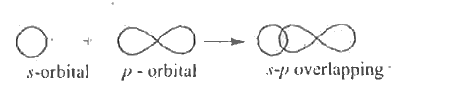
|
|
| 34. |
Giveexampleof continuousspectrum |
| Answer» Solution :(i)RAINBOW (ii)whitelight passesthrough PRISM. | |
| 35. |
Give example for the following types of organic reactions (i) beta- elimination (ii) Electrophilic substitution. |
|
Answer» Solution :(i) `beta` - elimination : Elimination reactions involve the cleavage of a `rho` bond and formation of a `pi` bond.A nucleophilic pair of electronsheads into a NEW `pi` bond as a leaving group departs. This PROCESS is called `beta` - elimination because the bond `beta` to the nucleophilic pairof electrons BREAKS. Example: (a) n-propyl bromide on reaction with alcoholic KOH give propens. In this reaction hydrogen and Br are eliminated.  (b) ACID - catalysed dehydration of ALCOHOLS  (ii) Electrophilic substitution: Substiution reactions when are brought about by electrophiles are called electrophilic substitution reaction. Example:(a) Nitration of benzene  (b) Bromination of benzene 
|
|
| 37. |
Give example for polar and non-polar molecule. |
| Answer» Solution :POLAR `HCL,H_(2)O,NH_(3)`, Non-polar `H_(2),O_(2),Cl_(2)` | |
| 38. |
Give example and structure of (i) AB_(3)L (ii) AB_(5) (iii) AB_(2)L_(2) type of molecules with example. |
|
Answer» Solution :(i) `AB_(3)L` : Number of bond pairs = 3 Number of LONE pairs = 1 ShapePyramidal Example : `NH_(3)` (ii) `AB_(5)` :Number of bond pairs= 5 Number of lone pairs = 0 Shape Trigonal bipyramidal Example : `PCl_(5)` (iii) `AB_(2)L_(2)` : Number of bond pairs = 2 Number of lone pairs = 2 Shape = Bent Example : `H_(2)O` 
|
|
| 39. |
Give example for p-p s overlapping |
Answer» SOLUTION :
|
|
| 40. |
Give examples for Aufbau principle is violated. |
|
Answer» |
|
| 41. |
Give equilibrium expression constant of the following reaction. (a) Ni_((s)) + 4CO_((g)) hArr Ni(CO)_(4(g)) (b)Ag_2O_((s)) + 2HNO_(3(g)) hArr 2AgNO_(3(aq)) + H_2O_((l)) |
|
Answer» Solution :(a) While EXPRESSION of equilibrium pure solid can ignore. `THEREFORE K_c=([Ni(CO)_4])/([CO]^4)` and `K_p=(p_(Ni(CO))_4)/(p_(CO))^4` (B) `K=([AgNO_(3(aq))]^2[H_2O_((l))])/([Ag_2O_((s))][HNO_(3(aq))]^2)` Solid `[Ag_2O]`= constant, `[H_2O_((l))]` = constant In reaction concentration of pure solid and liquid is constant so, ignore. `K_c=([AgNO_3]^2)/([HNO_3]^2)` |
|
| 42. |
Give equilibrium and equilibrium constant of aqueous solution of H_2S which used in analysis ? |
|
Answer» SOLUTION :`H_2S_((AQ))+2H_2O_((L)) HARR 2H_3O_((aq))^(+) + S_((aq))^(2-)` `K_a=([H_3O^+]^2[S^(2-)])/([H_2S])` |
|
| 43. |
Give equations for the reactions that occur when Sodium peroxide dissolves in water. |
|
Answer» Solution :`H2O2` is FORMD. `Na_(2)O_(2)+2H_(2)Oto2NaO+H_(2)O_(2)` |
|
| 44. |
Give equations for the reactions that occur when Magnesium metal is heated in air. |
|
Answer» Solution :`NO_(2)` GAS is LIBERATED. `2MG(NO_(3))_(2)to 2MgO+2NO_(2)+O_(2)` |
|
| 45. |
Give equations for the reactions that occur when Sodium metal is dropped into water. |
|
Answer» Solution :`underset("sodium")(2Na)+underset("WATER")(2H_(2)O)tounderset("sodium hydrexide")(2NOH)+underset("HYDROGEN")(H_(2))` Hydrogen gas is liberated. |
|
| 46. |
Give equation for each of the following reactions. Water is dropped on Calcium carbide |
|
Answer» |
|
| 47. |
Give equation of percentage of dissociation of weak acid. |
| Answer» SOLUTION :(DISSOCIATION in %)= `"dissociated [HA]"/"Initial [HA]"xx100` | |
| 48. |
Giveequationof wavenumberand periodictime |
| Answer» Solution :NUMBEROF WAVE`vec( V) = (1)/(lambda)m^(-1) ` (Numberofwavelengthper UNITLENGTH) | |
| 49. |
Give equation of Hydrolysis constant of NH_4Cl and CH_3COONa. |
|
Answer» SOLUTION :`K_h(NH_4Cl)=K_w/K_b` (ACIDIC solution) `K_h(CH_3COONa)=K_w/K_a` (BASIC solution) |
|
| 50. |
Give equation for each of the following reactions. Hydrogen bromide is added to propene in presence of peroxide |
|
Answer» |
|