

Saved Bookmarks
This section includes 7 InterviewSolutions, each offering curated multiple-choice questions to sharpen your Current Affairs knowledge and support exam preparation. Choose a topic below to get started.
| 1. |
Give the disproportionation reaction of H_(3)PO_(3). |
|
Answer» Solution :`H_(3)PO_(3)` on heating undergoes self-oxidation reduction, (i.e., disproportionation) to form `PH_(3)` in which P is reduced and `H_(3)PO_(4)` in which P is oxidised. `underset("Orthophosphorous acid")overset(+3)(4H_(3)PO_(3))overset(Delta)tounderset("Phosphine")overset(-3)(PH_(3))+underset("Orthophosphoric acid")overset(+5)(3H_(3)PO_(4))` |
|
| 2. |
Give the E-Z designation of the follwong compounds- |
|
Answer» enol-form |
|
| 3. |
Give the differential reaction for butane and butane and give the reaction. |
|
Answer» Solution :Baeyer test : BUTANE REACT with cold dil. `KMnO_(4)` and remove the colour of `KMnO_(4)`. `underset("Butene")(C_(4)H_(8)) underset(Na_(2)CO_(3) H_(2)O+(O))OVERSET("Cool", KMnO_(4))rarr underset("Diol")(C_(4)H_(8)(OH)_(2))` `underset("Violet (Purple)")(2KMnO_(4)) + H_(2)O rarr underset("Colorless")(2MnO_(2)) + 2KOH + 3[O]` Alkene when react with `Br_(2)` gives precipitates of addition product and remove reddish yellow colour. `underset("Butene")(C_(4)H_(8)) + underset("Red-yellow")(Br_(2(l))overset(C Cl_(4))rarr underset("SOLID dibromo butane")(C_(4)H_(8)Br_(2))` |
|
| 4. |
Give the different types of reaction of alkane compound. |
|
Answer» SOLUTION :(1) SUBSTITUTION reactions of alkanes : (i) Fluorination (ii) Chlorination (iii) Bromination (iv) Iodination (2) Combustion of alkane (OXIDATION) reaction : (i) Controlled oxidation od alkane. (ii) Incomplete oxidation of alkane. (3) Controlled oxidation of alkane. (4) Isomerization of alkane. (5) Aromatization of alkane. (6) Reaction with steam. (7) Combustion of alkane compound. |
|
| 5. |
Give the different arrangement of electron pair in SF_(4). |
Answer» SOLUTION :
|
|
| 6. |
Give the different stages name of chlorination of methane. |
| Answer» SOLUTION :(i) INITIATION (ii) PROPAGATION and (iii) TERMINATION | |
| 7. |
Give the different arrangement of electron pair in CIF_(3). |
Answer» SOLUTION :
|
|
| 8. |
Give the difference between eclipsed ethane and staggered ethane ? |
Answer» SOLUTION :
|
|
| 9. |
Give the difference in boiling point and meting point in alkane series in short ? |
|
Answer» Solution :(i) In alkane , there is weak van der Waals therefore at normal temperature till `C_(4)` is gas and `C_(5)` to `C_(13)` are LIQUID in state. (ii) As there is increase in MOLECULAR weight in alkane van der Waals force increase. It increases the boiling and melting POINT. (iii) Increase in the number of chains in isomers of alkane, DUE to it they are in shape of sphere and on increasing are van der Waals force are less therefore, boiling point is less. (iv) In isomers of alkane as the chain increases they are in the shape of sphere, due to it there isless internuclear distance and van der Waals force increases, there is increases in melting point. |
|
| 10. |
Give the difference between decarboxylation and electrolysis of sodium propanoate (or propanoic acid) ? |
Answer» Solution :Decarboxylation :  (ii) In electrolysis n-butane is FORMED at anode.  Therefore, both the products are ALKANE they are symmetrical. Diff.-(a) : product of electrolysis has double carbon than the decarboxylation. Diff.(B) : In the decarboxylati product has 1 carbon LESS than that of acid, where in electrolysis, the product has 1 more carbon alkane that reactant. |
|
| 11. |
Give the details of different layer of atmosphere and briefly describe about the substance in it. |
|
Answer» Solution :The atmosphere that surrounds the earth is not of the same thickness at all heights. There are concentric layers of air or regions and each layer has different density. The lowest region of atmosphere in which the human beings along with other organisms live is called troposphere. It extends up to the height of -10 km from sea level. Troposphere is a turbulent, dusty zone containing air, much water vapour and CLOUDS. This is the region of strong air movement and cloud formation. The region between 10 km to 50 km above the sea level lies is called STRATOSPHERE. Stratosphere, on the other hand, contains dinitrogen, DIOXYGEN, ozone and little water vapour. The presence of ozone in the stratosphere prevents about 99.5% per cent of the sun.s harmful ultraviolet (UV) radiations from reaching the earth.s surface and thereby protecting humans and other animals from its effects. |
|
| 12. |
Give the decreasing order of basic character at a,b,c,d in the following compounds : . |
|
Answer» Solution :(I) `d gt C gt b gt a[(d) 1^@` amine `gt ( c) p-`TOLUIDINE gt (b) m-toluidine `gt o-`toluodine] (II) `d gt b gt c gt a [(d) 2^@` amine `gt (b) 1^@` amine `gt ( c) 3^@` amine `gt (a)` aniline (aromatic amine) (III) `c gt b gt d gt a [( c) 3^@ (Et_3 ddot N) gt (b) 1^@ (EtNH_2) gt (d) p-`Nitroaniline `gt (a) o-`Nitroaniline]. For `(b)` and `( c)`, REFER to Section , under Basic CHARACTER of AMINES'. (IV)  . .
|
|
| 13. |
Give the decreasing order of acidic character of the following : (a) (1) Benzene (2) CH_3OH (3) H_2 O (4) CH_3 SH (b) (1) CH_3CH_2COOH (2) HOCH_2CH_2COOH (3) C1 CH_2 CH_2 COOH (4) O_2 NCH_2CH_2COOH ( c) (d) (1) [Fe(H_2O)_6]^(2 +) (2) [Fe(H_2O)_6]^(3 +) (3) [A1(H_2O)_6]^(3 +) (4) [Cr(H_2 O)_6]^(3 +) ( e) (1) HCHO (2) CH_3 CHO PhCHO (4) CH_(3)-overset(O)overset(||)(C)-CH_(3) (5) R-overset(O)overset(||)C-CI (6) (CH_3CO)_2 (7) (RCOOR) (8) RCONH_2. |
|
Answer» Solution :(a) `4 gt 2 gt 3 gt 1 [(4)` THIOLS `gt (2)` Methanol `gt (3) H_2 O gt (1)` BENZENE `(sp^2)`] (i) Thiols are stronger acid than alcohols (ii) Methanol is a stronger acid than `H_2O (pK_a of CH_3OH = 15.5, pK_a` of `H_2O = 15.7)` (see Table 4.3) (b) `4 gt 3 gt 2 gt 1` (`- I` effect of `-NO_2 gt -C1 gt -OH`). In `(I) + I` effect of `Et`. ( c) `4 gt 1 gt 2 gt 3 [(4) - I` effect of five `F` atoms `gt (1) - I` effect of `O` atom `o` position `gt (2) - I` effect of `O` atom at `m` position `(gt(3) LP overline e` donation from `N` atom by resonance] (d) `3 gt 2 gt 4 gt 1` The acidic character of the complexes is explained on the BASIS of charge density (ionic charge/ionic size). According to Fajan's rule, small cation and high charge mean more covalent and more ecidic character. Charge on the central metal : `(1) Fe^(2 +), (2) Fe^(3 +) , (3) A1^(3 +), (4) Cr^(3 +)` Ionic radius : `A1^(3 +) lt Fe^(3 +) lt Cr^(3 +) lt Fe^(2 +)` `(3)` is the strongest acid due to high charge density (high `3 +` charge and small ionic radius) Charge density and acidity ORDER : `3 gt 2 gt 4 gt 1` ( e) `1 gt 2 gt 3 gt 4 gt 5 gt 6 gt 7 gt 8` [see Section 4.10.1(f)]. |
|
| 14. |
Give the correct stability order of the following species : |
Answer» Solution :(i) `(I)` is most stable, since it is stabilised by resonance and has six `alpha-H` atoms (HYPERCONJUGATION). 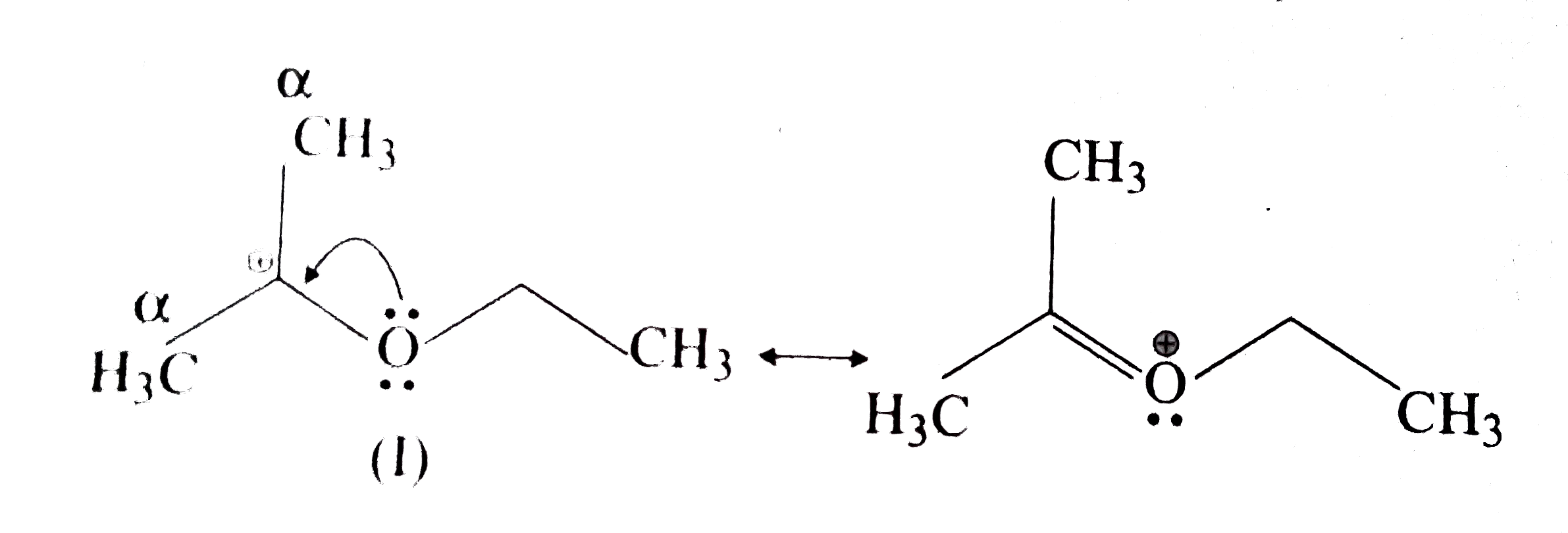 (ii) `(III)` is less stable than `(I)` but more stable than `(II)` and `(IV)`, since it is ALSO stabilised by resonance and has three `alpha-H` atoms (hyperconjugtion). 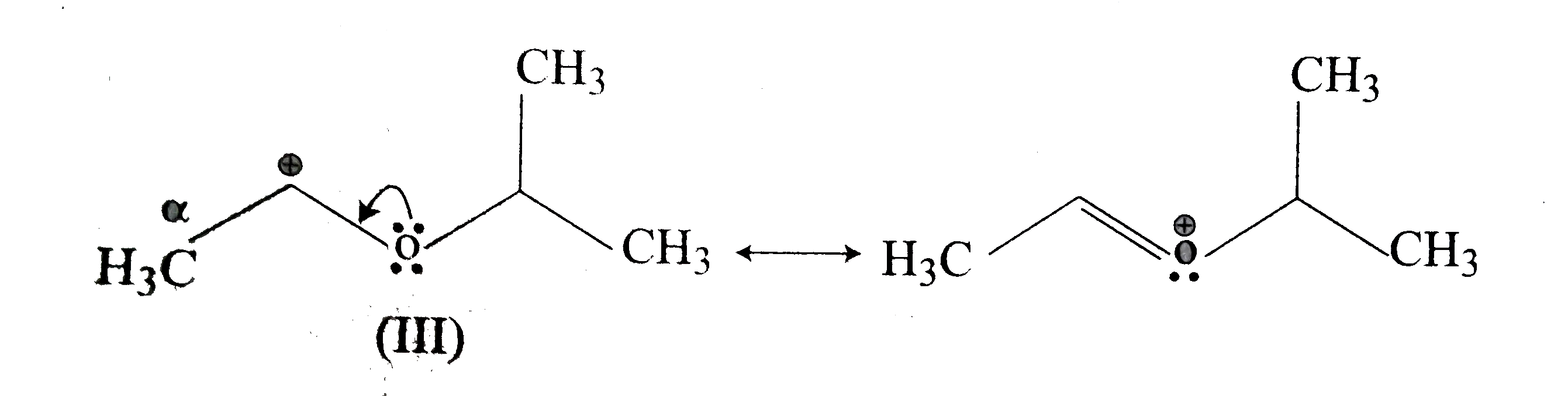 (iii) `(II)` is more stable than `(IV)` and is stabilished only be hyperconjugative structure (FIVE `alpha-H` atoms). 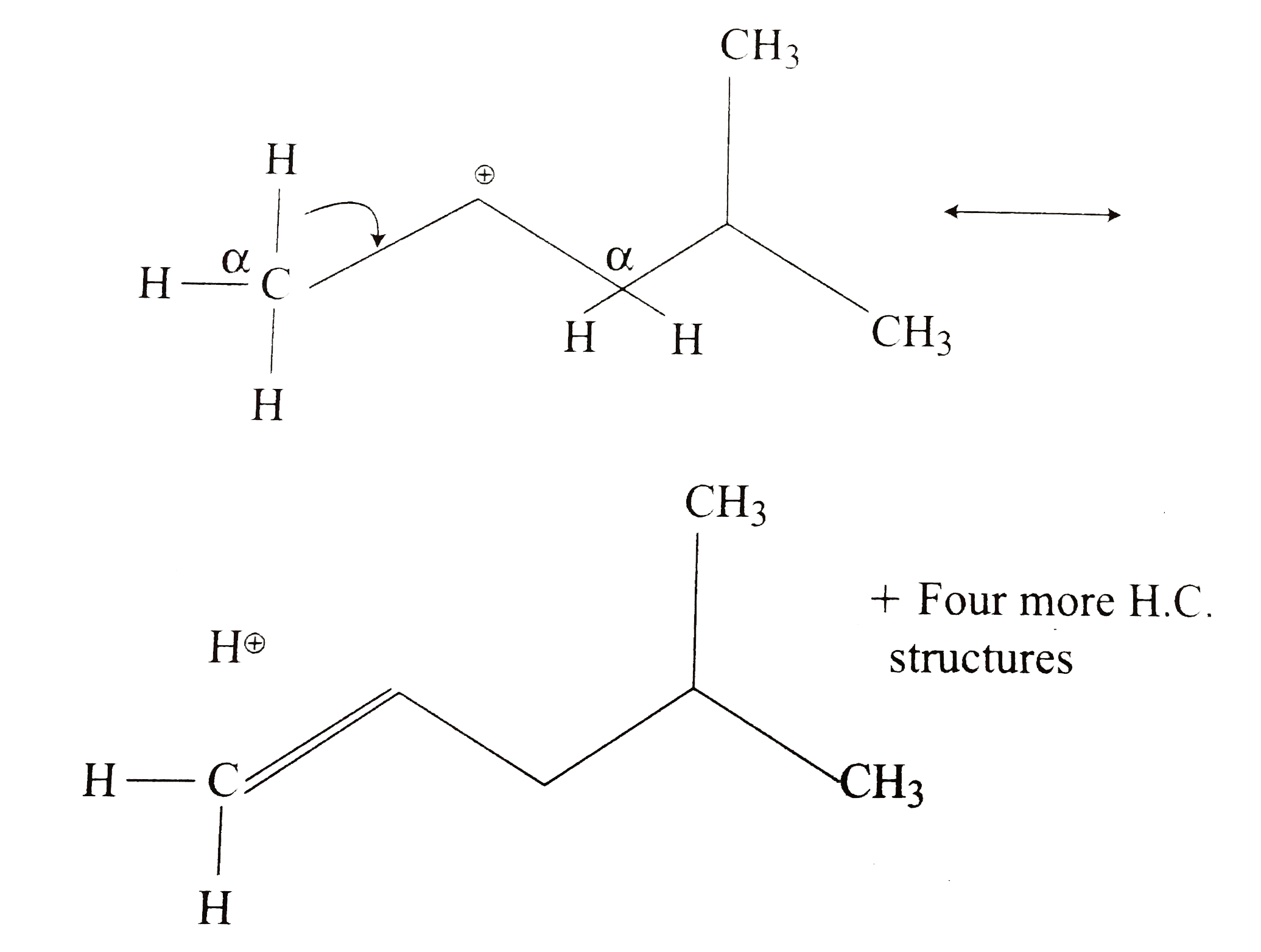 (IV) is least stable, it has only two `alpha`-H atoms. 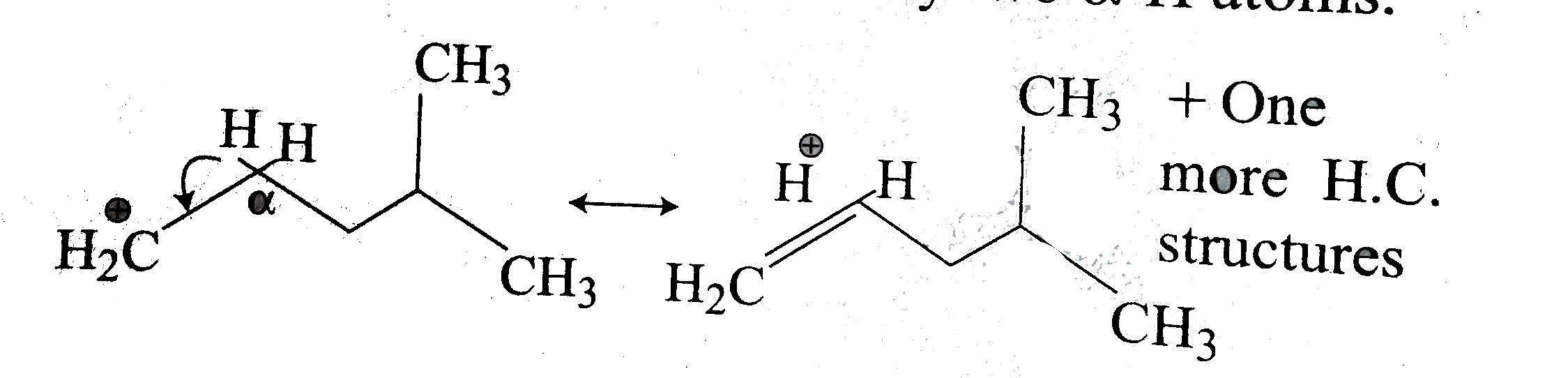 the stability ORDER is : `I gt III gt II gt IV`. |
|
| 15. |
Give the correct order of substitute group in the following (a) H_(3)C - underset(underset(CH_(3))(|))overset(overset(CH_(3))(|))(C )- CH_(2) - overset(overset(CH_(3))(|))(CH) - CH_(3) (b) H_(3)C - underset(underset(CH_(3))(|))overset(overset(CH_(3))(|))(C )- underset(underset(CH_(3))(|))(CH) - overset(overset(CH_(3))(|))(CH) - CH_(3) (c ) CH_(3)CH_(2)CH (CH_(3))CH (CH_(3))(CH_(2))(4) CH (CH_(3))_(2) (d) CH_(3)CH_(2)CH (CH_(3))CH (C_(2)H_(5)) CH_(2)CH_(2)CH_(3) (e ) (CH_(3))_(3)C CH (C_(2)H_(5)) CH_(2)CH_(3) (f ) (CH_(3))_(2) CH (CH_(2))_(4) CH (CH_(3)) CH C(C_(2)H_(5))_(2) |
|
Answer» SOLUTION :(a) `underset("2, 2,4-Trimethylpentane")(H_(3)overset(1)(C ) - underset(underset(CH_(3))(|))overset(overset(CH_(3))(2|))(C ) - overset(3)(CH_(2)) - overset(overset(CH_(3))(4|))(CH)- overset(5)(CH_(3)))` 2, 4, 4-trimethylpentane name is incorrect because in this second substitute is 4, which is high order (B) `overset(1)(CH_(3)) - underset(underset(CH_(3))(|))overset(overset(CH_(3))(2|))(C )- underset(underset(CH_(3))(|))overset(3)(CH) - overset(overset(CH_(3))(4|))(CH) - overset(5)(CH_(3))` (i) From the left side if the 1 number is given then the name is 2, 2, 3, 4-tetramethyl and from the right side is the 1 number is given then the name is 2, 3, 4, 4-tetramethyl. From these both name in (i) the order is low so the IUPAC name is 2, 2, 3, 4-tetramethylpentane. (c ) `overset(1)(CH_(3)) - overset(2)(CH_(2)) - underset(underset(CH_(3))(|))overset(3)(CH)- underset(underset(CH_(3))(|))overset(4)(CH) - overset(5)(CH_(2)) - overset(6)(CH_(2))- overset(7)(CH_(2)) - overset(8)(CH_(2)) - underset(underset(CH_(3))(|))overset(9)(CH)- overset(10)(CH_(3))` The substitution order from the left side (i) no. given then 3, 4, 9- and from the right side 1 no. given then 2, 7, 8- High order : `ul(3), 4, 9` so, this is wrong Low order: `ul(2), 7, 8` so, this is correct Thus, the correct IUPAC name is 2, 7, 8-trimethyl-decane Note: (i) In earlier the lowest addition of substitution was TAKEN. (ii) Now a days the lowest order of substitution is taken (d) `overset(1)(CH_(3))- overset(2)(CH_(2)) - underset(underset(CH_(3))(|))overset(3)(CH) - underset(underset(CH_(2)CH_(3))(|))overset(4)(CH)- overset(5)(CH_(2))- overset(6)(CH_(2)) - overset(7)(CH_(3))` (i) 4-ETHYL-3-methyl: order is 4, 3 or (ii) 4- ethyl -5-methyl : order is 4, 5 so, the order low (i) and the 4, 3 order in (i) is low then 4, 5 `:.` correct IUPAC name is 4-ethyl-3-methyl -heptane. (e ) `H_(3) overset(1)(C )- underset(underset(CH_(3))(|))overset(overset(CH_(3))(2|))(C ) - underset(underset(CH_(2)CH_(3))(|))overset(3)(CH)- overset(4)(CH_(2))- overset(5)(CH_(2)) - overset(6)(CH_(2))- overset(7)(CH_(2)) - underset(underset(CH_(3))(|))overset(8)(CH) - underset(underset(CH_(2)CH_(3))(|))overset(9)(CH_(2)) - overset(10)(CH_(2)) overset(11)(CH_(3))` Substitutes (i) 2, 2, 3, 8, 9 is low order so, correct or substitutes (ii) 3, 4, 9, 10 is high order so, incorrect. `:.` IUPAC Name: 3, 9-dimethyl, -2, 2, 8-trimethyl-decane (f ) `overset(1)(CH_(3))- underset(underset(CH_(3))(|))overset(2)(CH) - overset(3)(CH_(2))- overset(4)(CH_(2)) - overset(5)(CH_(2))- overset(6)(CH_(2)) - underset(underset(CH_(3))(|))overset(7)(CH)- underset(underset(CH_(2)CH_(3))(|))overset(8)(CH) - overset(9)(CH_(2)) - overset(10)(CH_(3))` (i) From the left side, if the 1 number is given then order is `ul(2)`, 7, 8 so, it is correct (ii) From the right side, if the 1 number is given then order is `ul(3)`, 4, 7. so, it is incorrect. FIRST substitute order `2 lt` order 3 `:.` IUPAC Name: 8 -ethyl, 2, 7-dimethyldecane |
|
| 16. |
Give the correct order of thermal stabiiity of alkaline earth metal carbonates. |
|
Answer» `BaCO_3gtSrCO_3gtCaCO_3gtMgCO_3gtBeCO_3` |
|
| 17. |
Give the correct order of stability of carbocation |
|
Answer» `3^(@) GT 2^(@) gt 1^(@) gt` METHYL |
|
| 18. |
Give the correct order of initials T (True) or F (False) for following statements. (I) If electron has zero magnetic quantum number, then it must be present in s-orbital. (II) In orbital diagram, pauli’s exclusion principle is violated. (III) Bohr.s model can explain spectrum of the hydrogen atom. (IV) A d-orbital can accommodate maximum 10 electrons only. |
|
Answer» <P>TTFF II is violating hunds rule IV d orbital can ACCOMMODATE 2 ELECTRONS only |
|
| 19. |
Give the condensed and bond-line structural formulae for the following : (a) 2-Methylbuta-1, 3-diene(b) Penta-1, 4-diene(c) Hexa-1, 3, 5-triene(d) 3-Ethylpenta-1, 3-diene |
Answer» SOLUTION :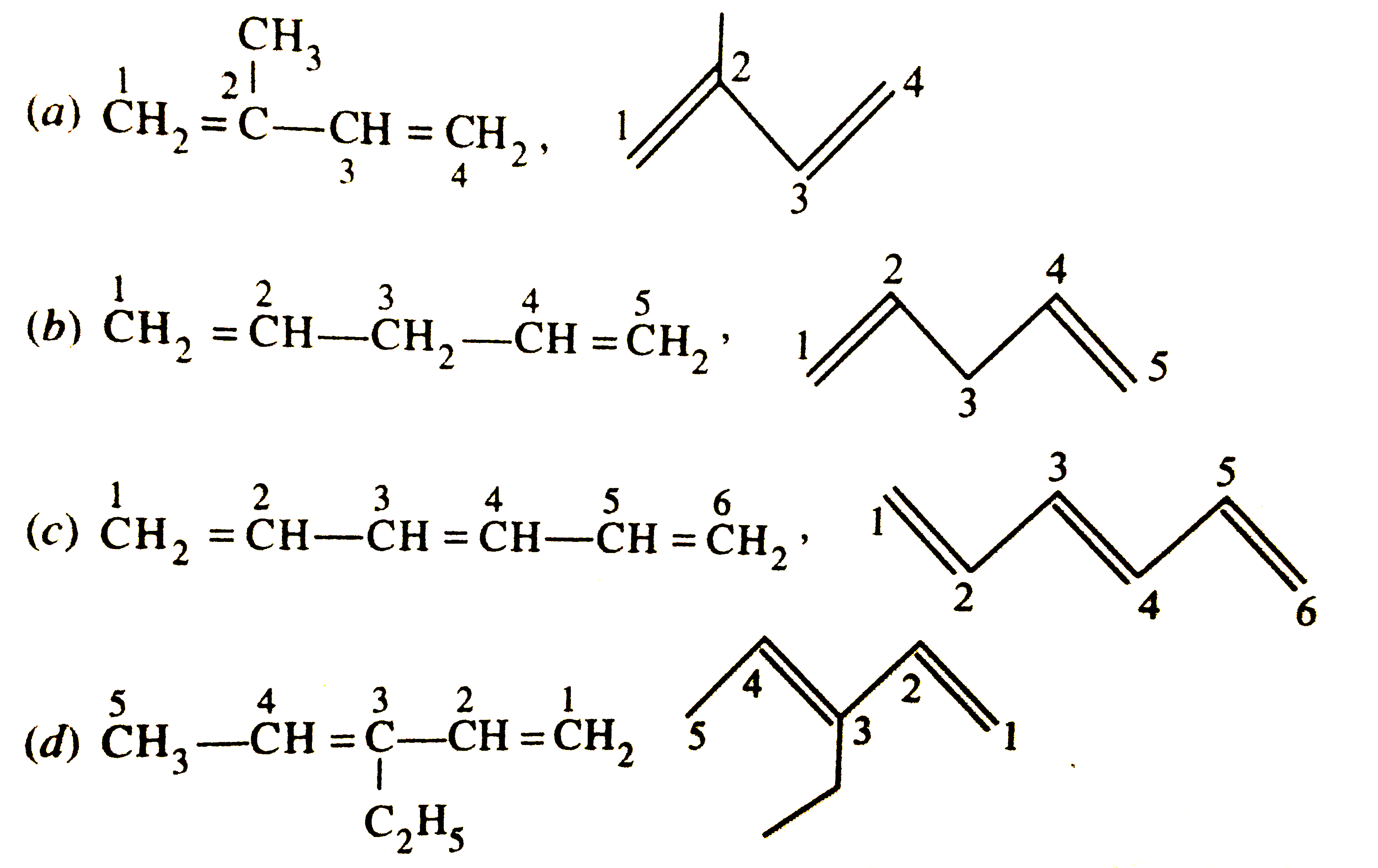
|
|
| 20. |
Give the condensed formula and bond line formula of 2,2,4-trimethylpentane. |
|
Answer» Solution :2,2,4-trimethylpentane `(CH_(3))_(3)"CC"H_(2)CH(CH_(3))_(2)` -CONDENSED formula  BOND line formula BOND line formula
|
|
| 21. |
Give the condensed and bond line formulae and identify the functional groups present if any for 2,2,4-Trimethylpentane |
|
Answer» |
|
| 23. |
Give the condensed and bond line formulae and identify the functional groups present if any for 2-hydroxy 1,2,3-propane tricarboxylic acid |
|
Answer» |
|
| 24. |
Give the condensed and bond line formulae and identify the functional groups present if any for Hexane dial |
|
Answer» |
|
| 25. |
Give the complete and incomplete combustion of heptane and nonane. |
|
Answer» Solution :(a) Controlled oxidation reaction od alkane : Alkanes on heating in the presence of air of dioxgen are completely OXIDIZED to carbon dioxide and WATER with the evolution of large amount of heat. Reaction of combusiton of alkane is as follows : Alkane + oxygen `underset("combustion")overset("Complete")rarr` carbondioxide + water (i) `CH_(4(g)) + 2O_(2(g)) rarr CO_(2(g)) + 2H_(2)O_((l))` Methane`Delta_(C)H^(ɵ) = -890 Kj mol^(-1)` ...(i) (ii) `CH_(4)H_(10(g)) + (13)/(2)O_(2(g)) rarr 4CO_(2(g)) + 5H_(2)O_((l))` Butane `Delta_(C)H^(ɵ) = -2875.84 Kj mol^(-1)` ...(ii) (iii) In any alkane on. of carbon = n then normal combustion reaction FORMULA is : `C_(n)H_(2n+2) + ((3n+1)/(2))O_(2) rarr nCO_(2) + (n+1)H_(2)O` ....(iii) Due to evolution of large amount of heat during combustion, alkanes are USED as fuels. `C_(8)H_(18) + (25)/(2)O_(2(g)) rarr 8CO_(2) + 9H_(2)O` Uses : Gas used in homes for kitchen, vehicles, trains, bus, car, aeroplane etc. |
|
| 26. |
Give the common and IUPAC name of an alkane having the lowest molecular mass that contains a quaternary carbon. |
|
Answer» SOLUTION :`{:(""CH_(3)),("|"),(CH_(3)-C-CH_(3)),("|"),(""CH_(3)):}` COMMON name : Neopentane IUPAC name : 2, 2-Dimethylpropane |
|
| 27. |
Give the combustion reaction of alkane. |
|
Answer» Solution :(a) Controlled oxidation reaction od alkane : Alkanes on HEATING in the PRESENCE of air of dioxgen are completely oxidized to carbon dioxide and water with the evolution of large amount of heat. Reaction of combusiton of alkane is as follows : Alkane + oxygen `underset("combustion")overset("Complete")rarr` carbondioxide + water (i) `CH_(4(G)) + 2O_(2(g)) rarr CO_(2(g)) + 2H_(2)O_((l))` Methane`Delta_(C)H^(ɵ) = -890 Kj mol^(-1)` ...(i) (ii) `CH_(4)H_(10(g)) + (13)/(2)O_(2(g)) rarr 4CO_(2(g)) + 5H_(2)O_((l))` Butane `Delta_(C)H^(ɵ) = -2875.84 Kj mol^(-1)` ...(ii) (iii) In any alkane on. of carbon = n then normal combustion reaction formula is : `C_(n)H_(2n+2) + ((3n+1)/(2))O_(2) rarr nCO_(2) + (n+1)H_(2)O` ....(iii) Due to evolution of large amount of heat during combustion, alkanes are used as fuels. `C_(8)H_(18) + (25)/(2)O_(2(g)) rarr 8CO_(2) + 9H_(2)O` Uses : GAS used in homes for kitchen, vehicles, trains, bus, car, aeroplane etc. |
|
| 28. |
Give the combined gas equation (or general equation for gases). |
| Answer» SOLUTION :`8.3124 JK^(-1)"MOL"^(-1)` | |
| 29. |
Give the classification depending upon bonds. |
Answer» SOLUTION :In HYDROCARBON, there are hydrogens and CARBONS. Classification is as follows : 
|
|
| 30. |
Give the chlorination of methane in presence of hv ? |
|
Answer» Solution :One or more hydrogen atoms of alkanes can be replaced by halogens, nitro group and sulphonic acid group. Halogenation takes place either at HIGHER temperature (573-773K) o in the presence of diffused sunlight or ultraviolet light. Lower alkanes do not undergo NITRATION and sulphonation reactions. These reactions in which hydrogen atoms of alkanes are substituted are known as substitution reactons. As an example, chlorination of methane is GIVEN below : Reaction of completely chlorination of methane (i) `underset("Methane")(CH_(4) +Cl_(2))underset(or 573-773)overset(hv)rarr underset("Chloromethane")(CH_(3)Cl+HCl)` ...(i) (ii) `CH_(3)Cl + Cl_(2) overset(hv)rarr underset("Dichlotomethane")(CH_(2)Cl_(2)+HCl)` ...(ii) (iii) `CH_(2)Cl_(2) + Cl_(2) overset(hv)rarr underset("TRICHLOROMETHANE")(CHCl_(3) + HCl)rarr` ....(iii) (iv) `CHCl_(3) + Cl_(2) overset(hv)rarr underset("Tetra-chloromethane")(C Cl_(4)-HCl)rarr` ...(iv) In SHORT `CH_(4)underset(-HCl)overset(Cl_(2), hv)rarr CH_(3)Cl underset(-HCl)overset(Cl_(2), hv)rarr CH_(2)Cl_(2)` `underset(-HCl)overset(Cl_(2), hv)rarr CHCl_(3) underset(-HCl)overset(Cl_(2), hv)rarr C Cl_(4)` ...(v) |
|
| 31. |
Give the chemical reaction to support that +5 oxidation state of Bi less stable than +3 state. |
Answer» Solution :Due to inert PAIR effect, BI can shown +3 and +5 oxidation states. Since the inert pair effect is MAXIMUM in case of Bi, therefore, its +5 oxidation state is less stable than +3 oxidation state. This is evident from the observation that `BiCl_(3)` EVEN onprolonged heating with `Cl_(2)` does not form `BiCl_(5)` 
|
|
| 32. |
Give the chemical reaction of methane. |
Answer» SOLUTION :
|
|
| 33. |
Give the chemical formula of the following: a. Plaster of paris, b. Asbestos, c. Hydrolith, d. Lithopone, e. Gypsum, f. Marble, g. Anhydrite, h. Baryta water, i. Quicklime, j. Slaked lime, k. Magnesite, l. Kieserite, m. Epsom salt, n. Baryta, o. Beryl, p. Witherite, q. Celsestine, r. Fluorspar |
|
Answer» SOLUTION :(a). Plaster of Paris:, `CaSO_(4).(1)/(2)H_(2)O` (B). Asbestos:, `CaMg_(3)(SiO_(4))_(2)` (c ). Hydrolith:, `CaH_(2)` (d). Lithopone:, `BaSO_(4)+ZnS` (E). Gypsum:`CaSO_(4).H_(2)O` (f). Marble: `CaCO_(3)` (g). Anhydrite: `CaSO_(4)` (h). Baryta water: `Ba(OH)_(2)` (i). QUICKLIME: `CaO` (j). Slaked lime: `Ca(OH)_(2)` (k). Magnesite: `MgCO_(3)` (L). Kieserte: `MgSO_(4).H_(2)O` (m). Epson salt: `MgSO_(4).7H_(2)O` (n). Baryta: `BaSO_(4)` (o). Beryl: `3BeO.Al_(2)O_(3).6SiO_(2)` (p). Witherite: `BaCO_(3)` (q). Celestine:, `SrSO_(4)` (r). Fluorspar:, `CaF_(2)` |
|
| 35. |
Give the chemical formula of dolomite and carnallite . |
| Answer» SOLUTION :Dolomite `: CaCO_(3) . MgCO_(3)` and Carnallite : `KCL . MgCl_(2) . 6H_(2)O`. | |
| 36. |
Give the chemical formula of borazine. |
|
Answer» |
|
| 38. |
The characteristicselectromagneticradiationgivenby whichproperties? |
|
Answer» SOLUTION :Theelectromagneticradiations arecharactersideby frequencywavelengthandwavenumber Wavelength: Thedistance betweentosuccesivepoint ofwaveis takensameaswavelength . this is calledspeedof ligthand isgiventhesymbol`(C =3.8 xx 10^(8)ms^(-1))` Thisfrequency( v)wavelengthand velocityof LIGHT( c) arerelatedby theequation . `c= v lambda` or `v = ( c) /( lambda )` |
|
| 39. |
Give the calculation of following : (i) (6.7xx10^(4))xx(8.4xx10^(7))(ii) ((3.4xx10^(-3)))/((6.5xx10^(-7))) |
|
Answer» `=56.28xx10^(11)` `=5.628xx10^(12)` (ii) `((3.4xx10^(-3)))/((6.5xx10^(-7)))=(3.4 div 6.5) (10^(-3+7))` `=0.5230xx10^(4)` `=5.230xx10^(5)` |
|
| 40. |
Give the bond order for hydrogen molecule, nitrogen molecule and NO. |
| Answer» SOLUTION :`{:("MOLECULE","BOND ORDER"),(H-H,1),(N-=N,3),( :OVERSET(.)N=overset(..)O:,2.5):}` | |
| 41. |
Give the answer of the following question in short. (i) When the simple distillation is used? (ii) When the fractional distillation is used? (iii) Which liquid is first obtain in fractional distillation? (iv) Which liquid is first cooled in fractional distillation? (v) What happend in fractional column? |
|
Answer» Solution :(i) (a) For purification of VOLATILE liquid. (b) For separation of liquid in which the difference in boiling point is more them `30^(@)C`. (ii) (a) For separation of liquid in which the difference in boiling point is loss. (b) In petroleum industry to separated the different components. (III) The liquid which is more volatile and LOW boiling is obtained first. (iv) In fractional DISTILLATION the freezing of liquid with high boiling point is first take place than the freezing of liquid with low boiling point. (v ) In fraction distillation COLOUM the heat exchange between the vapour moving upper side and liquid moving downwards. the condense liquid absorb heat from the vapour and again convert into vapour. So in vapour the liquid with low boiling point increases. |
|
| 42. |
Give the application of Hess's law. |
| Answer» Solution :HESS' s law can be APPLIED to CALCULATE ENTHALPIES of reaction the are DIFFICULT to measure . | |
| 43. |
Give the answer for Lassigne test. (i) If nitrogen and sulphur both present than which observation is observed? (ii) If bromine is present then? (iii) In Lassigne extract by adding CH_(3)COOH and lead acetate black ppts are not obtained? What is inducate? (iv) What is the reason to added FeSO_(4) in Lassigne extract? (v) Why the prussion blue colour is oberved? (vi) Lassigne extract gives violet colour sodium nitroprusside? |
|
Answer» Solution :(i) RED COLOUR is obtained due to `[Fe(SCN)]^(2+)` (ii) By adding `AgNO_(3)` yellow ppt will FORM (iii) Sulphur is not present (IV) To convert `Fe^(2+) " to " Fe^(3+)` by OXIDATION (v) Due to formation of `Fe_(4)[Fe(CN)_(6)]_(3)` (vi) Sulphur is present in compound |
|
| 44. |
Give the amount of water required to prepare 0.01 M aq. solution of 0.01 mole of sucrose. |
|
Answer» 1 kg |
|
| 45. |
Give the answer for 2.5 xx 1.25 in specificant figures. |
|
Answer» Solution :`2.5 xx 1.25=3.125` Since 2.5 has only two SIGNIFICANT figures, the ANSWER is 3.1. |
|
| 46. |
Give the answer for 2.5xx1.25 in specificant figures. |
|
Answer» SOLUTION :`2.5xx1.25=3.125` SINCE 2.5 has only TWO singnificant FIGURES, the ANSWER is 3.1. |
|
| 47. |
Give the advantage of future fuel-hydrogen. |
| Answer» Solution :Hydrogen is considered as a potential CANDIDATE for this purpose as it is a clean burning fuel. Hence, hydrogen can directly be used as a fuel and can replace existing GASOLINE (petrol) diesel/kerosene powered ENGINES, and indirectly be used with oxygen in fuel cells to GENERATE electricity. One major advantage of USING hydrogen is that the combustion product is essentially free from pollutants, the end product formed in both cases is water. | |
| 48. |
Givethe amountof protiumanddeuterium inhydrogenatomwith symbol . |
|
Answer» Solution :Protum : `._(1)^(1) H` AMOUNT(99.985 %) Deuteriou : symbol`: _(1)^(2) D ` almount(0.015 %)` |
|
| 49. |
Give the advantages of CHN method in estimation |
| Answer» Solution :The analyser requires only a very small amount of the substance (1-3 MG) and DISPLAYS the values on a screen within a short TIME. | |
| 50. |
Givesymbol of atomnameatomicnumber(Z) . Mass number(A )and theirelectron (e )proton(p) andneutron (n ) of1 to 20 atomicnumber containingelements . |
| Answer» SOLUTION :seetableno 2.2 | |