

Saved Bookmarks
This section includes 7 InterviewSolutions, each offering curated multiple-choice questions to sharpen your Current Affairs knowledge and support exam preparation. Choose a topic below to get started.
| 1. |
Group the given molecules as linear andnon-linear molecular : H_(2) O, HOCl, BeCl_(2), Cl_(2) O |
Answer» SOLUTION :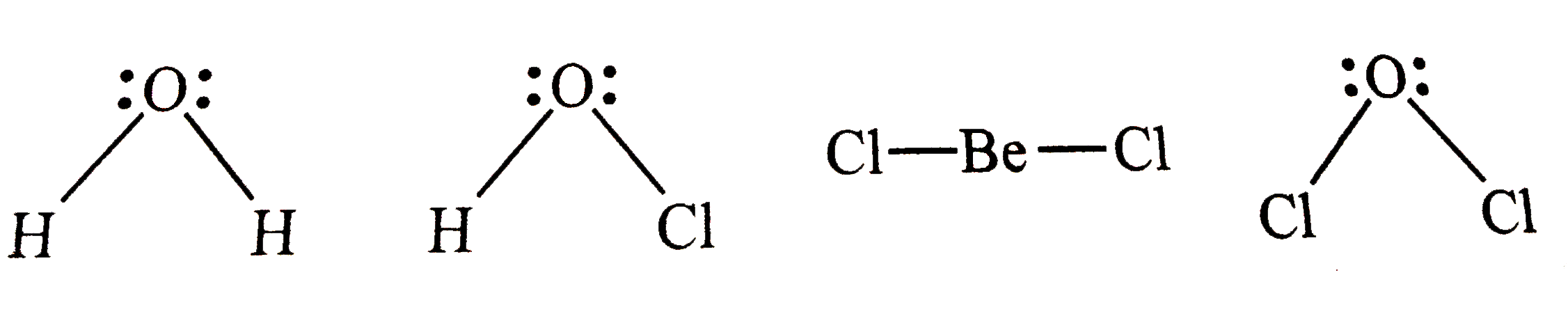 THUS , only `BeCl_(2)` is linear. All other MOLECULES are non-linear. |
|
| 2. |
Group the following as linear and non-linear molecules: H_(2) O, HOCl, BeCl_(2) , Cl_(2)O |
Answer» Solution :The structure of the GIVEN molecules are THEREFORE, only`BeCl_(2)` is linear and rest of the molecules are NON- linear . |
|
| 3. |
Group numbers 3 to 12 in the periodic table are called ........ |
| Answer» SOLUTION :TRANSITION ELEMENTS | |
| 4. |
Group number and valency has relation in |
|
Answer» FIRST GROUP |
|
| 5. |
Group-II elements react with water evolving hydrogen. This reactivity increases down the group from Be to Ba. They displace hydrogen from acids except Be with oxygen Be, Mg and Ca form monoxides while Sr, Ba and Ra form peroxides on heating with hydrogen, they form metal hydrides except Be with carbon, they form carbides on heating such as acetylides, methanides and allylides. When heated with halogens they form halides having different properties. Which of the following alkaline earth metal hydroxide is amphoteric in character ? |
| Answer» Solution :`Be(OH)_(2)` is amphoteric while `Ca(OH)_(2) Sr(OH)_(2)` and `Ba(OH)_(2)` and all basic. | |
| 6. |
Group-II elements react with water evolving hydrogen. This reactivity increases down the group from Be to Ba. They displace hydrogen from acids except Be with oxygen Be, Mg and Ca form monoxides while Sr, Ba and Ra form peroxides on heating with hydrogen, they form metal hydrides except Be with carbon, they form carbides on heating such as acetylides, methanides and allylides. When heated with halogens they form halides having different properties. Least ionic carbide is formed by |
| Answer» SOLUTION :Least ionic CARBIDE is formed by berllium. | |
| 7. |
Group-II elements react with water evolving hydrogen. This reactivity increases down the group from Be to Ba. They displace hydrogen from acids except Be with oxygen Be, Mg and Ca form monoxides while Sr, Ba and Ra form peroxides on heating with hydrogen, they form metal hydrides except Be with carbon, they form carbides on heating such as acetylides, methanides and allylides. When heated with halogens they form halides having different properties. Ionic hydride is not formed by |
|
Answer» `Be` |
|
| 8. |
Group 18 (or zero group) elements are best called as |
|
Answer» INERT GASES |
|
| 10. |
Group 13 of periodic table consists of boron or aluminium family. Boron being the first member, shows anomalous behaviour due to its small size and high nuclear charge/size ratiom high electrone gastivity and non availability of d-electrons. All the group 13 members forms hydrides, hydroxides, halides showing +3 covalency, however boron forms electron deficient species.Which one is not correct chemical change ? |
|
Answer» `H_(3)BO_(3)+3NaOH rarr Na_(2)BO_(3)+3H_(2)O` |
|
| 11. |
Group 13 of periodic table consists of boron or aluminium family. Boron being the first member, shows anomalous behaviour due to its small size and high nuclear charge/size ratiom high electrone gastivity and non availability of d-electrons. All the group 13 members forms hydrides, hydroxides, halides showing +3 covalency, however boron forms electron deficient species.Which of the following statement(s) is/are correct. (I) Both B and Al forms anionic hydrides(II) Both form alkaline hydroxide of formula M(OH)_(3)(III) Both B and Al forms a series of polymeric hydrides(IV) Both forms monoeric halides MX_(3) |
|
Answer» I, IV |
|
| 12. |
Group 13 element with lowest melting point is |
|
Answer» B |
|
| 13. |
Group 13 elements show |
|
Answer» only +3 OXIDATION STATE |
|
| 14. |
Grignard reagents give alkanes with |
|
Answer» Phenol |
|
| 15. |
Grignard reagent on reaction with a ketone forms |
|
Answer» TERTIARY ALCOHOL |
|
| 16. |
Grignard reagent is prepared by the reaction between_____ |
|
Answer» ZINC and ALKYL HALIDE |
|
| 17. |
Grignard addition to carbonyl compounds is specific case of nucleophillic addition reaction which leads to formation of all type of alcohols (1^(@),2^(@) & 3^(@)) .In this addition the strongly nucleophlic Grignard reagent uses its electron pair to form a bond with theC - atom ofgtC=O group, where one e^(-) pair of group ,shifts out towards oxygen . It results in the formation of an intermediate species in which alkoxide ion associated withMg^(2+) and . Now addition of an intermediate of this species to give alcohol.Here P andQare respectively : |
|
Answer»
 DIOL PROTECTS aldehyde since it is more REACTIVE. Grignard reagent reacts with keto carbon carbon since it does not REACT with (only oneequalent is given) |
|
| 18. |
Grignard addition to carbonyl compounds is specific case of nucleophillic addition reaction which leads to formation of all type of alcohols (1^(@),2^(@) & 3^(@)) .In this addition the strongly nucleophlic Grignard reagent uses its electron pair to form a bond with theC - atom ofgtC=O group, where one e^(-) pair of group ,shifts out towards oxygen . It results in the formation of an intermediate species in which alkoxide ion associated withMg^(2+) and . Now addition of an intermediate of this species to give alcohol.In which of the following reacton product formed is correctiy given ? |
|
Answer» I,II  DIOL protects ALDEHYDE since it is more reactive. Grignard REAGENT reacts with keto CARBON carbon since it does not react with (only oneequalent is given) |
|
| 19. |
Grignard addition to carbonyl compounds is specific case of nucleophillic addition reaction which leads to formation of all type of alcohols (1^(@),2^(@) & 3^(@)) .In this addition the strongly nucleophlic Grignard reagent uses its electron pair to form a bond with theC - atom ofgtC=O group, where one e^(-) pair of group ,shifts out towards oxygen . It results in the formation of an intermediate species in which alkoxide ion associated withMg^(2+) and . Now addition of an intermediate of this species to give alcohol. |
|
Answer»
 DIOL protects ALDEHYDE since it is more REACTIVE. Grignard REAGENT reacts with keto carbon carbon since it does not react with (only oneequalent is given) |
|
| 20. |
Green plants use carbon dioxide for photosynthesis and return oxygen to the atmosphere, even then carbon dioxide is considered to be responsible for greenhouse effect. Explain why? |
| Answer» SOLUTION :The amount of `CO_2` produced due to human activity such as burning of fossil fuels LIKE coal. natural gas, petroleum, ether, and PRODUCTION of lime from limestone is much more than that consumed during photosynthesis. The consumption in photosynthesis has further decreased due to deforestation | |
| 21. |
Green plants use carbon dioxide for photosynthesis and return oxygen to the atmosphere, even then carbon dioxide is considered to be responsible for green house effect. Explain why? |
|
Answer» Solution :`CO_2` is a natural constituent of atmosphere and is vital for all forms of plant life. It forms about 0.033% by volume of atmosphere. It helps to maintain the temperature of the earth required for living ORGANISMS. A balance of `CO_2`is maintained in air because `CO_2` is produced from burning of fossil fuels, decomposition of lime stone respiration but at the same time, it is also CONSUMED by plants. during photosynthesis. However, HUMAN activities have disturbed this balance and `CO_2`level in atmosphere is in increasing order. Due to deforestation, burning of more fossil fuel and industrialization. It has been estimated that `CO_2` CONCENTRATION has risen about 25% in the past century. During the past nearly 120 years, the average temperature of the planets increased between `0.4^@ C to 0.8^@ C`. Current estimated are that doubling the `CO_2` Concentration will result in a temperature increase of between `1.0^@ C and 3.5^@ C`. In green house effect, contribution of `CO_2` is 50% and of other trace gases is also about 50%. |
|
| 22. |
Green house gases radiate back the following radiations to the earth surface |
|
Answer» U.V |
|
| 23. |
Green house effect leads to global warming. Which substances are responsible for greenhouse effect ? |
| Answer» Solution :Trapping of heat by greenhouse gases namely CARBON dioxide, methane, nitrous OXIDE `(N_2O)`, OZONE and CHLOROFLUOROCARBONS (CFC's) is responsible for greenhouse EFFECT. | |
| 24. |
Green house effect leads to global warming. Which substances are responsible for green house effect ? |
Answer» Solution :The VARIOUS gases which GREEN house effect responsible for GLOBAL warming are the FOLLOWING with relative contributions. 
|
|
| 25. |
Green chemistry means such reactions which |
|
Answer» PRODUCE colour during reactions |
|
| 26. |
Green chemistry means such reactions which : |
|
Answer» produce COLOUR during reactions. |
|
| 27. |
Green chemistry deals with production and use of ___________ |
|
Answer» |
|
| 28. |
Green chemistry deals with |
|
Answer» STUDY of PLANT physiology |
|
| 29. |
Green chemistry aims to |
|
Answer» design chemical PRODUCTS and processes that maximize PROFITS |
|
| 30. |
Grastric juice contains 3 g of HCl per litre. If a person produces 2.5 litre of gastric juice per day, how many antacid tablets each containing 400 mL of Al(OH)_(3) are needed to neutralise all the HCl produced in one day ? |
|
Answer» |
|
| 32. |
Graphite is soft and slippery. Give reason. |
| Answer» Solution :Graphite has an HEXAGONAL LAYER structure and the layers are HELD together by weak VAN der Waal's FORCES . Hence it is soft and slippery. | |
| 33. |
Graphite is good conductor of electricity but diamond is non-conductor because |
|
Answer» diamond is HARD and graphite is soft |
|
| 34. |
Graphite is better lubricant in |
|
Answer» PRESENCE of `O_(2)` |
|
| 35. |
Graphite is a good conductor of electricity. Give reason. |
|
Answer» |
|
| 36. |
Graphite is a good conductor of electricity due to the presence of _____ |
|
Answer» LONE pair of electrons |
|
| 37. |
Graphite is a good conductor of electricity due to the presence of ……. |
|
Answer» LONE pair of ELECTRONS |
|
| 38. |
Graphite is a good conductor of electricity because it contains |
|
Answer» BONDED ELECTRONS |
|
| 39. |
Graphite conducts elecatricity because of the |
|
Answer» Highly POLARIZED nature of `PI`-electrons. |
|
| 40. |
Graphite cannot be classified as _____ |
|
Answer» CONDUCTING SOLID |
|
| 41. |
Graphite cannot be classified as ……… |
|
Answer» CONDUCTING SOLID |
|
| 42. |
Graphite at room temperature is |
|
Answer» a p-type semiconductor |
|
| 43. |
Graphically show the total work done in an expansion when the state of an ideal gas is changed reversibley and isothermally from( P_(i), V_(i))to(P_(f),V_(f)) . With the help ofa PV plot,compare the work done in the above case with carried out against a constant external pressure P_(f). |
Answer» Solution :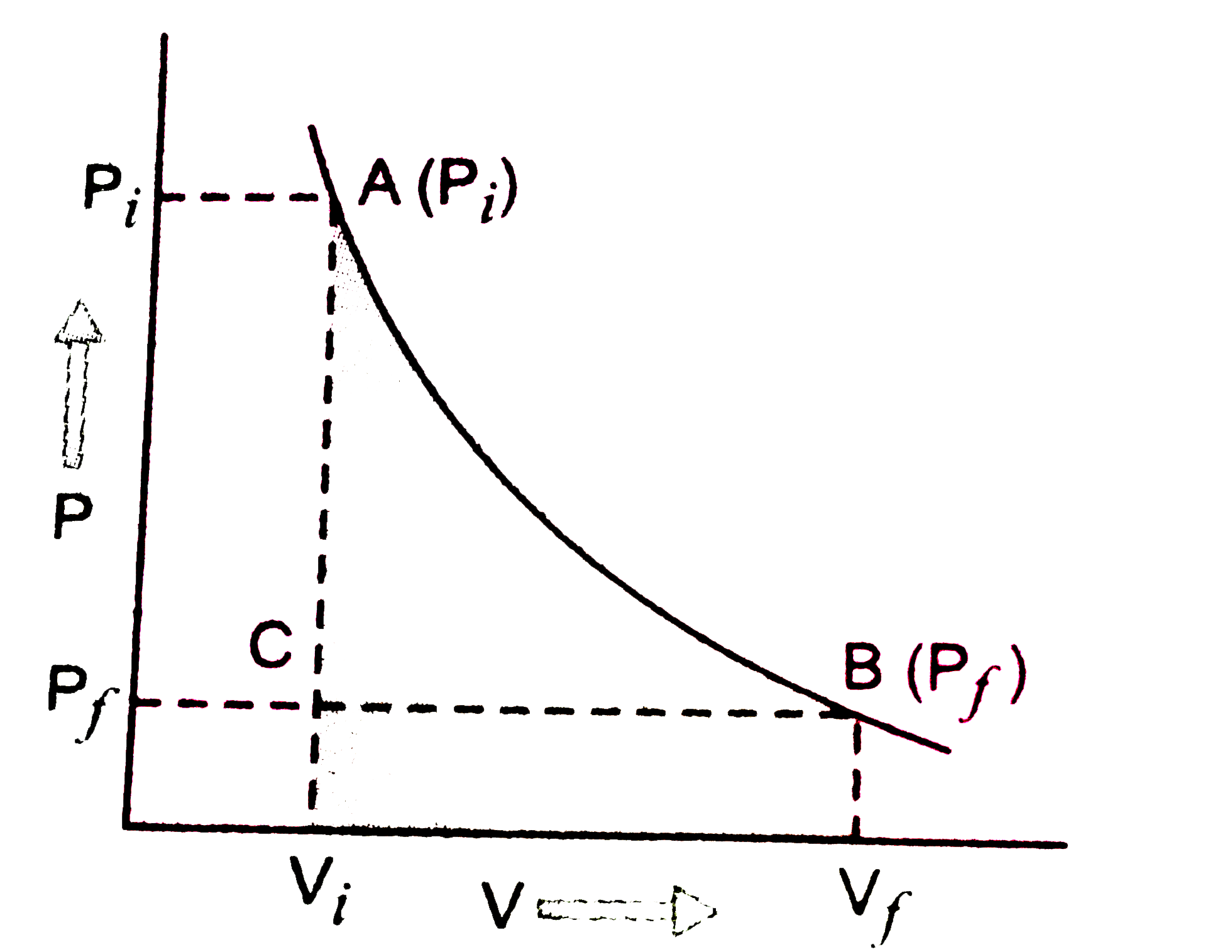 (i) Area AB `V_(i) V_(f)` represets total work done for REVERSIBLE isothermal EXPANSION from `(P_(i), V_(i)) ` to `(P_(f),V_(f))` (ii) Area CB `V_(i)V_(f)` represents work done against constant PRESSURE`P_(f)` OBVIOUSLY , work (i) `GT` work (ii) |
|
| 44. |
Graphically show the total work done in an expansion when the state of an ideal gas is changed reversibly and isothermally from (p_(i), V_(i) ) to (P_(f) , V_(f) ). With the help of a pV plot compare the work done in the above case with that carried out against a constant external pressure p_f. |
Answer» Solution :(i) TOTAL work done in an expansion when the state of an IDEAL gas is changed reversibly and isothermally p from `(p_(i) , V_(i) )` to `(p_(F) , V_(f) )`. Reversible work is represented by the combined areas ABC and BC `V_(i) V_(f)`.  ii) Work against constant PRESSURE, `p_f` is represented by the area `BCV_(i) V_(f)`. Work (i) `gt` work (ii). |
|
| 45. |
Graphically prove that T_(b) is greater than T_(b) ^(@). |
|
Answer» Solution :(i) The vapour pressure of the solution increases with INCREASE in temperature. The variation of vapoup pressure with respect to temperature of pure water is given by the curv-A. (ii) At `100^(@)C,` the vapour pressure of water is equal to 1 atm. Hence, the boiling point of water is `100^(@)C(T _(b) ^(@)).` (iii) When a SOLUTE is added to water, the vapour pressure of the reslultant solution is lowered. The variation of vapour pressure with respect to temperature for the solution is given by curve-B. (iv) From the GRAPH, it is evident that the vapour pressure of the solution is equal to 1 atm. pressure at the temperature `T _(b)` which is greater than `T_(b) ^(@).` The difference between these TWO temperatures `(T_(b)-T_(b)^(@))` GIVES the evavation of boiling point. `DeltaT_(b) = T_(b) - T_(b) ^(@).` |
|
| 46. |
Grams of oxygen required to be present in water for healthy growth of plants and animals is . |
| Answer» Answer :D | |
| 47. |
Gradual warming of the almospbere due to trapping of radia1ion of long wavelength is called |
|
Answer» AIR POLLUTION |
|
| 48. |
Goldschimidt's alumino-thermic process is not used for the extraction of the metal |
|
Answer» chromium |
|
| 49. |
Gold number represents |
|
Answer» PRECENTAGE of GOLD in the red gold sol |
|
| 50. |
Gold number is minimum in case of |
|
Answer» Gelatin |
|


