Saved Bookmarks
This section includes 7 InterviewSolutions, each offering curated multiple-choice questions to sharpen your Current Affairs knowledge and support exam preparation. Choose a topic below to get started.
| 1. |
Which shape of liquid observe at lowest energy state ? |
| Answer» Solution :The lowest energy STATE of the liquid will be when surace AREA is MINIMUM spherical shape satisfies this condition. | |
| 2. |
The series of lines present in the visible region of the hydrogen spectrum is |
|
Answer» Lyman |
|
| 3. |
When gas E reacts with sodium nitroprusside in basic medium then compound Z is formed. The colour of compound Z is : |
|
Answer» Green |
|
| 4. |
The solubility of Ag_2CrO_4 is S mol L^(-1) then what is the equation of K_(sp) ? |
|
Answer» `S^2` |
|
| 5. |
Which of the following is a correct statement? |
|
Answer» PAN, `O_3` are formed by CHEMICAL reactions from the PRIMARY pollutants |
|
| 6. |
What is the RMS speed of a moist particle of mass 10^(-12)g at 27°C according to kinetic molecular theory? |
|
Answer» 0.35 cm/sec |
|
| 7. |
Which one of the following processes will produce permanent hard water ? |
|
Answer» ADDITION of `Na_(2)SO_(4)` to WATER |
|
| 8. |
Which among the following carbocations is most stable : |
|
Answer» `CH_(3)-CH_(2) - OVERSET(o+)(CH_2)` |
|
| 9. |
What is the effect of the following processes on the bond order in N_(2) and O _(2) ? |
|
Answer» SOLUTION :(i)`N_(2) (B.O. = 3 )underset(-E^(-))to N_(2)^(+) (B.O.= 2.5).`Thus, bond order decreases. (ii) `O_(2) (B.O. = 2)underset(-e^(-))to O_(2)^(+) (B.O. = 2.5).` Thus, bond order INCREASES. |
|
| 10. |
What will be the volume of N//10 solution of oxalic acid obtained by dissolving 63 g of oxalic acid ? |
|
Answer» |
|
| 11. |
Which one of the following compounds does not undergo nucleophilic substitution reactions at all? |
|
Answer» Ethyl BROMIDE |
|
| 12. |
Which information was not found beforeMendeleev published periodic table ? |
| Answer» Solution :Internal STRUCTURE of ATOM, Particles and Electronic CONFIGURATIONS this type of information was not FOUND before he published PERIODIC table. | |
| 13. |
The standard atmospheric pressure is the pressure that supports a column of mercury exactly_______ high at 0^(@)C at sea level. |
|
Answer» 760 mm |
|
| 14. |
The values of K_(P1) and K_(P2) for the reactions : X hArr Y + Z and A hArr 2B are in the ratio 9 : 1 if degree of dissociation and initial concentration of X and A be equal then total pressure at equilibrium P_1, and P_2 are in the ratio |
|
Answer» `36:1` 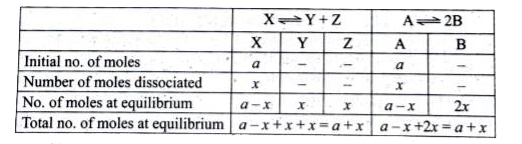 `K_(P_1)/K_(P_2) = (P_yP_z)/(P_x) XX P_A/P_B^2` `K_(P_1)/K_(P_2) = [((x/(a+x))P_1 (x/(a+x))P_1)/(((a-x))/((a+x))xxP_1)]xx[(((a-x))/((a+x))P_2)/((4x^2P_2^2)/((a+x)^2))]` `=((x^2P_1)/((a+x)(a-x)))xx(((a-x)(a+x))/(4x^2P_2))` `K_(P_1)/K_(P_2) = P_1/(4P_2)` Given that `K_(P_1)/K_(P_2) = 9/1` `:. 9.1 = P_1 /(4P_2) rArrP_1/P_2 = 36/1` |
|
| 15. |
Which are critical constant ? |
| Answer» Solution :(i) Critical TEMPERATURE `T_(C )` (ii) Critical VOLUME `V_(C )` (III) Critical pressure `P_(C )` | |
| 16. |
Which one of the followingis benzene ring deactivator |
|
Answer» `-CHO` |
|
| 17. |
What are intermolecular hydrogen bonds? Explain with example. |
|
Answer» SOLUTION :(i) Intermolecular hydrogen bonds occur between two separate molecules. They can occur between any numbers of like a UNLIKE molecules as long as hydrogen donors and acceptors are present in POSITION in which they can INTERACT (ii) For eg Intermolecular hydrogen bonds can occur between ammonia molecular ATOM, between water molecules alone or between ammonia and water 
|
|
| 18. |
What do you understand by the term 'auto-prolysis' of water ? What is its significance ? |
|
Answer» Solution :Auto-protolysis means self ionization of WATER. It may be represented as `underset("ACID"_(1))(H_(2)O(l))+ underset("Base"_(2))(H_(2)O(l))hArr underset("Acid"_(2))(H_(2)O^(+)(aq))+underset("Base"_(1))(OH^(-)(aq))` DUE to auto-protolysis , water is amphoteric in nature, i.e., it reacts with both acids and bases. It ACTS as a base towards acids STRONGER than itself and as an acid towards bases stronger than itself. For example, `underset("Acid"_(1))(H_(2)O(l))+ underset("Base"_(2))(NH_(3)(aq))hArr underset("Acid"_(2))(NH_(4)^(+)(aq))+underset("Base"_(1))(OH^(-)(aq))` `underset("Acid"_(1))(H_(2)O(l))+ underset("Base"_(2))(H_(2)S(aq))hArr underset("Acid"_(2))(H_(3)O^(+)(aq))+underset("Base"_(1))(HS^(-)(aq))` |
|
| 19. |
What is the hybridisation of the central atom in (i) H_(3)O^(+) (ii) XeF_(2) (iii) XeF_(4)? What are their shapes ? |
| Answer» SOLUTION :(i) `sp^(3) `, PYRAMIDAL (ii) `sp^(3) d,`linear (III) `sp^(3) d^(2)` , square planar. | |
| 20. |
What will be the pressure exerted by a mixture of 3.2 g of methane and 4.4 g of carbon dioxide contained in a 9 dm^(3) flask at 27 ^(@)C ? |
|
Answer» Solution :Total no. of moles (n) present in the GASEOUS mixture `=(3.2)/16 + (4.4)/44 = 0.3` `( :." mol. mass of " CH_4 = 16 " and mol. mass of " CO_2 = 44)` ACCORDING to the gas equation, `PV = nRT` `:. "" Pxx 9 = 0.3 xx 8.314 xx 10^3 xx 300` `( :. R = 8.314 xx 10^3 " Pa " dm^3 k^(-1) mol^(-1)`) or `P= (0.3 xx 8.314 xx 10^3 xx 300)/9` `=8.314xx10^4 Pa` |
|
| 21. |
Which the following reagent can not form tert- pentyl Benzene as the major product? |
|
Answer» BENZENE + 3 - Methyl 2 - butanol`OVERSET(BF_3)to` |
|
| 22. |
What is the effect of introducing an alkyl group on the stability of free radical? |
| Answer» SOLUTION :It INCREASES. | |
| 23. |
Which of the following is not formed by the addition of 1 mole of HCl to 2-methyl-1,3cyclohexadiene? |
|
Answer» 3-chloro-1-methylcyclohexene |
|
| 24. |
When Znconverts at its melting stste to its solid state,it has HCP structure, then find out the nearest number of atoms. |
|
Answer» 6 |
|
| 25. |
Which among the following has the highest volatility ? |
| Answer» Answer :B | |
| 26. |
Which of the following is not the charcteristic of ionic solids ? |
|
Answer» Very low value of electircal conductivity in the MOLTEN state. |
|
| 28. |
When a sample of Baking soda is strongly ignited in a crucible it suffered a loss in weight of 3.1g. The mass of baking soda is |
|
Answer» `16.8g` |
|
| 30. |
Which of the following contains a coordinate covalent bond ? |
| Answer» Answer :A::D | |
| 31. |
Which electron from 28 and 2p orbitals experiencing more shielding effect ? |
| Answer» SOLUTION :Electrons of 2p orbitals EXPERIENCING more SHIELDING effect than 2S. | |
| 32. |
When pentan-2-one is oxidised using conc. HNO_(3) the major product will be |
|
Answer» `n-`Butyric ACID and formic acid |
|
| 33. |
Which of the following statements are correct about the mechanism of this reaction ? |
|
Answer» A CARBOCATION will be formed as an intermediate in the reaction. |
|
| 34. |
Which is not used as a refrigerant |
|
Answer» `NH_(3)` |
|
| 35. |
Transport of oxygen by Hemoglobin in our body is …………… a reaction . |
| Answer» SOLUTION :REVERSIBLE | |
| 36. |
Which of the following dienophiles is the most reactive with buta-1,3-diene? |
|
Answer»
|
|
| 37. |
Zere witnoff's determination of active hydrogen in a compound is based upon its reaction with |
| Answer» Solution :`R-OH+CH_(3)MgI RARR CH_(4)+Mg(I)OR`. | |
| 38. |
Which of these is not a monomer for a high molecular mass silicon polymer ? |
|
Answer» `Me_(2)SiCl_(2)` |
|
| 39. |
Which nomenclature is not according to IUPAC system? |
|
Answer»
As bromo is treated as substituent. Hence, while numbering double BOND should get preference. |
|
| 40. |
Which of the following has highest octane number |
|
Answer» n-hexane |
|
| 41. |
underset(("Swollen white mass"))(Na_(2)B_(4)O_(7).XH_(2)O)overset(60^(@)C)rarr underset(("Glassy mass"))(Na_(2)B_(4)O_(7).YH_(2)O)overset(Delta)rarr Na_(2)B_(4)O_(7).ZH_(2)O overset(Delta)rarr B_(2)O_(3)+2NaBO_(2), then the valsue of (x-y+z) is |
|
Answer» `Na_(2) B_(4)O_(7) overset(Delta) rarr 2NaBO_(2) +B_(2)O_3` x = 10, y = 5 , Z = 10 x- y + z = 10 - 5 + 0 = 5 |
|
| 42. |
Which of following is not correct IUPAC name? |
|
Answer» `underset("Ethyl butanoate")(CH_(3)-CH_(2)-CH_(2)-COO-CH_(2)-CH_(3))` |
|
| 43. |
Write the state of hybridisation of carbon in the following compounds and shapes of each of the molecules (a) H_(2)C = O (b) CH_(3)F (c ) HC -= N |
|
Answer» Solution :(a) In `H_(2)C = O : SP^(2)` hybridised and CARBON shape: TRIGONAL planar (b)In `CH_(3)F: sp^(3)`hybridised and carbon shape: tetrahedral (c ) `H- C -= N : sp` hybridised and carbon shape: linear |
|
| 44. |
When sodium is dissolved in liquid ammonia, a solution of deep colour is obtained. The colour of the solution is due to |
|
Answer» 'ammoniated ELECTRON |
|
| 45. |
Which one of the following is a homogeneous catalysis ? |
|
Answer» HYDROGENATION of oils |
|
| 46. |
The structure of triphenylmethyl cation is given below . This very stable and some of its salts can be stored for months . Explain the cause of high stability of this cation . |
Answer» Solution : ` square ` In triphenylmethyl cation, DUE to RESONANCE the positve charge can MOVE at both the o- and p-positions of each benzene ring .  [ Six more structures are possible due to resonance in other two benzene rings] ` square ` TOTALLY nine resonance structures are possible for 3 benzene rings . ` square therefore ` Triphenylmethyl cation is HIGHLY stable due to these nine resonance structure . |
|
| 47. |
Which relation involve iodimetric titration? |
|
Answer» `2Na_(2)S_(2)O_(3)+I_(2)rarrNa_(2)S_(4)O_(6)+2NaI` |
|
| 48. |
The flame test with a salt P gave a brick red flame. What is the cation in P. |
|
Answer» CA |
|