Saved Bookmarks
This section includes InterviewSolutions, each offering curated multiple-choice questions to sharpen your knowledge and support exam preparation. Choose a topic below to get started.
| 85901. |
Account for the following: (i) In the series Sc to Zn, the enthalpy of atomisation of zinc is the lowest. (ii) The E^0 value for the Mn^(3+)//Mn^(2+) couple is much more positive than that for Cr^(3+)//Cr^(2+). |
|
Answer» Solution :(i) In the series Sc to Zn, the enthalpy of atomisation DECREASES from left to right. ZINC has fully filled 3d sub shell with inter atomic electronic bonding is weakest in Zn. Therefore zinc has lowest enthalpy of atomisation. (ii) In the electrochemical series, the SUBSTANCE are ARRANGED in the increasing order of reduction potential. The`E^0` for `MN^(3+)//Mn^(2+)` is more positive than Eo for `Cr^(3+)//Cr^(2+)`, because Mn has greater tendency to get reduced as compared to Cr. This is why Mn is below Cr in electrochemical series. |
|
| 85902. |
Account for the following : (i) IC l is more reactive than I_(2). (ii) Fluorine never acts as the central atom in polyatomic interhalogen compounds. (iii) Halogens are strong oxidising agents. |
|
Answer» Solution :(i) `IC l` is more reactive than `I_(2)` : It is because `I-Cl` bond is comparatively WEAKER than `I-I` Bond. (ii) Fluorine never acts as the CENTRAL atom in polyatomic interhalogen compounds because of its high electronegativity and high ioonisation energy. (iii) Halogens are strong oxidizing agents because they are only one electron less to ATTAIN noble gas configuration. THUS, they EASILY accept electrons to form halide ions. |
|
| 85903. |
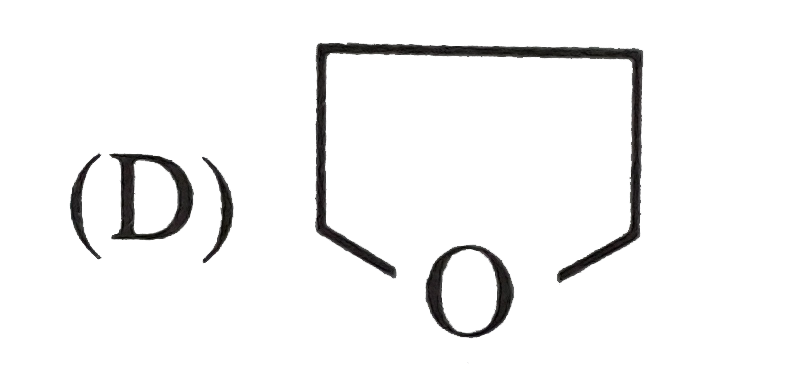
Account for the following : (i) Ethers have significant dipole moments. (ii) Ethers have lower boiling points than the corresponding isomeric alcohols but approximately equal to a paraffin with similar molecular mass structure. (iii) HI is better reagent than HBr for cleavage of ethers. (iv) Why a non-symmetrical ether is not prepared by heating a mixture of ROH and R'OH in acid ? (v) Why is it possible to prepare tertiary butyl ethyl ether in good yield by heating tertiar butanol and ethanol ? (vi) Ether are soluble in conc. H_(2)SO_94) but ethers separate out from the solution on addition of water. (vii) Why id diethyl ether used as a solvent for (i) BF_(3) and (ii) RMgBr ? (viii) Sometimes explosion occrs during distillation of an ether sample. (ix) Why [(CH_(3))_(3)C]_(2)O cannotbe prepared either by Williamson's reaction or by dehydration of tertiary butyalcohol ? (x) Why ArO-R ethers are clearved with HI togive RI and ArOH rather than ArI and R-OH ? (xi) Which of the following is the correct method for synthesising methyl tert-butyl ether and why ? (a) (CH_(3))_(3)C-Br+NaOMe rarr (b) CH_(3)+NaO -T-Bu rarr (xii) 2,2-Dimethyl oxirane can be cleaved by acid (H^(+)) . Write mechanism. (xiii) Write the equations of the reaction of hydrogen iodide with : (i) 1-Propoxypropane (ii) Methyoxybenzene 9iii) Benzyl ethyl ether |
|
Answer» Solution :(i) Ethers are weakly polar. The C-O-C bond angle is about 383K and the C-O moments do not CANCEL each other . (ii) ROH molecules have strong intermolecular attractive forces because of hydrogen bonding that is absent in ethers having two polarity. Hence, the boiling points of ethers are low. (iii) HI is a stronger acid than HBr and thus, oxonium salt is readily formedwith greater yields. `I^(-)` is also a better nucleophile than `Br^(-)` in `S_(N^(2))` reaction. (iv) A mixture of three ethers, `R-O-R,R'-O-R'` and `R-O-R'` is obtained. (v) When one alcohol is `3^(@)`, the oxonoium ion easily loses water to FORM carbocation, whichis solvated by `2^(@)` or `1^(@)` alcohol to form mixed ether. `Mg_(3)COoverset(+)(H_(2))underset((-H_(2)O))(rarr)Me_(3)overset(+)(C) underset(-H^(+))overset(HOCH_(2)CH_(3))(rarr)Me_(3)C-O-CH_(2)CH_(3)`. (vi) Water is a stronger base than ether and REMOVES the proton from `R_(2)OH^(+)` `R_(2)OH^(+)+H_(2)O rarr R_(2)O +H_(3)^(+)O` (viii) Ethers form peroxide with oxygen. The boiling point of peroxide is higher than that of ether . It is, thus, left as residue in the distillation of ether which is very unstable and decomposes violently on heating . (ix) The product in both the cases is isoubutylene as the tert-butyl carbocation elemination an `H^(+)`. The reaction between `(CH_(3))_(3)overset(+)(C)` on `(CH_(3))_(3)COH` to give an ether is sterically hindered. The instability of di-, tert-butyl ether in sulhuric acid may also be due to steric crowding of `CH_(3)` groups ? (xi) The ether FORMATION involves nucleophilic SUBSTITUTION of alkoxide ion for halide ion. `3^(@)` alkyl halide can also involve elimination of HX to give alkene in the presence of a base. So, it is better to start with `3^(@)` alkoxide and `1^(@)` alkyl halide, i.e., equation (b). (xii) The oxirane ring is cleaved via `S_(N^(2))` mechanism. ![]()
|
|
| 85904. |
Account for the following: (i) Formaldehyde gives Cannizzaro's reaction whereas acetaldehyde does not. (ii) Carboxylic acids do not give characteristic reactions of carbonyl group. |
|
Answer» Solution :(i) Fromaldehyde does not have a -HYDROGEN atom, THEREFORE , it gives Cannizzaro.s reaction. Acetaldehyde has a hydrogen atom, therefore, it cannot undergo Cannizzaro.s reaction. (ii) Due to resonance , carboxylic acids do not give the tests of carbonyl group. The position of the carbonyl group keeps CHANGING. |
|
| 85905. |
Account for the following : (i) Ferric hydroxide is positively charged. (ii) The extent of physical adsorption decreases with rise in temperature. (iii) A delta is formed at the point where the river enters the sea water. |
| Answer» | |
| 85906. |
Account for the following: (i) Ethanal is more reactive towards nucleophilic addition reactions than propanone. or CH_(3)CHO is more reactive than CH_(3)COCH_(3). (ii) Di-tert-butyl ketone does not give a NaHSO_(3) adduct but acetone does. |
|
Answer» Solution :Due to steric hindrance CAUSED by the bulky tert-butyl groups, the BISULPHITE ion cannot easily approach the carbonyl group for addition. (iii) Aldehyes are more reactive than ketones towards NUCLEOPHILIC addition reaction. (IV) HCHO reacts with HCN faster than `CH_(3)CHO` (v) Benzaldehye is less reactive than acetaldehyde towards nucleophilic addition reaction. |
|
| 85907. |
Account for the following : (i) Electrophilic substitution in aromaticamines takes place more readily then benzene. (ii) Nitro compounds have higher boiling points than hydrcarbons having almost same molecular mass. |
|
Answer» Solution :`-NH_(2)` is ERG, electrophilic substitution TAKES PLACE faster. (ii) Nitro compounds are more POLAR than hydrocarbons therefore have more van der Waal.s FORCES of attraction. |
|
| 85908. |
Account for the following : (i) Diazonium salts of aromatic amines are more stable than those of aliphatic amines. (ii) Amines are more basic than alcohols of comparable molecular masses. |
Answer» SOLUTION :(i) Diazonium SALTS of aromatic amines are more stable than those of aliphatic amines due to DISPERSAL of the POSITIVE charge on the benzene ring as shown below : (ii) Amines are more BASIC than alcohols of comparable molecular masses : `R-overset(..)underset(H)underset(|)(N)-H"" R-overset(..)underset(..)O-H` |
|
| 85909. |
Account for the following: (i) Cu^(+) ions are not stable in aqueous solution. (ii) Most of the transition metal ions exhibit paramagnetic behaviour. |
|
Answer» Solution :(i) `Cu^(+)` is unstable in aqueous solution due to lower hydration energy and higher REDUCTION potential. (ii) The transition elements involve the partial filling of d-subshells. Most of the transition METAL ions have unpaired electrons in d-subshell (from `d^(1 to 10)` ) and THEREFORE they GIVE RISE to paramagnetic character. |
|
| 85910. |
Account for the following (i) CI – CH_2COOH is a stronger acid than CH_3COOH(ii) Carboxylic acids do not give reactions of carbonyl group. |
|
Answer» Solution : (i) Monochloroacetic acid is comparatively stronger acid than acetic acid. This is due to -CI as a -I GROUP (ii) CARBOXYLIC acids do not give REACTIONS of carbonyl group because the lone pair of electrons on the oxygen attached to HYDROGEN in the – COOH group are involved in resonance, which makes the carbon less electrophilic. |
|
| 85911. |
Account for the following : (i) Bi(V) is a stronger oxidizing agent than Sb(V). (ii) N-N single bond is weaker than P-P single bond. (iii) Noble gases have very low boiling points. |
|
Answer» Solution :(i) Because the presence of f - orbital electrons, BI is more stable in `+3` OXIDATION state than that of Sb. (ii) Because of interelectronic repulsion showing to small bond length of `N-N`/smaller SIZE of nitrogen atom. (iii) Because of weak dispersion FORCES. |
|
| 85912. |
Account for the following: (i) Aspirin drug helps in the prevention of heart attack. , (ii) Diabetic patients are advised to take artificial sweeteners instead of natural sweeteners. ,(iii) Detergents are non-biodegradable while soaps are biodegradable. |
|
Answer» Solution :(i)Most of the heart attacks are due to blood clotting in the coronary arteries. Aspirin helps to make the blood thinner and THUS prevents the FORMATION of blood clots in the coronary arteries thereby preventing heart attacks. (ii)Diabetic patients do not produce enough insulin to metabolize the natural sugar. As a result, sugar remains in the blood and thus affects, liver, heart and kidneys. Therefore, diabetic patients are advised to take artificial sweeteners such as SACCHARIN. It is not metabolized in the body and is excreted as such through URINE without affecting the heart, liver and kidneys. (c )Soaps have straight hydrocarbon chains which are easily degraded by bacteria PRESENT in the sewage water and hence do not cause water pollution, aspartame. Most of the detergents, on the other hand, have branched hydrocarbon chains which are either not attacked or attacked only slowly by bacteria. As a result, detergents remain undegraded in rivers and waterways and thus cause water pollution. |
|
| 85913. |
Account for the following : (i) Aniline is weaker base than methylamine. (ii) Aryl cyanides cannot be formed by the reaction of aryl halides and sodium cyanide. |
|
Answer» Solution :(i) ANILINE is weaker base than methylamine because `C_(6)H_(5)-`group is electron withdrawing in aniline whereas `CH_(3)-`group is electron releasing in methylamine. MOREOVER, lone pair of ELECTRONS on N in aniline is delocalised DUE to resonance with benzene ring. This reduces electron density on amino group in aniline. It is due to double bond CHARACTER between `C underset("_________")(---)Cl` bond in aryl halide which cannot be broken easily. Therefore, -Cl cannot be easily replaced by -CN to get aryl cyanide. |
|
| 85914. |
Account for the following: (i) Aniline does not undergo Friedel -crafts reaction: ii. Diazonium slats of aromatic amines are more stable than those of aliphatic amines iii. pK_(b) of aniline is more tan that of methylamine iv. Gabriel phthalimide synthesis is preferred for synthesising primary amines. v. Ethylamine is soluble in water whereas aniline is not vi. Amines are more basic than amides vii. Although amino group is o- and p- directing in aromatic electrophilic susbtitution reactions, aniline on nitration gives a susbstantial amount of m-nitroaniline. |
Answer» Solution :(i) Aniline does not undergo Friedel -Crafts reaction: Due to presence of a positive charge on N-atom in the salt the group `overset(+)(N)H_(2)AlCl_(3)^(-)` ACTS as a strongly deactivating group. As a result, it reduces the electron density inteh benzene ring and which inhibits the electrophilic substitution reaction. Therefore, aniline does not under go Friedel-Crafts reaction. (ii) Diazonium salts of aromatic amines are more stable than those of aliphatic amines due to dispersal of the positive charge on the benzene ring as shown below: (iii) `pK_(b)` of aniline is more than that of methylamine: In aniline, the lone pair of electrons on the N-atom is decolized over the benzene ring. AS a result electron density on the nitrogen decreases. In contract in `CH_(3)NH_(2),+I` effect of `CH_(3)` increases the electron density on the N-atom. Therefore, aniline is a weaker base then methylamine and hence its `pK_(b)` value is more than that of methylamine. (iv) Gabriel phthalimide synthesis is preferred for synthesising primary amines: Gabriel phthalimide reaction gives pure `1^(@)`- amine without any contamination of `2^(@)` and `3^(@)-` amines. Threfore it is preferred for synthesisting priamry amines. v. Ethylamine is soluble in water whereas aniline is not: Ethylamine when added to water forms intermolecular H-bonds with water. And therefore it is soluble in water. But aniline does not form H-bond with water to a very large extent due to the presence of a large hydrophobic `-C_(6)H_(5)` group. Hence, aniline is insoluble in water. (vi). Amines are more basic than amides: In simple amines, the lone pair of electrons in on nitrogen and hence available for protonation. In amides on the other hand, the electron pair on nitrogen is delocalised to the carboxyl oxygen through resonance and thus, it is not available for protonation. so amines are more basic than amides. (vii) Although amino group is o- and p- directing in aromatic electrophilic substitution reactions, aniline on nitration gives a substantial amount of m- nitroaniline. Nitration is usually carried out with mixture of conc `HNO_(3)` and CON `H_(2)SO_(4)`.IN the presence of these ACIDS, most of aniline gets protonated to form anilium ion. Therefore, in the presence of acids, the reaction mixture consists of aniline and anilinium ion. Now `-NH_(2)` group in aniline is `O_(2)` P- directing and ACTIVATING while the `-NH_(3)` group is anilinium ion ismeta- directing and deactivating. Whereas nitration of anilien (due to steric hindrance at o- position) mainly gives p-nitroaniline, the nitration of anilinium ion gives m-nitro aniline. In actual practice, APPROXIMATELY a 1:1 mixture of P and m- nitroaniline is formed.
|
|
| 85915. |
Account for the following : (i) Aniline does not give friedel crafts reaction (ii) Ethylamine is solubelin water wheras aniline isnot (iii) Pk_(b) of methyalmine is les than of aniline |
|
Answer» Solution :(i) Aniline being a lewis base reacts with lewis acid `AICI_(3)` to form as solt `C_(6)H_(5)NH_(2)+AICI_(3)rarrC_(6)H_(5)N^(+)H_(2)AICI_(3)` As a resutl N of aniline acquires + ve charge and hence itacts a strong deacitvating GROUP for ELECTROPHILIC substitution reaction . consequently anilne does not undergo friedn crafts reaction . (ii) Ethylamine forms inter molecular H-bonding wiht water where as aniline LARGER is the hydorphobic part lkes is the extent of H Bonding hecne not soluble (iii) As methyl group is electron donating group which increases the electrons density hence more basic wheres the ELECTONS density on aniline decreases due to resonance hence made PKb value |
|
| 85916. |
Account for the following : (i) Ammonia is more basic than phosphine. (ii) Elements of Group - 16 generally show lower value of first ionisation enthalpy compared to the elements in the corresponding periods of Group - 15. (iii) Electron pair gain enthalpy with (-)ve sign for fluorine is less than that for chlorine. |
|
Answer» <P> Solution :Ammonia is more basic than `PH_(3)` : This is becuase of small size of NITROGEN, electron pairs are crowded in a small REGION and more available, whereas in `PH_(3)`, the electrons are more diffused due to large size of phosphorus hence less available.(ii) Elements of group - 16 generally show LOWER value of first ionisation enthalpy as COMPARED to the elements in corresponding periods of group - 15. This is because group - 15 members have `ns^(2)np^(3)` configuration, due to half filled p - orbital, they are more stable , hence greater ionisation enthalpy. (iii) Electron pair gain enthalpy with negative sign high for fluorine is less than that of chlorine : When an extra electron is added to fluorine repulsion occurs and energy released is less or electron gain enthalpy is less negative in comparison to chlorine, which is due to small size of 2p orbital of fluorine in comparison to 3p orbital of chlorine. |
|
| 85917. |
Account for the following: (i) Acidic character increases from HF to HI. (ii) There is large difference between the melting and boiling points of oxygen and sulphur. (iii) Nitrogen does not form pentahalides |
|
Answer» Solution :(i) Acidic character increases from HF to HI. This is because the stability of these halides decreases down the GROUP due to decrease in bond dissociation enthalpy in the ORDER : `H-F GT H-Cl gt H-Br gt H-I` Therefore the acidic character follows the order : `H-F lt H- cl lt H- Br lt H-I` (ii) Large difference in the melting and boiling points of oxygen and sulphur can be explained on the basis of their atomicity. Oxygen exists as diatomic molecule `(O_2)` with only weak van DER Waal.s forces between them whereas sulphur exists as polyatomic molecule `(S_8)` which have stronger forces of attraction between these polyatomic molecules. (iii) Nitrogen has the electronic configuration There are no d-orbitals in the second shell, therefore, nitrogen cannot expand its covalency BEYOND + 3. Hence, pentahalide formation is not possible |
|
| 85918. |
Account for the following : (i) A small amount of ethyl alcohol is added to CHCl3 stored for use as an anaesthetic. (ii) After using C Cl_(4) as a fire extinguisher inside a closed space, the space is thoroughly ventilated. (iii) When 2-chloro-3-methylbutane is treated with alcoholic potash, 2-methyl-2-butene is the main product. |
|
Answer» (ii) To sweep out `COCl_(2)` formed by `C Cl_(4)` vapour and `H_(2)O` vapour. (iii) SAYTZEFF rule. |
|
| 85919. |
Account for the following: Helium is used in diving apparatus. |
| Answer» Solution :Helium is used in DIVING APPARATUS because it acts as a diluent for oxygen because of its very low SOLUBILITY in BLOOD. | |
| 85920. |
Account for the following : H_3PO_2 and H_3PO_3 act as good reducing agents while H_3PO_4 does not. |
| Answer» Solution :Oxidation state of P in `H_3PO_2` is +1 , it can changeto higher oxidation STATES +3 and +5 . THEREFORE , it can act as REDUCING agent . Oxidation state of P in `H_3PO_3` is +3 , it can change to higher oxidation state +5 . Therefore , it can act as reducing agent . Oxidation state of P in `H_3PO_4` is +5 . Therefore , it can act as reducing agent. oxidation state of P in `H_3PO_4` is +5 . It is the highest . Therefore , it cannot act as a reducing agent. | |
| 85921. |
Account for the following : Gabriel phthalimide synthesis is preferred for synthesising primary amines. |
| Answer» Solution :Gabriel phthalimide reaction gives pure PRIMARY AMINES without any contamination of secondary and TERTIARY amines. THEREFORE, it is preferred for synthesising primary amines. | |
| 85922. |
Account for the following : For a strong electrolyte molar conductivity decreases as concentration increases. |
|
Answer» SOLUTION :(i) For a strong electrolyte, at high concentration, the number of constituent ions of the electrolyte in a given volume is high and hence the attractive force between the oppositely charged ions is also high. (ii) Moreover the ions also EXPERIENCE a VISCOUS drag due to greater solvation. (iii) These FACTORS attribute for the low molar conductivity at high concentration. |
|
| 85923. |
Write short notes on the following Gabriel phthalimide synthesis |
| Answer» Solution :Gabriel phthalimide synthesis results in the formation of `1^(@)` AMINE only. `2^(@)" and "3^(@)` amine are not formed by this synthesis. Thus PURE primary amine can be obtained. Therefore Gabriel phthalimide synthesis is prefered for synthesizing primary amines. | |
| 85924. |
Account for the following facts : The reduction of Cr_(2)O_(3) with Al is thermodynamically feasible, yet it does not occur at room temperature. |
| Answer» SOLUTION :This is DUE to lack of DIFFUSION of METAL through the mass in the solid state at ROOM temperature. | |
| 85925. |
Account for the following:Fluorine shows only-1 oxidation state. |
| Answer» Solution :FLUORINE is the most electronegative ELEMENT and so it SHOWS only-1 OXIDATION STATE. | |
| 85926. |
Account for the following: Fluorine does not exhibit positive oxidation state. |
| Answer» Solution : Fluorine does not EXHIBIT positive oxidation STATE because it has the HIGHEST electronegativity and has no TENDENCY to lose the electrons. | |
| 85927. |
Account for the following facts : The reduction of a metal oxide is easier if the metal formed is in the liquid state at the temperature of reduction. |
| Answer» Solution :If the metal is formed in the liquid state at the TEMPERATURE of reduction, the reduction of metal oxide BECOMES easier as there is greater ENTROPY and the diffusion of metal through the MASS takes place repidly. | |
| 85928. |
Account for the following facts : Pine oil is used in froth floatation method. |
| Answer» SOLUTION :Pine oil WETS the SULPHIDE ore and stabilisesthe FROTH. | |
| 85929. |
Account for the following facts: (a)The reduction of a metal oxide is easier if the metal formed is in liquid state at the temprature of reduction. (b)The reduction of Cr_(2)O_(3) with Al is thermodynamically feasible ,yet it does not occur at room temprature. (c )Pine oil is used in forth floatation method. |
|
Answer» Solution :(a)In liquid state entropy is HIGHER than the solid form ,this makes`Delta_(R)G` more negative. (b)By increasing the TEMPRATURE ,FRACTION of activated molecules icreases ,which helps in crossing over the energy barrier. (C ) PINE oil enhances the non-wetting property of the ore particles and also acts as the froth collector: |
|
| 85930. |
Account for the following : Ethylamine is soluble in water whereas aniline is not. |
Answer» Solution :ETHYLAMINE dissolves in water due to INTERMOLECULAR H-bonding as shown below : HOWEVER, in aniline, due to the LARGE hydrophobic hydrocarbon part, the extent of H-bonding decreases considerably and HENCE aniline is insoluble in water. |
|
| 85931. |
Account for the following fact. The reduction of a metal oxide is easier if the metal is formed in the liquid state at the temperature of reduction. |
| Answer» Solution :Entropy is higher when a METAL is in the liquid state than when it is in the solid state. Therefore, the value of entropy change (`Delta`S) of the reduction process is more on the +ve side when the metal formed is in the liquid state and the metal oxide being reduced is in the solid state. SINCE the value of T`Delta ` S INCREASES and that of `Delta ` H remains constant, therefore, the value of `Delta_rG^(@) (DeltaG = DeltaH-TDeltaS)` becomes more-ve and HENCE the reduction becomes easier. | |
| 85932. |
Ethylamine is soluble in water whereas aniline is not . Give reason. |
| Answer» SOLUTION :Ethyl amine is soluble in WATER as it forms intermolecular hydrogen bonds with water. But aniline does not form hydrogen bond with water to a very large EXTENT due to the presence of large hydrophobic `-C_6H_5` GROUP. Hence aniline is INSOLUBLE in water. | |
| 85933. |
Account for the following: Electrophilic substitution reactions in case of aromatic amines take place more readily as compared to benzene |
| Answer» SOLUTION :To REDUCE the ACTIVATING EFFECT of `NH_2` GROUP. | |
| 85934. |
Electrophilic substitution in case of aromatic amines takes place more readily than in benzene. |
| Answer» SOLUTION :To REDUCE the ACTIVATING EFFECT of `NH_2` GROUP. | |
| 85935. |
Account for the following Diazonium salts of aromatic amines are more stable than those of aliphatic amines. |
Answer» Solution :The stability of arenze DIAZONIUM salt is due to the dispersal of the POSITIVE charge over the BENZENE ring. Resonance stabilised diazonium ION is further stabilised by the INVOLVEMENT of the benzene ring. So C - N in anyl diazonium salt is stronger than that in aliphatic diazonium salt. |
|
| 85936. |
Account for the following : Diazonium salts of aromatic amines are more stable than those of aliphatic amines. |
Answer» Solution :The DIAZONIUM SALTS of aromatic amines are more stable than those of aliphatic amines DUE to delocalisation of the positive CHARGE on the BENZENE ring as shown below by the resonating structures :
|
|
| 85937. |
Account for the following : Chlorine water has both oxidising and bleaching properties. |
|
Answer» SOLUTION :Chlorine produces nascent oxygen in aqueous solution. `Cl_2 + H_2O to HCl + HClO` `HClO to HCl + [O]` Nascent oxygen brings about both oxidation and BLEACHING . It bleaches by oxidation DYE + [O] ` to` Colourless SUBSTANCE. |
|
| 85938. |
Account for the following : CH_3CH_2NH_2 is more basic than CH_3CONH_2. |
|
Answer» SOLUTION :(a) RESONANCE and inductive EFFECT POSSIBLE in acetamide involving the non bonding pair of electrons on the nitrogen atom. (B) Another important factor is that amides contaning a powerful elctron is not readily available for donation and it is less basic. (c) Thus ethylamine is more basic than acetamide. |
|
| 85939. |
Account for the following : (CH_3)_2NH is stronger base than NH_3. |
|
Answer» Solution :(a) `(CH_3)_2NH` (Secondary AMINE) is a stronger BASE than `NH_3` (AMMONIA). (B) In DIMETHYLAMINE, the methyl group with +I effects trends to increase the electron density on the nitrogen atom. |
|
| 85940. |
Account for the following : (c) Ce^(+3) can be easily oxidized to Ce^(+4) |
| Answer» SOLUTION :(C) DUE to GAIN noble gas electron configuration. | |
| 85941. |
Account for the following:Bond dissociation energy of F_2 is less than that of Cl_2. |
|
Answer» <P> Solution :Bond dissociation ENERGY of ` F_2` is less than that of `Cl_2` due to inter electronic repulsions in small size FLUORINE atoms. Chlorine has a large value of bond dissociation energy because of the possibility of multiple `p pi - dpi ` back BONDING involving filled p-orbitals and the vacant d-orbital. |
|
| 85942. |
Account for the following : (b) The Ist ionization energy of the 5d series are higher than 3d and 4d,transition elements in respective groups. |
| Answer» SOLUTION :(b) DUE to lanthanide contraction, effective NUCLEAR CHARGE INCREASE. | |
| 85943. |
Account for the following : Aniline is less basic than Ethyl amine. |
|
Answer» Solution :(a) The LONE pair of electrons on the nitrogen atom of aniline is involved in resonance and is not easily AVAILABLE for donation to protons. (b) The POSITIVE charge on nitrogen makes protonation difficult. Thus aniline is LESS basic than ethylamine. |
|
| 85944. |
Account for the following : Aniline is a weaker base compared to ethanamine. |
Answer» Solution :Aniline is a weaker base compared to ethanamine : The lone PAIR of ELECTRONS takes part in RESONANCE with the benzene ring. The electrons are not available on NITROGEN. Therefore aniline is a weaker base. |
|
| 85945. |
Account for the following : Aniline does not undergo Friedel-Crafts reaction. |
Answer» Solution :Aniline being a Lewis base reacts with Lewis ACID `AlCl_(3)`, which is used as a catalyst in Friedel-Crafts reaction to FORM a salt. As a result, N of aniline ACQUIRES +ve charge and hence it ACTS a strong deactivating group for electrophilic substitution reaction. CONSEQUENTLY, aniline does not undergo Friedel-Crafts reaction. |
|
| 85946. |
Aniline does not undergo Friedel - Crafts reaction. Explain. |
| Answer» Solution :ANILINE does not under GO FRIEDEL - Crafts reaction (alkylation and acetylation ) SINCE aniline is basic in nature and it donates its lone pair to the lewis acid `AlCl_3` to form an adduct which INHIBITS further the electrophilic substitution reaction. | |
| 85947. |
Account for the following : Aniline does not undergo Friedel - Crafts reaction. |
| Answer» Solution :Aniline does not UNDERGO Friedel - Crafts reaction : Anhydrous `AlCl_(3)` USED in the Friedel-Crafts reaction REACTS with aniline and is THEREFORE not available for the reaction. | |
| 85948. |
Account for the following : Ammonolysis of alkyl halide does not give a corresponding amine in pure state. |
|
Answer» |
|
| 85949. |
Account for the following: Amines are basic while amides are neutral |
| Answer» Solution :Amides have ELECTRON withdrawing `-OVERSET(O) overset(।। )C-` group ATTACHED to `NH_2` group. | |
| 85950. |
Account for the following Amines are more basic than amides. |
| Answer» Solution :In ALKYL amine, the lone PAIR of electrons is localised on the nitrogen. However, the lone pair of electron on amide is delocalised between the nitrogen and OXYGEN through resonance. This makes amides LESS basic compared to AMINES. | |