This section includes InterviewSolutions, each offering curated multiple-choice questions to sharpen your knowledge and support exam preparation. Choose a topic below to get started.
| 86451. |
A white sodium salt dissolves readily in water to give a solution which is neutral to litmus. When silver nitrate solution is added to the solution, a white precipitated is formed which does not dissolve I dilute nitric acid. The anion could be |
|
Answer» `SO_(4)^(2-)` `underset((aq))(NaCl)+underset((aq))(AgNO_(3))tounderset("white ppt")(AgCl) underset(dil)overset(HNO_(3))to`Insoluble. |
|
| 86452. |
A white sodium salt dissolves in water to give a solution which is neutral to litmus.When silver nitrate solution is added to the solution, a white precipitate is obtained which does not dissolve in dilute HNO_(3).The anion is |
|
Answer» `CO_(3)^(2-)` `Ag_(2)CO_(3)` and `Ag_(2)SO_(3)` dissolves in dilute `HNO_(3)` LIBERATING `CO_(2)` and `SO_(2)` respectively. Both `Ag_(2)CO_(3)` and `Ag_(2)SO_(3)` are white.`AGCL` is white but INSOLUBLE in dilute `HNO_(3)``NaCl` solutionisnetural to litmus as it is a salt of strong acid andstrongbase. |
|
| 86453. |
A white salt turns yellow on heating but becomes white on cooling. It may be a salt of |
|
Answer» Fe |
|
| 86454. |
A white salt is readily soluble in water and gives a colourless solution with a pH of about 9. The salt would be |
|
Answer» `(NH_4)_2CO_3` |
|
| 86455. |
A white salt is readily soluble in water and gives a colourless solution with a pH of a about 9. The salt would be |
|
Answer» `NH_(4)NO_(3)` |
|
| 86456. |
A white salt is insoluble in cold water but soluble in boiling water. Its solution when treated with potassium chromate solution gives yellow precipitate. The salt may be : |
|
Answer» `BaCl_(2)` |
|
| 86457. |
A white precipitate was formed slowly when AgNO_(3) was added to a compound (A) with molecular formula C_(6)H_(13)Cl. Compound A on treatment with hot alcoholic KOH gave a mixture of two isomeric normal alkenes (B) and (C) having formula C_(6)H_(12). The mixture (B) and (C) on ozonolysis furnished four compounds. what are A, B and C. |
Answer» Solution :From the molecular formula it is clear that compound is SATURATED alkyl halide. On treatment with alcoholic KOH, H-forms mixture of TWO normal ALKENES. It means halogen is not at TERMINAL carbon and the alkyl chloride contains long chain of carbon atoms. two possible alkene mixtures. But the second mixture of alkenes cannot give four different compounds on ozonolysis. hence the structure and reaction are:
|
|
| 86458. |
(A) White precipitate of silver chloride gets dissolved in NH_(4)OH solution. (R ) NH_(3) reacts with AgCl to form a soluble complex with formula [Ag(NH_(3))_(2)]Cl. |
|
Answer» Both (A) and (R ) are true and (R ) is the correct explanation of (A) |
|
| 86459. |
A white precipitate of AgCl dissolves in excess of : (I)NH_(3)(aq)(II)Na_(2)S_(2)O_(3)(III)NaCN |
|
Answer» III only |
|
| 86460. |
A white precipitate is obtained when a solution is diluted with H_(2)O and boiled.On addition of excess NH_(4)Cl//NH_(4)OH, the volume of precipitate decrease leaving behind a white gelationous precipitate. Identify the precipitate which dissolves in ammonia solution or NH_(4)Cl |
|
Answer» `AL(OH)_(3)` |
|
| 86461. |
A white precipitate obtained on hydrolysis of |
| Answer» Answer :C | |
| 86462. |
A white precipitate is obtained when |
|
Answer» a SOLUTION of `BaCl_(2)` is treated with one of `Na_(2)SO_(3)` |
|
| 86463. |
A white precipitate is obtained when: |
|
Answer» a solution of `BaCl_(2)` is treated with `Na_(2)SO_(3)` |
|
| 86464. |
A white precipitate is obtained on hydrolysis of: |
|
Answer» `PCl_5` |
|
| 86465. |
A whiteprecipitate insolublein cone HNO_(3) is formed when aqueous solution of X NaOHtreated with bariumchlorid and bromic water .The X is |
|
Answer» `SO_(3)` `Na_(2)SO_(3) + BaCI_(2) rarr BaSO_(4) + 2NaCI` `Br_(2) + H_(2)O rarr 2HBr + [O]` `BaSO_(3)+[O]rarrunderset("Whiteppt.(insoluble in conc."HNO_(3))(BaSO_(4))` |
|
| 86466. |
A whitepptobtainedin the anylsis of amixturebecomesblackon treatment with NH_(4)OH itmay be |
|
Answer» `Hg_(2)CI_(2)` |
|
| 86467. |
A white ppt obtained in the analysisof a mixturebecomesblackon treatmentwithNH_(3) or NH_(4)OHdue tothe formationof finelydividedHg and Hg (NH_(2))CI i.e. [Hg+Hg (NH_(2))CI] The salt may be |
|
Answer» `PbCI_(2)` |
|
| 86468. |
A white ppt obtained in a analysis of a mixture becomes black on treatment with NH_(4)OH. It may be- |
|
Answer» `PbCl_(2)` |
|
| 86469. |
A white ppt , is obtainned when |
|
Answer» A solution of `BaCl_(2)` is treated with `Na_(2)CO_(3)` |
|
| 86470. |
A white powder when strongly heated gives off brown fumes. A solution of this powder gives as yellow precipitate with a solutin of KI. When a solution of barium chloride is added to a solution of powder, a white precipitate results. This white powder may be |
| Answer» Answer :D | |
| 86471. |
A white powder when strongly heated gives off brown fumes. A solution of this powder gives a yellow precipitate with a solution of Kl. When a solution of barium chloride is added to a solution of powder, a white precipitate results. This white powder may be |
|
Answer» a soluble sulphate `AgNO_(3)+"Kl"tounderset("YELLOW ppt.")(Agl+)KNO_(3)` `AgNO_(3)+BaCl_(2)tounderset("Whitw ppt.")(AGCL+)BaNO_(3)` Hence,(D) is the correct answer. |
|
| 86472. |
A white powder whenstrongly heated givesoff brown forms A solution of thispowder gives a yellow precipitate with a solution of KI when a solution of burium choloride is added to a solution a solution of powder a white precipitate results .Thiswhite powder may be |
|
Answer» A solution SULPHATE `AgNO_(3) +KI rarr AgI + KNO_(3)` `BaCI_(2) + 2ANO_(3) rarr 2AgCI + Ba(NO_(3))_(3)` |
|
| 86473. |
A white powder solid A forms a light green solution with water, which one treatment with potassium hexacyanoferrate (III) gives a blue precipitate. On being strongly heated. A leaves a brown residue and forms a mixture off two gaseous oxides, which turns a dichromate solution green and forms a white precipitate with a BaCl_(2) solutio containing concentrated HCl. A is: |
|
Answer» `CuSO_(4)` |
|
| 86474. |
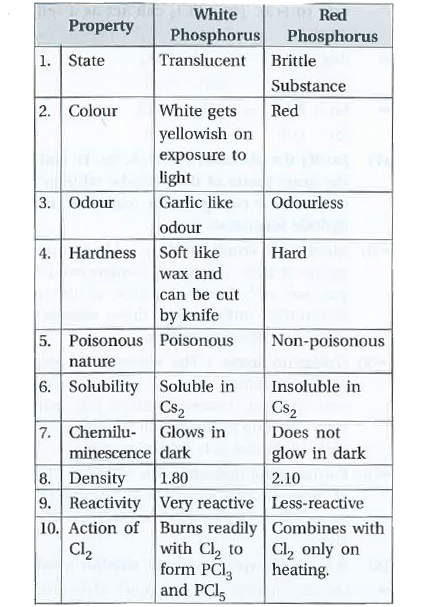
(A) White phosphorous is more reactive than Red P (R ) White phosphorous possesses high bond angle strain of 60^(@) |
|
Answer» Both (A) and (R ) are TRUE and (R ) is the CORRECT EXPLANATION of (A) |
|
| 86475. |
A white crystalline substance dissolves in water.On passing H_(2)S in this solution, a black precipitate is obtained.The black precipitate dissolves completely in hot HNO_(3).On adding a few drops of concentrated H_(2)SO_(4), a white precipitate is obtained which is soluble in ammonium acetate.The white precipitate is that of , |
|
Answer» `BaSO_(4)` `Pb^(2+)+S^(2+)to PbS darr ("black"),3PbS darr+8HNO_(3) to 3Pb^(2+)+6NO_(3)^(-) + 3S darr+2NO+4H_(2)O` `Pb^(2+) +SO_(4)^(2-) to PbSO_(4) darr` (white) `PbSO_(4)+2CH_(3)COONH_(4) to (CH_(3)COO)_(2)Pb+(NH_(4))_(2)SO_(4)` `BaS` and `SrS` precipitates are not black in colour.`Ag_(2)SO_(4)` is white precipitate but does not DISSOLVE in ammonium acetate. |
|
| 86476. |
A white metal sulphide soluble in wateris |
| Answer» Solution :Alkali metal SALTS are WATER solution | |
| 86477. |
A white crystallises salt imparts a violet colour to a Bunsen flame, and with hot concentrated H_(2)SO_(4), forms a pungent gas. On treatment with an AgNO_(3) solution, this gas forms a white precipitate readily soluble in NH_(3). The white crystalline salt may be |
|
Answer» `Na_(2)SO_(4)` |
|
| 86478. |
A white crystalline substance dissolves in water. On passing H_(2)S in this solution, a black precipitate is obtained. The black drops of conc. H_(2)SO_(4) a white precipitate is obtained. This precipitate is that of |
|
Answer» `BaSO_(4)` `3PbS+8HNO_(3)to3Pb(NO_(3))_(2)+2NO+3S+4H_(2)O` `Pb(NO_(3))_(2)+H_(2)SO_(4)to underset(("white ppt."))(PbSO_(4))darr+2HNO_(3)uarr` |
|
| 86479. |
A white crystalline solid A on boiling with caustic soda solution gave a colourless gas B which when passed through an alkaline solution of potassium mercurio iodide gave a brown ppt. The substance A on heating gave a gas C which rekindled a glowing splinter but did not give brown fumes on air oxidation. The gas B is |
|
Answer» `H_2 S ` `NH_(4) NO_(3) + NaOH to NaNO_(3)+ NH_(3) + H_(2) O` `NH_(3)` gives brown ppt. with Nessler.s REAGENT `(K_2 HgI_4)` `2K_2 [HgI_4] + NH_(3) + 3 KOH to H_(2) underset("Brown ppt.")(N.HgO.) HgI + 7 KI + 2H_(2)O` Substance A on heating gives `N_2O` (gas C) which rekindles GLOWING SPLINTER but is not converted into `NO_2` by air OXIDATION . `NH_4 NO_(3) overset(Delta)(to) N_2 O + 2 H_(2)O` |
|
| 86480. |
A white crystalline salt [A] reacts with dilute HCl to liberate a suffocating gas [B] and also forms a yellow precipitate. The gas [B] turns potassium dichromate acidified with dilute H_(2)SO_(4) to a green coloured solution [C]. A,B ad C are respectively. |
|
Answer» `Na_(2)SO_(3),SO_(2),Cr_(2)(SO_(4))_(3)` `underset((A))(Na_(2)S_(2)O_(3))+2HCl to 2NaCl+ underset((B))(SO_(2))uarr+underset(("yellow ppt."))(Sdarr)+H_(2)O` When acidified potassium dichromate paper is exposed to the gas, it attains a green colour due to the formation of CHROMIUM sulphate. `K_(2)Cr_(2)O_(7)+H_(2)SO_(4)+3SO_(2) to K_(2)SO_(4)+underset((C)" Green")(Cr_(2)(SO_(4))_(3)+H_(2)O` |
|
| 86481. |
A whitecrystalline salt(A)react withdiluteHCItoliberate asuffocating gas (B )andturnspotassium dichromateacidifiel withdil H_(2) SO_(4) to a greencolouredsolution( c)A, Band Carerespectively |
|
Answer» `Na_(2)SO_(3),SO_(2),Cr_(2) (SO_(4))_(3)` |
|
| 86482. |
A white crystalline salt (A) react with dilute HCl to liberate a suffocating gas (B) and also forms a yellow precipitate. The gas (B) turns potassium dichromate acidified with dil H_(2)SO_(4) to a green coloured solution (C). A, B and C are respectively......... |
|
Answer» `Na_(2) SO_(3), SO_(2)Cr_(2) (SO_(4))_(3)` `K_(2)Cr_(2)O_(7) + H_(2)SO_(4)+ 3SO_(2) to K_(2)SO_(4)+ underset("(C)")(Cr_(2)(SO_(4))_(3))+ H_(2)O` |
|
| 86483. |
A white crystaline oxide (A) having garlic smell reacts with cold water to form a compound (B). On heating, (B) gives compound (C) & gas (D). Which of the following are correct statements: |
|
Answer» SOLUTION of gas (D) does not TURN red litmus blue |
|
| 86484. |
A white crtystalline salt A reacts with dilute HCl to liberate a suffocating gas B and also forms a yellow precipitate. The gas B turns potassium dichromate acidified with dilute H_(2)SO_(4) to a green coloured solution C.A,B and C are respectively |
|
Answer» `Na_(2)SO_(3),SO_(2),Cr_(2)(SO_(4))_(3)` `underset((A))(Na_(2)S_(2)O_(3))+2HCl to2NaCl+underset((B))(SO_(2))uarr+underset("(Yellow ppt.)")(Sdarr+H_(2)O)` When ACIDIFIED POTASSIUM dichromate paper is exposed to the gas, it attains a GREEN colour due to the formation of chromium sulphate. `K_(2)Cr_(2)O_(7)+H_(2)SO_(4)+3SO_(2)toK_(2)SO_(4)+Cr_(2)underset("(C) green")(Cr_(2)(SO_(4))_(3))+H_(2)O` |
|
| 86485. |
A white amorphous powder (A) when heated gives a colourless gas (B), which turns lime water milky [which dissolves on passing excess of gas (B)] and the residue (C) which is yellow while hot but white when cold. The residue (C) dissolves in dilute HCI and the resulting solution gives a white precipitate on addition of potassium ferrocyanide solution. (A) dissolves in dil. HCI with the evolution of a gas which is identical in all respects to gas (B). The solution of (A) in dil. HCI gives a white ppt. (D) on addition of NH_(4)CI in excess of NH OH and on passing H_(2)S gas. Another portion of this solution gives initially a white ppt. (E) on addition of NaOH solution which dissolves in excess of NaOH. The solution on passing again H_(2)S gives back the white ppt. of (E), the white ppt. on heating with dil. H_(2)SO_(4) give a gas used in analysis of group II and IV cations. What are (A) to (E)? Give balanced chemical equations of the reactions. |
|
Answer» Solution :`underset("White powder")Aoverset(Delta)tounderset("Colourless gas TURNING lime milky")B+underset("A mixture yellow when hot and white in cold")C` (b) `Coverset("DiL HCl")toA solution overset(K_(4)Fe(CN)_(6))toWhite ppt.` (c) `Aoverset("DiL HCl")toSolution+B` From sequence (a), one may conclude that the colourless gas is `CO_(2)` because it turns lime water milky, due to formation of insoluble `CaCO_(3)` `Ca(OH)_(2)+CO_(2)toCaCO_(3)uarr+H_(2)O` `CaCO_(3)` is soluble in excess of `CO_(2)` due to formation of soluble calcium bicarbonate. `CaCO_(3)+CO_(2)+H_(2)Oto Ca(HCO_(3))_(2)` Soluble The compound (C) is zinc oxide (Zno) because it is yellow when hot and white when cold, hence the initial compound (A) is zinc carbonate `(ZnCO_(3))`. From sequence (b), it is inferred that (C) is a salt of ZN(II) which dissolves in dil. HCI and white ppt. obtained after ADDITION of `K_(4)Fe(CN)_(6)` is due to zinc ferrocyanide. `ZnCO_(3)` on treatment with dil. HCI gives gas (B), i.e. `CO_(2)`, while Zn (II) goes in solution, i.e., `ZnCl_(2)`. On passing `H_(2)S` gas in presence of `NH_(4)OH`, it gives a white ppt. of ZnS(D). ZnS on heating with dil. `H_(2)SO_(4)` evolves `H_(2)S` which is used for the precipitation of sulphides of group II in acidic MEDIUM and of group IV in alkaline medium. `ZnCl_(2)`, reacts with NaOH to give a ppt. of `Zn(OH)_(2)` which dissolves in NaOH, as `Zn(OH)_(2)` is amphoteric in nature. The solution `Na_(2)ZnO_(2)` again gives ZnS on passing `H_(2)S` gas into it. Different chemical equations concerned are given below. `ZnCO_(3)overset(Delta)toZnO+CO_(2)` `ZnO+2HCl toZnCl_(2)H_(2)O` `2ZnCl_(2)+K_(4)Fe(CN)_(6)toZn_(2)[Fe(CN)_(6)]darr+4KCl` `ZnCO_(3)+2HCloverset(Delta)toZnCl_(2)+CO_(2)+H_(2)O` `ZnCl_(2)+H_(2)StoZnS+2HCl` `ZnS+H_(2)SO_(4)overset(Delta)toZnSO_(4)+H_(2)Sdarr` `ZnCl_(2)+2NaOHtoZn(OH)_(2)darr+2NaCl` `Zn(OH)_(2)+2NaOHtoNa_(2)ZnO_(2)+2H_(2)O` `Na_(2)ZnO_(2)+H_(2)StoZnSdarr+2NaOH`
|
|
| 86486. |
A whiteamorphouspowder (A) when heatedgiven by a colourlesss gas (B) , white turmswatermilkyand the residue (C ) whichis yellow when but whitewhen cold .The resider (C )dissolveindiulite HCIand the resultingsolutiongiven given a white precipitateonpotassium ferrcyanidesolution (A)dissolvein dilute HCI with theevolationof a gaswhichis obtained abovegiven a whiteprecipitate (D) on additionof excessof NH_(4)OH and on passing H_(2)S Anotherportionof thissolutiongivesinitially a whiteprecipitate (E ) on additionof NaOH which dissolve in excess of it identify (A) to (E ). |
|
Answer» |
|
| 86487. |
A white amorphous powder (A) on strongly heating gives a colourless non-combustible gas (B) and solid (C). The gas (B) turns lime water milky and turbidity disappears with the passage of excess of gas.The solutionof (C) in dilute HCl gives a white ppt. with an aqueous solution of K_(4)[Fe(CN)_(6)]. The solution of (A) in dilute HCl gives a white ppt. (D) on passingH_(2)S in presence of excess of NH_(4)OH. Identify (A) to (D) by giving chemical equations. |
|
Answer» Solution :`{:((A)-ZnCO_(3),(B)-CO_(2)),((C)-ZNO,(D)-ZnS):}` (i) `underset((A))(ZnCO_(3))rarrunderset((C))(ZnO)+underset((B))(CO_(2))` (ii) `underset((B))(CO_(2))+Ca(OH)_(2)rarr underset("White")(CaCO_(3)+H_(2)O)` `CaCO_(3)+H_(2)O+CO_(2) rarr underset("Excess Soluble")(Ca(HCO_(3))_(2))` (III) `ZnO+2HCl rarr ZnCl_(2)+H_(2)O` `2ZnCl_(2)+K_(4)Fe(CN)_(6) rarr underset("White ppt.")(Zn_(2)[Fe(CN)_(6)]+4KCl)` (iv) `ZnCl_(2)+H_(2)S rarr ZnS+underset((D))(2HCl)` |
|
| 86488. |
A white amorphous powder a on heating yields a colourless, non-combustible gas B a solid C. The later compound assumes a yellow colour on heating and changes to white on cooling. C dissolves in dilute hydrochloric acid and the resulting solution gives a white precipitate with K_(4)Fe(CN)_(6) solution. A dissolves in dil. HCl with the evolution of gas, which is identical in all respect with B. The gas B turns lime water milky, but the milkiness disappears with the continuous passage of gas. The solution of A as obtained above, gives a white ppt E ob addition of NaOH solution, which dissolves on further addtion of base. Identify the compound A, B, C, D and E. |
| Answer» | |
| 86489. |
A white amorphous A on heating yields a colourless, non-combustible gas B a solid C .The lattercompound assumes a yellow colour on heating and changes towhite on cooling C dissolvein dilute hydrochloric acid and theresulting solutiongives a white precipitate with K_(4)Fe(CN)_(6) solution .A dissolve in dilute HCI withtheevolutionof gas , which is identicalin all respect B turnslime milky , but the milkinessdisuppearswith the contimous passage of gassolutionof A asobtained abovegives a white precipitate D on the additionof excess of NH_(4)OH and passing H_(2)S anotherportionof the solutiongivesinitialya whiteprecipitateE on theadditionof NaOHsolution , whichdissolves on furtheradditionof base , identifythecompounds A,B,C,D and E |
Answer» SOLUTION :
|
|
| 86490. |
a.Which is a stronger nucleophile ? C_(2)H_(5)SH (ethane thiol or ethyl mercaptan) and C_(2)H_(5)S^(-) (ethane thiol or ethyl mercaptide) in a protic solved ? b. Find out the stronger nucleophile between C_(2)H_(5)S^(-) and C_(2)H_(5)O^(-) in a protical solvent. c.Which of the following has higher boiling point: C_(2)H_(5)SH and C_(2)H_(5)OH ? d.Which of the following has high water solubility: C_(2)H_(5)SH and C_(2)H_(5)OH ? |
|
Answer» Solution :a.Nucleophilic character:`C_(2)H_(5)S^(-) gt C_(2)H_(5)SH`. `C_(2)H_(5)S^(-)` is NEGATIVELY charged, has high `bar e`-density, and is a stronger nucleophile than uncharged conjugate acid, `C_(2)H_(5)SH`. b.`C_(2)H_(5)SH` is a stronger acid than `C_(2)H_(5)OH`. ACIDIC character: `C_(2)H_(5)SH gt C_(2)H_(5)OH` Basic character : `C_(2)H_(5)S^(-) lt C_(2)H_(5)O^(-)` Nucleophilic character: `C_(2)H_(5)S^(-) gt C_(2)H_(5)O^(-)` When nucleophilic centes are different and belong to the same group of periodic table (16 groups), nucleophilicity and basic character are reversed. In protic solvent, the nucleophilicity of anion increases down the group in the periodic table. The `bar e` cloud on the larger S is more easily polarised, which makes easier for it to ATTACK an electrophile. However, the smaller `C_(2)H_(5)O^(-)` has a high `bar e`-density on the O ATOM per unit surface area, causing it to form H-bonding with protic solvent and thereby decreases the avaiabilityy of its `bar e`'s pairs in SN reaction. c.Alcohols `(C_(2)H_(5)OH)` have boiling points than the CORRESPONDING thiols, although thiols have high molecular masses than alcohols because alcohols are more polar and form H-bonding with each other. d.Alcohols `(C_(2)H_(5)OH)` have high water soulbilities than thiols because alcohols are more polar and form H-bonding with `H_(2)O`. S is less EN than O, and thus does not form H-bonding. Only high EN elements such N,O,F, and sometimes CI form H-bonding. |
|
| 86491. |
(a) Which of the following organic compound undergoes Cannizzaro’s reaction? (i) CH_(3)CHO (ii) HCHO(b) Write the mechanism of addition of HCN to a carbonyl compounds (c) Explain the conversion of carboxylic acid into an acid amide. Give the general chemical equation |
|
Answer» Solution :(a)HCHO or Formaldehyde (b) `HCN + OH to CN +H_(2)O` (c) `underset(carboxylic acid)(R-COOH) OVERSET(NH_(3))(to) R-COONH_(3) overset(Heat) underset(H_(2)O)(to) underset(AMIDE)(R-CONH_(2))` |
|
| 86492. |
(a). Which of the following two compounds would react faster by S_(N^(2)) pathway, 1-bromobutane or2-bromobutane and why? (b). Allyl chloride is more reactive than n-propyl chloride towards nucleophilic substitution reaction. Explain why? |
Answer» Solution :(a) In `S_(N^(2))` pathway, steric hindrance is involved. The order of reativity of the alkyl halides is `:1^(@) lt 2^(@) lt 3^(@)` 1-Bromobutane being a primary alkyl halide will offer less steric hindrance to the attacking nucleophile and will react faster than 2-bromobutane in `S_(N^(2))` reaction. (b). ALLYL chloride is more reactive than n-propyl chloride TOWARDS nucleophilic substitution reaction, (`S_(N^(1))` reaction). it readily ionises to GIVE a carbocation which is resonance stabilised. The other COMPOUND n-propyl chloride `(n-C_(3)H_(7)Cl)` is very little ionides since the n-propyl carbocation is not resonance stabilised. therefore, ionisation leading to `S_(N^(1))` reaction is quicker in allyl chloride than in n-propyl chloride. |
|
| 86493. |
(A) whichis better of (i)and (ii) ?(i) CH_(3)CH_(2)C(CH_(3))_(2)Br underset( (ii) "Cul ") overset( (i) "Li")to overset( CH_(3) CH_(2) Br)to (ii)CH_(3)CH_(2) Br underset((ii)"Cul")overset((i) Li)to overset( CH_(3) CH_(2)C(CH_(3))_(2)Br)toAlsoidentift theproductformed .( B) sodiumsaltof whichand will be neededfor theperparationof prepane?( C)whensulphuryl chloride (SO_(2)Cl_(2))is usedtochlorination of analkane, anExplainmechanism of chorination . ( D) givethecondensedformulaefor thealkanes (i ) C_(8 ) H_(18) and (ii)C_(11) H_(24)with thegreatest number of methylgroups ,( e) place thethree isomericpentanesin orderof increasingstabilityat roomtemperature . ( F) writethe structureof all tjhe alkanes that can behydrogentedto from2-methypentane . (G)in thehalogentationof alkanesotherthanmethane , thereis anotherchainterminingreactioncalleddisproportionationwritethe mechanium of thisreaction for overset(*)C_(2) H_(5) (h)write the structureof analkane , C_(8) H_(18)whichgivesonlyonemonochlorosubstitutionproduct. |
Answer» SOLUTION :
|
|
| 86494. |
(a) Which metal in the first transition series (3d series) exhibits+ 1 oxidation state most frequently and why? (b) Which of the following cations are coloured in aqueous solutions and why? Sc^(3+),V^(3+),Ti^(4+),Mn^(2+)(At. "nos".Sc=21,V=23,Ti=22,Mn=25) |
|
Answer» |
|
| 86495. |
(a) Which gas is liberated when (i) crystals of potassiumpermanganate is heated to 513K ? (ii) Acidified potassium permanganate is treated with oxalate ion at 333K ? (b) Complete the following equation: 2MnO_4^(-) + 3Mn^(2+) 2H_2O to 4H^(+). |
|
Answer» SOLUTION :(a) (i) OXYGEN `(O_2)` (ii) CARBON dioxide `(CO_2)` (b) `5MnO_2` |
|
| 86496. |
(a) Which bonds in the back bone of a peptide can rotate freely and which cannot ? Give reasons. (b) Write one difference between parallel and antiparallel beta-pleated sheets. Give one example of parallel beta-pleated sheet. |
|
Answer» Solution :(a) Because of partial double bond character of C-N bond on the peptide linkage, the amide part, i.e., -CO-NH is planar and RIGID i.e. no FREE rotation about this bond is possible. The free rotation of peptide chain can only occur around the bonds joining the nearly planar amide groups to the `alpha`-carbons. (b) The N-terminals are aligned head to head, i.e., on the same side of the parallel `beta`-PLEATED sheet conformation and are aligned head to tail i.e., Nterminals of one chain and C-terminals of another chain, are the same side in antiparallel conformation. The `beta` -pleated sheet is parallel in KERATIN, the protein conformation present in hair and antiparallel in silk fibroin. |
|
| 86497. |
(a) How is Buna-N prepared ?. Write the equation (b) Give one example for a non-biodegraduble polymer |
|
Answer» Solution :(a) (i) Nylon - 6, 6 - Co polymer (ii) PVC - HOMO polymer . (B) When 1-3 butadiene is heated with acrylonitrite in the presence of sodium, Buna-N is formed. `CH_(2)=CH-underset(H)underset(|)(C)=CH_(2)+CH_(2)=underset(CN)underset(|)(C)H underset(Heat)overset(NA)to(CH_(2)-underset(H)underset(|)(C)=CH-CH_(2)-CH_(2)-underset(CN)underset(|)(C)H-)_(n)` (c) POLY vinyl chloride [PVC] |
|
| 86498. |
(A) When SO_(2) is passed into dichromate solution, green colour is observed (R ) SO _(2) acts as oxidant as well as reductant |
|
Answer» Both (A) and (R ) are TRUE and (R ) is the correct explanation of (A) |
|
| 86499. |
A: When R_(3)C-NH_(2) is oxidised with KMnO_(4) R_(3)C-NO_(2) is formed in good yield. R: KMnO_(4), always oxidises Amines to Nitro compounds. |
|
Answer» If both Assertion & Reason are TRUE and the reason is the correct explanation of the assertion, then mark (1). |
|
| 86500. |
(a) When is the final product(s) in each reaction? (b) Identify the product(s) in the following reactions : |
Answer» Solution : (iii) The number of MONOHALOGEN products OBTAINED from any alkane depends upon the number of different types of hydrogen it contains. The possible producdts Total number of chiral COMPOUNDS are FOUR.
|
|