Explore topic-wise InterviewSolutions in .

This section includes InterviewSolutions, each offering curated multiple-choice questions to sharpen your knowledge and support exam preparation. Choose a topic below to get started.

86651.

(a) Use Hund’s rule to derive the electronic configuration of Ce^(+3) ions and calculate its magnitude moment.

Answer»

SOLUTION :`(a) ._(58)Ce= [XE]4F^(1) 5D^(1) 6s^(2)`
`Ce^(+3) = 4f^(1)` oneumpairedelectron
`= sqrt(N(n+2)) = 1.73` BM
86652.

(A) Ureasecatalyses the hydrolysis of urea.(R ) All catalystsare enzymes.

Answer»

Both (A) and (R ) are true and (R ) is the CORRECT explanation of (A)
Both (A)and (R ) are true and (R ) is not the correct explanation of (A)
(A) is true but (R ) is FALSE
Both (A) and (R ) are false

Answer :C
86653.

A: Urea is a diamide of carbonic acid. R: Aqueous solution of urea is neutral.

Answer»

If both Assertion & REASON are true and the reason is the correct explanation of the assertion, then mark (1).
If both Assertion & Reason are true but the reason is not the correct explanation of the assertion, then mark (2)
If Assertion is true STATEMENT but Reason is false, then mark (3)
If both Assertion and Reason are false statements, then mark (4)

ANSWER :2
86654.

(A) , Unknow compound (A) is :

Answer»


SOLUTION :
86655.

A Unknown salt (S) when heated with dil H_(2)SO_(4) does not evolve brown vapours but with conc. H_(2)SO_(4) brown vapours are obtained. The vapours when brought in contact with AgNO_(3) solution do not give any precipitate. The salt (S) contains.

Answer»

`NO_(2)^(-)`<BR>`NO_(3)^(-)`
`I^(-)`
`Br^(-)`

ANSWER :B
86656.

A unit cell that contains only one lattice point is called a …………………

Answer»

SOLUTION :PRIMITIVE UNIT CELL
86657.

(A) Units of rate of reaction are independent of order of the reaction (R ) Rate of reaction is the change in concentration of reactants in unit time

Answer»

Both (A) and (R ) are true and (R ) is the correct explanation of (A)
Both (A) and (R ) are true and (R ) is not the correct explanation of (A)
(A) is true but (R ) is false
Both (A) and (R ) are false

Answer :A
86658.

A unit cell of sodium chloride has four formula units. The edge length of the unit cell is 0.564 nm. What is the density of sodium chloride?

Answer»

SOLUTION :`2.16 XX 10^3 KG m^(-3)`
86659.

A unit cell of sodium chloride has four formula units. The edge length of the unit cell is 0.564 nm. What is the density of sodium chloride ?

Answer»

`1.2 g CM^(-3)`
`2.16 g cm^(-3)`
`3.64 g cm^(-3)`
`4.56 g cm^(-3)`

Solution :Density ` = (Z xx M )/( a^(3) xx N_(A))`
`= ( 4 xx 58.5 )/( ( 5.64 xx 10^(-8) cm)^(3) xx 6.022 xx 10^(23))`
`= 2.16g cm^(-3)`
86660.

A unit cell cube length for LiCl (just like NaCl structure) is5.14overset@A. Assuming anion-anion contact, the ionic radius for chloride ion is :

Answer»

`1.815overset@A`
`2.8overset@A`
`3.8overset@A`
`4.815overset@A`

ANSWER :A
86661.

A unit cell consists of a cube in which there are anions Y at each corner and cations X at the centres of alternate faces of unit cell. What is the simplest formula of the compound?

Answer»


Solution :No. of Y anions per unit cell = `8 XX 1/8= 1`
No. of X cations per unit cell = `3 xx 1/2 =3/2`
Formula of the COMPOUND `X_(3//2)` Y or `X_3Y_2`
86662.

A unit cell consists of a cube in which there are A atoms at the corners and B atoms at the face centres and A atoms are missing from two corners in each unit cell. What is the simplest formula of the compound ?

Answer»

Solution :No. of A atoms PER unit cell = `6 XX 1/8= 6/8`
No. of B atoms per unit cell = `6 xx 1/2 = 3` Thus, A:B :: `6/8` : 3 or `A_(6//8).B_3`.
Hence, the simplest FORMULA is `A_6.B_(24)` or `AB_4`
86663.

A uniform cylindrical, polymer molecule crystallizes in body centred cubic array. Determine the packing fraction of this polymer in solid state assuming that molecules are in their closest contact.

Answer»

Solution : The arrangement of molecules can be REPRESENTED as follows :
Here , `4r=sqrt(2)l`
`implies I=2sqrt(2r)`
Packing fraction `(phi)=(2pir^(2)l)/(I^(3))=(2pir^(3))/(I^(2))`
`=(pi)/(4)=0.785`
86664.

(A) underset(O_(2))overset(4KOH)rarr underset(("Green"))(2B) + 2H_(2)O (B) overset(4HCl)rarr 2B + 2H_(2)O (C ) underset(KI)overset(H_(2)O)rarr 2(A) + 2KOH + (D) In the above sequence of reactions (A) and (D) respectively are:

Answer»

`KI and KMnO_(4)`
`KI and K_(2)MnO_(4)`
`KIO_(3) and MnO_(2)`
`MnO_(2) and KIO_(3)`

Solution :`underset((A))(MnO_(2)) underset(O_(2))OVERSET(4KOH)rarr underset((B) ("Green"))(2K_(2)MnO_(4)) + 2H_(2)O`
`underset((B))(3K_(2)MnO_(4)) overset(4HCl)rarr underset((C )("Purple"))(2KMnO_(4)) + 2H_(2)O`
`underset((C ))(2KMnO_(4)) underset(KI)overset(H_(2)O)rarr underset((A))(2MnO_(2)) + 2KOH + underset((D))(KIO_(3))`
86665.

A underset(H_(2)SO_(4))overset(K_(2)Cr_(2)O_(7))to B underset("vigorous oxidation")overset("[O]")to CH_(3)COOH If B in the above sequence is propanone, then A is

Answer»

ethyl ALCOHOL
isopropyl alcohol
n-propyl alcohol
tert-amyl alcohol.

Solution :Since B is propanone, therefore, A MUST be isopropyl alcohol.
86666.

A underset("dil" H_(2)SO_(4))overset(K_(2)Cr_(2)O_(7))to B underset(H_(2)O)overset(CH_(3)MgI)to CH_(3)-underset(OH)underset(|)overset(CH_(3))overset(|)C-CH_(3). The reactant A is

Answer»

`CH_(3)CHOHCH_(3)`
`CH_(3)COCH_(3)`
`C_(2)H_(5)OH`
`CH_(3)COOH`

Answer :A
86667.

A underset(Delta)overset(Cu)larrCH_(3)CH_(2)OH underset(Delta)overset(Al_(2)O_(3))to B. A and B respectively are

Answer»

ALKENE, Alkanal
Alkyne, alkanal
Alkanal, alkene
Alkene, alkyne

Solution :`CH_(3)CHO UNDERSET(DELTA)overset(Cu) larr CH_(3)CH_(2)OH underset(Delta)overset(Al_(2)O_(3))to CH_(2)=CH_(2)`
86668.

A underset( "dil." H_2SO_4) overset(K_2Cr_2O_7) to B underset(H_2O)overset(CH_3MgI) to CH_3-underset(OH)underset(|)overset(CH_3)overset(|)C-CH_3 The reactant A is ________.

Answer»

`CH_3CHOHCH_3 `
`CH_3COCH_3 `
`C_2H_5OH`
`CH_3COOH`

ANSWER :A
86669.

A: Ultrapure metals are obtained by zone refining. R: Van arkel method is used for purification of titanium

Answer»

If both Assertion & Reason are true and the reason is the CORRECT EXPLANATION of the assertion, then MARK (1).
If both Assertion & Reason are true but the reason is not the correct explanation of the assertion, then mark (2)
If Assertion is true statement but Reason is false, then mark
 If both Assertion and Reason are false statements, then mark (4)

Answer :B
86670.

A typical compound undergoes Cannizzaro's reaction and aldol condensation. It is :

Answer»

`(CH_3)_2CHCHO`
HCHO
`C_6H_5CHO`
`CH_3CHO`

ANSWER :A
86671.

A two-step mechanism has been suggested for the reaction of nitric oxide and bromine NO(g)+br_(2)(g) overset(k_(1))(to)NOBr_(2)(g) NOBr_(2)(g)+NO(g)overset(k_(2))(to)2NOBr(g) Observed rate law is, rate =k[NO]^(2)[Br_(2)] : Hence, rate determining step is

Answer»

`NO(g)+Br_(2)(g) to NOBr_(2)(g)`<BR>`NOBr_(2)(g)+NO(g) to 2NOBr(g)`
`2NO(g)+Br_(2)(g) to 2NOBr(g)`
NONE of these

ANSWER :B
86672.

(a). Two electrolytic cells containing silver nitrate solution and dilute sulphuric acid solution were connected in series. A steady current of 2.5 amp was passed through them till 1.078g of silver was deposited (Ag=107.8" g "mol^(-1),1F=96500C] (i) How much electricity was consumed? (ii) What was the weight of oxygen gas liberated?

Answer»


Solution :(i) `Ag^(+)+etoAg, 1 mol (107.8g)` are deposited by 1F `therefore1.078` will be deposited by 0.01 F=965C
(ii) `2H_(2)Oto4H^(+)+O_(2)+4E^(-)` on each electrode
4F LIBERATED 32g `O_(2) therefore0.01F` will liberate `O_(2)=0.08g`
`O_(2)` liberated on both electrodes=`=2xx0.08g=0.16`G.
86673.

(a) Two, cis- and trans (b) Two, cis- and trans (c) No isomerism is exhibited. Illustration 21. What type of isomers are the following [(CO)_(5)MnSCN] and [(CO)_(5) MONCS. (ii) (Co(NH_(3))_(5))3][Cr(CN_(6))] and [Cr(en)_(3)][CO(CN)_(6)] (iii) [CO(NH_(3))_(5)NO_(3)]SO_(4) and [Co(NH_(3)) SO_(4)]NO_(3) (iv) [Co(py)_(2)(H_(2)O_(2))Cl_(2)]Cl and [Co(py)_(2)(H_(2O))CI_(3)]_(2)O

Answer»

SOLUTION :LINKAGE
(ii) COORDINATION
(ii) lonization
IV) Hydrate
86674.

(a) Two electrolytic cells containing silver nitrate solution and dilute sulphuric acid solution were connected in series. A steady current of 2.5 amp was passed through them till 1.078 g of silver was deposited. [Ag = 107.8 g mol^(-1), 1 F = 96,500 C] (i)How much electricity was consumed ? (ii) What was the weight of oxygen gas liberated ? (b) Give reason : (i) Rusting of iron pipe can be prevented by joining it with a piece of magnesium. (ii) Conductivity of an electrolyte solution decreases with the decrease in concentration.

Answer»

Solution :(a) (i) `Ag^(+) + e^(-) to Ag(s)`
Thus, 107.8 G of silver is deposited by = 96500 coulombs
1.078 g of silver is deposited by `=96500/107.8 xx 1.078 = 965` coulombs
(ii) Oxygen is liberated at the anode of the first cell as WELL as the second cell. Weight of oxygen liberated
`2H_(2)O (l) to O_(2)(g) + 4H^(+) (aq) + 4e^(-)`
4 x 96500 coulombs (4 Faraday) electricity is consumed to liberate 1 mole (32 g) of oxygen. Oxygen liberated with 965 coulombs of electricity
`=32/(4 xx 96500) xx 965 = 0.08 g`
Weight of oxygen liberated at the anode of the two cells = 2 x 0.08 = 0.16 g
(b)(i) Rusting of iron can be PREVENTED by joining iron pipe with a piece of magnesium, llus is called sacrificial method in which magnesium itself, being more reactive, corrodes itself and saves iron pipes.
(ii) Conductivity of an electrolyte solution decreases with decrease of concentration because the number of IONS per unit volume decreases with dilution i.e., decrease in concentration.
86675.

A tube with a porous wall allows 0.53 litre of N_(2) to escape per minute from a pressure of 1 atm to an evacuated chamber. What will be the amount escaping under the same conditions for He, C Cl_(4) vapour and UF_(6) ? (He = 4, N = 14, C = 12, Cl = 35.5, F = 19, U = 28)

Answer»

Solution :for He,
`(V_(He))/(V_(N_(2))) = SQRT((M_(N_(2)))/(M_(He))), (V_(He))/(0.53) = sqrt((28)/(4)) = sqrt(7)`
`V_(He) = 0.53 xx sqrt(7) = 1.40` litre per minute.
Similarly, for `C Cl_(4)` vapour and `UF_(6)`,
`(V_(C Cl_(4)))/(V_(N_(2))) = sqrt((M_(N_(2)))/(M_(C Cl_(4)))) = sqrt((28)/(152)), V_(C Cl_(4)) = 0.227` lit. per min.
`(V_(UF_(6)))/(V_(N_(2))) = sqrt((M_(N_(2)))/(M_(UF_(6)))) = sqrt((28)/(352)) , V_(UF_(6)) = 0.149` lit. per min.
86676.

(A) Tungsten has a very low melting point (R) Tungsten is a covalent compound

Answer»

Both (A) and (R) are TRUE and (R) is the CORRECT EXPLANATION of (A)
Both (A) and (R) are true and (R) is not the correct explanation of (A)
(A) is true but (R) is FALSE
Both (A) and (R) are false

Solution :Both (A) and (R) are false
86677.

A tube of uniform cross sectional area 1cm^(-2) is closed at one end with semi permeable mebrane. A solution having 5 gm glucose perglucose per 100 ml is placed inside the tube and dipped in pure water at 27^(@)C. When the equilibrium is established. what will be the osmotic pressure height developed in vertical column. Also caiculate molality and molarity of the solution Density of glucose is 1gm/ml.

Answer»


ANSWER :`0.29`
86678.

A true organometallic compound is:

Answer»

SODIUM CARBONATE
sodium methoxide
sodium AMIDE
sodium acetylide

Answer :D
86679.

A tripeptide (X) on hydrolysis gives three amino acids (A)(NH_(2)-underset(R )underset(|)(C )H-COOH), (B)(NH_(2)-underset(R ')underset(|)(C )H-COOH), and (C )(NH_(2)-underset(R ')underset(|)(C )H-COOH).(X) and reaction with NH_(2)NH_(2) gives a dipeptide (Y) and amino acid (B). The dipeptide (Y) is hydrolysed by carboxypeptidase enzyme and gives amino acid (A). what is the structure of (X)?

Answer»

SOLUTION :
FORM the above reaciton, it is clear that the AMINO acid (C ) is `N`-terminal. HENCE the squence is `(CrarrArarrB)`.
86680.

A tripeptide is written phenyl alanine,alanine and glycine. The correct structure of tripeptide is

Answer»


ANSWER :D
86681.

A tripeptide is written as Glycine-Alanine-Glycine. The correct structure of the tripeptide is

Answer»


SOLUTION :
86682.

A tripeptide is written as Glycine -Alanine -Glycine .

Answer»


SOLUTION :N//A
86683.

A tripeptide is composed equally of L-tyrosine, L-glycine and L-valine (one molecule of each). How many number of tripeptides can be obtained?

Answer»

3
4
6
8

Solution :The numbers of the PEPTIDES that can be obtained are 6.
TYR . GLY . ValGly . Tyr . ValVal . Gly .Tyr
Try . VAL . GlyGly . Val . TyrVal. Tyr . Gly
86684.

A tribasic acid with peroxy bond is

Answer»

`H_(3)PO_(2)`
`H_(3)PO_(3)`
`H_(3)PO_(4)`
`H_(3)PO_(5)`

Answer :4
86685.

A tribasic acid is

Answer»

OXALIC acid
Tartaric acid
lactic acid
Citric acid

Solution :`HCOOC-CH_(2)-underset(COOH)underset(|)OVERSET(OH)overset(|)(C)-CH_(2)-COOH`
citric acid consist of three carboxylic GROUP.
86686.

A tribasic acid ,H_(3)A, dissociates into a dibasic acid , H_(2)B and a monobasic HC, obeying first order kinetics. H_(3)A to H_(2)B+ HC , k =0.04 "min"^(-1) the kinetics is studied by withdrawing a definite volume (5 ml) of the reaction mixture at different times and titrating it with 0.4 M Na OH solution. If the volume of Na OH solution needed for complete titration at t=0is 25 ml, then the volume (in ml) of Na OH solution needed for titration at t=25min is :

Answer»


ANSWER :25
86687.

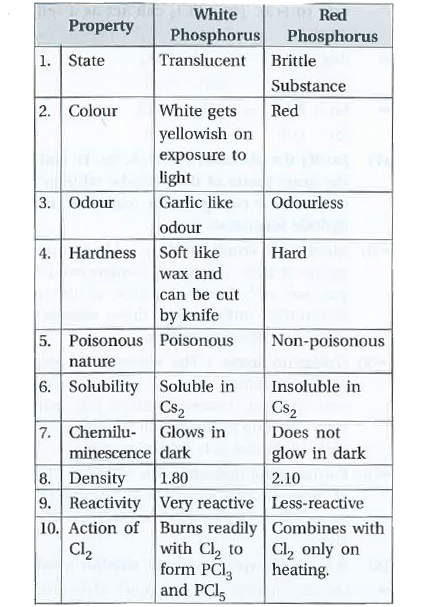
A translucent white waxy solid (A) on heating in an inert atmosphere is converted into its allotropic form (B). Allotrope (A) on reacton with very dilute aqueous KOH liberates a highly poisonous gas (C) having rotten fish smell. With excess of chlorine (C) forms (D) which hydrolyses to compound (E). Identify (A) to (E).

Answer»

Solution :(i) Since a translucent while waxy solid (A), on heating in an inert atmosphere, is converted into its allotrope (B), THEREFORE, (A) is white or yellow phosphorus while (B) is red phosphorus.
`underset("White phosphorus")(P_(4)(s)) overset("Heat, inert gas") (rarr) underset("Red phosphorus")(P_(4)(s))`
(ii) Since allotrope (A) on boiling with dilute aqueous KOH gives a heghly poisonous gas (C) having ROTTEN fish smell, therefore, it is confirmed that allotrope (A) is while phosphorus and the poisonous gas (C) is phosphine `(PH_(3))`
`underset("White phosphorus (A)")(P_(4) (s)) + 3 KOH (aq) + 3H_(2)O(l) overset("Heat") rarr underset("Pot. hypophosphite")(3KH_(2)PO_(2)(aq))+underset("Phosphine (C)")(PH_(3)(g))`
(iii) Since phosphine (C) reacts with excess of CHLORINE to form a compound (D) which upon hydrolysis gives compound (E), therefore, (D) MUST be phosphorus pentachloride `(PCl_(5))` and (E) must be phosphoric acid `(H_(3)PO_(4))`.
`underset("Phosphine (C)")(PH_(3)(g))+underset(("Excess"))(4Cl_(2)(g))rarr underset("Phosphorus pentachloride (D)")(PCl_(5)(s))+ 3HCl(g)`
`underset((D))(PCl_(5)(s))+4H_(2)O(l) rarr underset("Phosphoric acid (E)")(H_(3)PO_(4_(aq))+5 HCl(aq))`
Thus, (A) is white phosphorus, (B) is red PHOSPHOROUS, (C) is phosphine `(PH_(3))`. (D) is phosphorus pentachloride `(PCl_(5))` and (E) is phosphoric acid `(H_(3)PO_(4))`
86688.

A translucent white waxy solid (A) reacts with excess of chlorine to give a yellowish white powder (B). (B) reacts with organic compounds containing -OH group converting them into chloro derivatives. (B) on hydrolysis gives (C) and is finally converted to phosphoric acid. (A), (B) and (C) are

Answer»

`P_4, PCl_5 , H_3PO_4`
`P_4,PCl_5 , H_3PO_3`
`P_4, PCl_5, POCl_3`
`P_4, PCl_3 , POCl_3`

Solution :`UNDERSET"(A)"(P_)4 + 10Cl_2 to underset"(B)"(4PCl_5)`
`PCl_5 + C_2H_5OH to C_2H_5Cl + POCl_3 + HCl`
`PCl_5 + H_2O to underset"(C )"POCl_3 + 2HCL`
`POCl_3 + 3H_2O to H_3PO_4 + 3HCl`
86689.

A transitional metal X^(+2) in its hydrated state has six 3d electrons. The colour of ion is expected as

Answer»

GREEN
PINK
BLUE
YELLOW

ANSWER :A
86690.

(a) Transition metals show variable oxidation states. Explain.(b) Which metal of 3d-series exhibit maximum number of oxidation state?

Answer»

Solution :(a) The variable oxidation state of transition metals are due to :(i) both NS and (n - l)d electrons INVOLVE in bonding,
(ii) ns and (n-l)d SUBSHELLS have ALMOST same energy.
(B) Manganese (Mn)
86691.

Transition metals show catalytic property: Give reasons.

Answer»

SOLUTION :(i) Most of the transition METALS are used as catalysts because they exhibit variable oxidation states and form several intermediate compounds.
(II) Finely POWDERED metals provide a large surface area where reactants are absorbed and CONVERTED to products.
(ii) `Cu^(2+)_(aq)`
86692.

(A) : Transition metals form colored ions (R): They have completely filled d-orbitals in the nth shell.

Answer»

Both (A) and (R) are TRUE and (R) is the CORRECT EXPLANATION of (A)
Both (A) and (R) are true and (R) is not the correct explanation of (A)
(A) is true but (R) is FALSE
Both (A) and (R) are false

Solution : (A) is true but (R) is false
86693.

(a) Transition metals can act as catalysts because these can change their oxidation state. How does Fe(III) catalyse the reaction between iodide and persulphate ions? (b) Mention any three processes where transition metals act as catalysts.

Answer»

SOLUTION :(a) Reaction between IODIDE and persulphate ions is given by `2l^(-) + S_(2)O_(B)^(2-) overset(FE(III))rarr I_(2) + 2SO_(4)^(2-)`
MECHANISM: (i) `2Fe^(3+) + 2I^(-) rarr 2Fe^(2+) + I_(2)`
(ii) `2Fe^(2+) + 2S_(2)O_(B)^(2-) rarr 2Fe^(3+) + 2SO_(4)^(2-)`
(b) (i) contact process: `V_(2)O_(5)`
(ii) Haber.s process: Finely divided : Fe
(iii) Decomposition of `KClO_(3): MnO_(2)`
86694.

A transition metal Xhas a configuration [Ar] 3d^(4) in its + 3 oxidation state. Its atomic number is

Answer»

25
26
22
19

Solution :Electrons in the atom= 18 +4 + 3 = 25 i.e., Z=25.
86695.

(a) Transition metals can act as catalysts because these can change their oxidation state. How does Fe(III) catalyse the reaction between iodide and persulphate ions ? (b) Mention any three processes where transition metals act as catalysts.

Answer»

Solution :(a) REACTION between iodide and persulphate ions is :
`2I^(-)+S_(2)O_(8)^(2-)overset(Fe(III))toI_(2)+2SO_(4)^(2-)`
Role of Fe(III) ions :
`2Fe^(3+)+2I^(-)to2Fe^(3+)+I_(2)`
`2Fe^(2+)+S_(2)O_(8)^(2-)to2Fe^(3+)+2SO_(4)^(2-)`
(b) (i) VANADIUM (V) oxide in CONTACT process for oxidation of `SO_(2)` to `SO_(3)`.
(ii) Finely divided iron in Haber.s process in conversion of `N_(2)` and `H_(2)` to `NH_(3)`.
(iii) `MnO_(2)` in preparation of oxygen from `KCIO_(3)`.
86696.

(a) Transition metals and their compounds are used as catalysts. Give two reasons (b) Write the outer electronic configuration of chromium (atomic No. = 24)

Answer»

SOLUTION :(a) (i) They have an ABILITY to adopt multiple OXIDATION states.
(ii) They can form COMPLEXES.
(B) `3d^(5) 4s^(1)`
86697.

A transition metal M can exist in two oxidation states +2 and +3 It forms an oxide whose experiments formula is given by M_xO where xlt1 Then the ratio of metal ions in +3 state to those in +2 states in oxidegiven by :

Answer»

`(1-x)/(1+x)`
1+2x
`1+x/2`
`(2(1-x))/(3x-2)`

SOLUTION :In 1 mole of `M_x O_1`mole of `M^(2+)` ION=y `:.` mole of `M^(3+)` ion =x-y
Applying CHARGE BALANCE, 2y+3(x-y)-2=0 `implies` y=3x-2
`:. M^(3+)/M^(2+)=(x-y)/y=(x-(3x-2))/(3x-2)=((-2x+2))/(3x-2)=(2(1-x))/(3x-2)`
86698.

A transition metal ion exists in its highest oxidation state. It is expected to behave as

Answer»

a chelating AGENT
a central metal in a coordination compound
an oxidising agent
a reducing agent

SOLUTION :When a transition metal ion exists in its highest oxidation state, it acts as an oxidising agent.For example, Mn (VII) in `KMnO_(4)` is one of the strongest oxidising agents KNOWN in solution.
86699.

Transition metal " X " has a configuration [Ar] 3d^(4) in its +3 oxidation state . The atomic number of the metal is

Answer»

25
`26
32
19

Answer :A
86700.

A transition metal exists in its highest oxidation state.It is expected to behaveas

Answer»

a chelating agent
a central metal in a coordination compound
an oxidizing agent
a reducing agent.

Solution :In the HIGHEST OXIDATION state, it can undergo reduction and hence ACTS as oxidizing agent, e.g., in`KMnO_(4)`, Mnis in `+7` oxidation state. It is one of the STRONGEST oxidizing agent in solution.