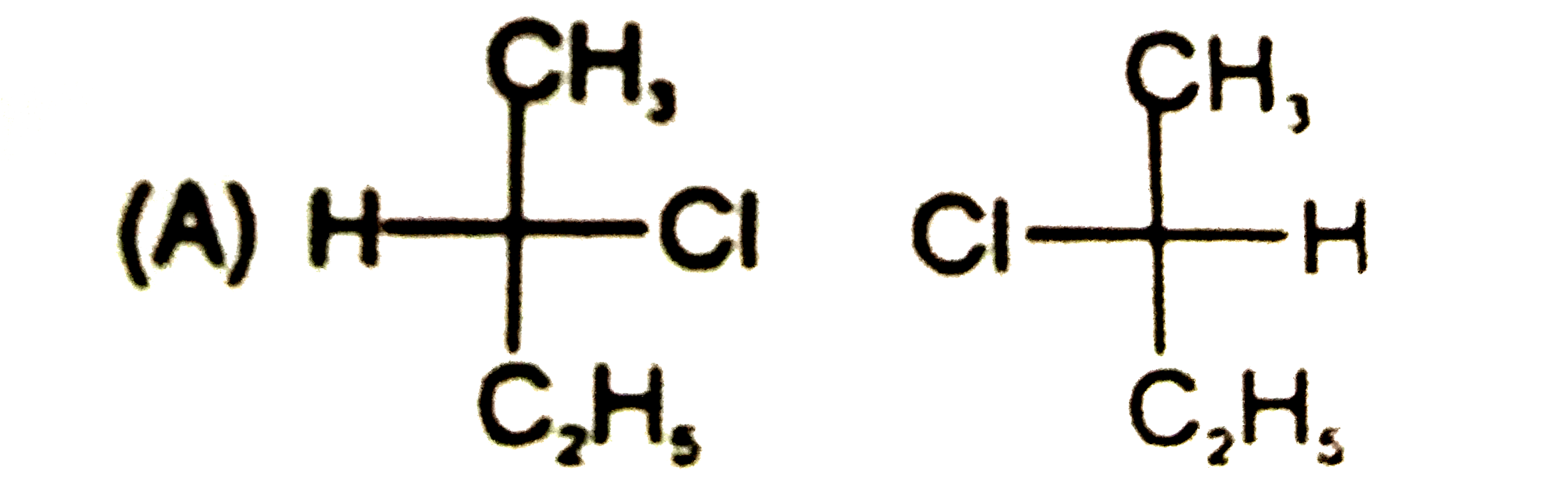
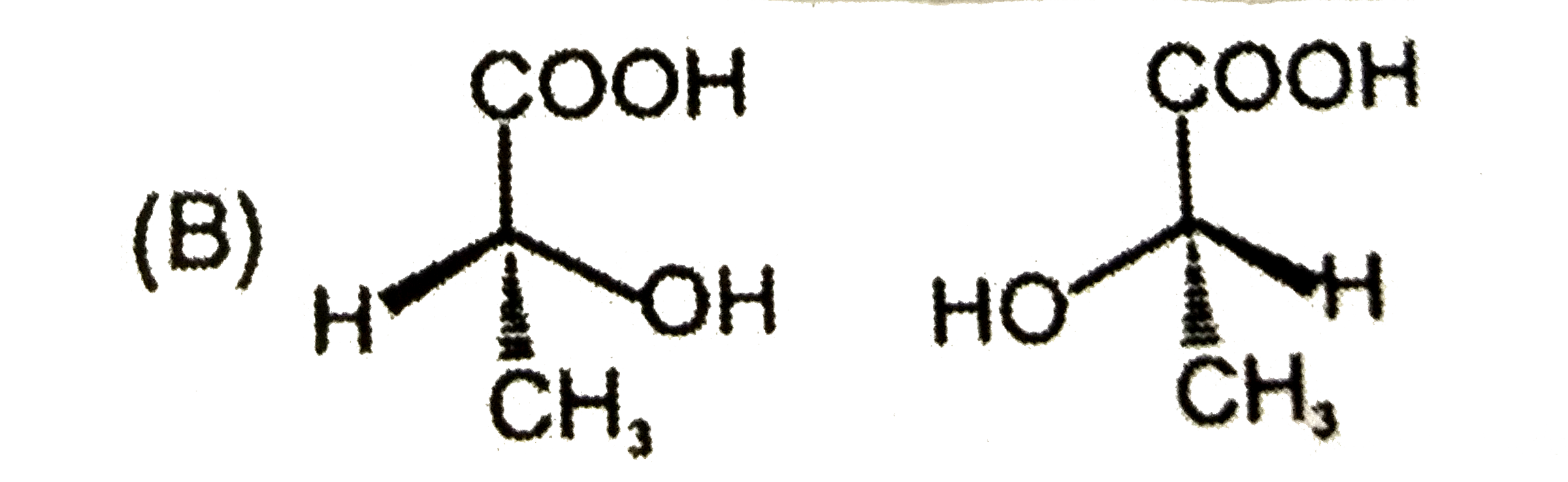
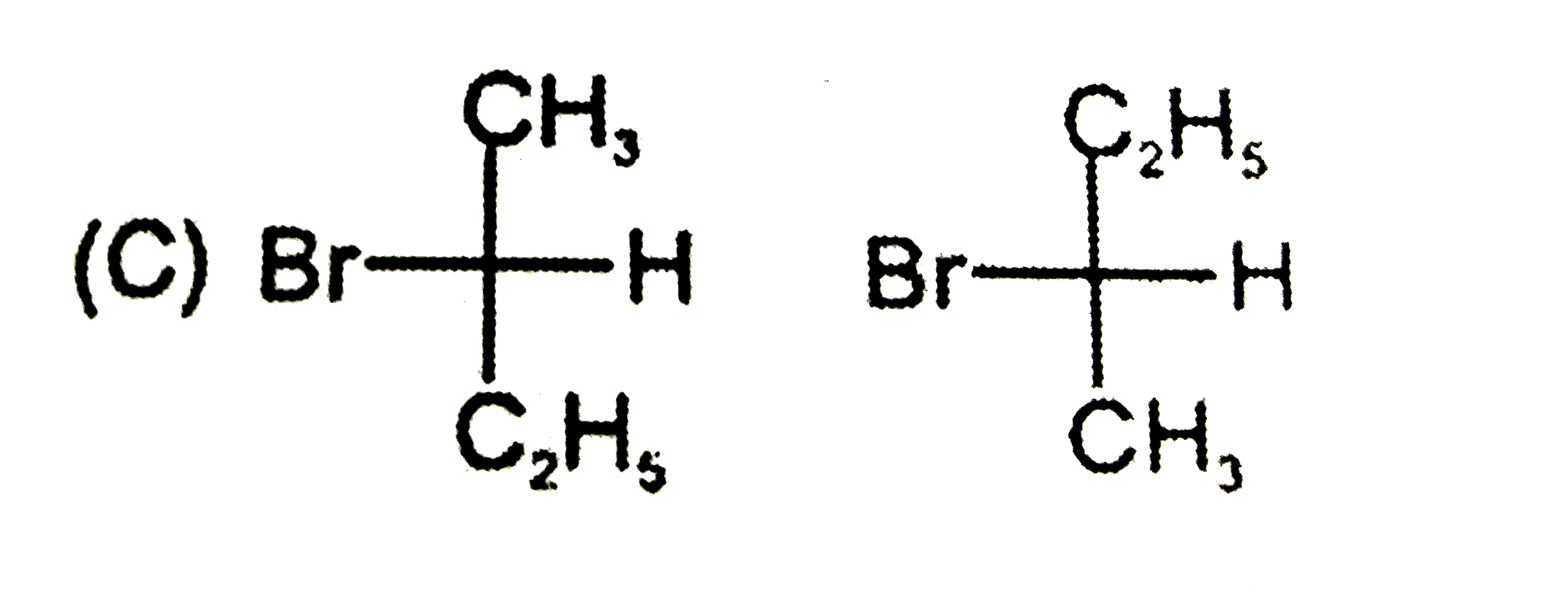
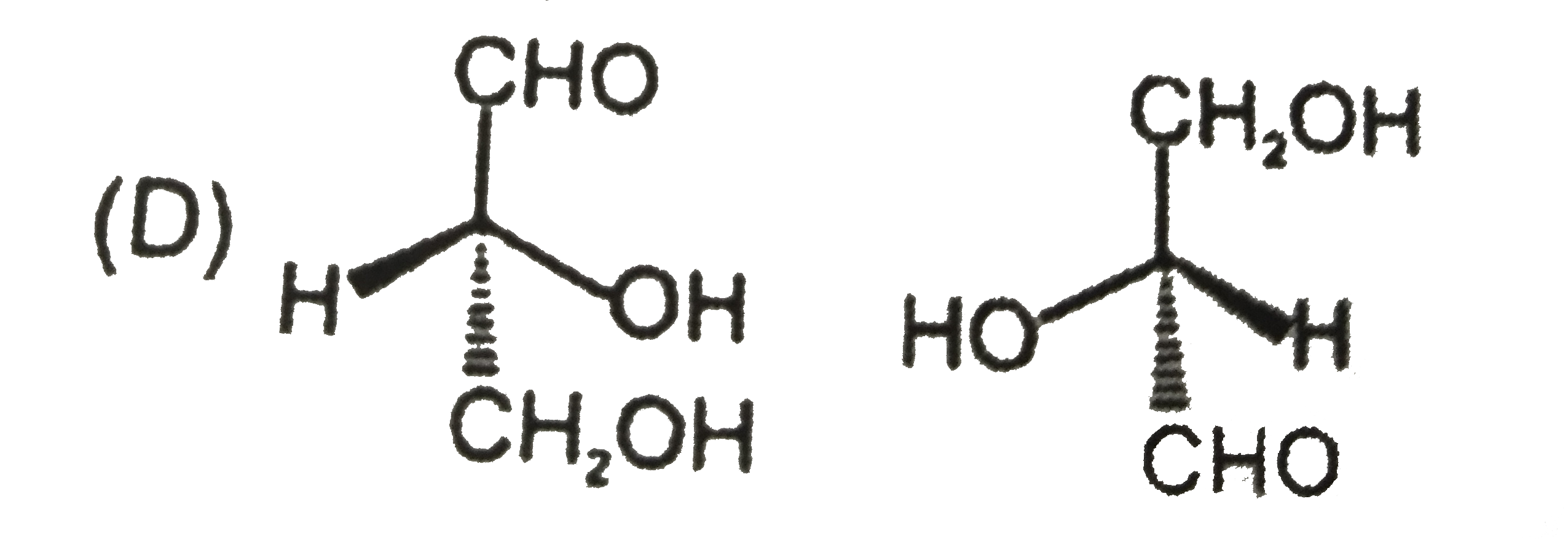
This section includes InterviewSolutions, each offering curated multiple-choice questions to sharpen your knowledge and support exam preparation. Choose a topic below to get started.
| 86801. |
(A) The energy difference between staggered and eclipsed conformations of ethylene dichloride is less than in ethylene dibromide. (R) The bond moment of C-Cl is greater than that of C-Br. |
|
Answer» |
|
| 86802. |
(a) The electrical resistance of a column of 0.05 M KOH solution of length 50 cm and area of cross-section 0.625 cm^2 is 5 xx 10^3 ohm. Calculate its resistivity, conductivity and molar conductivity. (b) Predict the products of electrolysis of an aqueous solution of CuCI_2 with platinum electrodes. [Given : E_(Cu^(2+)//Cu)^(o)=+0.34V, E_(((1)/(2)CI_(2) // CI^(-) ))^(o)=+1.36V, E_(H^(+) //H_(2) (g),Pt)^(o) = 0.00V, E_(((1)/(2) O_(2)//H_(2) O))=+1.23 V] OR (a) Calculate e.m.f. of the following cell : Zn(s)//Zn^(2+) (0.1 M )||(0.01 M)Ag^(+)//Ag(s) [Given : E_(Zn^(2+)//Zn)^(o)=-0.76V, E_(Ag^(+)//Ag)^(o) =+0.80 V, log 10=1] (b) X and Y are two electrolytes. On dilution molar conductivity of 'X' increases 2.5 times while that Y increases 25 times. Which of the two is a weak electrolyte and why ? |
|
Answer» Solution :(a) `A=0.625 CM^(2) , R=5 XX 10^(3) Omega, I=50 cm` Given, `R=(rhol)/(A)` or `rho= (RA)/(L) = (5xx10^(5) Omega xx 0.625 cm^(2) )/( 50 cm)` or `rho= 0.0625 xx 10^(5) Omega cm =6250 Omega cm` `k=((1)/( 6250))S cm^(-1) =0.00016 S cm^(-1)` Molar conductivity, `A_(m) =(k xx 1000)/( C ) =(0.00016 S cm^(-1) xx 1000 cm^(3) L^(-1))/(0.05 "mol"L^(-1))` Molar conductivity, `A_(m) =3.2 S cm^(2) mol^(-1)` (b) At cathode There are two cations in race, `Cu^(2+) and H^(+) Cu^(2+) (aq) + 2e^(-) to Cu (s), E^(n) =+0.34 V` `H^(+) (aq) +e^(-) to (1)/(2) H_(2) (g), E^(o) =0.0` Copper is deposited at the cathode because of higher reduction potential. At Anode `CI^(-) to (1)/(2) CI_(2) +e^(-) ""E^(o) =+1.36 V` `2H_(2) O (i) to O_(2) (g) + 4H^(+) (aq) +4e^(-) ""E^(o) =+1.23 V` The anion with lower reduction potential i.e., `CI^(-)` ion should be deposited at the anode but due to overpotential oxygen is liberated at the anode. OR (a) `E^(o) = E_(Ag^(+) //Ag)^(o) -E_(Zn^(2+)//Zn)^(o)` `=0.80-(-0.76)=1.56 V` According to Nernst equation, we have `E=E^(o) -(0.059)/(2) log (0.1)/(0.01^(2))` or `E=1.56 -0.0295 log (0.01)/(1 xx 10^(-4) )` or `E=1.56 0-0.0295 xx 3` or `E=1.56 -0.0885 = 1.4715 V` (b) Y is a weak electrolyte. This is because weak electrolytes have lower degree of dissociation at higher concentration and hence for such electrolytes, the change in `A_m` with dilution is due to increase in the degree of dissociation and consequently the number of ions in total volume of the solution that CONTAINS 1 mol of electrolyte. In such cases, `A_m` increases steeply. |
|
| 86803. |
(a) The electrode potential for the Daniell cell given below is 1.1 V. Zn(s) |Z_(n)^(2+)(aq)||Cu^(2+)(aq)|Cu(s) Write overall cell reaction and calculate the standard Gibb's energy for the reaction. [ F 96487 c//mol] (b) Mention any two factors which affects the conductivity of electrolytic solution . |
|
Answer» Solution :(a) `Zn(s) + Cu^(2+)(aq) to Zn^(2+) (aq) + Cu(s)` `Delta G^(0) = nFE_("CELL")^(0)` `DeltaG^(0) = -2 xx 96487 xx 1.1 = 21227//mol " OR " - 212.27 kJ//mol`. (b) (i) The NATURE of the electrolyte (ii) Temperature (III) Concentration of the electrolyte (IV) Size of the ions produced any their solvation (V) The nature of the solvent and its viscosity. |
|
| 86804. |
(A) The drugs which act on the central nervous system and help in reducing anxiety are called antibiotics. (R) Morphine is an antibiotic |
|
Answer» Both (A) and (R) are TRUE and (R) is the CORRECT EXPLANATION of (A) |
|
| 86805. |
(A): The dipole moment of CH_3 CI is greater than CH_3F. (R): Bond length of C-Cl bond is less than C-F bond. |
|
Answer» Both A & R are true, R is the correct EXPLANATION of A |
|
| 86806. |
(a) The depression in freezing point of water observed for the same molar concentration of acetic acid trichloroacetic acid and trifluoroacetic acid increases in the order as stated above. Explain. (b) Calculate the depression in freezing point of water when 20.0g of CH_(3)CH_(2) CHCICOOH is added to 500g of water. [Given: K_(a)=1.4xx10^(-3),K_(l)=1.86K kg "mol"^(-11)] |
|
Answer» |
|
| 86807. |
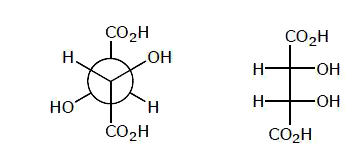
A. The correct statement(s) about the compound (A) is/are : (a) The total number of steteoisomers for (A) is 3 (b) The total number of mesoisomer possible for (A) is 1 (c ) The total number of pair of enantiomer possible for (A) is 1 (d) All of these B. Number of plane of symmetry in cis-from of compound (A) is : (a) 0(b) 1(c ) 2(d) 3 |
Answer»
|
|
| 86808. |
(A) : The Daniel cell becomes dead after some time (R) : Oxidation potential of zinc anode increases and that of copper cathode decreases |
|
Answer» Both (A) and (R) are true and (R) is the CORRECT explanation of (A) |
|
| 86809. |
(a)The conductivity of 0.001 mol L^(-1)solution of CH_3COOH is 3.905 xx 10^(-5) S cm^(-1). Calculate its molar conductivity and degree of dissociation (alpha). Givenlambda^(@) (H^(+)) = 349.6 S cm^(2) mol^(-1)and lambda^(@)(CH_(3)COO^(-)) =40.9 S cm^(2) mol^(-1) . (b) Define electrochemical cell. What happens if external potential applied becomes greater than E_("cell")^(@)of electrochemical cell ? |
|
Answer» Solution :(a) Molar conductivity is given by the relation : `Lambda_(m) = k/C` Substituting the values in the above equation, we have: `Lambda_(m) = (3.905 xx10^(-5) S cm^(-1))/(0.001 mol L^(-1)) = (3.905 xx 10^(-5) S cm^(-1))/(0.001 mol (cm^(3))^(-1))` or `Lambda_(0) = lambda_(H^(+))^(@) + lambda_(CH_(3)COO^(-))^(@)` `=349.6 + 40.9 =390.5 S cm^(2) mol^(-1)` `alpha = Lambda_(m)/Lambda_(0) = (39.05)/(390.5) = 0.1` ENERGY. An electrochemical cell consists of two parts an anode and a cathode. For example a Zn — Cu cell. If external potential APPLIED becomes greater than £°ceU the ELECTRONS flow in the opposite direction i.e., from cathode to anode and current flows from anode to cathode. |
|
| 86810. |
(a) The conductivity of 0.001 mol L^(-1)solution of CH_3COOH is 3.905 xx 10^(-5) S cm^(-1). Calculate its molar conductivity and degree of dissociation (alpha). Given :lambda^(@)(H^(+)) = 349.6 S cm^(2) mol^(-1) and lambda^(@)(CH_(3)COO^(-)) = 40.9 S cm^(2) mol^(-1) (b) What type of battery is lead storage battery ? Write the overall reaction occurring in lead storage battery. |
|
Answer» Solution : (a) Molar conductivity is GIVEN by the relation : `Lambda_(m) = k/C` Substituting the values in the above EQUATION, we have `Lambda_(m) =(3.905 XX 10^(-5)S cm^(-1))/(0.001 mol L^(-1)) =(3.905 xx 10^(-5) S cm^(-1))/(0.001 mol (cm^(3))^(-1))` or `Lambda_(m) = lambda_(H^(+))^(@) + lambda_(CH_(3)COO^(-))^(@) = 349.6 + 40.9 = 390.5 S cm^(2) mol^(-1)` `ALPHA =lambda_(m)/lambda_(0) = (39.05)/(390.5) = 0.1` Substituting the values in the above equation, we have: `Pb(s) + PbO_(2)(s) + 2SO_(4)^(2-) (aq) + 4H^(+) (aq) to 2PbSO_(4)(s) + 2H_(2)O` (l) |
|
| 86811. |
(A) : The conductivity of an aqueous solution of NaCl is greater than that of pure solvent. (R) : Conductivity is independent of the number of ions in solution. |
|
Answer» Both (A) and (R) are true and (R) is the correct EXPLANATION of (A) |
|
| 86812. |
(A) : The conductivity of 0.1M solutions of different electrolytes is same. (R) : The conductivity depends on the size of the ions. |
|
Answer» Both (A) and (R) are TRUE and (R) is the CORRECT EXPLANATION of (A) |
|
| 86813. |
(a) The conductivity of 0.001 M solution of CH_3COOH is 3.905 xx 10^(-5) S cm^(-1). Calculate its molar conductivity and degree of dissociation (alpha). Given : lambda^(@)(H^(+)) = 349.6 S cm^(2) mol^(-1) and lambda^(@)(CH_(3)COO^(-)) = 40.9 S cm^(2) mol^(-1) (b) Define electrochemical cell. What happens if external potential applied becomes greater than E_("cell")^(@)of electrochemical cell ? |
|
Answer» |
|
| 86814. |
(a) The cell in which the following reaction occurs: 2Fe^(3+) (aq) + 2I^(-) (aq) to 2Fe^(2+) (aq) + I_(2) (s) has E_("cell")^(@) 0.236 V at 298 K. Calculate the standard Gibbs energy of the cell reaction. [Given: 1F = 96,500 C mol^(-1)] (b) How many electrons flow through a metallic wire if a current of 0.5 A is passed for 2 hours? [Given: 1F =96,500 mol^(-1)] |
|
Answer» Solution :(a) `DeltaG^(@) =-nFE_("cell")^(@)` `DeltaG^(@) =-2 xx 96500 C MOL^(-1) xx 0.236 V = 45548 J mol^(-1)` `=45.548 kJ mol^(-1)` (B) Given, l = 0.5 A, t = 2hours `=2 xx 60 xx 60 = 7200 s` QUANTITY of electricity `= I xx t = 0.5 xx 7200 = 3600 C` 96500 C electricity is given by `=6.02 xx 10^(23)` electrons. 3600 C electricity is given by `=(6.02 xx 10^(23))/96500 xx 3600 = 0.2245 xx 10^(23)` electrons. `=2.245 xx 10^(22)` electrons. |
|
| 86815. |
Assertion: The complex [Co(NH_3)_3Cl_3] gives no precipitate with AgNO_3 solution Reason: The given complex is non-ionizable |
|
Answer» Both A & R are true, R is the correct explanation of A |
|
| 86816. |
(A) The charge of one mole of electron is one faraday. (R) The quantity of current required to deposite one mol of Mg from Mg^(2+) electrolyte solution is two faradays. |
|
Answer» If both (A) and (R) are CORRECT, and (R) is the correct EXPLANATION of (A). |
|
| 86817. |
(A): The chains of nylon-6, 6 are held by hydrogen bonding forces. (R): Intermolecular hydrogen bonding leads to molecular association. |
|
Answer» Both (A) and (R) are true and (R) is the CORRECT EXPLANATION of (A) |
|
| 86818. |
(A) The calculated spin only magnetic moment of Ti^(+2) is 1.73 BM. (R) Number of unpaired electrons in Ti^(+2) is 4. |
|
Answer» Both (A) and (R) are TRUE and (R) is the CORRECT EXPLANATION of (A) |
|
| 86819. |
(A): The bond dissociation energy of fluorine is less than bromine. (R): In fluorine molecule, large lone pair electronic repulsions and appreciable internuclear repulsions are present. |
|
Answer» Both (A) and (R ) are TRUE and (R ) is the CORRECT explanation of (A) |
|
| 86820. |
(A) The bond angle C-O-H in alcohol is less than in phenols(R) In phenols -OH group attached to the sp^2 carbon atom. While in alcohols OH group attached to sp^3carbon atom |
|
Answer» Both (A) and (R) are true and (R) is the CORRECT EXPLANATION of (A) |
|
| 86821. |
(A)the boiling pointofn- alkanesincrease withincreaseinnumber of carbonatoms, (R ) Van der Waals force ofattractionincreasewithincrease in numberof carbonand molcular mass . |
|
Answer» if both(A) and (R ) are correct and ( R) is THECORRECT EXPLANATIONOF the(A) |
|
| 86822. |
(A) The boiling point of cis-1,2-dichloroethene is higher than corresponding trans-isomer. (R) The dipole moment of cis-1,2-dichloroethene is higher than trans-isomers. |
|
Answer» |
|
| 86823. |
(A) The boiling point of C_2H_5OHis less than that of H_2O , though the molecular weight of C,H,OH is more than that of water.(R) C_2H_5OHmolecules are not highly associated through hydrogen bonding as in water. |
|
Answer» Both (A) and (R) are TRUE and (R) is the CORRECT EXPLANATION of (A) |
|
| 86824. |
(a) The boiling point of benzene is 353.23K. When 1.80g of a non-volatile,non-ionisable solute was dissolved in 90g benzene, the boiling point raised to 354.11K. Calculate molarass of the solute.[Kb for benzene =2.53K kg mol-1].(b)Define :(i) molality of a solution.(ii) Isotonic solutions. |
|
Answer» Solution :(a) Molality: Weight of KI in 100 g of water=20g weight of water in the solution=100-20=80=0.08kg Molar mass of KI =39+127=166`mol^(-1)` Molality of the solution (m) Number of MOLES of KI/Mass of water in Kg Molality : weight of the solution =100G Density of the solution =`1.202 g mL^-1` Volume of the solution =weight of the solution/Density ` (100g)/(1.202 g mL^(-1))` `=83.19 mL =0.083 L` Molarity of the solution (M) =`(20g)/((166 g mol^(-1))` `1.45 mol L^(-2)=1.45M` (C) Moles of FRACTION of KI: (Number of moles of KI) `n_(KI)`=Mass of KI/Molar mass of KI `((20g))/((166 g mol^-1))=0.12 mol` (Number of moles of water `nH_2O`=Mass of water/Molar mass of water =`((80 g))/((18 g mol^(-1)))=4.44 mol` Mole if fraction of KI `x_(KI)=n_(KI)/(n_(KI)+n_(H_2O))=((0.02mol))/((0.12+4.44)mol)=0.12/4.56=0.0263` Two different solutions having the same osmotic pressure are called isotonic solutions. (b) (i) It is defined as number of moles of the solute dissolved in one kilogram (1000g) of the solvent. (ii) Two solutions having same osmotic pressure at a given temperay are called isotonic solutions. |
|
| 86825. |
(A) The bleaching of flowers by chlorine is permanent while that by SO_(2) is temporary (R ) Chlorine bleaches by reduction and SO_(2) by oxidation |
|
Answer» Both (A) and (R ) are true and (R ) is the correct EXPLANATION of (A) |
|
| 86826. |
The boiling point of benzene is 353.23 K when 1.80 g of a non-volatile, non-ionising solute was dissolved in 90 g of benzene, the boiling point is raised to 354.11 K. Calculate the molar mass of solute. " "[Given K_(b) for benzene = 2.53 K kg mol^(-1)] |
|
Answer» Solution :(a)`M_2 = (k_b xx W_2 xx 1000)/(Delta T_b xx W_1) Delta T_b = 354.11 - 353.23 = 0.88` `M_2 = (253 xx 1.8 xx 100)/(0.88 xx 90) = 58 g mol^(-1)` . (b) (i) It is defined as number of MOLES of the SOLUTE dissolved in one kilogram (1000G) of the solvent (ii) Two solutions having same osmotic pressure at a given temperature are called isotonic solutions. |
|
| 86827. |
(a) The basic character among the hydrides of group-15 elements decreases with increasing atomic numbers. Explain.(b) Draw the structure of SF_4and XeF_4molecules.(c) What is the oxidation number of P in H_3PO_4acid ? |
|
Answer» <P> Solution :(a) This is due to decrease in charge density with increase in size.(b) `SF_4` (c ) LET OXIDATION number of P in `H_3PO_4` = x 3(+1)+x+4(-2)=0 x = +5 |
|
| 86828. |
(a) The basic character among the hydrides of group-15 elements decreases with increasing atomic numbers. Explain. (b) Draw the structure of SF_4and XeF_4molecules. (c) What is the oxidation number of P in H2PO4 acid ? |
Answer» Solution :(a) This is due to decrease in charge density with increase in SIZE. (c ) Let OXIDATION number of P in `H_3PO_4` = X 3(+1)+x+4(-2)=0 x = +5 |
|
| 86829. |
(A) The addition of catalyst lowers the activation barrier, yet there is no change in the enthalpy of reaction. (R ) Enthalpy change is equal to the difference in the activation energy for the forward and the backward reactions. |
|
Answer» Both (A) and (R ) are true and (R ) is the CORRECT explanation of (A) |
|
| 86830. |
(A) The activity of 1 g pure uranium-235 will be greater than the same amount present in U_(3) O_(6) (R ) In the combined state, the activity of the radioactive element decreases. |
|
Answer» If both (A) and (R ) are CORRECT and (R ) is the correct EXPLANATION for (A). |
|
| 86831. |
(A) The acidity of alcohols follow the order 1^@ gt 2^@ gt 3^@(R) The +I effect of alkyl groups (3^@ gt 2^@ gt 1^@) favour the dissociations of - O - H bond |
|
Answer» Both (A) and (R) are TRUE and (R) is the correct EXPLANATION of (A) |
|
| 86832. |
A tetrapeptide has -COOH group on alanine. This products glycine (Gly), valine (Val), phenylalanine (Phe) and alanine(Ala), on complete hydrolysis. For this tetrapeptide , the number of possible sequences (primary structures) with -NH_(2) group attached to a chiral centre is |
|
Answer» (a)`CH_(3)-overset(CH_3)overset(|)(CH)-overset(NH_2)overset(|)(CH)-COOH"""Valine (Val)"` (b)`CH_(3)-overset(NH_2)overset(|)(CH)-COOH"""Alanine (Ala)"` (c)`C_(6)H_(5)-CH_(2)-overset(NH_2)overset(|)(CH)-COOH"""Phenylalanine (PHE)"` (d) `H_(2)N-CH_(2)-CO_(2)H "" "Glycine (Gly)"` Since alanine is the end amino ACID and glycine does not contain a chiral CENTRE. therefore , all tetrapeptides begin either with valine or with phenylalanine. THUS , the following four tetrapeptides are possible : (i)Val -Phe- Gly-Ala (II) Val-Gly-Phe-Ala (iii) Phe- Val-Gly-Ala (iv) Phe-Gly-Val-Ala |
|
| 86833. |
(a) Tetragonal unit cell (b) Triclinic unit cell (c ) Frenkel defect. |
Answer» Solution :(a) edges are, `a = b ne C` and ANGLES are `alpha=beta=gamma=90^(@)` (b) ![]() edges are `a ne b ne c` and angles are `alpha ne beta ne gamma ne 90^(@)` (c )
|
|
| 86834. |
A test tube containing a nitrate and another containing a bromide and MnO_(2) are treated with concentrated H_(2)SO_(4).The reddish brown fumes evolved are passed through water.The water will be coloured by : |
|
Answer» the nitrate<BR>the bromide `Br^(-)+MnO_(2)` on heating with concentrated `H_(2)SO_(4)` gives `Br_(2)` gas which on passing through water imparts it a reddish brown COLOUR. |
|
| 86835. |
A test for complete romovel of Cu^(2+) ions form a solution of Cu_((aq.))^(2+) is to add NH_(3(aq.)). A buke colour signifies the fomaltionn of complex [Cu(NH_(3))_(4)]^(2+) having K_(f) = 1.1 xx 10^(13) and thus confirms the presence of Cu^(2+) in solution. 250 mL of 0.1 M CuSO_(4(aq.)) is electrolysed by passing a current of 3.512 ampere for 1368 second. After passage of this passage of this charge sufficient quantity of NH_(3(aq.)) is added to electrolysed solution maintaining [NH_(3)] = 0.10 M. If [Cu(NH_(3))_(4)]^(2+) is detectable up to its concentration as low as 1 xx 10^(-5), would a blue colour be shown by the electrolysed solution on addition of NH_(3). |
|
Answer» |
|
| 86836. |
A test tube containing a nitrate and another containing a bromide and MnO_2 are treated with conc. H_2 SO_4. The brown fumes evolved are passed through water. The water will be coloured by |
|
Answer» the nitrate<BR>the bromide |
|
| 86837. |
(A) Tertiary alcohols are more reactive for nucleophilic substitution reactions(R) The C-O bond is weak in tertiary alcohol |
|
Answer» Both (A) and (R) are TRUE and (R) is the CORRECT explanation of (A) |
|
| 86838. |
A tertiary alcohol [H] upon acid catalysed dehydration gives a product [I]. Ozonolysis of [I] leads to compounds [J] to [K]. The compound [J] upon reactions with KOH gives benzyl alcohol a compound [L] wheras [K} on reaction with KOH gives only [M]. The compund [M] has the formula. The structure of compound [I] is |
|
Answer»
|
|
| 86839. |
A tertiary alcohol [H] upon acid catalysed dehydration gives a product [I]. Ozonolysis of [I] leads to compounds [J] to [K]. The compound [J] upon reactions with KOH gives benzyl alcohol a compound [L] wheras [K} on reaction with KOH gives only [M]. The compund [M] has the formula. The structure of compounds [J], [K] and [L] are respectively : |
|
Answer» `PhCOCH_(3), PhCH_(2)COCH_(3)` and `PhCH_(2)COO^(-)K^(+)`
|
|
| 86840. |
A tertiary alcohol H on acid catalysed dehydration gives a product I. Ozonolysis of I leads to compounds. J and K . Compound J upon reaction. With KOH gives benzyl alcohol and a compound L, whereas K on reaction with KOH gives only. M The structure of compound I is : |
|
Answer»
|
|
| 86841. |
A tertiary alcohol [H] upon acid catalysed dehydration gives a product [I]. Ozonolysis of [I] leads to compounds [J] to [K]. The compound [J] upon reactions with KOH gives benzyl alcohol a compound [L] wheras [K} on reaction with KOH gives only [M]. The compund [M] has the formula. The compound [H] is formed by the reaction og : |
|
Answer»
`[K]` is `Ph-OVERSET(O)overset(||)(C)-CH_(3)` and `[M]` is formed by ALDOL condensation `J overset(KOH)rarrPhCH_(2)OH + L` Hence J is PhCH = O and L is `PhCOO^(-)`, the reaction INVOLVED is Cannizzaro's reactions ![]() compound [H] is formed by the reactants involved in (b) and gives compound (I) as follows :-
|
|
| 86842. |
A term ........... is used for sorption of gases on metal surfaces |
| Answer» SOLUTION :occulsion | |
| 86843. |
A tennis ball travels at a speed of 96 miles per hour. The speed of the ball in metres per second is : |
|
Answer» `9.6ms^(-1)` |
|
| 86844. |
A tetrapeptide has -COOH group on alanine. This produces glycine (Gly), valine (Val), phenyl alanine (Phe) and alanine (Ala), on complete hydrolyses. For this tetrapeptide, the number of possible sequences (primary structures) with -NH_(2) group attached to a chiral centre is |
|
Answer» |
|
| 86845. |
(A) Tendency of forming multiple bond is highest for oxygen among chalcogens (R ) Size of oxygen is smallest among chalcogens |
|
Answer» Both (A) and (R ) are true and (R ) is the correct EXPLANATION of (A) |
|
| 86846. |
A tenfold increase in pressure on the reaction N_(2(g))+3H_(2(g))hArr2NH_(3(g)) at equilibrium, makes K_(p) |
|
Answer» UNCHANGED |
|
| 86847. |
A tenfold increase in pressure on the reaction,N_2(g) + 3H_2(g) iff 2NH_3(g)atequilibrium results in ........in K_p |
| Answer» SOLUTION :No CHANGE | |
| 86848. |
A temperatureof -110^@C can be obtained by using , |
|
Answer» ETHER and `CO_2` |
|
| 86849. |
A temperature in 0^(@)C is converted into K |
|
Answer» By DEDUCTING 273.16 |
|
| 86850. |
A teacherr gave a student two salts (A) and (B) told him to identiify these salts. The student heated salt (A) strongly and observed two oxides to sulphur. He added NaOH solution to aqueous solution of (A) and observed a green precipitate, which turned brown on exposure to air. When he tok salt (B) to flame test, green colour was observed. On heating salt (B) with a solid compound (X) and concentrated sulphuric acid, orange red vapours are evolved. when this gas is passed through an aqueous solution of a base, the solution turns yellow. Q. Salt (B) suggest that the cation and anion in it are respectively: |
|
Answer» `BA^(2+) and SO_(4)^(2-)` |
|