Explore topic-wise InterviewSolutions in .

This section includes InterviewSolutions, each offering curated multiple-choice questions to sharpen your knowledge and support exam preparation. Choose a topic below to get started.

86951.

A substance decomposes in a solution following first order kinetics. Flask A contains 1L of 1M solution and flask B contains, 100 mL of 0.6 M solution. After 8 hours, the concentration of substance in flask A becomes 0.25 M. What will be time taken for the concentration of the same substance in flask B to become 0.3 M?

Answer»


Solution :In FLASK A, `k=2.303/8 log 1.0/0.25`
`=2.303/8 log 4=2.303/4 log 2`
In flask B,
`t=2.303/k log 0.6/0.3=2.303/k log 2`
`=(2.303 log 2) xx 4/(2.303 log 2)=4`
86952.

A substance C_(4)H_(10)O yields on oxidation a compound C_(4)H_(8)O which gives an oxime and a positive iodoform test. The original substance on treatment with conc. H_(2)SO_(4) gives C_(4)H_(8) . The structure of the compound is

Answer»

`CH_(3)CH_(2)CH_(2)CH_(2)OH`
`CH_(3)Ch(OH)CH_(2)CH_(3)`
`(CH_(3))_(3)COH`
`CH_(3)CH_(2)-O-CH_(2)CH_(3)`

Solution :`CH_(3)CH(OH)CH_(2)CH_(3)OVERSET("CONC." H_(2)SO_(4))to underset((C_(4)H_(8)))(CH_(3)CH=CHCH_(3) `
`underset(2-"BUTANOL")(CH_(3)CHOHCH_(2)CH_(3))overset([O])to underset("Butanol")(CH_(3)COCH_(2)CH_(3))`
Butanone gives both an oxime and positive iodoform test, therefore, the original compound is 2-butanol.
86953.

A substance decomposes according to zero order kinetics . If the rate constant is k and initial concentration is a then half life period is :

Answer»

1/ak
0.693 /K
k/2a
a/2k

Answer :D
86954.

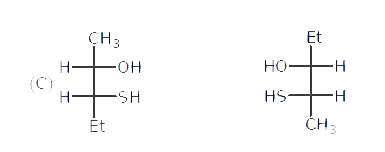
A substance C_(4)H_(10)O yield on oxidation C_(4)H_(5)O which gives oxime andpositive iodoform test. The original substance on treatment with conc. H_(2)SO_(4) gives C_(4)H_(8). The structure of compound is

Answer»


ANSWER :C
86955.

A substance A_(x)B_(y)crystallizes in an f.c.c. lattice in which atoms of A' occupy each corner of the cube and atoms of 'B' occupy the centres of each face of the cube. Identify the correct composition of the substance A_(x) B_(y)

Answer»

`AB_(3)`
`A_(4)B_(3)`
`A_(3)B`
composition cannot be specified

Answer :A
86956.

A substance 'A' undergoes a reaction such that its concentration at anytime t (in sec.) can be represented by the equation [A]_(t)^(4) = (1)/(t+1) where 't' is time in sec and [A_(t)] represents molar concentration. Calculate rate of disappearance of 'A' at concentration of 2M.

Answer»


ANSWER :8
86957.

Asubstance (A) is solubleindil.HCland producesobnoxidessmellwithalcholicpotash andhaloform . Whichtypeof compoundbehavelikethis .

Answer»

ALCOHAL
`1^(0)` AMINE
`2^(0)` amine
`3^(0)` amine

Answer :B
86958.

A substance 'A' decomposes in solution following the first order kinetics. Flask I constains 1 L of 1 M solution of A and flask II constains 100 ml of 0.6 M solution. After 8 hr, the conc. Of A in flask 1 becomes 0.25 M. What will be time for conc. of A in flask II to become 0.3 M?

Answer»

`0.4hr`
`2.4hr`
`4.0hr`
UNPREDICTABLE as RATE CONSTANT is not given

Answer :C
86959.

A substance ''A'' decomposes in solution following the first order kinetics. Flask I contains 1L of 1 M solution of A and falsk II contains 100 mL of 0.6 M solution. After 8 hr, the concentration, of A in flask I becomes 0.25 M. What will be the time for concentration of A in flask II to become 0.3 M ?

Answer»

0.4 hrs
2.4hrs
4.0hrs
Unprdictableas therateconstant is notgiven

ANSWER :C
86960.

A substance A decomposes in solution by following the first order kinetics. Flask I contains 1 L of 1 M of solution of A and flask II contains 100 ml of 0.6 M solution of A. After 8 hrs the concentrationof A is flask I become 0.25 M. What will be time for concentration of A in flask II to become 0.3 M?

Answer»

2.0hrs
8.0 hrs
4.0hrs
6.0 hrs

Solution :FLASK-I(A): (`1xx1` )mole (on 1 mole `overset(8HR)(to)(0.25xx1)` mole)
Flask II(A):`((0.6xx100)/1000)` (or) `0.06"mole"overset(t=?)(to)((0.3xx100)/1000)`
`(Kxx8)/(Kxxt)=(LOG((1xx1)/(0.25xx1)))/(log((0.6xx100//1000)/(0.3xx100/1000))),8/t,(log4)/(log2),8/t=(2log2)/(log2)impliest=8/2=4hr,t=4hr`
86961.

A substance A decomposes by a first order reaction starting initially with [A] = 2.00 m and after 200 min [A] = 0.15 m . For this reaction what is the value of k

Answer»

`1.29 XX 10^(-2) "min"^(-1)`
`2.29 xx 10^(-2) "min"^(-1)`
`3.29 xx 10^(-2) "min"^(-1)`
`4.40 xx 10^(-2) "min"^(-1)`

Solution :GIVEN A(a) = `2.00` m, t = 200 min and a(a-x) = 0.15 m we know
`k = (2.303)/(t) "log" (a)/(a-x) = (2.303)/(200) "log" (2.00)/(0.15)`
`= (2.303)/(200) xx (0.301 + 0.824) = 1.29xx 10^(-2) "min"^(-1).`
86962.

A substance 'A' crystallizes in fcc lattice. In a crystalline solid AB, some vacancy is produced by missing of equal number of oppositely charged ions. What is the defect called?

Answer»

SOLUTION :SCHOTTKY DEFECT
86963.

A substance A containing three carbon atoms gives white crystalline precipitate with sodium bisulphite solution. But does not guve red precipitate with Fehling solution. A on treatment with NH_(2)-NH_(2)//KOH will yield

Answer»

PROPENE
PROPANE
Cycloproapane
Propionic ACID

ANSWER :B
86964.

A subatomic particle of mass 10^(-18) mu gis in thermal equilibrium with its surrounding at a temperature of 400K. Then the wavelength of this particle will be

Answer»

`48.2 A^(@)`
`2.8 A^(@)`
`12.7 A^(@)`
`142 A^(@)`

ANSWER :B
86965.

(A): Styrene is more reactive than propylene towards cationic polymerization. (R): The carbocation resulting from styrene is more stable than that resulting from propylene.

Answer»

Both A & R are true, R is the CORRECT explanation of A
Both A & R are true, Ris not correct explanation of A
A is true, R is false
A is false, R is true 

Answer :A
86966.

A student was given a sample of colourless solution containing three cations and was asked to identify the cations. Student carried out a series of reactions as given below. White precipitate 'A' is not soluble in:

Answer»

`NH_(3)`
`2M HCl`
`KCN`
`Na_(2)S_(2)O_(3)`

SOLUTION :N//A
86967.

A student was given a sample of colourless solution containing three cations and was asked to identify the cations.Student carried out a series of reactions as given below. Which of the following statements is correct ?

Answer»

Precipitate 'C' gives Rinmann's green test
Precipitate 'B' is appreciably soluble in boling CONCENTRATED `H_2SO_4`
Precipitate (A) on exposure to sunlight or ultraviolet radiations turns BLACK
All of these

Solution :(A)`COO. ZnO`=Rinmann's green reagent used as green pigment
(B)`BaSO_4 darr + H_2SO_4` (CONC.) `to Ba^(2+)+HSO_4^(-)`
(C )`2AgCl darr`(WHITE ) `overset(hv)to 2Ag darr` (black) +`Cl_2 uarr`
86968.

A student was given a sample of colourless solution containing three cations and was asked to identify the cations.Student carried out a series of reactions as given below. White precipitate 'A' is not soluble in:

Answer»

`NH_3`
2M HCl
KCN
`Na_2S_2O_3`

SOLUTION :(A)`AGCL+2NH_3 to [Ag(NH_3)_2]Cl` SOLUBLE complex.
(B)2M HCl is GROUP reagent of `1^(st)` group but in concentrated HCl AgCl dissolves forming `[AgCl_2]^(-)` complex
(C )`AgCl+2CN^(-)to [Ag(CN)_2]^(-)`(soluble complex) +`Cl^-`
(D)`AgCl+2S_2O_3^(2-)to[Ag(S_2O_3)_2]^(3-)`(soluble complex) +`Cl^-`
86969.

A student was given a sample of colourless solution containing three cations and was asked to identify the cations.Student carried out a series of reactions as given below. Precipitates 'A','B' and 'C' are respectively :

Answer»

`Al(OH)_3 , BaSO_4 and AgCl`
`AgCl, BaSO_4 and Zn(OH)_2`
`AgCl, CA(OH)_2 and ZnSO_4`
`ZnCl_2, BaSO_4 and Al(OH)_3`

SOLUTION :
`Ag^(+)+Cl^(-)toAgCldarr("white") , 3AgCl+Na_3AsO_3 to Ag_3AsO_3 darr ("yellow")+3NaCl`
`Ba^(2+)+SO_4^(2) to BaSO_4darr ("white") , Ba^(2+)` SALTS give apple green colour to the Bunsen FLAME.
`Zn^(2+)+2NH_3 + 2H_2O to Zn(OH)_2darr ("white")+2NH_4 uarr`
`Zn(OH)_2darr + 4NH_4 HARR [Zn(NH_3)_4]^(2+)+2OH^(-)`
86970.

A student try to prepare p-nitroaniline by nitrating aniline with con. HNO_3-con.H_2SO_4 mixture but he got m-nitroaniline from aniline. Why?

Answer»

SOLUTION :Aniline reacts with ACID to form anilium ION `(C_6H_5-N^+H_3)`. In this ion `NH_3` GROUP is META directing.
86971.

A student states that burning of lime in air is an oxidation process. The reason he gives is that an oxide of the metal is produced on burning. Which one is correct ?

Answer»

The statement and reason are true, the reason is correct explanation
The statement and reason are true, the explanation is not correct
The statement is true but the reason is false
The statement in false but the reason is true

Solution :When Ca is heated in OXYGEN it changes to CaO i.e., metal OXIDE is FORMED. But lime cannot be further oxidised.
86972.

A student prepared a pure sample of 1-chloro-2-(dimethylamino) propanol. After standing for several weeks in a sealed container he opened it and found it has mostly 2-chloro-1-(dimethylamino) propane. Resolve student's dilemma and explain what has happened.

Answer»

SOLUTION :
86973.

A student performs a titration with different burettes and finds titre values of 25.2 mL, 25.25mL and 25.0mL . The number of significant figures in average litre value is:

Answer»


SOLUTION :AVERAGE TITRE VALUE `-(22.2+25.25+25.0)/(3)`
`=(75.45)/(3)=(75.4)/(3)=25.1`
86974.

A student performs a titration with different burettes and finds titre values of25.2 mL, 25.25 mL and 25.0 mL. What is the number of significant figures in the average titre value?

Answer»

Solution :All digits are significant EXCEPT zeros at the beginning of the numberand POSSIBLY TERMINAL zeros.
3
86975.

A student performs a titration with different burettes and find titre values of 25.2 mL, 25.25 mL, and 50.0 mL. The number of significant figures in the average titre value is

Answer»


SOLUTION :AVERAGE titre value
`=(25.2+25.25+25.0)/3=75.45/3=25.15=25.2 mL`
number of significant FIGURES will be 3.
86976.

A studentmakes a statement in the class by saying energy of a particle will not become zero at 0 kwhich of the following is correct in your opinion ?

Answer»

Hemade a wrong statement
he made a correct statement and it isaccordance with kinetic THEORYOF gases
he made a correct statement and it is in accordance with the QUANTUM THEORY of ELECTROMAGNETIC radiations
he made a correct statement and it is accordance with the heisenberg uncertainty PRINCIPLE

Answer :D
86977.

A student made the following observations in the laboratroy:(i) clean copper metla didn not react with 1 molarPb(NO_3)_2 solution (ii) Clean lead metal dissolved in a 1 molarAgNO_3 solution andcrystals of Ag metal appeared(iii)Clean silver metal did not react with 1 molar Cu(NO_3)_2 soution The order of decreasing reducing character of th three metals is :

Answer»

`CU,PB,AG`
`Cu,Ag,Pb`
`Pb,Cu,Ag`
`Pb,Ag,Cu`

ANSWER :C
86978.

A student made the following observations in the laboratory: (i) Clean copper metal did not react with 1 molar Pb(NO_(3))_(2) solution (ii) Clean lead metal dissolved in a 1 molar AgNO_(3) solution and crystals of Ag metal appeared (iii) Clean silver metal did not react with 1 molar Cu(NO_(3))_(2) solutions.

Answer»

`CU, PB, Ag`
`Cu, Ag, Pb`
`Pb, Cu, Ag`
`Pb, Ag, Cu`

SOLUTION :Metal having more `E_(OP)^(@)` replaces the other FORM its salt SOLUTIONS.
86979.

A student made the following observations in the laboratory i) clean copper metal did not react with 1 molar Pb (NO_(3))_(2) solution ii) clean lead metal dissolved ina 1 molar AgNO_(3) solution and crystals of Ag metal appeared iii) clean silver metal did not react with 1 molar Cu(NO_(3))_(2) solution The order of decreasing reducing character of the three metals is

Answer»

Cu, Pb , Ag
Cu , Ag , Pb
Pb, Cu , Ag
Pb , Ag , Cu

Solution :METAL placed below in electrochemical SERIES REPLACES the other from its SALT solutions .
86980.

A student is seperating CHCl_(3) (b.p.=61^(@)C) from CHCl_(2)CHCl_(2) (b.p.= 146^(@)C) by distillation. She has just begun to collect the first distillate in the receiving flask. At what position in the below apparatus will the temperature be 61^(@)C?

Answer»

A
B
C
D

Answer :B
86981.

A student made the following observations in the laboratory, A) Clean copper metal did not react with 1 molar Pb(NO_3)_2 solution B) Clean lead metal dissolved in a 1 molar AgNO_3 solution and crystals of Ag metal appeared C) Clean silver metal did not react with 1 molar Cu(NO_3)_2 solution. The order of decreasing reducing character of the three metals is :

Answer»

CU, PB, AG
Cu, Ag, Pb
Pb, Cu, Ag
Pb, Ag, Cu

Answer :C
86982.

A student heated some sulphur in a spatula and collected the gas 'X' . Which one among the following is correct about 'X' ?

Answer»

X is `SO_(2)` and it turns MOIST LITMUS to blue
X is `SO_(3)` and it turns moist litmus to red
X is `SO_(2)` and it turns moist litmus to red
X is `SO_(3)` and it turns DRY litmus to blue

Solution :`S + O_(2) to underset(X)(SO_(2)), SO_(2) + H_(2)O to underset("Sulfurous ACID")(H_(2)SO_(3))`
86983.

A student had taken solutions of KI, H_(2)S, C_(2)H_(5)OH and NaBr in four separate test tube but he forgot to label them. By taking a mall sample of the solution from each of the four test tubes, suggest a method by which he can find out the solution in each test tube by using the same reagent in each of the test tubes. Give the reaction in each case.

Answer»

Solution :The solution present in each of the four test tubes can be found by adding a mixture of potassium dichromate crystals and concentrated `H_(2)SO_(4)` . A different observation will be noted in different CASES
(i) In testcontaining KI, violet vapours of `I_(2)` will appear
`K_(2)Cr_(2)O_(7) + 7H_(2)SO_(4) + 6KI rarr 4K_(2)SO_(4) + Cr_(2)(SO_(4))_(3) + underset("violet vapours)")(3I_(2))+7H_(2)O`
(ii) In test tube containing `H_(2)S` solution , yellow ppt. of sulphur will appear
`K_(2)Cr_(2)O_(7) + 4H_(2)SO_(4) + 3H_(2)S rarr K_(2)SO_(4) +Cr_(2)(SO_(4))_(3)+ 7H_(2)O + underset ("(yellow)")(3S)`
(iii) In test tube containing `C_(2)H_(5)OH`, vinegar smell will be noticed due to formation of acetic acid
`K_(2)Cr_(2)O_(7) + 4H_(2)SO_(4) rarr K_(2)SO_(4)+Cr_(2)(SO_(4))_(3)+3(O)`
`CH_(3)CH_(2)OH+ (O) rarr CH_(3)CHO+ H_(2)O`
`CH_(3)CHO+ (O)rarr CH_(3)COOH`
(iv) In test tube containing NABR, the colour of the solution will turn BROWN due to formation of `Br_(2)` which dissolves in the solution . Reaction is similarto reaction given in (i) above.
86984.

A studentby chance mixed acetone with alcohol. This mixture of acetone and lcohol can be seperated by

Answer»

filtration
separating funnel
fractional CRYSTALLISATION
fractional distillation

Solution :Acetone and ALCOHOL both are liquids. These two have different BOILING points. So, they are separated from their mixture by fractional distillation.
86985.

A student Babita Phogat went to meet his friend Geeta Phogat, where she saw that Geeta Phogat was doing the study of a partcular chemistry book. But she could not find the theoretical value of bond length in H-F although she found that radius of hydrogen and Fluorine are 0.37 Å and 0.72 Å respectively & electronegativity of F & H are 4.0 and 2.1 respectively. What is bond length of H-F bond.

Answer»

`1.09`
`1.784`
`0.92`
`0.46`

SOLUTION :`d_(H - F) = 0.37 + 0.72 - 0.09 |4 - 2.1|`
`= 1.09 - 0.17`
`= 0.92 Å`
86986.

A student accidently splashes few drops of conc. H_2SO_4 on his cotton shirt. After a while, the splashed partsblacken and the holes appear. This has happened because sulphuric acid.

Answer»

DEHYDRATES the cotton with burning
CAUSES the cotton to react with AIR
Heats up the cotton
Removes the elements of WATER from cotton

Answer :A
86987.

A student accidently splashes few drops of conc. H,SO, on his cotton shirt. After a while, the splashed parts blacken and the holes appear. This has happened because sulphuric acid

Answer»

Dehydrates the COTTON with BURNING
Causes the cotton to react with air
Heats up the cotton
REMOVES the ELEMENTS of WATER from cotton

Answer :D
86988.

Astudent accidentlyadded conc. H_(2)SO_(4) to potassium permanganateand itexplodeddue to the formation of a explosivewhich is

Answer»

MNO
`Mn_(2)O_(3)`
`Mn_(2)O_(5)`
`Mn_(2)O_(7)`

SOLUTION :`Mn_(2)O_(7)` is FORMED which decomposes explosively on HEATING.
86989.

(A) : Structure of [Co(NH_(3))_(6)]^(+3) ion is octahedral (R) : The coordination number of the metal ion is 6

Answer»

Both A & R are true, R is the correct explanation of A
Both A & R are true, R is not correct explanation of A
A is true, R is FALSE
A is false, R is true

Answer :A
86990.

A strongly alkaline solution of a monoaminodicarboxylic acid contains how many basic groups ?

Answer»


Solution :In STRONGLY alkaline solution of an AMINO acid, all of its —COOH GROUPS are converted into —`COO^(-)`. Thus a strongly alkaline solution of a monoaminodicarboxylic acid will have one —`NH_2` and two —`COO^(-)` groups, all of which are basic in nature. Further, —`NH_(2)`is more basic than a -COO group.
86991.

A stronger reducing agent is

Answer»

`NH_(3)`
`PH_(3)`
`SbH_(3)`
`BiH_(3)`

ANSWER :4
86992.

A strong base can extract an alpha-hydrogen from

Answer»

ketone
alkane
alkene
amine

Answer :A
86993.

A strip of nickel metal is placed in a 1molar solution of Ni(NO_3)_2 and a strip of silver metal is placed in a one molar solution of AgNO_3. An electrochemical cell is created when the two solution are connected by a salt bridge and the two strips are connected by wires to a voltmeter. (a) Write the balanced equation for the overall reaction occuring in the cell and calculate the cell potential. (b) Calculate the cell potential, E at 25^@C for the cell, if the initial concentration of Ni(NO_3)_2 is 0.100 molar and the initial concentration of AgNO_3 is 1.00 molar. [E_(Ni^(2+)//Ni)^@=-0.25V, E_(Ag^+//Ag)^@=0.80 VJ] log10^-1=-1

Answer»

SOLUTION :(i) `Ni(s)to Ni^(2+) (aq) +2e^-`
`2Ag^+ (aq)+2e^(- ) to 2Ag (s) `
`Ni(s)+2Ag^+ (aq)to Ni^(2+) (aq)+2Ag(s)`
`E_(cell)^@=E_(cathode)^@-E_(anode)^@`
`=0.80-(-0.25)=1.05 V`
(II) `E_(cell)=E_(cell)^@-0.0591/2log""([Ni^(2+)])/([Ag^+]^2)`
`=E_(cell)^@-0.0591/2log""0.1/(1)^2`
`=0.05 -0.0591/2 times (-1)`
`=1.05 +0.0295=1.0795 V`
86994.

A stream of electrons from a heated filament was passed between two charged plates kept at a potntial difference V esu. If e and m are charge and mass of an electron respectively then the value of h//lamda (where lamda is wavelength associated with electron wave) is given by

Answer»

2meV
`SQRT(MEV)`
`sqrt(2meV)`
meV

Answer :C
86995.

A stream of dry air was passed through a bulb containing a solution of 7.5 g of a compound dissolved in 75 g of water and then through another bulb containing pure water. The loss of mass in the first bulb was 2.81 g and in the second bulb was 0.054 g. Calculate the molecular mass of the compound.

Answer»

Solution :` M_(2)= (P^(0)(W_(2)M_(1)))/((P^(0) - P)W_(1))`
OR
`M_(2) = (W_(2) M_(1))/(W_(1)) XX ((P^(0))/(P^(0)-P))`
`("Total LOSS in MASS of solution bulb and the solvent bulb")/("Loss in mass of solvent bulb")`
= `(7.5 xx 18)/(75) xx (2.864)/(0.054)`
`M_(2) = 95.47`.
86996.

A straight glass tube has two inlets 'X' and 'Y' at the two ends. The length of the tube is 200 cm. HCl gas through inlet X and NH_(3) gas through inlet Y are allowed to entre the tube at the same time. White fumes first appear at a point P inside the tube. Find the distance of P from X.

Answer»


ANSWER :81.1 CM
86997.

A storage battery contains a solution of H_(2)SO_(4) 38% by weight . Van't Hoff factor if the DeltaT_(f) is 29.08(K_(f)="mol"^(-1)kg) can be written as x-0.5.Find x ?

Answer»


ANSWER :3
86998.

A storage battery contains a solution of H_(2)SO_(4) 38% by weight. At this concentration, van't Hoff factor is 2.50. At what temperatue will the batter contents freeze? (K_(f) for water =1.86" K kg mol"^(-1)).

Answer»

Solution :WEIGHT of `H_(2)SO_(4)` (solute), `w_(2)=38g""therefore"Weight of water (solvent), "w_(1)=100-38 = 62g`
`therefore " Calculated value of "DeltaT_(f)=(1000K_(f)w_(2))/(w_(1)M_(2))=(1000xx1.86xx38)/(62xx98)=11.633^(@)`
`"van't Hoff factor, i "=("Observed "DeltaT_(f))/("Calculated "DeltaT_(f))`
`therefore"Freezing POINT "=273-29.08 = 243.92 K.`
86999.

A stockroom supervisor measured the contents of a partially filled 25.0 gallon acetone drum on a day when the temperature was 18^(@)C and atmospheric pressure was 780 mm Hg and found that 15.4 gallon of the solvent remained. After tightly sealing the drum a student assistant dropped the drum while carrying it upstairs to the organic laboratory. The drum was dented and its internal volume was decreased to 20.4 gallon. What is the total pressure inside the drum volume was decreased to 20.4 gallon. What is the total pressure inside the drum after the accident ? The vapour pressure of acetone at 18^(@)C is 400 mm Hg.

Answer»

Solution :At the TIME the drum was sealed, the pressure inside the drum which is equal to the sum of the pressures of air and acetone, is equal to the atmospheric pressure. Thus,
`p_("air") = 780 - 400 = 380 mm`
Mole of air `= (pV)/(RT) = ((380)(25-15.4))/(RT)`
After the ACCIDENT, mole of air will remain the same.
`p_("air") = (nRT)/(V)`
`= ((380) xx 9.6)/(RT) xx (RT)/((20.4 - 15.4))`
= 729.6 mm.
`therefore` total pressure `= p_("air") + p_("acetone")`
`= 729.6 + 400`
`= 1129.6 mm`.
87000.

A steel sample is to be analysed for Cr and Mn simultaneously . By suitable treatement Cr is oxidized as Cr_(2)O_(7)^(2-) and the Mn to MnO_(4)^(-) Cr rarr Cr_(2) O_(7)^(2-) Mn rarr MnO_(4)^(-) A 10 gm sample of steel is used to produce 250.0 mL of a solution containing Cr_(2)O_(7)^(2-) and MnO_(4)^(-). A 10mL portion of this solution is addedto a BaCl_(2) solution and by proper adjustment of the acidicty , the chromum is completely precipitated as BaCrO_(4) 0.0549 g is obtained. Cr_(2) O_(7)^(2-) overset( H^(o+))(rarr)BaCrO_(4) A second 10mL portion of this solution requires exactly 15.95mL of 0.0750 M standard Fe^(3+) solution for its titration ( in acid solution ) . Amount of BaCl_(2)required for conversion of Cr_(2)O_(7)^(2-) to BaCrO_(4) in steel sample .

Answer»

0.045
0.0549
1.125
2.82

Answer :C