Explore topic-wise InterviewSolutions in .

This section includes InterviewSolutions, each offering curated multiple-choice questions to sharpen your knowledge and support exam preparation. Choose a topic below to get started.

90851.

A chemical reaction is catalysed by a catalyst hence the catalyst

Answer»

increases the activation energy 
does not EFFECT the equilibrium constant of reaction 
reduces ENTHALPY of the reaction 
DECREASES rate constant of the reaction 

Answer :B
90852.

A chemical reaction has the rate expression Rate = K[A]^(2)[B]. What is its overall order?

Answer»

SOLUTION :Order of reaction, 2 +1 = 3.
90853.

A chemical reaction : A + BrarrAB , B is acting as limiting reagent then choose the correct option.The limiting reagent is {:("A","B "),("(1) 50 atom ","100 atom"),("(2) 100 atom ","200 atom"),("(3) 50 atom ","30 atom"),("(4) 50 atom ","200 atom "):}

Answer»

1
2
3
4

Answer :C
90854.

A chemical reaction, 2" A" to 4B+C, in gas phase occurs in a closed vessel. The concentration of B is found to be increased by 5xx10^(-3)"mol L"^(-1) in 10 seconds. Calculate (i) the rate of appearance of B (ii) the rate of disappearance of A.

Answer»


SOLUTION :Rate of APPEARANCE of `B=(Delta[B])/(Deltat)=(5xx10^(-3)" mol L"^(-1))/(10s)=5xx10^(-4)" mol L"^(-1)s^(-1)`
Rate `=-(1)/(2)(Delta[A])/(Deltat)=+(1)/(4)(Delta[B])/(Deltat)=+(Delta[C])/(Deltat)`
Rate of disappearance of `A=-(Delta[A])/(Deltat)=(2)/(4)(Delta[B])/(Deltat)=2.5xx10^(-4)" mol L"^(-1)s^(-1)`.
90855.

A chemical process is carried out in a thermostat maintained at 25^(@)C.The process may be termed as

Answer»

ISOBARIC process
isoentropic process
adiabatic process
isothermal process.

Solution :Because the TEMPERATURE is CONSTANT.
90856.

A chemical performs the following reactions : (P) K_(2)[PtCl_(4)]+2NH_(3) to A+2KCl (Q) [Pt(NH_(3))_(4)](NO_(3)_(2)+2KCl to B+2NH_(3)+2KNO_(3) He finds that both A and B are white, crystalline compounds that give elemental analysis for empirical formula PtCl_(2)(NH_(3))_(2). However, A is most soluble in polar solvents, such as ethanol, while B is soluble in petroleum either and carbon tetrachloride. Which of the following statement is true ?

Answer»

Both A and B forms are DIAMAGNETIC involving SQUARE planar geometry.
Both A and B forms are a PARAMAGNETIC involving square planar geometry.
Both A and B form are diamagnetic involving tetrahedral geometry.
Both A and B forms are paramagneitc involving tetrahedral geometry.

Solution :`B to underset((trans))[PtCl_(2)(NH_(3))_(2)],`
`A to [PtCl_(2)(NH_(3))_(2)]("cis"){"cis-platin is used in anti cancer"}`.
90857.

A chemical performs the following reactions : (P) K_(2)[PtCl_(4)]+2NH_(3) to A+2KCl (Q) [Pt(NH_(3))_(4)](NO_(3)_(2)+2KCl to B+2NH_(3)+2KNO_(3) He finds that both A and B are white, crystalline compounds that give elemental analysis for empirical formula PtCl_(2)(NH_(3))_(2). However, A is most soluble in polar solvents, such as ethanol, while B is soluble in petroleum either and carbon tetrachloride. Which of the following statements is true for the complex A and B ?

Answer»

Both the COMPOUNDS react with silver oxalate to give white precipitate.
Only A reacts with silver oxalate to give white precipitate.
Only B reacts with silver oxalate to give white precipitate.
None of these react with silver oxalate.

Solution :`B to underset((trans))[PtCl_(2)(NH_(3))_(2)],`
`A to [PtCl_(2)(NH_(3))_(2)]("CIS"){"cis-platin is USED in anti cancer"}`.
90858.

A chemical performs the following reactions : (P) K_(2)[PtCl_(4)]+2NH_(3) to A+2KCl (Q) [Pt(NH_(3))_(4)](NO_(3)_(2)+2KCl to B+2NH_(3)+2KNO_(3) He finds that both A and B are white, crystalline compounds that give elemental analysis for empirical formula PtCl_(2)(NH_(3))_(2). However, A is most soluble in polar solvents, such as ethanol, while B is soluble in petroleum either and carbon tetrachloride. Select the correct statement from the following statements.

Answer»

A FORMS is used as anti-cancer
B FORM has some dipole moment
(a) and (b) both
None

Solution :`B to underset((TRANS))[PtCl_(2)(NH_(3))_(2)],`
`A to [PtCl_(2)(NH_(3))_(2)]("cis"){"cis-platin is used in anti cancer"}`.
90859.

A chemical performs the following reactions : (P) K_(2)[PtCl_(4)]+2NH_(3) to A+2KCl (Q) [Pt(NH_(3))_(4)](NO_(3)_(2)+2KCl to B+2NH_(3)+2KNO_(3) He finds that both A and B are white, crystalline compounds that give elemental analysis for empirical formula PtCl_(2)(NH_(3))_(2). However, A is most soluble in polar solvents, such as ethanol, while B is soluble in petroleum either and carbon tetrachloride. The correct IUPAC name of complex A is :

Answer»

cis-dichloridodiammineplatinate(II)
cis-diamminedichloridoplatinum(II)
TRANS-diamminedichloridoplatinum(II)
trans-diamminedichloridoplatinate(II).

Solution :`B to underset((trans))[PtCl_(2)(NH_(3))_(2)],`
`A to [PtCl_(2)(NH_(3))_(2)]("cis"){"cis-platin is used in anti CANCER"}`.
90860.

A chemical or physical change that alters the sequence of bases in DNA molecules is called ............

Answer»

SOLUTION :MUTATION
90861.

A chemical equation is balanced according to the law of:

Answer»

MULTIPLE PROPORTIONS
CONSTANT proportions
RECIPROCAL proportions
CONSERVATION of mass.

Answer :D
90862.

A chemical compound is found to have the following composition : C=19.57%,Fe=15.2%,N=22.83%,K=42.39% Calculate the empirical formula of the compound. What will be its molecular formula if the molecular mass of the compound is 368 ? Name the compound.

Answer»


SOLUTION :The MOLECULAR FORMULA `K_(4)FeC_(6)N_(6)` suggests that it is POTASSIUM FERROCYANIDE, viz., `K_(4)[Fe(CN)_(6)].`
90863.

A chelating agent has two or more than two donor atoms to bind to a single metal ion. Which of the following is not a chelating agent ?

Answer»

thiosulphato
oxalato
glycinato
ethane-1, 2-diamine

SOLUTION :Thiosulphato `(SCN^(-))` is AMBIDENTATE UNIDENTATE LIGAND and is not a chelating ligand.
90864.

A chelating agent has two or more than two donor atoms to bind to a single metal ion. Which of the following is not a chelating agent?

Answer»

thiosulphato
OXALATO
gycinato
ethane-1, 2-diamine

Solution :Thiosulphato (SCN) is ambidentate/unidentate.
90865.

(A): Chelates are relatively more stable than non-chelated complexes. (R): Complexes containing ligands which can be easily replaced by other ligands are called labile complexes.

Answer»

Both A & R are true, R is the CORRECT EXPLANATION of A
Both A & R are true, R is not correct explanation of A
A is true, R is FALSE
A is false, R is true

Answer :B
90866.

A changes to ___ with hydroboration -oxidation A:CH_3CH=overset(CH_3)overset|C CH_3

Answer»

`CH_3undersetunderset(OH)|CH undersetunderset(CH_3)|CHCH_3`
`CH_3CH_2undersetunderset(CH_3)|oversetoverset(CH_3)|C CH_3`
`CH_3CH_2undersetunderset(CH_3)|CHCH_2OH`
NONE of these

ANSWER :A
90867.

A change of Zn to Zn^(2+) is a accompanied by a decrease in:

Answer»

NUMBER of VALENCE electrons
atomic mass
Atomic number of ELEMENT 'X' is 118
number of shells

Answer :A::D
90868.

A + CH_(3)MgI to "Addition product" overset(H-OH)to CH_(3)CH_(2)OH. What is 'A' ?

Answer»

`CH_3 - CHO`
`HCHO`
`CH_3 - CH_2 - CHO`
`CH_3 - CO- CH_3`

ANSWER :B
90869.

(A) CH_3COOHreacts with Cl_2 in the presence of red phosphorus while HCOOH does not (R) There are no alpha - hydrogens in HCOOH

Answer»

Both (A) and (R) are true and (R) is the CORRECT explanation of (A)
Both (A) and (R) are true and (R) is not the correct explanation of (A)
(A) is true but (R) is false
Both (A) and (R) are false

Answer :A
90870.

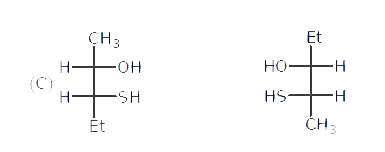
(a) CH_(3)CH_(2)CH=CH_(2) (b) CH_(3)-CH=CH-CH_(3) (c) CH_(3)-underset(CH_(3))underset(|)C=CH_(2) (d) Define relations between a,b,c,d ?

Answer»

Solution :`a` and `b-` Position ISOMERISM : `a` and `C -` Cjaom osp,eros,
`a` and `d-` RING CHAIN isomerism : `b` also show GEOMETRICAL isomerism
90871.

(a) (CH_3)_3Nis basic, but (CF_3)_3 Nis not basic. Explain. (b) Electron affinity of Chlorine is more than fluorine. Explain.

Answer»

SOLUTION :(a) `(CH_3)_3 N ` is basic because there is a lone pair of electrons present on N-atom which is available for sharing with a proton.
Trigonal pyramidal structure, In `(CF_3)_3N`the electron density on N atom is very much decrease due to - I effect of `CF_3`groups. Hence, lone pair of electron is not available for sharing with proton and `CF_3`groups are bulky and causes steric HINDRANCE.

(b) Chlorine has more electron affinity than fluorine. This is because of more electron-electron repulsion in compact 2p subshell of fluorine as COMPARED to 3p subshell of chlorine.
`Cl_17 ,1S^(2) 2s^(2) 2p^(6) 3s^(2) 3p^(5)`
`F_9 , 1s^(2) 2s^(2) 2p^(5)`
90872.

(A) : CH_3CHOforms aldol in presence of NaOH . (R) : Allylic hydrogen is involved in the formation of CH_3CH = CHCHO

Answer»

Both A & R are TRUE, R is the CORRECT EXPLANATION of A
Both A & R are true, R is not correct explanation of A
A is true, R is false
A is false, R is true

ANSWER :B
90873.

(A) (CH_(3))_(3)C-COOH does not give HVZ reaction. (R) It does not have any alpha-hydrogen.

Answer»

If both (A) and (R) are CORRECT and (R) is the correct EXPLANATION of (A).
If both (A) and (R) are correct but (R) is not correct explanation of (A).
If (A) is correct but (R) is INCORRECT.
If (A) is incorrect but (R) is correct.

ANSWER :A
90874.

(A): (CH_(3))_(3)C-ONa and CH_(3)Br react together to form (CH_(3))_(3)C-O-CH_(3) (R): Good yields are obtained when sodium tert.alkoxide is treated with 1^(@) alkyl halide

Answer»

Both (A) and (R) are TRUE and (R) is the correct EXPLANATION of (A)
Both (A) and (R) are true and (R) is not the correct explanation of (A)
(A) is true but (R) is false
Both (A) and (R) are false

Answer :A
90875.

A :CH_(3) - underset(O)underset(||)(C)-COOHgives haloform reaction.R :It is more acidic than acetic acid .

Answer»

If both Assertion & REASON are true and the reason is the CORRECT EXPLANATION of the assertion, then MARK (1)
If both Assertion & Reason are true but the reason is not the correct explanation of the assertion, then mark (2)
If Assertion is true statement but Reason is false , then mark (3)
If both Assertion and Reason are false statements , then mark (4)

Answer :B
90876.

(a). CH_(3)-CHOunderset(Delta)overset(SeO_(2))to (b). Me_(2)CO underset(Delta)overset(SeO_(2))to (c). H_(3)C-CH_(2)-overset(O)overset(||)(C)-CH_(3)underset(Delta)overset(SeO_(2))toP_(1)overset(mCPBA)toP_(2)overset(LAH)toP_(3). (f). CH_(3)-CH=CH_(2)overset(?)to"acrolein" (g). (h). CH_(3)-overset(O)overset(||)(C)-Hoverset(SeO_(2))toH-overset(O)overset(||)(C)-overset(O)overset(||)(C)-Hoverset(conc. NaOH)toP_(1)overset(H^(+)//Delta)toP_(2)

Answer»

Solution :
(h). `[CH_(3)-OVERSET(O)overset(||)(C)-Hoverset(SeO_(2))toH-overset(O)overset(||)(C)-overset(O)overset(||)(C)-H overset(Conc.NaOH)HCOONa+CH_(3)OH overset(H^(+)//Delta)toHCOOH+CH_(3)OH]`
90877.

(a) CH_(3)-CH=CH-CH=CH-C_(2)H_(5) (Molecule with dissimilar ends). Here n=2, So Number of G.I = 4 [cis, cis), (trans, trans), (cis, trans,), (trans, cis)] (b) CH_(3)-CH=CH-CH=CH-CH_(3) (Molecule with similar ends) Here n=2, So Number of G.I =3 [(cis, cis), (trans, cis), (cis, trans) = (trans, cis)] (c) CH_(3)-CH=CH-CH=CH-CH=CH-CH_(3) (Molecule with similar ends) Here n=3, So Number of G.I =6 [(cis, cis, trans)= (trans, cis, cis) (cis, trans, trans) = (trans, trans, cis), (cis, cis, cis) (trans, trans, tans), (cis, trans, cis, (trans, cis, trans)] (d) Let us draw the total stereoisomers ofCH_(3)-overset(***)(underset(overset(|)(OH))(CH))-overset(***)(underset(overset(|)(OH))(CH))-overset(***)(underset(overset(|)(OH))(CH))-CH_(3) (e) Let us draw the total stereoisomers of CH_(3)-overset(***)(underset(overset(|)(OH))(CH))-overset(***)(underset(overset(|)(OH))(CH))-CH_(3) (f) Let us draw the total stereoisomers of CH_(3)-CH(OH)-CH_(2)-CH=CH-CI

Answer»

Solution :n=3 (odd CHIRAL centers with similar ends.) so,
Total STEREOISOMERS `=2^(3-1) = 2^(2) = 4 ("enantlomers " = 2^(n-1) - 2^((n-1)/(2)) " & MESO compounds "=2^((n-1)/(2)))`

So, total isomers `=2^(n-1) + 2^((n)/(2)-1) ("enantiomers "=2^(n-1) " & meso compounds "=2^((n)/(2)-1))`

Total stereo cneters (n) = 1+1 = 2 (Molecule with dissimilar ends)
So, total stereoisomers`=2^(2) = 4` [(R, CIS), (R, trans), (S, cis), (S, trans)]
90878.

A: Ce^(+4) is a good oxidizing agent.R: Sm^(+2) is a good reducing agent

Answer»

If both Assertion & Reason are true and the reason is the correct EXPLANATION of the assertion, then mark (1)
If both Assertion & Reason are true but the reason is not the correct explanation of the assertion, then mark (2)
If Assertion is true statement but Reason is FALSE, then mark (3)
If both Assertion and Reason are false statements, then mark (4)

Answer :B
90879.

A : CH-=C-CH_(2)-CH=CH_(2) adds up HBr to give CH-=C-CH_(2)-underset(Br)underset(|)CH-CH_(3) while CH=underset(Br)underset(|)C-CH=CH_(2) adds up HBr to give CH_(2)=underset(Br)underset(|)C-CH=CH_(2) R : Double bond is always more reactive than triple bond towards electrophillic addition reaction.

Answer»

If both Assertion & Reason are true and the reason is the CORRECT EXPLANATION of the assertion, then mark (1).
If both Assertion & Reason are true but the reason is not the correct explanation of the assertion, then mark (2)
if Assertion is true statement but Reason is false, then mark (3)
If both Assertion and Reason are false statements, then mark (4)

ANSWER :3
90880.

A certaom cirrent liberates 0.504 g of hydrogen in 2 hr. How many gram of copper can be liberated by the same current flowing for the same time in CuSO_4 solution:

Answer»

`12.7`
16
`31.8`
`63.5`

ANSWER :B
90881.

A certain weak acid has a dissociation constant 1.0 xx 10^-4. What is the equilibrium constant for its reaction with a strong base?

Answer»

`1XX10^(-4)`
`1xx10^(-10)`
`1xx10^(10)`
`1xx10^(-14)`

ANSWER :C
90882.

A certain weak acid has a dissociation constant of 1.0 xx 10^(-4). The equilibrium constant for its reaction with a strong base is

Answer»

`1.0 xx 10^(-4)`
`1.0 xx 10^(-10)`
`1.0 xx 10^(10)`
`1.0 xx 10^(14)`

SOLUTION :The equilibrium constant for the NEUTRALIZATION of a weak ACID with a strong base,
`K = (K_(a))/(K_(W)) = (1.0 xx 10^(-4))/(1.0 xx 10^(-14)) = 1.0 xx 10^(10)`
90883.

A certain substane A .Is mixed with an equal amountof a substance, B . At theend of 1.0 hr, A is 70% reacted . Howmuch will it be leftunreacted at the end of 2.5 hr,reaction with respect to Aof firstorder ?

Answer»

`10%`
`5%`
`3%`
`1%`

SOLUTION :`k = (2.303)/t log [A]_(0)/[A]_(n) = ( 2.303)/(1.0) log (100)/30 `
Again ,` k = (2.303)/(2.5)log (100)/x`
Hence, ` (2.303)/(1.0) log (100)/30= (2.303)/(2.5) log 100/x`
` log 100/x = 2.5 log (100)/30`
` log 100/x = 2.5( log100- log 30) `
` 2.5XX 0.5220 = 1.307 `
` 100/x= " antilog 1.307 or 100/x = 20.28`
` orx= 100/(20.28)= 4.93% = 5%`
DENSITY of FEO =4 g/cc
mass of1 unit cell = ` 1.25 xx 10^(-22) xx4 = 5 xx 10^(-22) g `
Mass of 1 molecule`= 72/ ( 6.023 xx 10^(23)) = 1.195 xx 10^(-22) g `
Hence, number of FeO moleculesper unitcell
` (5xx 10^(-22))/(1.195 xx10^(-22)) = 4.18 = 4 `
Hence,there are four` FE^(2+)`and four ` O^(2-)`ionsin each unitcell.
90884.

A certain solution of benzoic acid in benzene boil at 82.6^(@)Cand freezes at 3.1^(@)C. What information about the no of particiles and the structure of benzoic acid at the two temperature can be deduced from the above data ? The boiling point and freezing point of pure benzene are 180.1^(@)C and 5.5^(@)C respectively. K_(r)=5.12 k kg//"mol", k_(b)=2.67 k kg/ mol.

Answer»

SOLUTION :Depression in freezing point
`=5.53-1=2.4`
ELVEATION in boiling point `=82.6-80.1=2.5`
We know that
`DeltaT_(f)=k_(f)xxm`
`rArr m_(1)=(Delta_(f))/(K_(f))=(2.4)/(5.12)=0.468`
And similarly
`DeltaT_(b)=K_(b)xxm_(2)`
`rArr m_(r)=(2.5)/(2.67)=0.936`
From the above CALCULATION it is CLEAR that the molality is half at freezing point as compared to molality at boiling point or we can say that the no. of mols of benzoic acid at its freeing point is half of that at boiling pont, this is possible only when benzoic acid dimerisesat low temperature.
90885.

A certain solid mixed oxide crystallising in the cubic system contains cations M_(1) and M_(2) and the oxide ion O^(2-) Each M_(1) ion is surrounded by 12 equidistant nearest neighbour oxide ions. If the oxide ions occupy face centers of the cubic unit cell, where are the M_(2) ions situated ?

Answer»

At the center of the until cell
At the CORNERS of the cube
At the edge centers
Occupying half the number of edge centers 

Solution :`M_(1)` is situated at the corners then `O^(-2)` ions at the face CENTRES then C.N of `M_(1)` 12 EQUIDISTANCE neighbour oxide ions.
90886.

A certain sample of gas has a volume of 0.2 itre measured to 1 atm. Pressure and 0^(@)C. At the same pressure but at 273^(@)G, its volume will be

Answer»

0.4 litre
0.8 litre
27.8 litre
55.6 litre

Answer :A
90887.

A certain salt (X) gives the following tests: (i) Its aqueous solution is alkaline to litmus. (ii) On strong heating it swells to give a glassy material. (iii) When concentrated sulphuric acid is added to a hot concentrated solution of (X) white crystals of a weak acid separate out. Identify (X) and write down the chemical equations for reactions at steps (i). (ii) and (iii).

Answer»

Solution :The salt (X) swells on heating to give a glassy material, it seems to be borax `Na_(2)B_(4)O_(7)`, a well-known compound showing this property. This is also in accordance with the fact that ite-aqueous solution is alkaline to litmus and its reaction with conc. `H_(2)SO_(4)` to give crystals of a weak acid, `H_(3)BO_(3)` (boric acid). Thus, (X) is `Na_(2)B_(4)O_(7).10H_(2)O`.
Chemical reactions: (i) `UNDERSET("Borax")(Na_(2)B_(4)O_(7))+7H_(2)Otounderset(ubrace"Strong base Weak acid"_("Alkaline"))(2NaOH+4H_(2)BO_(2))`
(ii) `Na_(2)B_(4)O_(7)overset(heat)tounderset("Glassy BEAD")(2NaBO_(2)+B_(2)O_(2))`
(iii) `Na_(2)B_(4)O_(7)+H_(2)SO_(4)+5H_(2)OtoNa_(2)SO_(4)+underset("Boric acid")(4H_(3)BO_(3))`
90888.

A certain sample of beer has a pH of 10. The concentration of hydrogen ions in the beer is :

Answer»

`10^(10)M`
`10^(-2)M`
`10^(-4)M`
`10^(-10)M`

ANSWER :D
90889.

A certain reaction is spontaneous at 85^(@)C . The reaction is endothermicby 34 kJ. The minimum value of DeltaS for the reaction is

Answer»

`497.2 J//K`
`-497.2 J//K`
`+2094 J//K`
cannot be calculated

Answer :A
90890.

A certain reaction is nonspontaneous at 298 K. The entropy change during the reaction is 121 J/K . Is the reaction endothermic or exothermic ? What is the minimum value of DeltaH for the reaction ?

Answer»

Solution :Given that `Delta` +ve for nonspontaneous process.
As, `DeltaG=DeltaH-TDeltaS` and `DeltaS=+121J//K`
`DeltaH` has to be POSITIVE that is the REACTION is endothermic
To calculate the MINIMUM VALUE of `DeltaH`, `DeltaG=0`
`:.DeltaH=TDeltaS`
or `DeltaH=298xx121J`
`DeltaH=36.06kJ`
90891.

A certain reaction is at equilibrium at 82^(@)C and the enthalpy change for the reaction is 21.3 kJ. The value of Delta S (in JK mol^(-1) for the reaction is

Answer»

`55.0`
`60.0`
`68.5`
`120.0`

Solution :At equilibrium, `Delta G = 0`
`Delta G = Delta H - T Delta S = 0`
:. `Delta H = T Delta S`
T = 82 + 273 = 355 K
`Delta S = (Delta H)/(T) = (21.3 XX 1000)/(355K) J mol^(-1)`
`= 60 JK^(-1) mol^(-1)`
90892.

A certain reactant B^(n+) is getting converted to B^((n+4)^(+)) in solution. The rate constant of this reaction is measured by titrating a volume of the solution with a reducing reagent which only reacts with B^(n+)and B^((n + 4)^(+)). In this process, it converts B^(n+)" to "B^((n–2)^(+)) and B^((n+4)^(+))" to "B^((n–1)^(+)). At t = 0, the volume of the reagent consumed is 25 ml and at t = 10 min, the volume used up is 32 ml. Calculate the rate constant of the conversion of B^(n+)" to "B^((n+4)^(+)) assuming it to be a first order reaction.

Answer»

SOLUTION :`0.0207" MIN"^(-1)`
90893.

A certain reactant XO_3^(-) is getting converted to X_2O_7 in solution.the rate constant of this reaction is measured by titrating a volume of the solution with a reducing agent which reacts only with XO_(3)^(-) and X_2O_7.In this process of reduction both the compounds converted to X^(-).At t=0 the volume of the reagent consumed is 30mL and at t=9.212 min.the volume used up is 36 mL.Find the rate constant (in hr^(-1)) of the conversion of XO_3^(-) to X_2O_7 ? Assuming reaction is of I^(st) order (Given that ln 10=2.303, log2=0.30)

Answer»


Solution :`XO_3^(-) to X_2O_7`
a-x
ax6=30`implies a=5`
`(a-x)xx6+(x/2xx16)=36`
`implies x=3`
`k=2.303/9.212"LOG"(5/2)=0.1 "min"^(-1) =6 HR^(-1)`
90894.

A certain radioisotope ""_(Z)^(A)X (t_((1)/(2))=10 days) decays to give ""_(Z-2)^(A-4)Y. If 1 mole of ""_(Z)^(A)X is kept in a sealed vessel, what volume of helium will accumulate in 20 days at NTP?

Answer»

SOLUTION :`""_(Z)^(A)X rarr ""_(Z-2)^(A-4)Y+ ""_(2)^(4)He`
Suppose that x moles of X give x moles of He after 20 days.
`therefore` moles of X after 20 days `=1-x`
Now, we have, `lamda= (2.303)/(t) "log" (N^(0))/(N)= (0.6932)/(t_((1)/(2)))`
or `(2.303)/(20) "log" (1)/(1-x) = (0.6932)/(10)`
x=0.75 mole
`therefore` VOLUME of He at NTP= `0.75 xx 22.4`
=16.8 litres
90895.

A certain radioactive substance has half life period of 10 days. How long will it take for its activity to reduce to 1/8 of its original value ?

Answer»

40 days
20 days
1.25 days
30 days

Answer :D
90896.

A certain radioactive isotope ._(Z)^(A)X(t_(1//2)=100 days decays to ._(Z-2)^(A-8)Y . If 1 mole of ._(Z)^(A)X is kept in sealed container , how much He gas will accumulate at STP in 200 days?

Answer»

11.2 litres
33.6 litres
22.4 litres
44.8 litres

Answer :B
90897.

A certain quantity of electricity is passed through aqueous solution of AgNO_3 andCuSO_4 connected in series, If Ag ( at. Wt. 108 ) deposited at the cathode is 1.08 g then Cu deposited at the cathode is (at. wt. of Cu is 63.53):

Answer»

`6.354`
`0.317`
`0.6354`
`3.177`

ANSWER :B
90898.

A certain quantity of electricity is passed through aq. Al_(2)(SO_(4))_(3) and CuSO_(4) solutions connected in series 0.09 g of Al is deposited on cathode during electrolysis . The amount of copper deposited on cathode in grams is (At., mass of Al = 27 , Cu = 63.6)

Answer»

`3.18`
`0.318`
`31.8`
`0.636`

Solution :A/c. to Faraday's SECOND LAW
`(W_(Al))/(W_(Cu)) = (E_(Al))/(E_(Cu))`
`therefore W_(Cu) = (W_(Al) + E_(Cu))/(E_(Al)) = (0.09 XX 63.6 // 2)/(9) = 0.318 g`
90899.

A certain quantity of electricity is passed through an aquesous solution of AgNO_(3) and cupric salt solution connected in series. The amount of Ag deposited in 1.08gm, the amount of copper deposited is (atomic weight of Cu=63.5,Ag=108)

Answer»

0.6454 g
6.354 g
0.3177 g
3.177 g

Solution :`(WT." of "CU)/("Wt. of AG")=("EQ. wt. of Cu")/("Wt. wt. of Ag"),("Wt. of Cu")/(1.08)=(63.5//2)/(108)`
Wt. of Cu=0.3177gm.
90900.

A certain quantity of electricity is passed through an aqueous solution of AgNO_(3) and cupric salt solution connected in series. The amount of Ag deposited is 10.8 gm . The amount copper deposited is : (At. Wt. of Cu=63.5 and Ag=108)

Answer»

6.35 gm
3.175 gm
0.3175 gm
0.03175 gm

Solution :10.8 G of AG `-=` 0.1F `THEREFORE 0.1F -= 3.17 g of CU`