

Saved Bookmarks
This section includes 7 InterviewSolutions, each offering curated multiple-choice questions to sharpen your Current Affairs knowledge and support exam preparation. Choose a topic below to get started.
| 1. |
Define basicity of an acid and acidity of a base. On the basis of these, explain the classification of acids and bases. Give suitable examples. |
Answer» Solution :Actual concentration of `H^(+)` ions or `OH^(-)` ions in an aqueous solution of an acid or BASE respectively DEPENDS upon the number of `H^(+)` ions or `OH^(-)` ions furnished by one molecule of an acid or base respectively on ionisation. This is GIVEN by basicity of an acid that number of `H^(+)` ions furnished by on molecule of acid and acidity of a base that is number of `OH^(-)` ions furnished by one molecule of base. 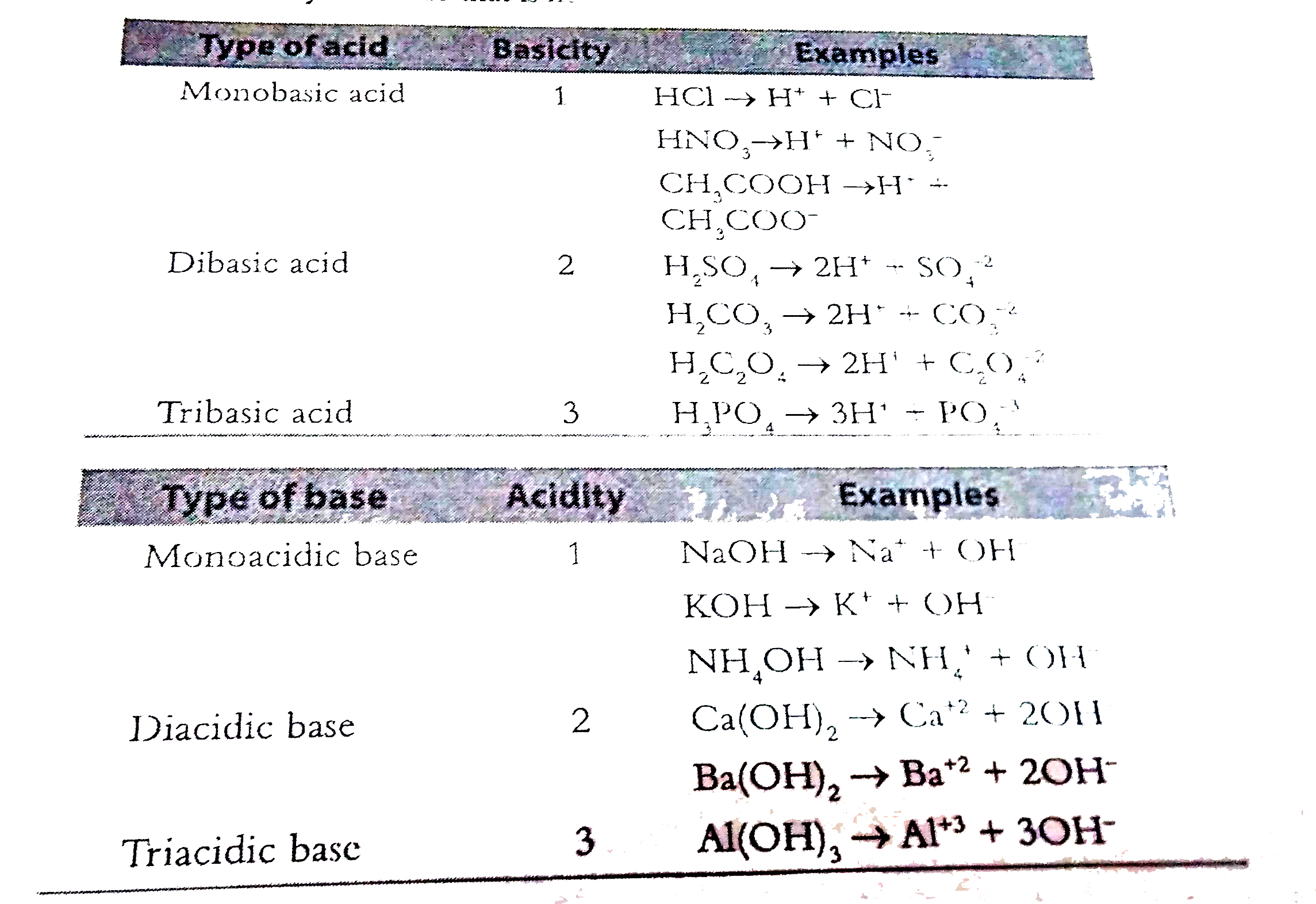
|
|
| 2. |
Deficiency of potassium iodide causes goitre in human beings. |
|
Answer» Solution :False REASON : Deficiency of IODINE CAUSES GOITRE in human BEINGS. |
|
| 3. |
Decomposition of solid ammonium chloride is associated with ___________ change. |
|
Answer» `NH_(4)Cl_((s))toNH_(4)Cl_((g))toNH_(3)+HCl` Hence it involves both physical and chemical changes. |
|
| 4. |
CuSO_(4)+XtoXSO_(4)+Cu,CuSO_(4)+YtoYSO_(4)+Cu,XSO_(4)+YtoNo reaction , CuSO_(4)+ZtoNoreaction,ArrangeCu , X, Y and Z in the ascending order of reactivity. |
|
Answer» X, Y, Z, Cu `:.X`is more REACTIVE than Cu `CuSO_(4)+YtoYSO_(4)+Cu` `:. Y`is more reactive than Cu `XSO_(4)+Yto` No REACTION `:.X`is more reactive than Y `CuSO_(4)+ZTO` No reaction `:.Z` is less reactive than Cu `:.` order is`ZltCu ltYltX` |
|
| 5. |
Cotton clothes can be made more easily wet than synthetic clothes. Explain. |
| Answer» SOLUTION :The forces of attraction between similar MOLECULES is called cohesive forces and that between dissimilar molecules is called adhesive force. In between WATER and cotton molecules adhesive forces act which are predominant over cohesive forces. As a RESULT cotton clothes can be EASILY made more wet than synthetic clothes. | |
| 6. |
Corrosionof a metal involves change in _______. |
|
Answer» CHEMICAL composition |
|
| 7. |
Copy and complete the following table. {:(,"Only one free surface",,),("Solid",,,),(,,,"Spontaneous and rapid diffusion"):} |
| Answer» Solution :`{:("LIQUID","Only one FREE surface","Only some LIQUIDS DIFFUSE",),("Solid","NUMBER of free surfaces","No diffusion",),("Gas","No free surfaces","Spontaneous and rapid diffusion",):}` | |
| 8. |
Copper is mixed with gold to make ornaments because alloying |
|
Answer» increases the hardness of gold. |
|
| 9. |
Composition of water gas is …………….. |
|
Answer» |
|
| 10. |
Compare three different states of matter with respect to the arrangement of molecules and their related parameters. |
Answer» Solution :The comparative study of three different states of MATTER with RESPECT to the arrangement of molecules and other related parameters is PRESENTED below in the tabular FORM. 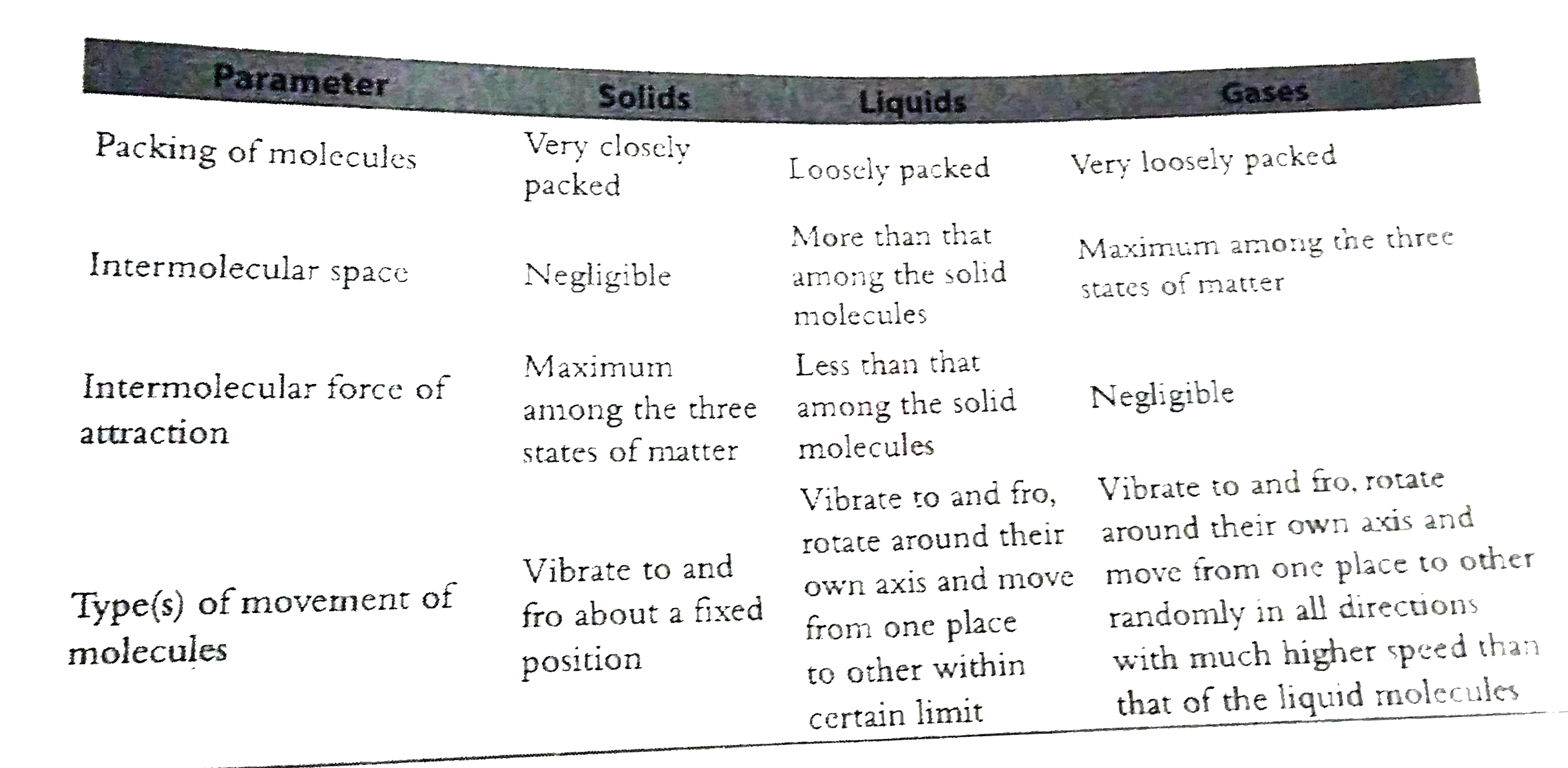
|
|
| 11. |
Compare the density of water at 4^(@)C with that below and above 4^(@)C. |
| Answer» Solution :`({:("TEMPERATURE","""Density"),(0^(@)C "below" 4^(@)C,""lt1g//c c),(4^(@)C,""1g//c c),(gt4^(@)C,""lt1g//c c):})/` | |
| 12. |
Compare solids, liquids and gases with respect to their physical properties. |
Answer» SOLUTION :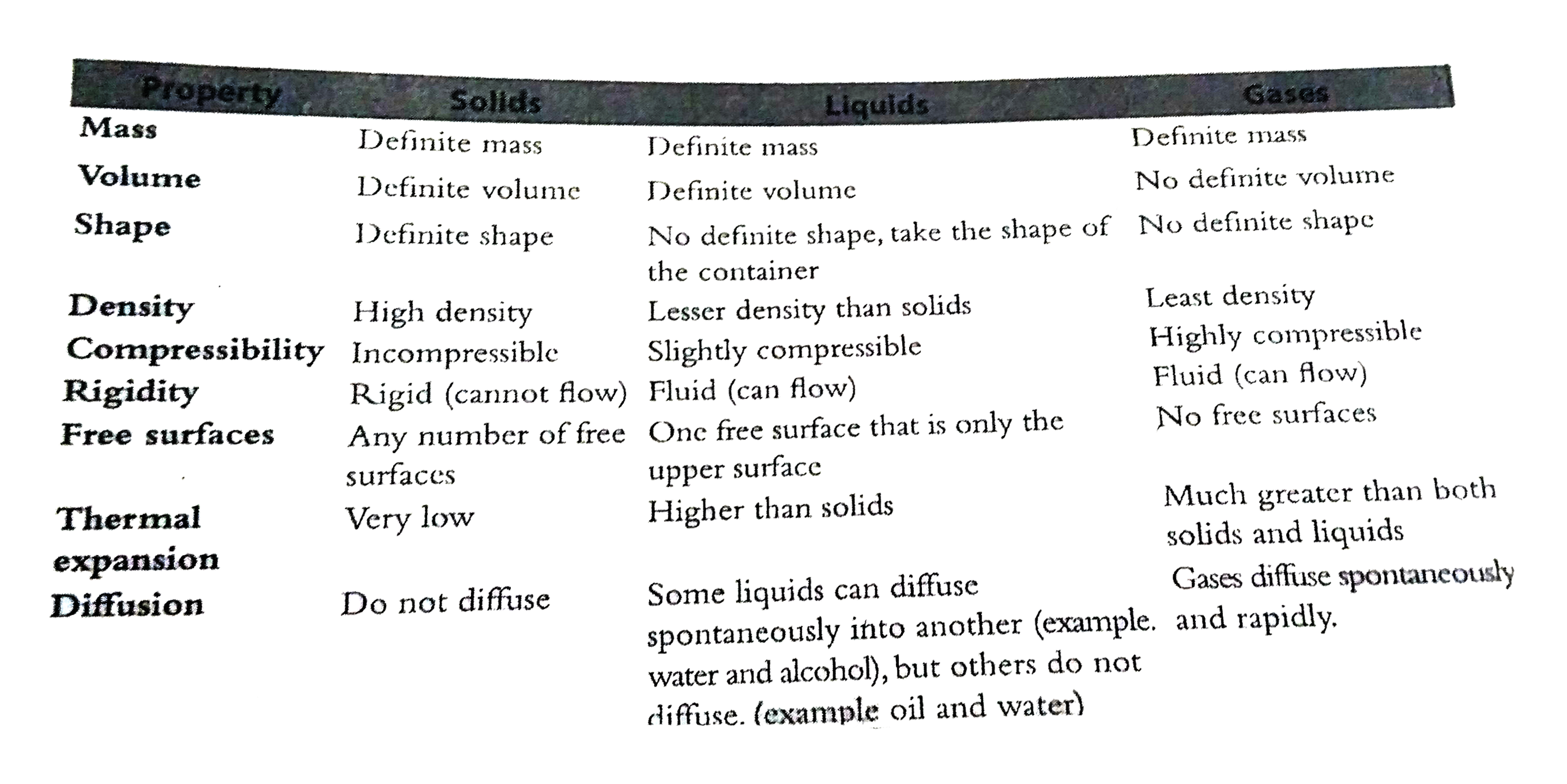
|
|
| 13. |
Compare physical properties of metals and nonmentals |
Answer» SOLUTION :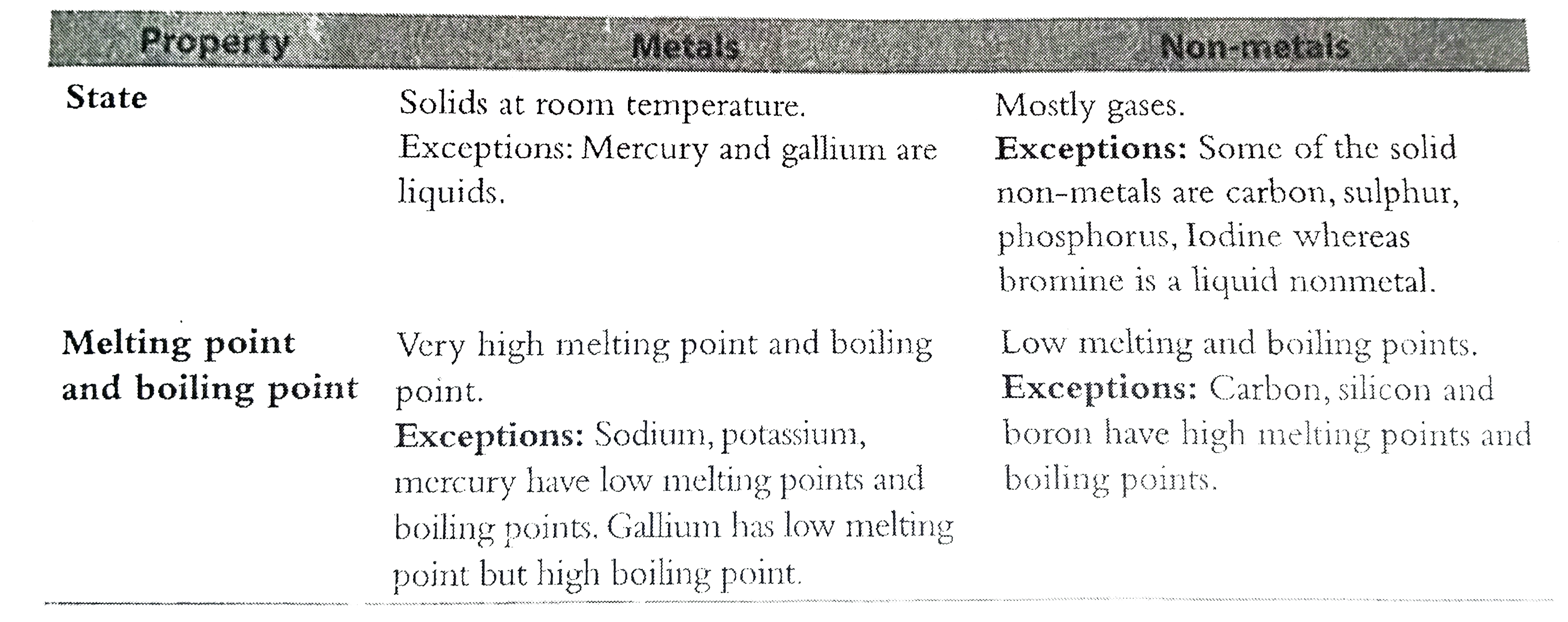 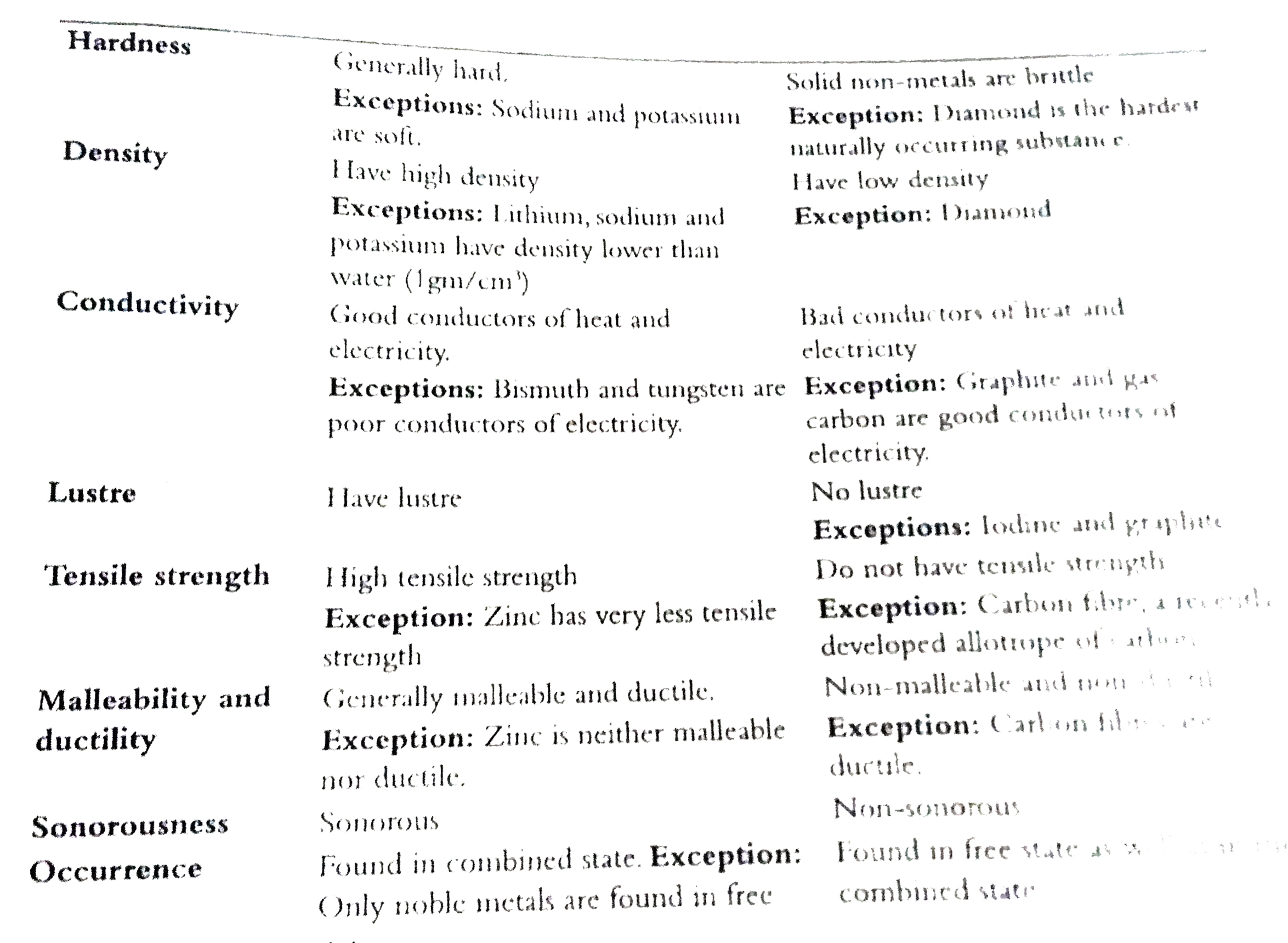
|
|
| 14. |
Compara the mass of proton , neutron and electron? |
|
Answer» Solution :Mass of PROTON is`1.67xx10^(-27)` kg Mass of ELECTRONS is`9.1xx10^(-31)` kg Mass of neutron is`1.72xx10^(-27)` kg |
|
| 15. |
Common salt is a mixture of |
|
Answer» sodium chloride andmagnesium chloride |
|
| 16. |
{:(,"Column A",,,"Column B"),(A.,"Specific heat of water","()",a.,250 cal//g^(@)C),(B.,"Latent heat of fusion of ice","()",b.,0^(@)C),(C.,"Latent heat of vapourisation of Water","()",c.,100^(@)C),(D.,"Temperature at which melting of ice starts under normal atmospheric pressure","()",d.,1 cal//g^(@)C),(E.,"Temperature at which boiling of water starts under normal atmospheric pressure","()",e.,80 cal//g^(@)C),(,,,f.,540 cal//g^(@)C):} |
|
Answer» The latent heat of fusion of ice is 80 `"cal"//g^(@)C`. The latent heat of vapourization of water is 540 `"cal"//g^(@)C`. Ice MELTS at `0^(@)C` Water boils at `100^(@)C`. |
|
| 17. |
{:(,"Column-A",,,"Column-B"),((A),"Sublimation",(),(a),NaCl+"water"),((B),"Filtration",(),(b),"Iodine+sand"),((C),"Evaporation",(),(c),"Sawdust+water"):} |
|
Answer» `Atoa" "BTOC" "Ctob` Filtration `to` Sawdust+water, sawdust floats on water Evaporation `to` NaCl+water, NaCl is soluble in water and undergose evaporation on heating |
|
| 18. |
{:(,"Column A",,,"Column B"),(A.,"Sedimentation","()",a.,"Softened water"),(B.,"Filtration","()",b.,"Additional of alum"),(C.,"Chlorination","()",c.,"Removal of suspended impurities"),(D.,"Permutit","()",d.,"Purification of drinking water"):} |
|
Answer» B - c FILTRATION is the PROCESS by which suspended IMPURITIES can be REMOVED. C - d Chlorination is the process used for disinfecting drinking water. D - a Permutit process is used to soften the HARD water. |
|
| 19. |
{:(,"Column A",,,"Column B"),(A.,"Sodium dihydrogen phosphate",(),a.,"Basic salt"),(B.,"Calcium hydroxy chloride",(),b.,"Gun powder"),(C.,"Nitre",(),c.,"Manufacture of glass"),(D.,"Ammonium carbonate",(),d.,"Acidic salt"),(,,(),e.,"Normal salt"),(,,,f.,"Smelling salt"):} |
|
Answer» B `rarr` a Calcium HYDROXY chloride is a basic salt. C `rarr` b, e Nitre is one of the components PRESENT in gunpowder. It is a normal salt. D `rarr` f Ammonium CARBONATE is called smelling salt. |
|
| 20. |
{:(,"Column A",,,"Column B"),(A.,"Removal of hardness by boiling","()",a.,"Resins"),(B.,"Clark's method","()",b.,"Can remove temporary and permanent hardness"),(C.,"Addition of washing soda","()",c.,"Decomposition reaction"),(D.,"Ion exchange method","()",d.,"Addition of slaked lime"):} |
|
Answer» Clark's method involves the addition of slaked lime to water either in solid or liquid form to remove temporary hardness. Addition of washing SODA helps in removing both temporary and PERMANENT hardness. Ion exchange method consists of solids called ion exchange resins. |
|
| 21. |
{:(,"Column A",,,"Column B"),(A.,"Potable water","()",a.,"Electrolysis"),(B.,"Distilled water","()",b.,"Irrigation"),(C.,"Acidulated water ","()",c.,"Pure water"),(D.,"River water","()",d.,"Laboratory purpose"),(,,"()",e.,"Human consumption"):} |
|
Answer» B - d, CRAIN water is pure water which is used for LABORATORY PURPOSE. C - a Acidulated water is used as an electrolyte in electrolysis process. D - b River water is used for irrigation purposes. |
|
| 22. |
{:(,"Column A",,,"Column B(Acidic)"),(A.,"Methyl orange",(),a.,"Red"),(B.,"Phenolphthalein",(),b.,"Yellow"),(C.,"Turmeric",(),c.,"Colourless"),(D.,"Litmus",(),d.,"Blue"),(,,(),e.,"Pink"):} |
|
Answer» B `rarr` cPhenolpthalein is colourless in acidic solution. C `rarr` bTurmeric shows YELLOW colour in acidic solution. D `rarr` aLitmus when added to acidic solution gives red colour. |
|
| 23. |
{:(,"Column A",,,"Column B"),(A.,"Hard water","()",a.,"Reverse osmosis"),(B.,"Soft water","()",b.,"Rain water"),(C.,"Desalinated water","()",c.,"Presence of "Ca^(+2)andMg^(2+)),(D.,"Lake water","()",d.,"Scum formation"),(,,"()",e.,"Lather formation"):} |
|
Answer» B - e Soft water forms lather with soap. C - a Reverse osmosis process is USED for desalination. D - b Rain water is the PUREST form of natural water stored in lakes. |
|
| 24. |
{:(,"Column A",,,"Column B"),(A.,"Nitric acid",(),a.,"Weak acid"),(B.,"Phosphoric acid",(),b.,"Strong acid"),(C.,"Calcium hydroxide",(),c.,"Car batteries"),(D.,"Sulphuric acid",(),d.,"Bleaching powder"),(,,(),e.,"Baking powder"):} |
|
Answer» B `rarr` a Phosphoric acid is a weak acid C `rarr` d Calcium HYDROXIDE is USED in the MANUFACTURE of bleaching powder D `rarr` c, b Sulphuric acid is used in the CAR batteries and it is a strong acid |
|
| 25. |
{:(,"Column A",,,"Column B"),(A.,"Green vitriol",(),a.,Na_(2)CO_(3) 10H_(2)O),(B.,"Blue vitriol",(),b.,MgSO_(4) 7H_(2)O),(C.,"Epsom salt",(),c.,FeSO_(4) 7H_(2)O),(D.,"Washing soda",(),d.,CuSO_(4) 5H_(2)O),(,,(),e.,CaSO_(4) 1//2 H_(2)O):} |
|
Answer» B `rarr` dFormula of blue vitriol is `CuSO_(4)*5H_(2)O` C `rarr` bFormula of epsom SALT is `MgSO_(4)*7H_(2)O` D `rarr` aFormula of washing soda is `Na_(2)CO_(3)*10H_(2)O` |
|
| 26. |
{:(,"Column A",,,"Column B"),(A.,"Defecation by living being","()",a.,"Arsenic, mercury etc"),(B.,"Industrial operation","()",b.,"Intesecticides, fungicides etc"),(C.,"Thermal pollution","()",c.,"Amoeba, fungicides etc"),(D.,"Agricultural activities","()",d.,"Favourable for growth of algae"):} |
|
Answer» Industrial operation produces pollutants such as MERCURY, ARSENIC etc. Water RELEASED from THERMAL POWER plants is favourable for growth of alge. Agricultural activities produces pollutants such as intesecticides, fungicides etc. |
|
| 27. |
{:(,"Column A",,,"Column B"),(A.,"Efflorescent",(),a.,"Cobalt chloride"),(B.,"Deliquescent",(),b.,"Sodium chloride"),(C.,"Hygroscopic",(),c.,"Zinc chloride"),(D.,"Food additive",(),d.,"Mercuric nitrate"),(,,(),e.,"Washing soda"):} |
|
Answer» B `rarr` c, d ZINC CHLORIDE and mercuric nitrate are examples of deliquescent substance. C `rarr` a Cobalt chloride is an example of hygroscopic substance. D `rarr` b Sodium chloride is used as food additive. |
|
| 28. |
{:(,"Column A",,,"Column B"),(A.,"Carbonic acid",(),a.,"Baking Powder"),(B.,"Tartaric acid",(),b.,"Antacid"),(C.,"Caustic soda",(),c.,"Soft drinks"),(D.,"Milk of magnesia",(),d.,"Additive in food stuffs"),(,,(),e.,"Soap industry"):} |
|
Answer» B `rarr` aTartaric acid is a component of BAKING POWDER. Tartaric acid is used in making cakes for baking process. C `rarr` eSodium hydroxide is used in soap industry. D `rarr` bMagnesium hydroxide is used as ANTACID to NEUTRALISE the acidity. |
|
| 29. |
Cold countries, water pipes burst in winter. Explain. |
| Answer» Solution :In cold COUNTRIES, the temperature is below `0^(@)C`. The WATER present in the pipes EXPANDS during freezing. As a result, ice exerts HUGE pressure on the pipes and they burst. | |
| 30. |
CO_(2) can be used to preserve food grains from destruction by insects. |
|
Answer» |
|
| 31. |
CO_(2) can be clooected by the downward displacement of air. |
| Answer» SOLUTION :`CO_(2)` can be collected by UPWARD DISPLACEMENT of air as `CO_(2)`is DENSER than air. | |
| 32. |
Clood formation almost doesn't take place in the stratoshere because |
|
Answer» the high termperature of layer does not allow the water vapour to reach this layer. |
|
| 33. |
Classify the elements based on atomicity with examples. |
|
Answer» Solution :The number of atoms that constitute a MOLECULE of an element is CALLED atomicity of that element. A molecule of HYDROGEN is MADE up of two atoms and hence its stomicity is two. BASED on the atomicity, elements can be classified as follows: (i) Monoatomic elements : The elements in which each molecule contains only one atom. Example : `Cu,Ag,He` etc (ii) Diatomic elements : The elements in which each molecule contains two atoms. Example : `H_(2),O_(2)N_(2)` etc (iii) Polyatomic elements : The elements in which each molecule contains more than two atoms. Example : `O_(3),P_(4),S_(8)` etc |
|
| 34. |
Chile salt petre is used in the manufuacture of _________ (nitric acid/ nitrous acid) |
|
Answer» |
|
| 35. |
Chile salt petre is used in the manufuacture of nitric acid. |
|
Answer» |
|
| 36. |
Chile salt petre and nitre are respectively |
|
Answer» sodium nitrate and potassium nitrate |
|
| 37. |
Chemical treatment of surface water can be carried out by the addition of |
|
Answer» bleaching power |
|
| 39. |
Characterstic reactions for four different substances are given below. Arrange the tests in the order of the substances given below. (i) P_(2)O_(s) (ii) CO_(2) (iii) O_(2) (iv) SO_(2) (a) Passage through potassium dichromate turns green. (b) Dissolu in water gives tribasic acid. (c ) Non-supporter of combustion but allows active metals continue to burn. (d) Turns alkaline pyrogallol brown. |
|
Answer» bdca `CO_(2)` is a non-suporter of COMBUSTION,but allows burning of active metals. (iii) OXYGEN turns ALKALINE pyrogallol brown. (iv) `SO_(2)` When passed through potassium dichromate turns the solution from orange to green. |
|
| 40. |
Certain statements which describe different types of salts are given below. (a) Two basic and one acidic radicals are present in one molecule of this salt. (b) This salt reacts further with a base. (c) This salt consists of one basic radical and one acidic radical and does not react further either with an acid or with a base. (d)This salt is a combination of two simple salts. (e) This salt reacts further with an acid. Arrange the statements in the following order. {:((i),"Acidic salt",(ii),"Basic salt"),((iii),"Normal salt",(iv),"Double salt"),((v),"Mixed salt",,):} |
|
Answer» becda (i) This salt reacts further with a BASE. (ii) This salt reacts further with an acid. (iii) This salt CONSISTS of one basic radical and one ACIDIC and does not react further either with an acid or with a base. (iv) This salt is a combination of two simple SALTS. (v) Two basic and one acidic RADICALS are present in one molecule of this salt. |
|
| 41. |
Cement replaces lime mortar in thefield of construction. Explain. |
| Answer» Solution :Both cement mortar and lime mortar are used for construction since they get HARDENED on exposure to air. But, cement is a stronger binding material than lime and due to COMPLEX chemical REACTIONS, it forms a HARDER MASS over a period of time. Moreover, oncombining withgravel, it forms concrete which is much harder. Its strength is further enhanced when used in combination with steel in the form of RCC. Therefore, cement replaces lime mortar as a better construction material. | |
| 42. |
Cation exchange resin is regenerated by passing HCl solution. |
|
Answer» |
|
| 44. |
Carbon dioxide on dissolution in water forms ______. |
|
Answer» Carbon DIOXIDE on DISSOLUTION in WATER forms carbonic acid. |
|
| 45. |
Carbon dioxide is used for extinguishing fires caused by petroleum products but not fires caused by metals like Na or Mg. Explain. |
| Answer» Solution :Active metals LIKE Na, Mg reacts with carbon dioxide and forming corresponding oxide and carbon MONOXIDE in trace amoundts which is harmful gas and also supported of COMBUSTION. And HENCE fires coused by metals like Na and Mg can not be exitinguished by `CO_(2)`. | |
| 46. |
Carbohydrates are the compounds of carbon, hydrogen and oxygen. |
|
Answer» REASON : Carbohydrates generally contian carbon, HYDROGEN and OXYGEN. |
|
| 47. |
Carbogen is a mixture of 94% oxygen 4% carbon and 2% nitrogen dioxide. |
| Answer» SOLUTION :Carbogen is a mixture of 95% oxygen and 5% CARBON DIOXIDE | |
| 48. |
Camphor pellets should be preserved in air tight containers. Give reasons. |
| Answer» Solution :The process of conversion of SOLID state to vapour state directly without passing through the intermittent LIQUID state is called SUBLIMATION. Camphor undergose sublimation at atmospheric pressure. As a result, camphor PELLETS should be PRESERVED in air tight containers. | |
| 49. |
Calculate the volume of nitrogen, oxygen and carbon dioxide in 750 1 of air. |
|
Answer» Solution :In 100 liters of AIR volume of nitrogen = 78.10 l Volume of nitrogen in 750 `=(78.1xx750)/(100)` = 585.75 l Volume of oxygen in 100 LITER of air = 21 l Volume of oxygen in 750 litres `=(21xx750)/(100)` = 157.5 l =157.5 l Volume of `CO_(2)` in litres of air = 0.03 l Volume of `CO_(2)` in 750 litres`=(0.03xx750)/(100)` =0.225 l =225 ML |
|
| 50. |
Calculate the ratio of the amount of heat energy lost during the conversion of 20 g of water at 0^(@)C to ice at 0^(@)C to heat energy gained during the conversion of same amount of water at 100^(@)C to steam at 100^(@)C. |
|
Answer» Solution :Latent heat of fusion or FREEZING is 80 cal/g that is 1 g of ice requires80 cal 20 g ice requires ? = 20 + 80 = 1600 cal Latent heat of VAPOURISATION of WATER is 540 kg cal/gthat is 1 g water requires 540 cal 20 g water requires ? `20 xx 540` = 10800 cal `therefore` Ratio = 1600 : 10800 = 1 : 6.75 |
|