

Saved Bookmarks
This section includes 7 InterviewSolutions, each offering curated multiple-choice questions to sharpen your Current Affairs knowledge and support exam preparation. Choose a topic below to get started.
| 1. |
Identify the quantifier in the statement and write the negation of the statement.There exists a number which is equal to its square. |
| Answer» SOLUTION :Each NUMBER is not EQUAL to its SQUARE. | |
| 2. |
If x=a+b, y=a omega+b omega^2,z=a omega^2+bomega show thatxyz =a^3+b^3 |
|
Answer» SOLUTION :`L.H.S.=xyz=(a+b)(aomega+bomega^2)(a OMEGA^2+b omega)` `=(a+b)(a^2omega^3+abomega^2+abomega^4+b^2omega^3)` `=(a+b){a^2+b^2+ab(omega^2+omega)}` `=(a+b){a^2-b^2+ab(omega^2=omega)}` `=(a+b)(a^2-ab+b^2)=a^3+b^3="R.H.S.(PROVED)"` |
|
| 3. |
Find (dy)/(dx) if 2x+3y=sinx |
| Answer» SOLUTION :DIFFERENTIATING throughout w.r.t.x, we GET `d/DX(2x)+d/dx(3y)=d/dx(sinx)2+3(DY)/(dx)=cosx3(dy)/(dx)=cosx-2,(dy)/(dx)=(cosx-2)/3` | |
| 4. |
Evaluation of definite integrals by subsitiution and properties of its : int_(0)^(pi/2)(2^(sinx))/(2^(sinx)+2^(cosx))dx=......... |
| Answer» ANSWER :A | |
| 5. |
Differentiate w.r.t.x the function in Exercises 1 to 11. (x)^(log x), x gt 1. |
| Answer» | |
| 6. |
If |x| is so small that x^(2) and higher powers of x may beneglected then the approximate value of (sqrt(4+x)+root(3)(8-x))/((1-(2x)/(3))^(3/2)) when x = (6)/(25) is |
| Answer» ANSWER :B | |
| 7. |
If (omega ne1) is a cube root of unity , then {:(1 , 1 + i+ omega^(2) , omega^(2)) , (1-i, -1 , omega^(2) -1) , (-i , -1 + omega - i, -1):}| |
| Answer» ANSWER :A | |
| 8. |
Evaluate the following integrals. int(3x-2)sqrt(2x^(2)-x+1)dx |
|
Answer» |
|
| 9. |
One of the value of [cos(pi//6)-isin(pi//6)]^(11//2)/[cos(pi//6)+isin(pi//6)]^(1//2) is |
|
Answer» 1 |
|
| 10. |
If A=[a" "b],B=[-b" "-a]andC=[{:(a),(-a):}]then out of the following ……… statement is true. |
|
Answer» A=-B |
|
| 11. |
Which set of magnitude of vectors can give null vector ? |
|
Answer» 2,2,4,9 |
|
| 12. |
A point M divides A and B in the ratio 1:2 where A and B diametrically opposite ends of a circle x^(2)+y^(2)-5x-9y+22=0 square AMCD and BMEF on the length AM and MB are constructed on the same side of line AB if co-ordinates of A is (1,3) then find the orthocentre of DeltaABE |
|
Answer» `(1,6)` 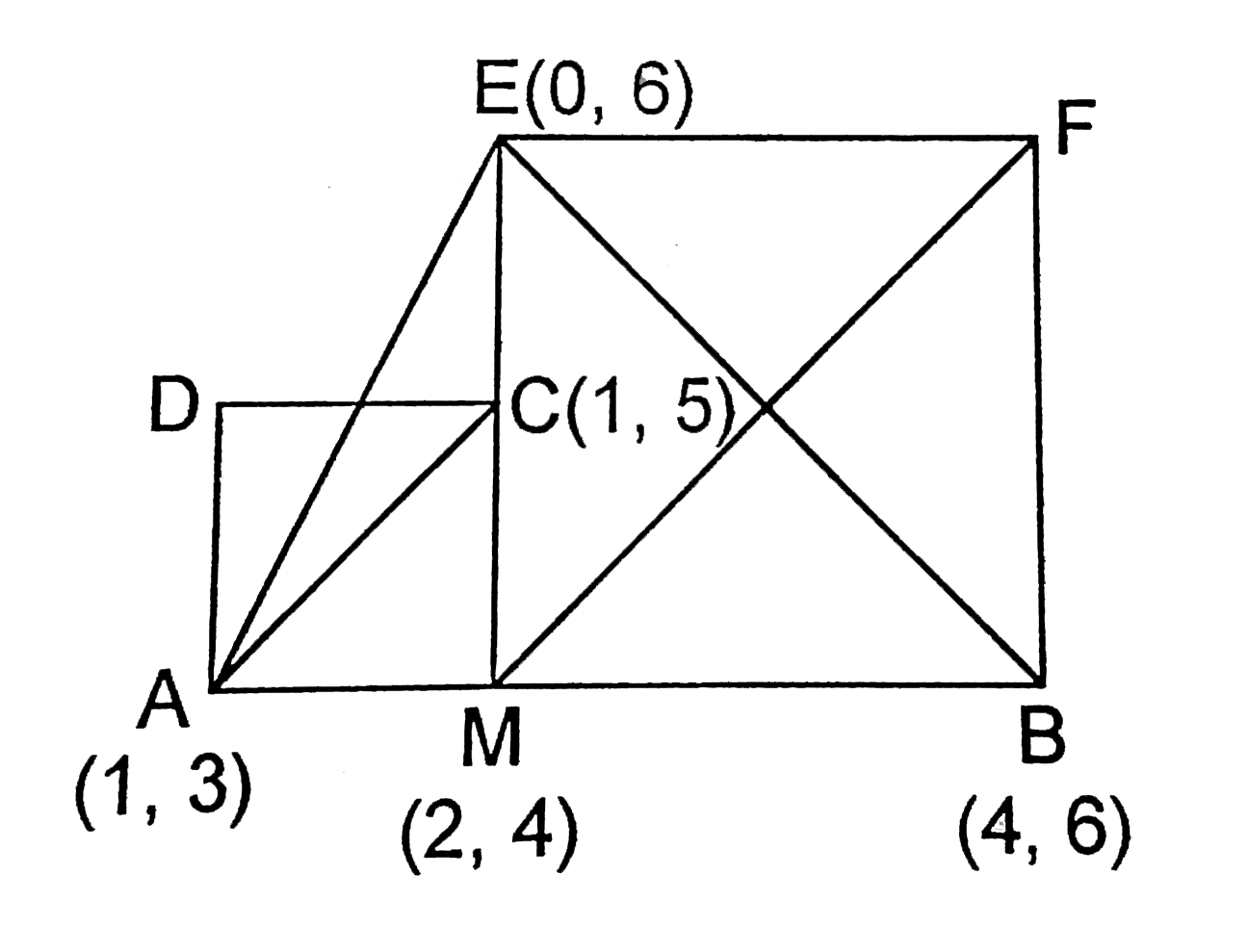
|
|
| 13. |
If for n gt 1, P_(n)=int_(1)^(e ) ( logx)^(n)dx, then P_(10)-90P_(8)is equal to: |
| Answer» Answer :3 | |
| 14. |
Let overset(-)a be a unit vector overset(-)b=2hati+hatj-hatk and overset(-)c=hati+3hatk. Then maximum value of [overset(-)a overset(-)b overset(-)c] is |
| Answer» Answer :D | |
| 15. |
sin47^(@)+sin61^(@)-sin11^(@)-sin25^(@)= |
|
Answer» `SIN7^(@)` |
|
| 16. |
The locus of the poles of the line 2x+3y-4=0 w.r.t. the circle x^(2)+y^(2)+2lambdax-16=0 is |
|
Answer» `13X^(2)-22xy-14y+48=0` |
|
| 17. |
Let f(x) denotes the number of zeroes in f'(x). If f(m)-f(n)=3, the value of ((m-n)_(max)-(m-n)_(min))/(2) is ........... . |
|
Answer» |
|
| 18. |
An ellipse and a hyperbola have the same centre as origin, the same foci and the minor-axis of the one is the same as the conhugate axis of the other . If e_1,e_2 betheir eccentricities respectively, then e_1^(-2)+e_2^(-2) equals |
|
Answer» 1 |
|
| 19. |
Latus rectum of the parabola whose axis is parallel to the y-axis and which passes through the points (0,4), (1,9) and (-2,6) is equal to |
|
Answer» 2 |
|
| 20. |
If A = [(2,52,152),(4 , 106,358),(6,162,620)] then det (adj ((1)/(2) A)) is equal to _______ . |
|
Answer» |
|
| 21. |
(1^2.2)/(1!) +(2^2.3)/(2!) + (3^2.4)/(3!)+......oo = |
|
Answer» 2e |
|
| 22. |
Statement 1 : Lines vecr=hati+hatj-hatk+lamda(3hati-hatj) and vecr=4hati-hatk+ mu (2hati+ 3hatk) intersect. Statement 2 : If vecbxxvecd=vec0, then lines vecr=veca+lamdavecb and vecr= vecc+lamdavecd do not intersect. |
|
Answer» Both the statements are true, andStatement 2 is the CORRECT explanation for Statement 1. `""[vec(a_(2))-vec(a_(1))vec(b_1)vec(b_2)]=|{:(4-1,,0-1,,-1+1),(3,,-1,,0),(2,,0,,3):}|` `""= |{:(3,,-1,,0),(3,,-1,,0),(2,,0,,3):}|=0` Hence, the lines are COPLANAR. Also VECTOR `vec(b_1) adn vec(b_2)`along which the lines are directed are not collinear. Hence, the lines intersect. When `vecbxxvecd=vec0` , vectors and `vecr=vecc+lamdavecd` are parallel and do not intersect. But this statement is not the correct explanation for Statement 1. |
|
| 23. |
Evaluate the following integrals inte^(x)sin^(2)x dx |
|
Answer» |
|
| 24. |
An urn contains 25 balls of which I0 balls bear a mark 'X' and remaining 15 bear a mark 'Y'. A ball is drawn at random from the urn, its mark is noted down and it is replaced. If 6 balls are drawn in this way, find the probability that i. all will bear 'X'mark ii. not more than 2 will bear 'Y' mark iii. atlest one ball will bear 'Y' mark iv. the number of balls with 'X' marks and 'Y' mark will be equal |
|
Answer» |
|
| 25. |
If s and p are respectively the sum and the product of the slopes of the lines 3x^(2) - 2 xy - 15 y^(2) = 0then s : p is equal to |
|
Answer» `4 : 3` |
|
| 26. |
Match the following . |
| Answer» | |
| 27. |
If 3,-2 are the Eigen values of a non-singular matrix A and |A|=4,then the Eigen values ofare : |
|
Answer» `3/4,(-1)/2` |
|
| 28. |
The point ofinersection of the line vec(r)=(hat(i)-hat(k))+t(3hat(i)+2hat(j)+7hat(k))" and the plane "vec(r)=(hat(i)+hat(j)-hat(k))=8 is |
|
Answer» `(8,6,22)` |
|
| 29. |
If one root of the equation lx^(2)+mx+n=0" is "(9)/(2) (l,m and n are positive integers) and (m)/(4n)=(l)/(m), then l+n is equal to |
|
Answer» `80` |
|
| 30. |
Match the following . |
|
Answer» <P>`{:(P,Q,R,S),(2,1,4,3):}` |
|
| 31. |
If x+1/x=2cos alpha,y+1/y=2cos beta, then xy+(1)/(xy)= |
|
Answer» `cos(pm alpha pm beta)` |
|
| 32. |
If a, b, c, d are in G.P., then (a + b + c + d)^(2) is equal to |
|
Answer» `(a + B)^(2) + (C + d)^(2) + 2(b + c)^(2)` |
|
| 33. |
Show that four points with position vectors 6 hat i - 7 hat j, 16 hat i - 19 hat j - 4 hat k, 3 hat i - 6 hat k and 2 hat i + 5 hat j + 10 hat k are not coplanar. |
|
Answer» |
|
| 34. |
For the curve x= 2a sin t+ a sin t cos^(2) t, y=-a cos^(3) t |
|
Answer» NORMAL is inclined at an ANGLE `(pi)/(2)+1` with x-axis. |
|
| 35. |
Incircle of Delta ABC touches AB, BC, CA at R, P, Q, respectively. If (2)/(AR)+(5)/(BP)+(5)/(CQ)=(6)/(r ) and the perimeter of the triangle is the smallest integer, then answer the following questions : The area of Delta ABC is |
|
Answer» 15 sq. units  LET `tan.(A)/(2)= x, tan.(B)/(2)=y, tan.(C )/(2)=z` `therefore x=(r )/(AR), y = (r )/(BP), z=(r )/(CQ)` Put the values of AR, BP and CQ in given RELATION, we GET `(2x)/(r )+(5y)/(r )+(5Z)/(r )=(6)/(r )` `rarr 2x+5y+5z=6` .....(1) Also in the triangle, `xy + yz + zx = 1`.....(2) It we interchange y and z, then both equations (1) and (2) remain unchanged `rArr ABC` is isoceles with `angle B = angle C rArr y =z` So form (1) and (2), we get x = 3 - 5 y.......(3) and `2xy + y^(2)=1` ....(4) Solving we get, `x = (4)/(3), y = z = (1)/(3)` `therefore AR = (3r)/(4), BP= 3r, C = 3r` Now perimeter `2s=2.AR+2.BP+2.CQ=(27r)/(2)` Given perimeter is smallest integer `rarr r =2` `therefore s=(27)/(2)` `therefore Delta = rs = 2xx(27)/(2)=27` sq. unit. |
|
| 36. |
If s = t^(3) - 4t^(2) + 7 the velocity when the acceleration is zero is |
|
Answer» `(32)/(3)` m/sec |
|
| 37. |
Incircle of Delta ABC touches AB, BC, CA at R, P, Q, respectively. If (2)/(AR)+(5)/(BP)+(5)/(CQ)=(6)/(r ) and the perimeter of the triangle is the smallest integer, then answer the following questions : The inradius of incircle of Delta ABC is |
|
Answer» 4  LET `tan.(A)/(2)= x, tan.(B)/(2)=y, tan.(C )/(2)=z` `THEREFORE x=(r )/(AR), y = (r )/(BP), z=(r )/(CQ)` Put the VALUES of AR, BP and CQ in given relation, we get `(2x)/(r )+(5y)/(r )+(5z)/(r )=(6)/(r )` `rarr 2x+5y+5z=6` .....(1) Also in the triangle, `xy + yz + zx = 1`.....(2) It we interchange y and z, then both equations (1) and (2) remain unchanged `rArr ABC` is isoceles with `angle B = angle C rArr y =z` So form (1) and (2), we get x = 3 - 5 y.......(3) and `2xy + y^(2)=1` ....(4) Solving we get, `x = (4)/(3), y = z = (1)/(3)` `therefore AR = (3r)/(4), BP= 3r, C = 3r` Now perimeter `2s=2.AR+2.BP+2.CQ=(27r)/(2)` Given perimeter is smallest integer `rarr r =2` `therefore s=(27)/(2)` `therefore Delta = rs = 2xx(27)/(2)=27` sq. unit. |
|
| 38. |
Incircle of Delta ABC touches AB, BC, CA at R, P, Q, respectively. If (2)/(AR)+(5)/(BP)+(5)/(CQ)=(6)/(r ) and the perimeter of the triangle is the smallest integer, then answer the following questions : Delta ABC is |
|
Answer» scalene  Let `tan.(A)/(2)= x, tan.(B)/(2)=y, tan.(C )/(2)=z` `therefore x=(r )/(AR), y = (r )/(BP), z=(r )/(CQ)` Put the values of AR, BP and CQ in given relation, we get `(2x)/(r )+(5y)/(r )+(5z)/(r )=(6)/(r )` `rarr 2x+5y+5z=6` .....(1) Also in the triangle, `xy + yz + zx = 1`.....(2) It we interchange y and z, then both equations (1) and (2) remain unchanged `rArr ABC` is isoceles with `angle B = angle C rArr y =z` So FORM (1) and (2), we get x = 3 - 5 y.......(3) and `2xy + y^(2)=1` ....(4) Solving we get, `x = (4)/(3), y = z = (1)/(3)` `therefore AR = (3r)/(4), BP= 3r, C = 3r` Now perimeter `2s=2.AR+2.BP+2.CQ=(27r)/(2)` Given perimeter is smallest integer `rarr r =2` `therefore s=(27)/(2)` `therefore Delta = RS = 2xx(27)/(2)=27` SQ. unit. |
|
| 39. |
If f(x) = [4-(x-7)^(3) ] , then f^(-1)(x) = ......... |
|
Answer» |
|
| 40. |
If ath term is independent of x in (sqrtx//7- sqrt5 //x^2 )^10, bth term is independent of x in (7x^(-1//3) - 3x^(1//2))^25 and cth term is independent of x in (3x^2//7+21 //4x)^9 then , the ascending order of a, b, c is |
| Answer» Answer :D | |
| 41. |
Iron filling and water were placed in a 5 litre tank and sealed. The tank was heated to 1273 K. Upon analysis the tank was found to contain 1.10 gram of hydrogen and 42.5 gm of water vapour. If the reaction in the tank is represented by 3Fe(s)+4H_(2)O(g)hArrFe_(3)O_(4)(s)+4H_(2)(g) the equilibrium constant will be- |
|
Answer» `2.949xx10^(-3)` |
|
| 42. |
Find the equation of the circle for which the point given below are the end points of a diameter.(7,-3) ,(3,5) |
|
Answer» |
|
| 43. |
Letz_(1),z_(2),z_(3) be complex numbers, not all real, such that |z_(1)|= |z_(2)| =|z_(3)| = 1 and 2(z_(1) +z_(2)+z_(3)) -3z_(1)z_(2)z_(3) in Rprove that ma (arg z_(1)arg z_(2), argz_(3)) ge pi/6 |
| Answer» | |
| 44. |
If p_(1),p_(2),p_(3) are the principal values of following trigonometric equations I) Sintheta=-1//2 II) Costheta=-sqrt(3)/(2) III) Tantheta=sqrt(3)-2 |
|
Answer» <P>`p_(1)lt p_(2)lt p_(3)` |
|
| 45. |
Evaluate the following integrals. int(1)/(x^(3)+1)dx |
|
Answer» |
|
| 46. |
The x intercept of the tangent to a curve f(x,y) = 0 is equal to the ordinate of the point of contact. Then the value of (d^(2)x)/(dy^(2)) at the point (1,1) on the curve is "_____". |
|
Answer» |
|
| 47. |
Solve the following differential equations.dy/dt=sqrt(1-y^2) |
|
Answer» SOLUTION :`dy/DT=sqrt(1-y^2)rArrdy/sqrt(1-y^2)=dt` `SIN^(-1)y=t+C` |
|
| 48. |
z, if A='[{:(0,2y,z),(x,y,-z),(x,-y,z):}] satisfy A'=A^(-1) |
|
Answer» SOLUTION :We have `A=[{:(0,2y,z),(X,-y,z):}]` and `A=[{:(0,x,x),(2y,y,-y),(z,-z,z):}]` By using elementary row transformation, we get `rArr [{:(0,2y,z),(x,y,-z),(x,-y,z):}]=[{:(1,0,0),(0,1,0),(0,0,1):}]A` `rArr [{:(0,2y,z),(x,y,-z),(0,2y,2z):}]=[{:(1,0,0),(0,1,0),(0,-1,1):}]A [because R_(3)rArrR_(3)-R_(2)]` `rArr [{:(0,2y,z),(x,3Y,0),(0,0,3z):}]=[{:(1,0,0),(1,1,0),(1,-1,1):}]A [{:(becauseR_(3)rArrR_(3),+R_(1)),("and"R_(2)rArrR_(2),+R_(1)):}]` `rArr [{:(-x,-y-z),(x,3y,0),(0,0,z):}]=[{:(0,-1,0),(1,1,0),((1)/(3),(-1)/(3),(1)/(3)):}]A[because R_(1)rArrR_(1)-R_(2)` and `R_(3)rArr(1)/(3)R_(3)`] `rArr[{:(-x,-y,0),(x,3y,0),(0,0,z):}]=[{:((-1)/(3),(-2)/(3),(-1)/(3)),(1,1,0),((1)/(3),(-1)/(3),(1)/(3)):}]A [because R_(10rArrR_(1)-R_(3)]` `rArr [{:(-x,-y,0),(0,2y,0),(0,0,z):}]=[{:((-1)/(3),(-2)/(3),(-1)/(3)),((2)/(3),(1)/(3),(-1)/(3)),((1)/(3),(-1)/(3),(1)/(3)):}]A[because R_(2)rArrR_(2)+R_(1)]` `rArr[{:(-x,0,0),(0,2y,0),(0,0z):}]=[{:(0,(-1)/(2),(-1)/(2)),((2)/(3),(1)/(3),(-1)/(3)),((1)/(3),(-1)/(3),(1)/(3)):}]A[because R_(1)rArrR_(1)+(1)/(2)R_(2)]` `rArr [{:(1,0,0),(0,1,0),(0,0,1):}]=[{:(0,(1)/(2x),(1)/(2x)),((1)/(3y),(1)/(6y),(-1)/(6y)),((1)/(3z),(-1)/(3z),(1)/(3z)):}]A[because R_(1)rArr(-1)/(x)R_(1)R_(2)rArr(1)/(2y)R_(2) "and" R_(3)rArr(1)/(2)R_(3)]` `[{:(0,(1)/(2x),(1)/(2x)),((1)/(3y),(1)/(6 y)),(-1)/(6y)),((1)/(3z),(-1)/(3z),(1)/(3z)):}]=[{:(0,x,x),(2y,y,-y),(z,-z,z):}]` `rArr (1)/(2x)=xrArr=+-(1)/sqrt(2)` `rArr (1)/(6y)=yrArry=+-(1)/sqrt(6)` and `(1)/(3z)=zrArrz=+-(1)/sqrt(3)` Alternate method We have, `A=[{:(0,2y,z),(x,y,-z),(x,-y,-z),(x,-y,z):}]` and `A=[{:(0,x,x),(2y,y, -y),(z,-z,z):}]` ALSO, `A'=A^(-1)`' `rArr A A'=A A^(-1) [because A A^(-1)=I]` `rArr A A=I` `rArr[{:(0,2y,z),(x,y,-2),(x,y,-z),(x,-y,z):}][{:(0,x,x),(2y,y,-y),(z,-z,z):}]=[{:(1,0,0),(0,1,0),(0,0,1):}]` `rArr[{:(4y^(2)+z^(2),2y^(2)-z^(2),-2y^(2)+z^(2)),(2y^(2)-z^(2),x^(2)+y^(2)+z^(2),x^(2)-y^(2)-z^(2)),(-2y^(2)+z^(2),x^(2)-y^(2)-z^(2),x^(2)+y^(2)+z^(3)):}]=[{:(1,0,0),(0,1,0),(0,0,1):}]` `rArr 2y^(2)-z^(2)=0rArr2y^(2)=z^(2)` `rArr 4y^(2)+z^(2)=1` `rArr 2.z^(2)+z^(2)=1` `z=+-(1)/sqrt(3)` `therefore y^(2)=(z^(2))/(2)rArry=+-(1)/sqrt(6)` Also, `x^(2)+y^(2)+z^(2)=1` `rArr x^(2)=1-y^(2)-z^(2)=1-(1)/(6)-(1)/(3)` `=1-(3)/(6)=(1)/(2)` `rArr x=+-(1)/sqrt(2)` `therefore x=+-(1)/sqrt(2).y=+-(1)/sqrt(6)` and `z=+-(1)/sqrt(3)` |
|
| 49. |
Find the roots ofz^n = (z + 1)^nand show that the points which represent them are collinear. Hence show that these roots are also the roots of the equation, (2sin.(mpi)/(n))^2bar(z)^2+(2sin.(mpi)/n)^2bar(z)+1=0 where m = 1 , 2, 3, ..... (n-1)& |z| is finite. |
|
Answer» |
|
| 50. |
Let f (x) =1+ int _(0) ^(1) (xe ^(y) + ye ^(x)) f (y) dy where x and y are independent vartiables. If complete solution set of 'x' for which function h (x) = f(x) +3x is strictly increasing is (-oo, k) then [(4)/(4) e ^(k) ] equals to: (where [.] denotes greatest integer function): |
|
Answer» 1 |
|