

Saved Bookmarks
This section includes 7 InterviewSolutions, each offering curated multiple-choice questions to sharpen your Current Affairs knowledge and support exam preparation. Choose a topic below to get started.
| 1. |
If a,b,c are in H.P. then which of the following is true. |
|
Answer» `(a)/(1-2a),(b)/(1-2b),( C)/(1-2c)` are in H.P. |
|
| 2. |
Verify that the function y = a cos x + b sin x, where a,b in R is a solution of the differential equation (d^(2)y)/(dx^(2)) + y = 0 |
|
Answer» |
|
| 3. |
Obtain the parametric equation of each of the following circles. (x-3)^(2) + (y-4)^(2) = 8^(2) |
|
Answer» |
|
| 4. |
All the letters of the word 'AGAIN' be arranged and the words thus formed are known as 'Simple Words'. Further two new types of words are defined as follows: (i) Smart word: all the letters of the word 'AGAIN' are being used, but vowels can be repeated as many times as we need. (ii) Dull word: All the letters of the word 'AGAIN' are being used, but consonants can be repeated as many times as we need. Q. Number of 7 letter dull words inw hich no two vowels are together, is |
|
Answer» 402 `{{:("XNXGXNXNX"),("OR"),("XNXGXGXGX"),("OR"),("XNXGXGXNX):}` Hence, required number of ways `=.^(5)C_(3)xx(3!)/(2!)xx{(4!)/(3!)+(4!)/(3!)+(4!)/(2!2!)}` `=30(4+4+6)=420` |
|
| 5. |
A medical company has factories at two places A and B. From these places supply is madeto each of its three agencies situated at P, Q and R. The monthly requirements of the agen cies are respectively 40,40 and 50 packets of the medicines, while the production capacity of the factories A and B are 60 and 70 packets respectively. The transportation costs per packet from the factories to the agencies are given below: |
|
Answer» `(##VVA_ISC_MAT_XII_MTP_16_E01_054_A01##)` Minimum transport cost = rs. 400 |
|
| 6. |
There are ten boxes numbered from 1 to 10 and 10 balls numbered from 1 to 10. If the number of ways of putting all balls in given boxes such that no box remains empty, oddnumbered balls go to odd numbered box and no ball goes to the box having same number which is written on the ball is K^(2), then find K |
|
Answer» |
|
| 7. |
The orthocentre of the triangle with vertices A(0,0), B(0, (3)/(2)), C(-5, 0) is |
|
Answer» `((5)/(2),(3)/(4))` |
|
| 8. |
If AA h in R - {0}, two distinct tangents can be drawn from the points (2+h,3h-1) to the curve y=x^(3)-6x^(2) - a+ bx then (a)/(b) is equal to "_____" |
|
Answer» <P> Let `P` be the POINT of inflection So `P-=(2,2b-a-16)` Equation of tangent line passing through inflection Point: `y=(b-12)x-a+8`…….(1) Let `Q-=(2+h,3h-1)` Locus of `Q:3x-y=7`…….(2) From equation (1) and (2) we GET ! So, `a=15` adn `b=15` 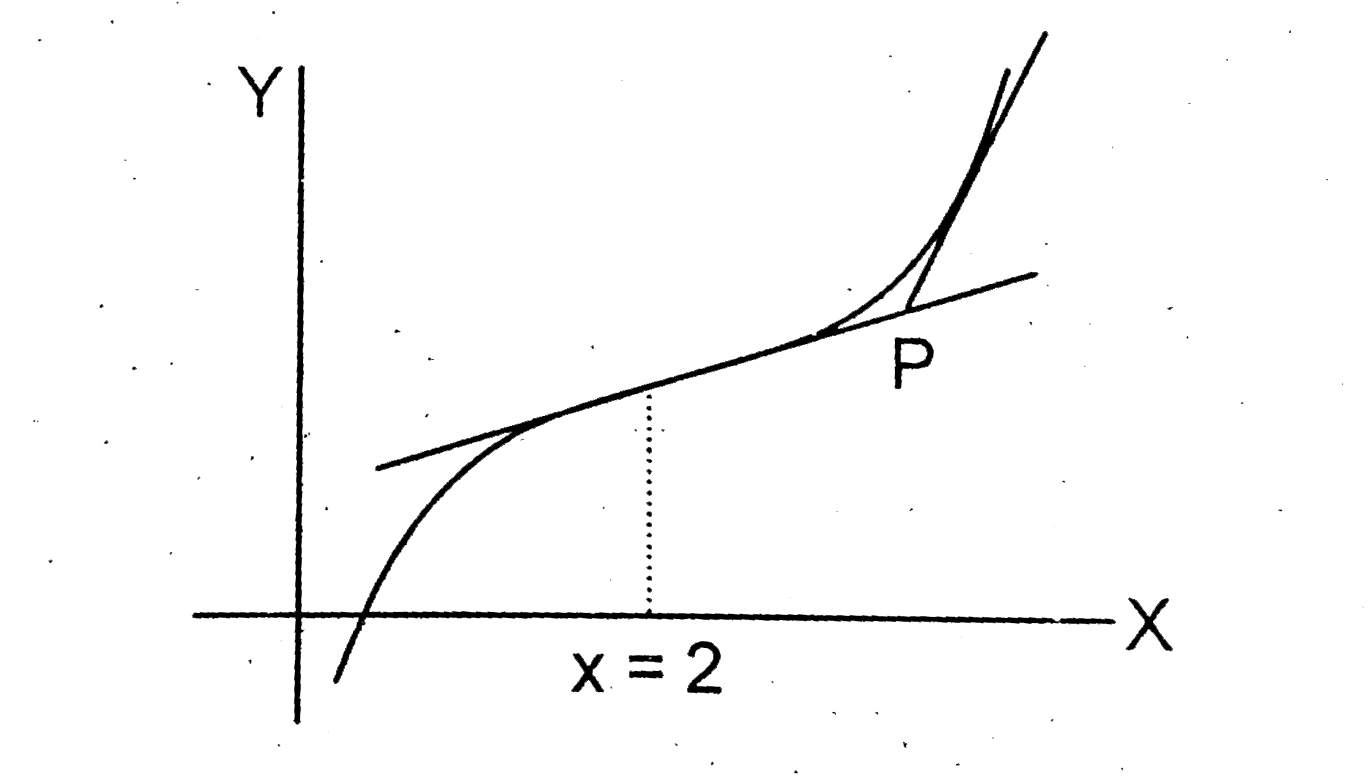
|
|
| 9. |
If n in N,then11^(n+2)+12^(2n +1)is divisibleby |
|
Answer» 113 |
|
| 10. |
Find the acute angle or angle or intersection of the following circles. a. x^(2)+y^(2)-12x-6y+41=0, x^(2)+y^(2)+4x+6y-59=0 |
|
Answer» |
|
| 11. |
A number n is chosen at random from the natural numbers 2 to 1001. The probability that n is a number that leaves remainder 1 when divided by 7, is |
| Answer» Answer :D | |
| 13. |
Define f(x) as the product of two real functions f_(1)(x)=x, x epsilon IR and f_(2)(x)={("sin"1/x, "if", x!=0),(0 , "if", x=0):} as follows f(x)={(f_(1)(x).f_(2)(x), "if", x!=0),(0, "if", x=0):} |
|
Answer» Statement-1 is True, Statement -2 is True, Statement -2 is True and Statement -2 is a CORRECT explanation for statement -1. |
|
| 14. |
If, x,y inR , then the determinant: Delta=|(cosx,-sinx,1),(sinx,cosx,1),(cos(x+y),-sin(x+y),0)|lies in the interval . |
|
Answer» `[-SQRT2,sqrt2]` |
|
| 15. |
The marginal cost of a product is given by MC =(14000)/(sqrt(7x+ 4)) and the fixed cost is 18000. Find the total cost and the average cost of producing 3 units of output. |
|
Answer» |
|
| 16. |
Four persons entered the lift cabin on the ground floor of a 5-floor house (Assume ground floor as also one floor). Assume that each of them independently and with equal probability can leave the cabin at any floor beginning from the first. Find the probability for all the four persons to leave the cabin at different floors : |
|
Answer» `3//32` |
|
| 17. |
If Delta = abs{:(x+y+z^(2) , x^(2) + y+ z, x+y^(2) + z),(z^2, x^2, y^2),(x+y,y+z,x+z):}, (where ( x ne y ne z) x, y, z in R- {0} ) then Delta= ........ |
|
Answer» `0` |
|
| 18. |
Find the value of y, if the matrix A = ((0,2y,z),(x,y,-z),(x,-y,z)) obeys the law A^(T).A = I. |
|
Answer» |
|
| 19. |
Find two positive numbers x and y such that their sum is 35 and the product x^(2) y^(5 )is a maximum. |
|
Answer» |
|
| 20. |
From points on the circlex^(2) +y^(2) =a ^(2) ,tangents are drawn to the hyperbolax^(2) - y^(2) =a^(2)The locus of the midpoints of chords of contact is |
|
Answer» `(X^(2) +y^(2)) ^(2) =a^(2) (x^(2) - y^(2)) ` |
|
| 21. |
Integrate the following functions: sin^2(2x+5) |
|
Answer» Solution :`sin^2(2x+5) = (1-cos2(2x+5))/2` =1/2[1-cos(4x+10)] therefore` INT sin^2(2x+5) DX` =`1/2[x-sin(4x+10)/4]+C` |
|
| 22. |
f:(2,4)rarr(1,3),f(x) = x - [(x)/2] , where [.] is a greatest integer function then f^(-1)(x) = ...... |
|
Answer» 2X |
|
| 24. |
If x in (0, 1) then intcos{2cot^(-1) sqrt((1+x)/(1-x))}dx= |
|
Answer» `COT^(-1)X+c` |
|
| 25. |
Solve as directed : x/2 - x/3 + x/5 le 11/3 for non-negative real numbers. |
|
Answer» Solution : x/2 - x/3 + x/5 `LE` 11/3 `rArr (15x-10x-6x)/30 le 11/3` `rArr 11x le (11/3) XX 30` `rArr 11x le 110 `rArr x le 10 If x is a non NEGATIVE real number then the solution set is S = {x:x `in` R and `0 le x le 10`} = {0, 10 } |
|
| 26. |
Evaluate the integerals.int e ^(x) log (e ^(2x) +5e^(x) +6)dx on R. |
|
Answer» |
|
| 27. |
If |x| lt 1, then the coefficient of x^(n) in (1 + 2x + 3x^(2) + 4x^(3) + ......)^(1//2), is |
| Answer» ANSWER :D | |
| 28. |
The sum of the first n terms of the series 1/(sqrt(2) + sqrt(5)) + 1/(sqrt(5) + sqrt(8)) + 1/(sqrt(8) + sqrt(11)) +... is |
|
Answer» `1/3(SQRT(3N + 2) - sqrt(2))` |
|
| 29. |
Find the angle between the line (x+1)/2=y/3=(z-3)/6 and the plane 10x + 2y - 11z = 3. |
|
Answer» |
|
| 30. |
Two friends A and B have equal number of sons. There are 3 cinema tickets which are to be distributed among the sons of A and B. The probability that all the tickets go to the sons of B is 1//20. The no. of sons each of them having is |
| Answer» ANSWER :D | |
| 31. |
A diet is to contain at leat 80 units of vitamin A and 100 units of minerals. Two foods F_(1) and F_(2) are available. Food F_(1) cost Rs. 4 per unit and F_(2)costs Rs. 6 per unit. One unit of food F_(1) contains 3 uinits of vitamin A and 4 units of minerals. One unit of food F_(2) contains 6 units of minerals. One unit of food F_(2) contains 6 units of vitamin A and 3 units of minerals. Formulate this as a linear programming problem. Find the minimum cost for diet that consists of mixture of these two foods and also meets the minimal nutritional requirements. |
Answer» Solution :Let `x` units of `F_(1)` and `y` units of `F_(2)` be in the food. Then, 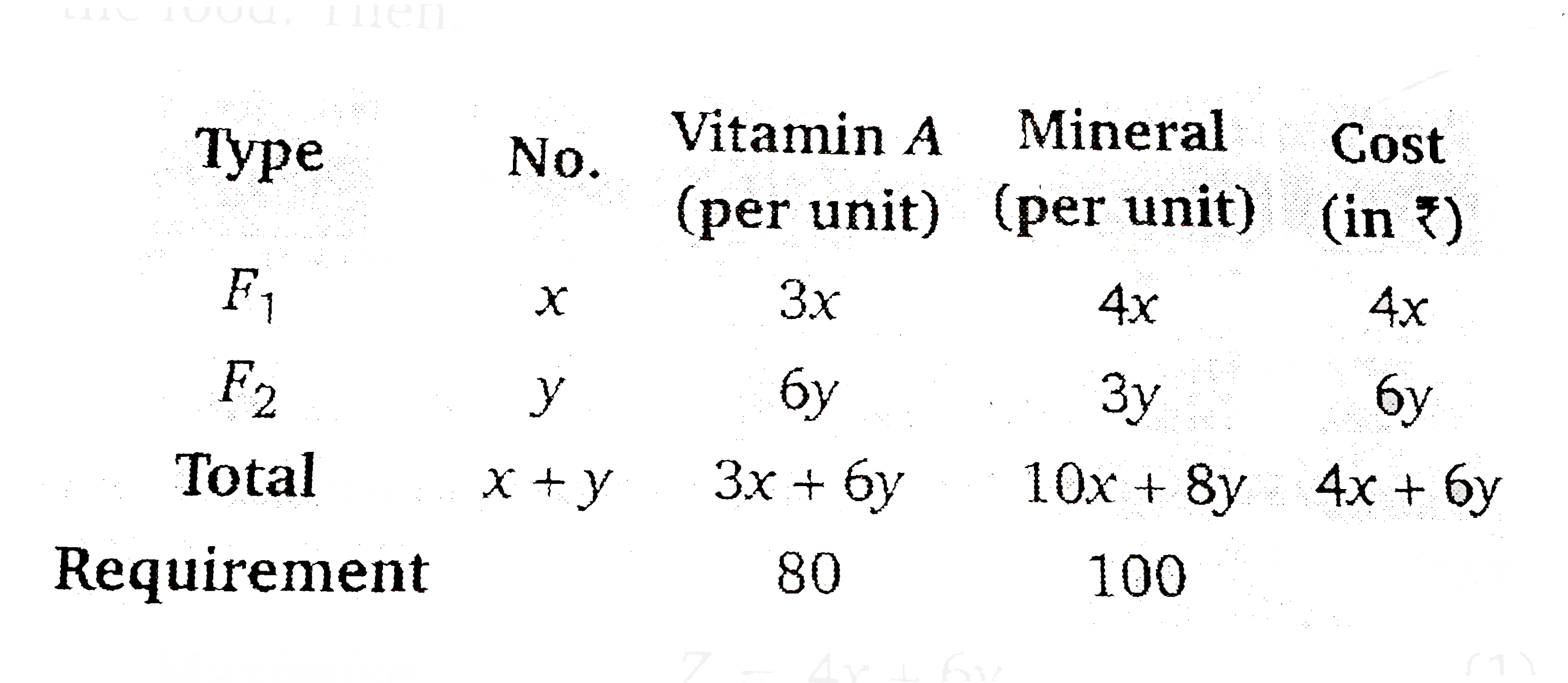 Maximise `Z=4x+6y`…………….1 Constraints `3x+6yge80` ………………….2 `4x+3yge100`……………….3 `xge0,yge0`…………………..4 First, draw the graph of the line `3x+6y=80`,. 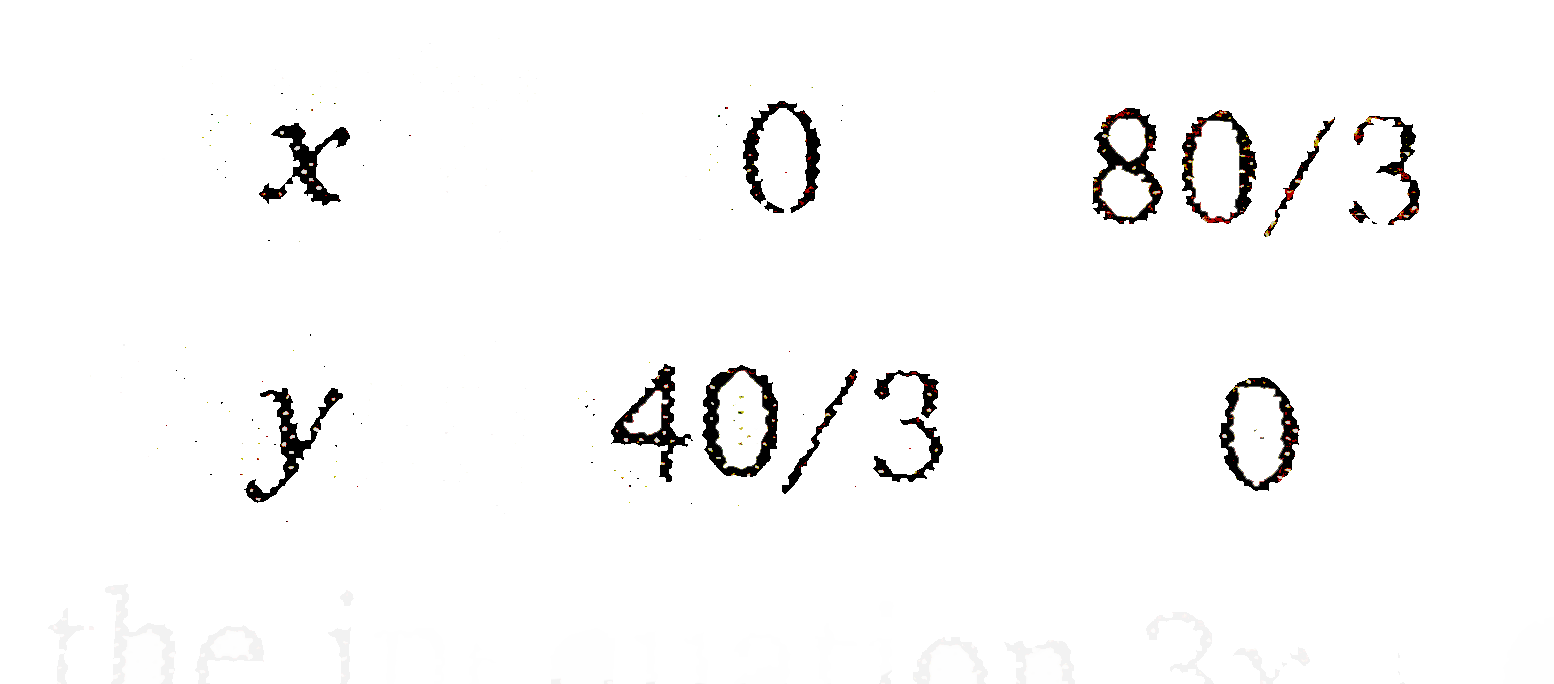 Put `(0,0)` in the inequation `3x+6yge80`, `3xx0+6xx0ge80implies0ge80` (FALSE) Thus, the half plane does not contain the ORIGIN. Since `x,yge0` so the feasible solution is in the first QUADRANT. Now, draw the graph of the line `4x+3y=100` 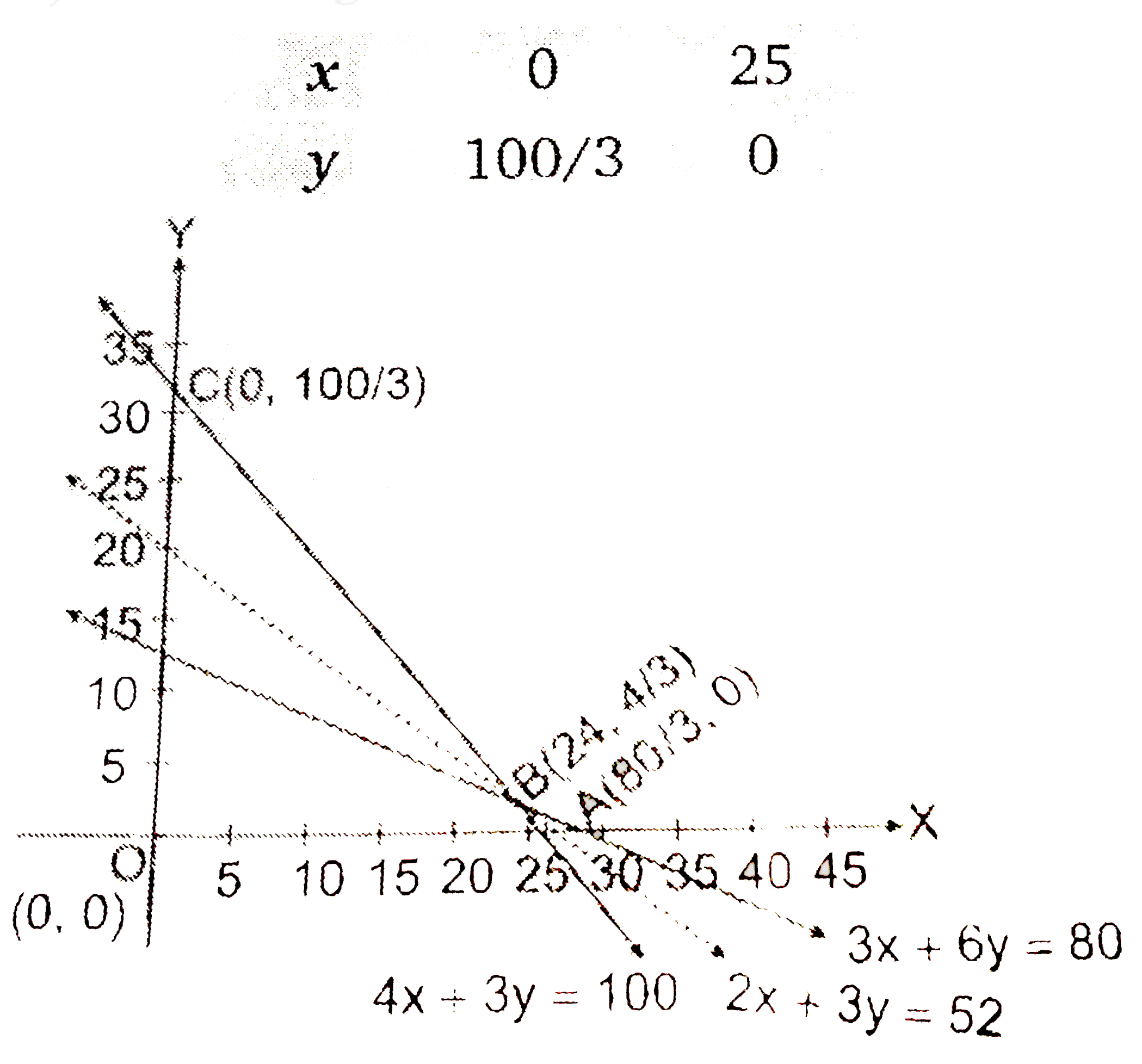 Put `(0,0)` in the inequation `4x+3yge100`, `4xx0+3xx0ge100` `implies0ge100` (False) Thus, the half plane does not contain the origin. From equations `3x+6y=80` and `4x+3y=100`. The POINT of intersection is `B(24, 4/3)` CLEARLY, the feasible region is unbounded. The vertices the feasible region are `A(80/3,0), B(24,4/3)` and `C(0,100/3)`. We find the value of `Z` at these vertices. 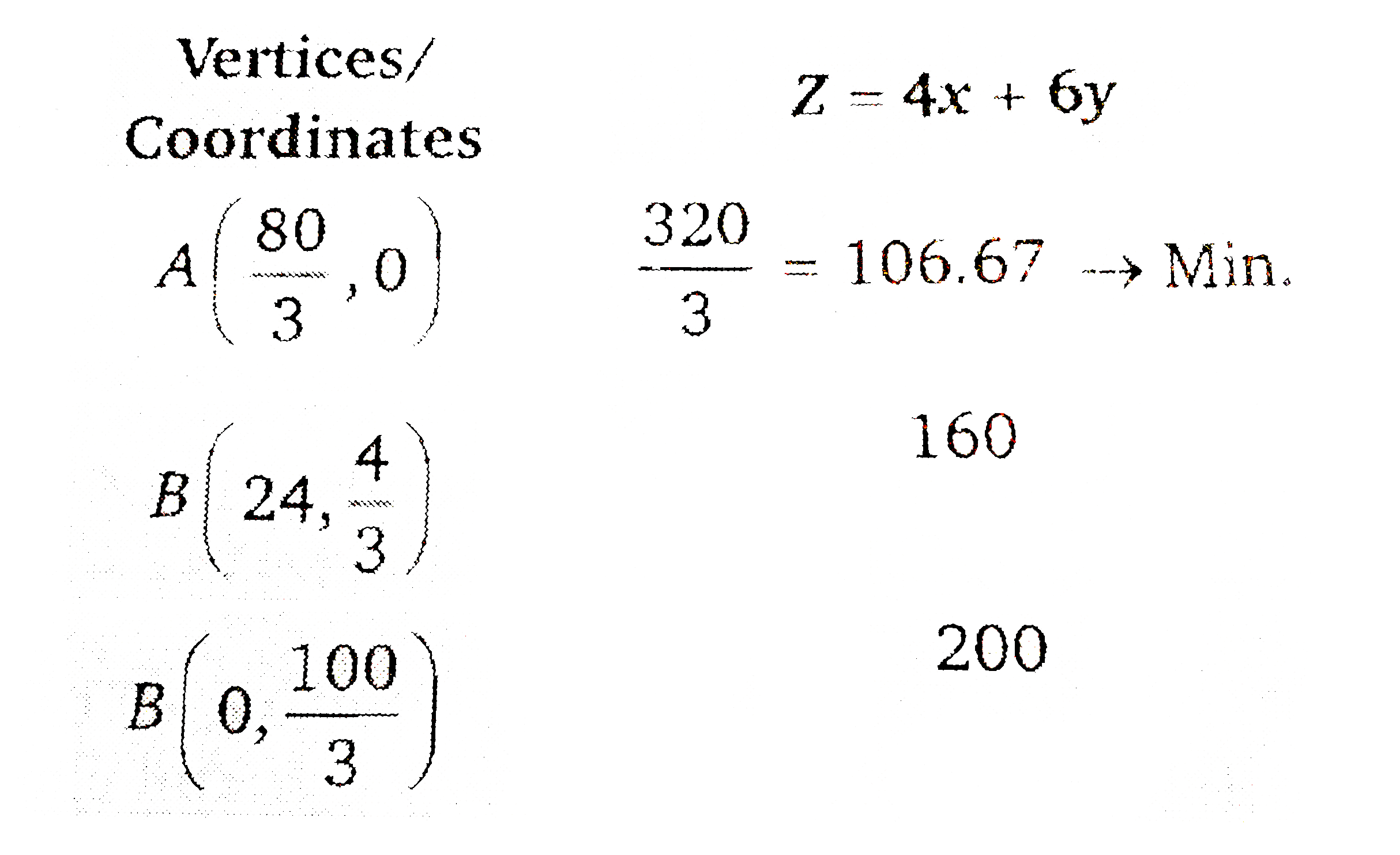 Since the feasible region is unbounded, so the minimum value of `z` may or may not be 104. For this we draw the graph of inequations `4x+6t lt 104` or `2x+3ylt52`. There is no common point here, so the minimum cost of mixture is Rs. 104. |
|
| 32. |
A tangent is drawn at any point (l, m), l, mne0 on the parabola y^(2)=4ax and the tangents are drawn from any point on this tangent to the circle x^(2)+y^(2)=0 (where agt0) such that all chords of contact pass through a fixed point (alpha,beta), then |
|
Answer» `alphalgt0,betamgt0` |
|
| 34. |
Prove that the angle of rotation of the axes to eliminate xy term from the equation ax^2+2hxy+by^2=0" is " Tan^(-1)((2h)/(a-b)) where a neb and (pi)/(4) ifa=b. |
|
Answer» |
|
| 35. |
If a_(r)=a+(r-1)d is rth term of an A.P., then a_(n)^(2)-2a_(n-1)^(2)+a_(n-2)^(2) is independent of |
|
Answer» N |
|
| 36. |
Evaluate the following integrals: int_0^1 dx/(1+x^2) |
|
Answer» SOLUTION :`INT DX/(1+x^2) = (tan^-1x)_0^1` =`tan^-1 1 -tan^-1 0 = pi/4-0 = pi/4` |
|
| 37. |
This passage is adapted from a 2018 article summarizing two different proposals for solving problems with maintaining New York City's mass transit system. The history of the New York City subsaw system, quickly told: the first stations opened in 1904, and over the next century, it expended to 472 stations, more than any other subway system in the world, with 850 miles of track. Operating 24 hours a day seven days a week, with an average weekday ridership of approximately 5.7 million, it is the plant's 7th-busiest rapid transit system. While the system is, on many levels, an amazing chievement, it is also beset by a problem that harms both quality of life and economic activity. Such a large system must inevitably suffer from service interruptions and delays, normal wear and tear combined with the sheer age of the system necessitates regular maintanance. However, there is no consensus as to the best way to accomplish the required repairs. The current maintanance scheme is designed to minimize service interruptions. A subway line in need of repair will be taken out of sevice during a comaratively less busy time, such as nights or weekends, while another line is re-routed to cover as many as possible of the missing line's stops. The main advantage to this approach is that trains are not taken out of service during rush hour, when most subway trips occur, subway service generally remains predictable and commuters are, for the most part, able to use the system to get to their desinations on time. But critics are quick to point out the disadvantages to this approach. Perhaps most obvious is the confusion caused by trains swithing lines. The labyrinthine system is hard enough to navigate at the best of times. especially for tourists A subway rider on the A terain naturally expects the train to make stops on teh A line. If instead, it is diverted temporatily to the F line, the rader may find herself miles from her intended destination. While annoying, the confusion arising from route switching is hardly the most serious problem with the current approach to repairs. Because the system runs 24 hours a day, routine maintenance can generally be done only during the temporary closures on nights and weekends. This means that more serious repair and crucial preventative maintenance is often neglected. Problems that could have been fixed or prevented reasonably expeditiously given a slightly longer closure wind up leading to major breakdowns and service interruptions later on. On rare occasions, such breakdowns have resulted in entire subway lines being shut down for months or even a year. Beginning in 2019, for example the I. Train connecting lower Manhattan to parts of Brooklyn was scheduled to close for as much as 15 months for long overdue service and upgrades. In a city fewar than half of whose households own a car, this can have serious economic impacts Residents of the affected area may face a much longer commute via an alternate subway line if one is available, or, if there is no alternate subway service, they may need to take other, potentially more exppensive, modes of transportation, such as taxis or ferries. Morover, studies indicate that increased stress from the commute to work can lead to lower productivity, and that businesses near the impacted lines may see decreased revenue as potential customers have a harder time getting to them. One controversial proposal for reducing breakdowns and the resulting transit interruptions is to end the subway's 24-hour service and to shut down for several hours each night. Proponents of this plan argue that this would allow time, on a regular rather than sporadic basis, for more preventative maintanacnce. This, they claim, would ultimately lead to more consistent service, rrather than shutting down entire lines for long periods of a time, there would merely be shorter service outages overnight, when fewer people use the subway system. While this may seem a preferable outcome to the economic consequence of a total shutdown resulting from a breakdown, it has its liabilities as well. While most subway trips may occur during rush hour, not everyone works during the daytime. New yourk is famously known as the "the city that never sleeps." Doctors, nurses, bartenders, police officers, and firefighters are just a few examples of occupations whose workers need transportion at all hours of the day and night. Rather than be subjected to a relatively short period of inconvenience, these workers would find their commutes irrevocably altered. One thing, at least, is clear the city must carefully condider many economic and social factors in designing a subway maintenance plan. In the third paragraph, the siscussion of two specific subway lines (lines 44-49) primarily serves to |
|
Answer» support the CONTENTION that line switching has a NEGATIVE impect on tourism. |
|
| 38. |
The variance of the data 2,3,5,11,13,17,19 is nearly |
|
Answer» `6.258` |
|
| 39. |
Find the value of the (1)/(root(3)(999) ) correct to 4 decimal places |
|
Answer» |
|
| 40. |
This passage is adapted from a 2018 article summarizing two different proposals for solving problems with maintaining New York City's mass transit system. The history of the New York City subsaw system, quickly told: the first stations opened in 1904, and over the next century, it expended to 472 stations, more than any other subway system in the world, with 850 miles of track. Operating 24 hours a day seven days a week, with an average weekday ridership of approximately 5.7 million, it is the plant's 7th-busiest rapid transit system. While the system is, on many levels, an amazing chievement, it is also beset by a problem that harms both quality of life and economic activity. Such a large system must inevitably suffer from service interruptions and delays, normal wear and tear combined with the sheer age of the system necessitates regular maintanance. However, there is no consensus as to the best way to accomplish the required repairs. The current maintanance scheme is designed to minimize service interruptions. A subway line in need of repair will be taken out of sevice during a comaratively less busy time, such as nights or weekends, while another line is re-routed to cover as many as possible of the missing line's stops. The main advantage to this approach is that trains are not taken out of service during rush hour, when most subway trips occur, subway service generally remains predictable and commuters are, for the most part, able to use the system to get to their desinations on time. But critics are quick to point out the disadvantages to this approach. Perhaps most obvious is the confusion caused by trains swithing lines. The labyrinthine system is hard enough to navigate at the best of times. especially for tourists A subway rider on the A terain naturally expects the train to make stops on teh A line. If instead, it is diverted temporatily to the F line, the rader may find herself miles from her intended destination. While annoying, the confusion arising from route switching is hardly the most serious problem with the current approach to repairs. Because the system runs 24 hours a day, routine maintenance can generally be done only during the temporary closures on nights and weekends. This means that more serious repair and crucial preventative maintenance is often neglected. Problems that could have been fixed or prevented reasonably expeditiously given a slightly longer closure wind up leading to major breakdowns and service interruptions later on. On rare occasions, such breakdowns have resulted in entire subway lines being shut down for months or even a year. Beginning in 2019, for example the I. Train connecting lower Manhattan to parts of Brooklyn was scheduled to close for as much as 15 months for long overdue service and upgrades. In a city fewar than half of whose households own a car, this can have serious economic impacts Residents of the affected area may face a much longer commute via an alternate subway line if one is available, or, if there is no alternate subway service, they may need to take other, potentially more exppensive, modes of transportation, such as taxis or ferries. Morover, studies indicate that increased stress from the commute to work can lead to lower productivity, and that businesses near the impacted lines may see decreased revenue as potential customers have a harder time getting to them. One controversial proposal for reducing breakdowns and the resulting transit interruptions is to end the subway's 24-hour service and to shut down for several hours each night. Proponents of this plan argue that this would allow time, on a regular rather than sporadic basis, for more preventative maintanacnce. This, they claim, would ultimately lead to more consistent service, rrather than shutting down entire lines for long periods of a time, there would merely be shorter service outages overnight, when fewer people use the subway system. While this may seem a preferable outcome to the economic consequence of a total shutdown resulting from a breakdown, it has its liabilities as well. While most subway trips may occur during rush hour, not everyone works during the daytime. New yourk is famously known as the "the city that never sleeps." Doctors, nurses, bartenders, police officers, and firefighters are just a few examples of occupations whose workers need transportion at all hours of the day and night. Rather than be subjected to a relatively short period of inconvenience, these workers would find their commutes irrevocably altered. One thing, at least, is clear the city must carefully condider many economic and social factors in designing a subway maintenance plan. The passage indicates that non-rush hour commuters |
|
Answer» would risk losing public transportation options if 24-hours SUBWAY service ware SUSPENDED. |
|
| 41. |
This passage is adapted from a 2018 article summarizing two different proposals for solving problems with maintaining New York City's mass transit system. The history of the New York City subsaw system, quickly told: the first stations opened in 1904, and over the next century, it expended to 472 stations, more than any other subway system in the world, with 850 miles of track. Operating 24 hours a day seven days a week, with an average weekday ridership of approximately 5.7 million, it is the plant's 7th-busiest rapid transit system. While the system is, on many levels, an amazing chievement, it is also beset by a problem that harms both quality of life and economic activity. Such a large system must inevitably suffer from service interruptions and delays, normal wear and tear combined with the sheer age of the system necessitates regular maintanance. However, there is no consensus as to the best way to accomplish the required repairs. The current maintanance scheme is designed to minimize service interruptions. A subway line in need of repair will be taken out of sevice during a comaratively less busy time, such as nights or weekends, while another line is re-routed to cover as many as possible of the missing line's stops. The main advantage to this approach is that trains are not taken out of service during rush hour, when most subway trips occur, subway service generally remains predictable and commuters are, for the most part, able to use the system to get to their desinations on time. But critics are quick to point out the disadvantages to this approach. Perhaps most obvious is the confusion caused by trains swithing lines. The labyrinthine system is hard enough to navigate at the best of times. especially for tourists A subway rider on the A terain naturally expects the train to make stops on teh A line. If instead, it is diverted temporatily to the F line, the rader may find herself miles from her intended destination. While annoying, the confusion arising from route switching is hardly the most serious problem with the current approach to repairs. Because the system runs 24 hours a day, routine maintenance can generally be done only during the temporary closures on nights and weekends. This means that more serious repair and crucial preventative maintenance is often neglected. Problems that could have been fixed or prevented reasonably expeditiously given a slightly longer closure wind up leading to major breakdowns and service interruptions later on. On rare occasions, such breakdowns have resulted in entire subway lines being shut down for months or even a year. Beginning in 2019, for example the I. Train connecting lower Manhattan to parts of Brooklyn was scheduled to close for as much as 15 months for long overdue service and upgrades. In a city fewar than half of whose households own a car, this can have serious economic impacts Residents of the affected area may face a much longer commute via an alternate subway line if one is available, or, if there is no alternate subway service, they may need to take other, potentially more exppensive, modes of transportation, such as taxis or ferries. Morover, studies indicate that increased stress from the commute to work can lead to lower productivity, and that businesses near the impacted lines may see decreased revenue as potential customers have a harder time getting to them. One controversial proposal for reducing breakdowns and the resulting transit interruptions is to end the subway's 24-hour service and to shut down for several hours each night. Proponents of this plan argue that this would allow time, on a regular rather than sporadic basis, for more preventative maintanacnce. This, they claim, would ultimately lead to more consistent service, rrather than shutting down entire lines for long periods of a time, there would merely be shorter service outages overnight, when fewer people use the subway system. While this may seem a preferable outcome to the economic consequence of a total shutdown resulting from a breakdown, it has its liabilities as well. While most subway trips may occur during rush hour, not everyone works during the daytime. New yourk is famously known as the "the city that never sleeps." Doctors, nurses, bartenders, police officers, and firefighters are just a few examples of occupations whose workers need transportion at all hours of the day and night. Rather than be subjected to a relatively short period of inconvenience, these workers would find their commutes irrevocably altered. One thing, at least, is clear the city must carefully condider many economic and social factors in designing a subway maintenance plan. The fifth paragraph (lines 66-90) serves mainly to |
|
Answer» illustrate the impect of the current MAINTENANCE plan on one subway line. |
|
| 42. |
This passage is adapted from a 2018 article summarizing two different proposals for solving problems with maintaining New York City's mass transit system. The history of the New York City subsaw system, quickly told: the first stations opened in 1904, and over the next century, it expended to 472 stations, more than any other subway system in the world, with 850 miles of track. Operating 24 hours a day seven days a week, with an average weekday ridership of approximately 5.7 million, it is the plant's 7th-busiest rapid transit system. While the system is, on many levels, an amazing chievement, it is also beset by a problem that harms both quality of life and economic activity. Such a large system must inevitably suffer from service interruptions and delays, normal wear and tear combined with the sheer age of the system necessitates regular maintanance. However, there is no consensus as to the best way to accomplish the required repairs. The current maintanance scheme is designed to minimize service interruptions. A subway line in need of repair will be taken out of sevice during a comaratively less busy time, such as nights or weekends, while another line is re-routed to cover as many as possible of the missing line's stops. The main advantage to this approach is that trains are not taken out of service during rush hour, when most subway trips occur, subway service generally remains predictable and commuters are, for the most part, able to use the system to get to their desinations on time. But critics are quick to point out the disadvantages to this approach. Perhaps most obvious is the confusion caused by trains swithing lines. The labyrinthine system is hard enough to navigate at the best of times. especially for tourists A subway rider on the A terain naturally expects the train to make stops on teh A line. If instead, it is diverted temporatily to the F line, the rader may find herself miles from her intended destination. While annoying, the confusion arising from route switching is hardly the most serious problem with the current approach to repairs. Because the system runs 24 hours a day, routine maintenance can generally be done only during the temporary closures on nights and weekends. This means that more serious repair and crucial preventative maintenance is often neglected. Problems that could have been fixed or prevented reasonably expeditiously given a slightly longer closure wind up leading to major breakdowns and service interruptions later on. On rare occasions, such breakdowns have resulted in entire subway lines being shut down for months or even a year. Beginning in 2019, for example the I. Train connecting lower Manhattan to parts of Brooklyn was scheduled to close for as much as 15 months for long overdue service and upgrades. In a city fewar than half of whose households own a car, this can have serious economic impacts Residents of the affected area may face a much longer commute via an alternate subway line if one is available, or, if there is no alternate subway service, they may need to take other, potentially more exppensive, modes of transportation, such as taxis or ferries. Morover, studies indicate that increased stress from the commute to work can lead to lower productivity, and that businesses near the impacted lines may see decreased revenue as potential customers have a harder time getting to them. One controversial proposal for reducing breakdowns and the resulting transit interruptions is to end the subway's 24-hour service and to shut down for several hours each night. Proponents of this plan argue that this would allow time, on a regular rather than sporadic basis, for more preventative maintanacnce. This, they claim, would ultimately lead to more consistent service, rrather than shutting down entire lines for long periods of a time, there would merely be shorter service outages overnight, when fewer people use the subway system. While this may seem a preferable outcome to the economic consequence of a total shutdown resulting from a breakdown, it has its liabilities as well. While most subway trips may occur during rush hour, not everyone works during the daytime. New yourk is famously known as the "the city that never sleeps." Doctors, nurses, bartenders, police officers, and firefighters are just a few examples of occupations whose workers need transportion at all hours of the day and night. Rather than be subjected to a relatively short period of inconvenience, these workers would find their commutes irrevocably altered. One thing, at least, is clear the city must carefully condider many economic and social factors in designing a subway maintenance plan. With which of the following statements would the authou of the passage be most likely to agree ? |
|
Answer» The cuntroversy currounding Neq York City's subway system REFLECTS similar issues for mass transit in many American cities. |
|
| 43. |
The volume of spherical balloon being inflated changes at a constant rate.If initially its radius is 3 units and after 3 seconds it is 6units. Find the radius ofballoon after t seconds. |
|
Answer» |
|
| 44. |
Measure of angle bewtwen lines (3+2sqrt(3))x^(2)-2xy-y^(2)=0 is |
|
Answer» `(PI)/2` |
|
| 45. |
5 boys and 5 girls sit in a row at random. The probability that the boys and girls sit alternatively is |
| Answer» Answer :C | |
| 46. |
Find the derivative of the following functions with respect to x (2 + 3 sinx) (3-2 cos x) |
|
Answer» |
|
| 47. |
Integrate the function (2x+4)/(sqrt(x^(2)+4x+10)) |
| Answer» | |
| 48. |
Integrate int sqrt(x^2-8x+7) dx |
|
Answer» `1/2 (x-4) SQRT(x^2-8x+7) + 9log|x-4+ sqrt(x^2-8x+7)|+C` |
|
| 49. |
This passage is adapted from a 2018 article summarizing two different proposals for solving problems with maintaining New York City's mass transit system. The history of the New York City subsaw system, quickly told: the first stations opened in 1904, and over the next century, it expended to 472 stations, more than any other subway system in the world, with 850 miles of track. Operating 24 hours a day seven days a week, with an average weekday ridership of approximately 5.7 million, it is the plant's 7th-busiest rapid transit system. While the system is, on many levels, an amazing chievement, it is also beset by a problem that harms both quality of life and economic activity. Such a large system must inevitably suffer from service interruptions and delays, normal wear and tear combined with the sheer age of the system necessitates regular maintanance. However, there is no consensus as to the best way to accomplish the required repairs. The current maintanance scheme is designed to minimize service interruptions. A subway line in need of repair will be taken out of sevice during a comaratively less busy time, such as nights or weekends, while another line is re-routed to cover as many as possible of the missing line's stops. The main advantage to this approach is that trains are not taken out of service during rush hour, when most subway trips occur, subway service generally remains predictable and commuters are, for the most part, able to use the system to get to their desinations on time. But critics are quick to point out the disadvantages to this approach. Perhaps most obvious is the confusion caused by trains swithing lines. The labyrinthine system is hard enough to navigate at the best of times. especially for tourists A subway rider on the A terain naturally expects the train to make stops on teh A line. If instead, it is diverted temporatily to the F line, the rader may find herself miles from her intended destination. While annoying, the confusion arising from route switching is hardly the most serious problem with the current approach to repairs. Because the system runs 24 hours a day, routine maintenance can generally be done only during the temporary closures on nights and weekends. This means that more serious repair and crucial preventative maintenance is often neglected. Problems that could have been fixed or prevented reasonably expeditiously given a slightly longer closure wind up leading to major breakdowns and service interruptions later on. On rare occasions, such breakdowns have resulted in entire subway lines being shut down for months or even a year. Beginning in 2019, for example the I. Train connecting lower Manhattan to parts of Brooklyn was scheduled to close for as much as 15 months for long overdue service and upgrades. In a city fewar than half of whose households own a car, this can have serious economic impacts Residents of the affected area may face a much longer commute via an alternate subway line if one is available, or, if there is no alternate subway service, they may need to take other, potentially more exppensive, modes of transportation, such as taxis or ferries. Morover, studies indicate that increased stress from the commute to work can lead to lower productivity, and that businesses near the impacted lines may see decreased revenue as potential customers have a harder time getting to them. One controversial proposal for reducing breakdowns and the resulting transit interruptions is to end the subway's 24-hour service and to shut down for several hours each night. Proponents of this plan argue that this would allow time, on a regular rather than sporadic basis, for more preventative maintanacnce. This, they claim, would ultimately lead to more consistent service, rrather than shutting down entire lines for long periods of a time, there would merely be shorter service outages overnight, when fewer people use the subway system. While this may seem a preferable outcome to the economic consequence of a total shutdown resulting from a breakdown, it has its liabilities as well. While most subway trips may occur during rush hour, not everyone works during the daytime. New yourk is famously known as the "the city that never sleeps." Doctors, nurses, bartenders, police officers, and firefighters are just a few examples of occupations whose workers need transportion at all hours of the day and night. Rather than be subjected to a relatively short period of inconvenience, these workers would find their commutes irrevocably altered. One thing, at least, is clear the city must carefully condider many economic and social factors in designing a subway maintenance plan. Which of the following best expresses the primary purpose of the passage ? |
|
Answer» To argue that the New York CITY subway system MAINTENANCE plan should be altered |
|
| 50. |
A circle of radius 4 cm is inscribed in DeltaABC, which touches side BC at D. If BD = 6 cm, DC = 8 cm then |
|
Answer» the triangle is necessarily acute angled `rArr "tan"(B)/(2) "tan"(C)/(2) = (s-a)/(s) = (1)/(3)` `rArr 2s = 3A = 42` `:. Delta = RS = 84 cm^^(2)` THUS, `"tan"(A)/(2), "tan"(B)/(2), "tan"(C)/(2)` all are less than 1 Hence, all angles of the triangle are acute |
|