Saved Bookmarks
This section includes 7 InterviewSolutions, each offering curated multiple-choice questions to sharpen your Current Affairs knowledge and support exam preparation. Choose a topic below to get started.
| 1. |
Write the vector equations of the lines (x-1)/(2) = (y-2)/(3)=(z+4)/(6) and (x-3)/(4)=(y-3)/(6)=(z+5)/(12). |
|
Answer» |
|
| 2. |
A compound of vanadium has a magnetic moment (mu) of 1.73 BM. If the vanadium ion in the compound is present as V^(x+) then, the value of x is ? |
|
Answer» 1 |
|
| 3. |
vec(a)=2hati-hatj+hatk,vec(b)=hati+2hatj-hatk,vec( c )=hati+hatj-2hatk. The vector vec( r ) is coplanner with vector vec(b) and vec( c ). If the magnitude of the projection vec( r ) on vec(a) is sqrt((2)/(3)) then vec( r ) = ………….. |
|
Answer» `2hati+3hatj-3hatk` |
|
| 4. |
ifalpha , betaare twodistinctsolutionsofa sintheta + b costheta =cthantan( alpha+ beta)/(2) is equalto |
|
Answer» `(C )/ ( SQRT(a^2+ b^2 ))` |
|
| 5. |
Lt_(ntooo){(1)/(sqrt(n^(2)+1))+(1)/(sqrt(n^(2)+2^(2)))+.......+(1)/(sqrt(n^(2)+n^(2)))}= |
|
Answer» `LOG (SQRT(2))` |
|
| 6. |
a xx [axx(axxb)] is equal to |
|
Answer» `(a xx a).(B xx a)` `=0-(a*a)(axxb)=(a*a)(bxxa)` |
|
| 7. |
Find the whichof theoperations given abovehas identity ? |
|
Answer» Solution :(i) Q , a*B= a-b Leta* e = a e*a `rArr""a- e = a= e - a ` Now, `""a-e=a rArre=0` and `"" e-a = a rArr e =2a` butthe identity is alwaysunique. `THEREFORE` In Q the identity elements does notexist with respect to the operationa*b = a-b (ii) In Q,`"a * b" = a^(2) +b^(2)` Leta* e = a * a `rArr""a^(2) + e^(2) =a = e^(2) + a^(2)` If a=-2 then e does not exist. `therefore` In Q, the identityelements does not exist with respect to the operate a* b `= a^(2) + b^(2)` (iii)In Q, a *b `= a^(2) + b^(2)` Let a * e = a = e * a `rArr` a + ae = a=e + ea Now , a + ae = a `rArr` ae = 0 `rArr` e = 0 ande + ea = `rArr e =(a)/(1+a), a NE 0` but the identify element is always unique `therefore` In Q, the identity element does not exist with respect to the OPERATION a * b = a + ab. (IV) InQ, `""a * b = (a-b)^(2)` `rArr""(a -e)^(2) a = (e-a)^(2)` For `"'" a=-3` `""(-3-e)^(2) = - 3`Whichis not possible. `therefore` In Q the identity element does not exist with respect to the operation a * b `= (-b)^(2)` (v) In Q, `a** b = (ab)/(4)` Let a* e= a = e*a. `rArr(ae)/(4) = a= (ea)/(4)` `rArre =4` `therefore` Operation`a ** b = (ab)/(4)` (vi) In Q , `a*b = ab^(2)` Let a*e = a = e*a `rArr ""ae^(2) =a = ea^(2)` Now `""ae^(2) = a "" rArr"" e = pm 1` `and "" a=ea^(2) "" rArr ""e = (1)/(a)` but the identity element is always unique. `therefore` In Q ·the identity element does not exist with respect to the operation `a ** b = ab^(2)` |
|
| 8. |
Find the coefficient of x^3 in ((1 - 5x)^3 (1+ 3x^2)^(3//2))/((3 +4x)^(1//3)) |
|
Answer» |
|
| 9. |
A balloon, which always remains spherical, has a variable diameter (3)/(2) (2x+1) . Find the rate of change of its volume with respect to x. |
|
Answer» |
|
| 10. |
If two of the straight lines respresented by the equation y^3+axy^2+(a^2+6)x^2y+2x^3=0are perpendicular to each other, then a is equal to |
| Answer» Answer :D | |
| 11. |
Fir any complex number z, the minimum value of |z|+|z-1| is |
| Answer» ANSWER :A | |
| 12. |
If |kveca| = 1, then |
|
Answer» `VECA` = 1/K |
|
| 13. |
cos^(-1).(2)/(sqrt(5)) + tan^(-1).(1)/(3) = |
|
Answer» `pi/2` |
|
| 14. |
Two fair dice are rolled, until doublet appears for the first time. Find the probability that the number of trails required is even. |
|
Answer» |
|
| 16. |
If alpha is the inclination of a tangent to the parabola y^(2)=4axthen the distance be tween the tangent and a parallel normal is |
|
Answer» a COSEC `ALPHA` SEC `alpha` |
|
| 17. |
If(x ^2+x + 1 ) /(x ^ 2+2x+ 1 )= A +(B)/(x + 1 ) + (C )/((x + 1 ) ^ 2 ), thenA - Bisequalto |
|
Answer» Solution :GIVENTHAT, `(X ^ 2+x+ 1 ) /(x ^ 2+2x+ 1 )=A + (B)/(( x + 1 )) +(C )/((x + 1 ) ^ 2 ) ` ` rArr( x ^ 2+ x+ 1 ) /(x^ 2+ 2x+ 1 )= ( A ( x+ 1 ) ^ 2+ B( x + 1 )+ C)/( ( x + 1 ) ^ 2 ) ` ` rArrx ^ 2+ x + 1= (A x ^ 2+x ( 2A + B)+ ( A + B + C))/( ( x + 1 ) ^ 2 ) ` `therefore A = 1, 2A + B = 1, A + B + C = 1` ` rArr2 (1)+ B = 1, 1 +( -1)+ C = 1` ` rArr B =-1 rArrC =1 ` `thereforeA - B = 1-( -1), 2(C )= 2 (1)` `= 2 "" ` ...(1) ` 2C =2 "" `...(2) `therefore` From (1)and (2) A - B = 2C |
|
| 18. |
Find the numerically greatest terms in the expansion of(2x+3x)^10 when x = 11/8 |
|
Answer» |
|
| 19. |
Find a particular solution of the differential equation (dy)/(dx) +y cot x = 4x cosec x ( x ne 0), given that y = 0 when x = (pi)/(2). |
|
Answer» |
|
| 20. |
Find the coordinates of the mid-point of the following pairs of points .(3/4,-2),(-5/2,1). |
|
Answer» SOLUTION :Mid points of the LINE segment JOINING the points. (3/4,-2) and (-5/2,1) is ((3/4-5/2)/2,(-2+1)/2)=(-7/8,-1/2). |
|
| 21. |
WHIch of the following is CORRECT combination? |
|
Answer» (iv) (iv) (S) |
|
| 22. |
Find x and y respectively such that [{:(x-y,3),(2x-y,2x+1):}]=[{:(5,3),(12,15):}] |
|
Answer» a) 7,2 |
|
| 23. |
WHICH of the following is CORRECT combination? |
|
Answer» (ii) (III) (P) |
|
| 24. |
Observe the following statements for the curve y^2=4ax. I : The length of the subnormal at any point is a constant. II : the length of the sub- tangent at any point is twice the abscissa of the point of contact III : Area of triangle formed by tangent normal and x-axis at any point is a constant. |
|
Answer» only I,II are true |
|
| 26. |
Which of the following is CORRECT combination? |
|
Answer» <P>(II) (i) (P) |
|
| 27. |
Find the scalar components and magnitude of the vector joining the points P(x_(1), y_(1), z_(1)) and Q(x_(2), y_(2), z_(2)). |
|
Answer» |
|
| 28. |
Show that the modulus function f: R rarr R given by f(x) = |x|, is neither one-one nor onto. |
|
Answer» Solution :`f(-2) = |-2| = 2` and `f(2) = |2| = 2`, f MAPS both -2 and 2 to 2 `THEREFORE` f is not one-one Since `|x|` assumes only non-negative real values, negative real numbers can.t have pre-images `therefore` f is not ONTO |
|
| 29. |
Still not satisfied and willing to give up, Sultan now brings up 9 jars filled with 4, 2, 6, 7, 3, 4, 5, 8 and 3 bananas respectively. In one minute Tintin can either double the content of one jar, or eat one banana from each jar, and gives him a time limit of 90 minutes. Can Tintin empty all the jars using these moves in the given time? If yes, then give the minimum time required by him (in minutes) to empty the jars?Answer 00 if it is not possible. |
|
Answer» Solution : First NOTE that a jar shall not become zero with other jars being nonzero.(Think !).Yes mario can always empty the jars. Basic idea is to reduce one from every jar until a jarcontains only one, then double that jar and continue. This will ensure emptying, though notin minimum STEPS.For minimum steps we shall reduce the unnecessary steps.The method is to first double each jar until it reaches a number less than or equal to the highest number, then deduct all jars by one until a jar becomes one OR if a jar can again be doubled under above condition (note that this doubling will not add any EXTRA work & infact reduce some.). Then check above rule after every deduction & double the necessaryjars.For eg, consider only 2 jars with 1 4 as initial counts. Then he shall FOLLOW these steps 1. Double the jar 1 (gives 2 4) 2. Double the jar 1 (gives 4 4) 3. Reduce both jars one by one `(3 3 gt 2 2 gt 1 1 gt 0 0)` (4 times)Which gives 6 as the minimum steps to empty the jars.eg 2: in the case 2 6 8, the number shall drop as follows (11 steps)`2 6 8 gtgt 4 6 8 gtgt 8 6 8` (double each jar CLOSE to highest number)`8 6 8 gt 7 5 7 gt6 4 6 gt 5 3 5 gt4 2 4` (reduce all ONLY until there is a double possibleagain!) ` 4 2 4 gt gt 4 4 4 gt3 3 3gt gt2 2 2gt gt1 1 1gt gt0 0 0` (then follow same procedure) Now that you have an idea, the original question will be easy to answer. 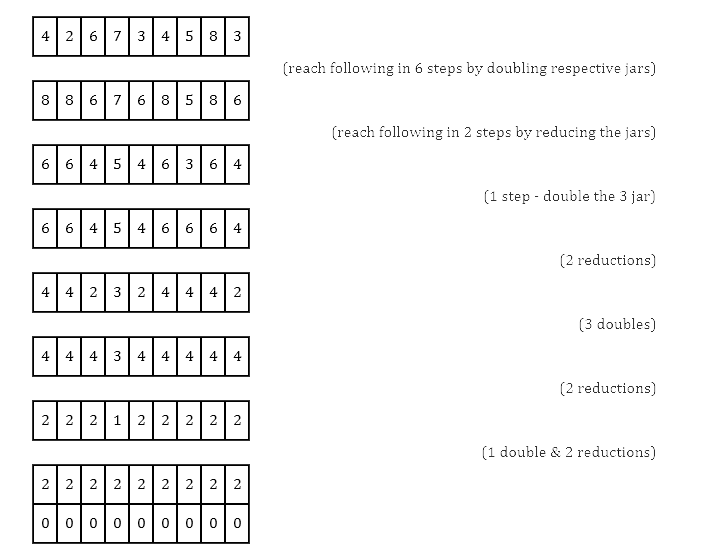 Which gives that minimum 19 steps are required for emptying the jars. |
|
| 30. |
There are 'n' different books and 'p' copies of each. The number of ways in which a selection can be made from them is |
|
Answer» <P>`N^(p)` |
|
| 31. |
Let t_(100)=sum_(r=0)^(100)(1)/(("^(100)C_(r ))^(5)) and S_(100)=sum_(r=0)^(100)(r )/(("^(100)C_(r ))^(5)), then the value of (100t_(100))/(S_(100)) is |
|
Answer» `1` ALSO `S_(100)=(100)/(('^(100)C_(0))^(5))+((100-1))/(('^(100)C_(1))^(5))+((100-2))/(('^(100)C_(2))^(5))+....+(0)/(('^(100)C_(100))^(5))`......`(2)` `:.` On adding `(1)` and `(2)`, we get `2S_(100)=100t_(100)` `implies(100t_(100))/(S_(100))=2` |
|
| 32. |
Fill in the blank choosing correct answer from the brackets if A = tan^(-1) x, then the value of sin 2A =__________((2x)/(1-x^2),(2x)/(sqrt(1-x^2)),(2x)/(1+x^2)) |
| Answer» SOLUTION :`(2X)/(1+x^2)` | |
| 33. |
Integrate intx^5/(x^2+1)dx |
| Answer» SOLUTION :`I=int(x^5dx)/(x^2+1)=intx3-x+x/(x^2+1)dx=int(x^2-x)dx+1/2int(2xdx)/(x^2+1)=x^4/4-x^2/2+1/2`In`(x^2+1)+C` | |
| 34. |
Ifalpha, beta , gammaare the rootsofx^3+ qx +r=0then (1)/(alpha+ beta- gamma) +(1)/( beta + gamma - alpha) +(1)/(gamma+ alpha - beta)= |
|
Answer» |
|
| 35. |
Find (dy)/(dx), if x^((2)/(3)) + y^((2)/(3))= a^((2)/(3)) |
|
Answer» |
|
| 36. |
Find the minimum value of Z = x + y subject to the constraints 2x+3y le 6, x ge 0, y ge 0 is ………. |
|
Answer» |
|
| 38. |
Solve the limit ; lim_(xto pi//2)(a^(cotx)-a^(cosx))/(cotx-cosx) is equal to |
|
Answer» LOG a |
|
| 39. |
Centre of the ellipse 3x^(2)+4y^(2)-12x-8y+4=0 |
| Answer» Solution :`|TAN^(-1)x|gt(PI)/(3)implies|x|gtsqrt(3)` | |
| 40. |
A class has 15 students whose ages are 14, 17, 15, 14, 21, 17, 19, 20, 16, 18, 20, 17, 16, 19 and 20 years. One student is selected in such a manner that each has the same chance of being chosen and the age X of the selected student is recorded. What is the probability distribution of the random variable X? Find mean, variance and standard deviation of X. |
|
Answer» MEAN =17.53, VAR(X)=4.78 and S.D(X)=2.19 |
|
| 42. |
A : The smallest value of x^2-3x+3 in [-3,3/2] is 3/4 R: The smallest value of f(x) in [a,b] is equal to the local minimum of f(x) |
|
Answer» Both A and R are TRUE and R is CORRECT explanation of A |
|
| 43. |
Choose the correct answer: If A and B are two events such that P(A) != 0 and P(B|A) = 1, then |
|
Answer» `A SUBSET B` |
|
| 44. |
The slopes of the focal chords of the parabola y^(2)=32x, which are tangents to the circle x^(2)+y^(2)=4 are |
|
Answer» `1/2 ,(-1)/2` |
|
| 46. |
Using differentials, find the approximate value of each of the up to 3 places of decimal. (255)^((1)/(4)) |
|
Answer» |
|
| 48. |
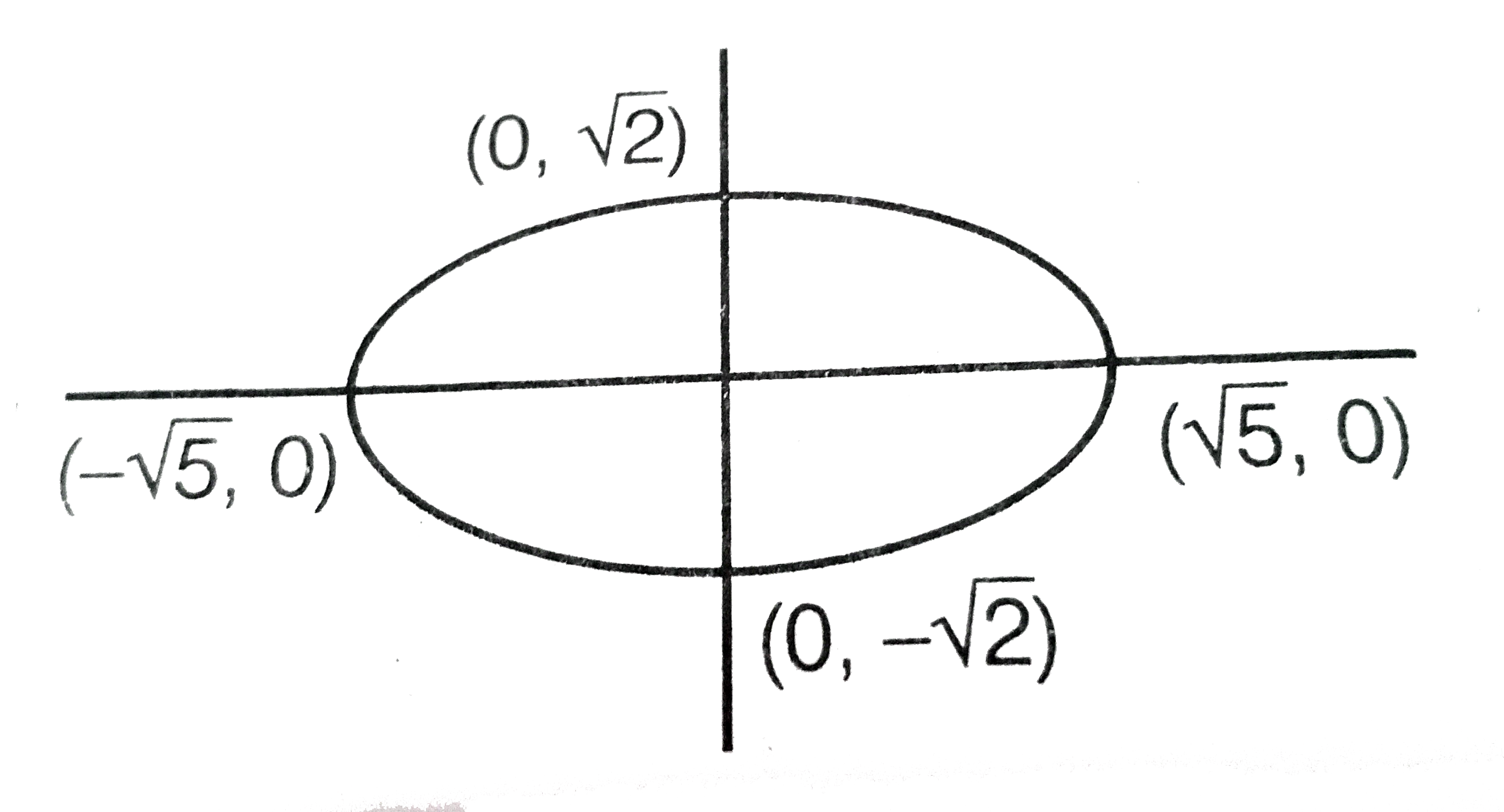
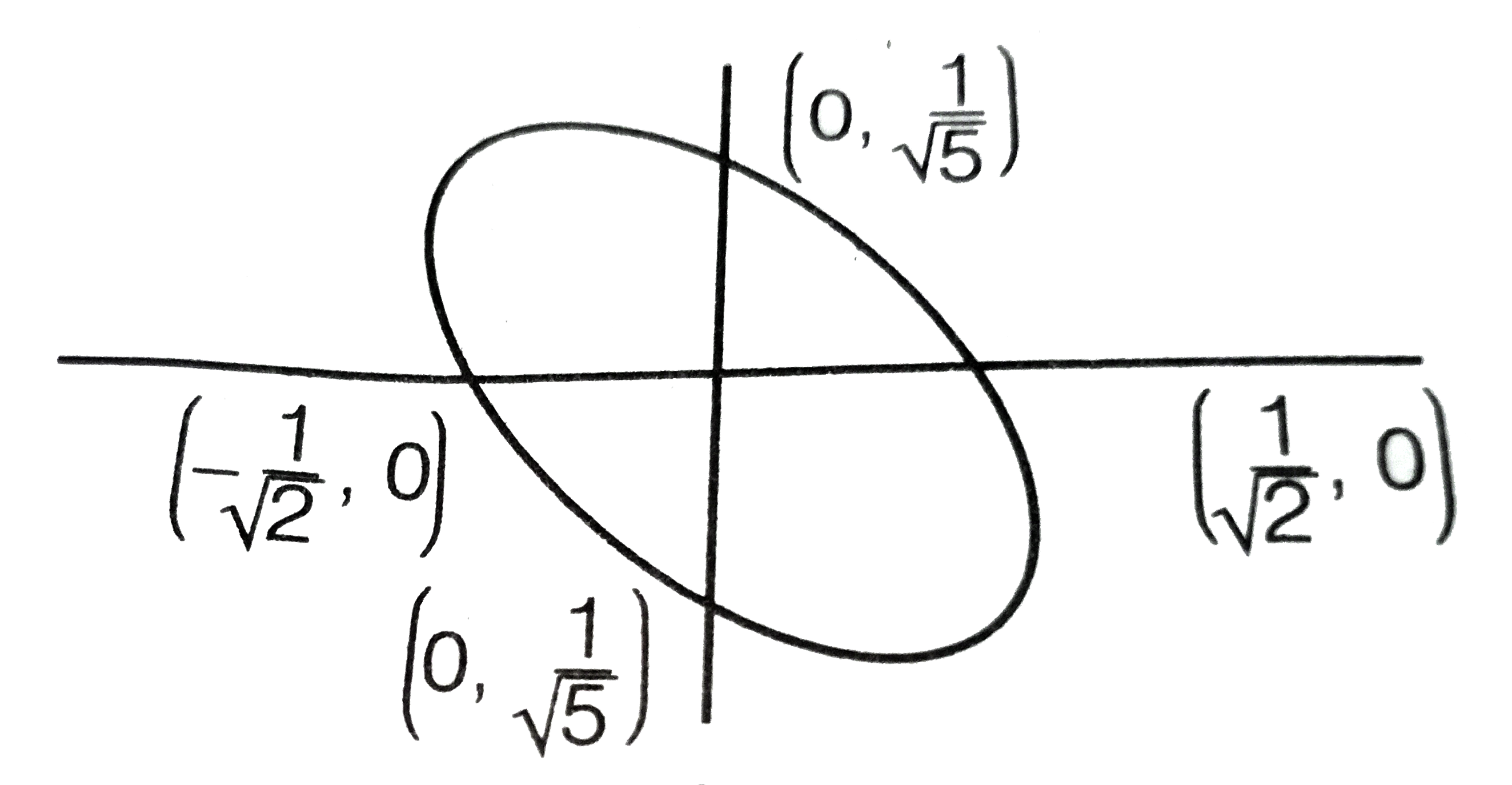
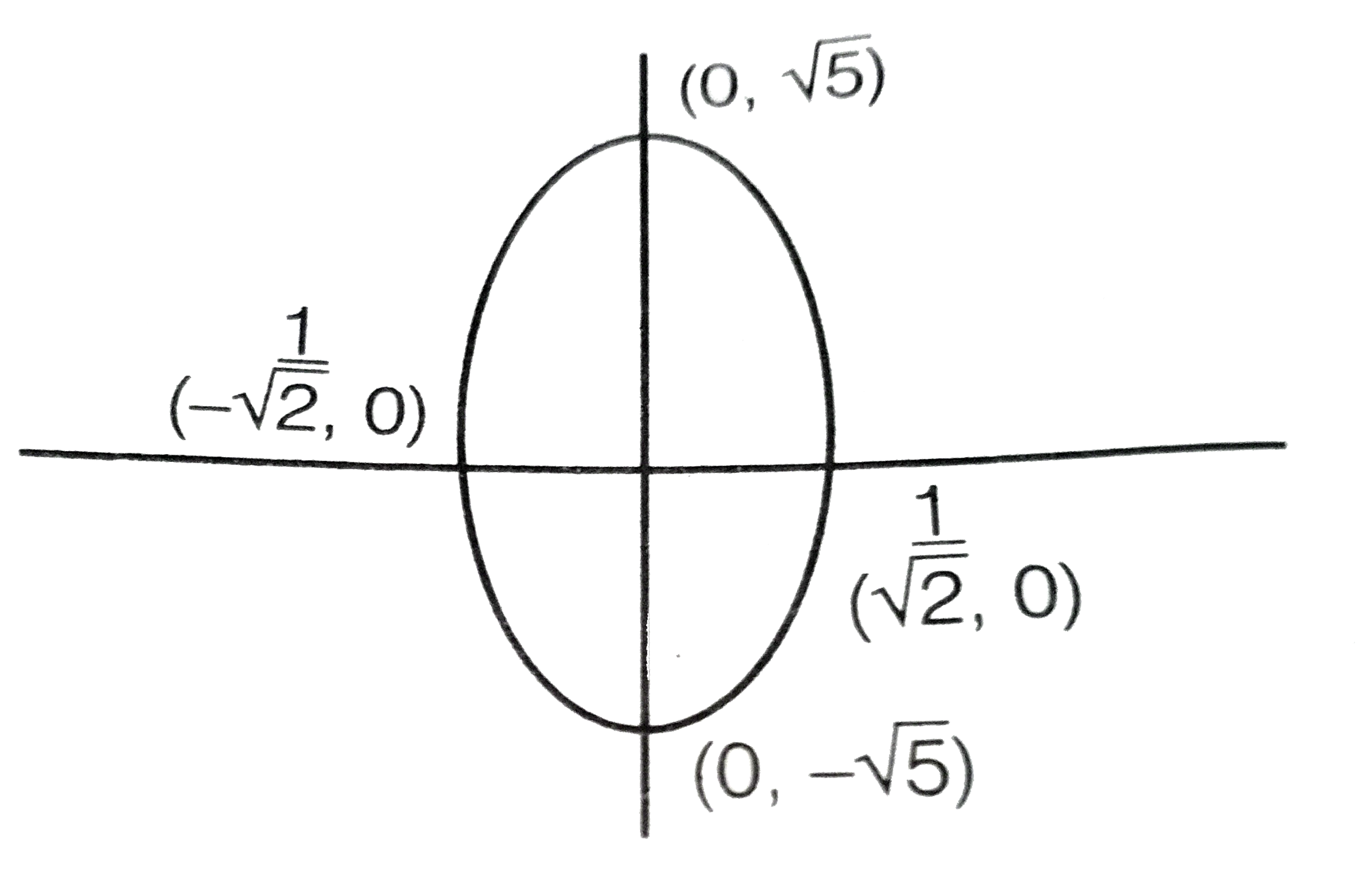
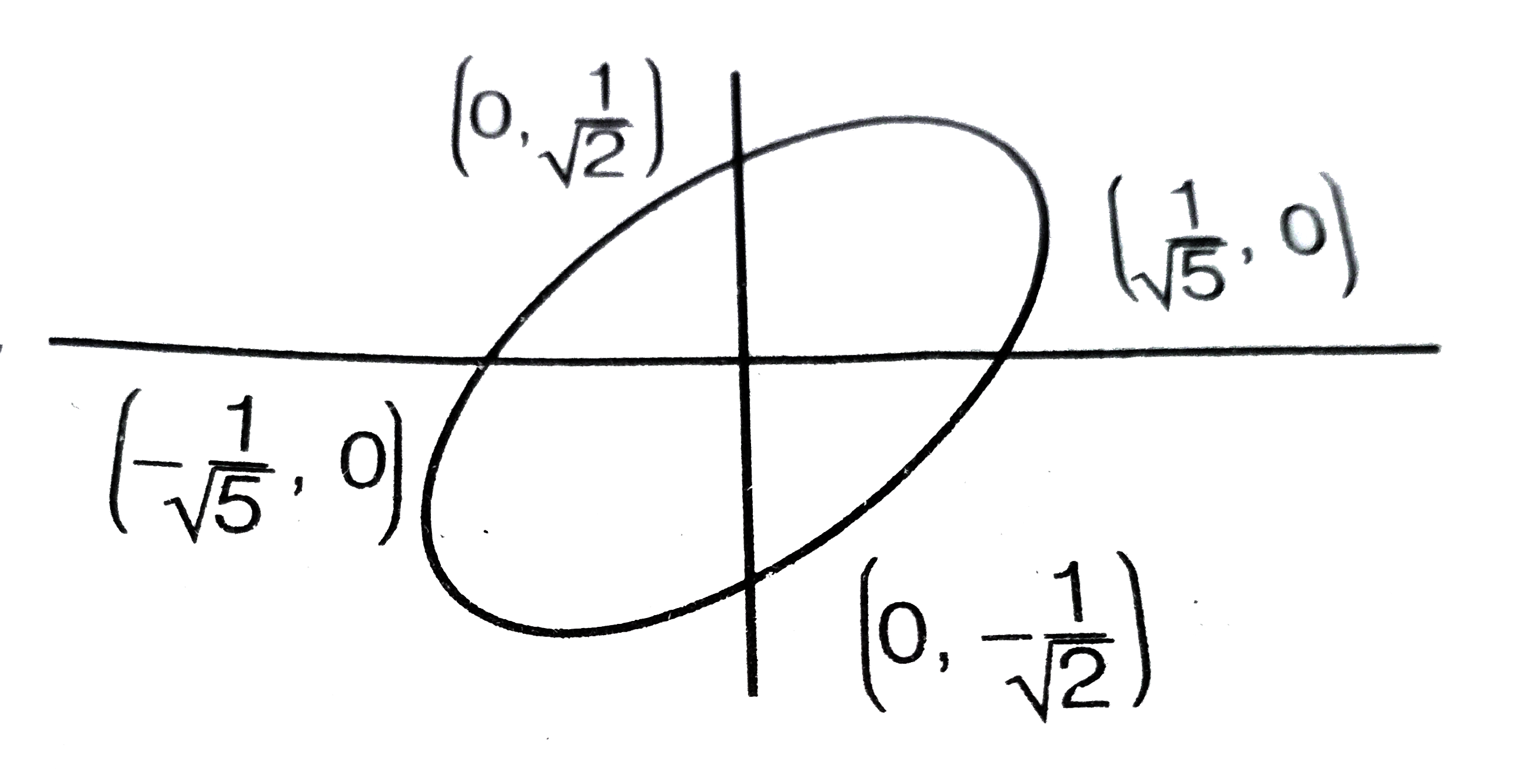
Which of the following curve is represented by 2x^(2)+6xy+5y^(2)=1? |
|
Answer»
`2x^(2)+6xy+5y^(2)=1` By putting - x for x and - y for y, the equation REMAINS same, therefore the curve is symmetric in opposite QUADRANTS. Putting `x = 0, 5y^(2)=1` `impliesy=pm(1)/(sqrt(5))` Putting `y=0, 2x^(2)=1` `implies y=pm(1)/(sqrt(2))` Then the curve passes through the points `(pm(1)/(sqrt(2)),0)` and `(0,pm(1)/(sqrt(5)))`. Thus, curve (c ) is the required curve. |
|
| 49. |
Integrate the rational functions in exercise. (1)/(x(x^(n)-1)) |
|
Answer» |
|