

Saved Bookmarks
This section includes 7 InterviewSolutions, each offering curated multiple-choice questions to sharpen your Current Affairs knowledge and support exam preparation. Choose a topic below to get started.
| 1. |
int (dx)/(tan x + cot x + sec x + cosec x) = |
|
Answer» `(1)/(2) (sin X - cos x + x) +c` |
|
| 2. |
Integrate the following functions : (x)/(1-cosx) |
|
Answer» |
|
| 3. |
Differentiate the following w.r.t. x: log (log x), x gt 1 |
|
Answer» |
|
| 4. |
Integrate the following : int2dx |
| Answer» SOLUTION :`int2dx`=2x+C | |
| 6. |
The values of theta in (0,(pi)/(2)) satisfying |
|
Answer» `|(1+sin^(2)THETA,cos^(2)theta,4sin4theta),(sin^(2)theta,1+cos^(2)theta,4sin4theta),(sin^(2)theta,cos^(2)theta,1+4sin4theta)|=0`, are |
|
| 7. |
Let veca,vecb,vecc be the three vectors such thatveca.(vecb+vecc)+vecb.(vecc+veca)+vecc.(veca+vecb)=0 and |veca|=1,|vecb|=4,|vecc|=8, then |veca+vecb+vecc| equals : |
|
Answer» 13 |
|
| 8. |
Let overset(n)underset(r=1)Sigma overset(r )underset(j=1)Sigma overset(j)underset(k=1)Sigma 1=364, then n = |
|
Answer» |
|
| 9. |
int_(pi)^(10pi) |sin x| dx= |
|
Answer» 18 |
|
| 10. |
If alpha, beta , gamma are the roots of the equation x^(3)+4x+1=0, then (alpha+beta)^(-1)+(beta+gamma)^(-1)+(gamma+alpha)^(-1) is equal to |
|
Answer» 2 |
|
| 11. |
Ifz = cos 6^(@) + isin 6^(@), " then " underset(n = 1) overset(20)sum (z^(2n-1))= |
| Answer» Answer :D | |
| 12. |
The tangent and normal to the ellipse x^2+4y^2=4 at a point (theta)on its meets the major axis in Q and R respectively. If 0ltthetaltx/2and QR=2 , then show that theta=cos^-1(2/3) . |
|
Answer» |
|
| 13. |
Find the number of ways to post 5 letters in 6 post boxes such that atleast two letters are posted in the same box. |
|
Answer» |
|
| 14. |
Assertion (A) : (1)/(5)+(1)/(3.5^(3))+(1)/(5.5^(5))+(1)/(7.5^(7))+…(1)/(2)log((3)/(2)) Reason (R ) : If |x| lt 1 then log_(e )((1+x)/(1-x))=2(x+(x^(3))/(3)+(x^(5))/(5)+…) |
|
Answer» A is TRUE, R is true and R is CORRECT explanation of A |
|
| 15. |
Evalute the following integrals int tan^(5) xdx |
|
Answer» |
|
| 16. |
A relation R is form set A to B , and a relation S is from set B to C . Then relation SOR is from ........ |
| Answer» Solution :N/A | |
| 17. |
If the area bounded by f(x) = sqrt(1 + x^(2) (x gt 0) the line y = x,y axis and y = - x + a (a > - 1) is k, then area bounded by the graph of f^(-1) (x), the line y = x between the lines y = - x + 1 and y = - x + a is |
| Answer» Answer :A-q, B-r, C-p, D-p | |
| 18. |
If the matrix [{:(0,-1,3x),(1,y,-5),(-6,5,0):}] is skew- symmetric, then |
|
Answer» `x=-2,y=0` |
|
| 19. |
If the inequality (m-2)x^(2) + 8x + m + 4 gt 0 is satisfied for all x in R, then the least integral value of m is: |
|
Answer» |
|
| 21. |
{ xcos ((y)/(x)) + y sin ((y)/(x))} y dx = { y sin ((y)/(x)) - x cos ((y)/(x))}x dy |
|
Answer» |
|
| 22. |
If C is arbitrary constant then inte^(sin^(-1)x)((lnx)/(sqrt(1-x^(2)))+1/x)dx is equal to |
|
Answer» `e^(SIN^(-1)xcosx)+C` PUT `x=sin theta impliesdx=cos theta d theta` `inte^(theta)((ln sin theta)/(cos theta)+1/(sin theta))cos theta d theta` `=inte^(theta)(ln sin theta+cot theta)d theta=e^(0).ln(sin theta)+c` `=e^(sin^(-1)x) lnx+c=-e^(sin^(-1)In(1/x)+C` |
|
| 23. |
[sqrt2(cos56^(@)15+isin56^(@)15')]^(8) |
|
Answer» 1 |
|
| 24. |
Two balls of mass m_1 and m_2 (m_1 gt m_2) are thrown from the same point on the ground with same speed at angles theta_1 and theta_2(theta_1 gt theta_2, theta_1+theta_2=90^@ and theta_1 ne 0) fromhorizontal respectively. If R_1 and R_2 ae range, T_1 and T_2 are time of flight, H_1 and H_2 are maximum height then choose the INCORRECT option. |
|
Answer» `T_1 GT T_2` |
|
| 26. |
Find the area of the smaller part of the circle x^(2) + y^(2) = a^(2) cut off by the line x=a/sqrt2. |
|
Answer» |
|
| 27. |
Unit vectors vec(a),vec(b),vec(c ) are coplanar. A unit vector vec(d) is perpendicular to them. If (vec(a)xxvec(b))xx(vec(c )xxvec(d))=(1)/(6)i-(1)/(3)hat(j)+(1)/(3)hat(k) and the angle between vec(a) and vec(b) is 30^(@), then vec(c ) is/are : |
|
Answer» `PM(1)/(3)(-HAT(i)-2hat(j)+2hat(k))` `THEREFORE" "(vec(a)xxvec(b).vec(d))vec(c )-(vec(a)xxvec(b).vec(c ))vec(d)=(1)/(6)hat(i)-(1)/(3)hat(j)+(1)/(3)hat(k)impliespm(1)/(2).vec(c )=(1)/(6)(hat(i)-2hat(j)+2hat(k))` |
|
| 28. |
Consider the points A(-2, -3) and B(1,6). i. Find the equation of the line passing through A and B. ii. Find the equation of the line passing through (2, 1) and perpendicular to AB iii. Find the foot of the above perpendicular to AB. |
|
Answer» |
|
| 29. |
If a, b and c are perpendicular to b+c, c+a and a+b respectively and if |a+b|=6, |b+c|=8 and |c+a|=10, then |a+b+c| is equal to |
|
Answer» `5sqrt(2)` `RARR""|a|^2+|b|^2+2a*b=36"…(i)"` Similariy,`|b|^2+|c|^2+2b*c=64"…(ii)"` and`|c|^2+|a|^2+2c*a=100"…(iii)"` On adding Eqs. (i), (ii) and (iii), we GET `2[|a|^2+|b|^2+|c|^2+(a*b+b*c+c*a)]=200` `rArr""|a|^2+|b|^2+|c|^2=100"...(IV)"[because a*b+b*c+c*a=0]` Now, `|a+b+c|^2=|a|^2+|b|^2+|c|^2+2(a*b+b*c+b*a=0)` `rArr""|a+b+c|^2=100"[from EQ.(iv)]"` `rArr""|a+b+c|=10` |
|
| 30. |
Show that the homogenous system of equations x - 2y + z = 0, x + y - z = 0, 3 x + 6y - 5z = 0has a non-trivial solution. Also find the solution |
|
Answer» |
|
| 31. |
If cosalpha+cosbeta+cosgamma=0=sin alpha+sinbeta+singamma then cos^2alpha+cos^2beta+cos^2gamma= |
|
Answer» 0 |
|
| 32. |
If the equation has no real root, then lamda lies in the interval |
|
Answer» `(-oo,0)` `(-b)/(2a)lt0implieslamdalt0""(5)` `f(0)gt0or9gt0` `:.lamdain(-oo,6)""["form"(2),(3),(5)]` ALSO for no real roots we can have `Dlt0` `implieslamda^(2)-36lt0implieslamdain(-6,6)` HENCE, `lamdain(-oo,6)` |
|
| 33. |
Consider the triangle formed by the lines y+3x+2=0, 3y-2x-5=0, 4y+x-14=0 Match the following lists: |
Answer» 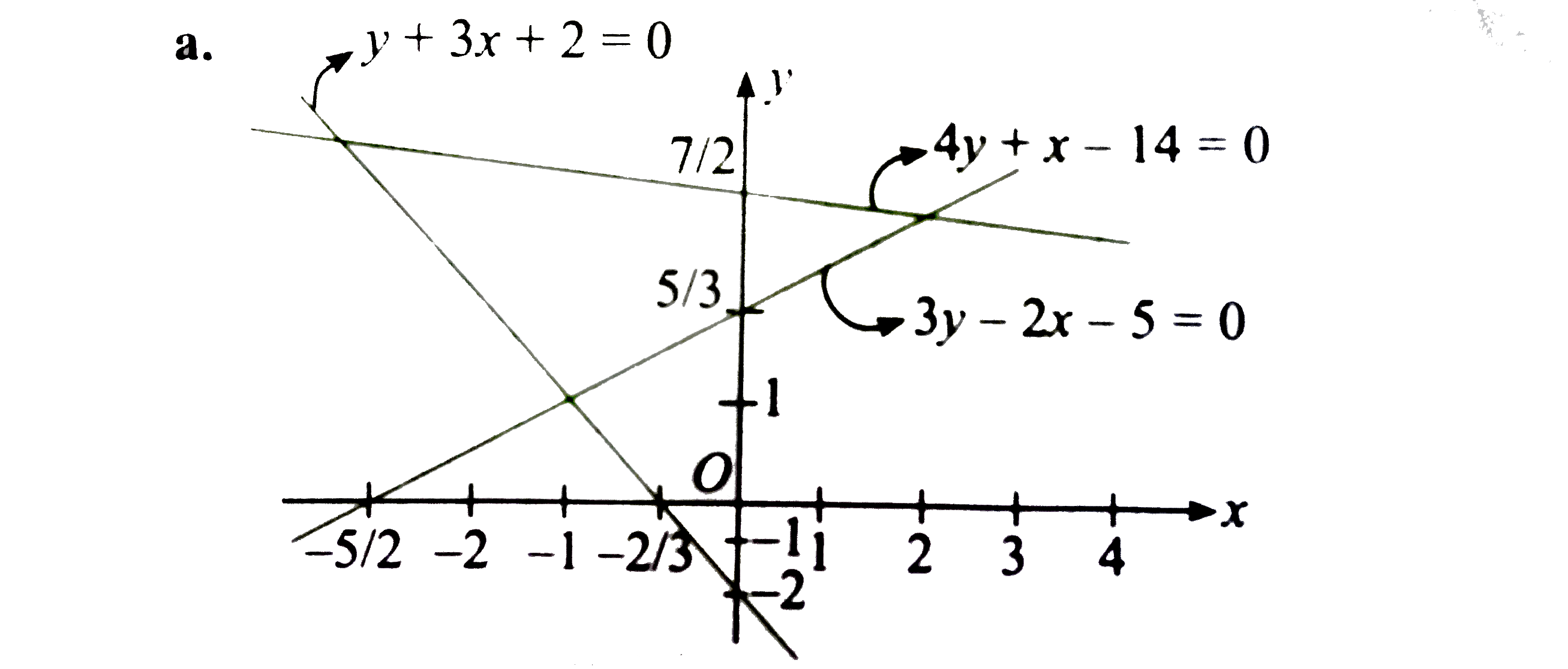 (b) Clearly, POINT `(0, alpha)` lies on y-axis. So, `5//3 lt alpha lt 7//2` (C) 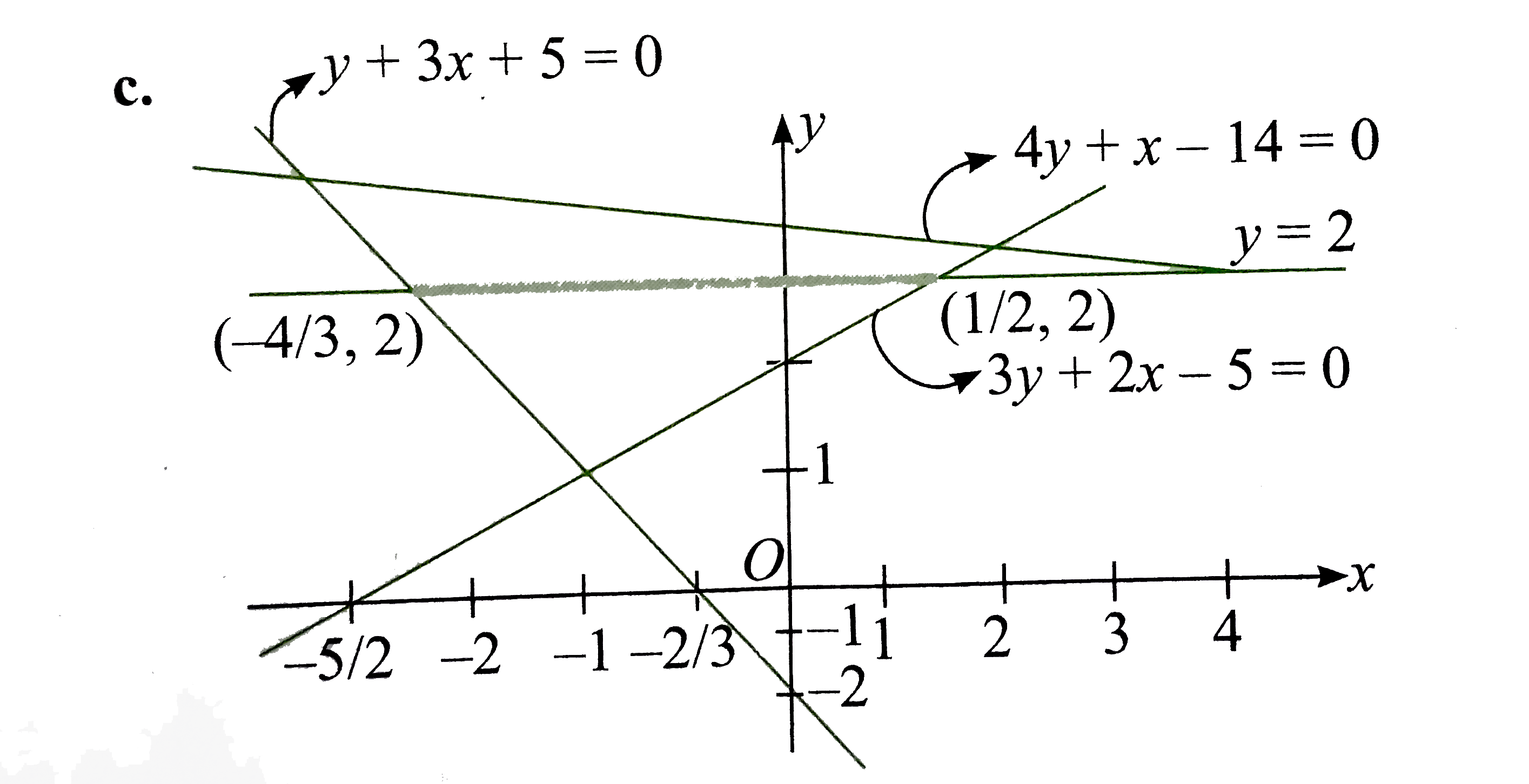 (d) 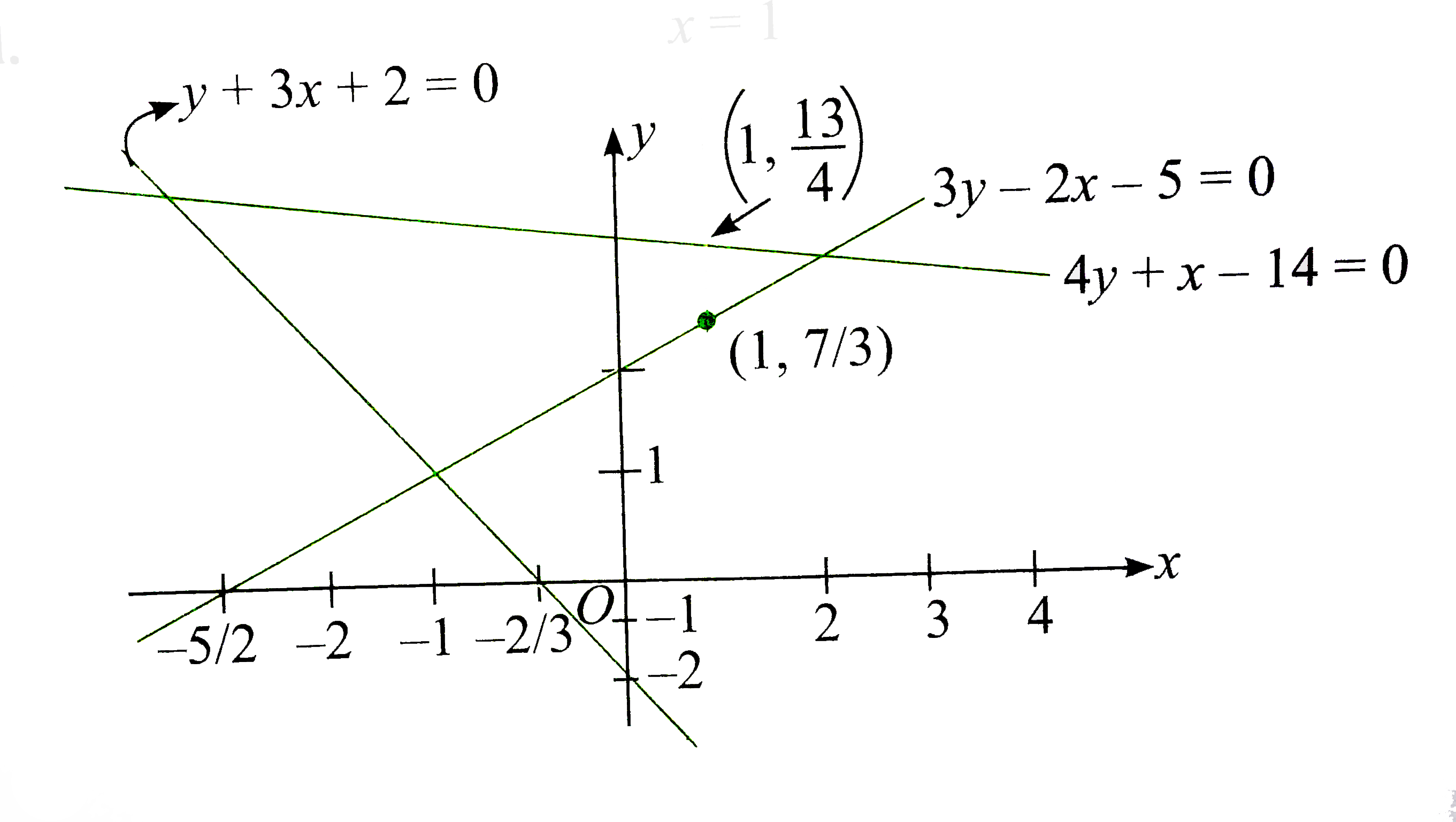
|
|
| 34. |
int_(0)^(pi//4)(sinx + cos x)/(7+9 sin 2x) dx = |
|
Answer» `(log 3)/(4)` |
|
| 35. |
Verify mean value theorem, if f(x) = x^(2) - 4x in the interval [1, 4]. |
|
Answer» |
|
| 36. |
A straight line L intersects perpendicularly both the lines : (x+2)/(2)=(y+6)/(3)=(z-34)/(-10) and (x+6)/(4)=(y-7)/(-3)=(z-7)/(-2), then the square of perpendicular distance of origin from L is |
|
Answer» |
|
| 37. |
What is the vital capacity of our lungs ? |
|
Answer» IRV + TV |
|
| 38. |
The non-zero vectors vec(a),vec(b),vec(c) are related by vec(a)=8vec(b)andvec(c)=-7vec(b). The angle betweenis vec(a)andvec(c) is |
|
Answer» `THETA` |
|
| 39. |
Match the following : Let f be a function defined on {(m,n) : m and n are positive integers }Satisfying (i) f(m,m+1) = 1/3for all m (ii) f(m,n) = f (m,k) +f (k,n)-2f (k,n) for all such that m lt k lt n {:(,P,Q,R,S),((A),1,2,3,4),((B),4,3,1,2),((C ),3,2,4,1),((D),2,1,4,3):} |
|
Answer» |
|
| 40. |
A chess game between two grandmasters X and Y is won by whoever first wins a total of two games. X's chances of winning or loosing any perticular game are a, b and c, respectively. The games are independent and a+b+c=1. The probability that X wins the match after (n+1)th game (nge1), is |
|
Answer» `na^2b^(n-1)` |
|
| 41. |
Show that the lines 5x+3y-9=0,2x+y=0,x+3y=0 and x+4y+2=0 taken in order form a cyclic quadrilateral. |
|
Answer» |
|
| 43. |
If A is a square matrix of order 3 such that |A|=13, then |adj A| is equal to |
|
Answer» 39 |
|
| 44. |
Let vec(a)=hati+4hatj+2hatk,vec(b)=3hati-2hatj+7hatk and vec( c )=2hati-hatj+4hatk. Find a vector vec(d) which is perpendicular to both vec(a) and vec(b), and vec( c ).vec(d)=15. |
|
Answer» |
|
| 45. |
int_(0)^(1) x^(3//2) sqrt(1-x) dx is equal to |
|
Answer» `pi/6` |
|
| 46. |
Derive the reduction formula for int tan^(n) xdx. |
|
Answer» |
|
| 47. |
On putting (y)/(x)=v the differential equation (dy)/(dx)(2xy-y^(2))/(2xy-x^(2)) is transfored to |
|
Answer» `X(2v-1)DX=3v(v-1)dx` `v+x(dv)/(dx)=(2v-v^(2))/(2v-1)rArr3v(1-v)dx=x(2v-1)dv` |
|
| 48. |
A steel plant is capable of producing x tonnes per day of a law-grade steel and y tonnes per day of a hight-grade steel, where y=(40-5x)/(10-x). If the fixed market price of low-grade steel is half that of high-grade steel, then what should be optimal productions in law-grade steel and high-grade steel in order to have maximum receipts. |
|
Answer» |
|
| 49. |
Solve the following differential equations (i) (dy)/(dx) - y tan x = e^(x)sec x (ii) (dy)/(dx) + y tan x = sin x |
|
Answer» (ii) y SEC x = log sec x + c |
|