

Saved Bookmarks
This section includes 7 InterviewSolutions, each offering curated multiple-choice questions to sharpen your Current Affairs knowledge and support exam preparation. Choose a topic below to get started.
| 1. |
Let Gamma be a circle with diameter AB and centre O.Let l be the tangent toGamma at B.For each point M onGamma different from A,consider the tangent t at M and let it interest l at P.Draw a line parallel to AB through P intersecting OM at Q.The locus of Q as M varies over Gammais |
|
Answer» an ARC of a circle 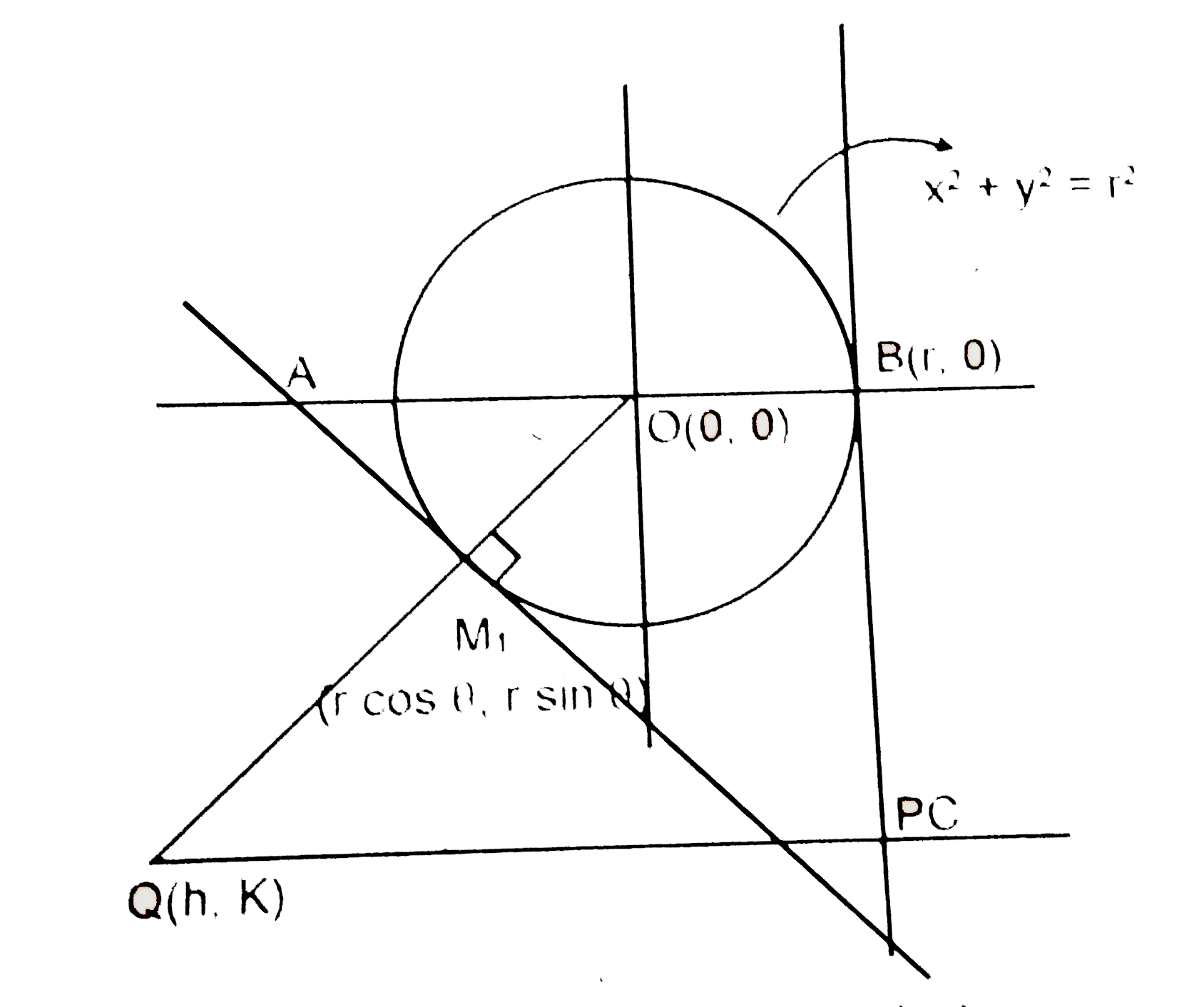 EQUATION of tangent at M, `x cos theta + y sin theta =r` PUT x=r, to get y-coordinate of point P. `r cos theta + y sin theta =r` `implies y=(r(1-cos theta))/(sin theta)=(r .2.sin^(2)"" theta/2)/(2.sin ""theta/2.cos"" theta/2)=r tan ""theta/2` `:. P=(r,rtan""(theta)/(2))` `:.` Q has y-coordinate same as point P `:. K= r tan""theta/2 impliestan""(theta)/(2)=(K)/(r)` Slope of tangent at `M= - cot theta` Slope of `OQ=(K)/(h)` `:.(K)/(h),(- cot theta)= -h implies than theta =(K)/(h)` `implies (2 tan""(theta)/(2))/(1- tan^(2)""(theta)/(2))=(K)/(h ) implies(2. (K)/(r))/(1-(K^(2))/(r^(2)))=(K)/(h)` `implies (2h)/(r)=1-(K^(2))/(r^(2)) implies(2h)/(r)=(r^(2)-K^(2))/(r^(2))` `implies 2hr=r^(2)-K^(2)` `implies y^(2)=r^(2)-2Kr` `y^(2)= - 2r(x-r//2)` `:.` Parabola |
|
| 2. |
Treating x as dependent variable, find the line of best fit for the following data : {:(x, 15, 12, 11, 14, 13),(y, 26, 28, 24, 22, 30):} Hence, predict the value of y when x = 10 |
|
Answer» |
|
| 3. |
STATEMENT - 1 : If n is even, .^(2n)C_(1)+.^(2n)C_(3)+.^(2n)C_(5)+"….."+.^(2n)C_(n-1) = 2^(2n-1). STATEMENT - 2 : .^(2n)C_(1) + .^(2n)C_(3)+ .^(2n)C_(5)+ "……"+ .^(2n)C_(2n-1) = 2^(2n-1) |
|
Answer» STATEMENT - 1 is true, STATEMENT - 2 is true and STATEMENT - 2 is CORRECT explanation for STATEMENT - 1. |
|
| 4. |
int_(1)^(0)((tan^(-1)x)/x + (lnx)/(1+x^(2))) dx is equal to |
|
Answer» `1/e_(tan^(-1)e)` `=(tan^(-1) x ln x)_(1)^(e) - int_(1)^(e) 1/(1+x^(2)) ln dx + int_(1)^(e) (ln x)/(1+x^(2)) dx` `=tan^(-1)(e). Lne - tan^(-1)(1).ln1` `= tan^(-1)(e)` |
|
| 5. |
A car completes the first half of its journey with a velocity V_(1) and the remaining half with a velocity V_(2). Then the average velocity of the car for the whole journey is |
|
Answer» `(V_(1) + V_(2))/(2)` |
|
| 6. |
Of the following the one which is not a statement is |
|
Answer» 2+3=4 |
|
| 7. |
If the lines (x-2)/(k)=(y-8)/(-3)=(z+5)/(9) and (x-5)/(1)=(y+2)/(1)=(z+5)/(k) have same direction then k = ......... |
|
Answer» 3 |
|
| 8. |
State the converse, inverse and contrapositive of If Gopal is clever, then he is rich propositions. Stating it as a conditional, wherever necessary. |
|
Answer» Solution :CON :If Gopal is RICH is rich, then he is clever. INV: If Gopal is not clever, then he is not rich. Cont : If Gopal is not rich, then the is not clever. |
|
| 9. |
Two numbers X and Y are chosen at random from the set {1,2,……3n} . Find the probability that X^(2)-Y^(2) is divisible by 3. |
|
Answer» |
|
| 11. |
If P(A)=(6)/(11), P(B) =(5)/(11) and P(A cup B)=(7)/(11), find (i) P(A cap B) (ii) P (A|B) (iii) P(B|A) |
|
Answer» |
|
| 12. |
Integrate the functions (sin^(8)x-cos^(8)x)/(1-2sin^(2)xcos^(2)x) |
|
Answer» |
|
| 13. |
If a line is drawn through a point A(3,4) to cut the circle x^(2)+y^(2)=4 at P and Q then AP .AQ= |
|
Answer» |
|
| 14. |
Solvetheequation 3x^3 -26 x^2 + 52 x-24 =0 the rootsbeinginG.P |
|
Answer» |
|
| 15. |
A tangent to thecurve y=1 -x^(3) is drawn so thatthe abscissa x_(0) of thepoint of tangency belongs to theinterval (0,1].Thetangent at x_(0) meetsthe x-axisat A & Brespectively . Then find the minimum area of the triangle OAB where O is the origin |
|
Answer» |
|
| 16. |
Let f(x)={(xsin((pi)/x), "at" xgt0),(0,"at"x=0):} |
|
Answer» `f^(')(x)` VANISHES atleast once in `[1/3,1/2]` `:.f^(')(x)=0` on each interval `[1/(k+1),1/k],KepsilonN` |
|
| 17. |
Solve : sin["sin"^(-1)1/5+cos^(-1)x] = 1 .Find x. |
|
Answer» `(PI)/(2)` |
|
| 18. |
At what delta gt 0does the relation|int_(0) pisin x dx - sum_(i=0)^(n-1)sin zeta _(k) Delta x_(k)| lt 0 . 001 follow from the inequalitymax Deltax_(i) lt delta |
|
Answer» |
|
| 19. |
The position vectors of the vertices, A,B,C of a tetrahedron ABCD are hati+hatj+hatk,hati.3hati. The altitude from vertex D to opposite face ABC meets the median line AF of DeltaABCat the point E. IF AD=4 and volume of tetrahedron is (2sqrt2)/3 then barE is |
|
Answer» `3hati-hatj-hatk` |
|
| 20. |
A factor o |((a-x)^(2),(b-x)^(2),(c-x)^(2)),((a-y)^(2),(b-y)^(2),(c-y)^(2)),((a-z)^(2),(b-z)^(2),(c-z)^(2))| is |
|
Answer» `a+b` |
|
| 21. |
The smallest positive integer n for which ((z-1)/(z+1))=k , where k is non-zero real, is |
|
Answer» a circle with center on y-axis |
|
| 22. |
n-sqrt(2n-22)=1 Given the equation above, whichof the following is a possible value of n? I.7 II. -3 III. -5 |
|
Answer» I only |
|
| 23. |
Solve the inequality (5x)/(2)+(3x)/(4) ge (39)/(4) , when x is a real number. |
|
Answer» |
|
| 24. |
A tangent to the hyperbola meets x-axisat P and y-axis at Q. Lines PR and QR are drawn such that OPRQ is a rectangle (where O is the origin) then R lies on |
|
Answer» `(4)/(X^(2))+(2)/(y^(2))=1` |
|
| 26. |
If 5th term of the expansion (root(3)(x) - 1/x)^n is independent of x then n = |
|
Answer» 16 |
|
| 27. |
Find the coordinates of the foot of the perpendicular drawn from the origin to the plane 2x – 3y + 4z - 6 = 0. |
|
Answer» |
|
| 28. |
Showthat thelines (x-1)/(2)=(y+1)/(3) "and" (x+1)/(5)=(y-2)/(2),z=2 do notintersect each other . |
|
Answer» <P> SOLUTION :Theequationsof the givenlines are`(x-1)/(2)=(y+1)/(3)=(z-0)/(1)=lambda`(say) `(x+1)/(5)=(y-2)/(1)=(z-2)/(0)=mu`(say) Anypoint onthe LINES(i) is`P(2lambda +1, 3lambda -1, lambda)` Any POINTON the line (ii) is`Q (5mu-1,mu+2,2)` If THELINES (i)and (ii) intersectthen Pand Qmustcoincide forsomeparticularvalues of `lambda " and' mu` This gives `2lambda+1 =5mu -1, 3lambda -1=mu+2 " and"lambda=2` `rArr {underset(lambda=-3)underset(3lambda -mu=3)(2lambda -5mu =-2)` Putting`lambda=2` in (iv)we get `mu =3` Clearly`lambda =2 " and" mu ` =3do not satisfy (ii) Hencethe givenlinesdo notintersecteach other . |
|
| 29. |
(d)/(dx)(e^((1)/(2)log(1+tan^(2)x))) is equal to |
|
Answer» `1/2sec^2x` |
|
| 30. |
If the vector equation of a plane passing through three points (1,0,z_1),(1,-1,1)," and "(4,-3,2) is barr.(-hati+3hatk)=2, then the value of z_1 is |
|
Answer» 0 |
|
| 31. |
For each binary operation ** defined below, determine whether ** is commutative or associative on Q, define a**b=ab+1 |
|
Answer» SOLUTION :`a**b=ab+1` `b**a=ba+1=a**b``a,b in Q` `THEREFORE **` is COMMUTATIVE Since `(1**2)**3=(1xx2+1)**3` `3**3=3xx3+1=10` and `1**(2**3)=1**(2xx3+1) `=1**7=1xx7+1=8`, `(1**2)**3 ne 1**(2**3)` `therefore **` is not associative |
|
| 33. |
Evaluate the following:""^(105)C_(0)= |
| Answer» | |
| 34. |
Integrate the following functions e^x((1+sinx)/(1+cosx)) |
|
Answer» SOLUTION :`INT e^x((1+sinx)/(1+cosx)) dx` =`int e^x((1+2sin (x/2) COS(x/2)/(2cos^2 (x/2)) dx` =`int e^x(1/2 sec^2 (x/2) + TAN (x/2)) dx` =`e^x tan(x/2)+c, F(x) = tan x/2` `f^.(x) = 1/2 sec^2 x/2` |
|
| 35. |
If a curve is ............. |
|
Answer» `(d^(2)x)/(dy^(2))=d/(dy)((dx)/(dy))=d/(dt)(1/t).(dt)/(dy)=(-1)/t^(2). 1/(12 t^(3))=(-1)/(12 t^(5))` so `((-1)/(12 t^(5)))/((1/t)^(N))` is constant `implies n=5` |
|
| 36. |
Integrate the following functions. int(sqrtx)/(sqrt(a^(3)-x^(3)))dx |
|
Answer» |
|
| 37. |
Evaluate the following integrals inte^(x)(tan^(-1)x+(1)/(1+x^(2)))dx |
|
Answer» |
|
| 38. |
| overset(to)(a) | = 3, | overset(to)(b) | = sqrt(2)//3 and | overset(to)(a) xx overset(to)(b) | =1 . find the angle between overset(to)(a) and overset(to)(b) |
|
Answer» |
|
| 39. |
Consider f: {1,2,3} to {a,b,c} and g: {a,b,c} to {apple, ball, cat} defined as f (1) =a, f (2) =b, f (3)=c, g (a) = apple, g (b) =ball and g (c )= cat. Show that f, g and gof are invertible. Find out f ^(-1) , g ^(-1) and ("gof")^(-1) and show that ("gof") ^(-1) =f ^(-1) og ^(-1). |
|
Answer» |
|
| 40. |
If x^(2)- y^(2) + 4x-6y + k is resolvable into two linear factors, then k = |
|
Answer» -1 |
|
| 41. |
We have three solid bodies of same material A rightarrow a solid cube of edge length 'r' Brightarrow a solid sphere of radius 'r' and C rightarrow a solid hemisphere of radius 'r' In coloumnI certain situation related to these bodies are given Match the appropriate outcome indicated in column-II {:(,"Column-I",,"Column-II"),("(A)",underset("300k Then rate of fall of temperature with time")"All 3 bodies are heated to some temperature of 350k and kept in a room at",,"(P)for C is highest" "(Q)for B is highest"),("(B)",underset("C is kept with base on ground height of centre of mass from ground")"All 3 bodies are kept on level ground",,"(R)for C is lowest"),("(C)",underset("for cube and hemisphere is perpendicular to the fase and base respectively Moment of inertia")"All 3 bodies are rotated about an axis passing through their repective centre of mass the axis",,"(S) for one of the body is half of another body"):} |
Answer» SOLUTION :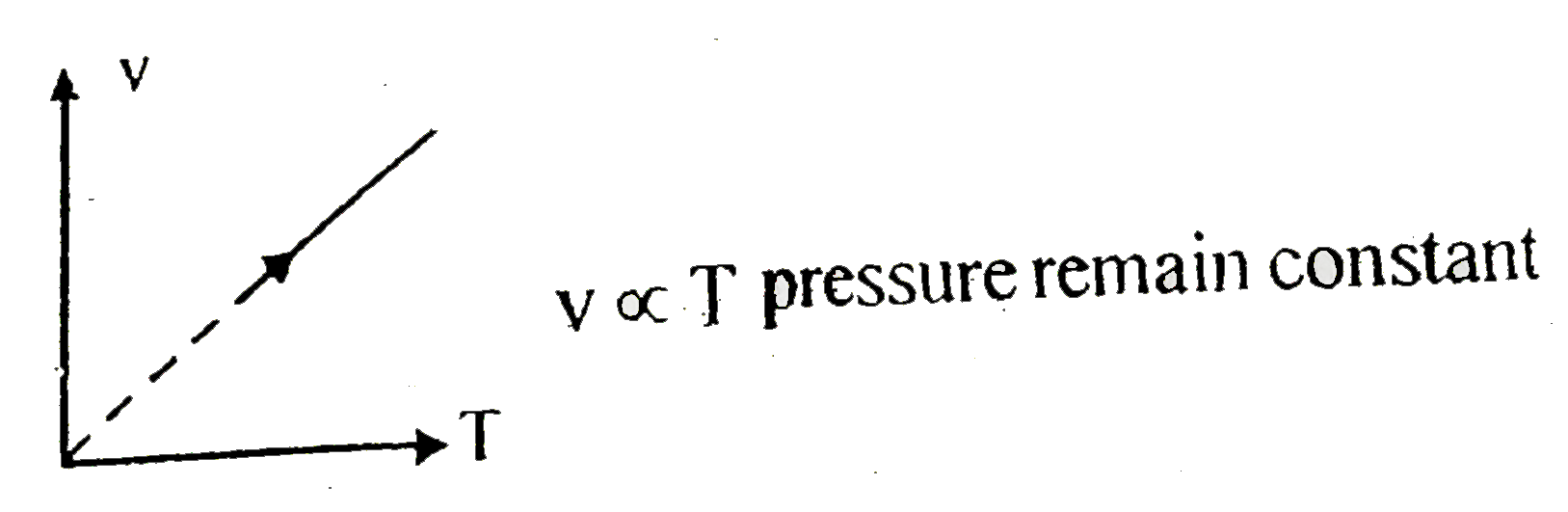
|
|
| 42. |
The value of the integral int_(0)^(n pi +1) (| cosx|+|sin x|) dx is |
|
Answer» `N` |
|
| 43. |
If 3A =[(1,2,2),(2,1,-2),(x,2,y)] and A'A =I then x+y is equal to |
| Answer» Answer :A | |
| 44. |
A : If cos (x-y) =3 cos ( x+y) " then " cot x - cot y=2 R : If (a)/(b)=(c)/(d) " then " (a+b)/(a-b)=(c+d)/(c-d) |
|
Answer» A is TRUE , R is true and R is correct EXPLANATION of A |
|
| 45. |
If f(x) = cos^(2)x + cos^(2) 2x + cos^(2) 3x, then the number of values of x in [0, 2pi] for which f(x) = 1 is |
|
Answer» 4 |
|
| 46. |
Evalute the following integrals int x " tan"^(-1) (x^(2))dx |
|
Answer» |
|
| 47. |
If therootsof theequation x^4 - 10x^3 +50 x^2- 130 x+ 169= 0 areof theforma +- ibandb +- iathen(a,b)= |
|
Answer» `(3,2)` |
|
| 48. |
Statement 1: in aDelta ABC ifa lt b lt cand r inradius andr_(1), r_(2), r_(3)are the exradii opposite to angle r gt r_(1) gt r_(2) gt r_(3)respectively thenStatement 2: For ,Delta ABC r_(1)r_(2) + r_(2) r_(3) + r_(3)r_(1) = (r_(1)r_(2)r_(3))/(r ) |
|
Answer» If STATEMENT -1 is TRUE, statement –II is true, statement –II is a correct explanation for statement-I |
|
| 49. |
Coefficient of x^(n) in(e^(5x)+e^(x))/(e^(2x)) is ..... |
|
Answer» `1/(N!) (3^(n) +1)` |
|
| 50. |
Draw the graph of f(x) " maximum " {2 sin x, 1 - cos x}, x in (0, pi). Also find the range of g(x) " min " {2 sin x, 1 - cos x}, x in (0, pi) |
|
Answer» Solution :Let us first DRAW graphs of `g_(1)(x) = 2 sin x` and `g_(2)(x) = 1 - cos x` `g_(1)(0) = g_(1)(pi) = 0, g_(1)(pi//2) = 2` `g_(2)(x) = sin x gt 0, AA x in (0, pi)` So `g_(2)' (x)` is increasing. `g_(2)(0) = 0, g_(2)(pi//2) = 1, g_(2)(pi) = 2` Graph of functions are as shown in the FOLLOWING figure. 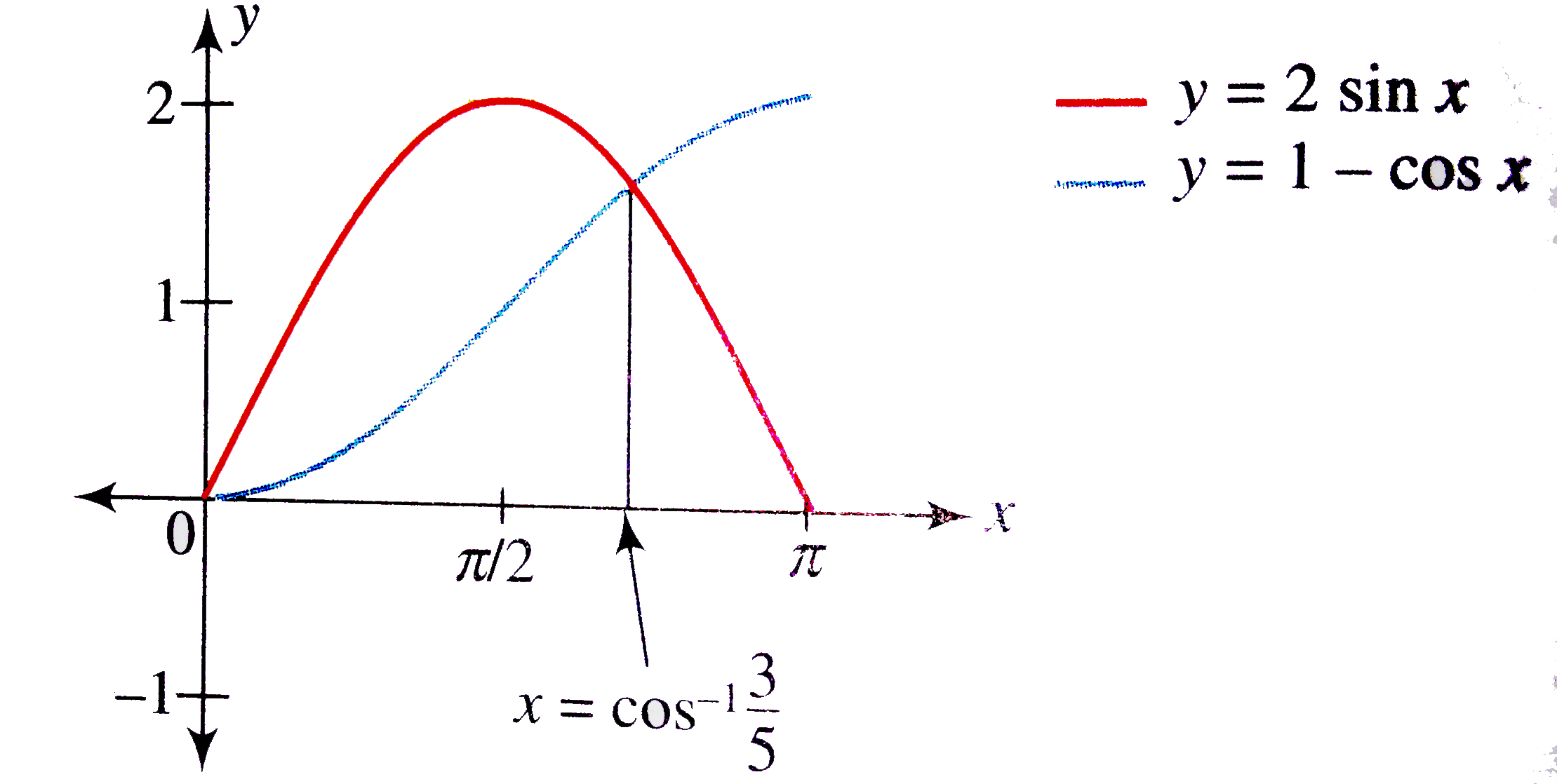 Curves y = 2 sin x and y = 1 - cos x intersect when `4 sin^(2)x = (1 - cos x)^(2)` `rArr` `4(1 + cos x) = (1 - cos x)` `rArr` `4 + 4 cos x = 1 - cos x` `rArr` `cos x = -3//5` `rArr` `x = cos^(-1) (-3//5)` `THEREFORE` `f(x) = {{:(2sinx",", 0 LT x lt pi - "cos"^(-1)(3)/(5)),(1- cos x",", pi - "cos"^(-1)(3)/(5) lt x lt pi):}` Also the range of `g(x) = min {2 sin x, 1-cosx}` is `[0,1 - cos cos^(-1)(-(3)/(5))] -=[1, 8//5].` |
|