

Saved Bookmarks
This section includes 7 InterviewSolutions, each offering curated multiple-choice questions to sharpen your Current Affairs knowledge and support exam preparation. Choose a topic below to get started.
| 1. |
Each side of a square has length 4 units and its center is at (3,4). If one of the diagonals is parallel to the line y=x, then anser the following questions. ,brgt The radius of the circle inscribed in the triangle formed by any two vertices of the square and the center is |
|
Answer» `2(sqrt(2)-1)` Also, the length of the DIAGONAL of the square is `4 sqrt(2)` Hence, the equation of one of the diagonals is `(x-3)/(1//sqrt(2))=(y-4)/(1//sqrt(2))=r = +-2 sqrt(2)` Hence, `x-3= y-4= +- 2` or `x=5,1` and `y=6,2` Hence, two of the VERTICES are `(1,2)` and `(5,6)` The other diagonal is parallel to the line `y= -x` , so that its equation is `(x-3)/(-1//sqrt(2))=(y-4)/(1 //sqrt(2))=r = +- 2 sqrt(2)` Hence, the two vertices on this diagonal are (1,6) and (5,2) 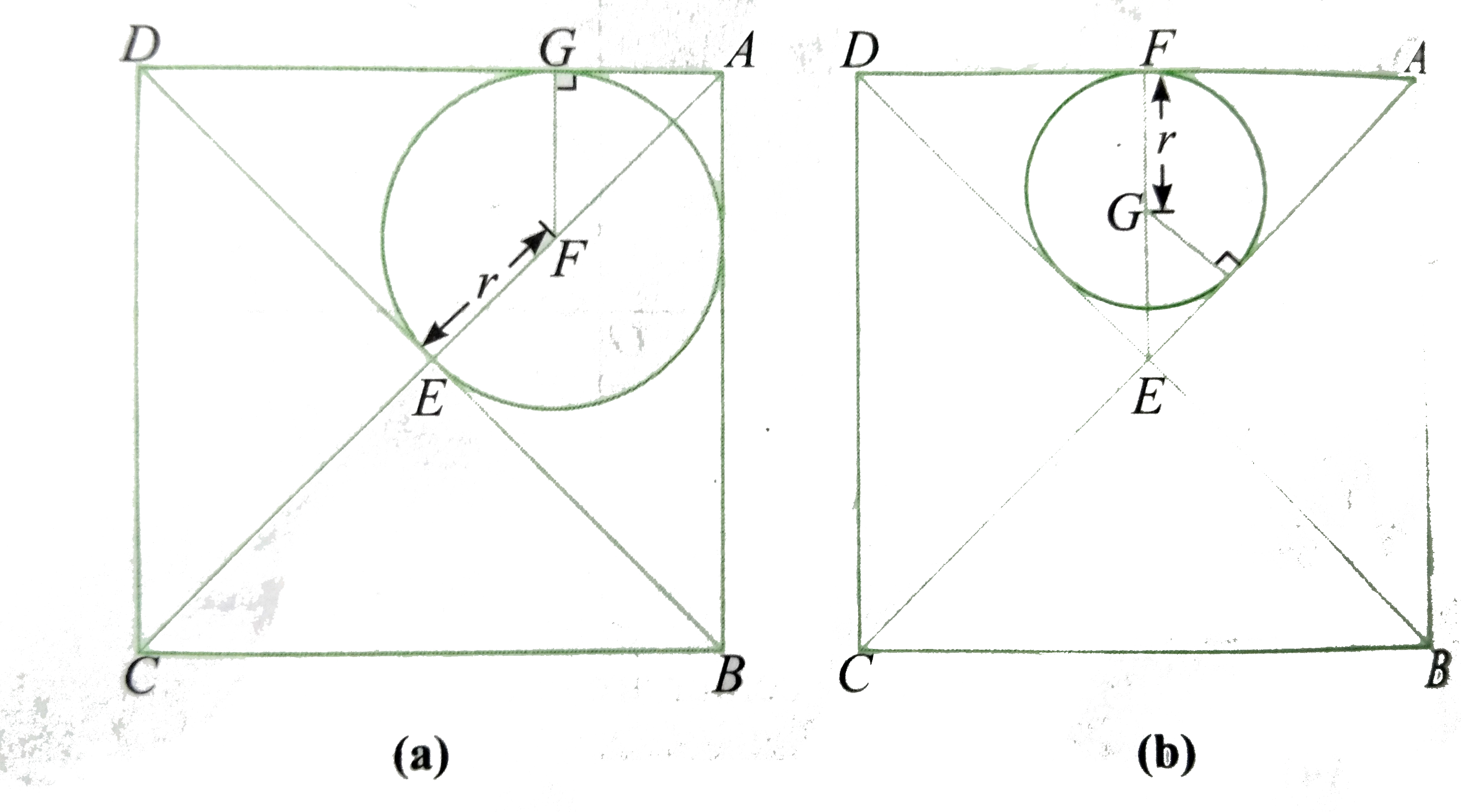 `AB =4, AC= 4 sqrt(2)` `:. AE =2 sqrt(2)` In first figure, `EF+FA = AE` or `r +sqrt(2) r = 2 sqrt(2)` or `r= (2sqrt(2))/( sqrt(2)+1)=2sqrt(2)(sqrt(2)-1)` In second figure, `EG +FG =EF` or `sqrt(2)r +r=2` or `r= (2)/(sqrt(2)+1)=2(sqrt(2)-1)` |
|
| 2. |
Cinnamic acid (Ph-CH=CH-CO OH) is nitrated preferablyat __________ and it is __________ then nitration of benzene. |
|
Answer» m-position,faster |
|
| 3. |
Draw the rough sketch of y= log x. Using integration find the area bounded by the curve,x-axis and x=2 |
|
Answer» |
|
| 4. |
Let **' be the binary operation on N given by a**'b= L.c.m. of a and b. Is ** commutative ? |
|
Answer» SOLUTION :`a**B`=L.c.m. of a and b = L.c.m of b and a =`b**a` for all `a,b in N` `THEREFORE **` is COMMUTATIVE |
|
| 5. |
If x is positive, the first negative term in the expansion of (1 + x)^(27/5 is |
| Answer» Answer :D | |
| 7. |
Show that the function f(x) = log cos xis : (i) Strictly decreasing in ]0,pi/2[ (ii) Strictly increasing in ]pi/2, pi [ |
| Answer» | |
| 8. |
Area of the triangleformed by the lines x+y =2 and angel bisectors of the pairof st linesx^(2)+2y=1 is |
| Answer» Answer :A | |
| 9. |
if statements p and r are false and q is true, then trueth value of ~pimplies(q ^^ r)vv ris |
|
Answer» <P>T |
|
| 10. |
If a is a non - zerointerger andb is a postivenumbersuch ab^(2) = log_(10)b,the mediamof the set {0,1,a,b,(1)/(b)} is |
|
Answer» 1 |
|
| 11. |
From 1^(st) 101 natural numbers, 4 numbers are selected at random. Find the probability that the selected numbers are in A.P. with greatest possible common difference. |
|
Answer» |
|
| 12. |
Let vec(u),vec(v),vec(w) be such that vec(u)+vec(v)+vec(w)=0. If |vec(u)|=3,|vec(v)|=4,|vec(w)|=5, then vec(u).vec(v)+vec(v).vec(w)+vec(w).vec(u)= |
|
Answer» 47 |
|
| 13. |
If f (x) is a function such that f''(x)+f(x)=0 and g(x)=[f(x)]^(2)+[f'(x)]^(2)and g(3)=3 then g(8)= |
|
Answer» 0 |
|
| 14. |
If x and y are positive intergers such that the greastest common factor of x^(2) y^(2) and xy^(3) is 45, then which of the following could y equal? |
|
Answer» 45 |
|
| 15. |
int_0^4(dx)/(sqrt(x^2+9) |
|
Answer» SOLUTION :`int_0^4(DX)/(SQRT(x^2+9)) =` `int_0^4(dx)/(sqrt(x^2+3^2))` `=[In(x+sqrt(x^2+3^2)]_0^4` `=In9-In3=In3` |
|
| 16. |
The set of all values of 'a' for which the expression (ax^(2)+2x-3)/(2x-3x^(2)+a) assumes all real values for real vales of x, is |
| Answer» ANSWER :C | |
| 17. |
Find all the values of following . (1 + i)^(2//3) |
|
Answer» |
|
| 18. |
If veca, vecb, vecc are three non-zero vector such that each one of then is perpendicular to the sum of the other two vectors, then the value of |veca+vecb+vecc|^(2) is : |
|
Answer» `(5)/(SQRT(2))` |
|
| 19. |
Let f: R rarrR be defined by f(x)=2x+6 which is bijective mapping then f^(-1)(x) is given by |
| Answer» ANSWER :A | |
| 20. |
Using differentials, find the approximate value of each of the up to 3 places of decimal. (3.968)^((3)/(2)) |
|
Answer» |
|
| 22. |
Using differentials, find the approximate value of each of the up to 3 places of decimal. (15)^((1)/(4)) |
|
Answer» |
|
| 23. |
{:("Column A","q is an integer greater than 1. Let stand for the smallest positive integer factor of q that is greater than 1.", "Column B"),(,,):} |
|
Answer» If COLUMN A is larger |
|
| 24. |
The sides of a triangle are the straight lines x +y = 1 , 7y = x and y + x = 0. Then which of the following is an interior point of the triangle? |
|
Answer» circumcentre |
|
| 25. |
A merchant plans to sell two types of personal computers - a desktop model and a portable model that will cost Rs. 25000 and Rs. 40000 respectively. He estimates that the total monthly demand of computers will not exceed 250 units. Determine the number of units of each type of computers which the merchant should stock to get maximum profit if he does not want to invest more than Rs. 70 lakhs and if his profit on the desktop model is Rs. 4500 and on portable model is Rs. 5000. |
|
Answer» |
|
| 26. |
Evaluate (ii) int_(0)^(pi/2)(x)/(sin x + cos x) dx |
|
Answer» |
|
| 27. |
Find the differential equation that will represented family of all circles havingcentres on the x axisand the radiusis unity |
|
Answer» |
|
| 28. |
Evaluate the integrals in exercise. overset(2)underset(1)((1)/(x)-(1)/(2x^(2)))e^(2x)+dx |
|
Answer» |
|
| 29. |
underset(x to 0)(lim) (5^(x) + 4^(x) - 2^(x) -1)/(5x) is equal to |
| Answer» Answer :A | |
| 30. |
If A and B are two events, then P(A uu B)=P(A nn B) if and only if |
|
Answer» P(A)+P(B)=1 |
|
| 31. |
The remainder obtained when the polynominal 1+x+x^(3)+x^(9)+x^(27)+x^(81)+x^(243) is divided by x-1 is |
|
Answer» 3 |
|
| 32. |
For each of the differential equations given in find a particular solution satisfying the given condition : (1+x^(2))(dy)/(dx)+2xy=(1)/(1+x^(2)), y=0 when x=1 |
|
Answer» |
|
| 33. |
If the set A contains 5 elements and the set B contains 6 elements , then the number of one -one and onto mapping from A to B is .... |
|
Answer» 720 |
|
| 34. |
The maximum and minimum distance of a satellite moving around the earth is an elliptic orbit having the earth at a focus are 82000 km and 24000 km. Find the distance of earth from other focus. |
|
Answer» |
|
| 35. |
Select the Correct Option If A is an invertible matrix of order 2, then det(A^-1) is equal to |
|
Answer» 0 |
|
| 36. |
If A=[{:("cos"(2pi)/(3),-"sin"(2pi)/(3)),("sin"(2pi)/(3),"cos"(2pi)/(3)):}] then , A^(3)= ……. |
|
Answer» `[{:(0,1),(1,0):}]` |
|
| 37. |
Find the minimum integral value of k for which the equation e^(x)=kx^(2) has exactly three real distinct solutions. |
|
Answer» Solution :Given equation is `e^(x)=kx^(2)`. `RARR k=e^(x)/x^(2)` Now let `f(x)=e^(x)/x^(2)` `THEREFORE f^(')(x) = ((x-2)e^(x))/(x^(3))` `f^(')(x)=0 therefore x=2`, which is the point of MINIMA. Also `f(2) =e^(2)/4` `underset(x to infty)"lim"e^(x)/x^(2)=infty` (using L' Hospital rule twice) `underset(x to infty) e^(x)/x^(2)=0` `underset(x to 0)"lim"e^(x)/x^(2)=infty` Further `f(x) gt 0, AA x in R`. From this INFORMATION, the graph of `f(x)` is as shown in the following figure. 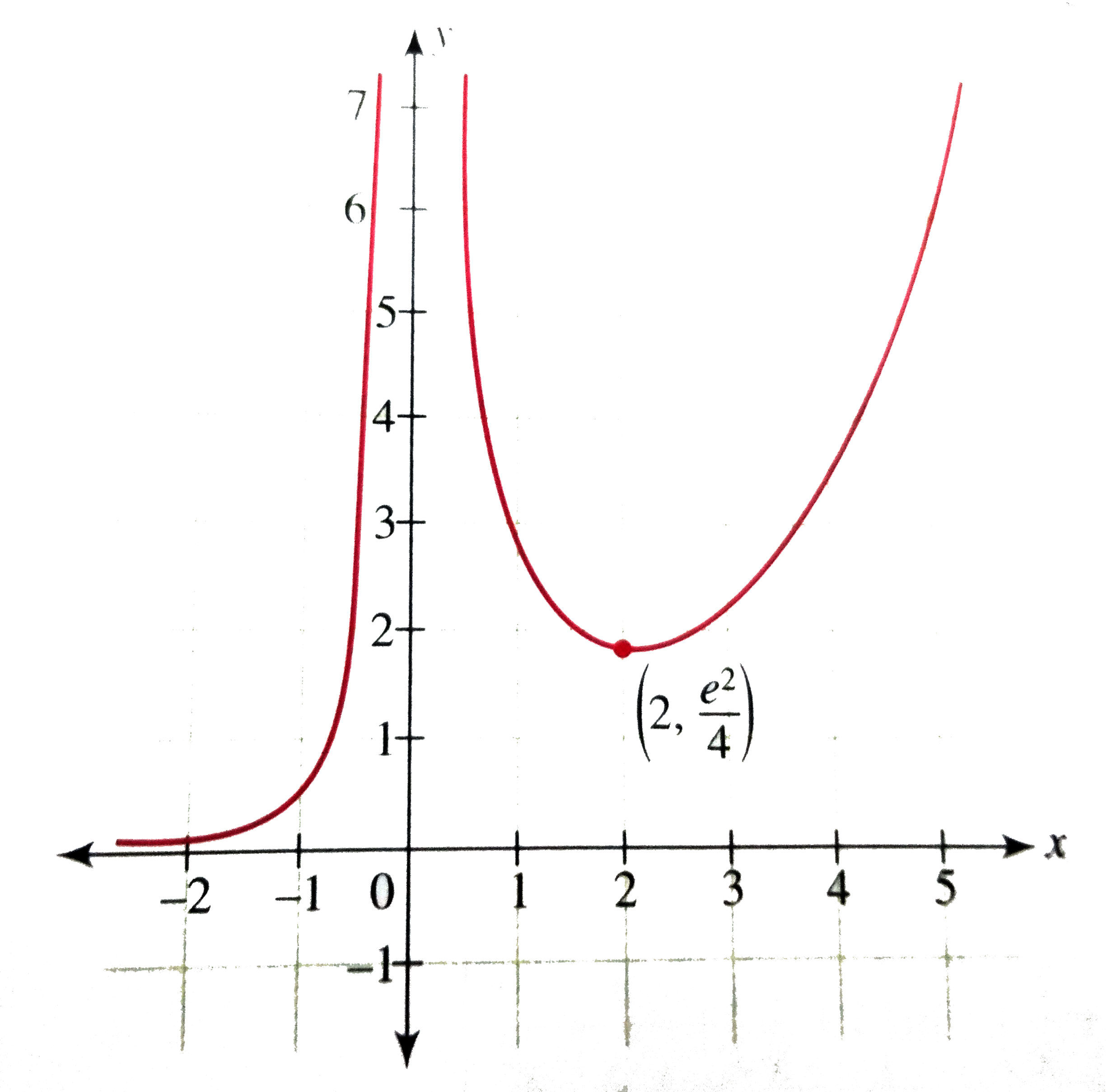 Thus, three real distinct solutions for `k lt e^(2)/4, k in I`. So, `k_("min") =2`. |
|
| 38. |
If f(x) = |x|^(3), show that f''(x) exists for all real x and find it |
|
Answer» |
|
| 39. |
Express the following differential equations in the form f(x)dx+g(y)dy = 0 (i) (dy)/(dx) = (2y)/(x) (ii) x+y(dy)/(dx) = 0 (iii) (dy)/(dx) = e^(x-y) + x^(2).e^(-y) (iv) (dy)/(dx) + x^(2) = x^(2)e^(3y) |
|
Answer» (III) `(x^(2) + E^(x))dx - e^(y) dy = 0` (iv) `x^(2)dx - ((1)/(e^(3Y) - 1))dy = 0` |
|
| 40. |
AFruitsbasketcontains4 organes, 5applesand6 mangoes. Thenumberofwaysapersom makeselectionoffruitsfromamongthefruits in tebasketis |
|
Answer» 210 |
|
| 41. |
Consider the function f(x) satisfying the identityf(x) +f((x-1)/(x))=1+x AA x in R -{0,1}, and g(x)=2f(x)-x+1. The domain of y=sqrt(g(x)) is |
|
Answer» `(-oo,(1-sqrt(5))/(2)] CUP [1,(1+sqrt(5))/(2)]` In (1), replace x by `(x-1)/(x)`. Then `f((x-1)/(x))+f(((x-1)/(x)-1)/((x-1)/(x)))=1+(x-1)/(x)` `ORF((x-1)/(x))+f((1)/(1-x))=1+(x-1)/(x) "(2)" ` Now, from `(1) -(2)`, we have `f(x)-f((1)/(1-x))=x-(x-1)/(x) "(3)" ` In (3), replace x by `(1)/(x-1)`. Then `f((1)/(1-x))-f((x-1)/(x))=(1)/(1-x)-((1)/(1-x)-1)/((1)/(1-x))` ` orf((1)/(1-x))-f((x-1)/(x))=(1)/(1-x)-x "(4)" ` Now, from `(1)+(3)+(4)`, we have `2f(x)=1+x+x-(x-1)/(x)+(1)/(1-x)-x` ` orf(x)=(x^(3)-x^(2)-1)/(2x(x-1))` `g(x)=(x^(3)-x^(2)-1)/(x(x-1))-x+1=(x^(2)-x-1)/(x(x-1))` Now, for `y=sqrt(g(x)),` we must have `(x^(2)-x-1)/(x(x-1)) GE 0` `or ((x-(1-sqrt(5))/(2))(x-(1+sqrt(5))/(2)))/(x(x-1)) ge 0` `orx in (-oo,(1-sqrt(5))/(2)] cup (0,1)cup [(1+sqrt(5))/(2),oo)` |
|
| 42. |
If z = (x + iy) and if the point P in the Argand plane represents z , then discribe geometrically the locus of P satisfying the equations |2z - 3| = 7 |
|
Answer» |
|
| 44. |
Evalute the following integrals int (2x + 3)/(x^(3) + x^(2) - 2x)dx |
|
Answer» |
|
| 45. |
Statement I . The equation 2x^2-3xy-2y^2+5x-5y+3=0 represents a pair of perpendicular straight lines. Statement II A pair of lines given by ax^2+2hxy+by^2+2gx+2fy+c=0 are perpendicular if a+b=0 |
|
Answer» |
|
| 46. |
Find the slope of the tangent to the curve y= (x-1)/(x-2), x ne 2at x = 10. |
|
Answer» |
|
| 47. |
int x sin x dx |
|
Answer» |
|
| 48. |
Evaluate int(sqrt(x^(2)+1){log_(e)(x^(2)+1)-2logx}dx)/(x^(4)). |
|
Answer» |
|
| 49. |
Find the valve of 'a' for which the following equations have equal roots. i) x^(2)+(a+3)x+a+6=0 ii) 2(a+1)x^(2)+2(a+3)x+a+5=0 |
|
Answer» |
|