

Saved Bookmarks
This section includes 7 InterviewSolutions, each offering curated multiple-choice questions to sharpen your Current Affairs knowledge and support exam preparation. Choose a topic below to get started.
| 1. |
If the vector equation of the line is barr= (1, -5,9) + k(2, 2, -1), k epsilon R then its cartesian equation is ......... |
|
Answer» `(x+1)/(2)=(y-5)/(2)=(z+9)/(-1)` |
|
| 2. |
|{:(x+1,x^2+2,x^2+x),(x^2+1,x+1,x^2+2),(x^2+2,x^2+x,x+1):}|=ax^6+bx^5+cx^4+dx^3+ex^2+fx+g" then "f= ........., g=..... |
|
Answer» `f=-3,g=7` |
|
| 3. |
Find the number of ways of arranging the letters of the word. INTERMEDIATE |
|
Answer» |
|
| 4. |
The two curve x^(3)-3xy^(2)+2=0 and 3x^(2)y-y^(3)-2=0 intersect at an angle of ……………. |
|
Answer» `(pi)/(4)` |
|
| 5. |
The sum of the coefficient in the expansion of (1 + x+x^2)^n is |
|
Answer» 2 |
|
| 6. |
Integrate the function is exercise. sqrt(x^(2)+4x+1) |
|
Answer» |
|
| 7. |
If you add up 5 consecutive odd integers that are each greater than 15, what is the smallest possible sum ? |
|
Answer» 75 |
|
| 8. |
For given vectors, vec(a)=hati+2hatj and vec(b)=hati+2hatk, find the unit vector in the direction of the vector 3vec(a)-2vec(b). |
|
Answer» |
|
| 9. |
""^(n)C_(r)+4.""^(n)C_(r-1)+6.""^(n)C_(r-2)+4.""^(n)C_(r-3)+""^(n)C_(r-4) is equal to |
|
Answer» `""^(n+4)C_(R)` |
|
| 10. |
If a=3+4i, z_(1) " and "z_(2) are two complex numbers such that abs(z_(1))=3 " and "abs(z_(2)-a)=2, then the maximum value of abs(z_(1)-z_(2)) is |
|
Answer» 5 |
|
| 11. |
If m is a variable the locus of the point of intersection of the lines x/3-y/2=m and x/3+y/2=1/m is |
|
Answer» a parabola |
|
| 12. |
If P(A)= 0.2, P(B) = 0.3andP(A cup B) = 0.25 thenP(B | A') = ……….. |
|
Answer» `(1)/(6)` |
|
| 13. |
BF_(3)+NH_(3)rarrProduct A Total number of lone pair present in product(A) |
|
Answer» |
|
| 14. |
If from the origin a chordis drawn to the circle x^(2)+y^(2)-2x=0, then the locus of the mid point of the chord has equation |
|
Answer» `X^(2)+y^(2)+x+y=0` |
|
| 15. |
Differentiate the functions given in Exercises 1 to 11 w.r.t. x. (x cos x)^(x)+ ( x sin x)^(1/x). |
|
Answer» |
|
| 16. |
Graph of y=f(x) and y=g(x) is given in the following figure. If h(x)= f(g(x)), then find the value of h'(2). |
|
Answer» Solution :`""h'(2)=F'(g(2))g'(2)` `""g'(2)`is the slope of the LINE passing through the points `(0, 0) and (3, 6)` `THEREFORE ""g'(2)=2` ALSO `""g(2)=4` `therefore""h'(2)= f'(4)xx2` Now `f'(4)` is the slope of the line passing through the pointps `(3, 0) and (5, 6)` `therefore""f'(4)=3` `therefore ""h'(2)= 3xx2=6` |
|
| 17. |
f(x)= {((|sin x|)/(x)",",x ne 0),(1",",x=0):} Examine the continuity of f(x), x= 0 |
|
Answer» |
|
| 18. |
Findthe vectorequationof theplanethepassesthroughthreepoints(2,5,-3 ),(-2,-3,5) and( 5 ,3,-3) |
|
Answer» |
|
| 19. |
If n is an integer and z=cis theta,(theta ne (2n+1)pi/2), then show that (z^(2n)-1)/(z^(2n)+1)=i tan n theta). |
| Answer» | |
| 20. |
Find the continued product of the four values of(cos(pi)/(3)+isin(pi)/(3))^(3//4) |
|
Answer» |
|
| 21. |
If T is the length of the subtangent drawn at any point on the curve 3y^(2) = 4x^(3) and N is the length of the subnormal at the same point, the (3T)^(2) = |
| Answer» ANSWER :C | |
| 22. |
Ifalpha, beta, gammaare the rootsofx^3 -3ax^2 +3 bx-c=0whichareinH.Pthenbeta = |
|
Answer» `c/B` |
|
| 23. |
Question 37 and 38 refer to the following information The U.S. federal Government tracks the Consumer Price Index (CPI)- a comprehensive standard used to estimate the average price change for the typical goods and services purchased by consumers. This measure gives economics a usefulway to estimate the rates of the inflation or deflation, which reflects the respective general increase or decrease of prices of goods and services in the economy. The accompanying tables summarizes the changes in the CPI for the years 2005 through 2014, which can be assumed to be the corresponding percent rates of inflation. Q. At a beginning of 2015, a retired person is shopping for a retirement annunity, which is an investment policy that will give him fixed monthly payments for the rest of his life. He would like the amount of his annuity payments to more than keep up with the rate of inflation. He decides that he will choose a policy that issuse payments that increase annually at a rate of that is at least 1.5% greater than the average yearly compounded rate of inflation calculated from the period that extends from the second half of 2005 through the first half of 2008. What should be the minimum annual rate of increase in his monthly annuity payments, correct to the nearest tenth? |
|
Answer» |
|
| 24. |
Some special square matrices are defined as follows. Nilpotent matrix: A square matrix. A is said to be rilpotent (of order 2)it, A^(2)=O. A squre matrix is said to be nilpotent of order p, if p is the least positive integer such that A^(p)=O. Idempotent martrix: A square matrix A is said tto be idempotent it, A^(2)=A. e.g.[{:(,1,0),(,0,1):}] is an idempotent matrix. Involutory matrix: A square A is said to be involutnary if A^(2)=I, I being the identify matrix. e.g..A=[{:(,1,0),(,0,1):}]is an involutary matrix. Orothogonal matrix: A square matrix A is said to be an orthogonal matrix it A' A=I=A A' The matrix A [{:(,1,1,3),(,5,2,6),(,-2,-1,-3):}] |
|
Answer» indepotent matrices |
|
| 25. |
Some special square matrices are defined as follows. Nilpotent matrix: A square matrix. A is said to be rilpotent (of order 2)it, A^(2)=O. A squre matrix is said to be nilpotent of order p, if p is the least positive integer such that A^(p)=O. Idempotent martrix: A square matrix A is said tto be idempotent it, A^(2)=A. e.g.[{:(,1,0),(,0,1):}] is an idempotent matrix. Involutory matrix: A square A is said to be involutnary if A^(2)=I, I being the identify matrix. e.g..A=[{:(,1,0),(,0,1):}]is an involutary matrix. Orothogonal matrix: A square matrix A is said to be an orthogonal matrix it A' A=I=A A' If A and B are two square matrices such that AB=A&BA then A&B are |
|
Answer» indepotent matrices |
|
| 26. |
Some special square matrices are defined as follows. Nilpotent matrix: A square matrix. A is said to be rilpotent (of order 2)it, A^(2)=O. A squre matrix is said to be nilpotent of order p, if p is the least positive integer such that A^(p)=O. Idempotent martrix: A square matrix A is said tto be idempotent it, A^(2)=A. e.g.[{:(,1,0),(,0,1):}] is an idempotent matrix. Involutory matrix: A square A is said to be involutnary if A^(2)=I, I being the identify matrix. e.g..A=[{:(,1,0),(,0,1):}]is an involutary matrix. Orothogonal matrix: A square matrix A is said to be an orthogonal matrix it A' A=I=A A' If[{:(,0,2beta,gamma),(,alpha,beta,-gamma),(,alpha,-beta,gamma):}] is orthogonal, then |
|
Answer» `alpha=pm(1)/(SQRT2)` |
|
| 27. |
If bar(x)=(1,2,4),bar(y)=(-1,-2,k),k ne -4 then |bar(x).bar(y)|………|bar(x)||bar(y)| |
| Answer» ANSWER :A | |
| 28. |
If the corner points of the feasible region for an LPP are (0,2),(3,0),(6,0),(6,8),(0,5) thenmaximum of F - minimum of F = |
|
Answer» 60 |
|
| 29. |
From a collection of 20 consecutive natural numbers, four are selected such that they are not consecutive. The number of such selections is |
|
Answer» `284xx17` |
|
| 30. |
Two cards are drawn from a pack at a time. Find the probability that (a) one of them is an ace of hearts (b) atleast one of them is ace. |
|
Answer» (B) `1- (.^(48)C_(2))/(.^(52)C_(2))` |
|
| 31. |
Differentiate the following w.r.t.x x^x+x^a+a^x+a^a for some fixed agt0 and xgt0 |
| Answer» SOLUTION :`d/dx(x^x+x^a+a^x+a^a)=x^x(1+logx)+AX^(a-1)+a^xloga+0=x^x(1+logx)+ax^(a-1)+a^xloga` | |
| 32. |
If a tangent to the parabola y^(2) = 4ax meets the x-axis in T and the tangent at the Vertex A in P and the rectangle TAPQ is completedthen locus ofQ is |
|
Answer» `y^(2)+ax=0` |
|
| 33. |
If two roots of the equation x^3 - px^2 + qx - r = 0 are equal in magnitude but opposite in sign, then: |
|
Answer» |
|
| 34. |
If int sqrt(2) sqrt(1+sinx)dx=-4 cos (ax+b)+c then the value of (a,b) is.... |
| Answer» Answer :A | |
| 35. |
Rectangle ABCD has area 200. An ellipse with area 200pi passes through A and C and has foci at B and D. If the perimeter of the rectangle is P. Then the value of (P)/(20) is |
|
Answer» 2 `((r)/(2)+x)^(2)=((r)/(2)-x)^(2)+y^(2)` `therefore 2rx=r^(2)-2rx`. `x=(r)/(4)` Given 2. `PI.((r)/(4))^(2)+pi.((r)/(2))^(2)=120implies(3pir^(2))/(8)=120` Req.Area =`(1)/(2).pir^(2)-(2.pi.((r)/(4))^(2)+pi.((r)/(2))^(2))=(pir^(2))/(8)=40` 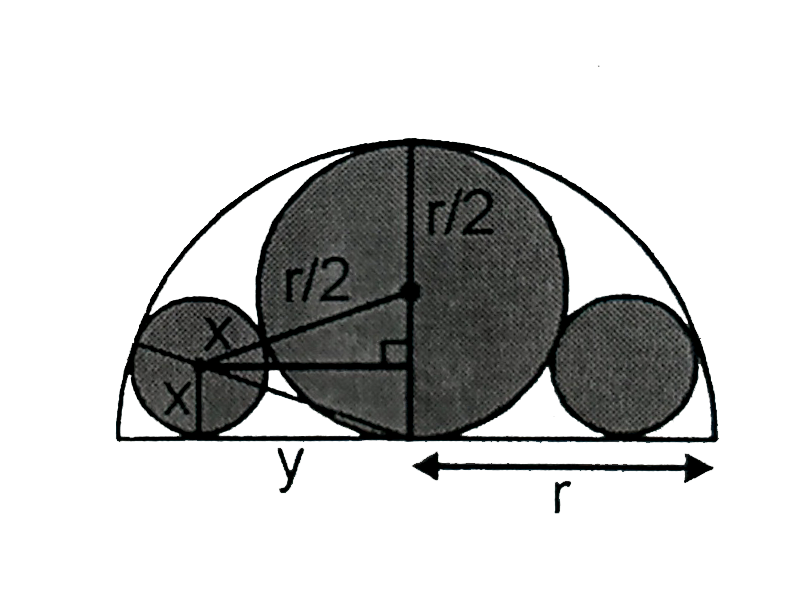
|
|
| 36. |
The sum and product of the slopes of the tangents to the hyperbola x^(2)/4-y^(2)/2=1 drawn from the point (3,-2) are |
|
Answer» `(-12)/(5), 6/5` |
|
| 37. |
Find the area of the regions bounded by the curve rho= 2a cos 3 varphi and the arcs of the circle rho= a and situated outside the circle. |
|
Answer» |
|
| 38. |
If l,m,n be d.cs, of a line ,then the line is perpendicular to the plane x-3y+2z+1=0 if ______. |
| Answer» | |
| 39. |
The shaded region shown in fig. is given by the inequations : |
|
Answer» `14x + 5y le 70, y le 14 and x - y le 5 ` |
|
| 40. |
(C_0)/(2)+(C_1)/(6)+(C_2)/(12)+…..+ (C_n)/((n+1)(n+2))= |
|
Answer» `(2^(n+2) -1)/((n+1)(n+2))` |
|
| 42. |
Which of the following are correct (where [.] denotes greatest integer funcation and {.} fractional part funcation) |
|
Answer» `1 le [x] le 5 rArr x in[1x,6)` |
|
| 43. |
Let R be the relation in the set {1,2,3,4,} givenby R = {(1,2),(2,2),(1,1),(4,4),(1,3),(3,3),(3,2)}.Choose the correct answer.a) R is reflexive and symmetric but not transitiveb) R is reflexive and transitive but not symmetricc) R is symmetric and transitive but not reflexived) R is an equivalence relation |
|
Answer» R is REFLEXIVE and SYMMETRIC but not transitive. |
|
| 44. |
A square matrix A is said to be invertible if and only if A is a |
|
Answer» SINGULAR MATRIX |
|
| 45. |
For every function f (x) which is twice differentiable , these will be good approximation ofint_(a)^(b)f(x)dx=((b-a)/(2)){f(a)+f(b)},for more acutare results forcin(a,b),F( c) = (c-a)/(2)[f(a)-f( c)]+(b-c)/(2)[f(b)-f( c)]Whenc= (a+b)/(2)int_(a)^(b)f(x)dx=(b-a)/(4){f(a)+f (b)+2 f ( c) }dxIff''(x)lt0,AAx in(a,b), and (c , f(c )) is point of maxima , wherec in (a,b) , then f ' ( c)is |
|
Answer» `(F(b)-f(a))/(b-a)` `F'' ( c) = f '' (c ) (b -a) lt 0` `RARR F' ( c) = 0 rArr f '( c) = (f(b)-f(a))/(b-a)` |
|
| 46. |
Define g(x)=int_(-3)^(3)f(x-y)f(y)dy, for all real x, where f(t)={{:(1","0letle1),(0", elsewhere."):} Then |
|
Answer» g(x) is not CONTINUOUS everywhere `g(x)=int_(0)^(1)f(x-y)DY` `x-y=t,-dy.dt` `g(x)=int_(x-1)^(x)f(t)dt` `g(x)={{:(0,xle0),(x,0lt x lt1),(2-x,1lexle2),(0,xgt2):}` Now, CHECK yourself |
|
| 47. |
When a die is rolled twice, if the event of getting an even number is denoted by a success and the number of successes as a random and the number of successes as a random variable, then distributionand mean of thevariate are |
|
Answer» `{:(0,1,2),(1//4,1//2,1//4):}, MU = 1` |
|
| 48. |
int sinx .log(Secx + tanx ) dx = f(x) + x + c then f(x)= |
|
Answer» cosx.log(SECX+TANX) |
|
| 49. |
(x - y)dy - (x + y) dx = 0 |
|
Answer» |
|
| 50. |
If the normal at any point on the ellipse (x^(2))/(a^(2))+(y^(2))/(b^(2))=1. Meet the major & minor axes at G and g such that PG: Pg=1:5 and area of Delta CBS=10 sq. units C is centre of ellipse S is focus & B in one endof minor axis, then |
|
Answer» Equation of ELLIPSE `(X^(2))/(50)+(y^(2))/(10)=1` |
|