

Saved Bookmarks
This section includes 7 InterviewSolutions, each offering curated multiple-choice questions to sharpen your Current Affairs knowledge and support exam preparation. Choose a topic below to get started.
| 1. |
An urn contains 12 red balls and 12 green balls. Suppose two balls are drawn one after another withoutreplacement . Find the probability that the second ball drawn is green given that the first ball drawn is red. |
|
Answer» |
|
| 2. |
int_(0)^(2)x[2x]dx, where[.] denotes greatest integer function, equals: |
|
Answer» `540` `=0+((x^(2))/2)_(1//2)^(1)+(x^(2))_(1)^(3//2)+((3X^(2))/2)_(3//2)^(2)=17/4` |
|
| 3. |
Use differential to approximate (25)^((1)/(3)). |
|
Answer» |
|
| 4. |
Determine if A sub B or A cancel sub B where A={x :x is an integer which is both even and odd"},B ={x:x is an integer, x ≠x} |
| Answer» SOLUTION :`A SUB B,…A = PHI "and" B = phi` | |
| 5. |
The mean and variance of 7 observations are 8 and 16 respectively . If five of the observations are 2,4,10,12,14, find the remaining two observations. |
|
Answer» |
|
| 6. |
C is a skew symmetric matrix of order n. X is a column matrix of order nxx1, then X'CX is a …… matrix. |
|
Answer» Square |
|
| 7. |
Statement-1 : tanA+tanB+tanC=tanAtanBtanC implies A, B, C are angles of a triangle. Statement-2 : In any triangle ABC, A+B+C=0. |
|
Answer» Statement-1 is TRUE, statement-2 is true, statement-2 is a CORRECT EXPLANATION for statement-5 |
|
| 8. |
(vec(a). hat(i) )^(2) + ( vec(a).hat(j))^(2) + ( vec(a) . hat(k))^(2) is equal to |
|
Answer» 0 |
|
| 9. |
Let Q(x) be a function defined for xepsilon [e^(3), e^(6)] be a real valued differentiable function such that Q(e^(3))=1 and Q(x)=2/(x+"In"("In"x+3/("In")+e-4)) then maximum value of Q can't exceed a number l(l epsilon N), then minimum value of l is________ |
|
Answer» So, `int_(E^(3))^(e^(6))Q^(')(x)dxleint_(e^(3))^(e^(6)) 2/x dx` `Q(e^(6))le7` |
|
| 10. |
C : x^(2) + y^(2) - 2x -2ay - 8 = 0, a is a variable If the chord joining the fixed points substends an angle theta at the centre of the circle C_(1). Point of chord of contact lies on the line x+ 2y + 5 = 0. then theta equals |
|
Answer» `30^(@)` |
|
| 11. |
For theminimumvalue of 3x+2y subject to constrains 5x+y ge 10, x+y ge6 , x+y ge12 and x ge 0, y ge 0 we get x=2 and y=k find the value of k |
| Answer» | |
| 12. |
Let alpha_(n) be an interior angle of a regular n-gon (n=3,4,...). Write the first several terms of the sequence alpha_(n). Prove that lime a_n= pi. |
|
Answer» |
|
| 13. |
The points (1, 1), (-5,5) and (13, lambda) lie on the same straight line if lambda= |
|
Answer» 7 |
|
| 14. |
Findthepolynomialwithrationalcoefficientsand whoserootsare 1 +- 2i ,4,2 |
|
Answer» |
|
| 15. |
Find the direction cosines of the sides of the triangle whose vertices are (3, 5, – 4), (1, 1, 2) and (- 5, – 5, - 2). |
|
Answer» Direction cousine of `vec(BC)(-2)/(sqrt(17)),(-3)/(sqrt(17)),(-2)/(sqrt(17))` Direction cousine of `vec(CA)(4)/(sqrt(42)),(5)/(sqrt(42)),(-1)/(sqrt(42))` |
|
| 16. |
Locus of the point of intersection of tangents at the extremeties of a chord of a circlex^(2)+y^(2)=a^(2) which touch the circle x^(2)+y^(2)-2ax=0 is |
|
Answer» `y^(2)=a-2x` |
|
| 17. |
Ifthe function defined by f(x) ={{:((x^2+e^(1/(2-x)))^(-1)),(""k):} {:("For"" "x ne 2),("For" " "x=2):} is right continuous at x=2 then k= |
|
Answer» `-1/4` |
|
| 18. |
A garden measuring 10 feet by 12 feet, contains individual plots that measure 1 foot by 1 foit…30% of the plots contain bell peppers, 30% contain cherry tomatoes, 25% contain squash, and the remaining 15% contain eggplants. Each bell peppers plot produce 4 cherry tomatoes every 6 days, a squash plot produces 1 squash every 15 days, and an eggplant plot produces 3 eggplants every 10 days. An unusually warm and wet month causes the montly production of eggplants to double. What is the daily average number of eggplants produced in the garden during a 30-day month at the new rate? |
|
Answer» |
|
| 19. |
Let f be defined on D = R-{-1,1} by f(x) = (|x|)/(1-|x|), then |
|
Answer» f is DIFFERENTIABLE on D |
|
| 20. |
Find the area of the parallelogram whose diagonals are a = 3 hat i + hat j - 2 hat k and hat b = hat i - 3 hat j + 4 hat k. |
|
Answer» `3SQRT5` |
|
| 21. |
If "^(n)C_(0)-^(n)C_(1)+^(n)C_(2)-^(n)C_(3)+...+(-1)^(r )*^(n)C_(r )=28 , then n is equal to …… |
|
Answer» Solution :`(c )` `'^(n)C_(0)-^(n)C_(1)+^(n)C_(2)-^(n)C_(3)+....+(-1)^(r )*^(n)C_(r )` `="COEFFICIENT of" x^(r ) "in the expansion of" (1-x)^(n)(1+x+x^(2)+….)` `="coefficient of" x^(r ) "in the expansion of" (1-x)^(n)(1-x)^(-1)` `="coefficient of" x^(r ) "in the expansion of" (1-x)^(n-1)` `=(-1)^(r )*^(n-1)C_(r )` `implies(-1)^(r )*^(n-1)C_(r )=28impliesr` MUST be even `'^(n-1)C_(r )=28implies^(n-1)C_(r )=7xx4=(7xx8)/(2)=^(8)C_(2)=n-1=8impliesn=9` |
|
| 22. |
Fora crickettrempeoplefromone classand 8 peoplefromanotherclasshavecomefor selection. Inhowwayscanweselecta cricketteamof 11 peopletakingatleast2 fromthe firsttclassand atleastoneformanotherclass ? |
|
Answer» |
|
| 23. |
If (1 + x - 3x^(2))^(10) = a_(0) + a_(1)x + a_(2)x^(2) + ....... + a_(20)x^(20), then a_(2) + a_(4) + a_(6)+ ……. + a_(20) = |
|
Answer» `(B^(N) - a^(n))/(b - a)` |
|
| 24. |
IFintriangleABCa cos^2((C )/(2 ))c cos^2((A) /(2 )) = (3 b)/(2) then thesidesa,b,andc |
|
Answer» areinG.P |
|
| 25. |
If O is the origin and OP, OQ are the tangents to the circle x^(2)+y^(2)+2x+4y+1=0, the pole of the line PQ is |
| Answer» Answer :A | |
| 26. |
If 1 +1/(2!) + (1.3) /(4!) + (13.5)/(6!) + ......oo = l 1+(2)/(2!) + (2+4)/(3!) + (2+4+6)/(4!) + .....oo = m, 1/(2!)+(1+2)/(3!)+(1+2+3)/(4!)+......oo = n then the ascending order of l , m , n is |
| Answer» Answer :D | |
| 27. |
Left hand derivative and right hand derivative of a function f(x) at a point x=a are defined as f'(a^-)=undersetlim_(hrarr0^(+))(f(a)-f(a-h))/(h) =lim_(hrarr0^(+))(f(a+h)-f(a))/(h) andf'(a^(+))=lim_(hrarr0^(+))(f(a+h)-f(a))/(h) =lim_(hrarr0^(+))(f(a)-f(a+h))/(h) =lim_(hrarr0^(+)) (f(a)-f(x))/(a-x) respectively. Let f be a twice differentiable function. We also know that derivative of a even function is odd function and derivative of an odd function is even function. If f is even function, which of the following is right hand derivative of f' at x=a? |
|
Answer» `UNDERSET(hrarr0^(-))LIM(F'(a)+f'(-a+H))/(-h)` |
|
| 28. |
(i) If f(x) = int_(0)^(sin^(2)x)sin^(-1)sqrt(t)dt+int_(0)^(cos^(2)x)cos^(-1)sqrt(t) dt, then prove that f'(x) = 0 AA x in R. (ii) Find the value of x for whichfunction f(x) = int_(-1)^(x) t(e^(t)-1)(t-1)(t-2)^(3)(t-3)^(5)dt has a local minimum. |
|
Answer» |
|
| 29. |
IFtan18^@and tan27^@arethe rootsofax^2 - bx +c=0 then |
|
Answer» `a +B+c=1` |
|
| 30. |
A die is thrown again and again until three sixes are obtained. Find the probability of obtaining the third six in the sixth throw of the die. |
|
Answer» |
|
| 31. |
Conside the matrices A=[(1,2,3),(4,1,2),(1,-1,1)] B=[(2,1,3),(4,1,-1), (2,2,3)] C=[(14),(12),(2)] D=[(13),(11),(14)]. Now x=[(x),(y),(z)]is such that solutions of equation AX=C and BX=D represent two pointsL andM respectively in 3 dimensional space. If L' and M' are hre reflections of L and M in the plane x+y+z=9 then find coordinates of L,M,L',M' |
|
Answer» (3, 4, 2) |
|
| 32. |
Matrix A=[{:(0,2y,z),(x,y,-z),(x,-y,z):}]if A A^(T)=Ithen , (x,y,z)=(...,...,...)(x,y,zgt0) |
|
Answer» `((1)/(sqrt(2)),(1)/(sqrt(3)),(1)/(sqrt(6)))` |
|
| 33. |
Consider any set of observations x_(1),x_(2),x_(3),..,x_(101). It is given that x_(1) lt x_(2) lt x_(3) lt .. Lt x_(100) lt x_(101), then the mean deviation of this set of observations about a point k is minimum when k equals |
|
Answer» `x_(1)` |
|
| 34. |
Select incorrect match for the following complexes. |
|
Answer» `[IrF_(6)]^(3-)""(DeltagtP)` (B) Due to HIGHER oxidation STATE of Cobalt in `[overset(III)(Co)(H_(2)O)_(6)]^(3+),PltDelta_(0)`,also `H_(2)O` lies to'wards stronger ligand sife in spectrochemical series. (C) CO is a STRONG field ligand hence `PltDelta` (D) Due to high value `Z_(eff)` of `Pd^(2+)`, which belongs to `2^(nd)` transition series, `(PltDelta)""]` |
|
| 35. |
vec(a) , vec(b), vec(c ) are three vectors of which every pair is non collinear. If the vector vec(a)+vec(b) and vec(b)+vec(c ) are collinear with vec(c ) and vec(a) respectively then vec(a) + vec(b) + vec(c ) is :- |
|
Answer» Unit vector `implies bar(a) + bar(b) + bar(c ) = (t_(1)+1) bar(c )` ……..(i) `bar(b)+bar(c )=t_(2) bar(a)` `implies bar(a) + bar(b) + bar(c ) = (t_(2)+1) bar(a)` ……..(ii) from (i) and (ii) `(t_(1)+1) bar(c )=(t_(2)+1)bar(a)` but `bar(a) and bar(c )` are non-collinear `:. t_(1) + 1 = t_(2) + 1 = 0` `implies t_(1) = t_(2) = -1` PUT `t_(1) = -1` in (i) `bar(a) + bar(b) + bar(c ) = 0`. |
|
| 36. |
The value of lim_(nto oo)(sqrt(n^(2)+n+1)-[sqrt(n^(2)+n+1)]) where [.] denotes the greatest integer function is |
|
Answer» 0 |
|
| 38. |
Two numbers x and y are chosen at random without replacement from the numbers 1, 2, 3,…, 3n. Find the probability that x^(3) + y^(3) is divisible by 3. |
|
Answer» |
|
| 39. |
Evaluate :int_(0)^((pi)/2)) (sqrt(cot x))/(sqrt(cot x)+ sqrt(tan x)) dx |
|
Answer» |
|
| 40. |
omega + 2omega^(2) + 3 omega^(3) + ….. 90 omega^(90) = |
|
Answer» `30 (1 - omega)` |
|
| 41. |
If a_(n)=sum_(r=0)^(n)(1)/(""^(n)C_(r)) then sum_(r=0)^(n)(r)/(""^(n)C_(r)) equal to |
|
Answer» `""^((n-1))a_(0)` |
|
| 42. |
If the tangent at P on the circlex^(2) +y^(2)=a^(2)cuts two parallel tangents of the circle at A and B then PA, PB = |
| Answer» ANSWER :B | |
| 43. |
Compute the magnitude of oversetrarrc=1/sqrt3 overset^^i+1/sqrt3 overset^^j -1/sqrt3 overset^^kvector |
|
Answer» SOLUTION :`|vecc|=SQRT((1/SQRT3)^2+(1/sqrt3)^2+((-1)/sqrt3)^2)` `sqrt(1/3+1/3+1/3)=sqrt1=1` |
|
| 44. |
If A = {1,2,3,4} , define relations on A which have properties of being : Reflexive , transitive but not symmetric |
|
Answer» |
|
| 45. |
If ad-bc ne 0, A={:[(a,b),(c,d)]:}and A^(2)+xA+yI_(2)=0, then_______ |
| Answer» Answer :B,C | |
| 47. |
Differentiate the following w.r.t.xxsin^-1x |
| Answer» SOLUTION :`d/dx(xsin^-1x)="X"XX1/(SQRT(1-x^2))+sin^-2x` | |
| 48. |
A man makes a forward step with probability 0.6. Find the probability that at the end of eleven steps, he is one step away from the starting point. |
|
Answer» |
|
| 49. |
Find the volume of the parallelepiped whosecoterminous edgesare represented by the vectors (i) vec(a)=hat(i)+hat(j)+hat(k), vec(b)=hat(i)-hat(j)+hat(k), vec(c)=hat(i)+2hat(j)-hat(k) (ii) vec(a)=-3hat(i)+7hat(j)+5hat(k), vec(b)=-5hat(i)+7hat(j)-3hat(k), vec(c)= 7 hat(i)-5hat(j)-3hat(k) (iii)vec(a)=hat(i)-2hat(j)+3hat(k), vec(b)=2hat(i)+hat(j)-hat(k), vec(c)=hat(j)+hat(k) (iv) vec(a)=6hat(i), vec(b)=2hat(j), vec(c)=5hat(i) |
|
Answer» |
|
| 50. |
Each side of a square has length 4 units and its center is at (3,4). If one of the diagonals is parallel to the line y=x, then anser the following questions. The radius of the circle inscribed in the triangle formed by any three vertices is |
|
Answer» `2sqrt(2)(sqrt(2)+1)` Also, the length of the DIAGONAL of the square is `4 sqrt(2)` Hence, the equation of one of the diagonals is `(x-3)/(1//sqrt(2))=(y-4)/(1//sqrt(2))=r = +-2 sqrt(2)` Hence, `x-3= y-4= +- 2` or `x=5,1` and `y=6,2` Hence, two of the VERTICES are `(1,2)` and `(5,6)` The other diagonal is parallel to the line `y= -x` , so that its equation is `(x-3)/(-1//sqrt(2))=(y-4)/(1 //sqrt(2))=r = +- 2 sqrt(2)` Hence, the two vertices on this diagonal are (1,6) and (5,2) 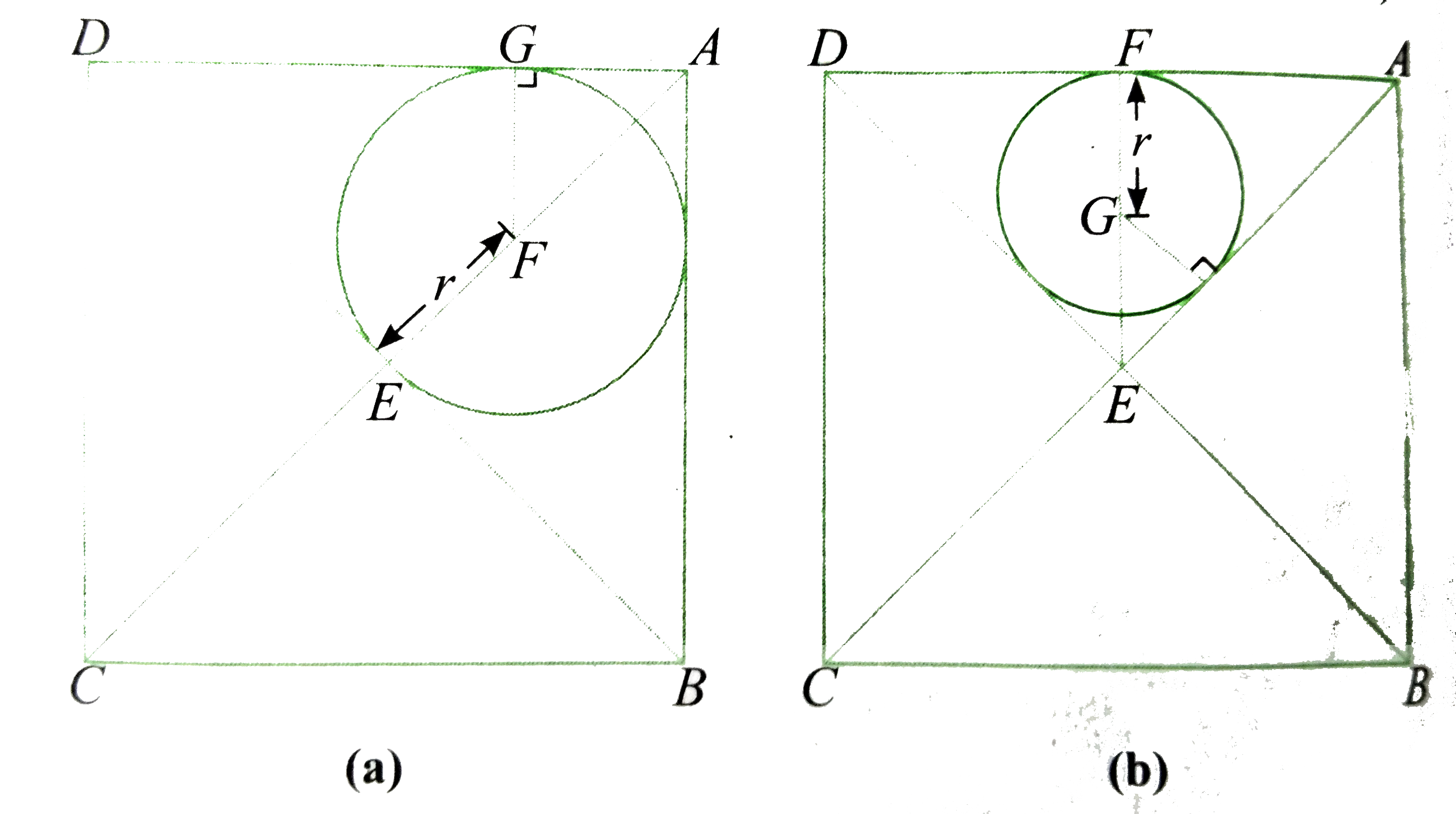 `AB =4, AC= 4 sqrt(2)` `:. AE =2 sqrt(2)` In first figure, `EF+FA = AE` or `r +sqrt(2) r = 2 sqrt(2)` or `r= (2sqrt(2))/( sqrt(2)+1)=2sqrt(2)(sqrt(2)-1)` In second figure, `EG +FG =EF` or `sqrt(2)r +r=2` or `r= (2)/(sqrt(2)+1)=2(sqrt(2)-1)` |
|