

Saved Bookmarks
This section includes 7 InterviewSolutions, each offering curated multiple-choice questions to sharpen your Current Affairs knowledge and support exam preparation. Choose a topic below to get started.
| 1. |
The shortest distance between the skew lines r = (6hati + 2hatj + 2hatk) + t(hati - 2hatj + 2hatk) and r= ( -4hati - hatk ) + s(3hati - 2hatj - 2hatk) is |
|
Answer» 9 |
|
| 2. |
int(x^(8)-9x^(2)+18)/(x^(4)-3x^(2)+3)dx= |
|
Answer» `(x^(5))/(4)+x^(3)+6X^(2)+c` |
|
| 3. |
If bara=(1)/(sqrt10)(3overset(^)i+overset(^)k),barb=1/7(2overset(^)i+3overset(^)j-6overset(^)k), then the value of (2bara-barb).{(baraxxbarb)xx(bara+2barb)} is |
| Answer» Answer :A | |
| 4. |
In a box containing 100 bulbs, I0 are defective. The probability that out of a sample of 5 bulbs, none is defective is |
| Answer» Answer :c | |
| 5. |
A pair of dice is thrown . Find the probability that the sum is 10 or greater if ,br> (i) 5 appears on the first die (ii) 5 appears on atleast one of the dice |
|
Answer» |
|
| 6. |
If B = [(-2,-2),(-1,0)] and A is a matrix such that A^(-1) B = B^(-1)and kA^(-1) =2B^(-1) +I_(2) where k is some scalar then value of kis |
| Answer» Answer :D | |
| 7. |
Find r if P (20,r)=13.P(20,r-1). |
|
Answer» SOLUTION :`""^20P_r=13xx""^20P_(R-1)` `or,(20!)/((20!-r)!)=13xx(20!)/((20-r+1)!)` `or,(20-r)! =((21-r)(20-r)!)/(13)` `or,21-r=13` `or,r=8` |
|
| 8. |
Show that the area enclosed by one arc of y=sinx and the x-axis between x=0 and x=pi. |
|
Answer» |
|
| 9. |
Let A and B be independent events with P(A)= 0.3 and P( B)= 0.4. Find P( A cup B) |
|
Answer» |
|
| 10. |
A doctor is to visit a patient. From the past experience, it is known that the probabilities that he will come by train, bus, scooter or by other means of transport are respectively (3)/(10),(1)/(5),(1)/(10) and (2)/(5) and. The probabilities that hewill be late are (1)/(4), (1)/(3) and (1)/(12) and if he comes by train, bus and scooter respectively, but if he comes by other means of transport, then he will not be late. When he comes, he is late. What is the probability that he comes by train? |
|
Answer» |
|
| 11. |
Find the area of the region bounded by y =x^(2)+1,y=x ,x=0 and y=2 |
|
Answer» |
|
| 12. |
Means and standard deviations of the scores of an intelligence test of two classes of different sizes of 25 and 75 are M_(1) = 80 makrs and M_(2) = 85 marks and S.D. = 15 marks and S.D = 20 marks Calculate the combined mean and the standard deviation of the two classes. |
|
Answer» |
|
| 13. |
Now with Hagrid’s task out of the way, Harry now faces Mad Eye Moody. Moody has prepared a special mechanical puzzle for Harry. There are 9 cubes, whose front and back sides are shown in the image below. The image on the left is the front, and right next to it is the back. The task is to arrange them in a 3x3 grid. The following conditions need to be followed: •Each letter from A to F need to be replaced with a unique number from 1-9. No two alphabets can be replaced with the same value. Once a number is assigned to an alpha- bet, the alphabet is always replaced by the same number. For example, if A is assigned the value 1, wherever there is a A, it will take the value of 1. •The Black region should be aligned with the Black region on the grid. When arranged, each equation reading from left to right, and each equation read up to down, should be correct. •When the entire arrangement is turned upside down, and placed on the 2nd grid, simi- larly, all equations should be correct. All calculations are performed in order from left to right, or top to bottom, and each individual calculation results in a positive integer value (no negative numbers, zeros, or fractions ever need to be used). What is the value of (A xx B) + (C xx D) + (E xx F) ? |
Answer» SOLUTION :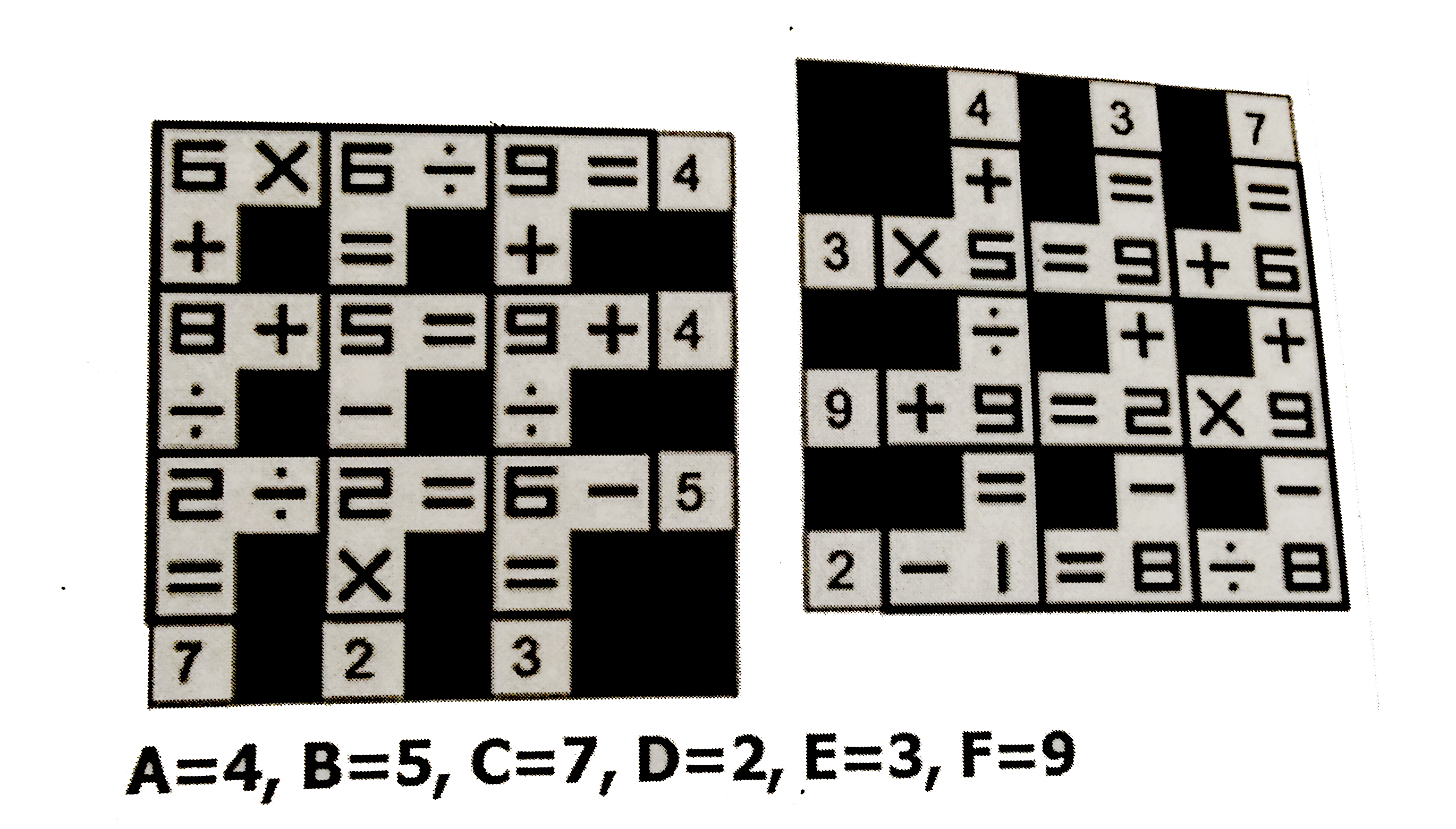
|
|
| 14. |
Compute the""^8C_0+""^8C_1+……+""^8C_8 |
| Answer» SOLUTION :`""^8C_0+ ""^8C_1+""^8C_2…….+""^8C_8=2^8=256` | |
| 15. |
An insurance company insured 2000 scooter drivers 4000 car drivers and 6000 - truck drivers. The probability of an accident are 0.01, 0.03 and 0.15 respectively one of the insured person meets with an accident. What is the probability that he is a scooter driver. |
|
Answer» |
|
| 16. |
If the distances of two points P and Q on the parabola y^(2) = 4ax from the focus of a parabola are 4 and 9 respectively then the distance of the point of intersection of tangents at P and Q from the focus is |
|
Answer» `angleTSP=angleTSQ` |
|
| 17. |
If u_(n)=int_(0)^((pi)/(2))(sin(2n-1)x)/(sinx)dxandv_(n)=int_(0)^((pi)/(2))((sinnx)/(sinx))^(2)dx and n is an integer, prove that, u_(n+1)=u_(n)andv_(n+1)-v_(n)=u_(n+1). |
|
Answer» |
|
| 18. |
The value of lambda for which the homogeneous system of equations possesses a non-trivial solution x + lambday + 2 z = 0 3x+ 2 lambda y + z = 0 is 2 x + 3y - 4z = 0 |
| Answer» ANSWER :C | |
| 19. |
Consider the general equation of second degree ax^(2) + by^(2) + 2hxy + 2gx + 2fy+ c = 0. If this represents a pair of straight lines, match the two columns in the most accurate sense. Match the column |
|
Answer» |
|
| 20. |
Which of the followingdo/does not reduce to unity ? |
|
Answer» `(sin(180^(@) + A))/(tan (180^(@) + A)).(cot(90^(@) +A))/(tan(90^(@) +A)).(cos(360^(@) -A)cosecA)/(sin(-A))` |
|
| 21. |
Two integers x and y are chosen one by one with replacement at random from the set {x =0 le x le 10 and x is an integer}. Find the probability that |x-y| le 5. |
|
Answer» |
|
| 22. |
The logical statement‘ p ^^ q 'can be related to the set theory's concept of |
|
Answer» UNION of TWO sets |
|
| 23. |
If the root of f(x) = ax^(3) + bx^(2) +cx +d =0 are a_(1),a_(2),and a_(3) and roots of g(y) = ay^(3) + f''(m)/2y^(2) + f'(m)/1y + f(m) = 0 are beta_(1), beta_(2) and beta_(3) then show that a_(1)-beta_(1) = a_(2)-beta_(2)=a_(3)-beta_(3). |
| Answer» | |
| 24. |
The probability of getting a total score of 7 when two unbaised dice are thrown simultaneously is |
| Answer» Answer :C | |
| 25. |
Evaluate int " x cosh"^(-1) x dx |
|
Answer» |
|
| 26. |
Write the equation of the line passing through the points (3,-2,-5) and (3,-2,6). |
| Answer» Solution :The EQUATION of the REQUIRED line is `(x-1)/3=(y+2)/-4=(z-3)/5` | |
| 27. |
If int(dx)/(1+sinx)=tan((x)/(2)+a)+b then a = |
|
Answer» `-pi//4` |
|
| 28. |
Find the coefficient of x^7 in the expansion of (1+2x + 3x^2 + 4x^3 + 5x^4 + 6x^5 + 7x^6 + 8x^7)^10 |
|
Answer» |
|
| 29. |
The point of intersectionof the tangent at 't_(1)' and 't_(2)' to the parabola y^(2)=4x is: |
|
Answer» `(3T^(2),4T)` |
|
| 30. |
Let f(x)be definedin theinterval [0,4] such that f(x) ={{:(1-x,0lex le 1),( x+2, 1lt xlt2),( 4-x, 2 le x le 4):}thenthenumberof pointswheref(f(x)) is discontinuousis |
|
Answer» 1 |
|
| 31. |
Let A be point on the ellipse ((x-2)^(2))/(16)+(y^(2))/(12)=1, B and C be its foci. Prove that locus of the incentre of DeltaABC is an ellipse. Find its eccentricity. |
|
Answer» |
|
| 32. |
If AD,BE and CF are the altitudes of a triangle ABC whose vertex A is the point (-4,5). The coordinates of the points E and F are (4,1) and (-1,-4) respectively, then equation of BC is |
|
Answer» `3X - 4y - 28 = 0`  Slope of `AF = (5-(-4))/(-4+1) = (9)/(-3) =- 3` `:.` Slope of `CF = (1)/(3)` `:.` EQUATION of CF is `x - 3y - 11 = 0` (i) Slope of `AF =(5-1)/(-4-1) = (4)/(-8) =- (1)/(2)` `:.` Slope of `BE = 2` `:.` Equation of BE is `2x - y - 7 = 0`(ii) Solving (i) and (ii), we get point `O =(2,-3)` Equation of AC is `x+2y - 6 = 0` (iii) Solving (i) and (iii) we get point `C (8,-1)` Also slope of AO is `-4//3` `:.` Slope of BC is `3//4` `:.` Equation of BC is `3x - 4y - 28 = 0` |
|
| 33. |
Find the area bounded by the curves y=x^(3)-x and y=x^(2)+x |
|
Answer» |
|
| 34. |
If x is so small that x^2 and higher powers of x may be neglected then ((1+2x//3)^(-4) (4+5x)^(1//2))/((9+x)^(3//2))= |
|
Answer» `(2)/(27) (1-(55X)/(12))` |
|
| 35. |
A random variable X has the following probability distribution Determine P(X>6) |
|
Answer» <P> SOLUTION :`P(Xgt6)`=P(X=7)=P(7) = `7k^2+k` =7/100+1/10=17/100 |
|
| 36. |
(d)/(dx ) {log ((sqrt(x +a ) + sqrt(x -a ))/(sqrt(x -b) - sqrt( x -c)))}= |
|
Answer» `1/2{(1)/(sqrt(X ^(2) - a ^(2)))+ (1)/(sqrt((x -b) (x -C )))}` |
|
| 37. |
If for a continuous function f, int_(-a)^(a) f(x)dx = K int_(0)^(a) (f(x) + f(-x) ) dx then the value of K is |
| Answer» ANSWER :A | |
| 38. |
Let A = ((a,b),(c,d)) ,a,b,c,d in R , a+d ne 7. If n is the number of matrices A satisfying the equation A^(2) -7 A +12I_(2) = O_(2) then 6.31 +n is equal to ______ . |
|
Answer» |
|
| 39. |
If A=[[cos alpha, -sin alpha],[sin alpha, cos alpha]], then A+A^T=I if the value of alpha is |
| Answer» ANSWER :B | |
| 40. |
The tangent to the curvey y = x^(3) + 1 at (1, 2) makes an angle theta with y-axis, then the value of tan theta is |
| Answer» ANSWER :A | |
| 41. |
Integrate: I= int ( x^(3) + 1) cos x dx. |
|
Answer» |
|
| 42. |
A data consists of n observations: x_1,x_2,…….x_n ,"If"underset( i=1) overset( n) sum (x_1+ 1)^(2)=9n and underset( i=1) overset( n) sum (x_1-1) ^(2)= 5n ,then the standard deviations of this data is: |
| Answer» Answer :B | |
| 43. |
The volume of the tetrahedron with bara,barb,barc as co-terminus edges is (1)/(6)|[bara barb barc]|. |
|
Answer» |
|
| 44. |
Differentiate x^3(sinx)e^(4lnx) |
|
Answer» SOLUTION :`=x^3(SINX)E^(lnx^4)` `=x^3(sinx)x^4` `=x^7sinx` `impliesdy/dx=d/dx(x^7) CDOT sinx+x^7d/dx(sinx)=7x^6sinx+x^7cosx` |
|
| 45. |
Statement 1 The sum of the products of numberspm a_(1),pma_(2),pma_(3),"....."pma_(n) taken two at a time is -sum_(i=1)^(n)a_(i)^(2). Statement 2 The sum of products of numbers a_(1),a_(2),a_(3),"....."a_(n) taken two at a time is denoted by sum_(1le iltjlen)suma_(i)a_(j). |
|
Answer» Statement 1 is TRUE, Statement 2 is true, Statement 2 is a correct explanation for Statement 1 `(sum_(i=1)^(N)x_(i))^(2)=sum_(i=1)^(n)x_(i)^(2)+2sum_(1leiltjlen)sumx_(i)x_(j)` `:.(a_(1)-a_(1)+a_(2)-a_(2)+"...."+a_(n)-a_(n))^(2)=2sum_(i=1)^(n)a_(i)^(2)+25` `:. S=-sum_(i=1)^(n)a_(i)^(2)` `:.` Statement 1 is true. Statement 2 is true but not correct explanation for Statement 1. |
|
| 47. |
Find the points on the curve x^(2) + y^(2) – 2x – 3 = 0 at which the tangents are parallel to the x-axis. |
|
Answer» |
|
| 48. |
Expand the following (a-7c/3)^4 |
|
Answer» SOLUTION :`(a-(7c)/3)^4` = `a^4 + "^4C_1 a^(4-1) ((-7c)/3)^1 + ^4C_2 a^(4-2) ((-7c)/3)^2 + ... +((-7c)/3)^4` = `a^4-4a^3xx(7c)/3 + 6a^2xx49c^2/9 + ... + (7^4c^4)/81` = a^4- 28/3a^3c + 98/3a^2c^2+ ... +(7^4c^4)/81` |
|
| 49. |
Let z_(1)" and "z_(2) be the roots of the equation z^(2)+pz+q=0, where p,q are real. The points represented by z_(1),z_(2) and the origin form an equilateral triangle if |
| Answer» Answer :A | |