

Saved Bookmarks
This section includes 7 InterviewSolutions, each offering curated multiple-choice questions to sharpen your Current Affairs knowledge and support exam preparation. Choose a topic below to get started.
| 1. |
If x_(1),x_(2)and x_(3) are the three real solutions of the equationsx^(2lnx-1)+e^(1//9)=(1+e^(19))(x^(lnx-0.5)) none of them being unity. Find the value of (x_(1)x_(2)x_(3)) |
|
Answer» |
|
| 2. |
The sum of the surface areas of a rectangular parallelopiped with sides x, 2x and (x)/(3) and a sphere is given to be constant. Prove that the sum of their volumes is minimum, if x is equal to three times the radius of the sphere. Also find the minimum value of the sum of their volumes. |
|
Answer» |
|
| 3. |
Neel and Nick are brothers. Neel is a distributor and Nick is a retailer. Neel purchased electronic shavers of a particular type at $4 a piece and sold all of them to Nick at $6 a piece. Nick sold all the shavers at $8 a piece to consumers. {:("Column A" , "The percent of profit is defined","ColumnB"),(, "as"("Profit")/("cost") cdot10,),("The percentage of profit that", ,"The percentage of profit that"),("Neel made in the deal", ,"Nick made in the deal"):} |
|
Answer» If column A is LARGER |
|
| 4. |
(1+1/3.(1)/(2^(2))+1/5.(1)/(2^(4))+1/7(1)/2^(6)+…..oo) = |
|
Answer» `log_(e)2 ` |
|
| 5. |
The points (2, 5) and (5, 1) are the two opposite vertices of a rectangle. If the other two vertices are points on the straight line y = 2x + k, then the value of k is |
|
Answer» 4 |
|
| 6. |
The value of the expression 1+"cosec"(pi)/(4)+"cosec"(pi)/(8)+"cosec"(pi)/(16) is equal to |
|
Answer» `cot.(pi)/(8)` |
|
| 7. |
If P(A) = 0.30, P(B) = 0.40and P( A cup B)= 0.60 then P(B | A)= ……….. |
|
Answer» `(2)/(3)` |
|
| 8. |
Let f (x) =1+ int _(0) ^(1) (xe ^(y) + ye ^(x)) f (y) dy where x and y are independent vartiables. If acute ange of intersection of the curves x/2 +y/3 +1/5 =0 and y=f (b) betheta then tan theta, equals to: |
|
Answer» `8/25` |
|
| 9. |
alpha, betaare therootsof ax ^2+bx+c=0andgamma, sigmaarethe rootsofpx ^3 + qx +r=0 andD_1:D_2 betherespective discriminationof theseequations.Ifalpha, betagammaanddeltaarein A.Pthen D_1 :D_2= |
|
Answer» `a^2:p^2` |
|
| 10. |
Let ABC be a triangle whose vertices areA- (-5,5), and B (7, -1) if vertex c has on a circle whose director circle hs equation x ^(2) +y ^(2)=100, then locus of the orthocentre of triangle ABC is equal to |
|
Answer» `X ^(2) +y ^(2) - 4X-8x-30=0` |
|
| 11. |
Person (A) speaks truth in 70% of cases and (B) in 80 % of cases. Find the probability of an event that in what percentage of cases are they likely to contradict each other? |
|
Answer» |
|
| 12. |
When the origin is shifted to the point (3,-4), the transformed equation of a curve is x^2+2y^2=4. Find the original equation. |
|
Answer» |
|
| 13. |
Evalute the following integrals int (1)/(e^(x) e^(-x)) dx |
|
Answer» |
|
| 14. |
A salad dressing requires oil, vineger, and water in the ratio 2:1:3. If Oliver has 1 cup of oil, 1/3 cup of vinegar, and 2 cups of water, what is the maximum number of cups of dressing that can mix? |
|
Answer» |
|
| 15. |
Find the area the parallelogram whose adjacent sides are determined by the vectors veca=hati-hatj+3hatkandvecb=2hati-7hatj+hatk. |
| Answer» | |
| 17. |
Let a = hati + hatj, b = hatj+ hatk and c = hati+ hatk. If d is unit vector such that a.d = 0 and b . (c xxd)=0 and d= |
|
Answer» `PM (1)/(sqrt2) (HATI+ hatj)` |
|
| 18. |
If m is a non-zero number and int (x^(5m-1)+2x^(4m-1))/((x^(2m)+x^(m)+1)^(3))dx=f(x)+c, then f(x) is |
|
Answer» `(x^(5M))/(2m(x^(2m)+x^(m)+1)^(2))` |
|
| 20. |
A dice is thrown again and again until three sixes are obtained. Find the probability of obtaining the third six in the sixth throw of the dice. |
|
Answer» |
|
| 21. |
Let f (x) =(sinpi)/(x^2),xgt 0 Let x_1lt x_2lt x_3lt..lt x_nlt...be all the poitns of local maximum of f and y_1lty_2lty_3lt.....lt y_nlt....... be all the poins of local minimum of f. Then which of the following opions is/are correct? |
|
Answer» `|x_n-y_n|gt 1` for EVERY n `impliesf(x)=(x^(2)picos(pix)-2xsin(pix))/(x^(4))` `=(2xcos(pix)[(xpi)/(2)-tan(pix)])/(x^(4))` `=(2cos(pix)[(xpi)/(2)-tan(pix)])/(x^(3))` Since, for maxima and minima of `f(x),f(x)=0` `impliescos(pix)=0` or `tan(pix)=(pix)/(2),` (as `xgt0`) `becausecos(pix)ne0impliestan(pix)=(pix)/(2)` `becausef'(P_(1)')lt0 and f'(P_(1)')lt0impliesx=P_(2)in(2,(5)/(2))` is point of local maximum. From the graph, for opition of maxima `x_(1),x_(2),x_(3)` . . . .it is clear that `(5)/(2)-x_(1) gt (9)/(2)-x_(2) gt (13)/(2)-x_3 gt (17)/(2)-x_(4)` . . . `impliex_(n+1)-x_(n) gt 2,AAn`. From the graph for point of minima `y_(1),y_(2),y_(3)`. . . , it is clear `|x_(n)-y_(n)|gtAAn and x_(1) gt (y_(1)+1)` And `x_(1)in(2,(5)/(2)),x_(2)in(4,(9)/(2)), x_(3)in(6,(13)/(2))` `impliesx_(n)in(2n,2n+(1)/(2)),AAn`. HENCE, options (a), (b) and (d) is correct 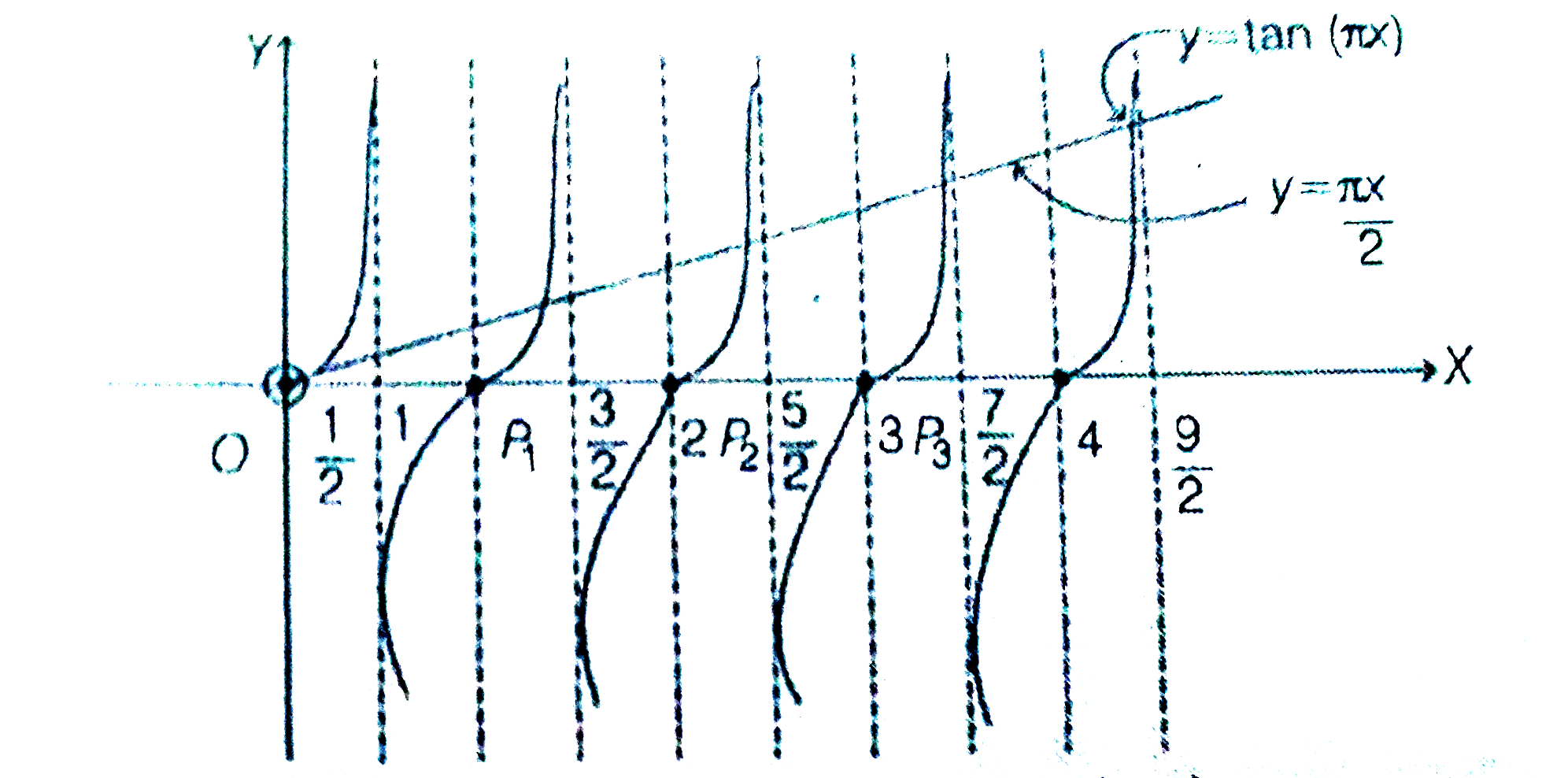
|
|
| 22. |
The solution of xd(xy) = ((f(xy))/(f^(1)(xy)))dx is |
|
Answer» f(XY) = c |
|
| 23. |
Intregate int(dx)/(sqrt(9-4x^(2))) |
| Answer» | |
| 24. |
A point moves such that the distance from the point (2,0)is always 1/3 of its distance from the line x-18=0 . If the locus of a point is conic its length of latus rectum. |
|
Answer» `16//3` |
|
| 25. |
Evaluate the following integrals (vii) int_(1)^(2) x^(2) log x dx |
|
Answer» |
|
| 26. |
Find the power of the point P(2,3) with respect to the circleS = x^(2) +y^(2) -2x +8y -23 =0 |
|
Answer» |
|
| 27. |
If the radical axis of the circles x^(2)+y^(2)+2gx+2fy+c=0 and 2x^(2)+2y^(2)+3x+8y+2c=0 touches the circle x^(2)+y^(2)+2x+2y+1=0, then |
|
Answer» `g=(3)/(4)" or F"=2` |
|
| 28. |
The value of xin the interval (-pi,0) satisfying sinx+int_(x)^(2x)cos2t dt =0 is |
|
Answer» `-(PI)/(2)` |
|
| 29. |
Equation of line touching both parabolas y^(2)=4x and x^(2) = -32y is |
|
Answer» x+2y + 4 =0 |
|
| 30. |
A function is called one - one if each element of domain has a distinct image of co - domain or for any two or more the two elements of domain, function doesn'thave same value. Otherwisefunction will be many - one. Function is called onto if co - domain = Range otherwise into. Function which is both one - one and onto, is called bijective. answer is defined only for bijective functions. If f:R rarr and f(x) = ax+sinx+a, then |
|
Answer» f(x) is ONE - one ONTO function if `a in R` |
|
| 31. |
Resolve the following into partial fractions. (3x^(2)-8x^(2) + 10)/((x-1)^(4)) |
|
Answer» `(3)/(x-1)-(1)/((x-1)^(2))-(7)/((x-1)^(3))+(5)/((x-1)^(4))` |
|
| 32. |
Find the sum of all three digit numbers those can be formed by using the digits, 0,1,2,3,4 |
|
Answer» |
|
| 33. |
Do both parts of problem 2 if 3 cards drawn at random. |
|
Answer» Solution :3 cards are DRAWN ONE after another. As they are of different SUITS , we have their probability `=52/52xx39/51xx26/50` As the 3 cards are of different denominations, we have their probability `=52/52xx48/51xx44/50` |
|
| 34. |
Consider a 20-sided convex polygon K, with vertices A_(1), A_(2),…, A_(20) in that order. Find the number of ways in which three sides of K can be chosen so that every pair among them has at least two sides of K between them (For example (A_(1), A_(2), A_(4), A_(5), A_(11) A_(12)) is an admissible triple while (A_(1)A_(2), A_(4)A_(5), A_(19)A_(20)) is not) |
|
Answer» |
|
| 35. |
Ifalpha , betaare acute angles,sin alpha= 4//5 , tan beta = 5//12then the descending order of A=sin(alpha + beta ) , B= cos ( alpha + beta ) , C= tan ( alpha + beta )is |
| Answer» ANSWER :D | |
| 37. |
Find the D.E. of the family of rectangular hyperbolas which have the corrdinate axes as asymptotes. |
|
Answer» |
|
| 38. |
If P is a point inside a convex quadrilateral ABCD such that PA^2+PB^2+PC^2+PD^2 is twice the area of the quadrilateral , then the correct statements is/ are |
|
Answer» <P>PA, PB , PC all are EQUAL |
|
| 39. |
Let{a_(n)}be an A.P with common difference d(d !=0 ) , {b_(n)}be a geometric progression withcommon ratio q, q is a positive rational number . If a_(1)=d, b_(1)= d^(2)and (a_(1)^(2)+a_(2)^(2)+a_(3)^(2))/(b_(1)+b_(2)+b_(3))is a positive integar , then q equals |
|
Answer» `1//4` |
|
| 40. |
If A equiv (2, 3, 4), B equiv (3, 4, 5). The direction cosine of a line are (1/sqrt(3), 1/sqrt(3), 1sqrt(3)) Now integral value of the projection of AB on the given line is _______. |
|
Answer» |
|
| 41. |
findthe conditionthat x^3 -px^2 +qx -r=0may havetworootsequalin magniudebutof oppositesign |
|
Answer» |
|
| 42. |
Find the coordinate of the point on y^(2) = 8x which is closest from x^(2) + (y+6)^2 = 1. |
|
Answer» |
|
| 43. |
Integrate the following functions x/e^(x^2) |
|
Answer» SOLUTION :Let `x^2 = t. Then DT = 2X dx `gt xdx = (dt)/2` therefore` int x/e^(x^2) dx = int x e^(-x^2) dx` =`int e^(-1) (dt)/2 = 1/2 xx e^(-1)/(-1) +c` =`-1/2 e^(-1)+c = -1/2 e^(-x^2) +c` =`-1/(2e^(x^2) +c` |
|
| 44. |
Define * on Z by a*b =a+b+ab showthat * is a binary operation operation on z which is neither commutativenor associative |
|
Answer» SOLUTION :`a in Z b in Z rarr (a-b) ein Z and ab in Z` `rarr {(a-b)+ab) in Z rarr a-b + ab in Z` `therefore` Z is closed for * Show that 3*2 ne 2 * 3 and (4*3)*2 ne 4 *(3*2) |
|
| 45. |
A straight line with slope 1 passes through Q(-3,5) and meets the straight line x+y-6=0 at P. Find the distance PQ. |
|
Answer» |
|
| 46. |
If -(pi)/(4) lt x lt (pi)/(4), then the general solution of the differential equation cos^(2)x .(dy)/(dx) - (tan 2x) y = cos^(4)x is |
|
Answer» `y = (1)/(2) [(TAN 2X + c)/(1-tan^(2)x)]` |
|
| 47. |
Differentiate the functions with respect to x in 2 sqrt(cot (x^(2))) |
|
Answer» |
|
| 48. |
Find the range of x for which the binomial expansions of the following are valid .(7 + 3x)^(-5) |
|
Answer» |
|
| 49. |
Integrate the following function : int(dx)/(sqrt(x^(2)+16))dx |
|
Answer» |
|