

Saved Bookmarks
This section includes 7 InterviewSolutions, each offering curated multiple-choice questions to sharpen your Current Affairs knowledge and support exam preparation. Choose a topic below to get started.
| 1. |
If p=Xcostheta-Ysintheta,q=Xsintheta+Ycosthetaandp^(2)+4pq+q^(2)=AX^(2)+BY^(2),0le0le(pi)/(2).What is the value of B ? |
|
Answer» `-1` `q=xsintheta+ycostheta` Given, `p^(2)+4pq+q^(2)=Ax^(2)+By^(2)` Letus take`theta=(pi)/(4)`. `p=x"COS"(pi)/(4)-y" cos"(pi)/(4)=(x+y)/(sqrt(2))` `q=x" sin"(pi)/(4)+y" cos"(pi)/(4)=(x+y)/(sqrt(2))` `pq=(x^(2)-y^(2))/(2)rArr2pq=x^(2)-y^(2)rArr4pq=2X^(2)-2y^(2)` . . . (1) Now, `p^(2)+q^(2)=x^(2)cos^(2)theta+y^(2)sin^(2)theta-2xycosthetasintheta+x^(2)sin^(2)theta+y^(2)cos^(2)theta+2xysinthetacostheta=x^(2)+y^(2)`. . . (2) From(1) , (2) , `p^(2)+q^(2)+4pq=x^(2)+y^(2)+2x^(2)-2y^(2)=3x^(2)-y^(2)` Comparingthis with the given from , we get `theta=(pi)/(4),A=3,B=-1` |
|
| 2. |
[[7,1,2],[9,2,1]][[3],[4],[5]] + 2[[4],[5]] is equal toa) [[43],[50]]b) [[43],[45]]c) [[45],[44]]d) [[44],[45]] |
|
Answer» `[[43],[50]]` |
|
| 3. |
Incircle of Delta ABC touches the sides BC, CA and AB at D, E and F, respectively. Let r_(1) be the radius of incircle of DeltaBDF. Then prove that r_(1) = (1)/(2) ((s-b) sin B)/((1+ sin.(B)/(2))) |
Answer» Solution : `ANGLE DIF = pi -B` Now, `FD = 2FP = 2r sin ((pi -B)/(2)) = 2r cos.(B)/(2)` Also, `BD = BF = s - b` Now, in -radius of `DeltaBDF` is `r_(1)` `:. r_(1) ("AREA of "DeltaBDF)/("Semiperimeter of " DeltaBDF)` `= ((1)/(2) (s-b)^(2) sinB)/((1)/(2) (2(s-b) + 2r cos.(B)/(2)))` `= ((s-b) sin B)/(2(1 + tan.(B)/(2) cos.(B)/(2))) "" ( :' r = (s-b) tan.(B)/(2))` `= ((s-b) sin B)/(2(1+ sin.(B)/(2))) ( :' r = (s-b) tan.(B)/(2))` |
|
| 4. |
(C_0)/(2)+(C_1)/(3)+(C_2)/(4)+…...+(C_n)/(n+2)= |
|
Answer» `(N.2^n +1)/((n+1)(n+2))` |
|
| 5. |
Write the following function in the simplest form : "tan"^(-1)x/(sqrt(a^(2)-x^(2))),|x|lta |
|
Answer» |
|
| 6. |
Let A be a square matrix of order 3xx3" then "|5A|= |
|
Answer» `5|A|` |
|
| 7. |
Sovle tan^(-1)2x+tan^(-1)3x=(pi)/4 |
|
Answer» |
|
| 8. |
If S_(n)=1^(3)+2^(3)+…+n^(3) and T_(n)=1+2+….+n, then |
|
Answer» `S_(N)=T_(n^(3))` |
|
| 9. |
If continued product of three number in G.P. is 216 and sum of there product in pairs is 156. Find the numbers. |
|
Answer» |
|
| 10. |
Let A be a 2 xx2 matrix such that 3A^(2) + 6A - l_(2)= O_(2) . Then a value of det (A+l) is : |
|
Answer» `- 7 //SQRT(3)` |
|
| 11. |
For the final puzzle before the first round, professor McGonagall takes Harry to a dun- geon. The 9 floors of the dungeons are shown below as 9 cards.The floor have gotten out of order, so Harry has to stack them up again. When they are stacked correctly, they will contain a path from the start (S) on the bottom floor to the Finish (F) on the top floor that goes through every up and down stairway. As Harry travels the path, every time he hits an up stairway, he must go to the square with the same coordinates on the floor immediately above the one he's on. Likewise, when he hits a down stairway, he must go to the square with the same coordinates on the floor immediately below the one he's on. Harry cannot cross the enchanted blacl walls or retrace his path. The cards are given the values 1-9 row wise starting from the left for every new row. In the final arrangement, let the card corresponding to ith floor be called ci. The, the value of [(c**c9) +(c2**c8) +(c3**c7)+(c4**c6)+c5] is? |
|
Answer» 73 
|
|
| 12. |
Differentiate the following functions with respect to x. y= cos (x^(x)) + sin (x^(x)) |
|
Answer» |
|
| 13. |
If f(x) = int cosec^(2) x dx, then f ((pi)/(4)) = |
|
Answer» `-(1)/(4) [3 sqrt2 - 5 LOG (sqrt2 + 1)] + c` |
|
| 14. |
Consider P,Q,R to be vertices with integral coordinates and (|PR|+|RQ|)^(2)lt8. Area (/_\PQR)+1 then |
|
Answer» `/_R` can be a right angle `|PR|.|RQ|ge 2Ar(/_\PQR)` `implies8Ar(/_\PQR)le|PR|^(2)+|RQ|^(2)+4aR(/_\PQR)` `le|PR|^(2)+|RQ|^(2)+2.|PR|^(2).|RQ|lt8Ar(/_\PQR)+1` `implies8Ar(/_\PQR)=|PQ|^(2)+|QR|^(2)+4Ar(/_\PQR)` and `|PQ|^(2)+|QR|^(2)=2|PQ|.|QR|=4Ar(/_\PQR)` `:./_R=9^(@)` and `RP=RQ` 
|
|
| 16. |
If one quarter of all three element subsets of the set A={a_(1), a_(2), a_(3), ......., a_(n)} is equal to the three element subsets which contains the element az, then n is |
|
Answer» 10 |
|
| 17. |
Find the number of distinct terms in the following expansions. (x^(2)+1+(1)/(x^(2)))^(40) |
|
Answer» |
|
| 18. |
If bara,barb" and "barc represent the vertices A,B and C respectively of triangleABC, then prove that |(bara xx barb)+(barb xx barc)+(barc xx bara)| is twice the area of triangle ABC. |
|
Answer» |
|
| 19. |
Discuss the applicability of Rolle's theorem on the function given by f(x) = {(x^(2) + 1",","if" 0 le x lt 1),(3-x",","if" 1 le x le 2):} |
|
Answer» |
|
| 20. |
If int(f(x))/(x^(2)-x+1)dx=(3)/(2)log(x^(2)-x+1)+(1)/(sqrt(3))tan^(-1)(2x-1)/(sqrt(3))+C then f(x) is equal to |
| Answer» ANSWER :C | |
| 21. |
Prove that the image of point P(costheta, sin theta) in the line having slope tan(alpha//2) and passing through origin is Q(cos(alpha-theta),sin(alpha-theta)). |
Answer» SOLUTION : 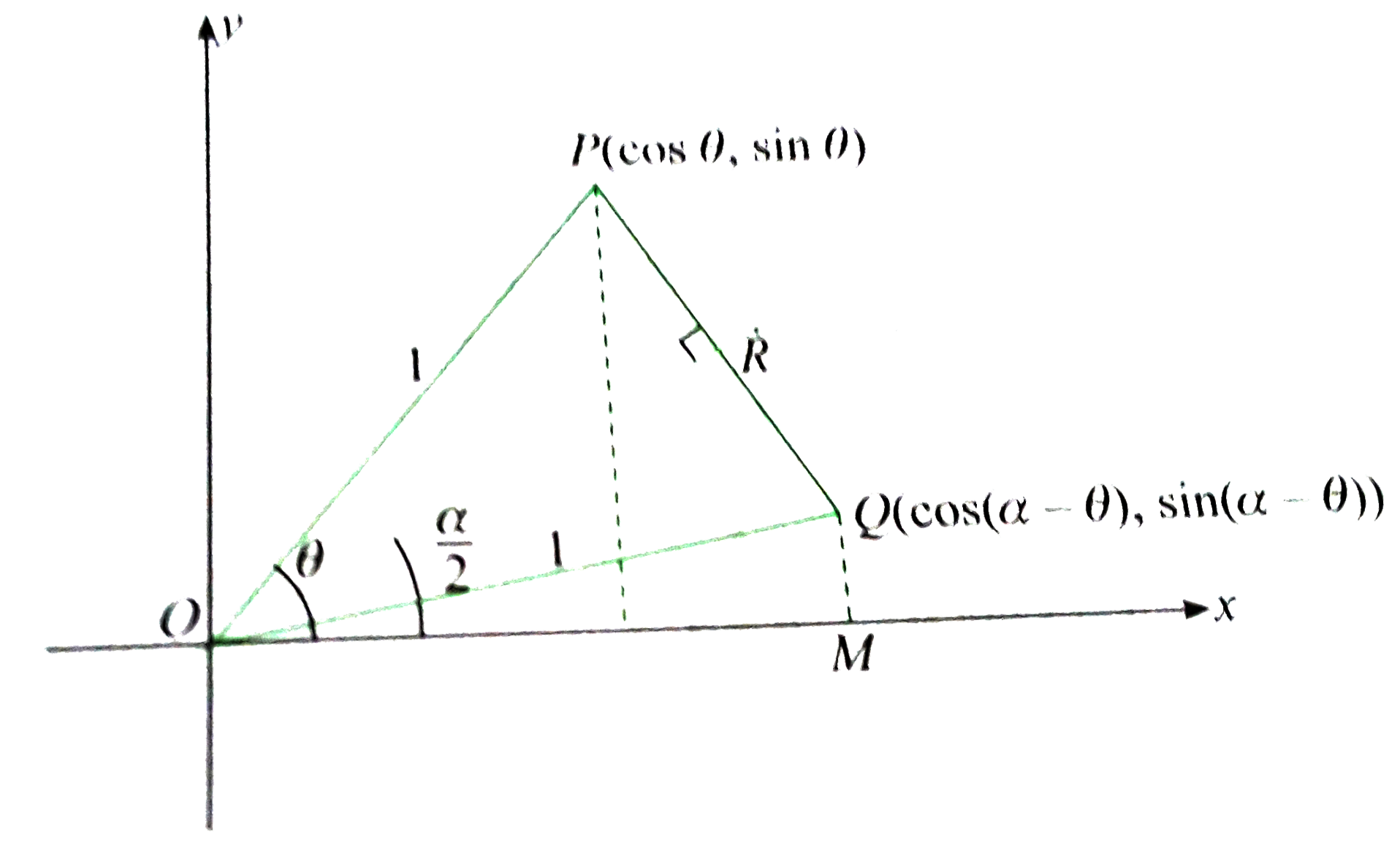 Clearly, `OP=OQ=1` Now, we have to prove that Q is the image of P in the LINE OR which has slope tan `(alpha//2)`. Triangle `POQ` is isosceles triangle. If Q is the image of P in line OR, then OR is the PERPENDICULAR bisector of PQ. We have to prove that `angle QOM=alpha-THETA`. `angle ROQ=angle POR=theta-(alpha//2)` `THEREFORE angle QOM=angleROM-angle ROQ` `=(alpha//2)-(theta-(alpha))=alpha-theta` |
|
| 22. |
If three lettersare placed in three addressed envelopesthen the mean and variance of X where X denotes the number of correct despatches. |
|
Answer» 1,1 |
|
| 23. |
For X ~ B (n = 8, p = 0.5), P (|X-2| le 2) = |
|
Answer» `(163)(0.5)^9` |
|
| 24. |
If a,b,c, are the radii of the circles x^(2)+y^(2)-6x-8y=0, x^(2)+y^(2)+4x-6y-3=0, x^(2)+y^(2)+6x+8y-11=0 then the ascending order of a,b,c is |
|
Answer» a,B,c |
|
| 25. |
The primitive of (1)/((x-a)^(3//2)(b-x)^(1//2)) is |
|
Answer» `(1)/(b-a)[(b-x)/(x-a)]^(1//2)+C` |
|
| 26. |
Integrate the functions ((logx)^(2))/x |
|
Answer» |
|
| 27. |
Evaluate the following :[[a,h,g],[h,b,f],[g,f,c]] |
|
Answer» Solution :`[[a,H,G],[h,b,f],[g,f,C]]` `a[[b,f],[f,c]]-h[[h,f],[g,c]]+g[[h,b],[g,f]]` =`a(bc-f^2)-h(ch-fg)+g(hf-bg)` `abc-af^2-ch^2+fgh+fgh-bg^2` `abc+2fgh-af^2-bg^2-ch^2` |
|
| 28. |
(i) Find the equations of the tangents to 9x^(2)+16y^(2)=144, which makes equal intercepts on the coordinate axes.(ii) Find the value of k if 4x + y + k = 0 is a tangent to the ellipse x^(2) + 3y^(2) = 3 |
|
Answer» (B) `pm7` |
|
| 30. |
Consider the system of equations x cos^(3) y+3x cos y sin^(2) y=14 x sin^(3) y+3x cos^(2) y sin y=13 The value/values of x is/are |
|
Answer» `pm 5sqrt(5)` `x cos^(3)y+3x cos y sin^(2) y=14` ...(i) and `x sin^(2) y+3x cos^(2) y sin y=13` ...(ii) Adding EQS. (i) and (ii), we have `x(cos^(3) y+3 cos y sin^(2) y+3 cos^(2) y sin y+ sin^(3) y)=27` or `x(cos y+ sin y)^(3)=27` or `x^(1//3) (cos y + sin y) =3` ...(iii) SUBTRACTING Eq. (ii) from Eq. (i), we have `x(cos^(3)y+3 cos y sin^(2) y-3 cos^(2) y sin y- sin^(3) y)=1` or `x(cos y- sin y)^(3)=1` or `x^(1//3) (cos y- sin y)=1` ...(IV) Dividing Eq. (iii) by (iv), we get `cos y+sin y=3 cos y-3 sin y` or `tan y=1//2` Case I : `sin y=1//sqrt(5) and cos y =2//sqrt(5)` `y=2n pi +alpha`, where `0 lt alpha lt pi//2` and `sin alpha =1//sqrt(5)` i.e., y lies in the first quadrant From Eqs. (iii) `x^(1//3) (3//sqrt(5))=3 or x=5 sqrt(5)` Case II : `sin y=-1//sqrt(5) and cos y=-2//sqrt(5)` `y=2npi+(pi+alpha)`, where `0 lt alpha lt pi//2` and `sin alpha = -1 //sqrt(5)` i.e., y lies in the third quadrant. Therefore, from Eq. (iii), `x^(1//3) (-3//sqrt(5))=3 or x=-5sqrt(5)`. Thus, `sin^(2) y+2 cos^(@) y=1//5+8//5=9//5`. Also there are exactly six values of `y in [0, 6pi]`, there in 1st quadrant and three in 3rd quadrant. |
|
| 31. |
Consider differential equation (x^(2)+1).(d^(2)y)/(dx^(2))=2x.(dy)/(dx) Statement I For many member of this family ytooo as xtooo. Statement II Any solution of this differential equation is a polynomial of odd paralled to y-axis with and latusrectum is fixed is 2. |
|
Answer» Statement I is TRUE ,and Statement II is the correct explanation for Statement I. |
|
| 32. |
A student read common difference of are A.P. as -3 instead of 3 and obtained the sum of first 10 terms as -30. Then the actual sum of first 10 terms is equal to |
|
Answer» a. 240 |
|
| 33. |
Integration of some particular functions : int(x-2)/(x^(2)-4x+3)dx=....+c |
|
Answer» `LOG SQRT(X^(2)-4x+3)` |
|
| 34. |
The maximum area of a rectangle inscribed in the circle (x+1)^(2)+(y-3)^(2)=64 is |
|
Answer» 64 sq. UNITS |
|
| 35. |
Solve system of linear equations , using matrix method if exists x-2y=10 2x+y+3z=8 -2y+z=7 |
|
Answer» |
|
| 36. |
A line has slope m and y-intercept 4. The distance between the origin and the line is equal to |
|
Answer» `(4)/(SQRT(1-m^(2)))` |
|
| 37. |
Let A ={x in R : x is not an integer} Define f : A to R as f(x) = (2x)/(x-1) AA x in A, then f is |
|
Answer» INJECTIVE but not surjective |
|
| 39. |
Consider a plane P-=2x+y-z-=0 a line (x-3)/2=(y+1)/(-3)=(z-2)/(-1) and a point A(3,-4,1). L_(2) is a line passing through A intersecting L_(1) an parallel to the plane P Plane containing L_(1) and L_(2) is |
|
Answer» Parallel to `yz` plane (1) Equation of plane containing `L_(1)` & `L_(2)` `|(x-3, y+1, z-2),(0,3,1),(-1,6,2)|=0implies+3z-5=0` (2) Volume of tetrahedron `=1/6 |(3,-4,1),(5,-4,1),(7,-7,0)|=7/3` |
|
| 40. |
A survey of 500 television viewers produced the following information, 285 watch foot ball, 195 watch hockey, 115 watch basket ball, 45 watch foot ball and basket ball, 70 watch foot ball and hockey, 50 watch hockey and basket ball, 50 do not watch any of the three games. The number of viewers, who watch exactly one of the three games is |
|
Answer» 325 |
|
| 41. |
If (x^(4)+24x^(2)+28)/((x^(2)+1)^(3))=A/((x^(2)+1))+B/((x^(2)+1)^(2))+C/((x^(2)+1)^(3)), then A + C = |
|
Answer» 26 |
|
| 42. |
Examine the following functions for continuity. f(x) = |x-5| |
|
Answer» |
|
| 43. |
Let f:R to R and g:R to R is define by f(x)=2x-1 and g(x)=5x+2, then find (g circ f)^(-1)(x) |
| Answer» | |
| 44. |
Equation of the circle of radius sqrt(2), and touching the line |x-1| =|y-1| ,is : |
|
Answer» `x^(2) +y^(2) -3X + 4y + 7 =0` |
|
| 45. |
Letf'(sin x)lt0 and f''(sin x) gt0 forall x in (0,(pi)/(2)) and g(x) =f(sinx)+f(cosx) which of the following is true? |
|
Answer» g(x) is DECREASING in `((pi)/(4),(pi)/(2))` or `g(x)=f(sinx)sinx+COS^(2)xf(sinx)` `f(cos x)sin^(2)x-f(cosxgt0forall x in (0,pi//2)` [as it is given `f(sinx)=f(cos x (pi//2-x))lt0` Thus g(x) is increasing in `(0,pi//2)`. Also` g(pi//4)=0` or `g(x)gt0forallx in ((pi)/(4),(pi)/(2))` and `g(x) ltforall x in (0,pi//4)` Thus g(X) is decreasing in `(0,pi//4)` |
|
| 46. |
If the line, y=mx bisects the area of the region {(x,y):0 le x le (3)/(2), 0 le y le 1+4x-x^(2)}, then m equals: |
|
Answer» `(39)/(16)` |
|
| 47. |
Assertion (A) : If z = ilog (2 - sqrt3) then cos z= 2 Reason (R) : cos h theta = (e^(itheta ) + e^(itheta))/(2) |
|
Answer» Both A and R are TRUE R is CORRECT explanation to A |
|
| 48. |
Each of the following defines a relation of N : x is greater than y,x, y inN. Determine which of the above relations are reflexive , symmetric and transitive . |
|
Answer» |
|
| 49. |
E and F are independent 'such that P(E) = 0.35 and P(E cup F)=0.6 then find P(F). |
|
Answer» |
|