

Saved Bookmarks
This section includes 7 InterviewSolutions, each offering curated multiple-choice questions to sharpen your Current Affairs knowledge and support exam preparation. Choose a topic below to get started.
| 1. |
Expand the following using binomial theorem. ((2p)/(5)-(3q)/(7))^(6) |
|
Answer» |
|
| 2. |
The matrix A=[{:(1,0,0),(0,2,0),(0,0,4):}] is a ....... |
|
Answer» IDENTITY matrix |
|
| 3. |
Solve the following differential equations. (dy)/(dx)+(4x)/(1+x^(2))y=(1)/((1+x^(2))^(2)) |
|
Answer» |
|
| 4. |
What isbest reagent would you choose to convert MnO_(4)^(2-) to MnO_(4)^(-). |
|
Answer» `Cl_(2)` WATER `2K_(2)MnO_(4)+O_(3)+H_(2)Orarr2KMnO_(4)+2KOH+O_(2)uarr` |
|
| 5. |
A random variable X has a poisson distribution with parameter 2 then find P(X gt 1.5). |
|
Answer» |
|
| 6. |
How many triangles can be drawn by joining the vertices of a decagon ? |
|
Answer» Solution :A decagon has 10 VERTICES and 3 non- collinear points are required to be a triangle. `:. "The number of triangles formed by the joining the vertices of a decagon is """^10C_3=(10!)/(3!7!)= (10*9*8)/(3*2*1)=120` |
|
| 7. |
If y=x+cotx then prove that sin^2x(d^2y)/(dx^2)-2y2x=0. |
| Answer» | |
| 8. |
Differentiate the functions w.r.t. x. (x cos x)^(x)+ ( x sin x)^(1/x). |
|
Answer» |
|
| 9. |
x cos^(-1)x |
|
Answer» Solution :`" Let " I = INT x cos^(-1) x dx` `underset(RARR x = cot t rArr dx=- sin t dt)("Let " cos^(-1) x=t)` ` :. I= int x cos^(-1) xdx =- int t cos t. sin t dt` `=-(1)/(2) int t.2 sin t cot t dt=- (1)/(2) int t . sin 2t dt` ` I= -(1)/(2) [t int sin 2t dt - int {(d)/(dx) (t). int sin 2t dt }dt]` ` =-(1)/(2) [t((-cos 2t))/(2)+ int 1. (cos 2t)/(2)dt]` `=(1)/(2) t cos 2t -(1)/(4)(sin 2t)/(2)+C` ` =(1)/(4)t cos 2t - (1)/(8) sin 2t +C` `=(1)/(4) t (2cos^(2) t-1)-(1)/(8) sin 2t+C` ` =(1)/(4) t (2 cos^(2) t-1)- (1)/(4) (1-cos^(2)t)^(1//2) cos t +C` ` :. intx cos^(-1) x dx =(1)/(4) cos^(-1) x (2x^(2)-1)` `- (1)/(4)(1-x^(2))^(1//2) x+C` `=(1)/(2) (2x^(2) -1) cos^(-1) x-(1)/(4) x SQRT(1-x^(2)) +C` |
|
| 10. |
The random variable X can take only the values 0, 1, 2. Given that P(X=0) = P(X= 1) = p and E(X^2) = E(X) , then find the value of p |
|
Answer» |
|
| 11. |
Examine the continuity of the following functions at indicated points.f(x)={((e^(1/x)-1)/(e^(1/x)+1)if xne0 at x=0),(0 if x=0):} |
|
Answer» Solution :f(0)=0 `L.H.L. =lim_(hto0)(e^(-1/h)-1)/(e^(-1/h)+1)=-1` `R.H.L.=lim_(hto0)(e^(1/h)-1)/(e^(1/h)+1)` `=lim_(hto0)(1-e^(1/h))/(1+e^(1/h))=1` Thus `L.H.L NE R.H.L. ne f(0)` HENCE f(X) is discontinuous at the origin. |
|
| 12. |
Ifx^(2) + y ^(2) = c^(2) and ( x)/(a) + (y )/(b)= 1 intersect at A and B , then find AB . Hence deduce the coordinates that the line touches the circle. |
|
Answer» |
|
| 13. |
Find the second order derivatives of the following functions: e^(-2 log x) |
|
Answer» |
|
| 14. |
Evaluate the definite integrals int_(0)^(1)(5x^(2)+1)dx |
|
Answer» |
|
| 15. |
Match the following. Roots of the equation"" Equation i. 2,3 , 6 ""x^(3) - 3x^(2) - x + 3 = 0 ii.-2, 3, pm sqrt(5)""x^(3) - 11x^(2) + 36x - 36 = 0 iii. 1, 3 pm 2i"" x^(3) - 4x^(2) - 8x + 8 = 0 iv 1,-1,3""x^(3) - 7x^(2) + 19x - 13 = 0 |
|
Answer» C, d, a, B |
|
| 16. |
When x is large sqrt(1 + x^(2)) is nearly equal to |
|
Answer» `X + 1/(2X)` |
|
| 17. |
A class has 15 students whose ages are 14, 17, 15, 14, 21, 17, 19, 20, 16, 18, 20, 17, 16, 19 and 20 years. One student is selected such a manner that each has the same chance of being chosen and the age X of the selected student is recorded. What is the probability distribution of the random variable X? Find mean, variance and standard deviation of X. |
|
Answer» MEAN =17.53, VAR(X)=4.78 and S.D(X)=2.19 |
|
| 18. |
Three dice, each numbered 1 to 6 are rolled. One die is fair and others are biased so that for each of them a six is twice as likely to occur as any other score. One of the dice is chosen at random and on two throws it shows a six on each occasion. The probability that the die chosen was biased is |
|
Answer» `423/674` |
|
| 19. |
Increase in the amount of pleural fluid is called :- |
|
Answer» Pneumonia |
|
| 20. |
Iff:R–>R is defined and f(x)= (3x+4)/2 then f^(-1) is |
|
Answer» (4x-3)/2 |
|
| 21. |
Thetriad (x,y,z) of real number such that(hat(i)-hat(j)+2hat(k))=(2hat(i)+3hat(j)-hat(k))x + (hat(i)- 2hat(j)+2 hat(k) )y + (-2hat(i) +hat(j) - 2 hat(k)) z is |
|
Answer» (-,2,5,3) |
|
| 22. |
Find the equation of the circle which cuts each of the following circles orthogonally. x^2+y^2+2x+4y+1=0 2x^2+2y^2+6x+8y-3=0 x^2+y^2-2x+6y-3=0 |
|
Answer» |
|
| 23. |
Find the two positive numbers whose sum is 15 and sum of whose squares minimum. |
|
Answer» |
|
| 24. |
Let f(x)=(a_(2k)x^(2k)+a_(2k-1)x^(2k-1)+...+a_(1)x+a_(0))/(b_(2k)x^(2k)+b_(2k-1)x^(2k-1)+...+b_(1)x+b_(0)),where k is a positive integer, a_(i), b_(i) in R " and " a_(2k) ne 0, b_(2k) ne 0 such that b_(2k)x^(2k)+b_(2k-1)x^(2k-1)+...+b_(1)x+b_(0)=0 has no real roots, then |
|
Answer» F(x) must be one to one |
|
| 25. |
A variable circule always touches theline y =xand passes through the point ( 0,0). The common chords of above circle and x^(2) +y^(2)+ 6x + 8 y -7=0 will pass through a fixed point whose coordinates are : |
|
Answer» `(- ( 1)/( 2) , ( 3)/(2))` |
|
| 26. |
Fill in the blanks with appropriate answer from the brackes. The determinant[[1,1,1],[1,2,3],[1,3,6]] is equal to ________. |
|
Answer» `[[2,1,1],[2,2,3],[2,3,6]]` |
|
| 27. |
If I_(n) = int ("cosnx")/("cosx")dx then I_(n) = |
|
Answer» `- (2)/((N- 1)) " cos (n - 1) X" + I_(n - 2) ` |
|
| 28. |
Prove that the vectors bara=2bari-barj+bark, barb=bari-3barj-5bark and barc=3bari-4barj-4bark are coplanar. |
|
Answer» |
|
| 29. |
The pane x+2y -2z = 6 makes the intercepts with the axes, The centroid of the triangel whose vettices are these intersection points with axes is .... |
|
Answer» (-2,-1,1) |
|
| 30. |
Statement Icosec^(-1)(1/2 +1/sqrt2) gt sec^(-1)(1/2+1/sqrt2) Statement II cosec^(-1) x gt sec^(-1)x", if " 1 le x lt sqrt2 |
|
Answer» Statement I is TRUE, Statement II is True, Statement II is a correct explanation for statement I |
|
| 31. |
Identify the type of conic and find centre, foci, vertices, and directices of each of the following: ((x-3)^(2))/(225)+((y-4)^(2))/(289)=1 |
|
Answer» |
|
| 32. |
If the l x+ my=1 is a normal to the hyperbola (x^(2))/(a^(2))-(y^(2))/(b^(2))=1, then shown that (a^(2))/(l^(2))-(b^(2))/(m^(2))=(a^(2)+b^(2))^(2) |
|
Answer» `a^(2)-B^(2)` |
|
| 33. |
The minimum value of z=10x+25y subject to |
|
Answer» `0 le x le 3, 0 le y le 3, x+y ge 5 ` is and subject to `0 le x le 3, 0 le y le 3, x+y ge5` On TAKING given constraints as equation, we GET the following graph 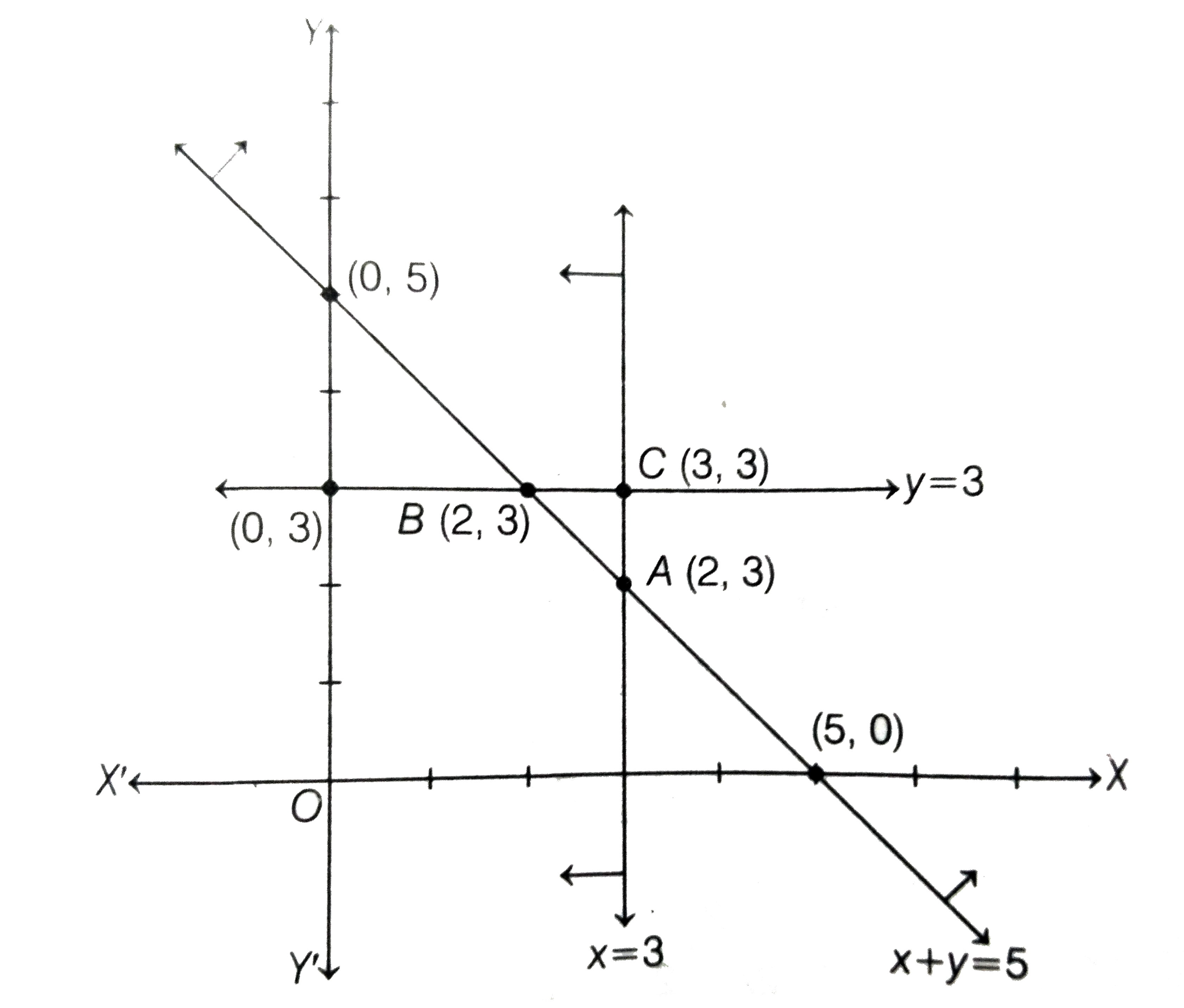 here, intersecting point of lines x=3 and x+y=5 is A(3,2), intersecting point of lines y=3 and x+y=5 is B(2,3) and intersecting point of lines, x=3 and y=3 is C(3,3). Here, ABCA is the FEASIBLE region whose corner points are A(3,2), B(2,3) and C(3,3) `{:("Corner points","Z=10x+25y"),(A(3","2),10xx3+25xx2=80" (minimum)"),(B(2","3),10xx2+25xx3=95),(C","3),10xx3+25xx3=105):}` |
|
| 34. |
To obtaina gold coin, 6 men, all of different weight, are trying to build a human pyramid as shown in the figure. Human pyramid is called "stable" if some one not is the bottom row is "supported by" each of the two closestpeople beneath himand no body can be supportedby anybody of lower weight. Formation of 'stable' pyramid is the only condition to get a gold coin. What is the probabilitythat they will get gold coin ? |
|
Answer» `(1)/(45)` |
|
| 35. |
Let p andq be two -logical statements, then dual of (p vee ~ q ) ^^ q ^^ ( ~ p vee q ) |
|
Answer» <P>`(p ^^ ~Q) VEE q ^^ ( ~ p vee q)` |
|
| 36. |
Evaluate the following integrals inte^(ax)cosbxdx |
|
Answer» |
|
| 37. |
If int(x^(49)tan^(-1)(x^(50))/(1+x^(100)))dx = k(tan^(-1)(x^(50))^(2)+c), then k is equal to |
|
Answer» `1/50` |
|
| 38. |
If overset(to) (a) = hat(i) + 2 hat(j) + hat(k) and overset(to)(b) = hat(i) - 2 hat(j) - 3 hat(k) then ( overset(to)(a) + overset(to)(b) ). ( overset(to)(a) - overset(to)(b) ) = …...... |
| Answer» ANSWER :B | |
| 39. |
If veca = hati + hatj - hatk, vecb =- hati + 2 hatj + 2 hatk and vec c=- hati + 2 hatj - hatk, then a unit vector normal to the vectors veca + vecb and vecb - vecc is : |
|
Answer» `HATI` |
|
| 40. |
There exists a function f(x) satisfying : f(0)=1,f(1)=-(1)/(e),f(x)gt0 for all x and : |
|
Answer» `f''(x)GT0` for all x |
|
| 41. |
The value of lambda with |lambda| lt 16 such that 2x^(2) - 10 xy + 12y^(2) + 5x + lambda y -3 = 0 represents a pair of straight lines , is |
| Answer» Answer :B | |
| 42. |
Find the vector equation of the plane containing the lines vecr=(hati+hatj-hatk)+lambda(3hati-hatj) and vecr=(4hati-hatk)+mu(2hati+3hatk). |
|
Answer» |
|
| 43. |
Find the possiblepointsof Maxima//Minima for f(x) =|x^(2)-2x| (X inR) |
|
Answer» Solution :` f(x) ={ underset( X^(2) -2X ""X LE 02)underset(x^(2) -x^(2) "" 0 lt x lt 2)(X^(2) -2x "" X le 2).` `f(x) ={underset(2(x-1) ""x lt 0)underset(2(1-x)""0 lt x le2)(2(x -1) ""x GT2).` f(x) =0 at x=1 and f(x) doesnot EXIST at x=0 ,2. Thusthese are critical points |
|
| 44. |
Find the approximate change in the surface area of a cube of side x m caused by decreasing the side by 1% ? |
|
Answer» |
|
| 45. |
If a normal subtends a right angle at the vertex of a parabola y^(2)=4ax then its length is |
| Answer» Answer :A | |
| 46. |
Let f(x)=ax^(2)+x+3andf(x)ge0AAx inR,AAainA" where "AsubR. "Also "L=Lim_(xto oo) (x+1-sqrt(ax^(2)+x+3)). Range of a is equal to |
|
Answer» (0,1) `"So, "agt0andDiscle0rArr1-12ale0rArr1le12arArrge(1)/(12)` `"So,"ain[(1)/(12),oo)`. (ii) `L=underset(xtooo)LIM(x+1-sqrt(ax^(2)+x+3))=L=underset(xtooo)Lim((x+1)^(2)-(ax^(2)+x+3))/((x+1)+sqrt(ax^(2)+x+3))=L=underset(xtooo)Lim((1-a)x^(2)(2a-1)x-2)/((x+1)+sqrt(ax^(2)+x+3))` `rArrL={{:(oo_(,),if,ain[(1)/(12)_(,))),((1)/(2)",",if,a=1),(-oo_(,),if,ain(1_(,)oo)):}` Now, werify alternatives. |
|
| 48. |
Find the derivative of the following functions 'ab initio', that is, using the definition.x^2+1 |
|
Answer» SOLUTION :LET `y=x^2+1` Then `dy/dx=lim_(deltaxto0)([(x+DELTAX)^2+1]-[x^2+1])/(deltax)` `=lim_(deltaxto0)(x^2+2xcdot deltax+deltax^2-x^2)/(deltax)` `=lim_(deltaxto0)(2X+deltax)=2x` |
|
| 49. |
At t = 2 sec., a particles is at (1,0,0,). It moves towards (4,4,12) with a constant speed of 65 m/s. The position of the paritcle is measured in metres and the time is sec. Assuming constant velocity, the position of the particle at t = 3 s is, |
|
Answer» `(13hati-120hatj+40hatk)` `vecr_(F)-HATI=(65(3hati+4hatj+12hatk))/(13)xx3` `vecr_(f)=46veci+60vecj+180veck` |
|