

Saved Bookmarks
This section includes 7 InterviewSolutions, each offering curated multiple-choice questions to sharpen your Current Affairs knowledge and support exam preparation. Choose a topic below to get started.
| 1. |
The vector equation of a plane is a relation satisfied by position vectors of all the points on the plane. If P is a plane and hat(n) is a unit vector through origin which is perpendicular to the plane P then vector equation of the plane must be rcdothat(n)=d where d represents perpendicular distance of plane p from origin Q. If A is a point vector a then perendicular distance of a from the plane rcdothat(n)=d must be |
|
Answer» `|d+ahat(N)|` |
|
| 2. |
If 'X' has a binomial distribution with parameters n=6, p and P(X=2)=12, P(X=3)=5 then P= |
| Answer» | |
| 3. |
One vertex of a triangle of given species is fixed and another moves along circumference of a fixed circle. Prove that the locus of the remaining vertex is a circle and find its radius. |
|
Answer» |
|
| 4. |
The vector equation of a plane is a relation satisfied by position vectors of all the points on the plane. If P is a plane and hat(n) is a unit vector through origin which is perpendicular to the plane P then vector equation of the plane must be rcdothat(n)=d where d represents perpendicular distance of plane p from origin Q. If b be the foot of perpendicular from A to the plane rcdothat(n)=d, then b must be |
|
Answer» `a+(d-acdothat(N))HAT(n)` |
|
| 5. |
Differentiate the following w.r.t. x : e^(x) + e^(x^2)+"……….."+e^(x^5). |
|
Answer» |
|
| 6. |
int (1)/(sqrt(4-5x))dx= |
|
Answer» `(3)/(5) SQRT(4 - 5X) +` C |
|
| 7. |
The vector equation of a plane is a relation satisfied by position vectors of all the points on the plane. If P is a plane and hat(n) is a unit vector through origin which is perpendicular to the plane P then vector equation of the plane must be rcdothat(n)=d where d represents perpendicular distance of plane p from origin Q. The position vector of the image of the point a in the plane rcdothat(n)=d must be (dne0) |
|
Answer» `-acdothat(N)` |
|
| 8. |
If |bar(a)|=|bar(b)|, then necessarily it implies bar(a)=+-bar(b). |
|
Answer» |
|
| 9. |
Find n in the binomaial[ root (3)(2) + (1) /root(3)(3)]^(n) ,if the ratio of 7th term from beginning to 7th term from the end is 1/6. |
|
Answer» |
|
| 10. |
Which of the following is/are true? (you may use f(x)=In((Inx))/(Inx) |
|
Answer» `(In2.1)^(In2.2)gt(In2.2)^(In2.1)` |
|
| 11. |
Circle touching y-axis and centre (3,2) is |
|
Answer» `X^(2)+y^(2)-8x+2y+16=0` |
|
| 12. |
thevalueof""^50C_(4) +underset( r=1)overset( 6 )sum""^(56 - r)C_(3) is |
|
Answer» `""^(55)C_(4)` |
|
| 13. |
Find the period of (a) (|sin4x|+|cos 4x|)/(|sin 4x-cos 4x|+|sin 4x+cos 4x|) (b) f(x)="sin"(pi x)/(n!)-"cos"(pi x)/((n+1)!) (c ) f(x)=sin x +"tan"(x)/(2)+"sin"(x)/(2^(2))+"tan"(x)/(2^(3))+ ... +"sin"(x)/(2^(n-1))+"tan"(x)/(2^(n)) |
|
Answer» Period of `|sin 4x-cos 4x|+|sin 4x+cos 4x|=(pi)/(8)` So, the period of GIVEN function is `(pi)/(8).` (B) `f(X)="sin"(pi)/(n!)-"cos"(pi x)/((n+1)!)` Period of `"sin"(pi)/(n!) " is " (2pi)/((pi)/(n!))=2n!` and period of` "cos"(pi x)/((n+1)!) " is " (2pi)/((pi )/((n+1)!))=2(n+1)!` HENCE, period of `f(x)=L.C.M" of "{2n!,29n+1)!}=2(n+1)!` (c ) `f(x)=sin x +"tan"(x)/(2)+"sin"(x)/(2^(2))+"tan"(x)/(2^(3))+ ... +"sin"(x)/(2^(n-1))+"tan"(x)/(2^(n))` Period of `sin x " is " 2pi.` Period of ` "tan"(x)/(2) " is " 2pi.` Period of ` "sin"(x)/(2^(2)) " is " 8pi.` Period of ` "tan"(x)/(2^(3)) " is " 8pi`. Period of `"tan"(x)/(2^(n)) " is " 2^(n) pi.` Hence, period of `f(x)=L.C.M. " of " (2pi,8pi, ..., 2^(n) pi)=2^(n) pi` |
|
| 14. |
Let (a,b,c)ne(0,0,0). The pair of equations which does not represent a straight line is: |
|
Answer» `ax-by+cz+d=0,ax+b'y+cz+d=0(bneb')` |
|
| 15. |
Find the middle term (s) in the expansion of (I) (1+2x)^(12) (II) (2y-(y^(2))/(2))^(11) |
|
Answer» |
|
| 16. |
Find r(X,Y) from the tworegression equation 3x=y and 4y=3x. |
|
Answer» |
|
| 17. |
The inverse point of (1,2) origin w.r.t. the circle x^(2)+y^(2)-4x-6y+9=0 is |
| Answer» Answer :B | |
| 18. |
A company has two plants to manufacture scooters. Plant I manufacture 70% and plant II manufacture 30% of scooters. In plant I 80% and in plant II, 90% scooters are rated as standard quality.A scooter is selected at random and found to be standard quality. What is the probability that it is manufactured in plant (II) ? |
|
Answer» |
|
| 19. |
Let p,q be chosen one by one from the set {1, sqrt(2),sqrt(3), 2, e, pi} with replacement. Now a circle is drawn taking (p,q) as its centre. Then the probability that at the most two rational points exist on the circle is (rational points are those points whose both the coordinates are rational) |
|
Answer» `2//3` `x_(1)^(2) + y_(1)^(2) + 2gx_(1) +2fy_(1) + c= 0 "(1)"` `x_(2)^(2) + y_(2)^(2) + 2gx_(2) +2fy_(1) + c= 0 "(2)"` `x_(3)^(2) + y_(3)^(2) + 2gx_(3) +2fy_(3) + c= 0 "(3)"` Solving Eqs. (1), (2) and (3), we will get g, f, c as rational. Thus, center of the circle (-g, -f) is a rational point. Therefore, both the coordinates of the center are rational numbers. Obviously, the possible values of p are 1, 2. Similarly, the possible values of q are 1, 2. Thus, for this CASE, (p, q) may be chosen in `2 xx 2`, i.e., 4 ways. Now, (p, q) can be, without restriction, chosen in `6 xx 6`, i.e., 36 ways. Hence, the probability that at the most rational point exist on the circle is `(36 - 4)//36 = 32//36 = 8//9`. |
|
| 20. |
Find the perpendicular distance of the point (2, 1, 3) from the line (x-1)/(3)=(y-3)/(1)=(z-4)/(-5) |
|
Answer» |
|
| 22. |
If two lines (x-2m)/(2m+5)=(y)/(8m)=(z-4)/(2) and (x-m)/(m-2)=(y)/(-1)=(z-2m)/(1-3m) are parallel for some m inR, then distance between them is: |
| Answer» Answer :A | |
| 23. |
O is the origin and B is a point on the x-axis at a distance of 2 units from the origin. Match the following lists. |
Answer» 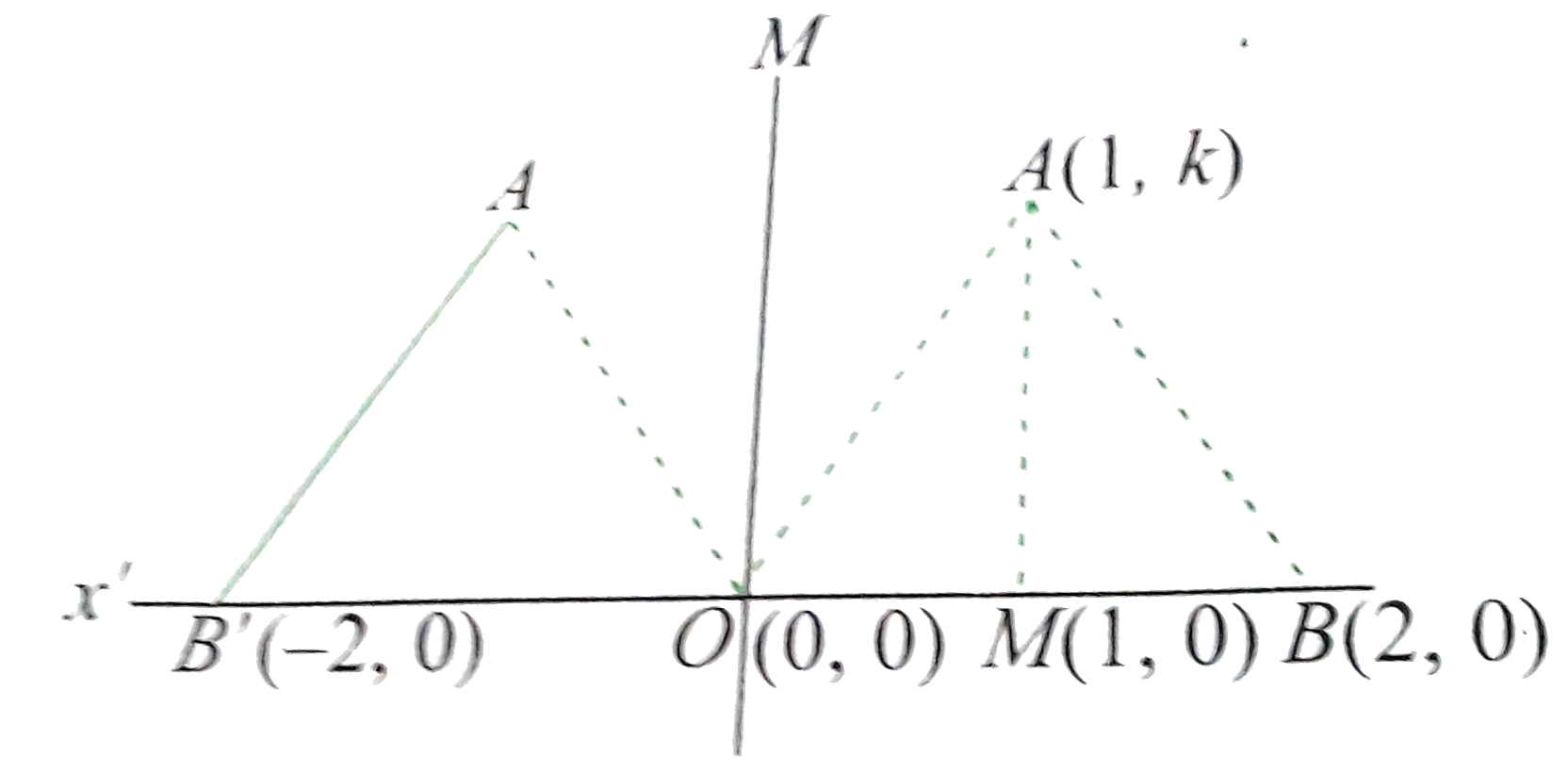 From the figure ,`Delta ABC` is equilateral. Hence, `tan60^@=k` i.e., `k=sqrt(3)` (for first quadrant) or `k=-sqrt(3)` (for fourth quadrant) then the possible coordinates are `(1,+-sqrt(3))`. Similarly , for the second quadrant, the point is `(-1,sqrt(3))` and for the third quadrant , the point is `(-1,-sqrt(3))`. (b)CASE i : If `OA=AB`, then `angleA=30^@`, Therefore 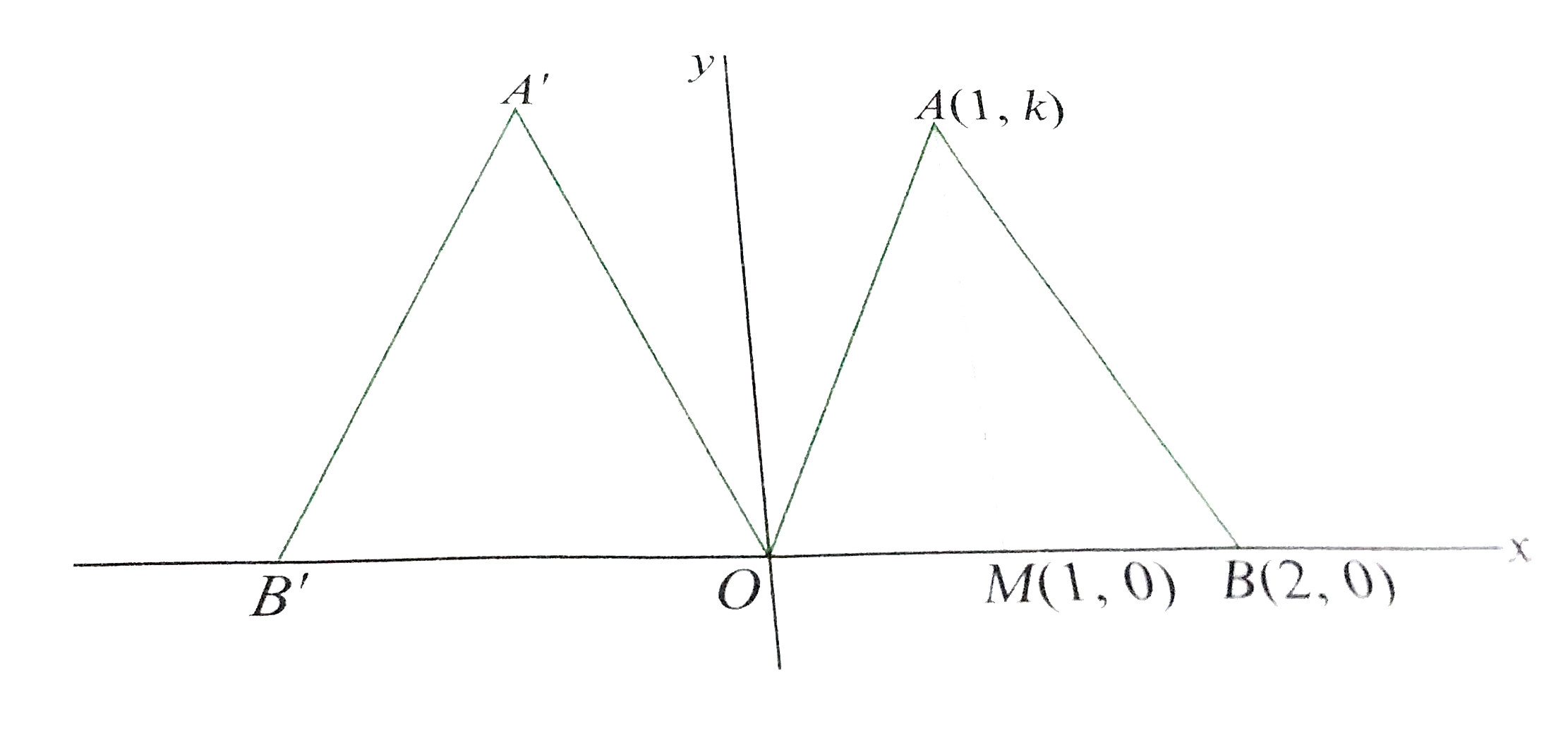 `angle AOB=75^@` `therefore (AM)/(OM)=tan75^(@` `AM=OMtan75^@` `k=1xx(2+sqrt(3))` `therefore k=2+sqrt(3)` Hence, point A is `(1,2+sqrt(3))`. By symmetry, all possible points are `(+-1,+-(2+sqrt(3)))`. Case ii: `AO=OB` `therefore angle AOB=120^@` 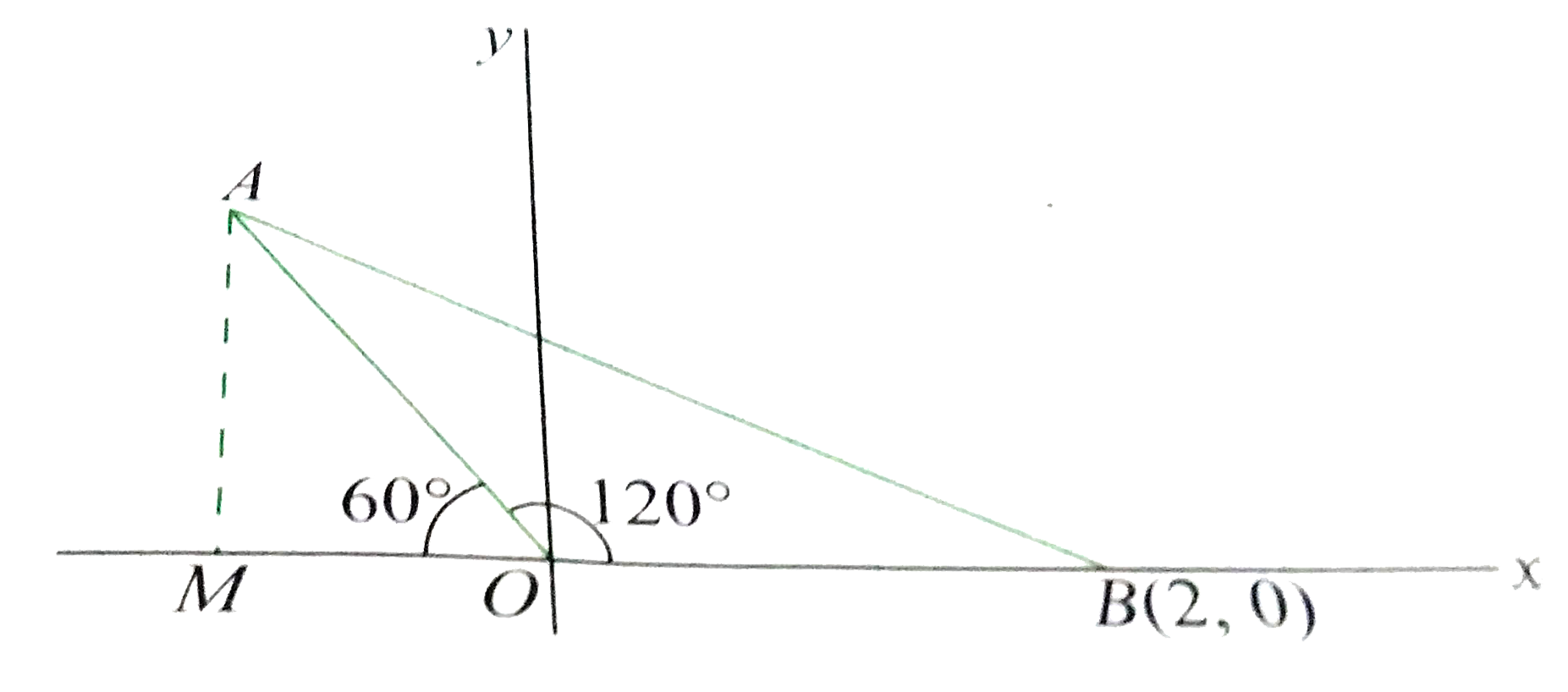 `AM=2 sin 60^@=sqrt(3)` and `OM=2cos60^@=1` Hence, point A is `(-1,-sqrt(3))`, By symmetry, all possible points are `(+-1,+-sqrt(3))`. (C). 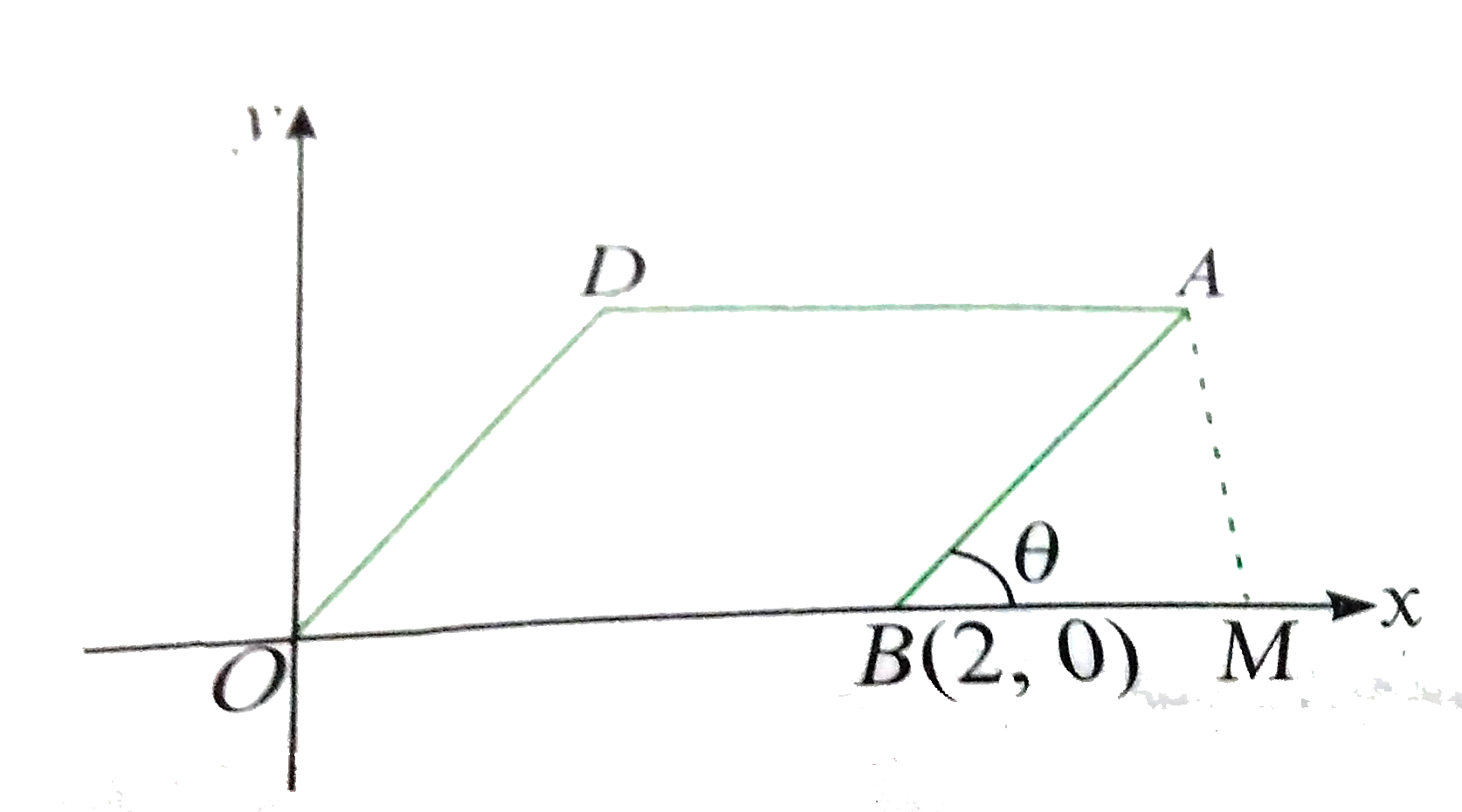 Let `angleDOB =angleABM=theta`. Area of `DeltaOAB =(1)/(2)xxOBxxAM=(1)/(2)xx2sqrt(3)` or `2xx2sintheta=2sqrt(3)` or `sintheta=(sqrt(3))/(2)` or `AM=sqrt(3) and BM=1` Hence, A has coordinates `(3,sqrt(3))`, By symmetry, all the possible coordinates are `(+-3,+-sqrt(3))`. 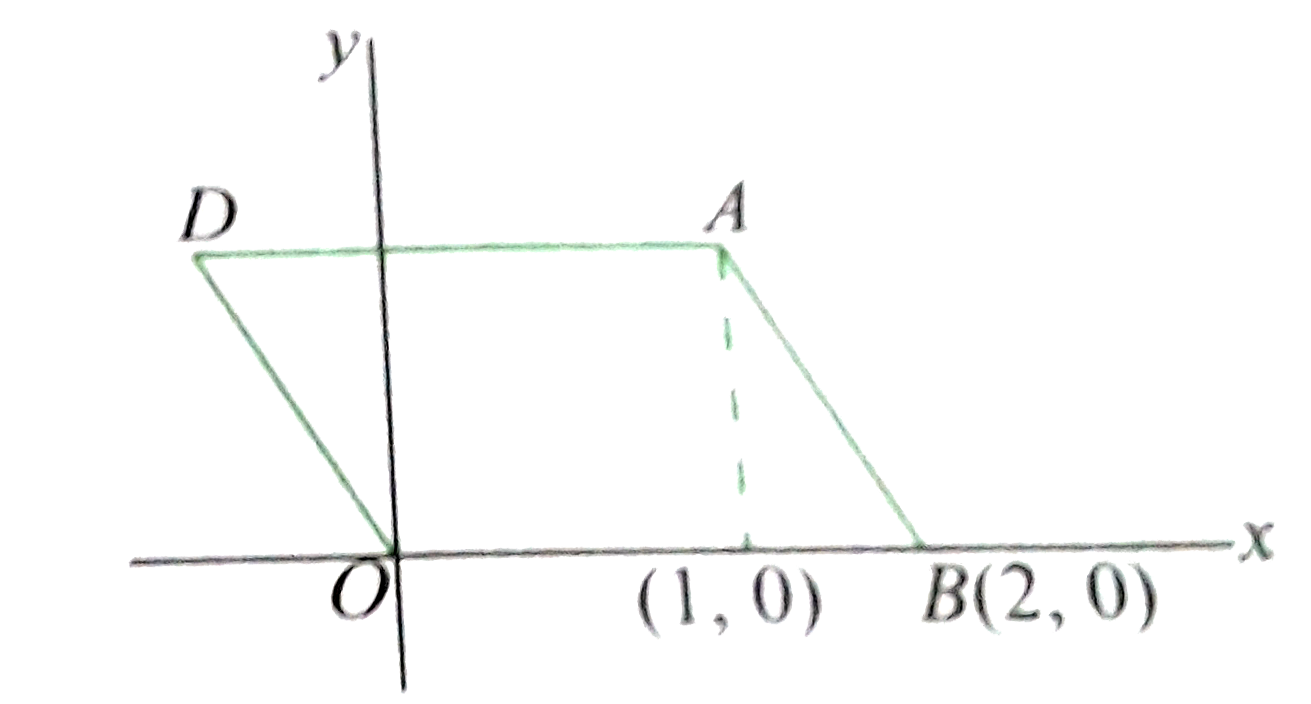 From the figure, A has coordinates `(1,sqrt(3))`. By symmetry, all possible coordinates are `(+-,+-sqrt(3))`. (d) 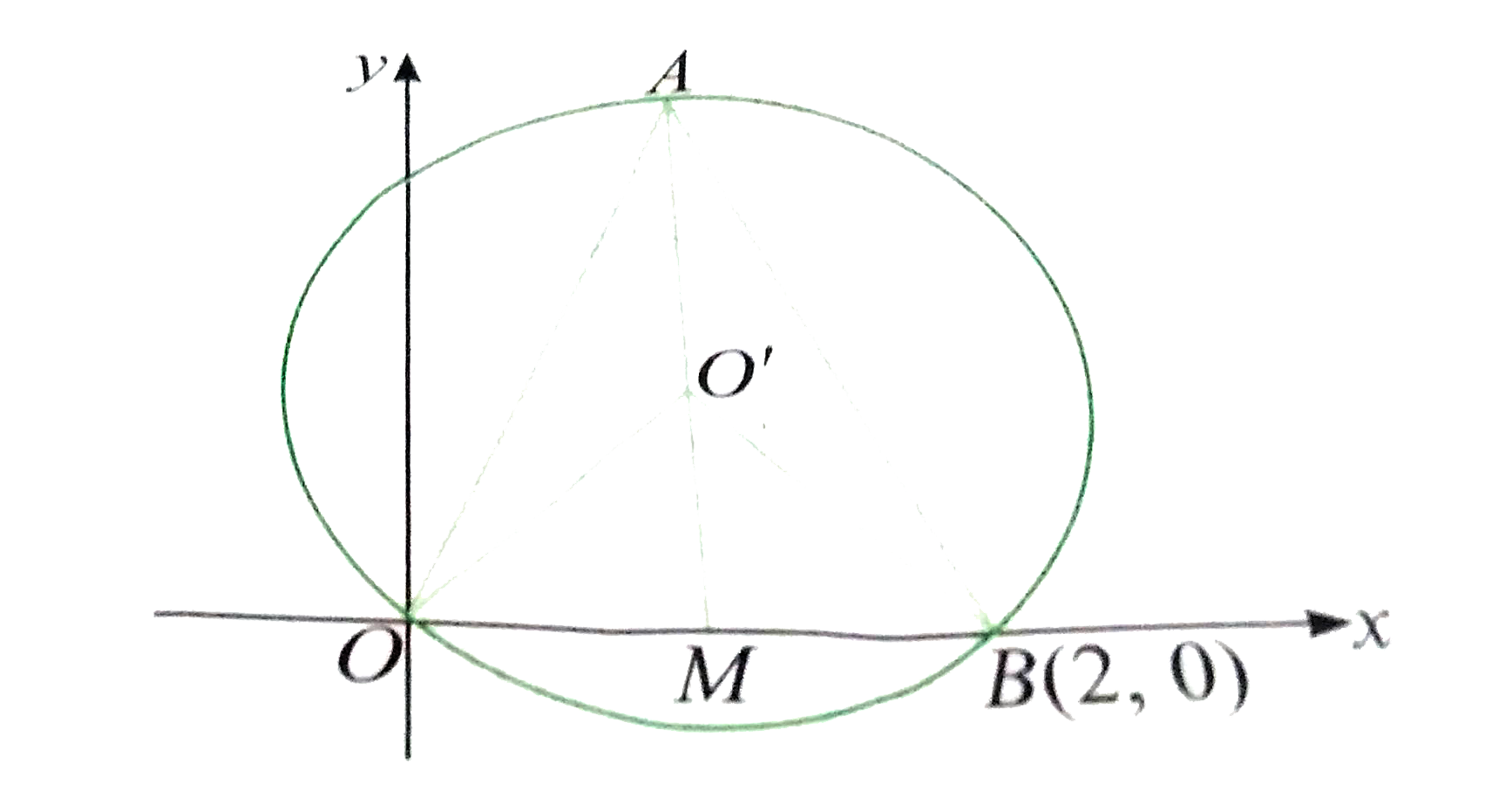 `OB=2units =OO'= "RADIUS"` or `OM=(2)/(2)=1"unit"` In `DeltaOO'M`, `O'M=sqrt(4-1)=sqrt(3)` SINCE `DeltaOAB` is isosceles, point A lies on the perpendicular bisector of OB. Therefore, `AM=sqrt(3)+2=OM+OA` Hence, the coordinates of A will be `(1,2+sqrt(3))` in the first quadrant. By symmetry, all possible coordinates of A are `(+-1,+-(2+sqrt(3))`. |
|
| 24. |
A spherical snowball is melting in such a way that its volume is decreasing at a rate of 1 cm^(3)//min. The rate at which the diameter is decreaseing when the diameter is 10 cms is .. |
|
Answer» `(-1)/(50PI)cm//min` |
|
| 25. |
If int((sqrt(x))^(5))/((sqrt(x))^(7)+x^(6))dx = a log ((x^(k))/(x^(k)+1))+c |
|
Answer» `=2/5 , 5/2` |
|
| 27. |
A student has to answer 10 out of 13 questions inan examination. The number of ways in which he can answer if he must answeratleast 3 of the first five questions is276b. 267c. 80d. 1200 |
|
Answer» 276 |
|
| 28. |
The number of ways in which 19 different objects can be divided into two groups of 13 and 6 is |
|
Answer» `""^(19)C_(13)` |
|
| 29. |
Find the value of lambda such that the vectors bar(a)=2bar(i)+lambda bar(j)+bar(k) and bar(b)=bar(i)+2bar(j)+3bar(k) are orthogonal ……. |
| Answer» ANSWER :D | |
| 30. |
Find the area of the circle x^(2) + y^(2) = a^(2) using integration. |
|
Answer» |
|
| 31. |
If omega ne 1" and "omega^(3)=1, the (a omega+b + c omega^(2))/(a omega^(2)+b omega+c)+(a omega^(2)+b+c omega)/(a+b omega+c omega^(2)) is equal to |
|
Answer» `2` |
|
| 32. |
Findthe areaof theregionbounded by theliney= 3x +2 ,the x -axisand theordinatesx=-1 and x=1. |
|
Answer» |
|
| 33. |
If the first and the (2n+1) -th terms pf AP, GP and HP are equal and their n-th terms are respectively a , b , c then always |
|
Answer» `a=B=c` |
|
| 34. |
Assertion (A) : A fair coin is tossed n times. If the probablities of getting 4,5 and 6 heads be in A.P then n is equal to 7,14 Reason (R ) : If .^(n)C_(r+1), .^(n)C_(r ), .^(n)C_(r+1) are in A.P then (n-2r)^(2)=n+2 The correct answer is |
|
Answer» Both A and R are true, R is the correct EXPLANATION of A |
|
| 35. |
ABC is a triangle with 1 as its incentre. The radii ofthe incircles of the triangles BIC, AIB and AIC are r_1,r_2" and "r_3 respectively. Prove that AI+BI+CI= (a(r-r_1))/(2r_1) + (b(r-r_2))/(2r_2)+(c(r-r_3))/(2r_3). |
|
Answer» |
|
| 36. |
{:("Column A","in the figure,"Delta ABC"is inscribed in the circle.The triangle does not contain the center of the circle O","Column B"),(x,,90):} |
|
Answer» If COLUMN A is larger |
|
| 37. |
Find the second order derivatives of the functions given in Exercises 1 to 10. tan^(-1) x. |
|
Answer» |
|
| 38. |
Translate "Jamini will be rewarded if and only if he is punctual" propositions into symbolic form, stating the prime components |
|
Answer» <P> SOLUTION :Let p :Jamini will be rewarded, q: He is PUNCTUAL. The GIVEN statement is `p |
|
| 40. |
Integrate the following int(dx)/(sqrt(11-4x^2) |
|
Answer» Solution :`INT(DX)/(sqrt(11-4x^2))` [PUT 2x=`sqrt11sintheta` Then 2dx=`sqrt11costhetad theta`] `int((sqrt11)/2 costheta d theta)/(sqrt(11-11sin^2theta))` `(1/2)intd theta =(1/2)theta+C =(1/2)sin^(-1)(2x/sqrt11)+C` |
|
| 41. |
A bag contains n coins of which five of them are counterfeit with heads on both sides and the rest are fair coins. If one coin is selected from the bag and tossed, the probability of getting head is 5//8 then n= |
| Answer» ANSWER :B | |
| 42. |
Method of integration by parts : int cos^(2)xdx=.... |
|
Answer» `(X^(4))/(4)-(1)/(4)x SIN2X-(1)/(8)cos2 x+c` |
|
| 43. |
The cartesian equation of the plane passing through A and perpendicular to vec(AB) where 3i + j + 2k, I - 2j + 4k are the position vectorsof A,B respectively |
|
Answer» [R (3i + j - 2k)]. (2i + 3j + 6K) = 0 |
|
| 44. |
A fair die is rolled. Consider the events E={1,3,5}, F = {2,3} and G={2,3,4,5}. FindP(E/G) and P(G/E) |
|
Answer» SOLUTION :Here, S = {1,2,3,4,5,6} `EnnG`={3,5} THEREFORE `(P(EnnG))`=2/6. ALSO,P(E)=3/6 and P(G)=4/6 THUS,P(E/G)=`(P(EnnG))/(P(G))` 2/6/4/6=2/4=1/2 and P(G/E)=`(P(EnnG))/(P(E))`=2/63/6=2/3 |
|
| 45. |
{:(" "Lt),(n rarr oo):} {sum_(r=1)^(n)1/n e^(r//n)}= |
|
Answer» `e+1` |
|
| 47. |
Two cards are drawn at random from a pack of 52 cards . The probability that one of them is black and other is red is |
|
Answer» `(13)/(51)` |
|
| 48. |
For the reaction ............. |
|
Answer» `1.2 X10^(-3)=K(0.1)^(x) (0.2)^(y)` ...(2) `2.4xx10^(-3)=K(0.2)^(x) (0.1)^(y)` ...(3) from (1) and (2) `y=0` from (1) and (3) `x=1` `:.` rate LAW `=(dc)/(dt)=K[A]^(f)[B]^(0)` |
|
| 49. |
A small puddle is monitored by scientists for the number of paramecia present. The scientists are in two distinct species, let's call them ''species A'' and ''species B''. At time t = 0, the scientists measure and estimate the amount of species A and species B present in the puddle. They then proceed to measure and record the number of each species of paramecium present every hour for 12 days. the data for each species were then fit by a smooth curve, as shown in the graph above. Which of the following is a correct statement about the data above? |
|
Answer» At time t = 0, the number species B present is `150%` greater than the number of species A present |
|