Saved Bookmarks
This section includes 7 InterviewSolutions, each offering curated multiple-choice questions to sharpen your Current Affairs knowledge and support exam preparation. Choose a topic below to get started.
| 1. |
Find |veca-vecb|, if two vectors veca and vecb are such that |veca|=2,|vecb|=3 and veca*vecb=4. |
| Answer» ANSWER :A | |
| 2. |
Given the following frequency distribution with some missing frequencies {:(Class , "Frequency") , (10-20 ,, 180), (20-30 ,, --), (30-40 ,, 34) , (40-50 ,, 180) , (50-60 ,, 136) , (60-70 ,, --) , (70-80 ,, 50):} If the total frequency is 685 and median is 42.6 then the missing frequencies are |
|
Answer» ` 81, 24` |
|
| 3. |
On a multiple choice examination with three possible answers for each of the five questions. Then what is the probabilitythat a candidate would get four or more correct answer is |
|
Answer» `(12)/(243)` |
|
| 4. |
Find the inverse of the following A=[[2,1,3],[4,-1,0],[-7,2,1]] |
| Answer» SOLUTION :`A^(-1) = [(3,-1,1),(-15,6,-5),(5,-2,2)]` | |
| 5. |
If A=[{:(1,2,1),(2,1,3),(1,1,0):}] then prove that A^3-2A^2-7A-4I_3=0. Hence find A^(-1) |
|
Answer» |
|
| 7. |
A vertical lamp-post, 6 m high stands at a distance of 2 m from a wall, 4 m high. A 105 m tall man starts to walk away from the wall on the other side of the wall, in line with the lamp-post. The maximum distance to which the man can walk remaining in the shadow is : |
|
Answer» `3/2 m` |
|
| 8. |
Determine whether the solution set is finite or infinite or empty: x lt 1, x in Z (set of integers) |
| Answer» SOLUTION :INFINITE | |
| 9. |
intdx/((2x+5)sqrt(x+2)) |
|
Answer» Solution :`intdx/((2x+5)sqrt(x+2))` [PUT x+2=t^2` dx=2tdt] =`int(2tdt)/([2(t^2-2)+5].t)=int(2dt)/(2t^2+1)` =`intdt/(t^2+(1/sqrt2)^2)=sqrt2tan^-1(sqrt2t)+C` =`sqrt2tan^-1(sqrt(2x+4))+C` |
|
| 10. |
The number of whole number solutions of x + y + z = 20 is |
|
Answer» 231 |
|
| 11. |
If y=e^(x)(log x), " then " xy_(2)+(x-1)y= |
|
Answer» `(2x-1)y_(1)` |
|
| 12. |
If alpha, beta are roots of equation x^(2)-4x-3=0 and s_(n)=alpha^(n)+beta^(n), n in N then the value of (s_(7)-4s_(6))/s_(5) is |
|
Answer» 4 |
|
| 13. |
(dy)/(dx) + 2x tan (x-y) = 1 rArr sin (x-y) = |
|
Answer» `Ae^(-X^(2))` |
|
| 14. |
The shortest distance between the lines r = (3t-4) hati -2thatj -(1+ 2t) hatkand r ( 6 + s) hati + (2- 2s) hatj + 2 (1 + s) hatk is |
|
Answer» 3 |
|
| 15. |
int (dt)/((e^(t) + e^(-t))^(2)) = |
|
Answer» `(1)/(4)` sech `t` |
|
| 17. |
If A = [( 1, cos theta , 1),( - cos theta ,1,cos theta ),( -1 , - cos theta ,1)] where0 lethetale2 pithen ….. |
|
Answer» DET (A)=0 |
|
| 18. |
Three normals from a point to the parabola y^(2)=4ax meet the axis of the parabola in points whose abscissa are in A.P. Find the locus of the point. |
|
Answer» |
|
| 20. |
If 2a + 3b + 6c = 0, then atleast one root of the equation ax^(2) + bx + c = 0 lies in the interval |
|
Answer» 0,1 |
|
| 21. |
The points O, A, B, X and Y are such that bar(OA)=bar(a), bar(OB)=bar(b), bar(OX)=3bar(a) and bar(OY)=3bar(b)," find "bar(BX) and bar(AY) in terms of bar(a) and bar(b). Further if the point p divides bar(AY) in the ratio 1 : 3 then express bar(BP) interms of bar(a) and bar(b). |
|
Answer» |
|
| 22. |
From the following frequency distribution (i)Find mean. (ii)Calculate variance and standard deviation. |
|
Answer» |
|
| 23. |
Fromthe polynomial equation whose roots are 3,2,1+I,,1-I |
|
Answer» |
|
| 24. |
If f(x)={((sqrt(1+kx)-sqrt(1-kx))/x),((2x+1)/(x-1)):} if -1lexlt0 is continuous at x=0, then the value of |
|
Answer» k=1 |
|
| 26. |
I: In a Delta ABC, if a=3,b=4, angle A=30^@ the number of possible triangles is 2 II. In a Delta ABC, ((a+b)cosC+(b+c)cosA+(c+a)cosB)/(sinA+sinB+sinC)=R |
|
Answer» only I is true |
|
| 27. |
1+(log_(e)5)/(1!) +(log_e5)^2/(2!)+(log_e5)^3/(3!)+ .......oo = |
| Answer» Answer :B | |
| 28. |
A : (3^(2))/(2!)+(3^(4))/(4!)+(3^(6))/(6!)+...=cosh3-1.""R:coshx=1+(x^(2))/(2!)+(x^(4))/(4!)+.... |
|
Answer» Both A and R are TRUE and R is the correct explanation of A |
|
| 29. |
If x+y ge 6, 2x+y ge 8, x ge 0, y ge 0 then the minimum value of f=x+y is |
|
Answer» 6 |
|
| 30. |
int_(1)^(32) (dx)/(x^(1//5)sqrt(1+x^(4//5)))= |
|
Answer» `2/5 (SQRT(17)+sqrt(2))` |
|
| 31. |
Find the second order derivatives of the functions given in Exercises 1 to 10. e^(x) cos 3x. |
| Answer» | |
| 32. |
Let I_(1) and I be two lines intersecting at P. If A_(1), B_(1), C_(1) are points on hi and A_(2), B_(2), C_(2),D_(2), E_(2) are points on l_(2) and if none of these coincides with P, then the number of triangles formed by these eight points, is |
|
Answer» 56 |
|
| 33. |
{:(,"List-I",,"List-II"),((A),"In a "DeltaABC a+b=3c", then "cot.(A)/(2)cot.(B)/(2)" is",(i),b^(2)-c^(2)),((B),"If the sides a, b, c of a triangle are in A.P., then the value of "cot.(A)/(2)cot.(C)/(2)" is",(ii),(pi)/(3)),((C),"In a "DeltaABC a(bcosC-cosB)" is equal to",(iii),3),((D),"In a "DeltaABC a=2band|A-B|=(pi)/(3)" Then "angleC " is",(iv),2):} |
|
Answer» |
|
| 34. |
If x=phi(t) is a differentiable function of 't', then prove thatintf(x)dx=intf[phi(t)]phi'(t)dt. |
|
Answer» Solution :`x = phi(t)` is differentiable function of t. `THEREFORE""(dy)/(dt)=phi'(t)` `"LET"intf(x)dx=F(x)` `therefore""(dx)/(dt)[F(x)]=f(x)` `(d)/(dt)[F(x)]=(d)/(dx)[F(x)].(dx)/(dt)` `"(Using chain rule)"` `=f(x).(dx)/(dt)` `=f[phi(t)].phi'(t)` `therefore""` By the DEFINITION of integral, `F(x)=INT f[phi(t)].phi'(t)dt` `therefore""intf(x)dx=intf[phi(t)].phi'(t) dt.` Hence PROVED. |
|
| 35. |
Consider thepolynomial fucntion f(x) = |{:((1+x)^(2),,(1+2x)^(b),,1),(1,,(1+x)^(a),,(1+2x)^(b)),((1+2x)^(b),,1,,(1+x)^(a)):}| a,b beingpositiveintegers. Whichof the followingis true ? |
|
Answer» All the rootsof theequationf(x)=0are positive `|{:((1+x)^(a),,(1+2x)^(b),,1),(1,,(1+x)^(a),,(1+2x)^(b)),((1+2x)^(b),,1,,(1+x)^(a)):}|=A +Bx+Cx^(2)+…….` Putting x=0 we get `A= |{:(1,,1,,1),(1,,1,,1),(1,,1,,1):}|=0` nowdifferentingboth sides withrespect to x and putting x=0 we get `B= |{:(a,,2b,,0),(1,,1,,1),(1,,1,,1):}|+|{:(1,,1,,1),(0,,a,,2b),(1,,1,,1):}|+|{:(1,,1,,1),(1,,1,,1),(2b,,0,,a):}|=0` HENCE ,coefficientof x IS0 .Since f(x)=0 and f(0)=0 ,x=0 isa repreatingroot ofthe equation f(x)=0 |
|
| 36. |
If y= f(x) be an invertible function with inverseg and h(x) = x f(x), then int_(f(a))^(f(b)) g(x) dx+ int_(a)^(b) f(x) dx is equal to |
|
Answer» `H(a) - h(B)` |
|
| 37. |
If the straight lines 2x+3y-3=0 and x+ky+7=0 are perpendicular, then the value of k is |
|
Answer» 1)`2//3` |
|
| 38. |
If A and B are any two events such that P(A) + P(B) -P(A and B) = P(A), then |
| Answer» Answer :b | |
| 39. |
Solve the equation 6x^6-25x^5+31x^4-31x^2+25x-6=0 |
|
Answer» |
|
| 40. |
The solution of (dy)/(dx) = e^(2x-y) + x^(3) e^(-y) is |
|
Answer» `4e^(y) = 2E^(2X) - X^(4) + c` |
|
| 41. |
Find square root of a^2-1+2asqrt(-1) |
|
Answer» SOLUTION :`=a^2=i^2+2ai=(a+i)^2` `:.SQRT(a^2-1+2asqrt(-1))= +-(a+i)` |
|
| 42. |
Let f(x) = sin a x^(- +) cos bx be a periodic function, then |
|
Answer» `a = (3pi)/(2), b = PI` |
|
| 43. |
Prove that two parabolas y_(2)=4ax "and" x^(2)=4by intersect (other than the origin ) at an angle ofTan^(-1)[(3a^(1//3)b^(1//3))/(2(a^(2//3)+b^(2//3)))] . |
|
Answer» |
|
| 44. |
Find the asymptotes of the following curves : y=x/(x^(2)+1) |
|
Answer» |
|
| 45. |
A department store escalator is 25 feet long and forms an angle of 43^@ with the floor , with is horizontal . What of the follow is an expression for the horizontal distance of the escalator from beginning to end ? |
| Answer» Answer :B | |
| 46. |
If M is the midpoint of the side vec(BC) of a triangle ABC, prove that vec(AB)+vec(AC) = 2vec(AM) |
|
Answer» Solution :Let M is the midpoint of BC of `triangleABC` Clearly `VEC(BM)` and `vec(CM)` are equal and OPPOSITE. Now `vec(AB)+vec(BM)` = `vec(AM)` and `vec(AC)+vec(CM)` = `vec(AM)` `implies vec(AB)+vec(AC)+vec(BM)+vec(CM)` = `2vec(AM)` `implies vec(AB)+vec(AC)` = `2vec(AM)` |
|
| 47. |
The value of int_(- pi//2)^(pi//2) ((2- sin theta)/( 2+ sin theta)) d theta is |
| Answer» Answer :A | |
| 48. |
For what values of x in R, the following expressions are negative i) -6x^(2)+2x -3 ii) 15+4x-3x^(2) iii) 2x^(2)+5x -3 iv) x^(2)-7x+10 v) x^(2)-5x-6 |
|
Answer» |
|
| 49. |
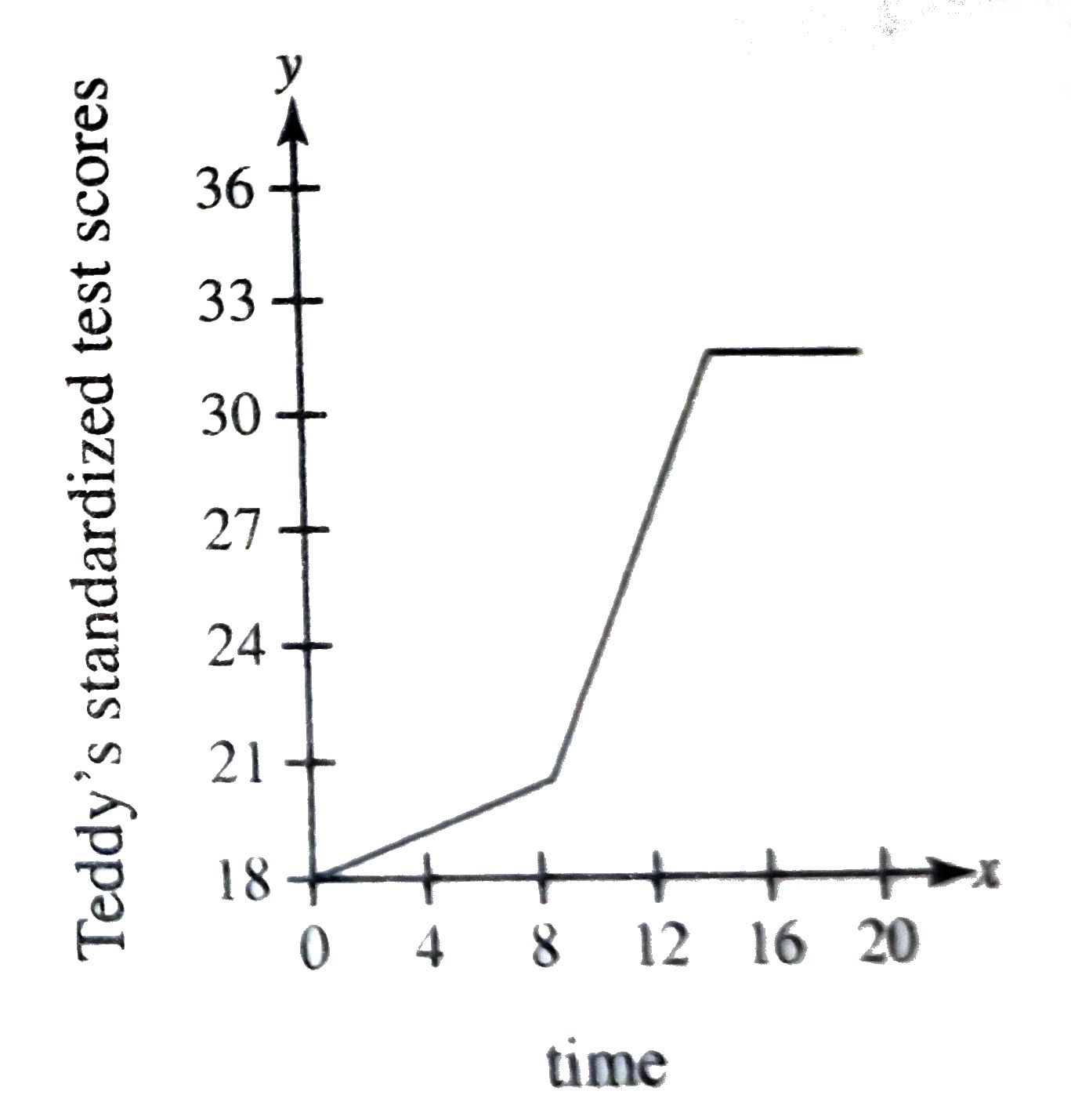
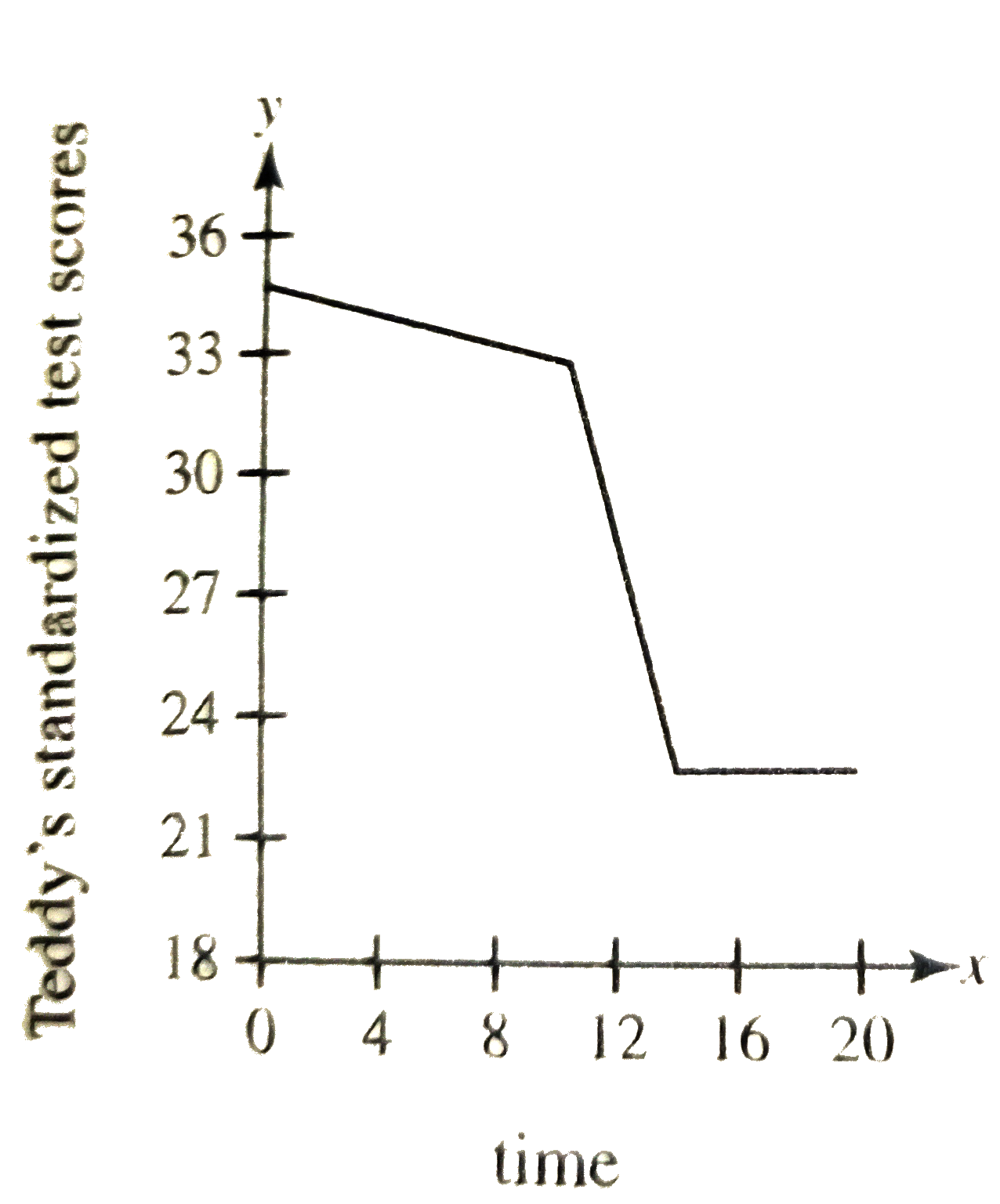
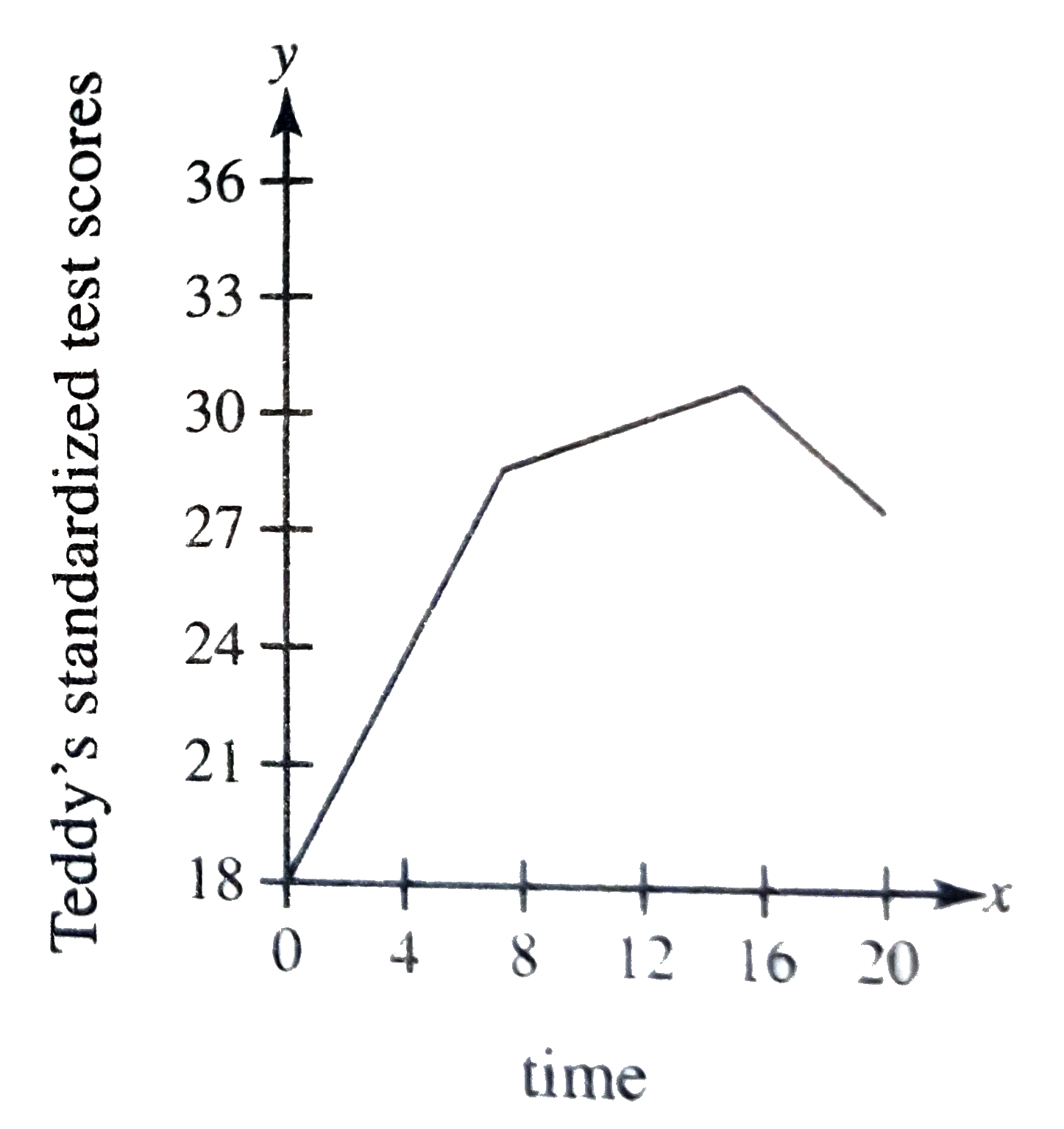
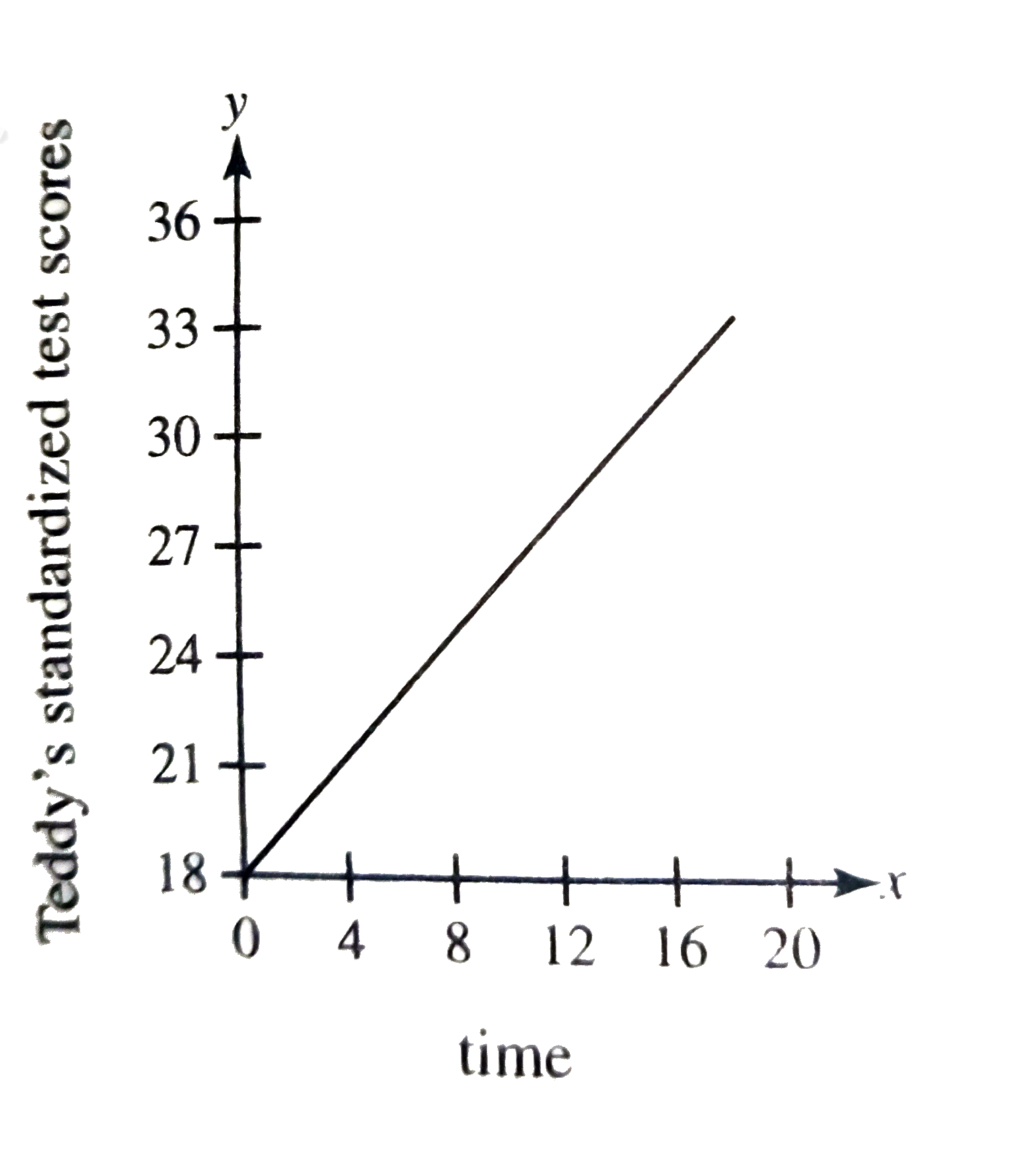
For the first several weeks after hiring a private tutor, Teddy's score on a standardized test increased slowly . As Teddy began to understand the concepts more clearly , though , his standardized test scores improved more rapidly. After several more weeks, Teddy stopped working with his tutor and his scores did not imporve any more . Which of the following graphs could represent all of Teddy's standardized test scores as a function of times , in weeks, after he hired a private tutor ? |
|
Answer»
|
|
| 50. |
Let A_1,A_2,A_3,….,A_m be the arithmetic means between -2 and 1027 and G_1,G_2,G_3,…., G_n be the gemetric means between 1 and 1024 .The product of gerometric means is 2^(45) and sum of arithmetic means is 1024 xx 171 The number 2 A_(171,G_5^2+1,2A_(121) |
|
Answer» A.P `A_(171)+A_(172)=-2+1027=1025` or `(2A_(171)+2A_(172))/2=1025` Also, `G_(5)=1xx2^(5)=32` `rArrG_(5)^(2)=1024` or `G_(5)^(2)+1=1025` HENCE, `2A_(171),G_(5)^(2)+1,2A_(172)` are in A.P. |
|