

Saved Bookmarks
This section includes 7 InterviewSolutions, each offering curated multiple-choice questions to sharpen your Current Affairs knowledge and support exam preparation. Choose a topic below to get started.
| 1. |
Statement I : Thecommon regiondetermined by all the constraints of a LPP is called the feasible region Statement II : A solutionthat also satisfies the non negativtiy restrications of a LPP is called the feasible soltion |
|
Answer» Statement I is TRUE Statement II is true , Statement II is a CORRECT explanatio for Statement I |
|
| 2. |
Answer the folliwng as true of false. (i) vec(a) and vec(a) and collinear. (ii) Zero vector is unique. (iii) Two collinear vectors with equal magnitude are not equal. |
|
Answer» |
|
| 4. |
If alpha, beta, gammabe any three arbitrary angles then cos alpha, cos beta, cos gammacan always be considered as the direction cosines of a line. |
|
Answer» |
|
| 5. |
Minimum length of a normal chord to the hyperbola xy = c^(2) lying between different branches is |
|
Answer» `sqrt2c` |
|
| 6. |
Some standard forms of integration : intsqrt(x^(2)-4x+2)dx=..........+c |
|
Answer» `(X-2)/(2)sqrt(x^(2)-4x+2)+log|x-2+sqrt(x^(2)-4x+2)|` |
|
| 7. |
Let bara, barb and barc be mutually orthogonal vectors of equal magnitudes. Prove that the vector bara+barb+barc is equally inclined to each of bara, barb and barc, the angle of inclination beingcos^(-1)" 1/sqrt3 |
|
Answer» |
|
| 8. |
If a,b,c and d are the roots of the equation x^(4)+2x^(3)+4x^(2)+8x+16=0 the value of the determinant |{:(1+a,1,1,1),(1,1+b,1,1),(1,1,1+c,1),(1,1,1,1+d):}| is |
|
Answer» |
|
| 9. |
Compute the area of the surface formed by revolving about the straight line x+ y=a the quarter of the circle x^(2) + y^(2)=a^(2) between A(a, 0) and B(0, a). |
|
Answer» |
|
| 10. |
Prove that the distance between the circumcenter and the orthocenter of triangle ABC is R sqrt(1 -8 cos A cos B cos C) |
|
Answer» Solution :Let O and H be the circumcenter and the orthocenter, respectively. If OF is the PERPENDICULAR to AB, we have `angleOAF = 90^(@) - angle AOF = 90^(@) -C`  Also, `angleHAL = 90^(@) -C` Hence, `angle OAH = A - angle OAF - angle HAL` `= A -2 (90^(@) -C)` `= A + 2C -180^(@)` `= A + 2C -(A + B +C) = C -B` Also, `OA = R and HA = 2R cos A` Now in `Delta AOH` `OH^(2) = OA^(2) + HA^(2) - 2OA HA cos (angle OAH)` `=R^(2) + 4R^(2) cos^(2) A - 4R^(2) cos A cos (C -B)` `= R^(2) + 4R^(2) cos A [cos A - cos (C -B)]` `=R^(2) -4R^(2) cos A [cos (B + C) + cos (C - B)]` `= R^(2) -8R^(2) cos A cos B cos C` Hence, `OH = R sqrt(1-8 cos A cos B cos C)` |
|
| 12. |
If the line ax + y = c, touchs both the curves x^(2) + y^(2) = 1 and y^(2) = 4 sqrt(2)x, then |c| is equal to |
|
Answer» `(1)/(SQRT(2))` `x^(2) + y^(2) = R^(2)`, if `(|c|)/(sqrt(a^(2) + b^(2)) = r` Since equation of given parabola is `y^(2) = 4 sqrt(2x)` and equation of tangent line is ax + y = c ory = - ax + c then `c = (sqrt(2))/(m) = (sqrt(2))/(-a)`[`:.` m = slope of line = - a] [`:'` line y = mx + c touches the parabola `y^(2) = 4ax` if c = a/m] Then, equation of tangent line BECOMES `y = - ax - (sqrt(2))/(a)` ......(i) `:.` Line (i) is also tangent to the circle `x^(2) + y^(2) = 1` `:.` Radius = 1 = `(|-(sqrt(2))/(a)|)/(sqrt(1 + a^(2)) implies sqrt(1 + a^(2)) = | - (sqrt(2))/(a)|)` `implies 1 + a^(2) = (2)/(a^(2))` [squaring both side] `implies a^(4) + a^(2) - 2 = 0 implies (a^(2) + 2) (a^(2) - 1) = 0` `implies a^(2) = 1``[:. a^(2) gt 0, AA a in R]` `:. |c| = (sqrt(2))/(|a|) = sqrt(2)` |
|
| 13. |
1.""^20C_1 - 2.""^20C_2 + 3.""^20C_3 - …..-20.""^20C_20 = |
|
Answer» 1 |
|
| 14. |
Let f: (1 to infty) to (1, infty) be defined by f(x) =(x+2)/(x-1). Then |
|
Answer» F is 1 - 1 and ONTO |
|
| 15. |
int (2x^2-1+x^2 sqrt(x^2+4))/(x^2(x^2+4))dx |
|
Answer» `9/8tan^(-1) x/2+1/(4x)+cos h^(-1)x/2+C` |
|
| 16. |
Find the sum of the infinite series (3)/(4)+(3.5)/(4.8)+(3.5.7)/(4.8.12)+…. |
|
Answer» |
|
| 17. |
Let A=[(2, -1, 1),(-2, 3, -1),(-4, 4, -x)] be a matrix. If A^(2)=A, then the value of x is equal to |
|
Answer» |
|
| 18. |
If z = x +iy and P represents z in the Argand plane and mod (2z-3) = 4 , then the locus of P is |
|
Answer» `(2 x- 3)^(2) - 4y^(2) = 16` |
|
| 19. |
State whether the following statements are true or false. Justify If ** is a commutative binary operation on N, then a**(b**c)=(c**b)**a |
|
Answer» SOLUTION :`a**(b**C)=a**(c**b)=(c**b)**a,` for all `a,b,c in N` `THEREFORE ` The given STATEMENT is TRUE |
|
| 20. |
Find the points of maximaminima of f(x) =x^(3) -12 x. Alsodraw the graph of this functions. |
|
Answer» Solution :`F(x) =x^(3) -12x` `f'(x) =3(x^(2)-4) =3(x-2) (x+2)` `RARR""x= +- 2` 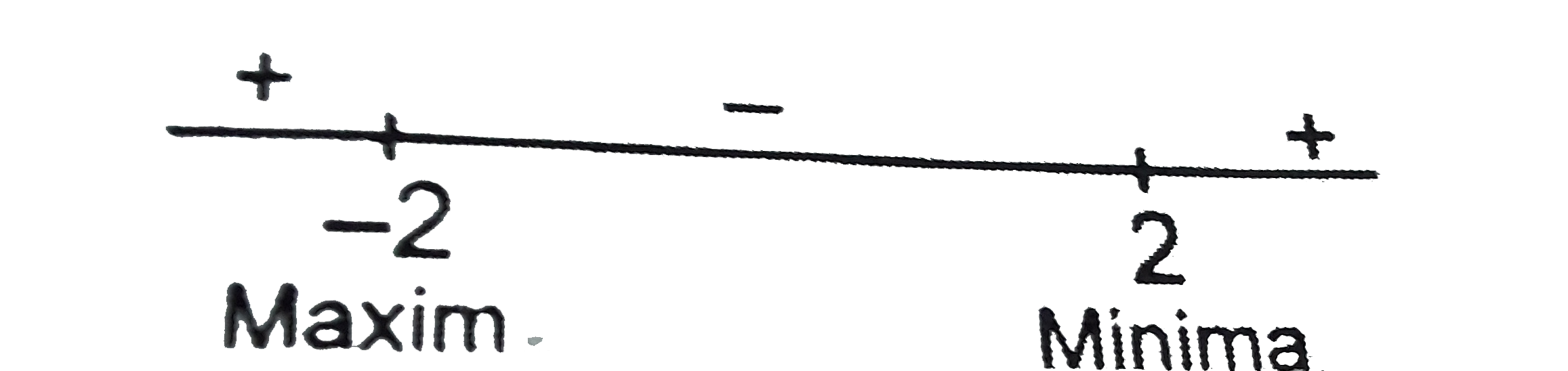 fortracingthe graphlet usfindmaximum and minimum VALUES of (x) . 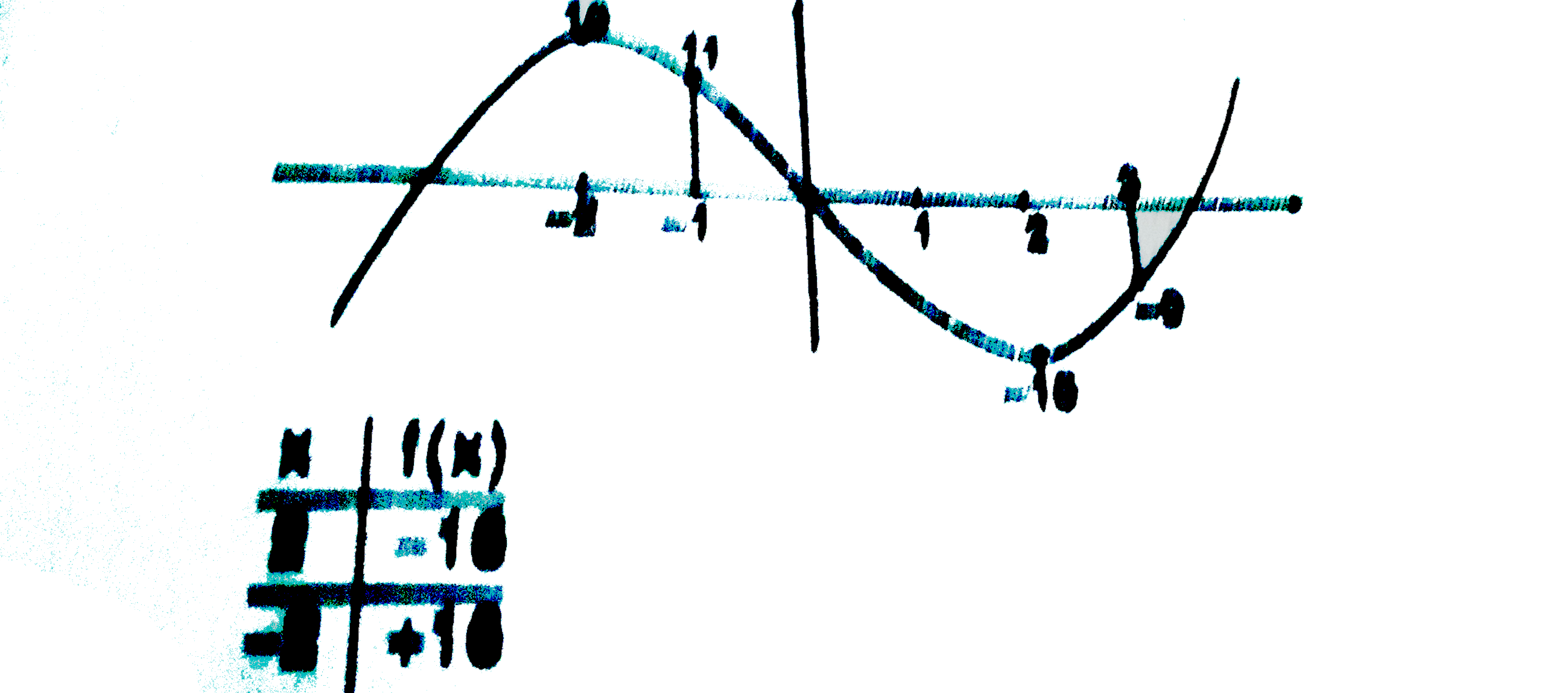
|
|
| 21. |
If f(t)=int_(-t)^(t)(e^(-|x|))/(2)dx" then "lim_(ttooo)f(t)= |
|
Answer» 1 |
|
| 22. |
If A_l=(x-a_i)/(|x-a_i|)30, i=1,2,..., n and if a_1 lt a_2 lt a_3lt ..... lta_n. Then, lim_(xtoa_m) (A_1A_2.....A_n), 1 le mle n |
|
Answer» is EQUAL OT `(-1)^m` |
|
| 23. |
If the remainders respectively when f(z) = z^(3)+z^(2)+2z+1 is divided with z-i and z+i and 1+3i and 1+i then find the remainder when f(z) is divided with z^(2)+1 ? |
|
Answer» |
|
| 24. |
Find the number of ways of arranging 'r' things in a line using the given 'n' different things in which atleast one thing is repeated. |
|
Answer» |
|
| 25. |
Prove that : If the coefficientsof (2r+4)^("th") and (r-2)^("nd") terms in the expansion of (1+x)^(18) are equal, find r. |
|
Answer» |
|
| 26. |
Which of the following is logically equivalent to ~(~q rarr p) ? |
|
Answer» <P>`Q ^^ p` |
|
| 27. |
If log(x^(2)y^(3))=a and log(x)./(y)=b find log x and logy in terms of a and b |
|
Answer» |
|
| 28. |
If m is the A.M. of two distinct real number l and n (l, n gt 1) and G_(1), G_(2) and G_(3) are three geometrc means between l and n then G_(1)^(4)+2G_(2)^(4)+G_(3)^(4) equals. |
|
Answer» `4 L^(2) m n ` |
|
| 29. |
In a bolt factory three machines A, B and C manufactures bolts 25%, 35% and 40% respectively. From this production 5%, 4% and 2% bolts are defective from machines respectively. A bolt is drawn at random from the product what is the probability of the event that the selected bolt is defective ? |
|
Answer» |
|
| 30. |
If A+B is a non -singular matrix then A-B -A(A+B)^(-1)A+B(A+B)^(-1) Bequals |
|
Answer» O |
|
| 31. |
intdx/(e^x-1) |
|
Answer» SOLUTION :`I=intdx/(e^x-1)` =`inte^-x/(1-e^-x)DX` LET `1-e^-x=t` `e^-xdx=dt` `THEREFORE I=intdt/t` =`Inabst+C` =`Inabs(1-e^-x)+c` =`Inabs((e^x-1)/e^x)+c` |
|
| 32. |
If (6,8),(k,2)are inverse points w.r.t the circle x^(2)+y^(2)=25 then 2k= |
|
Answer» 1 |
|
| 33. |
Evaluate the following intergrals : intsqrt(4-3x-3x^(2))dx |
|
Answer» |
|
| 34. |
int("log"x)^(3) x^(5)dx= |
|
Answer» `x^(8)[((logx)^(3))/(12)-(1)/(2)(logx)^(2)+(1)/(6)logx-(1)/(36)]+c` |
|
| 35. |
Using the property of determinants andd without expanding in following exercises 1 to 7 prove that |{:(1,x,x^2),(x^2,1,x),(x,x^2,1):}|=(1-x^3)^2 |
|
Answer» |
|
| 36. |
int_(pi//2)^(0)sin^(11)xdx |
|
Answer» |
|
| 37. |
If costheta =4/5,then find the value of cos2theta. |
| Answer» | |
| 38. |
Using the property of determinants andd without expanding in following exercises 1 to 7 prove that |{:(1,1,1),(a,b,c),(a^3,b^3,c^3):}|=(a-b)(b-c)(c-a)(a+b+c) |
|
Answer» |
|
| 39. |
Using the property of determinants andd without expanding in following exercises 1 to 7 prove that |{:(1,a,a^2),(1,b,b^2),(1,c,c^2):}|=(a-b)(b-c)(c-a) |
|
Answer» |
|
| 40. |
Expand the binomial ((x^(2))/(3) + (3)/(x))^(5) |
|
Answer» |
|
| 41. |
If 4.05^(p) = 5.25^(q) , what is the value of (p)/(q) ? |
|
Answer» <P>`-0.11` |
|
| 42. |
Two circles with radii r_1 and r_2, r_1 gt r_2 ge 2,touch other externally. If 'alpha' be the angle between direct common tangents ,then |
|
Answer» ` alpha = SIN ^(-1)((r_1 +r_2)/( r_1-r_2)) ` |
|
| 43. |
Evaluate int secx ( sec x + tan x ) dx |
|
Answer» |
|
| 45. |
If the median of the data 6,7,x-2,18,21 written in ascending order is 16, then the variance of that data is |
|
Answer» `30(1)/(5)` |
|
| 46. |
If cosec^(-1)(x) + sec^(-1)(sqrt(x^4 + 1)) + tan^(-1) (x^2 + 1) = pi ( x > 0) then x = |
|
Answer» `1` |
|
| 47. |
int(x-1)/((x+1)^(3))e^(x)dx=.......+c |
|
Answer» `(E^(X))/((x+1)^(2))` |
|
| 48. |
The value of log_(e) (5^(13/2)) is between which of the following pairs of consecutive integers? |
|
Answer» 0 and 1 |
|
| 49. |
Find int (xdx)/((x-1)(x-2)) |
|
Answer» `LOG|(x-1)^2/(x-2)|+C` |
|
| 50. |
Draw the graph of y=|||x|-2|-3| by transforming the graph of y=|x| |
Answer» SOLUTION :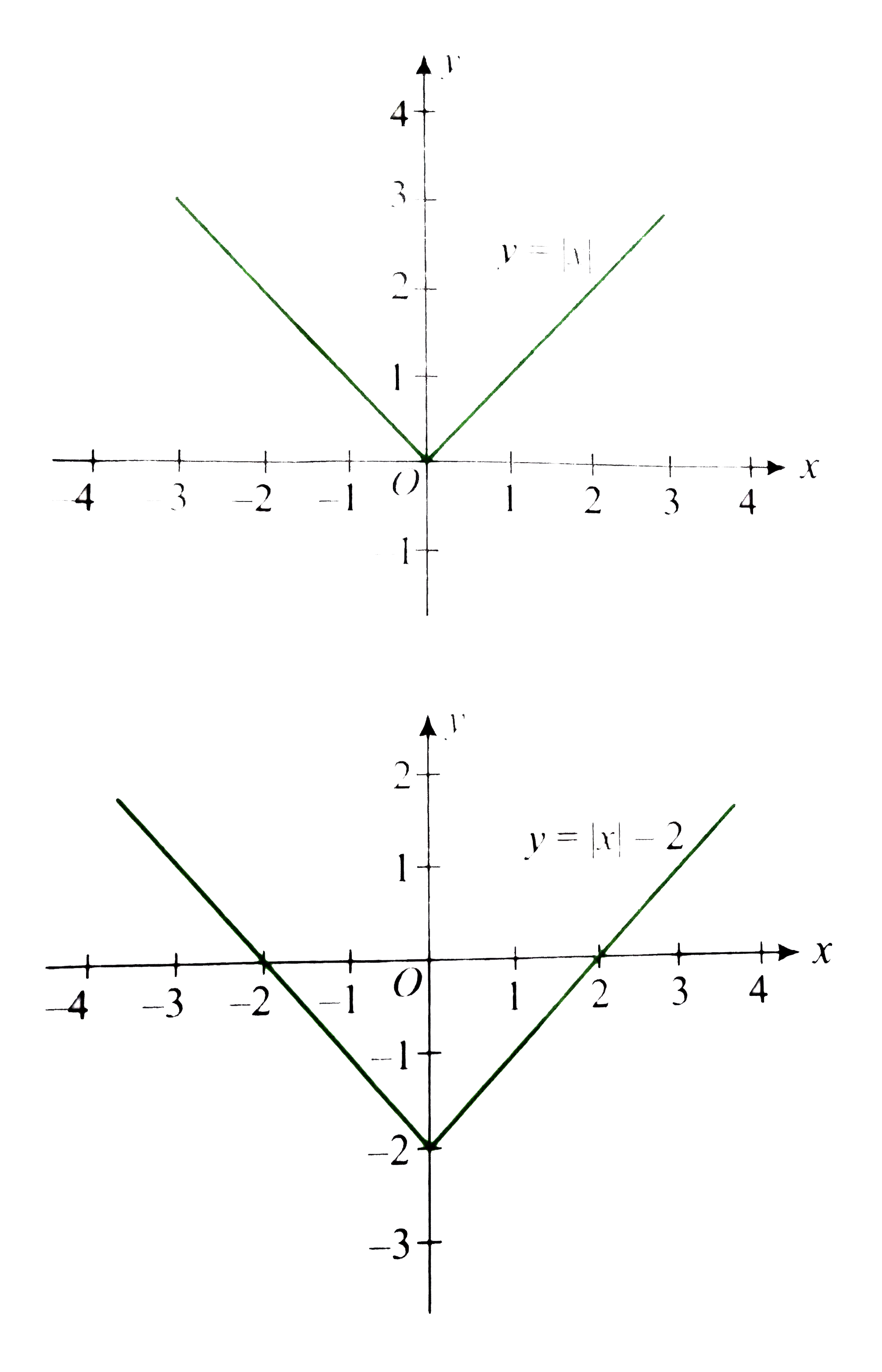 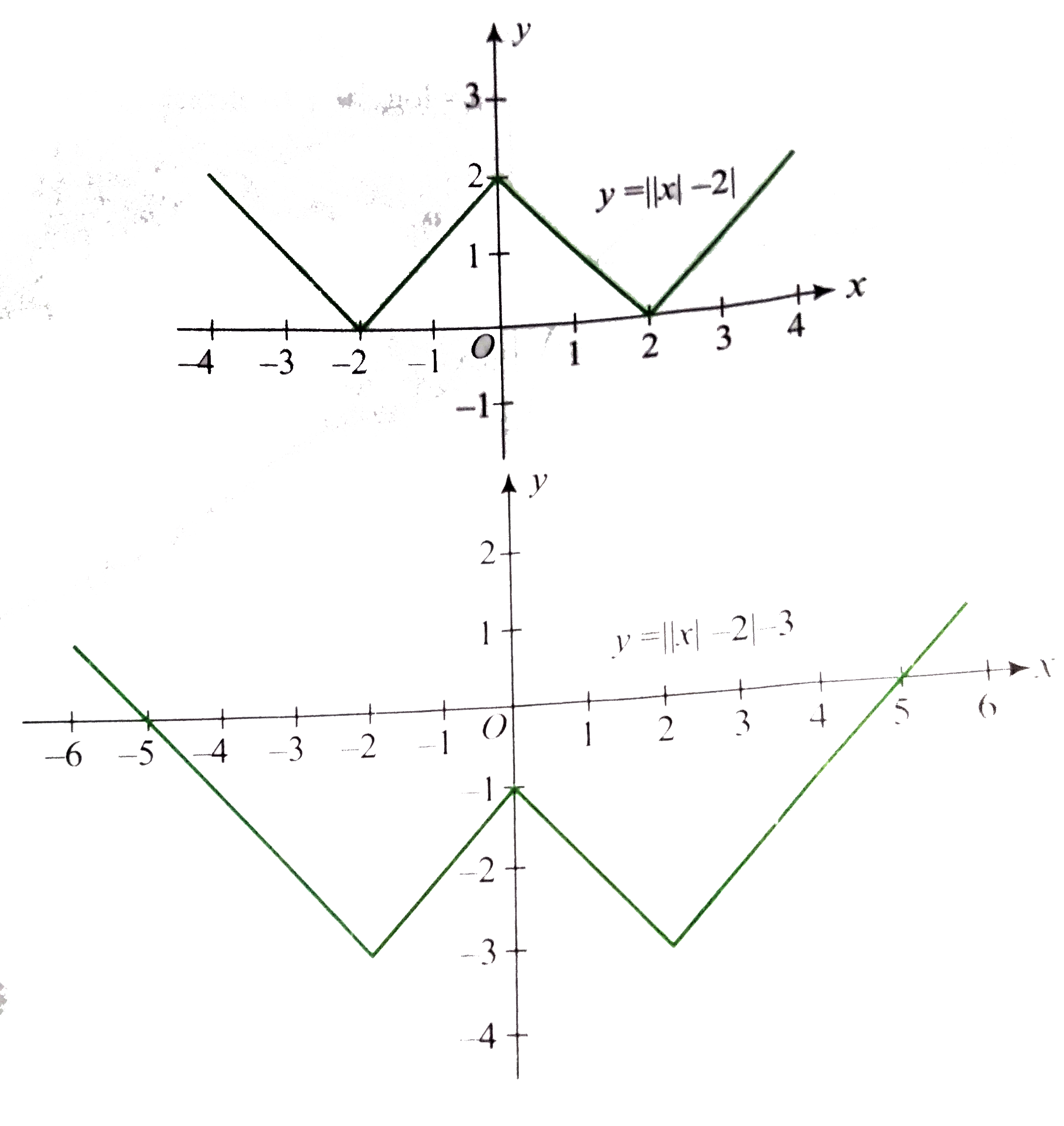
|
|