

Saved Bookmarks
This section includes 7 InterviewSolutions, each offering curated multiple-choice questions to sharpen your Current Affairs knowledge and support exam preparation. Choose a topic below to get started.
| 2. |
The unit's digit of 1^2 + 2^2 + ….. + n^2is 5. The unit's digit of 1^(10) + 2^(10)+ … + n^(10) is |
|
Answer» 1 |
|
| 3. |
If the functionf(x) = [tan(pi/4 + x)]^(1/x) for x ne 0 is = K for x = 0 |
|
Answer» e Since, f(x) is continuousat `x = 0`,then `f(0) = underset(xrarr0)("LIM")f(x)` `= underset(xrarr0)("lim") [tan((x)/(4) + x)]^(1//x)` `RARR K = underset(xrarr0)("lim") [(1+TANX)/(1-tanx)]^(1/x)` [`1^(oo)` form] `=e^(underset(xrarr0)("lim")[(1+tanx)/(1-tanx)-1]1/x)` `=e^(underset(xrarr0)("lim")((2tanx)/(1-tanx)-1)1/x)` `=e^(underset(xrarr0)("2lim")(tanx)/(x)underset(xrarr0)("lim")(1)/(1-tanx))` `[ :' underset(xrarr0)("lim")(tanx)/(x) = 1]` `:. K = e^(2.1(1/1-0)) = e^(2)` |
|
| 4. |
If A and B are two events, show that i) P(AcapB^(C))=P(A)-P(AcapB)and ii) the probability that one of them occurs is given by P(A)+P(B)-2P(AcapB) |
|
Answer» <P> |
|
| 5. |
The value of((Delta^(2))/(E))x^(3)at h=1is |
|
Answer» 8x `=((E^(2)-2E+1)/(E))x^(3)` `=E(x^(3))-2x^(3)+E^(-1)(x^(3))` `=(x+1)^(3)-2x^(3)+(x-1)^(3)` `=x^(3)+1+3x^(2)+3x-2x^(3)+x^(3)-1-3x^(2)+3x` `=6x` |
|
| 6. |
A retailer sells only radios and clocks. IF she currently has 44 total items in inventory, how many of them are radios? (1) The retailer has more than 28 radios in inventory. (2) The retailer has less than twice as many radios as clocks in inventory. |
|
Answer» |
|
| 7. |
A stock portfolio is comprised of Stock A, whose annual gain was 10%, and Stock B, whose annual gain was 20%. If the stock portfolio gained 14% overall, does it contain more shares of Stock A or Stock B ? |
|
Answer» |
|
| 8. |
Find all points of discontinuity of f, where f is defined by f(x)={(2x+3"," ,"if" xle2),(2x-3",","if"xgt2):} |
|
Answer» |
|
| 9. |
If an angle between the line, (x+1)/(2)=(y-2)/(1)=(z-3)/(-2) and the plane x-2y+kz=3 is cos^(-1)((2sqrt(2))/(3)), then a value of k is: |
|
Answer» `SQRT((5)/(3))` |
|
| 10. |
int sec^(5)x dx = |
|
Answer» `1/4 sec x TAN^(3)x + 5/8 sec x tan x + 3/4 ( logsec x + tan x)+C` |
|
| 11. |
If 2^(2010)=a_(n)10^(n)+a_(n-1)10^(n-1)+………..+a_(2)10^(2)+a_(1)*10+a_(0), where a_(i) in {0, 1, 2, ………, 9} for all i=0,1, 2,3, …………, n, then n= |
|
Answer» 603 |
|
| 12. |
If the coefficients of 3rd, 4th , 5th terms in (1+x)^(2n) are A.P. then 4n^2 -26n + 40 = |
|
Answer» 3 |
|
| 13. |
int(dx)/(x+sqrt(x-1))= |
|
Answer» `log_e|x+sqrt(x-1)|-1/SQRT3 tan^-1((2sqrt(x-1)+1)/sqrt3)+C` |
|
| 14. |
Find the order and degree of the differential equation (d^(2)y)/(dx^2)-y+((dy)/(dx)+(d^(3)y)/(dx^(3)))^(3/2)=0 |
|
Answer» |
|
| 15. |
If thevalue of C_(0) + 2C_(1) + 3C_(2) + ……. + (n+1) C_(n) =576 then n is : |
|
Answer» 7 |
|
| 17. |
Find the number of 4 letter words that can be formed using the letters of the word "EQUATION". How many of them (i) begin with vowel |
|
Answer» |
|
| 18. |
If bar(x).bar(y)=bar(x).bar(z) ne 0 and bar(x)xx bar(y)=bar(x)xx bar(z)ne bar(0) and bar(x)ne bar(0) then ………….. |
|
Answer» `BAR(x)` is PARALLEL to `bar(y)` and `bar(z)` |
|
| 19. |
If the number ofterms in the expansion (1+2x-3y+4z)^(n) is 286, then find thecoefficient of term containing xyz. |
|
Answer» `= .^(n+4-1)C_(4-1) = .^(n+3)C_(3) = ((n+3)(n+2)(n+1))/(3!)` ACCORDING to the question, `((n+3)(n+2)(n+1))/(3!) = 286` `:. n = 10` So, theterm containing `(xyz)` is `(10!)/(7!!!!!!!!) (1)^(7) (2x)^(1) (-3y)^(1)(4Z)^(1)` `= -17280 xyz`. THEREFORE, the requiredcoefficient is `- 17280`. |
|
| 21. |
Find |vec(a)xx vec(b)|, if vec(a)=hati-7hatj+7hatk and vec(b)=3hati-2hatj+2hatk. |
|
Answer» |
|
| 22. |
Find the probability distribution of the maximum of the two scores obtained when a die is thrown twice. Determine also the mean of the distribution. |
|
Answer» |
|
| 23. |
If four whole numbers taken at random are multiplied together, show that the probability that the last digit of the product is 5 is (369)/(10^(4)). |
|
Answer» |
|
| 24. |
Applying the formula for multiple integration by parts, calculate the following integrals : (a) int (3x^(2) + x-2) sin^(2) (3x + 1) dx, |
|
Answer» |
|
| 25. |
If x^(n) = a_(0) + a_(1) (1 + x) + a_(2)(1 + x)^(2) + .. .+ a_(n) (1 +x)^(n) = b_(0) + b_(1) (1 - x) + b_(2) (1 - x)^(2) + ... + b_(n)(1 - x)^(n) then for n = 201, (a_(101) , b_(101) ) is equal to: |
|
Answer» `(-""^(201)C_(101),-""^(201)C_(101))` |
|
| 26. |
Let a and b be positive integers. The values. The value of xyz is 55 and (343)/(55) when a,x,y,z,b are in arithmatic and harmonic progression respectively. Find the value of (a+b) |
|
Answer» |
|
| 27. |
An electron collides with a fixed hydrogen atom in its ground state. Hydrogen atom gets excited and the colliding electron loses all its kinetic energy. Consequently the hydrogen atom may emit a photon corresponding to the largest wavelength of the Balmer series. The K.E. of colliding electron will be |
|
Answer» 10.2 eV |
|
| 28. |
Method of integration by parts : int sqrt(xe)^(sqrt(x))dx=.... |
|
Answer» `2sqrt(X)-e^(SQRT(x))-4sqrt(x)e^(sqrt(x)+c` |
|
| 31. |
Show that y =a cos (log x)+b sin (logx),xle0is a soluton of thedifferentialequationx^(2)y''+xy'+y=0 |
|
Answer» |
|
| 32. |
If S=Sigma_(n=2)^(oo) (""^(n)C_(2))/(n+1)! then S equals |
| Answer» Answer :B | |
| 33. |
Which of the following is CORRECT combination ? |
|
Answer» <P>`(IV) (iv) (S) ` |
|
| 34. |
Find area of the triangle with vertices at the point given in each of the following: (1,0) ,(6,0) ,( 4,3) |
|
Answer» |
|
| 36. |
If int(sqrt(x)dx)/(sqrt(1-x^(3))) = (2)/(3) log (x) + C then : |
|
Answer» `f(X) = SQRT(x)` |
|
| 37. |
f: [(-pi)/(2),(pi)/(2)] to [-1,1] : f(x) = sin x is |
|
Answer» one-one and into |
|
| 38. |
If the sum of the squares of the distances of a point from the three coordinate axes be 36, then its distance from the origin is : |
|
Answer» 6 |
|
| 39. |
Let Sigma_(n)^(n-1) vec(a_(i))=0 , where |vec(a_(i))|=1AAi, then Sigma_(1leiltjlen)Sigmavec(a_(i))vec(a_(j))= |
|
Answer» N |
|
| 41. |
Refer to the statement of Example 110, and let S_(k) denote the area bounded by L_(k) and y=x^(2), then 3 overset(oo)underset(k=1)Sigma overset(S_(k))/(T_(k)^(2)) is equal to |
|
Answer» |
|
| 42. |
Prove that the roots of the equation 8x^(2)-4x^(2)-4x+1=0 are cos. (pi)/(7), cos. (3pi)/(7), cos. (5pi)/(7) and hence, show that sec. (pi)/(7) + sec. (3pi)/(7) + sec. (5pi)/(7) = 4 and deduce the equation whose roots are tan^(2). (pi)/(7)+sec. (3pi)/(7)+sec. (5pi)/(7)=4 and deduce the equation whose roots are tan^(2). (pi)/(7) , tan^(2) . (3pi)/(7), tan^(2). (5pi)/(7). |
|
Answer» `tan^(2). (pi)/(7), tan^(2). (3PI)/(7), tan^(2). (5pi)/(7)` |
|
| 43. |
Match the following {:("(A) The minimum value of "(x^(2)+2x+4)/(x+2)" is", "(P) "0),("(B) Let A and B be 3 × 3 matrices of real" , "(Q) " 1) ,(" numbers, where A is symmetric, B is" ,),(" skew-symmetric, and "(A + B) (A – B),),( = (A – B) (A + B)". If "(AB)^(t)= (–1)^(k) AB",",),(" where "(AB)^(t)" is the transpose of the matrix",),(" AB, then the possible values of k are",),("(C) Let " a=log_(3)log_(3)2." An integer k", "(R) " 2), ("satisfying " 1 lt 2^((-k+3^(-a)))lt 2", must be",),("(D) If "sin theta=cos phi", then the possible", "(S) " 3),("values of " (1)/(pi)(theta pm phi - (pi)/(2)) " are",):} |
|
Answer» |
|
| 44. |
Evaluate the following integrals. int(1)/(asinx+bcosx)dx |
|
Answer» |
|
| 45. |
Solve y((dy)/(dx))^(2) |
|
Answer» Solution :`y((dy)/(dx))^(2)+2x(dy)/(dx)-y=0` Solving quadratic in `(dy)/(dx)`, we GET `(dy)/(dx) = (-2x+-sqrt(4x^(2)+4y^(2)))/(2y)` `=(-X+_sqrt(x^(2)+y^(2)))/(y)` which is homogenous Put y=vx, i.e., `(dy)/(dx)=v+x(dv)/(dx)` Then given EQUATION transforms to `v+x(dv)/(dx)=(-1+-sqrt(1+v^(2)))/(v)` or `v^(2)+xv(dv)/(dx) -1+-sqrt(1+v^(2))` or `(v^(2)+1)+sqrt(1+v^(2))=-xv(dv)/(dx)` or `int(vdx)/((1+v^(2))+-sqrt(v^(2)+1))=-int(dx)/x` `or int(vdv)/(sqrt(v^(2)+1)(sqrt(1+v^(2)+-1)))= -int(dx)/(x)`................(1) Put `sqrt(1+v^(2))+-1` i.e., `v/sqrt(1+v^(2))dv=dt` Then, equation (1) transforms to `int(dt)/(t) = -int(dx)/(x)` or `"ln"t="ln"x+"ln"c` or `tx=c` or `(sqrt(1+v^(2))+-1)x=c` Given when `x=0, y=sqrt(5)` or `[sqrt(5)-0]=c` or `c=sqrt(5)` `THEREFORE x^(2)+y^(2)=5+x^(2)+-2sqrt(5)x` or `y^(2)=5+-2sqrt(5)x` |
|
| 46. |
If cos^(-1)(x) + cos^(-1) (y) + cos^(-1) (z)= pi (sec^(2)(u) + sec^(4) (v) + sec^(6) (w)), where u,v, w are least non-negative angles such that u lt v lt w, then the value of x^(2000) + y ^(2002) + z ^(2004)+(36pi)/(u +v+w)is ............. |
|
Answer» |
|
| 47. |
A man wishes to mix two types of food X and Y in such a way that the vitamins contents of the mixture contain at least B units of vitamin A and 11 units of vitamin B. Food X costs Rs. 50 per kg and food Y costs Rs. 60 per kg. Fod Xcontains 2 units per kg of vitamin A and 5 kg per unit of vitamin B while food Y contains 5 units per kg of vitamin A and 2 units per kg of vitamin B. Determine the minimum cost of the mixture. |
|
Answer» Solution :Let there is `X` KG of food `X` and `y` kg of food `Y` in the mixture. `:.` Minimize cost `z=50x+60y` Subject to `XGE0` `yge0` `2x+5yge8` brgt `5x+2yge11` Draw the graph of equations `x=0, y=0, 2x+4y=8` and `5x+2y=11`. Now the feasible region for the inequations `xge0,yge0,2x+5yge8,5x+2yge11`, and shade it. The VERTICES of the shaded region are `A(4,0),B(0,11/2)` and `C(13/7,6/7)`. We will find the value of `z` at these vertices. 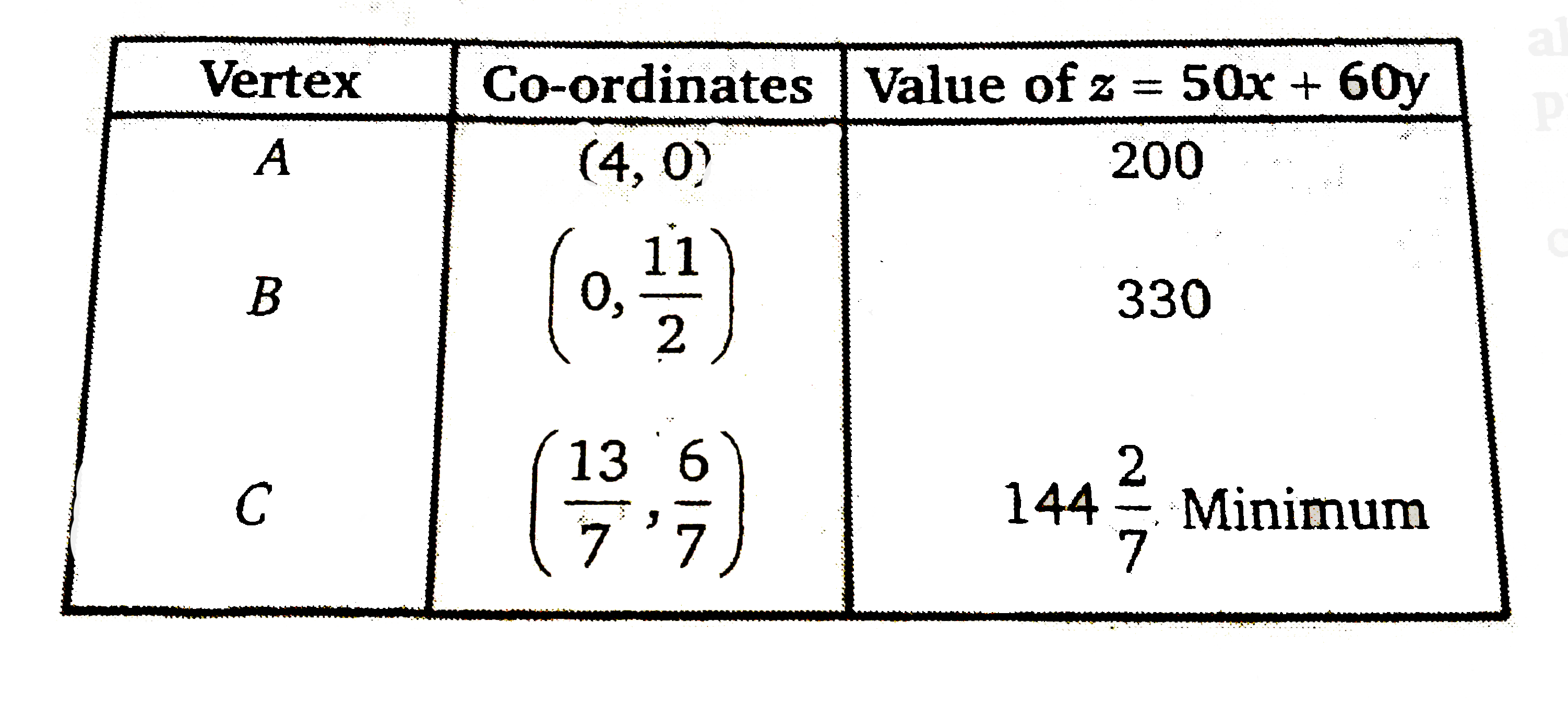 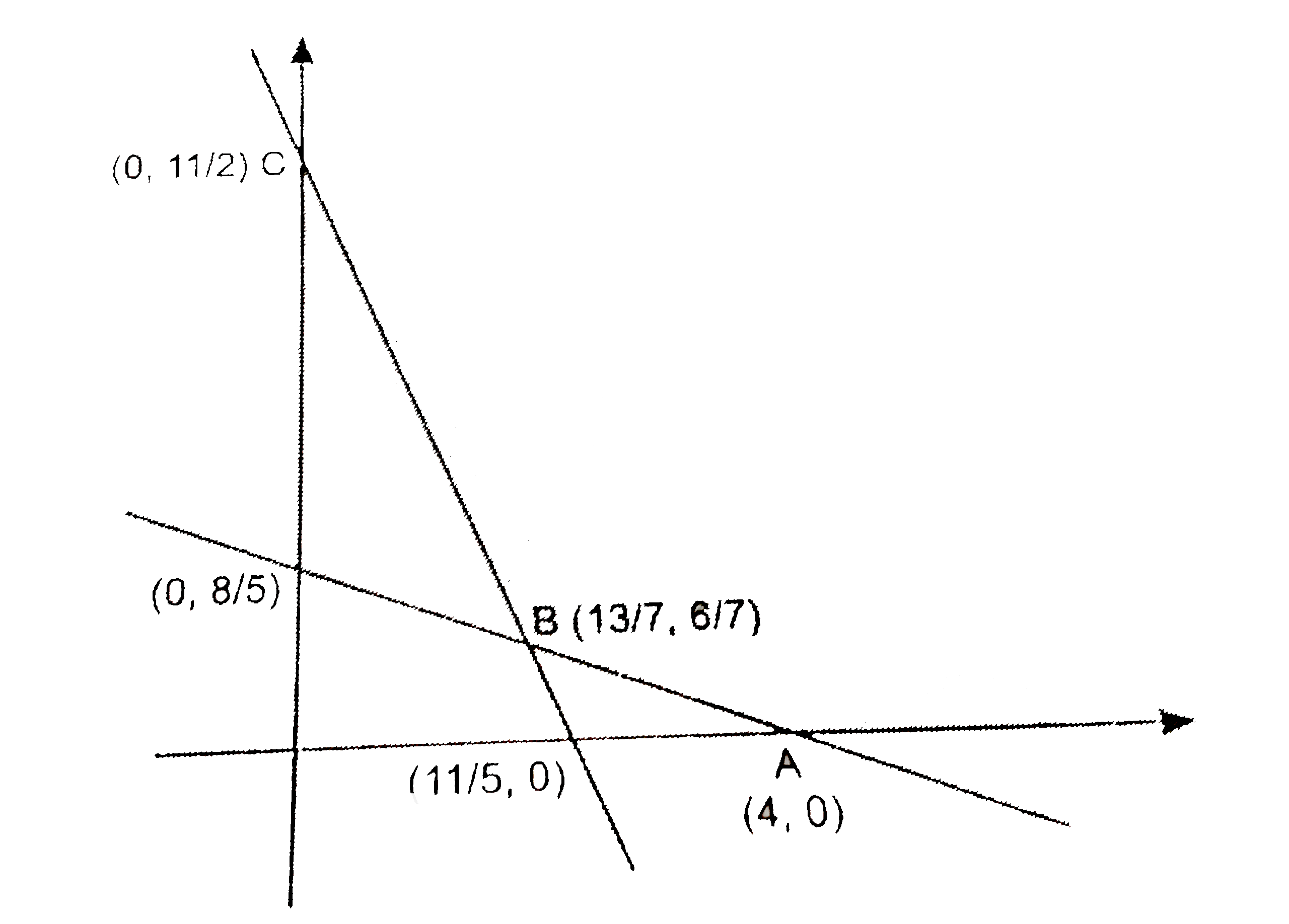 Therefore the minimum cost is Rs. `144 2/7` and food `X` and `Y` are taken `13/7` kg and `6/7` respectively. |
|
| 48. |
Evaluate the following: intx^3e^xdx |
|
Answer» SOLUTION :`intx^3e^xdx=x^3e^x-int3x^2e^xdx` =`x^3e^x-3{x^2e^x-int2xe^xdx` =`x^3e^x-3x^2e^x+6intxe^xdx` =`x^3e^x-3x^2e^x+6{x.e^x-int1.e^xdx}` =`x^3e^x-3x^2e^x+6xe^x-6e^x+C` |
|
| 49. |
int e^(cot x + 2" log cosecx")dx = |
|
Answer» `e^(cot x)` + C |
|