

Saved Bookmarks
This section includes 7 InterviewSolutions, each offering curated multiple-choice questions to sharpen your Current Affairs knowledge and support exam preparation. Choose a topic below to get started.
| 1. |
A bag consists of 10 balls each marked with one e digits 0 to 9. If four balls are drawn successively with replacement from the bag, what is the probability that none is marked with the digit 0? |
|
Answer» |
|
| 2. |
Equation of one of the two lines x^(2)+2xy+cos theta-y^(2)=0 is |
|
Answer» `x-y.cot THETA=0` |
|
| 3. |
If 2alpha= -1-isqrt(3)" and"2beta= -1+isqrt(3), then 5alpha^(4)+5beta^(4)+7alpha^(-1)beta^(-1) is equal to |
| Answer» ANSWER :D | |
| 4. |
Find points at which the tangent to the curve y = x^(3) – 3x^(2) – 9x + 7 is parallel to the x-axis. |
|
Answer» |
|
| 5. |
The vector perpendicular to the vectors 4hat(i)-hat(j)+3hat(k) and -2hat(i)+hat(j)-2k whose magnitude is 9, is |
|
Answer» `3HAT(i)+6hat(j)-6hat(k)` and `c = x hati + y hatj +z hatk` Given, `a*c=0` i.e., ` 4x-y+3z=-0""…(i)` and `b*c=0` i.e, `x^(2)+y^(2)+z^(2)=0""…(ii)` Also, `|c|=9` i.e.,` x^(2)+y^(2)+z^(2)=81""...(iii)` Now, from Eqs. (i) and (ii), we get `2x+z=0impliesz=-2x` On putting this value in Eq. (ii) by 3 and then adding, we get `({:(8x-2y+6z=0),(-6x+3y-6z=0):})/(2x+y=0impliesy=-2x)` On putting this value in Eq. (iv) we get `5x^(2)+4x^(2)=81` `=?9x^(2)=81impliesx^(2)=9` `impliesx = pm 3` `therefore y= pm 6 and z = pm 6` `therefore` REQUIRED vector, `c=x hati+y hatj +z hatk = pm 3 hatipm 6 hatj pm 6 hatk=3 hati-6 hatj - 6 hatkor -3 hati+6 hatj+6 hatk` |
|
| 6. |
Choose the correct answer The mean of the numbers obtained on throwing a die having written 1 on three faces, 2 on two faces and 5 on one face is |
|
Answer» 1 |
|
| 7. |
int(1+x^(2))/(sqrt(1-x^(2)))dx=... |
|
Answer» `(3)/(2)SIN^(-1)x-(1)/(2)x SQRT(1-x^(2))+C` |
|
| 8. |
If A=[{:(4,x+2),(2x-3,x+1):}]is symmetric matrix then find x. |
|
Answer» |
|
| 9. |
The product of lenghts of perpendicular from any point on the hyperbola x^(2) - y^(2) = 16 to its asymptotes, is |
|
Answer» 2 |
|
| 10. |
Find the rate of change of the area of circle w.r.t.r when r=8 cm. |
| Answer» SOLUTION :Let radius =R cm. `therefore` AREA of the CIRCLE `A=pir^2rArr(dA)/dr=2pir` The RATE of change of area for r=8 is `(dA)/(dr)]_(r=8)=[2pir]_(r=8)=16picm^2//cm` | |
| 11. |
The region represented by the inequation x-y le -1, x-y le 0, x le 0, y le 0 is ……………. |
|
Answer» BOUNDED |
|
| 12. |
f(x)=-1+kx+k neither touches nor intecepts the curve f(x)= In x, then minimum value of k in |
|
Answer» `((1)/(e),(1)/SQRT(e))` |
|
| 13. |
Evaluate : int (sin x +cos x ) sqrt(9 +16 sin 2x) dx |
|
Answer» |
|
| 14. |
Consider the function f(x)=x^(2)+bx+c, where D=b^(2)-4cgt0, then match the follwoing columns. |
Answer» SOLUTION :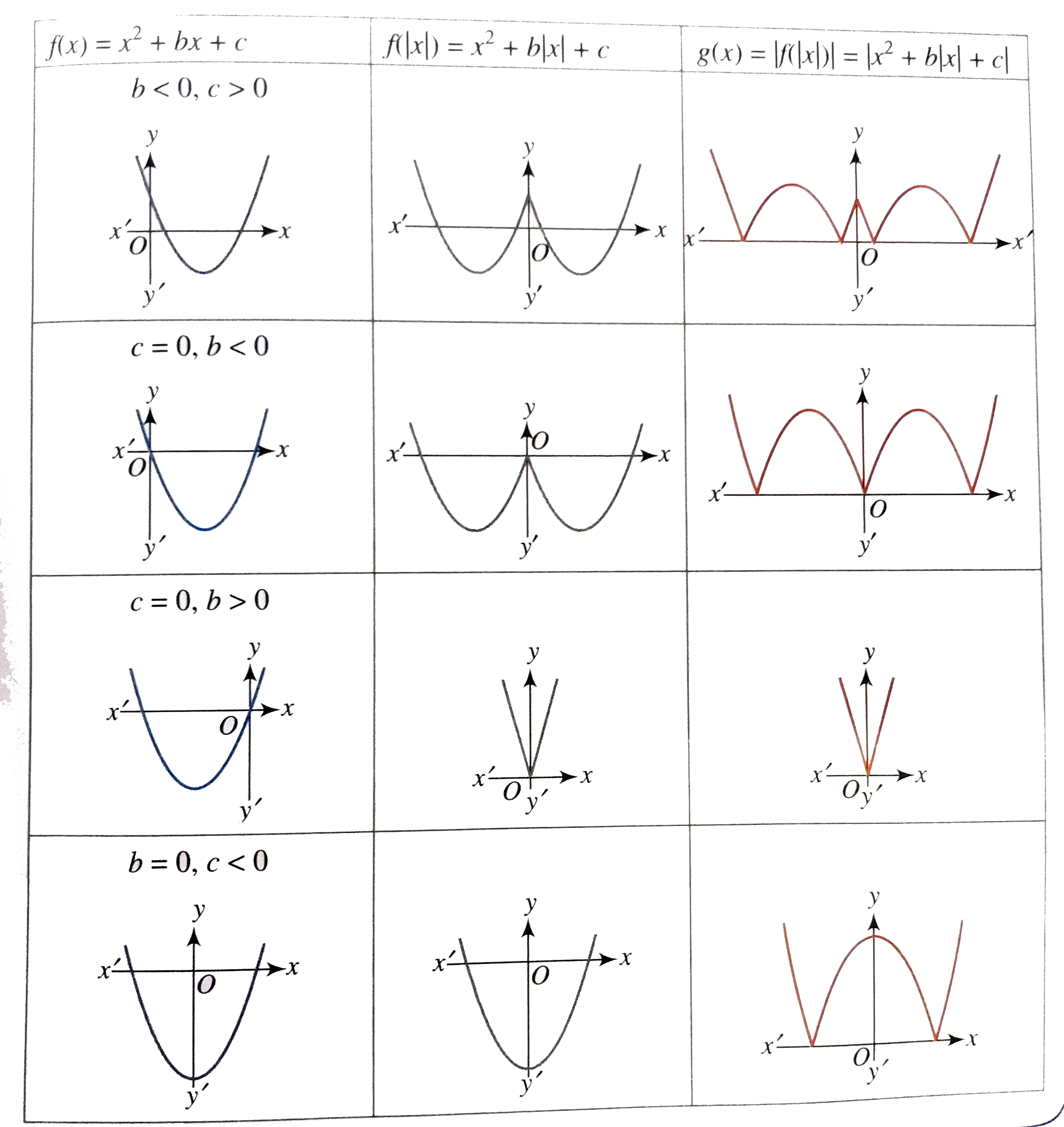
|
|
| 15. |
Solution of the differential equation x-tan^(-1)y-1c e^(-tan^(-1)y) is |
|
Answer» `y=(c-X)E^(x)` |
|
| 16. |
Letvec v_(0) be a fixedvector and vecv_(0)=[(1)/(0)]. Then for n ge 0 a sequence is definedvec v_(n+1)=vec v_(n)+((1)/(2))^(n+1)[(0,-1),(1,0)]^(n+1) vec v_(0) then lim_(n to oo) vecv_(n)=[(alpha), (beta)]. Find (alpha)/(beta) . |
|
Answer» |
|
| 17. |
Let theta=(a_(1),a_(2),a_(3),...,a_(n)) be a given arrangement of n distinct objects a_(1),a_(2),a_(3),…,a_(n). A derangement of theta is an arrangment of these n objects in which none of the objects occupies its original position. Let D_(n) be the number of derangements of the permutations theta. There are 5 different colour balls and 5 boxes of colours same as those of the balls. The number of ways in which one can place the balls into the boxes, one each in a box, so that no ball goes to a box of its own colour is |
|
Answer» `40` `(D_(n))/(n!)=sum_(r=2)^(n)((D_(r ))/(r!)-(D_(r-1))/((r-1)!))=sum_(r=2)^(n)((-1)^(r ))/(r!)` `impliesD_(n)=n!sum_(r=2)^(n)((-1)^(r ))/(r!)` `:. D_(5)=5!((1)/(2!)-(1)/(3!)+(1)/(4!)-(1)/(5!))=44` |
|
| 18. |
Let theta=(a_(1),a_(2),a_(3),...,a_(n)) be a given arrangement of n distinct objects a_(1),a_(2),a_(3),…,a_(n). A derangement of theta is an arrangment of these n objects in which none of the objects occupies its original position. Let D_(n) be the number of derangements of the permutations theta. The relation between D_(n) and D_(n-1) is given by |
|
Answer» `D_(n)-nD_(n-1)=(-1)^(n)` By implied induction on `n`, we OBTAIN `D_(n)-nD_(n-1)=(-1)^(n-2)(D_(2)-2D_(1))`, Where `D_(1)=0` and `D_(2)=1` `=(-1)^(n)` |
|
| 19. |
Let theta=(a_(1),a_(2),a_(3),...,a_(n)) be a given arrangement of n distinct objects a_(1),a_(2),a_(3),…,a_(n). A derangement of theta is an arrangment of these n objects in which none of the objects occupies its original position. Let D_(n) be the number of derangements of the permutations theta. D_(n) is equal to |
|
Answer» `(N-1)D_(n-1)+D_(n-2)` Hence `=D_(n)=(n-1)(D_(n-1)+D_(n-2))` |
|
| 20. |
Solve 24x lt 100, when (i) x is a natural number, (ii) x is an integer. |
|
Answer» ii. The solution set of the inequality is {………..-3, -2, -1,0,1,2,3,4} |
|
| 21. |
If p has truth value T, what can be said about the truth values of ~~p ^^qrarr p vv q. |
Answer» SOLUTION :
|
|
| 22. |
If a line lies in the octant OXYZ and it makes equal angles with the axes, then |
|
Answer» `l=m=n=(1)/(sqrt(3))` |
|
| 23. |
If angle bisector of overline(a) = 2hat(i) + 3 hat(j) + 4 hat(k) and overline(b) = 4hat(i) - 2 hat(j) + 3 hat(k) is overline(c ) = alpha hat(i) + 2 hat(j) + beta hat(k) then |
|
Answer» `vec(c ).hat(k) + 7 = 0` `overline(p) = lambda (hat(a) + hat(b))` `= lambda (((2 hat(i) + 3 hat(j) + 4 hat(k)) + (4 hat(i) - 2 hat(j) + 3 hat(k)))/(sqrt(4 + 9 + 16))) = (lambda)/(sqrt(29)) [6 hat(i) + hat(j) + 7 hat(k)]` `= (lambda)/(2 sqrt(29)) [12 hat(i) + 2 hat(j) + 14 hat(k)]` then `overline(p) = overline(c ) IMPLIES alpha = 12 beta = 14` Now `overline(c ). hat(k) = 14 = 0` |
|
| 24. |
Find the numerically greatest term (s) in the expansion of (4a-6b)^(13)" when "a=3,b=5 |
|
Answer» |
|
| 25. |
lim_(xto0^(-))(1)/(3-2^((1)/(x))) is equal to |
|
Answer» 0 |
|
| 26. |
Consider an infinite geometric series with first term a and common ratio r. If its sum is 4 and the second term is ( 3)/( 4) , then : |
|
Answer» `a = 2, R = (3)/(8)` |
|
| 27. |
Solve system of linear equations, using matrix method in examples 7 to 14 x-y+z=4 2x+y-3z=0 x+y+z=2 |
|
Answer» |
|
| 28. |
Integrate the following functions (xcos^-1x)/sqrt(1-x^2) |
|
Answer» Solution :`int (x cos^-1 x)/SQRT(1-x^2) dx` =`1/2 int (-2X)/sqrt(1-x^2) cos^-1 x dx` =`-1/2 [cos^-1 x XX 2 sqrt(1-x^2) - int -1/sqrt(1-x^2) 2 sqrt(1-x^2) dx]` =`-1/2 [2sqrt(1-x^2) cos^-1 x+2 int dx]` =`-1/2[2sqrt(1-x^2) cos^-1x +2x]+c` =`-[sqrt(1-x^2) cos^-1 x+x]+c` |
|
| 29. |
Form the differential equation of the family of hyperbolas havig foci on x-axis and centre at origin. |
|
Answer» |
|
| 30. |
(sqrt(3)-1)+(1)/(2)(sqrt(3)-1)^(2)+(1)/(3)(sqrt(3)-1)^(3)+….oo |
|
Answer» `log(3+sqrt(2))` |
|
| 31. |
Given four points A(2, 1, 0), B(1, 0, 1), C(3, 0, 1) and D(0, 0, 2). Point D lies on aline L orthogonal to the plane determined by the points A, B and C. |
|
Answer» `sqrt(2)` 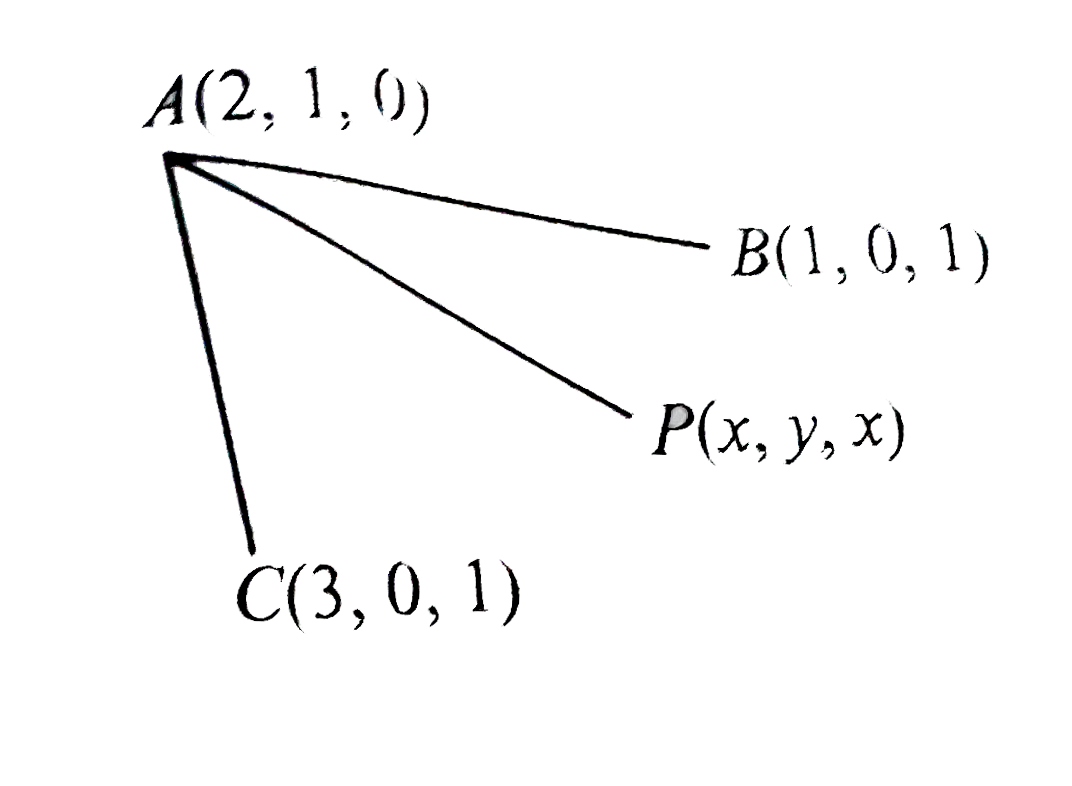 `""|{:(x-2,,y-1,,z),(1-2,,0-1,,1-0),(3-2,,0-1,,1-0):}|=0` `""(x-2)[(-1)-(-1)]-(y-1)[(-1)-1]+z[1+1]=0` or `""2(y-1)+2z=0` or `""y+z-1=0` The vector NORMAL to the PLANE is `vecr= 0hati+hatj+ hatk` The equation of the line through `(0, 0, 2)` and PARALLEL to `vecn` is `vecr = 2hatk+lamda(hatj+hatk)` The perpendicular distance of `D(0, 0, 2)` from plane `ABC` is `|(2-1)/(sqrt(1^(2)+1^(2))|=(1)/(sqrt2)|` |
|
| 32. |
Given four points A(2, 1, 0), B(1, 0, 1), C(3, 0, 1) and D(0, 0, 2). Point D lies on aline L orthogonal to the plane determined by the points A, B and C. The equation of the line L is |
|
Answer» `vecr=2hatk+lamda(hati+HATK)` 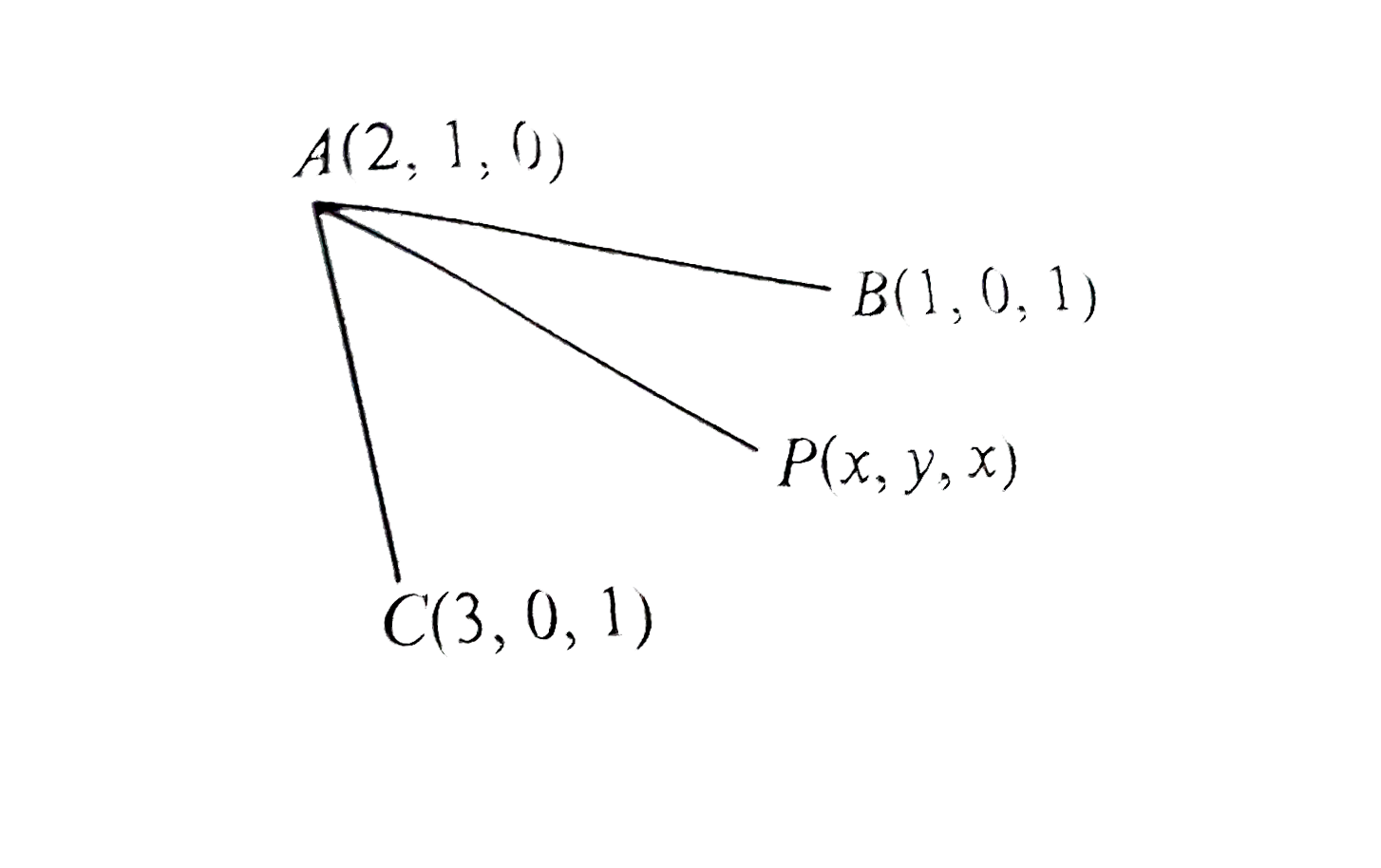 `""|{:(x-2,,y-1,,z),(1-2,,0-1,,1-0),(3-2,,0-1,,1-0):}|=0` `""(x-2)[(-1)-(-1)]-(y-1)[(-1)-1]+z[1+1]=0` or `""2(y-1)+2z=0` or `""y+z-1=0` The vector normal to the plane is `vecr= 0hati+hatj+ hatk` The equation of the line through `(0, 0, 2)` and parallel to `vecn` is `vecr = 2hatk+lamda(hatj+hatk)` The perpendicular DISTANCE of `D(0, 0, 2)` from plane `ABC` is `|(2-1)/(sqrt(1^(2)+1^(2))|=(1)/(sqrt2)` |
|
| 33. |
If A and B are two events such that P(A)= (1)/(2), P(B)= (1)/(3) and P(A//B)= (1)/(4) then P(A' cap B') equals ……….. |
|
Answer» `(1)/(12)` |
|
| 34. |
Equation of the hyperbola with one focus at the origin and directrix x+3=0 and eccentricity sqrt3 is |
|
Answer» `X^(2)-2y^(2)+18x+27=0` |
|
| 35. |
The variance of 6,5,8,10,3,4,9,11 is |
|
Answer» 8 |
|
| 36. |
Construct a 2 xx 2 matrix A=[a_(ij)], whose elements are given by a_(ij)= (i)/(j) |
|
Answer» |
|
| 37. |
Draw the graph of y=(3x-x^(3))/(1-3x^(2)) and hence the graph of y=tan^(-1).(3x-x^(3))/(1-3x^(2)). |
|
Answer» Solution :We have `y=F(x)=(3x-x^(3))/(1-3x^(2))`, which is an odd function. Domain of the function is `R-{+-(1)/(sqrt(3))}` 1. y-intercept f(0)=0 So the graph cuts the y-axis at (0,0). 2. x-intercept (zeros) Put y=0 or `3x-x^(3)=0 :. x=0, +-sqrt(3)` So the graph meets the x-axis at (0,0) and `(+-sqrt(3),0)`. 3. Asymptotes Vertical asymptotes Clearly , the graph has vertical asymptote `x=+-(1)/(sqrt(3))`, where the denominator becomes zero. Horizontal asymptotes Clearly, the graph has no horizontal asymptote as the degree of the NUMERATOR is higher than the degree of the numerator is higher than the degree of the denominator. Oblique asymptotes ltbr. `y=(x^(3)-3x)/(3x^(2)-1)=(1)/(3)x-(-(8)/(9)x)/(3x^(2)-1)` Hence the oblique asymptote is `y=(1)/(3)x`. THUS, importantpoints ans lines are as shown in the following figure. 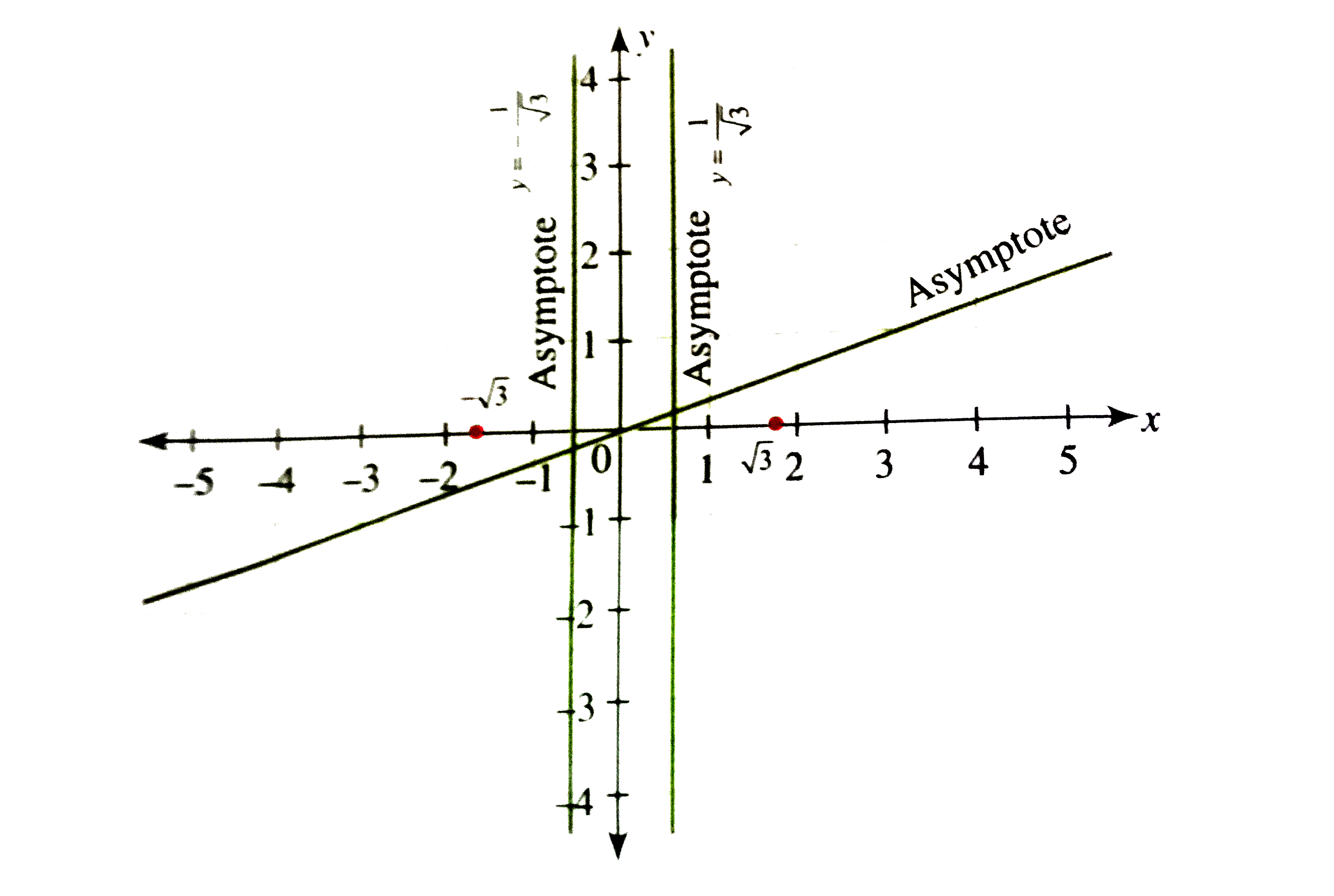 4. Monotinicity/Extremum `f'(x)=((3-3x^(2))(1-3x^(2))+6X(3x-x^(3)))/((1-3x^(2))^(2))` `=3((x^(2)+1)^(2))/((1-3x^(2))^(2)) gt0` Hence the function is increasing throughout. `underset(xrarr-(1^(-))/(sqrt(3)))lim(3x-x^(3))/(1-3x^(2))=oo` and `underset (xrarr-(1^(+))/(sqrt(3)))lim(3x-x^(3))/(1-3x^(2))=-oo` f(x) approaches asymptote `y=x//3` as `xrarr-oo`. Thus, in `(-oo,-(1)/(sqrt(3)))`, f(x) increases from `'-oo'` to `'oo'` intersecting the x-axis at `(-sqrt(3),0)` `underset(xrarr-(1^(+))/(sqrt(3)))lim(3x-x^(3))/(1-3x^(2))=-oo` and `underset(xrarrsqrt(3)^(-))lim(3x-x^(3))/(1-3x^(2))=oo` Thus, in `(-(1)/(sqrt(3)),(1)/(sqrt(3)))`, f(x) increases from `'-oo'` to `'oo'` intersecting the x-axis at (0,0). `underset(xrarrsqrt(3)^(+))lim(3x-x^(3))/(1-3x^(2))=-oo` and `underset(xrarroo)lim (3x-x^(3))/(1-3x^(2))=oo` Thus, in `((1)/(sqrt(3)),oo),f(x)` increases from `'-oo'` to `'oo'` intersecting the x-axis at `(sqrt(3),0)`. f(x) approaches asymptote `y=x//3` as `xrarroo`. From the above discussion, the graph of `y=f(x)` can be drawn as follows. 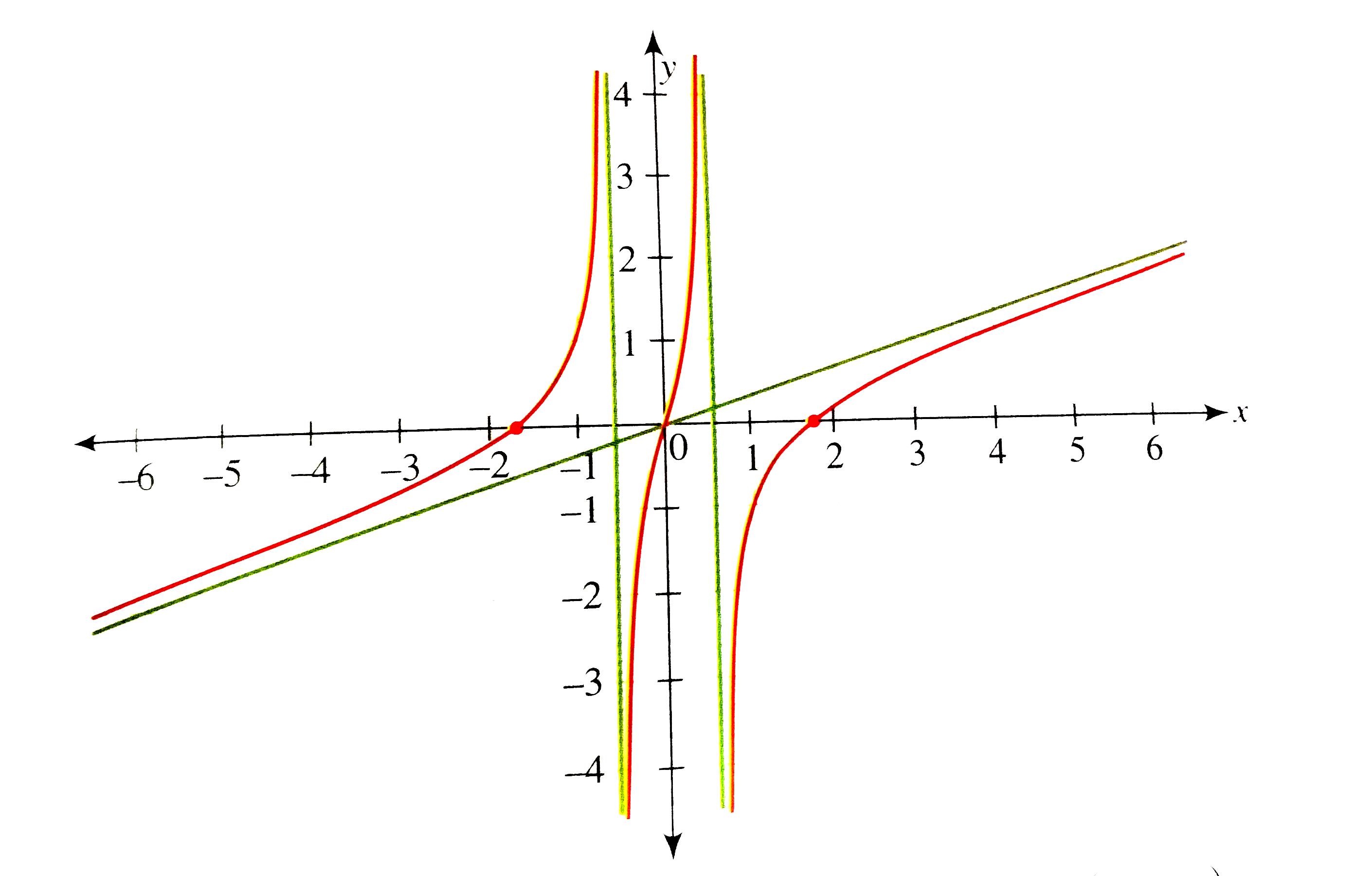 Now in each of the intervals `(-oo,-(1)/(sqrt(3))),(-(1)/(sqrt(3)),(1)/(sqrt(3))), ((1)/(sqrt(3)),oo), f(x)` takes values `(-oo,oo)`. So in each of the intervals, `tan^(-1).(3x-x^(3))/(1-3x^(2))` takes values `(-(pi)/(2),(pi)/(2))`. So the graph of `g(x)=tan^(-1).(3x-x^(3))/(1-3x^(2))` can be drawn as follows. 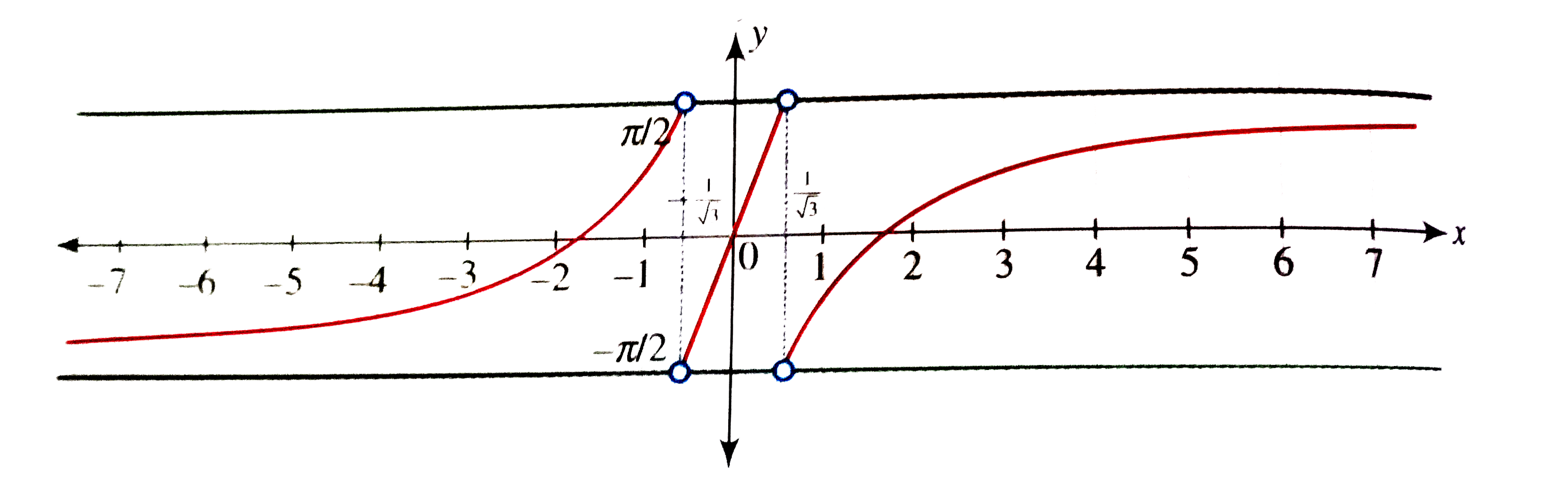 Here `y=+-(pi)/(2)` are asymptotes. |
|
| 38. |
A batsman can score 0, 2, 3, or 4 runs for each ball he receives. If N is the number of ways of scoring a total of 20 runs in one over of six balls, then N is divisible by: |
|
Answer» 5 |
|
| 39. |
Given the sequence a, ab, aab, aabb, aaabb,aaabbb,…. Upto 2004 terms, the total number of times a's and b' s are used from 1 to 2004 terms are : |
|
Answer» |
|
| 40. |
Integrate the following int(cosec^2(Inx))/(x) dx |
|
Answer» SOLUTION :`int(cosec^2x(Inx))/x(DX) PUT In x=z then (dx/x)=DZ] `intcosec^2zdz` -cotz+C=-cot(Inx)+C |
|
| 41. |
A person buys a lottery ticket in 50 lotteries, in each of which his chance of winning a prize is (1)/(100). What is the probability that he will win a prize (a) at least once (b) exactly once (c) at least twice? |
|
Answer» |
|
| 42. |
int (1 +x -x^(-1)) e^(x + x^(-1))dx = |
|
Answer» `(x + 1) E^(x +x^(-1)) + C` |
|
| 43. |
Evaluate the following determinants: [[1,0,-5863],[-7361,2,7361],[1,0,4137]] |
|
Answer» Solution :`[[1,0,-5863],[-7361,2,7361],[1,0,4137]]` =`2[[1,-5863],[1,4137]]` (expanding along 2ND COLUMN) =2(4137+5863) =`2xx10000=20000` |
|
| 44. |
For a series the information available is n = 10 sum x = 60, sum x^(2) = 1000. The standard deviation is |
|
Answer» 8 |
|
| 45. |
If y ^(y ^(y ^(.^(,^(,^(oo)))))) = log _(e) (x + log _(e) (x + .....)), then (dy)/(dx)at (x = e ^(2) -2, ysqrt2 )is |
|
Answer» `(log (( E )/( 2)))/( 2 SQRT2 (e ^(2) -1 ))` |
|
| 46. |
Which one of the following relations on R is an equivalence relation ? |
|
Answer» `a R_(1) b iff |a|=|b|` |
|
| 47. |
Form the differential equation of the family of circles in the first quadrant whichtouch the coordinate axes. |
|
Answer» |
|
| 48. |
If , 15 and 45 are in G.P. then x = |
|
Answer» A.P. |
|
| 49. |
Prove that :int_(0)^(1)(sin^(-1)x)/(x) dx = (pi)/(2) log 2 |
| Answer» | |
| 50. |
Forthe followingquestion , choosethe correctanswerfrom thecodes(a).(b).(c) and (d)defindasfollows |
|
Answer» Statements I istrueStatementII is thealso true, `:' vec(TR)` is resultant of `vec(RS)" and" vec(ST)` `"VECTORS" rArr vec(PQ) xx (vec(RS + vec(ST)) ne 0` But forstatementII we have `vec(PQ) xx vec(RS) =vec(0)` 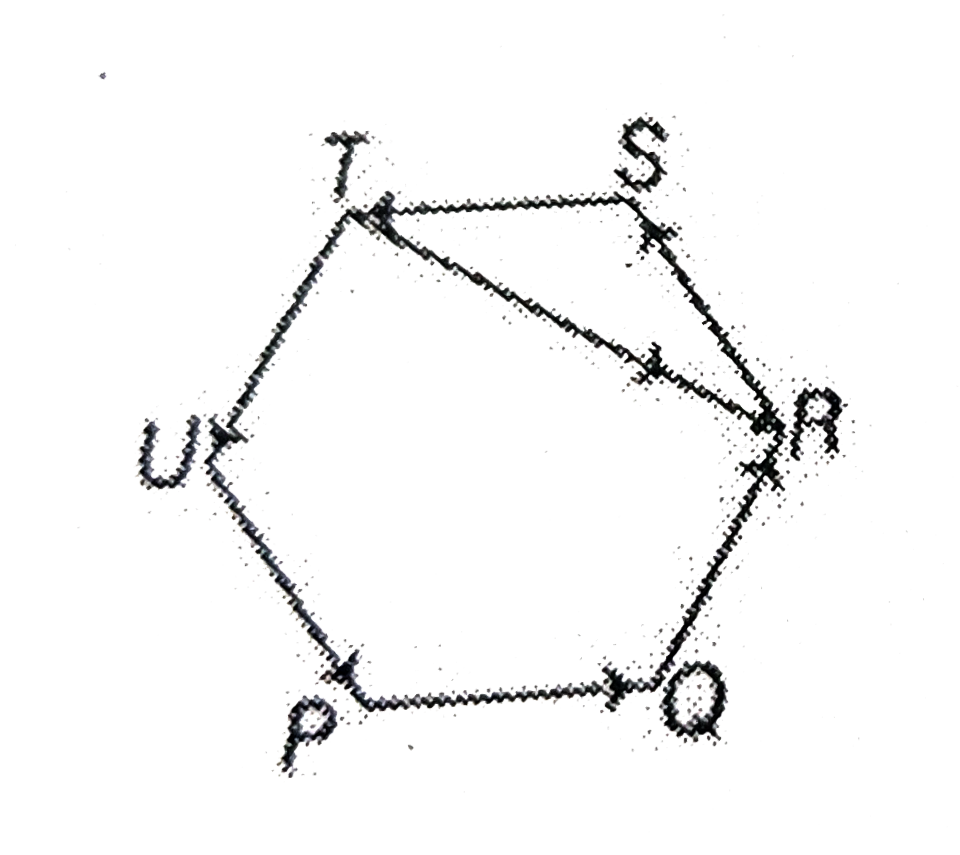 Whichis notpossibleas `vec(PQ)" notparallel to" vec(RS)` HenceStatmentI is trueand Statement II is false. |
|