

Saved Bookmarks
This section includes 7 InterviewSolutions, each offering curated multiple-choice questions to sharpen your Current Affairs knowledge and support exam preparation. Choose a topic below to get started.
| 1. |
To determine the age of stone it was analysed for the nuclei of 'B' & 'D' and were found to 10^(18)and3xx10^(18) respectively. Assuming that all the 'D' was produced by the disintegration of 'A' only, the age of the stone is [(Given : ln2=0.3,ln3=0.45] |
|
Answer» 6930 days |
|
| 2. |
Find the position vector of a point R which divides the line joining two points P and Q whose position vectors are (2veca+vecb)and(veca-3vecb) externally in the ratio 1:2 Also , show that P is the mid point of the line segment RQ. |
|
Answer» |
|
| 3. |
Find the value of the following cos^(-1)(cos frac(13pi)6) |
|
Answer» SOLUTION :`TAN^(-1)(tan FRAC(7pi)6)=tan^(-1)tan(pi+pi/6)` `tan^(-1)tan(pi/6=pi/6)` |
|
| 4. |
Find the point on the straight line 3x+y+4=0 which is equidistant from the points (-5,6) and (3,2). |
|
Answer» |
|
| 5. |
The value of the expression ""^(23)C_(6)underset(j=1)overset(5)Sigma ^(28-j)C_(5)+underset(k=1)overset(5)Sigma^(33-k)C_(28)-k is |
| Answer» Answer :A | |
| 6. |
int_(0)^(x) (dx)/(1-2a cos x+a^(2)) is equal to |
|
Answer» `(pi)/(2(1-a^(2)))` `int _(0)^(pi) (dx)/((1+a^(2)) (cos^(2).x/2 +SIN^(2). x/2 ) - 2a (cos^(2). x/2 - sin^(2) .x/2 ) )` `= int _(0)^(pi) (dx)/((1-a^(2))cos^(2) . x/2 + (1+ a^(2)) sin^(2). x/2 ) ` ` = 2/ ((1+a^(2)) )int _(0)^(oo)(dt)/({((1-a))/((1+a))}^(2)+t^(2))` ` [ t = tan .x/2 rArr dt = 1/2 sec^(2) . x/2 dx] ` ` l = 2/(1+a)^(2).((1+a))/((1-a)) [ tan^(-1)((1+a)/(1-a).t ) ] _(0)^(oo) ` ` l = 2/((1-a^(2))) [ tan ^(-1) oo - tan ^(-1) 0 ] = pi/(1-a^(2))` |
|
| 7. |
Find the equation of parabola whose focus is (-2,3) and the directrix is 2x+3y=4 |
|
Answer» |
|
| 8. |
(overset(-)a+2overset(-)b-overset(-)c) (overset(-)a-overset(-)b) xx (overset(-)a -overset(-)b-overset(-)c) is equal to |
|
Answer» `-[OVERSET(-)a overset(-)B overset(-)C]` |
|
| 9. |
Find (dy)/(dx) of each of the functions expressed in parametric form:x=3 cos theta-2 cos^(3) theta, y= 3 sin theta- 2 sin^(3) theta |
|
Answer» |
|
| 10. |
Probability that A is telling the truth is given as 0.6 and probability that B is telling the truth is 0.7 while narrating on same question. Find the probability that both of them will give contradict options narrating on same scene |
| Answer» | |
| 11. |
Let a = a_(1) I + a_(2) + a_(3) k. Assertion (A) : The identity |a xx i|^(2) + |a xx j|^(2) + |a xx k|^(2) = 2 |a|^(2) hold for a, Reason (R ) : a xx I = a_(3) j = a_(2) k, a xx j = a_(1) k - a_(3) I, a xx k = a_(2) I = a_(1) j Which of the following is correct? |
|
Answer» both A and R are TRUE and R is the correct EXPLANATION of A |
|
| 12. |
Find the mean deviation about the mean for the following data38,70,48,40,42,55,63,46,54,44 |
|
Answer» |
|
| 13. |
Using properties evaluate the following definite integrals, evaluate the following: int_(-pi/2)^(pi/2) sin^2x dx |
|
Answer» SOLUTION :`sin^2(-x) = (-SINX)^2 = sin^2x` THEREFORE `sin^2x` is an even FUNCTION therefore `int_(-pi/2)^(pi/2) sin^2 x dx = 2int_0^(pi/2) sin^2x dx` =`2 int_0^(pi/2) (1-cos 2x)/2 dx` =`[x-(sin2x)/2]_0^(pi/2)` `(pi/2 -sinpi/2) -(0-sin0/2) = pi/2` |
|
| 14. |
If area bounded by the curves y^(2)=4axandy=mx is a^(2)//3 then the value of m is |
| Answer» ANSWER :B | |
| 15. |
A circle cuts therectangular hyperbola xy=1 in the points (x_(1),y_(1)), r=1,2,3,4. Prove that x_(1)x_(2)x_(3)x_(4)=y_(1)y_(2)y_(3)y_(4)=1 |
|
Answer» |
|
| 16. |
If a, b, c are in AP then ax + by + c = 0 will always pass through a fixed point whose coordinates are |
| Answer» ANSWER :A | |
| 17. |
Find the graph of linear inequation in xy plane 2y+7 le 0 |
| Answer» | |
| 18. |
Integrate the following functions: sin^3(2x+1) |
|
Answer» Solution :`sin^3(2x+1) = (3 sin(2x+1) -sin3(2x+1))/4` =1/4[3sin(2x+1)-sin(6x+3)] therefore` int sin^3(2x+1) dx` `=1/4[(-3cos(2x+1)/2 + COS(6x+3)/6]+c` |
|
| 19. |
The value of c in Rolle's theorem for the function f(x)= x^(3) in the interval x in [0, sqrt3] |
| Answer» ANSWER :A | |
| 20. |
Find the most general solution of the following (i) sin 6x=sin 4x-sin 2x (ii)sec 4x-sec 2x=2 (iii)3-2 cos theta - 4 sin theta - cos 2 theta + sin 2theta =0 (iv)2(cos theta + cos 2 theta )+ sin 2 theta (1+cos theta)=2 sin theta |
|
Answer» (ii)`(2n+1)(pi)/(10),(2m+1)(pi)/(2) ` (iii)`2npi,2npi+(pi)/(2)` (IV)`2npi(pi)/(2),2npui+(pi)/(3),(2n+1)pi` |
|
| 21. |
Let alpha and beta be the roots of the quadratic equation ax^(2) + bx + c = 0, observe the lists given below : The correct match is |
|
Answer» `{:(A,B,C,D),(5,2,4,6):}` |
|
| 22. |
Show that the line joining the origin to the point (2, 1, 1) is perpendicular to the line determined by the points (3, 5, - 1), (4, 3, - 1). |
|
Answer» |
|
| 23. |
Find |vec(a)-vec(b)|, if two vectors vec(a) and vec(b) are such that |vec(a)|=2,|vec(b)|=3 and vec(a).vec(b)=4. |
|
Answer» |
|
| 24. |
Find the probability of getting a prime number in a single roll of the die |
|
Answer» <P> `=P(3)+P(5)+P(2)` `3/21+ 5/21+2/21=10/21` |
|
| 25. |
a' xx b' + b' xx c' + c' xx a' = |
|
Answer» `(a + B+ C)/([a BC])` |
|
| 26. |
If e is the eccentricity, l is the semi latus-rectum and S. S^(1) are foci of the hyperbola 9x^(2)-16y^(2)+72x-32y=16 then ascending order of l, e SS^(1) is |
|
Answer» `1,e,SS^(1)` |
|
| 27. |
If I_(n)=int_(0)^(pi//4) tan^(n) x dx then {:(" " Lt),(n rarr oo):}n(I_(n)+I_(n+2))= |
| Answer» Answer :B | |
| 28. |
The slope of tangents drawn from a point (4,10) to the parabola y^(2)=9x are |
|
Answer» `(1)/(4),(3)/(4)` |
|
| 29. |
Find the points of local mixima and local minima, if any, of the following function : f(x)=sinx+(1)/(2)cos2x:0lexle(pi)/(2). |
|
Answer» |
|
| 30. |
Select correct set of quantum numbers ? |
|
Answer» `{:(N,L,m,s),(2,2,0,-1/2):}` |
|
| 31. |
Find the eccentricity of the ellipse (i) whose latus rectum is equal to half of its minor axis (ii) whose latus rectum is equal to half of its major axis (iii) if the major axis is three times the minor axis |
|
Answer» |
|
| 32. |
Let f(x)={(lim_(nto oo) ((px)/n sum_(r=1)^(n) ([r^(2)-e^(-x)+r-1])/(r(r+1)))+lamda,xgt0),(q, x=0),(lim_(nto oo) sum_(r=1)^(n) ({r^(2)+r+e^(x)-1})/(r(r+1)), xlt0):} Is differentiable is R: ([.] is G.I.f and {.} is F.P. of x) Then, |
|
Answer» `p=1` `f(x)={(px+lamda, XGT0),(q,x=0),(E^(x),XLT0):}` |
|
| 33. |
State with reason,"All sincere students of Ravenshaw college during the academic year 1998-99 " is set or not ? |
| Answer» Solution :It is not a set, as the WORD SINCERE. is not PROPERLY defined. | |
| 34. |
If a=(1-isqrt(3))/(2)then the correct matching of List - I from List - II is {:("List - I","List - II"),("i)"abara,"A)"2pi//3),("ii)"arg(1//bara),"B)"-i//sqrt3),("iii)"a-bara,"D)"1),("iv)"Im (4//3a),"E)"pi//3),(,"F)"2sqrt(3)):} Correct match is |
|
Answer» `{:("(i)",(II),(iii),(iv)),(D,E,C,B):}` |
|
| 35. |
A lottery sells n^(2) tickets and declares n prizes. If a man purchases n tickets, the probability of his winning exactly one prize is …… |
|
Answer» `1-(.^(N^(2)-n)C_(n))/(.^(n^(2))C_(n))` `f'(x)=0" at "x=(piL)/(pi+4)."Check "f(0),f(L),f((piL)/(pi+4))` |
|
| 36. |
Find the number of words that can be formed by taking all the letters of the word "QUESTION' such that Q, N are separated exactly by 2 letters |
|
Answer» |
|
| 37. |
Find the number of words that can be formed by taking all the letters of the word "QUESTION' such that Q, N are separated by atmost 4 letters |
|
Answer» |
|
| 38. |
If AB =3hati-2hatj+2hatk and BC=-hatj-2hatk are adjacent sides of a parallelogram, then angle its diagonals can be |
|
Answer» `cos^(-1)((2)/(SQRT(13)))` `=(3hat(i)-2hat(j)2hat(k))+(-hat(j)-2hat(k))` `=3hat(i)-3hat(j)` Also `BC=AD` and `AB=AD+DB` `DB=AB=AD` `=(3hat(i)-2hat(j)+2hat(k))-(-hat(j)-2hat(k))` `=3hat(i)-hat(j)+4hat(k)` `THEREFORE` Angle between AC and BD is `theta = cos^(-1)(AC.BD)/(|AC|.AD|)` `=cos^(-1).((3hat(i)-3hat(j)).(3hat(i)-hat(j)+4hat(k)))/(sqrt(3^2+(-3)^2)sqrt(3^2+1^2+4^2))` `=cos^(-1).((9+3)/(sqrt(18)sqrt(20)))=cos^(-1).((12)/(3sqrt(2)sqrt(2)sqrt(3)))` `=cos^(-1)((2)/(sqrt(13)))` . |
|
| 39. |
bar(a)=2hati+hatj-2hatk and bar(b)=hati+hatj. The vector bar( c ) is such that bar(a)*bar( c )=|bar( c )|,|bar( c )-bar(a)|=2sqrt(2) and the angle between bar(a)xx bar(b) and bar( c ) is 30^(@) then |(bar(a)xx bar(b))xx bar( c )| = ………… |
| Answer» Answer :B | |
| 40. |
Evaluation of definite integrals by subsitiution and properties of its : int(dx)/(sqrt(2x-x^(2)))=..........+C |
|
Answer» `2SIN^(-2)(x-1)` |
|
| 41. |
Let f(x) = {{:((cos x-e^(x^(2)//2))/(x^(3))",",x ne 0),(0",",x = 0):}, then Statement I f(x) is continuous at x = 0. Statement II lim_(x to 0 )(cos x-e^(-x^(2)//2))/(x^(3)) = - (1)/(12) |
|
Answer» STATEMENT I is CORRECT, Statement II is also correct, Statement II is the correct EXPLANATION of Statement I |
|
| 42. |
if Sigma_(i=1)^(4)(x_(i)^(2)+y_(i)^(2))le 2x_1x_3+2x_2x_4+2y_2y_3+2y_1y_4, the points (x_1,y_1),(x_2,y_2),(x_3,y_3),(x_4,y_4) are |
|
Answer» the vertices of a rectangle Given `x_1^2+x_2^(2)+x_4^(2)+y_1^(2)+y_2^(2)+y_3^(2) +y_4^2-2x_1x_3-2x_(2)x_4-2y_(2)y_(3)-2y_(1)y_4le0` or `(x_1-x_3)^2+(x_2-x_4)^2+(y_2-y_3)^2+(y_2-y_3)^2+(y_1-y_4)^2le0` or `(x_1+x_2)/(2)=(x_3+x_4)/(2) and (y_1+y_2)/(2)=(y_4+y_3)/(2)` Hence AB and CD bisect each other. therefore, ACBD is a PARALLELOGRAM. Also, `AB^2=(x_1-x_2)^2+(y_1-y_2)^2` `=(x_3-x_4)^2+(y_4-y_3)^2` `=CD^2` 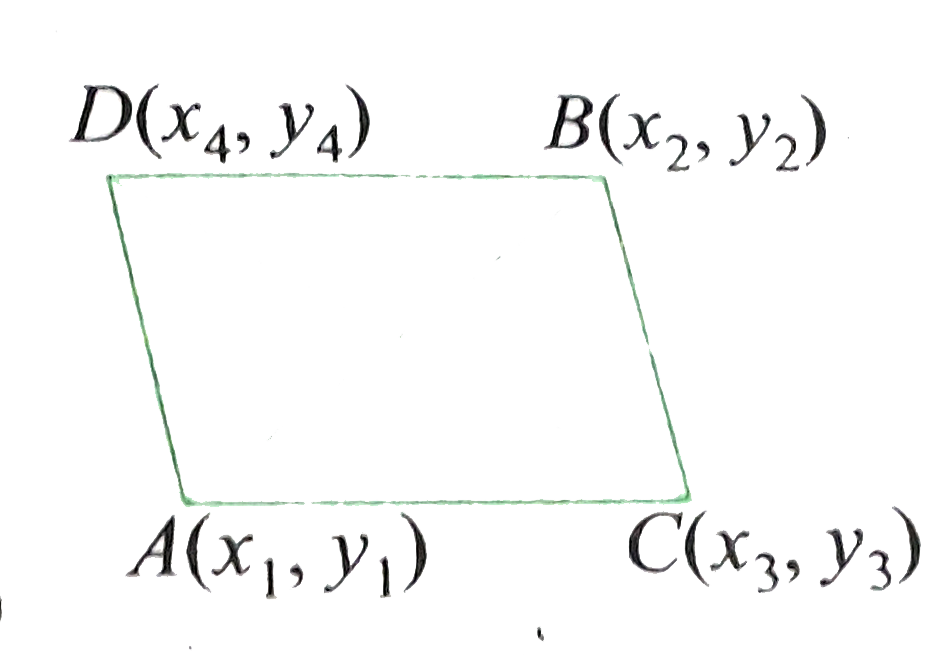
|
|
| 44. |
Let f (x) = x |x| and g (x) = sin x Statement -1 g^(@) f is differentiable at x =0 and its derivative is continous at that point Statement -2 g ^(@)f is twice differentiable at x =0. |
|
Answer» STATEMENT -1 is true, Statement-2 is true, Statement-2 is not a CORRECT explanatin for Statement-1 |
|
| 45. |
Determine if A sub B or A cancel sub B where A=|a,b,c|,B ={|a|,|b|,|c|} |
| Answer» SOLUTION :`A cancelsub B` | |
| 46. |
(2+5omega +2 omega^2)^6=(2+2omega+5 omega^2)^6=729 |
|
Answer» Solution :`L.H.S.=(2+5OMEGA+2omega^2)^6` `=(2+2omega^2+5omega)^6={2(1+omega^2)+5omega}^6` `=(-2omega+5omega)^6=(3omega)^6=729omega^6=729` `"Again", (2+2omega+5omega^2)^6` `={2(1+omega)+5omega^2}^6` `=(-2omega^2+5omega^2)^6=(3omega^2)^6` `=729omega^(12)=729` `:.(2+5omega+2omega^2)^6=(2+2omega+5omega^2)^6=729` |
|
| 47. |
If the coefficient of the 2^(nd),3^(rd) and 4^(th) terms in the expansion of (1 + x)^(n) are in A.P, then n= |
|
Answer» 7 |
|
| 48. |
int_(0)^(1)(x^(3))/((1+x^(2))^(3))dx= |
|
Answer» `1/8` |
|
| 49. |
Obtain the following integrals : int (x^((1)/(2)))/(1+x^((3)/(4)))dx |
|
Answer» |
|