

Saved Bookmarks
This section includes 7 InterviewSolutions, each offering curated multiple-choice questions to sharpen your Current Affairs knowledge and support exam preparation. Choose a topic below to get started.
| 1. |
Determine P(E|F) Mother, father and son line up at random for a family picture E : son on one end, F : father in middle |
|
Answer» |
|
| 2. |
Find the second order derivatives of the functions e^(6x) cos 3x |
|
Answer» |
|
| 3. |
Apply Binomial Theorem to find the value of (1.01)^5 |
|
Answer» SOLUTION :`(1.01)^5` = `(1+0.01)^5` `1+^5C_1(0.01)^1+^5C_2(0.01)^2 + ^5C_3(0.01)^3 + ^5C_4(0.01)^4 + (0.01)^5` = `1+5xx0.01+10(0.0001) + 10(0.000001) + 5(0.00000001) + 0.0000000001 1+0.05+0.001+0.00001+0.00000005+0.000000001 1.0510100501 |
|
| 4. |
If alpha, beta, gamma are the roots fo x^(3)-x^(2)+ax+b=0 and beta, gamma, delta are the roots of x^(3)-4x^(2)+mx+n=0. If alpha, beta, gamma and delta are INAP with common difference d then |
|
Answer» `a=m` `beta=alpha +d, gamma =alpha +2X` and `delta=alpha+3d`…i Given `a, beta, gamma` are the roots of `x^(3)-x^(2)+ax+b=0` then `alpha+beta+gamma=1`………….ii `alpha beta+beta gamma+gamma alpha =a`...........iii `alpha beta gamma=-b`...........IV Also `beta, gamma, delta` are the roots of `x^(3)-4X^(2)+mx+n=0` then `beta+gamma+dleta=4`...........v `beta gamma+gamma delta+delta beta=m`.......vi `beta gamma delta=-n`..........vii From eqs i and ii we get `3 alpha +3 d=1`............viii and from Eqs i and v we get `3 alpha +6d=4` .IX From eqs viii and ix we get `d=1, alpha=-2/3` NOw from Eq i we get `beta=1/3, gamma=4/3` and `delta=7/3` From eqs iii, iv, vi and vii we get `a=-2/3, b=8/27,m=13/3,n=-28/27` `:.a=m-5,n=b-a-2` and `b=m+n-3` |
|
| 5. |
The slopes of the focal chords of the parabola y^(2)=32 x which are tangents to the circle x^(2)+y^(2)-4 are |
|
Answer» `(1)/(2),(-1)/(2)` |
|
| 7. |
If the angle between veca and vecb is 2pi//3 and the projection of veca in the direction vecb is -2, the |veca|= |
|
Answer» 1)2 |
|
| 8. |
(1)/(x(x+1)(x+2).....(x+n))=(A_(0))/(x)+(A_(1))/(x+1)+...+(A_(n))/(x+n) rArr A_(r)=(0 le r le n) |
|
Answer» `(-1)^(R)(r!)/((n-r)!)` |
|
| 9. |
Probability of solving specific problem independently by A and B are (1)/(2) and 3(1)/(3) respectively. If both try to solve the problem independently, find the probability that (i) the problem is solved (ii) exactly one of them solves the problem. |
|
Answer» |
|
| 10. |
Solve the following differential equations.dy/dx=y+2 |
|
Answer» SOLUTION :`DY/DX=y+2rArr dy/(y+2)=dx` `In (y+2)=x+C_1` `y+2=E^(x+c_1)=e^xcdot e^(C_1)=Ce^x` Where `C=e^(c_1)` |
|
| 11. |
An instructor has a question bank consisting of 300 easy True/False question,200 difficult true/false questions, 500 easy multiple choice questions and 400 difficult multiple choice questions. If a question is selected from the test question bank, what is the probability that it will be an easy question given that it is a multiple choice question? |
|
Answer» Solution :The total number of MULTIPLE choice questions = 500+400 = 900. Out of these 900 question, 500 are easy QESTIONS. Hence,the REQUIRED probability=500/900=5/9 |
|
| 12. |
The polar of a point P w.r.t. a circle of radius a touching both x and y axis and lying in the first quadrant is x+2y=4a. The coordinate of P are |
|
Answer» (a,2a) |
|
| 13. |
If z is a complex number such that Re(z)=Im(z), then |
|
Answer» `Re(z^2)=0` |
|
| 14. |
Examine the consistency of the system of linear equtions in 1 to 6 x+3y=5 2x+6y=8 |
|
Answer» |
|
| 15. |
Let ** be a binary operation on the set Z of integers as a**b=a+b+1. Then find the identity element: |
Answer» SOLUTION :
|
|
| 16. |
Find which of the following of the operations given above has identity. |
Answer» SOLUTION :
|
|
| 17. |
int (x^(2) +1)/(x^(4) + x^(2) + 1)dx = |
|
Answer» `(1)/(3) tan^(-1) ((x^(2) - 1)/(3X)) + C` |
|
| 18. |
If(1+ 2x+3x^2 ) ^(10)=a _ 0 +a _ 1 x +a _2 x ^ 2 + … +a _(20) x ^ (20), then(a _ 2)/(a_1)isequal to |
|
Answer» `10.5 ` `rArr( 1 + x ( 2 + 3x ) )^(10)= a _0 + a _1 x + a _ 2 x ^ 2+ … + a _ (20)x^(20) ` ` rArr ""^(10) c _0 + ""^(10) c _1x ( 2 + 3x )+ ""^(10) c_2 x ^ 2( 2 + 3x) ^2+""^(10) c_3 x ^ 3` `( 2 + 3x ) ^3 +.... +""^(10)c_(10)x ^(10)(2+ 3x) ^2 ` `=a _ 0+ a _1 x +a _2 x ^ 2 + .... +a _(20)x ^(20 ) ` `thereforea _ 1= 2 xx 10` ` a _2 =""^(10) c _ 1xx3xx ""^(10 c _ 2xx 4 ` ` = 3 xx 10+(10 xx 9 ) /(1 xx 2 )xx 4` `= 30+180 ` `= 210 ` `therefore (a _ 2 ) /(a_1) = (210)/(2 xx 10 )= (21 ) /(2)= 10.5 ` |
|
| 19. |
A person takes 1//2 kg of cheese sandwitches of energy equivalent to 813 kJ. Suppose that all the energy is lost only through perspiration, what mass of water would he need to perpire in order to maintain his original temperature. Given : Enthalpy of vapurisation of water is 40.65 kJ mol^(-1). |
|
Answer» 360g |
|
| 20. |
Evaluate the following integrals. int(2sinx+3cosx+4)/(3sinx+4cosx+5)dx |
|
Answer» |
|
| 21. |
S is a relation over the set R^(+) of all real numbers and it is given by (a,b)in S iff ab gt 0 Then S is |
|
Answer» symmetric and transitive only |
|
| 23. |
How many 5 digited numbers can be made with odd digits so that no two consecuitive digits are same. |
|
Answer» |
|
| 24. |
If 1 is multiple root of order 3 for the equation x^(4)-2x^(3)+2x-1=0, then the other root is |
|
Answer» 0 |
|
| 25. |
If the area bounded by circle x^(2) + y^(2) = 4 the parabolay = x^(2) + x+ 1 and the curve y = [sin^(2) (x)/(4) + cos (x)/(4)]. Where [.] denotes the greatest integer function) and x-axis is (sqrt(3) + (2pi)/(3) - (1)/(k)) then the numerical quantity k should be ________ |
|
Answer» |
|
| 26. |
If X denotes number of heads obtained in tossing two coins. Then which of the following is false a) X(HH) = 2 b)X(HT) = 1 c)X(TH) = 0 d)X(TT) = 0 |
|
Answer» X(HH) = 2 |
|
| 27. |
Two squares are inscribed in a circle of diameter sqrt2 units. Prove that the area of the common region of the squares is atleast 2(sqrt2-1). |
|
Answer» |
|
| 28. |
Find the sum of all 4 digited numbers that can be formed using the digits 1,2,4,5,6 without repetition. |
|
Answer» |
|
| 29. |
Evaluate the following inegrals intx^(3)(4+x^(2))^(2)dx |
|
Answer» |
|
| 30. |
A stone is thrown in upward direction. Its equation is S=80 t-16 t^(2). The time to attain maximum height is …………. second. |
|
Answer» `2.5` |
|
| 31. |
Discuss the continuity of the function f given by f(x)= x^(3) + x^(2)-1 |
|
Answer» |
|
| 32. |
A rock is shot vertically upward from the edge of the top of a tall building. The rock reaches its maximum height above the top of the building 1.75s after being shot. Then, after barely missing the edgr of the building as it falls downward, the rock stikes the ground 6.0 s after ut us kaybcged, In SI units, how tall is the builging ? |
|
Answer» `u=17.5m//s=17.5xx6-1/2xx10xx6^(2)=105-180=-75m"""]"` |
|
| 33. |
Let all chords of parabola y^(2)=x+1 which subtends right angle at (1,sqrt(2)) passes through (a,b) then the value of a+b^(2) is |
|
Answer» `(Y+2sqrt(2))^(2)=X+1+1,y=Y+sqrt(2),x=X+1` `Y^(2)+(2sqrt(2)Y-X)((Y-mX)/C)=0` `1+(2sqrt(2))/C+m/C=0` `C+m+2sqrt(2)=0` `Y=mx-=m-2sqrt(2)` `y-sqrt(2)=m(x-1)-m-2sqrt(2)` it is PASSES through `(a,B)AAm` `impliesa=2` and `b=-sqrt(2)` |
|
| 34. |
If |z_1|=1,|z_2|=1and A = Arg(z_1,z_2),B=Arg(z_1//z_2),C=Arg(z_1+z_2),D=(z_1-z_2)arrange A,B,C,D in ascending order |
| Answer» Answer :B | |
| 35. |
If a,b and c are distinct positive real numbers in A.P, then the roots of the equation ax^(2)+2bx+c=0 are |
|
Answer» imaginary |
|
| 36. |
Number of points ofdiscontinuity of f(x) =[x^(3)+3x^(2)+7x+2], where[.]representsthegreatest integer function in [0,1] is ___________. |
|
Answer» |
|
| 37. |
Match the Section (A) with the Section (B) properly. |
|
Answer» `1 RARR A, 2 rarr D , 3 rarr B , 4 RARRC` |
|
| 38. |
For the vectors vec(x) and vec(y),vec(x)+vec(y)=vec(a),vec(x)xx vec(y)=vec(b) and vec(x).vec(a)=1 then vec(x) = ………….., vec(y) = ………. |
|
Answer» `VEC(a),vec(a)-vec(X)` |
|
| 39. |
If a,b,c are noncoplanner vectors then (a.(b xx c))/((c xx a). B) + (b. (a xx c))/(c. (a xx b)) = |
|
Answer» 0 |
|
| 40. |
If the area of a circle increases at a uniform rate, then prove that perimeter varies inversely as the radius. |
|
Answer» |
|
| 41. |
If a and b are the maximum and minimum values of the quadraticexpressions 1-2x - 5x^(2) and x^(2) - 2x + 5 respectively, then the set of all values of x for which the expression 5 ax^(2) + bx + 7 is positive, is |
|
Answer» (a, B) |
|
| 42. |
A point P moves such that the sum of the slopes of the normals drawn from it to the hyperbola xy = 16 is equal to the sum of ordinates of feet of normals . The locus of P is a curve C. If the tangent to the curve C cuts the corrdinate axes at A and B, then the locus of the middle point of AB is |
|
Answer» `x^(2)=4y` The equation of TANGENT of P is  `x*4t=(16(y+t^(2)))/(2)` `"or"4txx=8y+8t^(2)` `"or"tx=2y+2t^(2)` `A-=(2t,0), B-=(0,t^(2))` LTBRGT M(H,k) is the middle point of AB. `h=t,k=-(t^(2))/(2)or2k-h^(2)` Therefore, the locus of `M(h,k)` is `x^(2)+2y=0`. |
|
| 43. |
A point P moves such that the sum of the slopes of the normals drawn from it to the hyperbola xy = 16 is equal to the sum of ordinates of feet of normals . The locus of P is a curve C. The area of the equilateral triangle inscribed in the curve C having one vertex as the vertex of curve C is |
|
Answer» `772 sqrt3"sq. units"` `"or"(1)/(sqrt3)=(4)/(t_(1))or t_(1)=4sqrt3`  `AB=8t_(1)=32sqrt3` `"Area of "DELTAOAB=(sqrt3)/(4)xx32sqrt3xx32sqrt3` `=768sqrt3"sq. units"` |
|
| 44. |
Let a_1,a_2,... a_49 be in A.P. Such that sum_(k=0)^12a_(4k+1)=416 and a_9+a_43=66.if a_1^2+a_2^2+...+a_17^2=140m, then m is equal to |
|
Answer» 68 |
|
| 45. |
Which of the following set are finite and which are infinite ?The set of prime number . |
| Answer» SOLUTION :"The SET of PRIME NUMBERS" is an INFINITE set. | |
| 46. |
Given the graph of f(x), draw the graph each one of the following functions : (a) y=f(x)+3 "(b) " y= -f(x)+2 (c ) y=f(x+1)-2 "(d) " y= -f(x-1) (e ) y=f(-x) "(f) " y=f(|x|) (g) y=f(1-x) |
Answer» Solution :(a) For `y=f(x)+3,` SHIFT the graph of `y=f(x), 3` units upward. 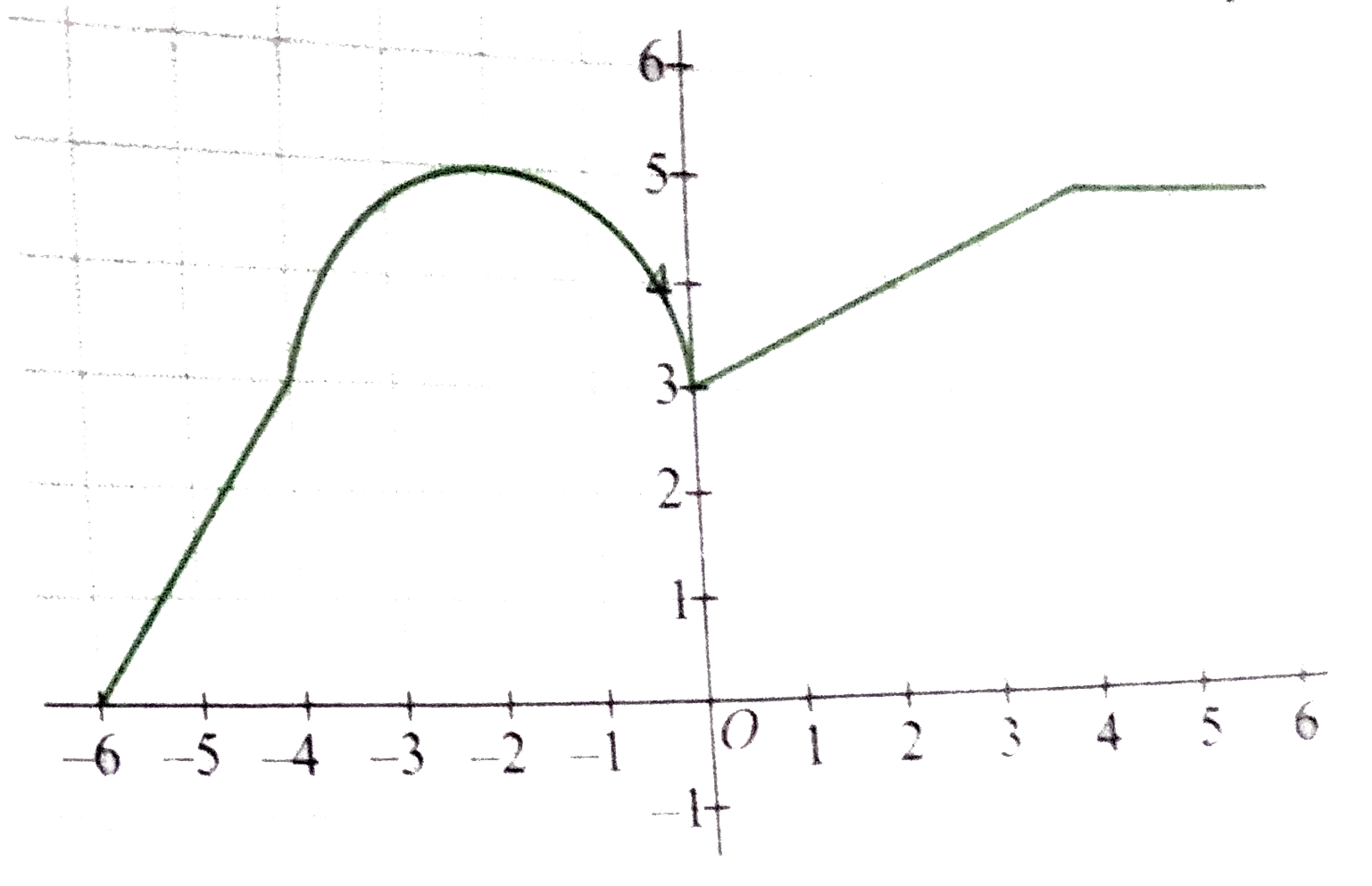 (B) `y= -f(x) +2` First graph of `y=f(x)` about x-axis to GET `y= -f(x).` 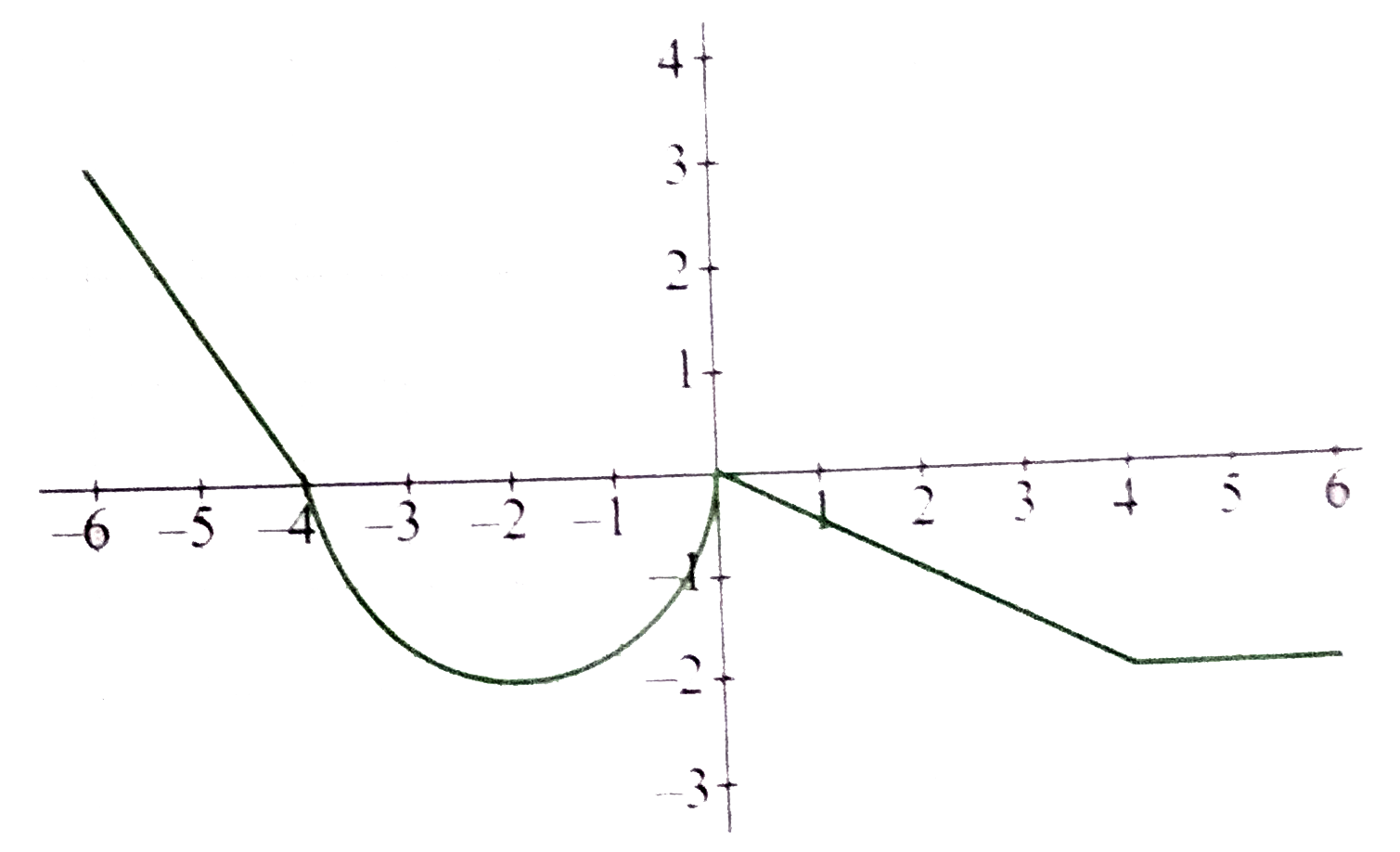 Now, shift the above graph 2 units upward to get `y=2-f(x).` 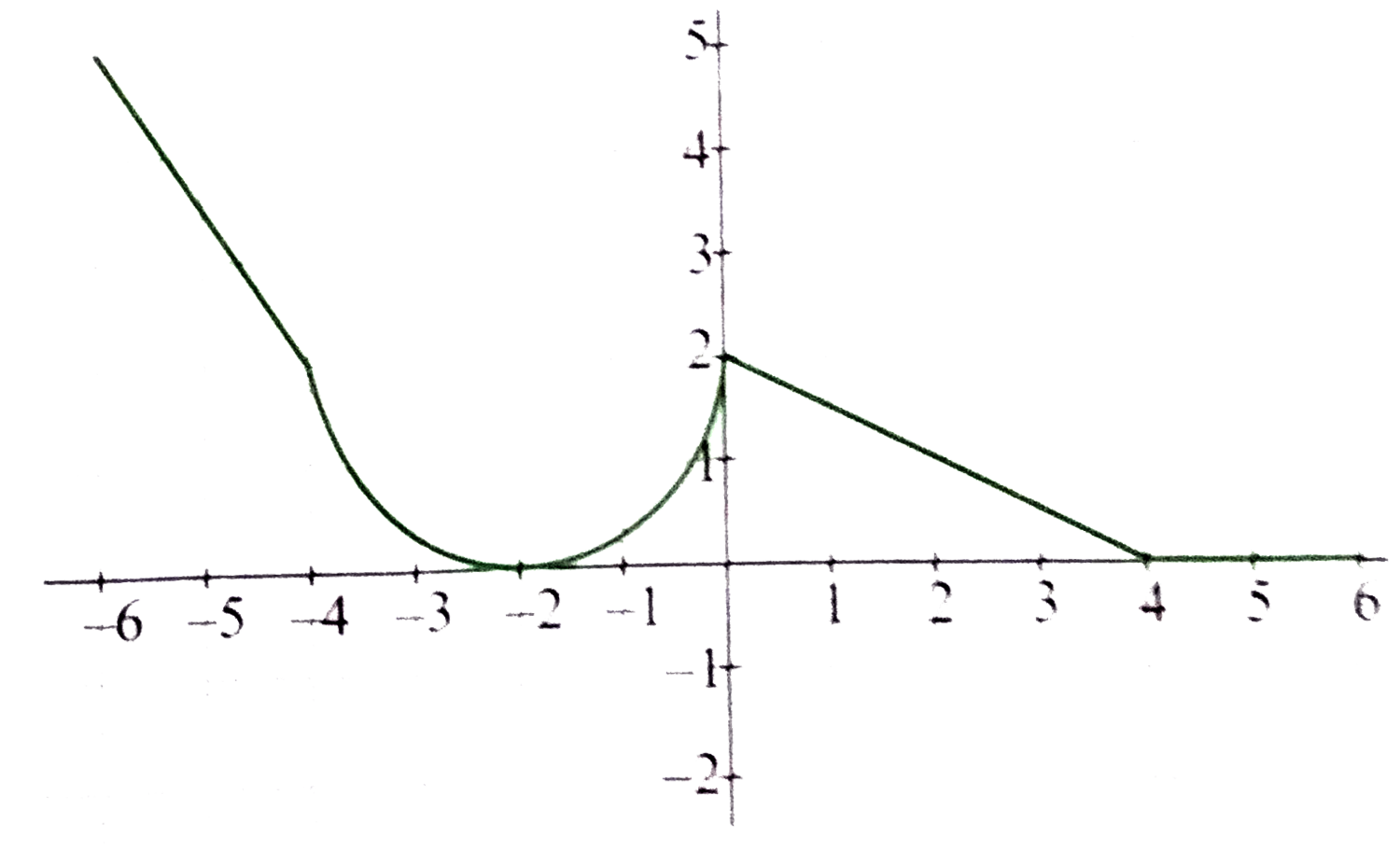 (c ) `y=f(x+1)-2` First shift the graph of `y=f(x),` 1 units left to get `y=f(x+1).` 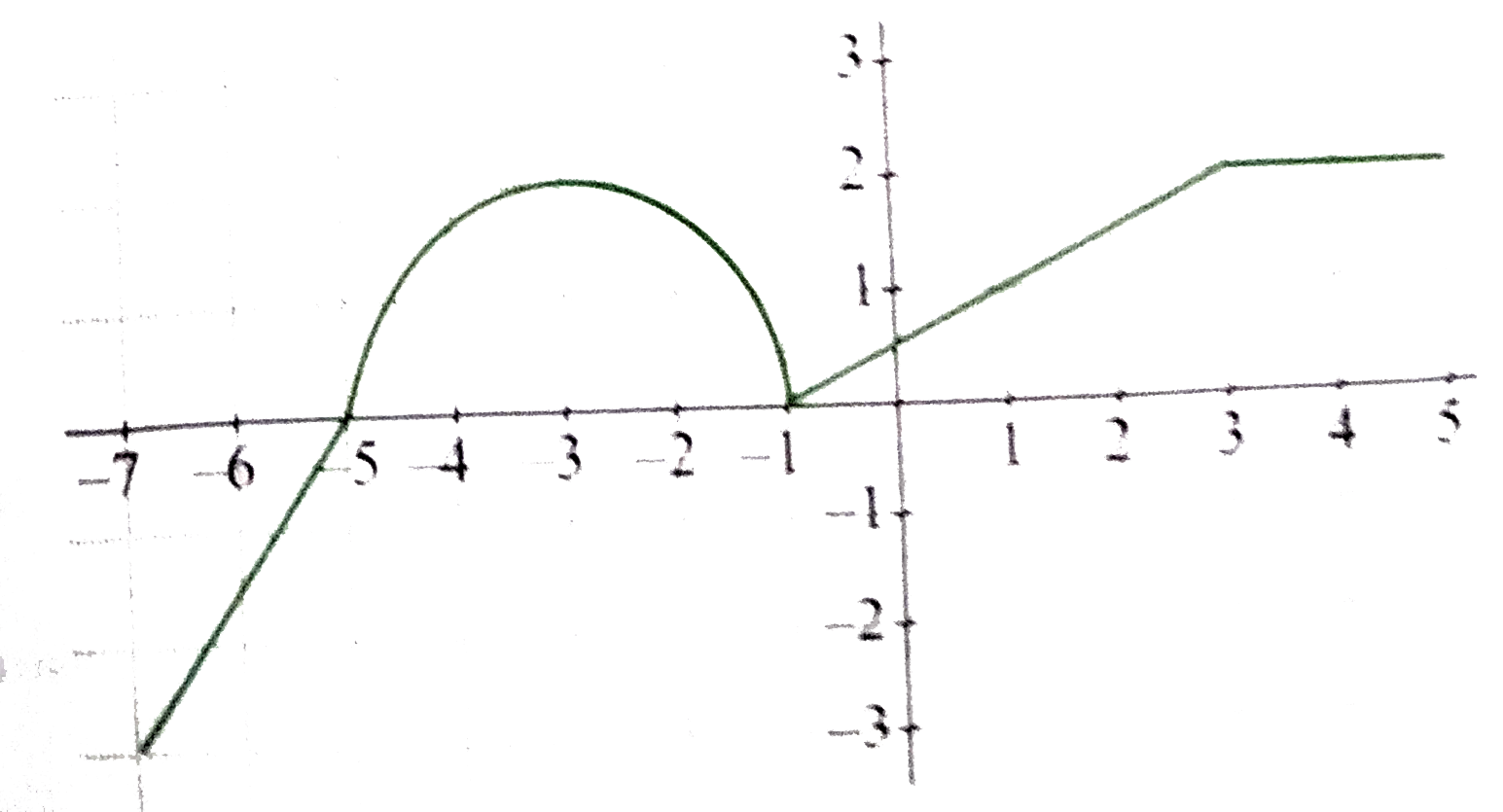 Now shift the above graph 2 units DOWNWARD to get `y=f(x+1)-2`. 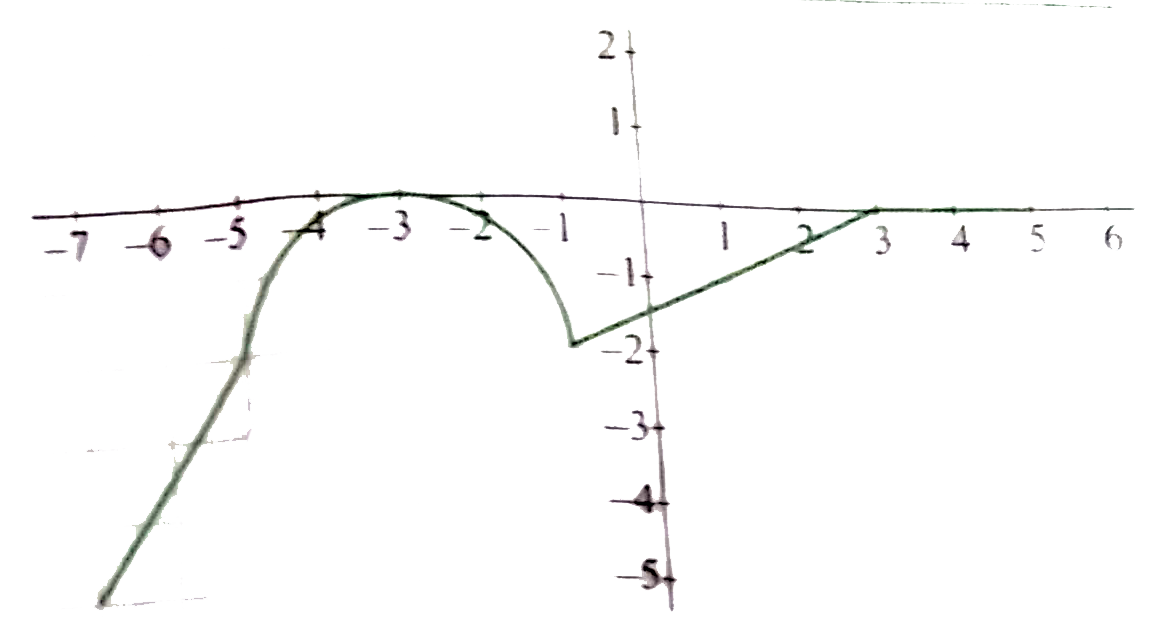 (d) `y= -f(x-1)` First shift the graph of `y=f(x), `1 unit right to get `y=f(x-1).` 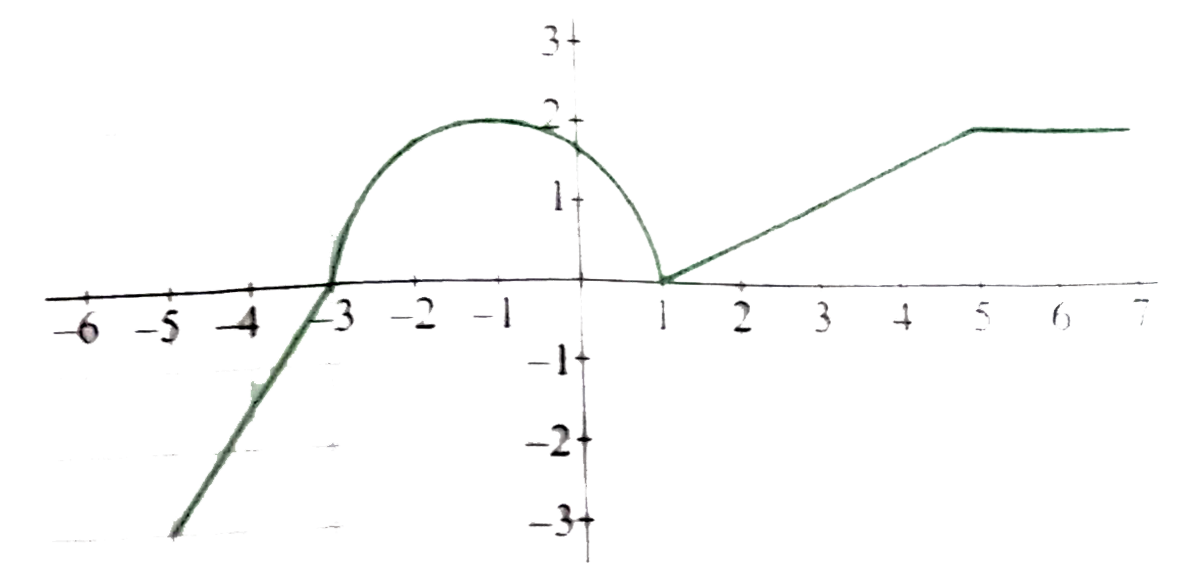 Now, flip the above graph about x- axis to get `y=-f(x-1).` 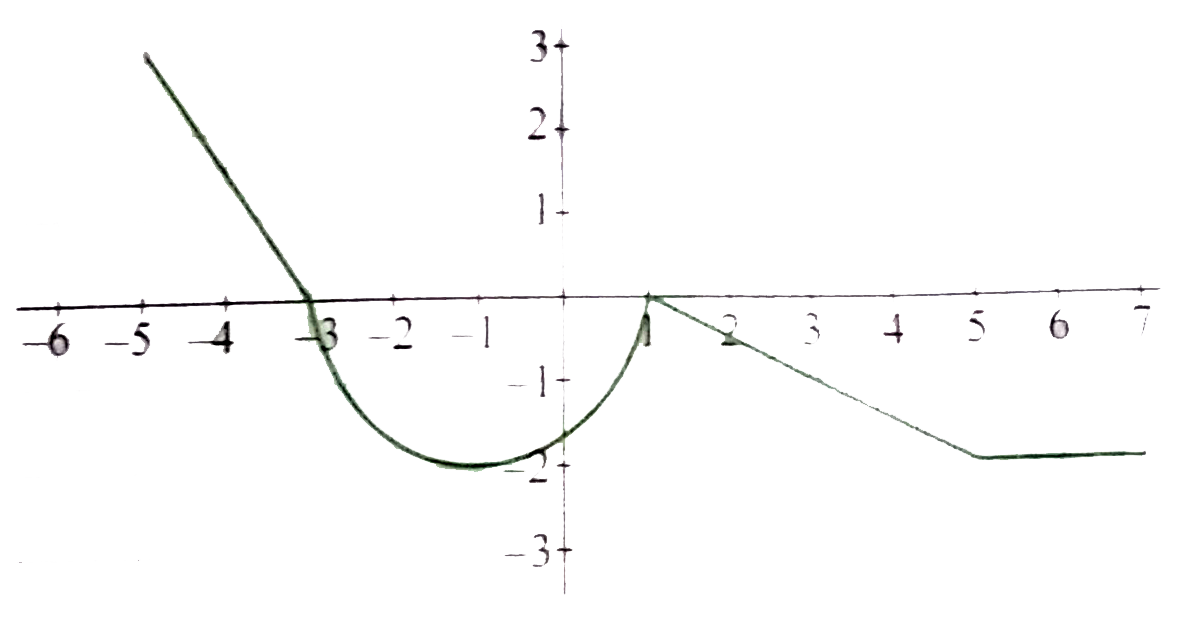 (e )`y=f(-x)` Flip the graph about y-axis to get `y=f(-x).` 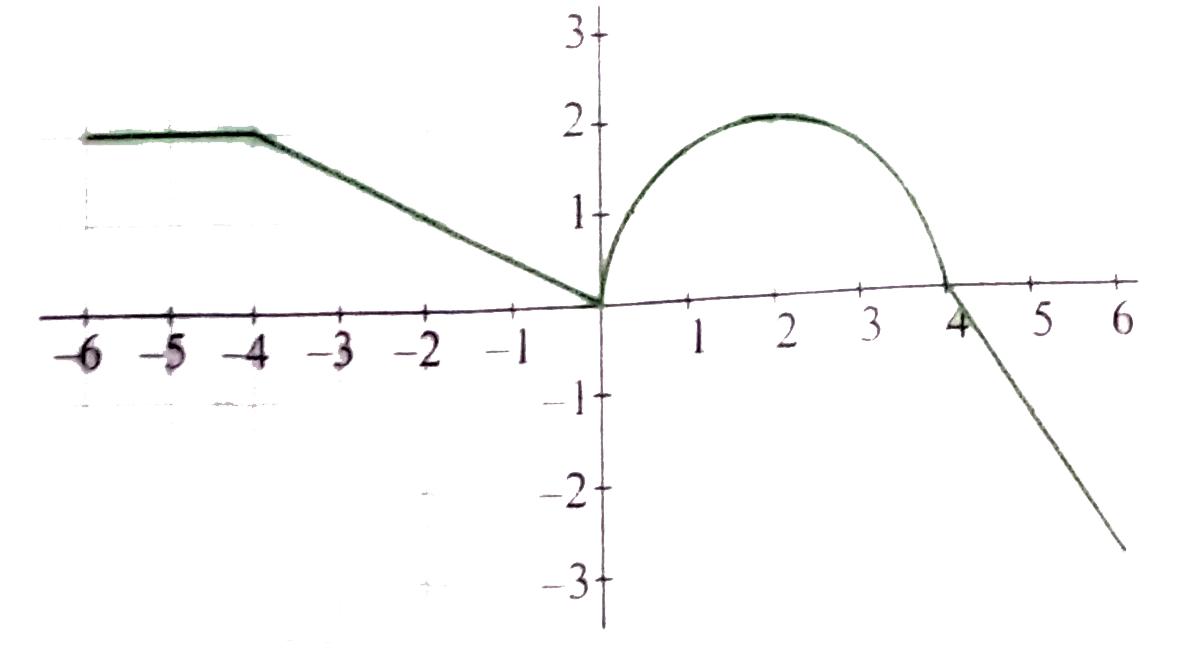 (f) `y=f(|x|)` Neglect the graph of `y=f(x)` for `x lt 0` and take the mirror image of `y=f(x)` for `x gt 0` about y-axis, keeping `y=f(x)` for `x gt 0`. 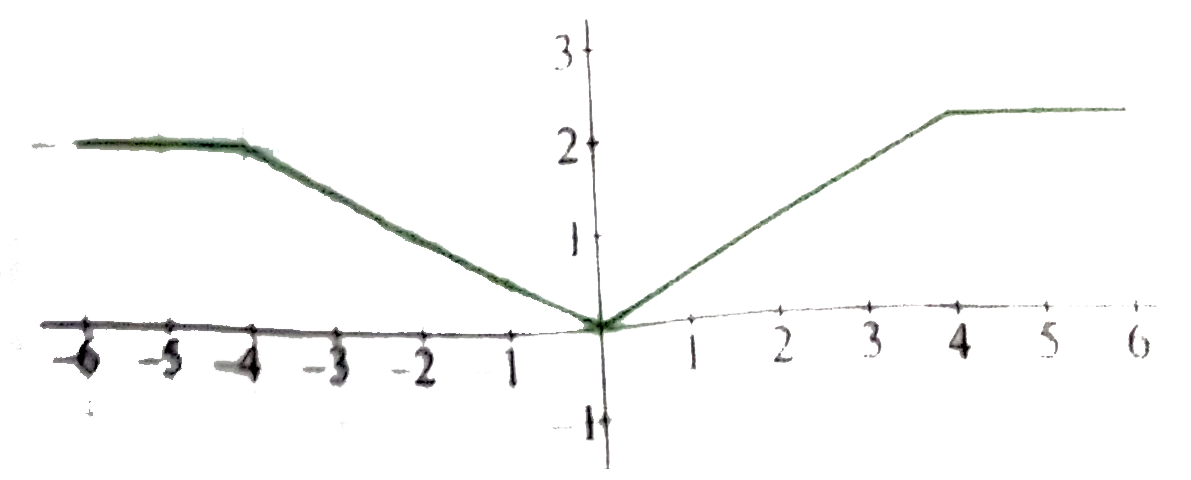 (g) `y=f(1-x)` First flip the graph to get `y=f(-x)` as in (e ). Then shift `y=f(-x),` 1 unit left hand SIDE to get `y=(1-x).` 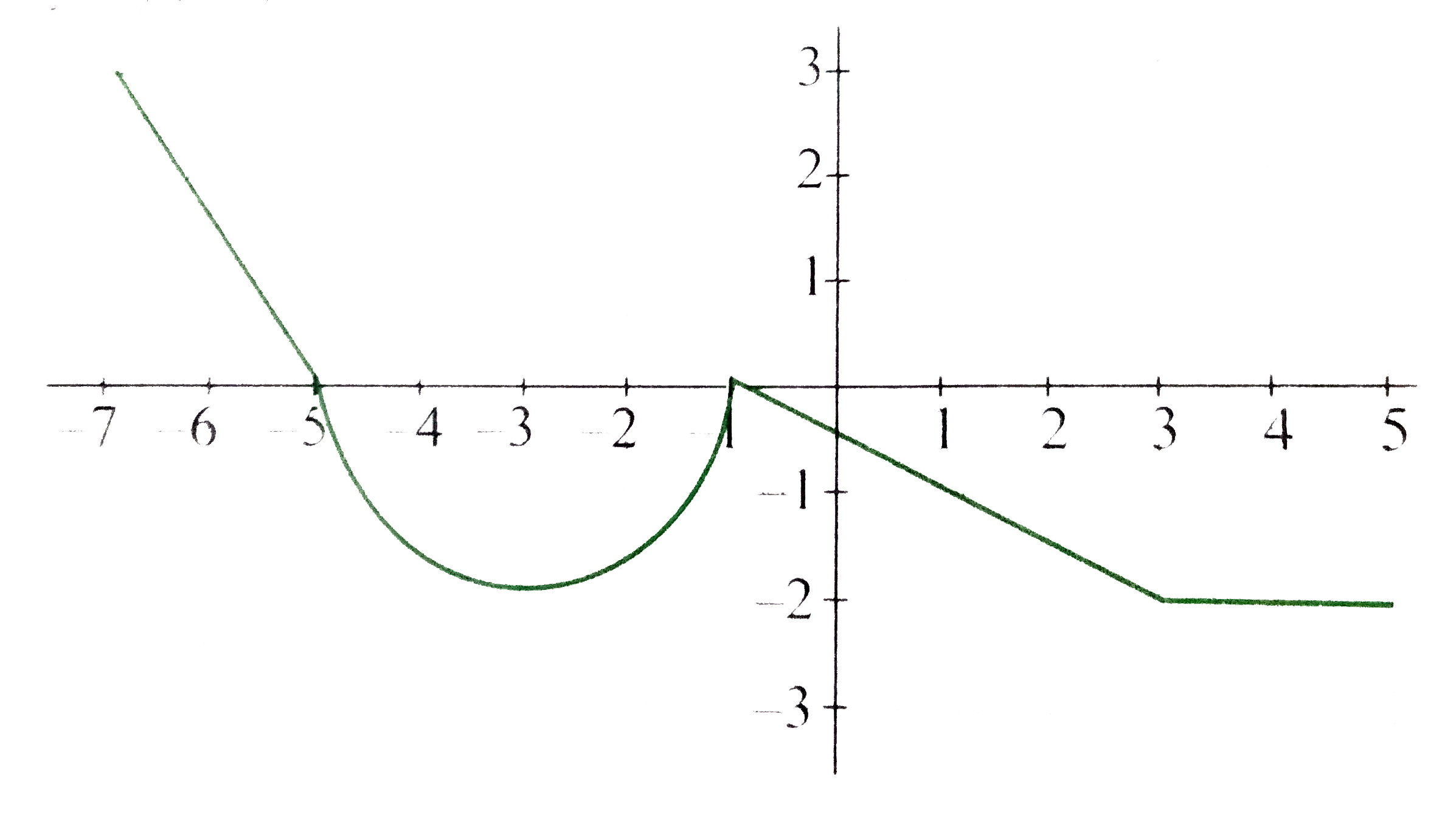
|
|
| 47. |
If A is a square matrix of order 3, then |adj(adjA^2)| is equal to |
|
Answer» `|A|^(2)` |
|
| 49. |
Integration using trigonometric identities : int (cos^(8)x-sin^(8)x)/(1-2sin^(2)xcos^(2)x)dx=...+c |
|
Answer» `-(sin2x)/(2)` |
|
| 50. |
If a_(1), a_(2), a_(3), ......... , are in A.P. with common difference 5 and if a_(i)a_(j) != - 1 for i ,j = 1, 2, .... , n, then tan^(1)(5/(1 + a_(1) a_(2))) + tan ^(1)(5/(1 + a_(2)a_(3))) + ...... + tan^(-1)(5/(1 + a_(n - 1)a_(n))) is equal to |
|
Answer» `tan^(-1)(5/(1 + a_(N)a_(n - 1)))` |
|