

Saved Bookmarks
This section includes 7 InterviewSolutions, each offering curated multiple-choice questions to sharpen your Current Affairs knowledge and support exam preparation. Choose a topic below to get started.
| 1. |
Find the condition that the linex cos alpha+y sin alpha =P may touch the curve (n)/((x)/(a))(n-1)+ (n)/(y/b)(n-1)=1 |
|
Answer» |
|
| 2. |
Integrate the followinginte^(4x)/(e^(8x)+4)dx |
|
Answer» SOLUTION :`inte^(4x)/(e^(8x)+4)dx` `[put e^(4x)=2tan THETA` then `e^(4x)dx=2sec^2thets d theta implies e^(4x)dx=(1/2)sec^2theta d theta ` `int((1/2)sec^2theta d theta)/(4+4tan^2 theta) (1/8)tan^(-1)(e^(4x)/2)+C` |
|
| 3. |
Evaluate int(cosx)/(c cosx+d sinx)dxandint(sinx)/(c cos x + d sin x)dx |
|
Answer» |
|
| 4. |
Determine whether each of the following relations is reflexive, symmetric and transitive.Relation R in the set A of human beings in a town at a particular time given by R={(x,y): x is father of y } |
|
Answer» SOLUTION :Clearly (X,x)`!in`R for any `x in A` `THEREFORE`R is not reflexive `(x ,y) inR RARR ` x is FATHER of y `rArr `y can.t be father of x `rArr (y,x)!in R` `therefore `R is not symmetric `(x,y) in R (y,z)in R ` `rArr ` x is father of y and y is father of z `rArr` x can.t be father of z(br)`rArr (x,z) !in R` `therefore`R is not transitive . |
|
| 5. |
Determine whether each of the following relations is reflexive, symmetric and transitive.Relation R in the set A of human beings in a town at a particular time given by R={(x,y): x is wife of y } |
|
Answer» Solution :Clearly `(X,x)!in`R for any `x in A` `therefore`R is not reflexive `(x ,y) inR rArr `is wife of y`rArr `y is husband of x `rArr (y,x)!in R` `therefore `R is not symmetric There can.t EXIST `x,y,z in A` so that x is wife of y and y is wifeof z `therefore`R is OBVIOUSLY transitive. |
|
| 6. |
Determine whether each of the following relations is reflexive, symmetric and transitive.Relation R in the set A of human beings in a town at a particular time given by R={(x,y): x and y live in the same locality} |
| Answer» SOLUTION :As proved in the PREVIOUS CASE wemay PROVE that R is reflexive, symmetric and transitive. | |
| 8. |
Determine whether each of the following relations is reflexive, symmetric and transitive.Relation R in the set A = {1,2,,3,…,13,14} defined as R= {(x,y) : 3x -y = 0} |
|
Answer» SOLUTION :R = {(1,3) (2,6) (3,9)(4,12)} R is not REFLEXIVE because` (1,1)!in R` R is not SYMMETRIC because `(1,3) in` R but `(3,1)!in R` R is not TRANSITIVE because `(1,3) in R `and `(3,9) in R`but `(1,9) !in R`. |
|
| 9. |
The ratio of R : r of an equilateral triangle is : where R and r are circumradius and inradius respectively |
|
Answer» `1 : 1` |
|
| 10. |
Let cosA+cosB=x,cos2A+cos2B=y,cos3A+cos3B=z,then which of the following is true |
|
Answer» `cos^(2)A+cos^(2)B=1+ y/2` `y=2(cos^(2)A+cos^(2)B)-2` `:.cos^(2)A+cos^(2)B=1+y/2` `:' cos A.cosBB=1/4(2x^(2)-y-2)` and `z=-2x^(3)+3xy+3x` `:.2x^(3)+z=3x(y+1)` ltbrogt `xyz=0AA A` and `B` is not true |
|
| 11. |
Solve the following system of linear equations using matrix method.2x+3y+3z=5x-2y +z=-43x-y-2z=3 |
|
Answer» Solution :[[2,3,3],[1,-2,1],[3,-1,-2]][(x),(y),(Z)]=[(5),(-4),(3)] i.e.,AX=B `A^(-1)=(adj A)/|A|=1/40 [[5,3,9],[5,-13,1],[5,11,-7]]` `X=A^(-1)B=[(1),(2),(-1)]` x=1,y=2,z=-1 |
|
| 12. |
For what values of a the function f given by f(x) = x^(2) + ax + 1 is increasing on [1, 2]? |
|
Answer» |
|
| 13. |
Two point charge (Q each) are placed at (0,y) and (0,-y). A point charge q of the same polarity can move along X-axis. Then : |
|
Answer» The force on q is maximum at `xpmy//sqrt(2)` |
|
| 14. |
If f(x+y)=f(x) f(y) and f(x)=1+g(x), h(x)" where "underset(x to 0)"Lt" g(x)=underset(x to 0)"Lt" h(x)" exists, then f(x) is continuous on " |
|
Answer» `phi` |
|
| 15. |
Let f(x)={{:(a+bx","xlt1),(4","x=1),(b-ax","xgt1):} and if lim_(xto1)f(x)=f(1) what are the possible values of a and b |
|
Answer» |
|
| 16. |
Which of the following factors are favourable for the formation of oxyhaemoglobin ? |
|
Answer» HIGH `pO_(2)`, low `pCO_(2)` |
|
| 18. |
Lt_(n rarr oo)[(1n^(2))/((n+1)^(3))+(n^(2))/((n+2)^(3))+(n^(2))/((n+3))+...."to n terms"] |
|
Answer» |
|
| 19. |
Three fair dice are rolled. What is the probability of getting different numbers on the dice such that 1^(st) die show show bigger number than the remaining two dice. |
|
Answer» |
|
| 20. |
A line L_1 passing througha point with position vector p=i+2h+3k and parallel a=i+2j+3k, Another line L_2 passing through a point with position vector to b=3i+j+2k. Q. Equation of a line passing through the point (2, -3, 2) and equally inclined to the line L_1 and L_2 may equal to |
|
Answer» `(x-2)/(2)=(y-3)/(-1), (z-2)/(1)` |
|
| 21. |
Consider the circle x^(2)+y^(2)=1 and thhe parabola y=ax^(2)b(agt0). This circle and parabola intersect at |
|
Answer» FOUR distinct POINTS is `agtbgt1` `impliesa^(2)x^(4)+(1-2ab)x^(2)+(b^(2)-1)=0` `impliesa^(2)t^(2)+(1-2ab)t+(b^(2)-1)=0` `impliesf(t)=0` `D=4a^(2)-4ab+1` `agtbgt1impliesDgt0`, `f(0)gt0` and `(2ab-1)/(2a^(2))gt0impliest_(1)gt0,t_(2)gt0` `implies` four distinct real values of x `blt-1impliesDgt0,f(0)gt0` and `(2ab-1)/(2a^(2))lt0` `impliest_(1)lt0,t_(2)lt0implies` no real value of x `-1ltblt1impliesf(0)lt0impliest_(1)gt0,t_(2)lt0` `implies` two distinct real values of x |
|
| 22. |
y= e^(x+ e^(x+ e^(x+ ....oo))) then find (dy)/(dx) |
|
Answer» |
|
| 23. |
Let bara, barb, barc be such that barc ne 0, bara xx barb = barc, barb xx barc = bara. Show that bara,bard, barc are pair orthogonal vectors and |barb|=1,|barc|=|bara|. |
|
Answer» |
|
| 24. |
Find the coefficient of x^(5) in ((1-3x)^(2))/((3-x)^(3//2)). |
|
Answer» |
|
| 25. |
A line L_1 passing througha point with position vector p=i+2h+3k and parallel a=i+2j+3k, Another line L_2 passing through a point with position vector to b=3i+j+2k. Q. Equation of plane equidistant from line L_1 and L_2 is |
|
Answer» `hat(R)CDOT(i-7j-5k)=3` |
|
| 26. |
Draw a graph of f(x) = sin {x}, where {x} represents the greatest integer function. |
|
Answer» Solution :We have `f(x) = sin {x}` Now `{x} in [0, 1)` for all `x in R.` `therefore` `sin {x} in [0, sin 1)` FIRST DRAW the GRAPH of `y = {x}` from which we can easily draw the graph of `f(x) = sin {x}.` 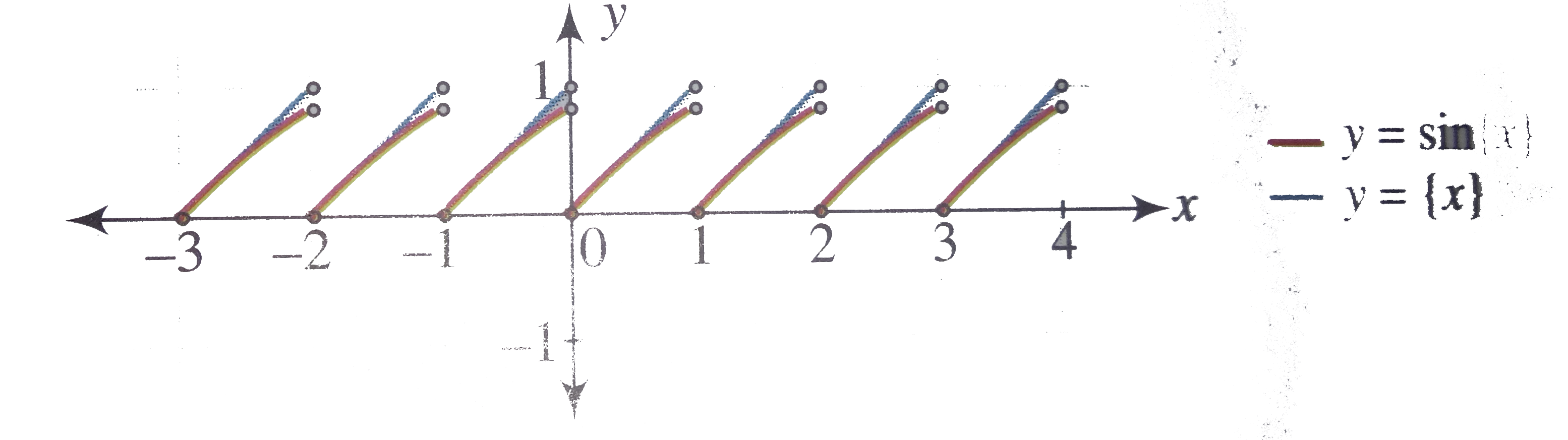
|
|
| 27. |
If x and 'a' are real, then the value of 'a' for which x^(2)-(3ax)/(2)+1-a^(2) is positive is |
|
Answer» `-(4)/(25)p` |
|
| 28. |
Show that the function f : R rarr {x inR:-1lt x lt1}defined by f(x) =x/(1+|x|),x in Ris one one and onto function. |
|
Answer» |
|
| 29. |
intcosx.log (tan""(x)/(2))dx = |
|
Answer» sinx.logtanx- X + C |
|
| 30. |
A,A,B,B,C,C,D,E,F are arranged in a row so that no two alike alphabets are together. Find number of such arrangment |
|
Answer» |
|
| 31. |
If f(a+b-x)=f(x)," then "int_(a)^(b)xf(x)dx= |
|
Answer» `((a+B)/(2))int_(a)^(b)f(X)DX` |
|
| 33. |
The set of all points where f(x) is increasing in (a,b)cup(c, infty) then [a+b+c] is (where [.] denotes the greatest integer function). Given that f(x)=2f(x^(2)/2)+f(6-x^(2)) for all xinR and f(x)gt 0 "for all" x in R------ |
|
Answer» |
|
| 34. |
int(sin^(3)2x)/(cos^(5)2x)dx=... |
|
Answer» `TAN^(4)x+c` |
|
| 35. |
Five cards are drawn successively with replacement from a well-shuffled deck of 52 cards. What is the probability that (i) all the five cards are spades? (ii) only 3 cards are spades? (iii) none is a spade? |
|
Answer» |
|
| 36. |
Show that the foot of the perpendicular drawn from the centre on any tangent to the ellipse lies on the curve (x^2+y^2)^2=a^2x^2+b^2y^2. |
|
Answer» |
|
| 37. |
The complex equation |z + 1- i| = |z + i-1| represents a |
|
Answer» Only I is TRUE |
|
| 38. |
If p_1,P_2,P_3 denot the distances of the plane 2x-3y+4z +2 = 0 from the planes2x-3y + 4z + 6 = 0, 4x-6y+8z +3 = 0 and 2x -3y + 4z -6 = 0 repectively then , .......... Is not true. |
|
Answer» `P_1 + 8P_2 - P_3 = 0` |
|
| 39. |
Match the following lists : |
|
Answer» `{:(a,b,c,d),(q,p,s,r):}` 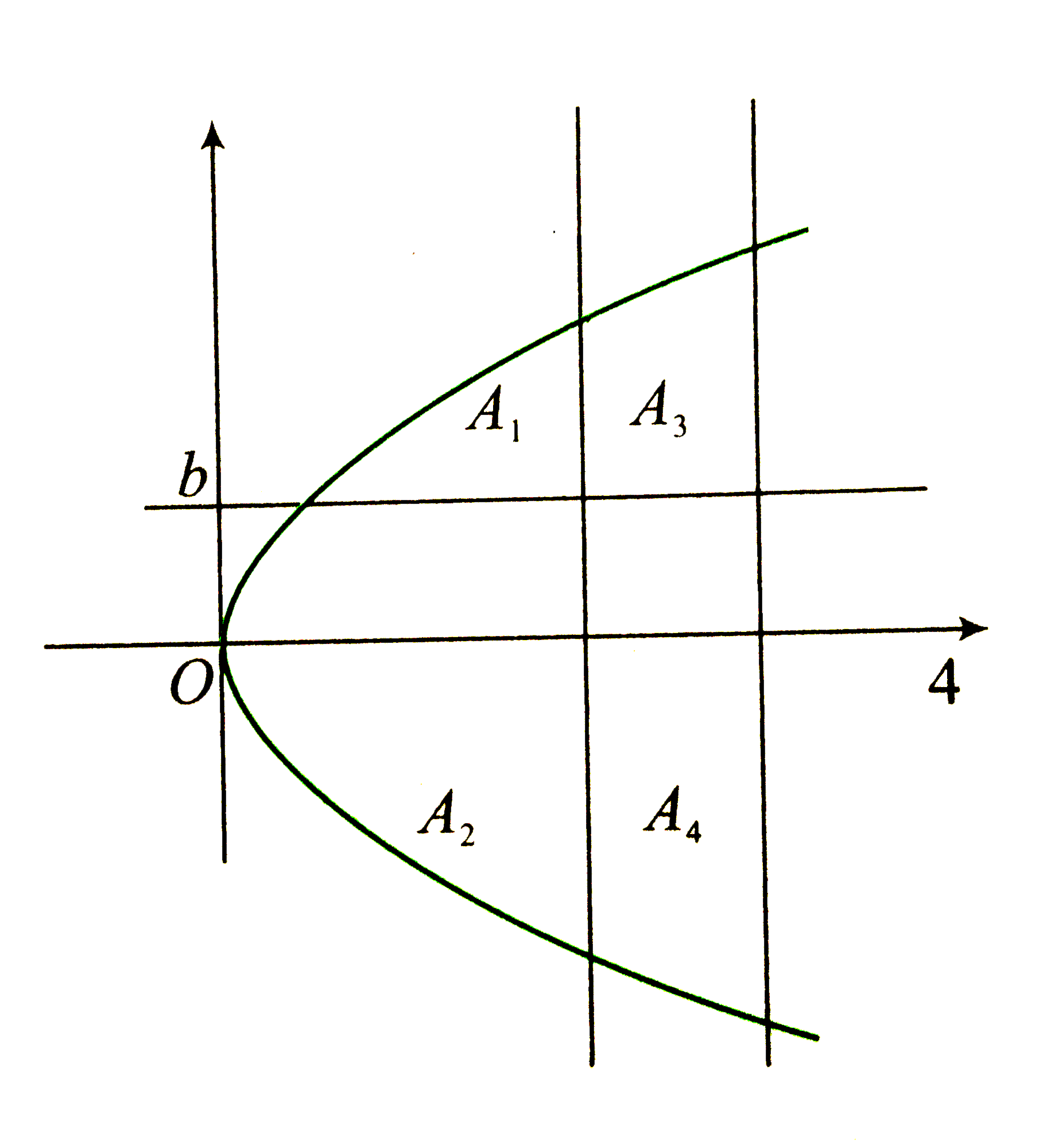 `"Total area "=2overset(4)underset(0)intsqrt(x)DX=(32)/(3)` `"Area of each PART "=8//3` `A_(3)=A_(4)rArroverset(4)underset(a)int(sqrt(x)-b)dx=overset(4)underset(a)int(b+sqrt(x))dx=(8)/(3)` `therefore""b=0` `therefore""overset(4)underset(a)intsqrt(x)dx=(8)/(3)` `therefore""a^(3)=16` b. `f(x)={{:(x^((1)/(log_(e)x))",",xne1),(e",",x=1):}={{:(x^((1)/(log_(e)x))",",xne1),(e",",x=1):}=e` Hence required area bound by `y=f(x) and y=|x-e|" is "e^(2)` c. 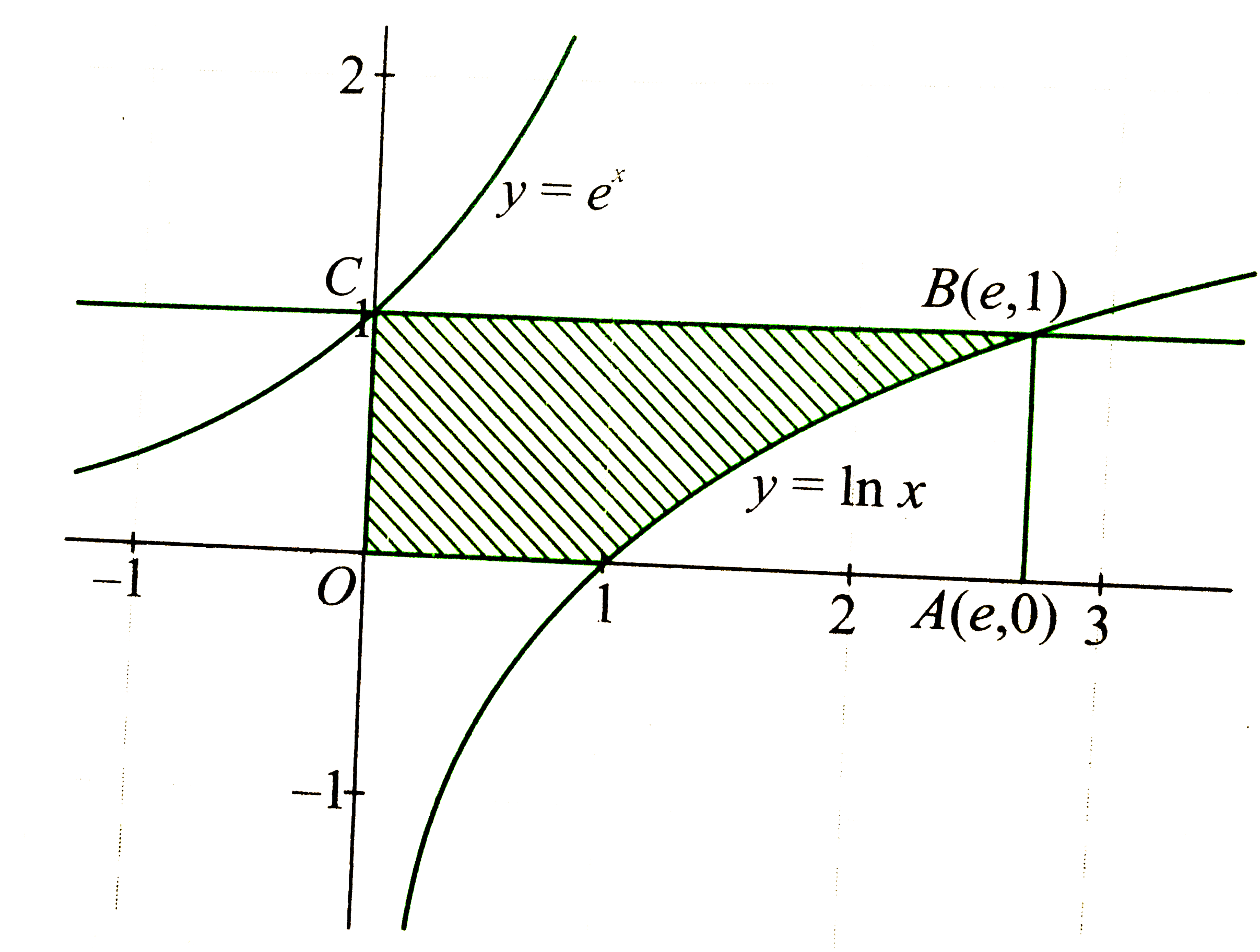 Area = Area of rectangle `OABC-overset(e)underset(1)" In "xdx` `=e-1` SQ. units. d. Solving `2 cos x =3 TAN x we GET, 2-2 sin^(2)x =3 sin x` `rArr""sin x=(1)/(2)rArrx=(pi)/(6)` `"Required area "=overset(pi//6)underset(0)int(2cos x- 3 tan x)dx` `=(2 sin x -3" In "sec x)_(0)^(pi//6)` `=1+(3)/(2)log_(e)3-3log_(e)2` |
|
| 40. |
Match the following lists : |
|
Answer» `RARR""[x]=pm[y]` 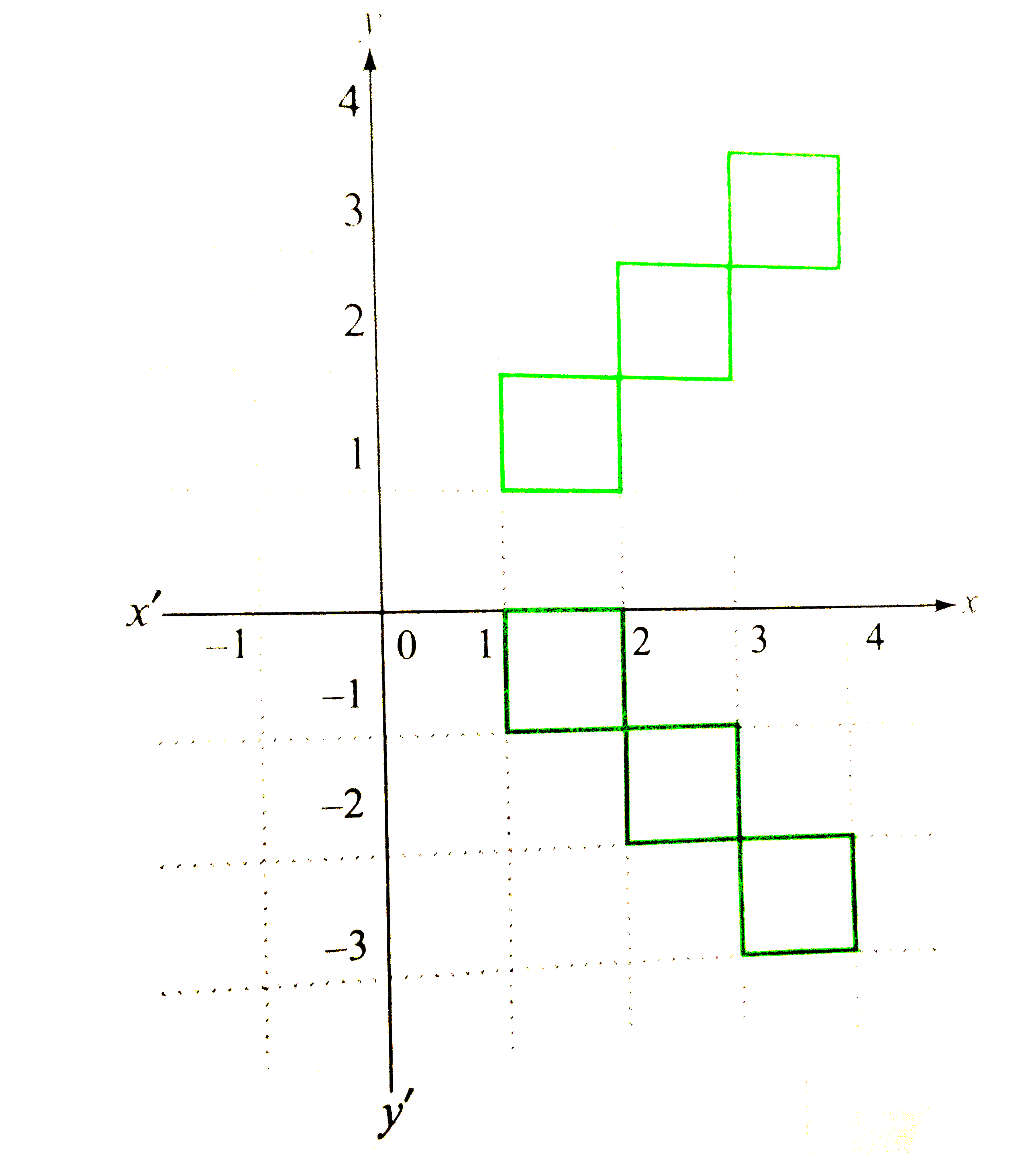 b. `[|x|]+[|y|]=2` The graph is SYMMETRICAL about both x-axis and y-axis. `"For "x,YGT0,[x]+[y]=2.` `rArr""[x]=0 and [y]=2,[x]=1 and [y]=1 or [x]=2 and [y]=0`. 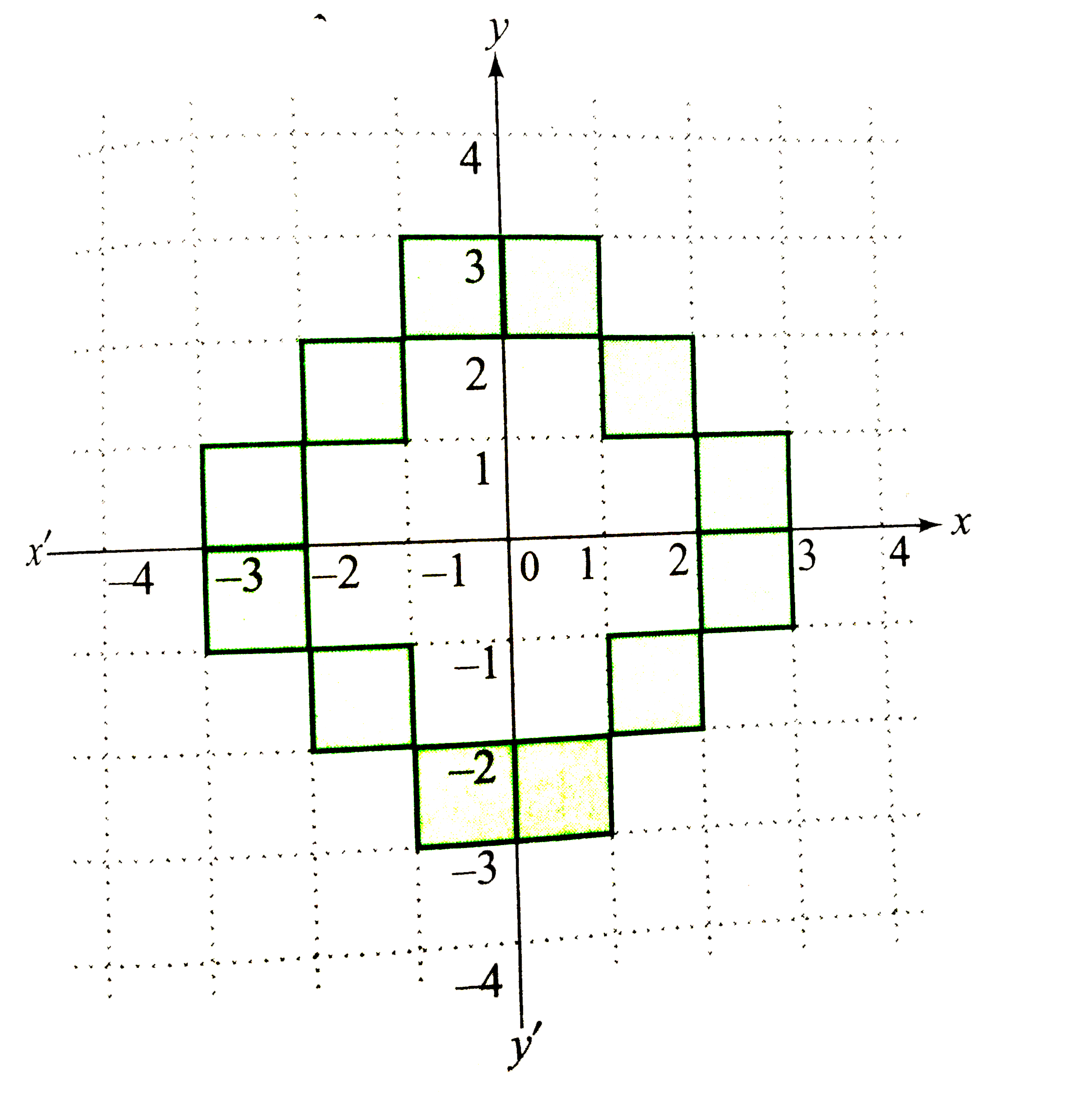 c. `[|x|][|y|]=2` The graph is symmetrical about both x-axis and y-axis. `"For "x,ygt0,[x][y]=2` `rArr""[x]=1 and [y]=2 or [x] = 2 and [y]=1.` 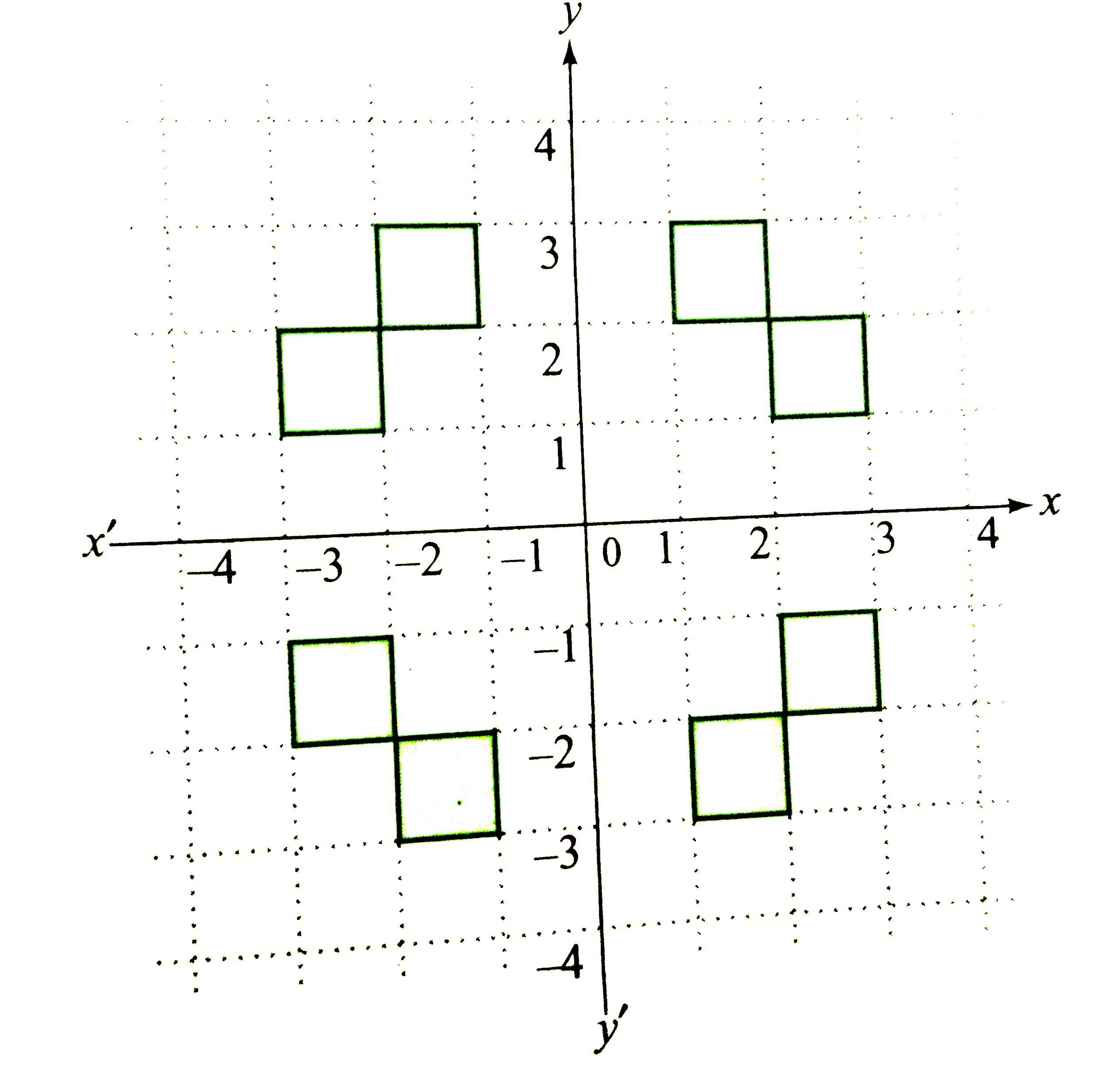 d. `([|x|])/([|y|])=2," where "-5lexle5.` The graph is symmetrical about both the axes. `"For "x,ygt0,[x]=2[y],[y]ne0`. `rArr""[x]=2 and [y]=1 or [x]=4 and [y]=2.` 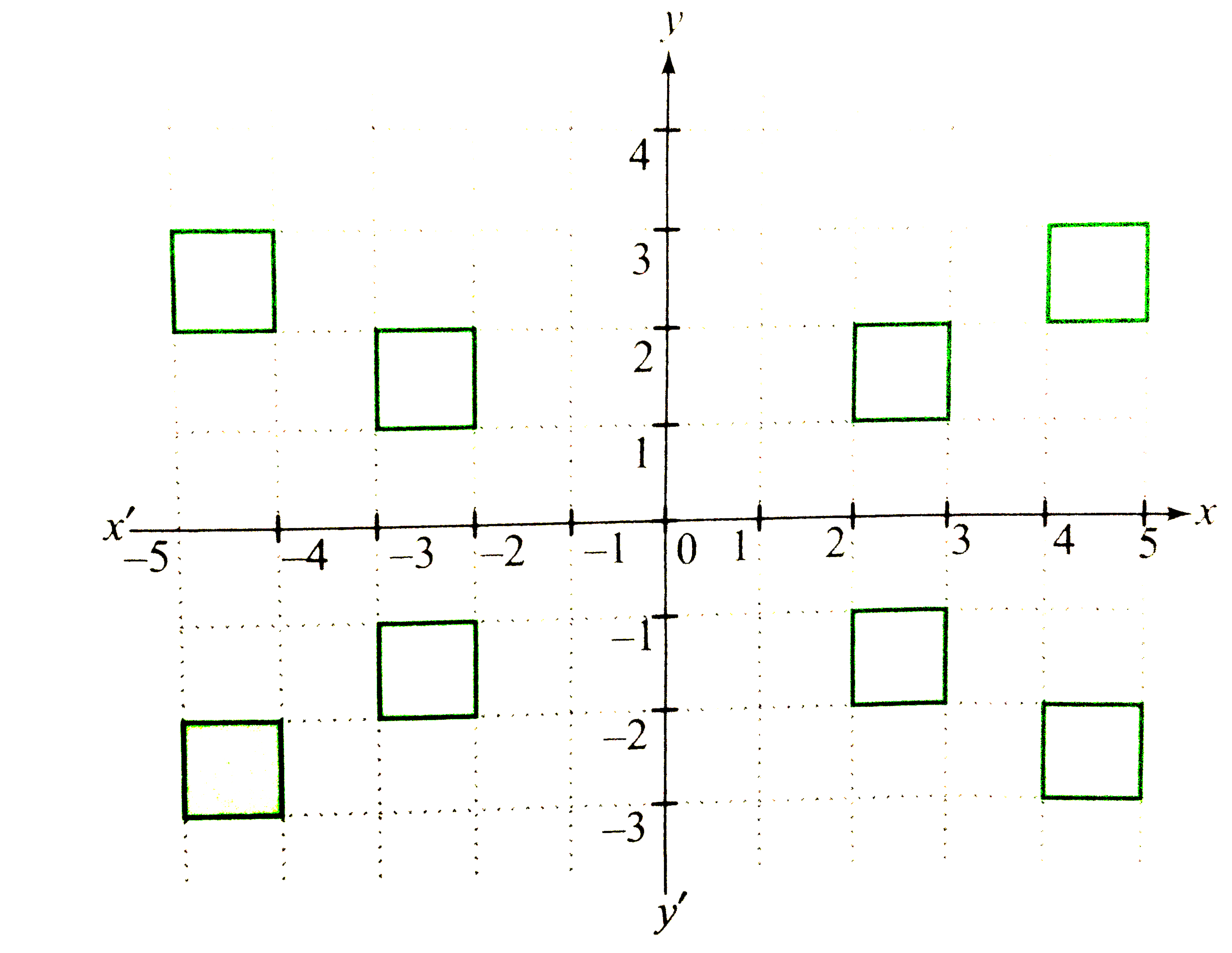
|
|
| 41. |
Match the following lists : |
Answer» 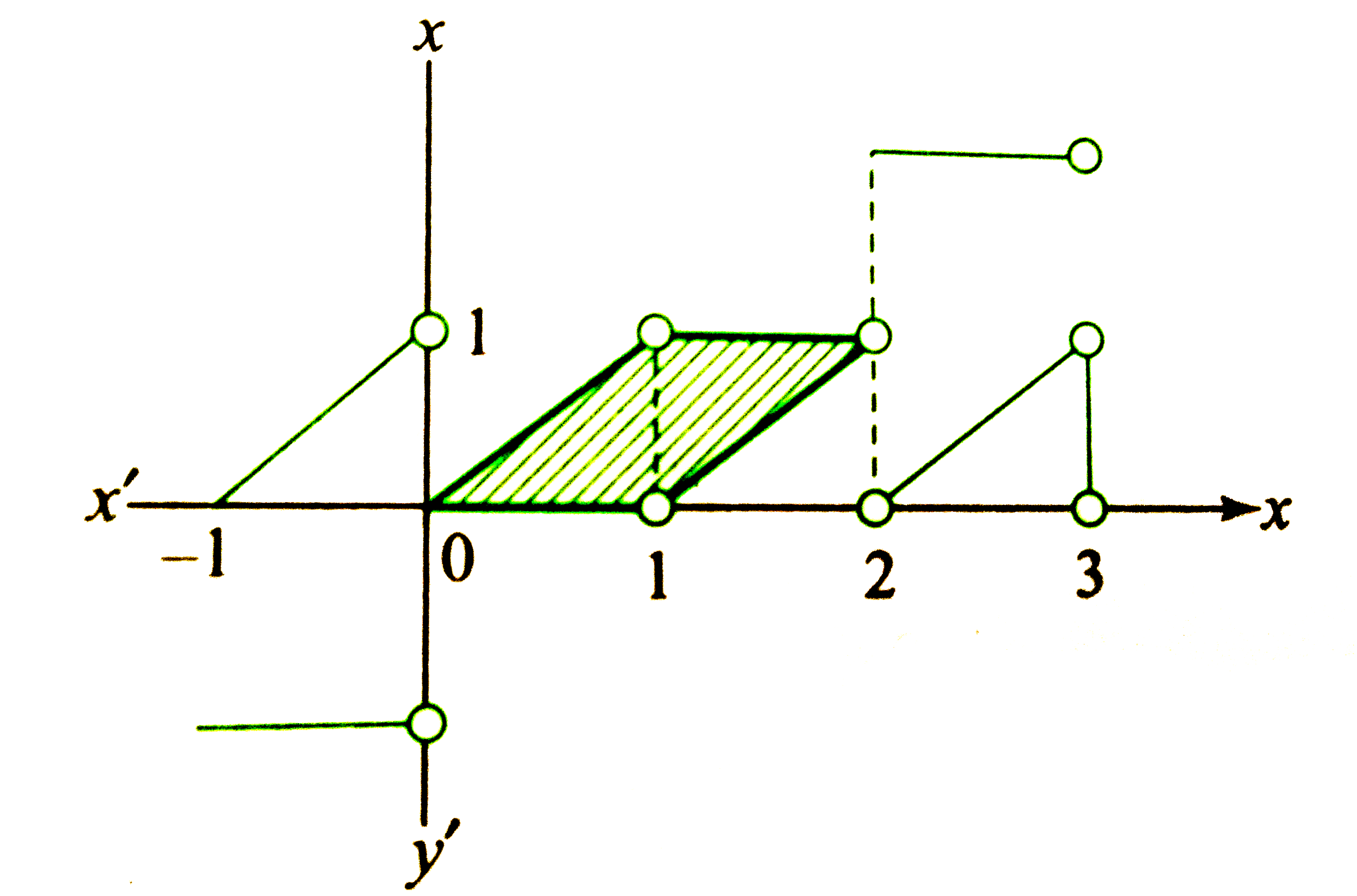 b. `y^(2)=x^(3) and |y|=2x,` both the curve are SYMMETRIC about y-axis 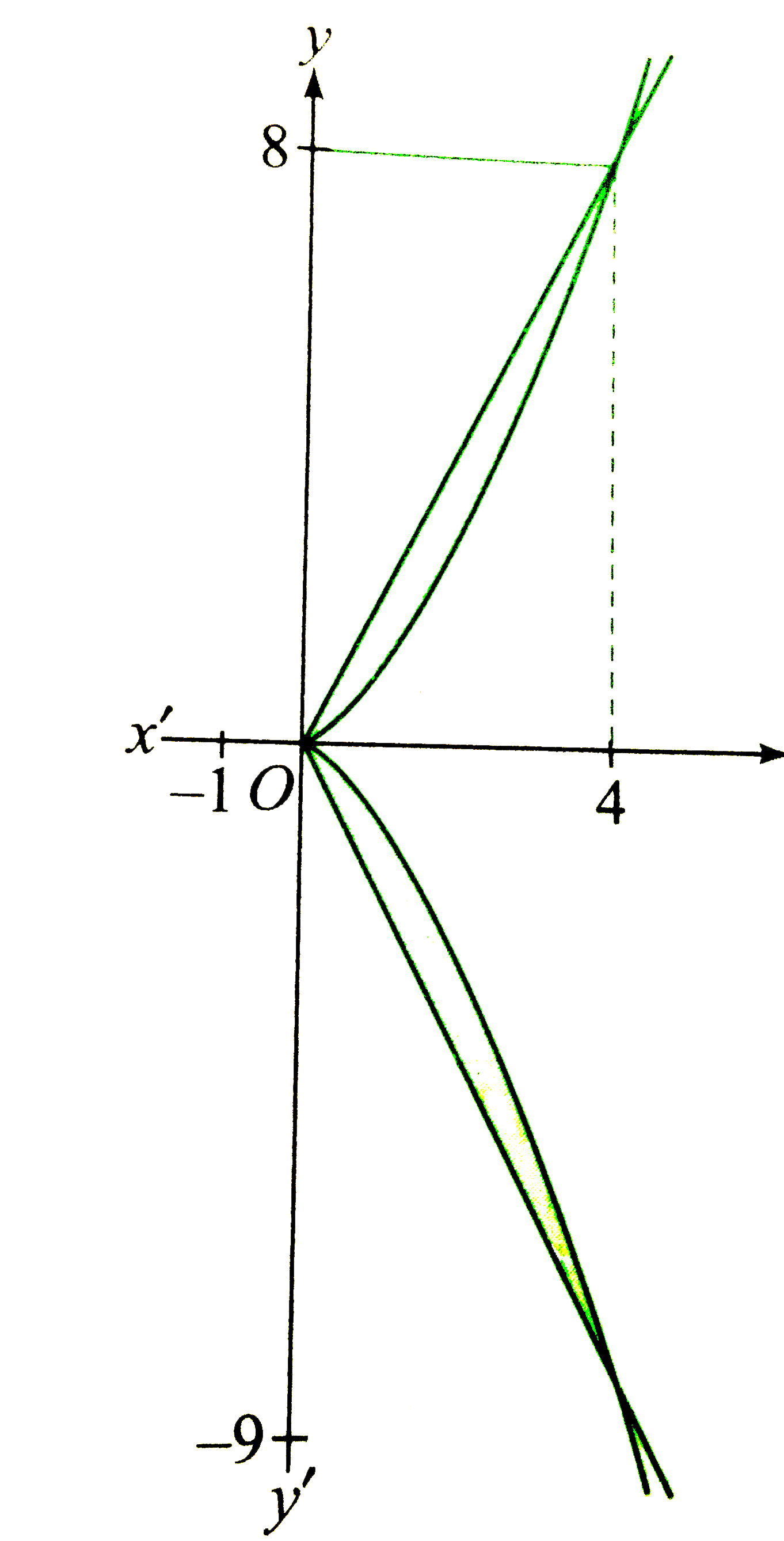 `4X^(2)=x^(3)or x=0, 4. ` `"Required area "=2overset(4)underset(0)int(2x-x^(3//2))dx=(32)/(5)` sq. units. c.`sqrt(x)+sqrt(|y|)=1` 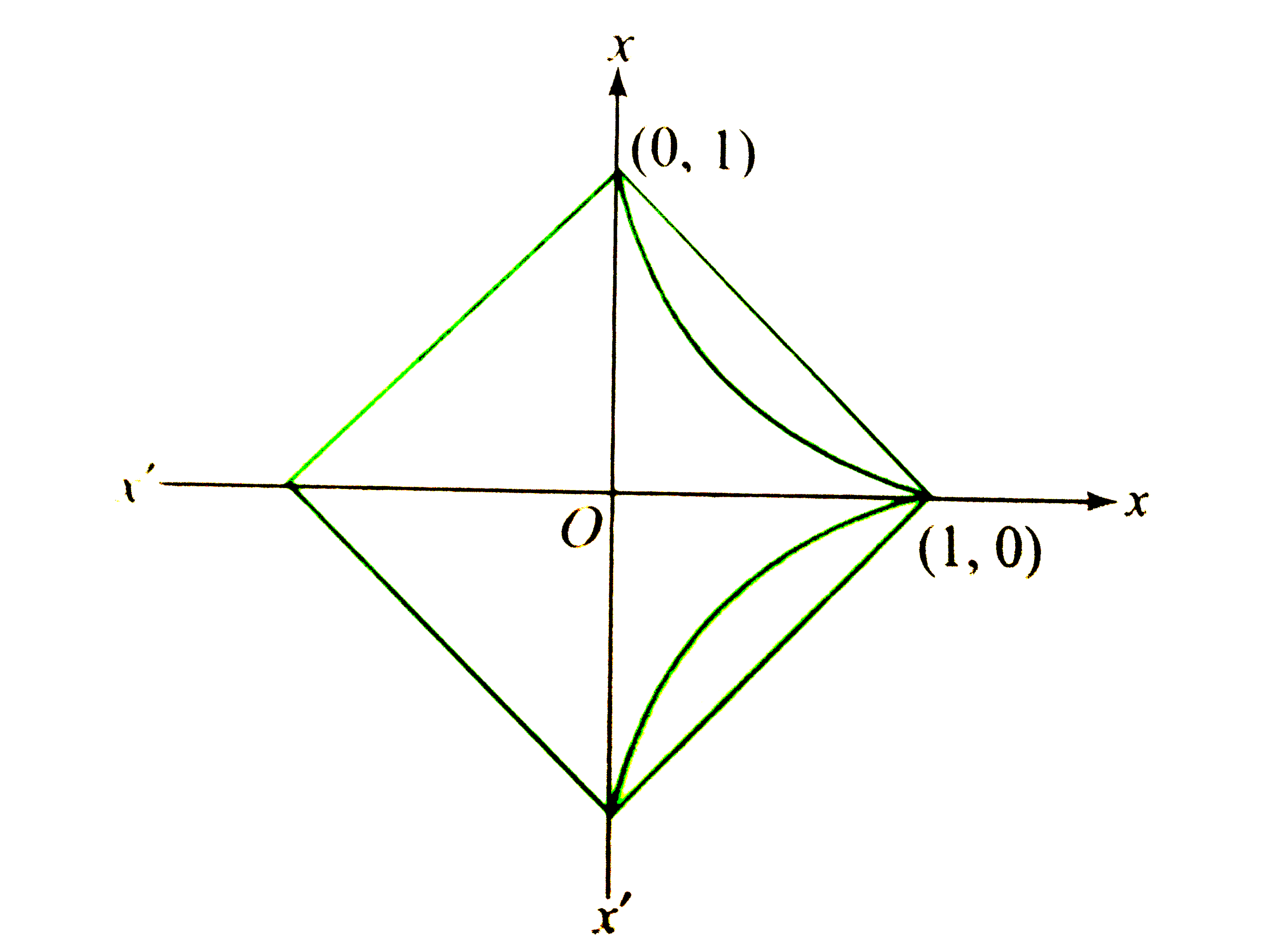 The curve is symmetrical about x-axis `sqrt(|y|)=1-sqrt(x)and sqrt(x)=1-sqrt(|y|)` `rArr"for "xgt0,ygt0sqrt(y)=1-sqrt(x)` `(1)/(2sqrt(y))(DY)/(dx)=-(1)/(2sqrt(x))` `(dy)/(dx)=-sqrt((y)/(x))` `(dy)/(dx)lt0," function is decreasing "` `"Required area "=2overset(1)underset(0)int((1-x)-(1-2sqrt(x)+x))dx` `=4overset(1)underset(0)int(sqrt(x)-x)dx` `=4[(x^(3//2))/(3//2)-(x^(2))/(2)]_(0)^(1)` `=4[(2)/(3)-(1)/(2)]` `=(2)/(3)` sq. units. d. If `-8ltxlt8,` then y=2. `"If "x in (-8sqrt(2),-8]cup[8,8sqrt(2))," then "y=3,` and so on Intersection of `y=x-1 and y=2." We get "x=3 in (-8,8).` Intersection of `y=x-1 and y=3`. `"We get "x=4 notin (-8sqrt(2),-8]cup[8,8sqrt(2))`. `"Similarly, "y = x-1" will not intersect "y=[(x^(2))/(64)+2]" at any"` other integral, except in the interval `x in (-8,8).` Required area (shaded REGION ) `=2xx3-(1)/(2)xx2xx2` =4 sq. units. 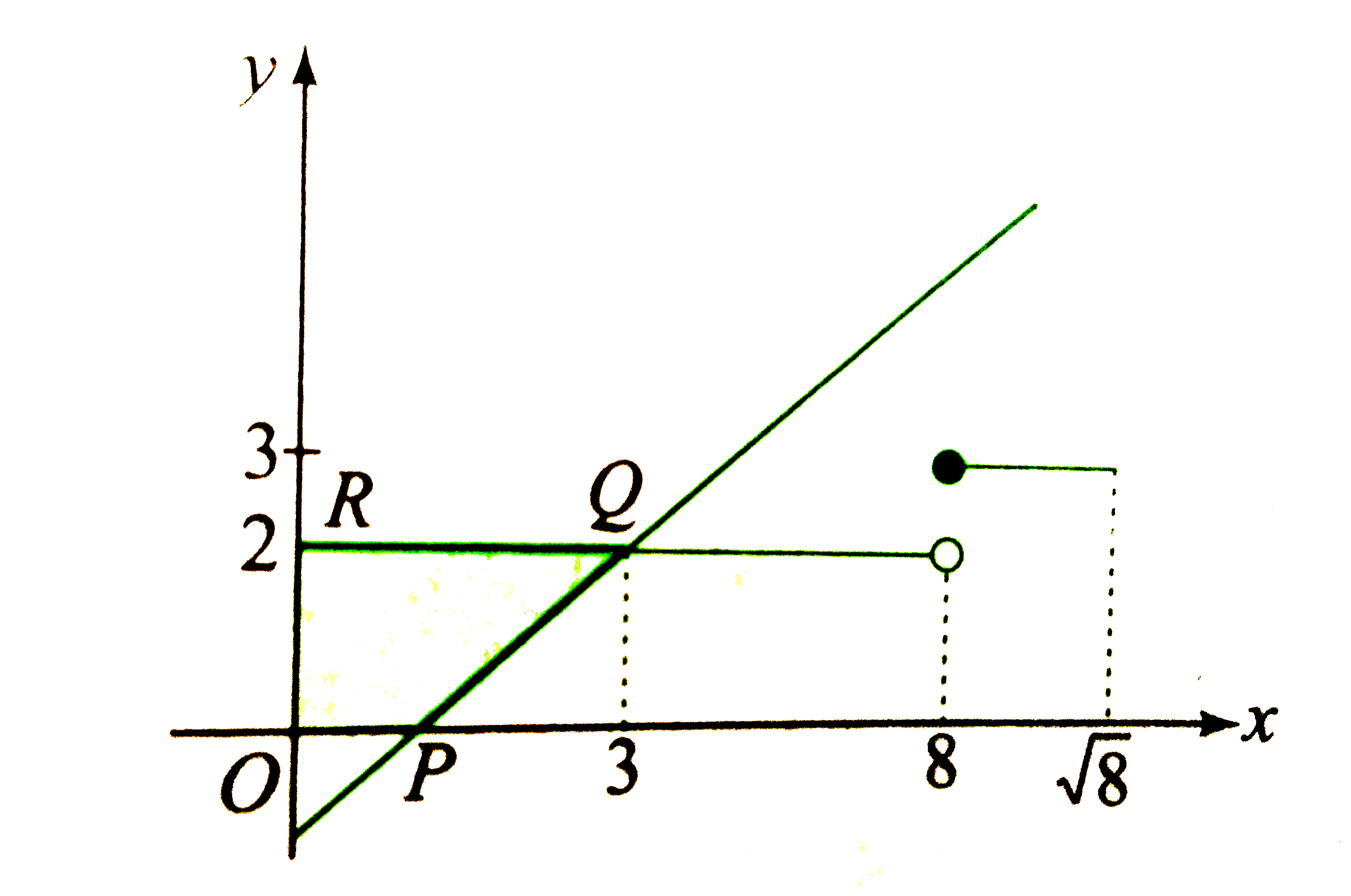
|
|
| 42. |
Match the following lists : |
Answer» 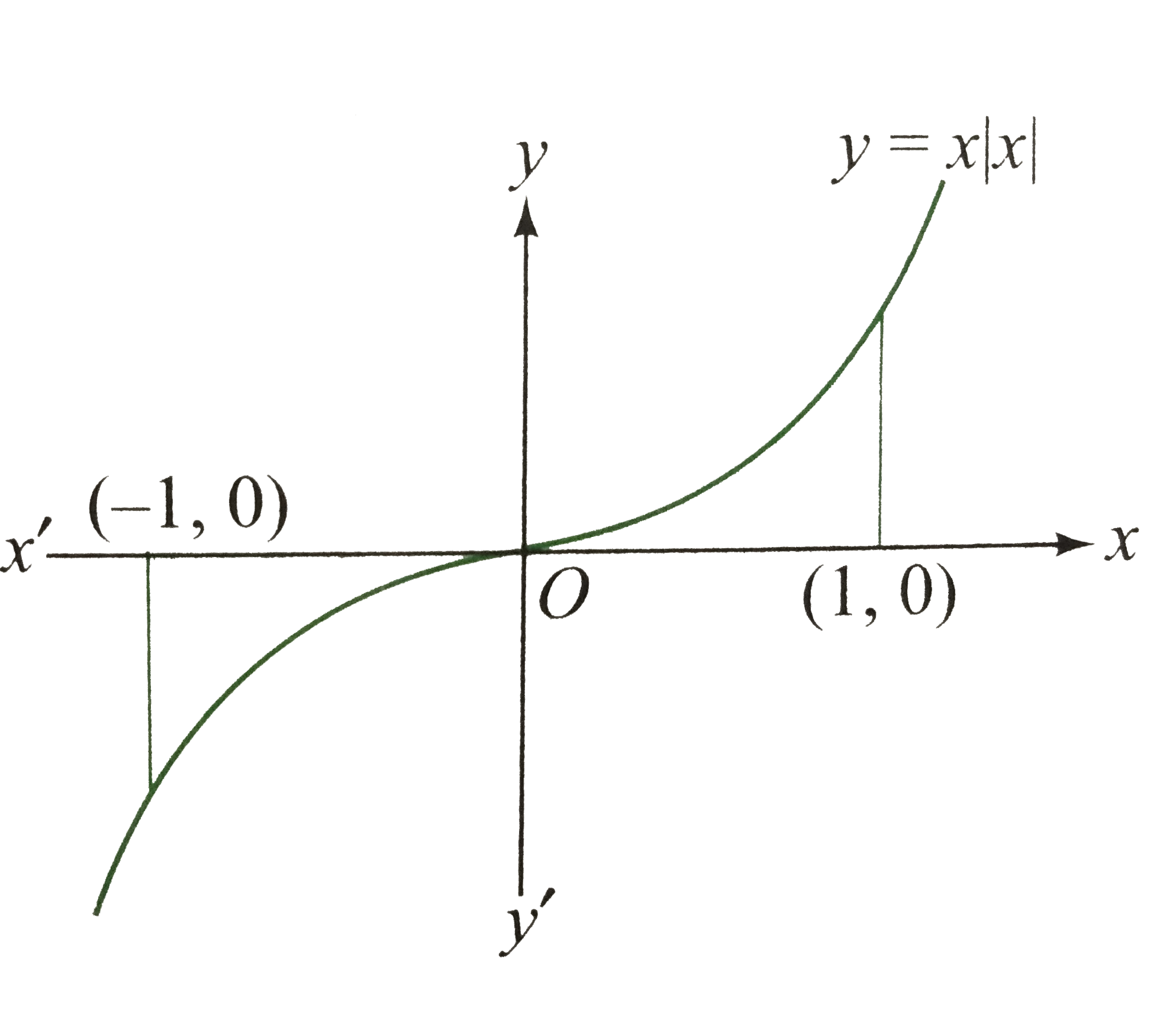 `"Required area "=2int_(0)^(1)X|x|dx` `=2((x^(3))/(3))_(0)^(1)=(2)/(3)` b. 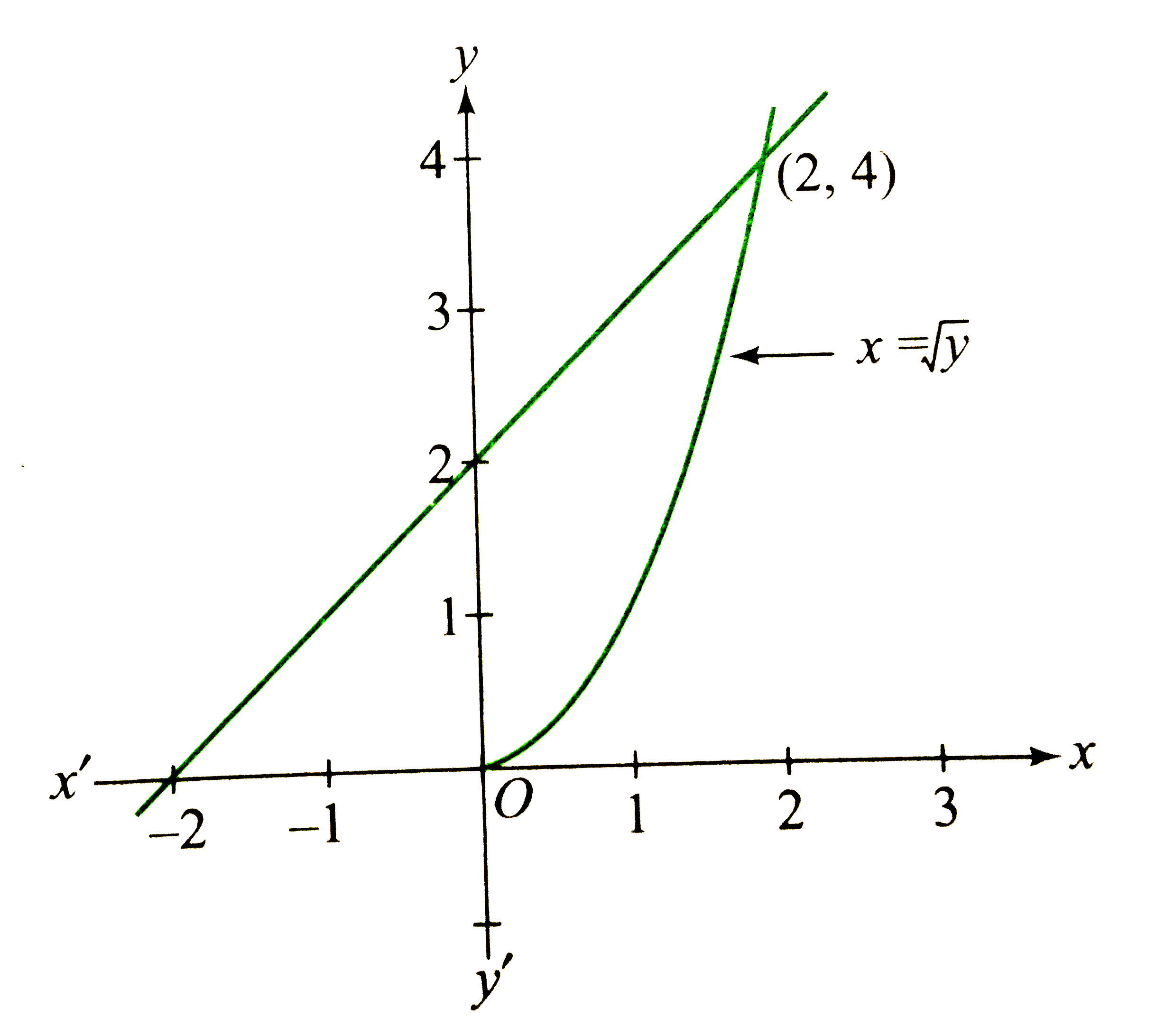 `"Required area "=int_(0)^(2)[(x+2)]-(x^(2))]dx=[(x^(2))/(2)+2x-(x^(3))/(3)]_(0)^(2)` `=2+4-(8)/(3)=(10)/(3)` sq. units. c. `"Reqd. area "=int_(0)^(1)(sqrt(x)-x)dx=[(x^(3//2))/(3//2)-(x^(2))/(2)]_(0)^(1)` `=((1)/(3//2)-(1)/(2))=(2)/(3)-(1)/(2)=(1)/(6)` sq. units. 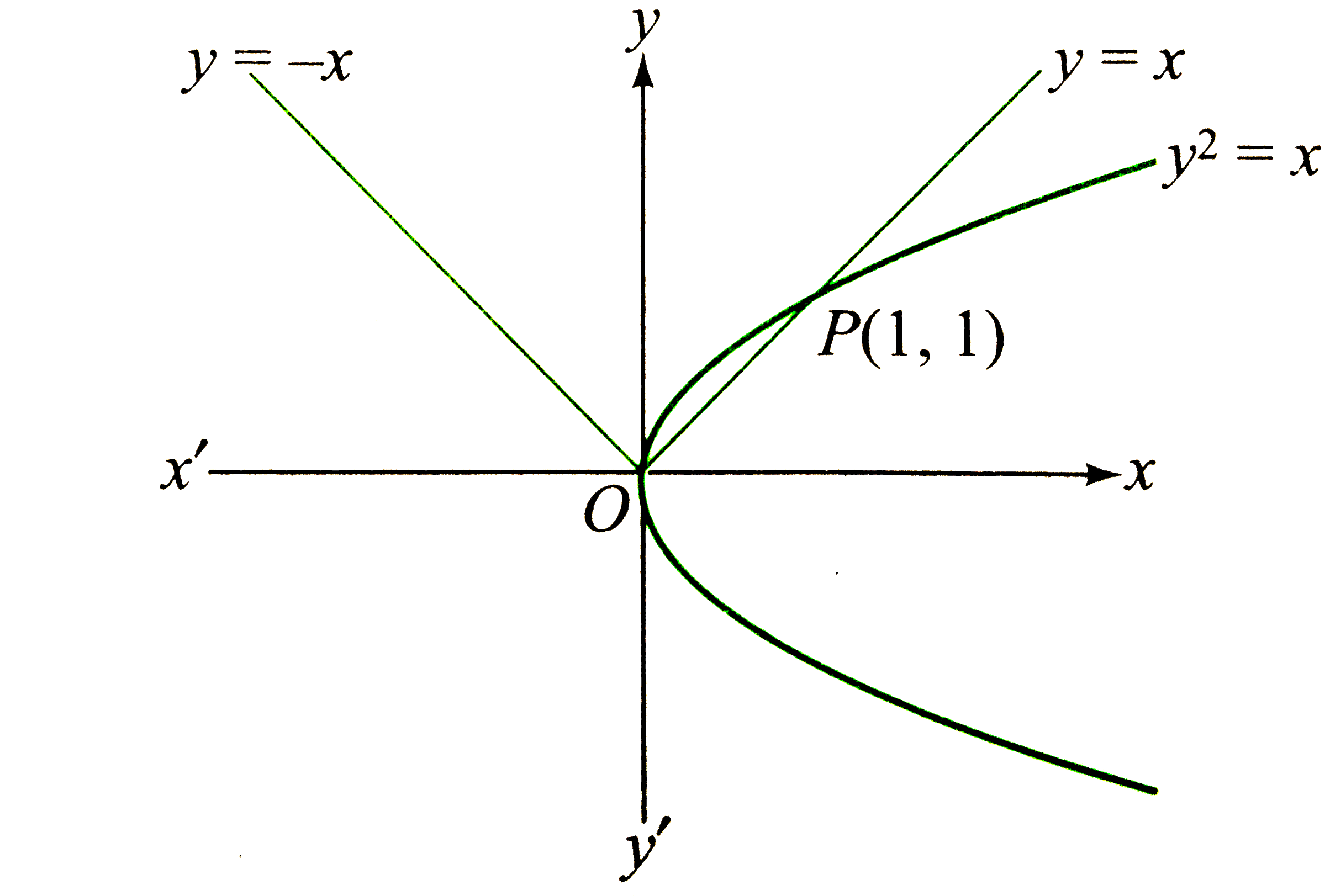 d. `y=4" meet the parabola "y^(2)=x" at "A" is "(16,4)` 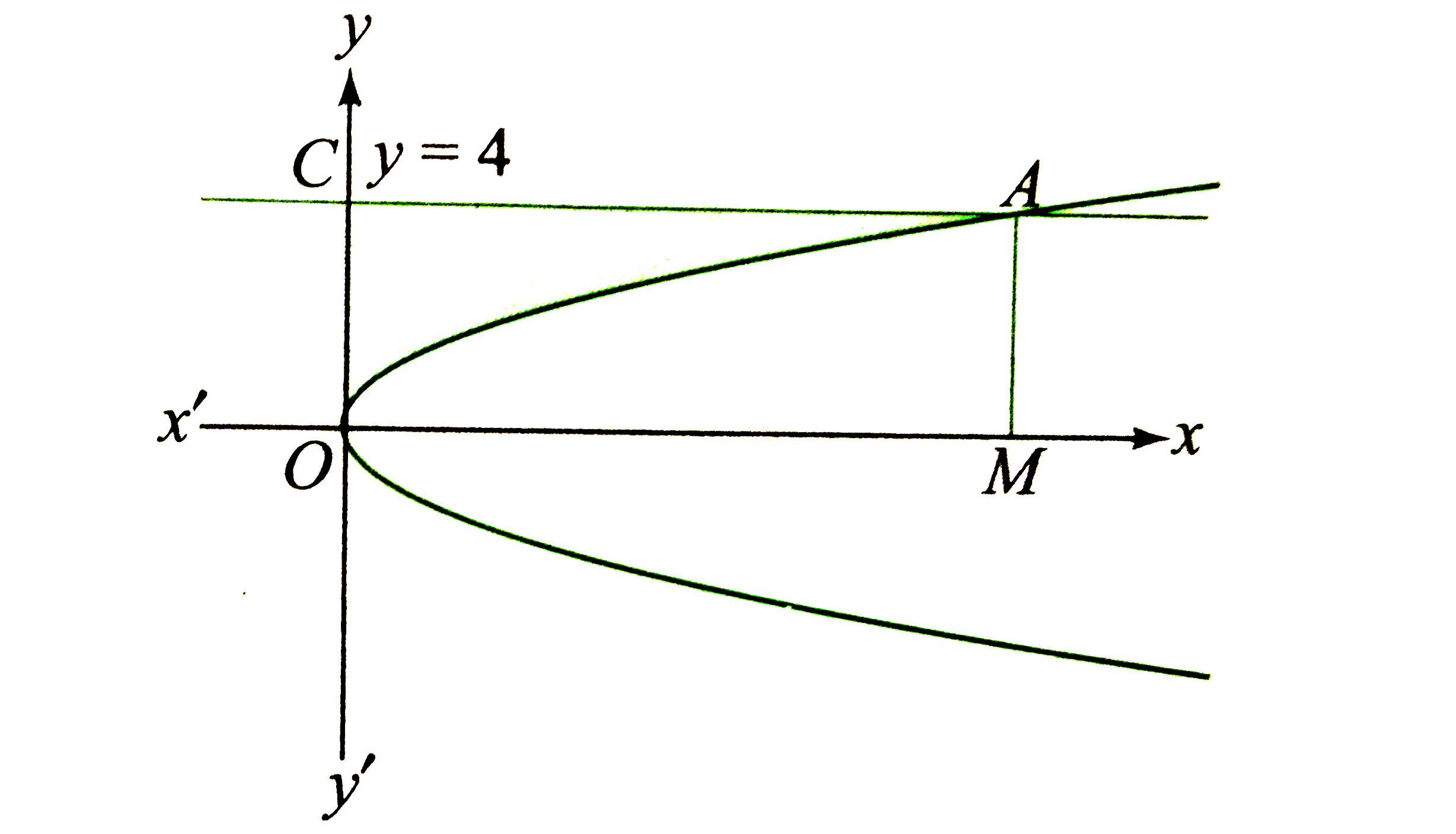 Required area= Area of rectangle OMAC-Area OMA `=4xx16-int_(0)^(16)sqrt(x)dx=64-|(x^(3//2))/(3//2)|_(0)^(16)` `=64-(2)/(3)(4)^(3)` `=64-(128)/(3)=(64)/(3)` sq. units. |
|
| 43. |
Check whether the realtion R defined in the set {1,2,3,4,5,6} as R = {(a,b) : b =a +1} is reflexive, symmetric or transitive. |
|
Answer» |
|
| 44. |
If (l,m) is the circumcentre of an equailateral triangle inscribedin theellipse (x^(2))/(a^(2))+(y^(2))/(b^(2))=1 havingverticlesat pointswith ecentric angles theta_(1),theta_(2) and theta_(3) then 2/3[cos(theta_(1)-theta_(2))+cos(theta_(2)-theta_(3)+cos(theta_(3)-theta_(1))] = |
|
Answer» `(9L^(2))/(2a^(2)) + (9M^(2))/(b^(2))-1` |
|
| 45. |
A fair coin and an unbiased dice are tossed. Let A be the event 'head appears on the coin' and B be the event '3 on the dice' . Check whether A and B are independent events or not. |
|
Answer» |
|
| 46. |
If tan^(-1)((x-1)/(x-2)) + tan^(-1)((x+1)/(x+2)) = pi/4, then find the value x. |
|
Answer» |
|
| 47. |
Consida square matrix A of order 2 which has its elements as 0, 1, 2 and 4. Let N denotes the number of such matrices. |
|
Answer» <P> |
|
| 48. |
I= int x "In" (1+(1)/(x) ) dx. |
|
Answer» |
|
| 49. |
STATEMENT-1 : Ifl, m, n are direction ratios of a straight line then minimum value of l^(2) + m^(2) + n^(2) will be 1. STATEMENT-2 : If the line joining the origin to the point (0, -1, 9) makes angles alpha, beta and gamma eith the positive direction of the axes then the value of cos 2 alpha + cos2beta +cos2gamma is -1 STATEMENT-3 : The angle between two lines that have the direction ratios (1, 2, 3) and (3, -2, 1) is cos^(-1)(1/7). |
|
Answer» T T T |
|
| 50. |
Two cards are drawn successively with replacement from a well-shuffled deck of 52 cards. Find the probability distribution of the number of aces. |
| Answer» | |