

Saved Bookmarks
This section includes 7 InterviewSolutions, each offering curated multiple-choice questions to sharpen your Current Affairs knowledge and support exam preparation. Choose a topic below to get started.
| 1. |
Evaluate : int (cos x + x sin x)/( x (x + cos x)) dx |
|
Answer» |
|
| 3. |
A manufacture produces two types of soap bars using two machines, A and B.A is operated for 2 minutes and B for 3 minutes to manufacture the first type, while it takes 3 minutes on machine A and 5 minutes on machine B to manufacture the second type. Each machine can be operated at the most for 8 hours per day. The two types of soap bars are sold at a profit of R. 0.25 and Rs 0.50 each. Assuming that the manufacture can sell all the soap bars he can manufacture, hwo many bars of soap of each type should be manufactured per day so as to maximize his profit ? |
|
Answer» |
|
| 4. |
Using the property of determinants,show that the points A(a,b+c),B(b,c+a), C(c,a+b) are collinear. |
|
Answer» SOLUTION :`|[x_1, y_1,1],[x_2, y_2,1],[x_3, y_3,1]|=|[a, B+c,1],[b, c+a,1],[c, a+b,1]|` `=|[a+b+c, b+c,1],[a+b+c, c+a,1],[a+b+c, a+b,1]|` (by `C_1rarrC_1+C_2)` `=(a+b+c)|[1, b+c,1],[1, c+a,1],[1, a+b,1]|=0` `(because C_1=C_3)` Thus, the given points are collinear. |
|
| 5. |
Let M be a column vector (not null vector) and A=(MM^T)/(M^TM) the matrix A is : (where M^T is transpose matrix of M) |
|
Answer» idempotant |
|
| 6. |
Two poles of height 16 m ans 22 m stand vertically on the ground 20 m apart. Find a point on the ground, in between the poles, such that the sum of the square of the distances of this point from the tops of the poles is minimum. |
|
Answer» |
|
| 7. |
Evaluate the following integrals. int(2x+3)/(3x^(2)+14x-5)dx |
|
Answer» |
|
| 8. |
If a random variable X has a poisson distribution with parameter 1/2 then find P(X = 2) |
|
Answer» |
|
| 9. |
How many on-to functions can be defined from a set A containing n elements to another set B containing 3 elements |
|
Answer» |
|
| 11. |
Find the number of ways to arrange 8 persons around circular table id never sit together |
|
Answer» |
|
| 12. |
Two cards are drawn form pack of 52 cards one after another with replacement. Find the mean of the number of kings. |
|
Answer» |
|
| 13. |
If {0.1,0.2,c,0.5} determines a probability distribution, find c. |
| Answer» SOLUTION :The GIVEN SET is a PROBABILITY DISTRIBUTION `rArr0.1+0.2+c+0.5=1` `rArrc=1-0.8=0.2` | |
| 14. |
The straight lines represented by (y-mx)^(2)=a^(2)(1+m^(2))and(y-nx)^(2)=a^(2)(1+n^(2))form a |
|
Answer» rectangle `y-mx=+-asqrt(1+m^(2))` i.e., `y-mx=asqrt(1+m^(2))`(1) and `y-mx=-asqrt(1+m^(2))` (2) Similarly , the straight lines representd by`(y-nx)^(2)=a^(2)(1+n^(2))` are `y-nx=asqrt(1+n^(2))` (3) and ` y-nx=-asqrt(1+n^(2))` (4) Since the lines (1) and (2) are parallel , the distance between thems is `|(asqrt(1+m^(2))+asqrt(1+m^(2)))/(sqrt(1+m^(2)))| =|2a|` Similarly , the lines (3) and (4) are parallel lines and the distance between them is `|2a|` . Since the distances between parallel lines are the same , the four lines form a rhombus. |
|
| 15. |
Compute the following integrals : (a) int_(pi//4)^(pi//2) (sin x)/( x) dxaccurate to three decimalplaces, using Simpson's formula : (b)int_(0)^(1) e^(-x^(2))dxaccurate to three decimal places, bythe trapezoidal formula |
|
Answer» (B)0.7462 |
|
| 16. |
Prove that : Find the sum of the series (3.5)/(5.10)+(3.5.7)/(5.10.15)+(3.5.7.9)/(5.10.15.20)+....oo |
|
Answer» |
|
| 17. |
If (p ^^ ~q) ^^ ( p ^^ r) rarr ~ p vee ris false, then the truth values of p. q and r are respectively: |
|
Answer» T, T, T |
|
| 18. |
Let a^r and b^bot are two vectors making angle theta with each other , unit vectors along bisector of a^r and b^bot is : |
|
Answer» `pm (HATA+ hatb)/2` `|hata+hatb|^2=|hata|^2+|hatb|^2 + 2hata.hatb` 1+1+2 cos `theta` `=2(1+cos theta)` `=2xx2 cos^2 theta//2` `=4 cos^2 theta//2` SINCE `pm (hata + hatb)/(2 cos theta//2)` |
|
| 19. |
Find the slope of the tangent to the curve y = 3x^(4) – 4x at x = 4. |
|
Answer» |
|
| 20. |
If z = 2e^(i"" (pi)/(4)) then |e^(iz)| = |
|
Answer» `E^(-SQRT2)` |
|
| 21. |
Let int(1-6cosecx)/(6+f(sinx))d(sinx)=g(x)+K, where g(x) contains no constant term. Then find the value of lim_(t to pi//2)g(t). (where K is indefinite integration constant.) |
| Answer» Answer :B | |
| 22. |
Which of the following function is not continuous at x=0? |
|
Answer» `F(x)(1+2x)^(1//x),x NE 0` and `underset(x to 0)(lim)f(x)=underset(x to 0)(lim)(1+2x)^(1//x)=e^(2)""[becauseunderset(xto0)(lim)(1+lamdax)^(1//x)=e^(lamda)]` `thereforef(0)=underset(xto0)(lim)f(x)=e^(2)` `impliesf(x)` is CONTINOUS at x=0. Option (b), here, f(0)=-1. and `underset(xto0)(lim)FF(x)=underset(xto0)(lim)(sinx-cosx)=sin0-cos0=-1` `thereforef(0)=underset(xto0)(lim)f(x)=-1` `impliesf(x)` is continuous at x=0 option (c). here `f(0)=-1` and `underset(x to 0)(lim)f(x)=underset(x to 0)(lim)(e^(1//x)-1)/(e^(1//x)+1)=underset(xto0)(lim)(1-e^(-1//x))/(e^(-1//x))=1` `therefore f(0) ne underset(x to 0)(lim)f(x)impliesf(x)` is not continuous option (d), here f(0)=1 and `underset(xto0)(lim)f(x)=underset(x to 0)(lim)(e^(5x)-e^(2x))/(sin3x)xx(3x)/(3x)` `=underset(xto0)(lim)(e^(5x)-e^(2x))/(3x)xxunderset(xto0)(lim)(3x)/(sin3x)` `(1+(5x)/(1!)+((5x)^(2))/(2!)+ . . .)-` `=underset(xto0)(lim)((1+(2x)/(1!)+((2x)^(2))/(2!)+ . .))/(3x)""(because underset(xto0)(lim)(3x)/(sin3x)=1)` `=underset(x to 0)(lim)(((3x)/(1!)+(21x^(2))/(2!)+ . . .))/(3x)=1` `thereforef(0)=underset(xto0)(lim)f(x)=1`. `impliesf(x)` is continuous at x=0. |
|
| 23. |
A set of m parallel lines intersect another set of n parallel lines in a plane. The number of parallellograms formed is |
|
Answer» `""^(m)C_(2)XX""^(N)C_(2)` |
|
| 24. |
If a function f(x) is defined on a infinite interval [0, oo], then its average value will be mu= underset(b rarr oo)(lim) (1)/(b) int_(0)^(b) f(x)dx, If this limit exists. Find the average power consumption of an alternating current circuit if the current intensity I and voltage u are expressed by the following formulas, respectively: I= I_(0) cos (omega t + alpha), u= mu_(0)cos (omega t + alpha + varphi ), where varphi is the constant phase shift of the voltage as compared with the current intensity (the parameters omega and alpha will not enter into the expression for the average power) |
|
Answer» |
|
| 25. |
Consider equation ((x^(2)+x)^2)+a(x^(2)+x)+4=0Match the values of a in Lits II for the types of roods in Lits I. |
|
Answer» `{:(,a,b,c,d),((1),p,q,r,s):}` Let `t=x^(2)+x=(x+1//2)^(2)-1//4`. `impliestin[-(1)/(4),OO]` Now, `f(t)=t^(2)+at+4=0""....(1)` (a) All four real and distinct roots. So, equation (1) has both roots greater then `-1//4`. 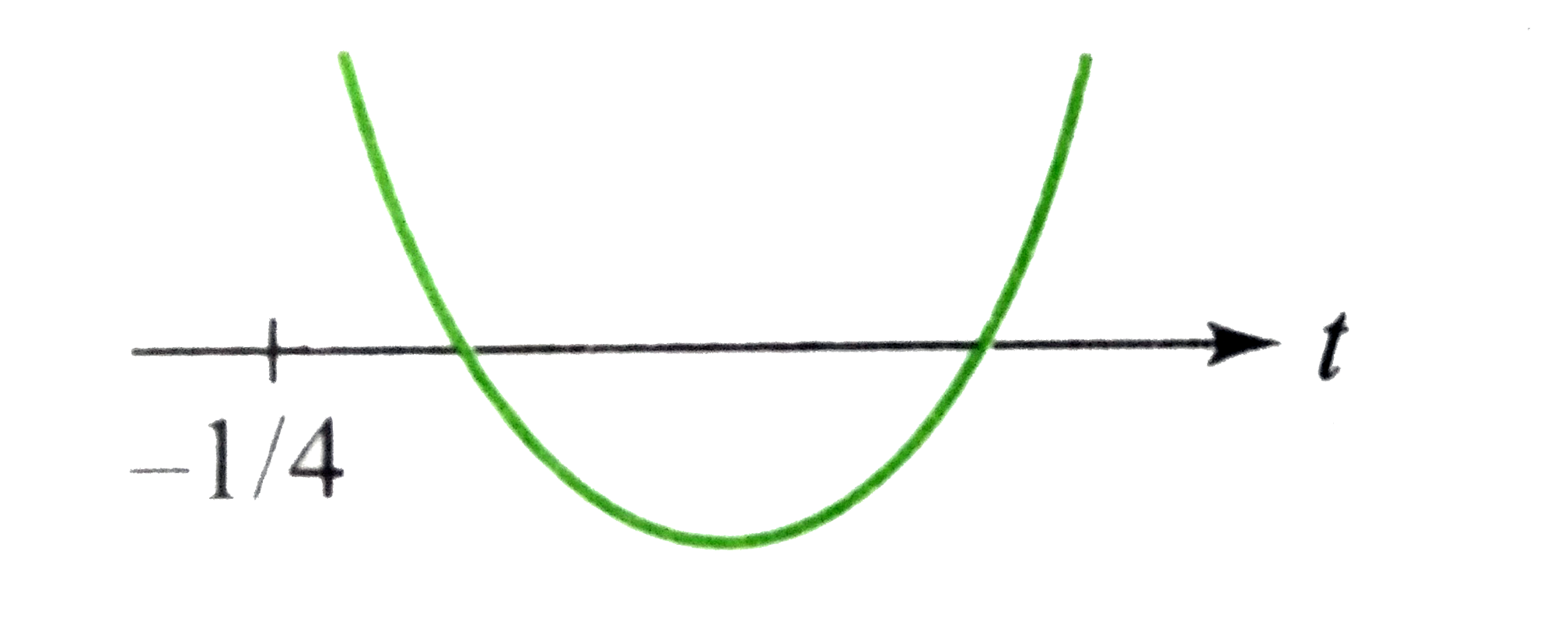 FOLLOWING conditions are required: `(i) Dgt0impliesa^(2)-16gt0implies|a|gt4` (ii) `f(-1//4)=(1)/(16)-(a)/(4)+4gt0impliesalt65//4` (iii) `-(B)/(2A)=(a)/(2)gt-(1)/(4)impliesalt(1)/(2)` `impliesain(-oo,-4)` (b) TWO real roots which are distinct. 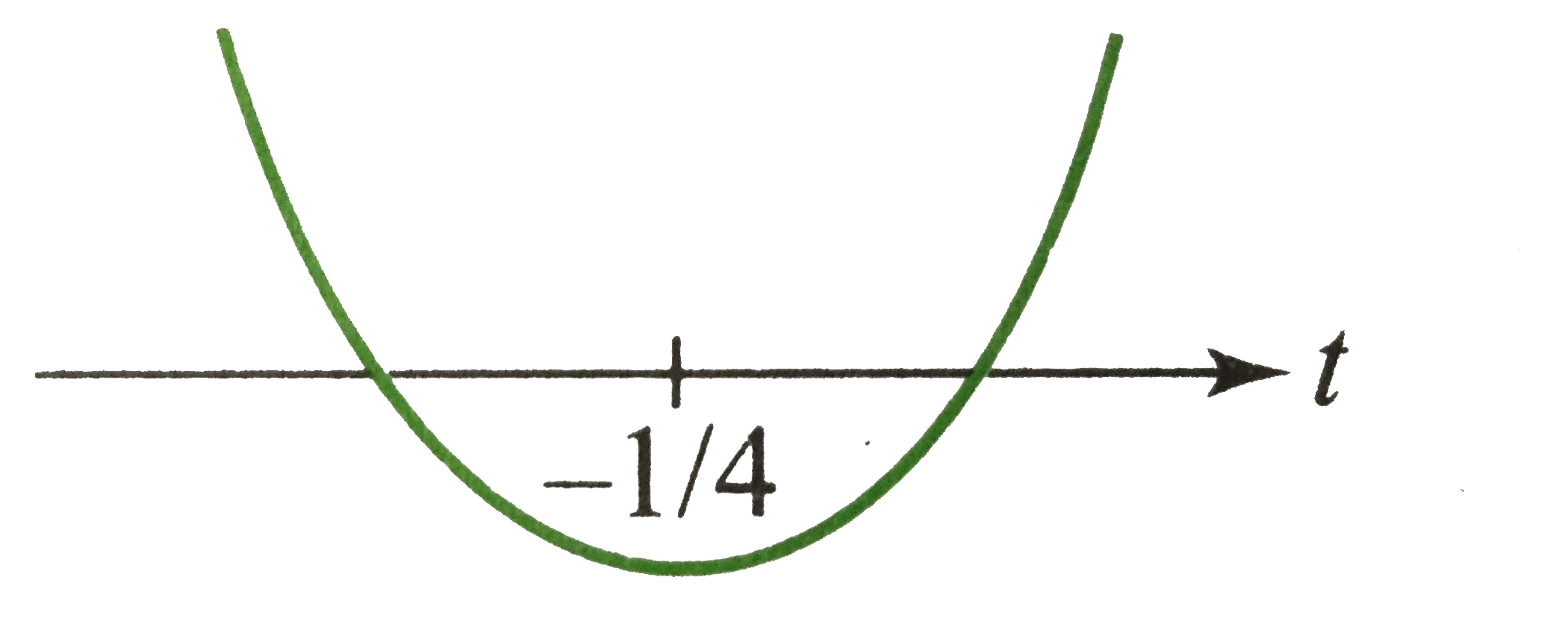 `impliesf(-1//4)lt0` `impliesagt65//4` `impliesain(65//4,oo)` (c) All four roots are imaginary. 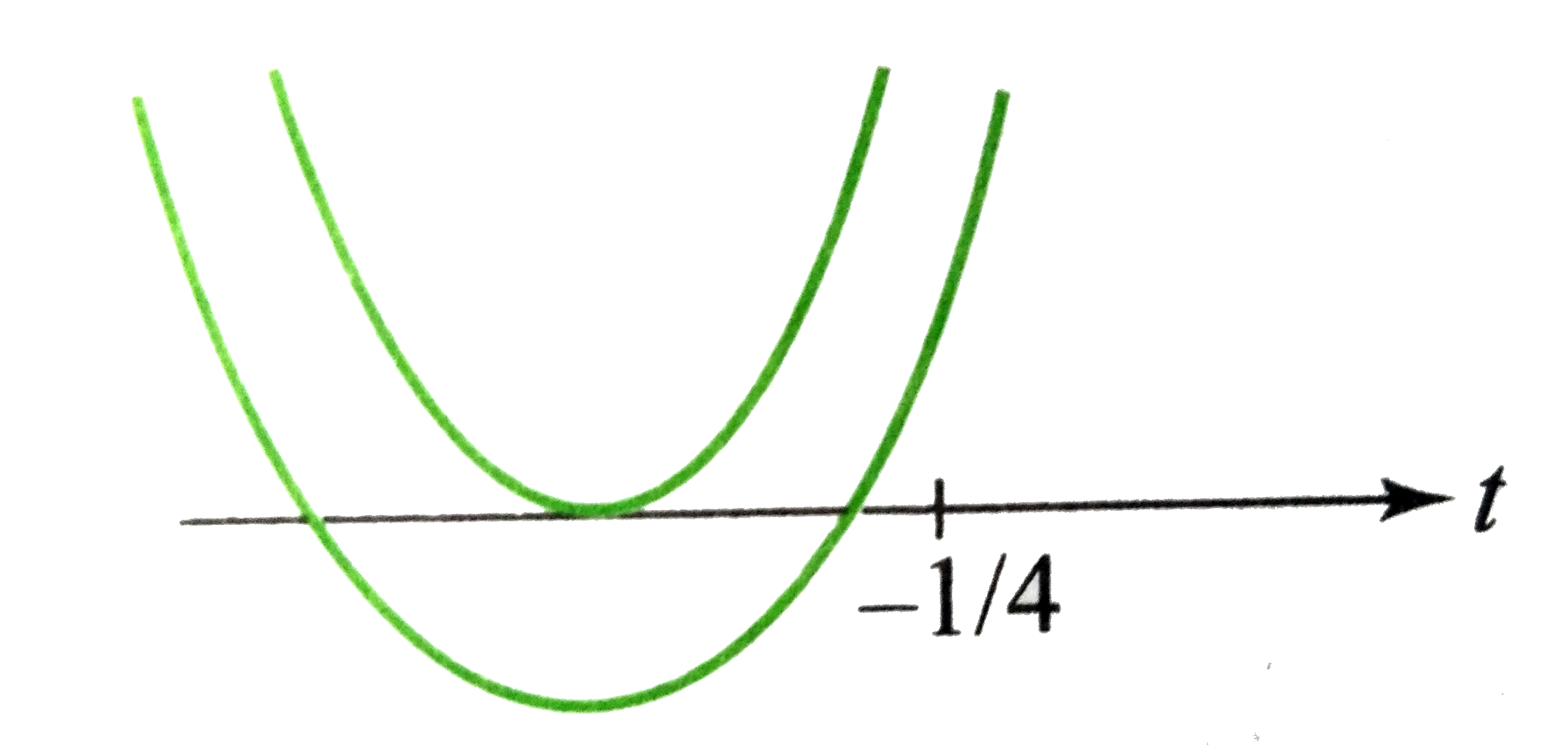 (i) `Dge0implies|a|ge4` (ii) `f(-1//4)gt0impliesalt(65)/(4)` (iii) `-(B)/(2A)LT-(1)/(4)impliesagt(1)/(2)impliesain[4,(65)/(4)]` Case II: `Dlt0` 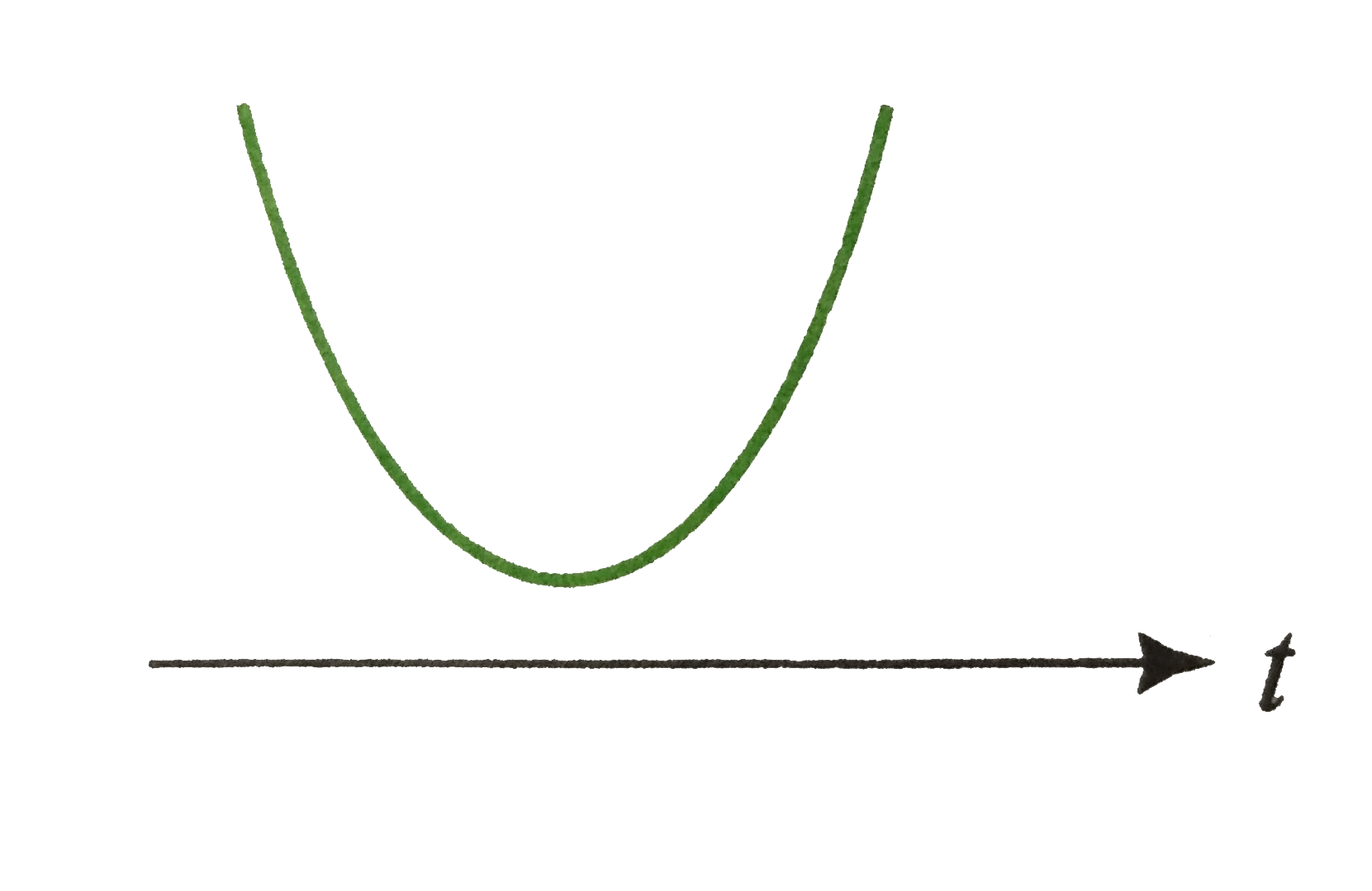 `impliesain(-4,4)""....(2)` From case I and case II, `ain(-4,(65)/(4))` (d) Four real roots in which two are equal. 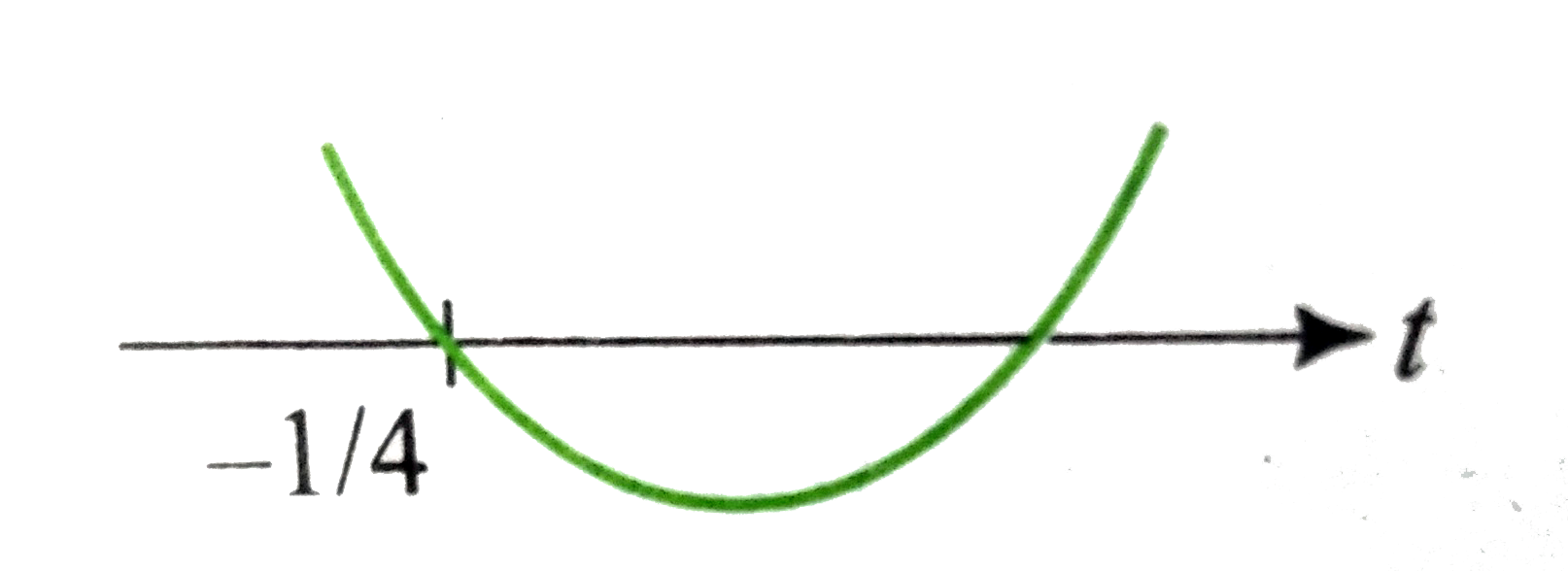 (i) `Dgt0implies|a|gt4` (ii) `f(-1//4)=0impliesa=65//4` (iii) `-(B)/(2A)gt-(1)/(4)impliesalt(1)/(2)` No common solution. `:.ainphi`. |
|
| 26. |
Let f : R to Rbe defined as f (x) = x ^(4). Choose the correct answer. |
|
Answer» F is one-one ONTO |
|
| 27. |
If I_(1) = int_(1)^(2)(dx)/(sqrt(1+x^(2))) and I_(2)= int_(1)^(2) (dx)/(x) then |
|
Answer» `I_(1)=I_(2)` |
|
| 28. |
Find (dy)/(dx) in the following: y= sin^(-1) (2x sqrt(1-x^(2))), (1)/(sqrt2) lt x lt 1 |
|
Answer» |
|
| 29. |
If a ne be ne c such that |(a^3-1,b^3-1,c^3-1),(a,b,c),(a^2,b^2,c^2)|=0 then, |
|
Answer» `ab+bc+ca=0` |
|
| 30. |
Find (dy)/(dx) in the following : y= sin^(-1) (2x sqrt(1-x^(2))), (-1)/(sqrt(2)) lt x lt (1)/(sqrt(2)). |
|
Answer» |
|
| 31. |
Given x ge 0, 2x+y ge 10, x+2y le 10 and x+y le 10, then the maximum value of F=(x-y) is |
|
Answer» `20//3` |
|
| 33. |
Differentiate (x + 1/x)^(x) w.r.to x. |
|
Answer» |
|
| 34. |
Let f(x) = ax^(3)+ bx^(2) + cx + d, b^(2) - 3ac gt 0, a gt 0, c lt 0. Then f(x) has |
|
Answer» local MAXIMUM at some `x in R^(+)` |
|
| 35. |
If a relation R is defined on the set Z of integers as follows (a,b)in R iff a^(2)+b^(2)=25 then, domain ( R ) = |
|
Answer» `{3,4,5}` |
|
| 36. |
Which of the following expressions gives the number of distinct permutations of the letters in PEOPLE? |
|
Answer» 6! |
|
| 37. |
Two farmers Ramkishan and Gurpreet singh cultivates only three varieties of rice namely Basmati , perimal and Jirasar .The sales (in Rs.) of these varieties of rice by both the farmers in the months of September October are given by the following matrices A and B. (i)Find the combined sales in Septemberand October for each farmer in each variety. (ii)In which month the selling is maximum. |
|
Answer» (II)In SEPTEMBER month |
|
| 38. |
Let A, B and C be three mutually exclusive events such that P(A) = p_(1), P(B) = p_(2) and P( C) = p_(3). Then, Let p_(1) = 1/2(1-p), p_(2) = 1/3(1+2p) " and " p_(3) = 1/5(2+3p), then p belongs to |
|
Answer» `PHI` |
|
| 39. |
If a=hat(i)-hat(j)-hat(k), b=2hat(i)-3hat(j)+hat(k)" and "p_(1), p_(2) are the orthogonal projection vectors of a on b and b on a respectively, then (p_(1)+p_(2))*(p_(1)-p_(2))= |
|
Answer» `-46/21` |
|
| 40. |
Find the Generel Solution x (dy)/(dx) + 2y = x^(2)log x |
|
Answer» |
|
| 41. |
Match the following. Equation"" Roobts I x^(3) - 3x^(2) - 16x + 48 = 0""a) 6, 4, -1 II.x^(3) - 7x^(2) + 14x - 8 = 0""(b)1, 1/3, 1/5 III.15x^(3) - 23x^(2) - 9x - 1= 0 ""(c ) 1, 2, 4 IVx^(3) - 9x^(2) + 14x + 24 = 0""(d)4, -4, 3 |
|
Answer» C, d, a, B |
|
| 42. |
For the real parameter t, the locus of the complex number z=(1-t^(2))+isqrt(1+t^(2)) in the complex plane is |
|
Answer» an ellipse |
|
| 43. |
Evaluate the following definite integrals as limit of sums. int_(a)^(b)xdx |
|
Answer» |
|
| 44. |
Find the equation of all lines having slope – 1 that are tangents to the curve y=(1)/(x-1) , x ne 1. |
|
Answer» |
|
| 45. |
The median and S.D. of a distribution are 20 and 4 respetively. If eahc item is increased by 2, the new median and S.D. are |
|
Answer» 20, 6 |
|
| 46. |
If 4 is added to each term of a G.P., then the resulting series is a - |
|
Answer» |
|
| 47. |
From an urn containing a white b black balls, k balls are drawn and laid aside, their colour unnoted. Then one more ball is drawn. Find the probability that it is white assuming that klta,b. |
|
Answer» Solution :Let `E_(1)` denote the event that out of the first K balls DRAWN, I balls are ehite, and A be the event that `(k+1)^(1)` ball drawn is also white. We have to find P(A). Now ways of selecting I white balls feom a white balls and k-I black balls from b black balls is `""^(a)C_(i)""^(b)C_(k-i)(0leilek).` ways to sleck k balls from a + b balls is `""^(a+b)C_(k)` Therefore, `P(E_(i))=(""^(a)C_(i)""^(b)C_(k-i)),0leilek` Also, `P(A//E_(i))=(""^(a-i)C_(1))/(""^(a+b-k)C_(1))=(a-i)/(a+b-k)(0leilek)` By the theorem of TOTAL PROBABILITY, we have `P(A)=underset(i-0)overset(k)sumP(E_(i))P(A//E_(i))` ltlbrgt `=underset(i-0)overset(k)SUM (""^(a)C_(i)""^(b)C_(k-i))/(""^(a+b)C_(k))(a-1)/(a+b-k)` `=underset(i-0)overset(k)sum([(a-i)""^(a)C_(a-i)]""^(b)C_(k-i))/((a+b-k)^(a+b)C_(a+b-k))` `=(a)/(a+b)underset(i-0)overset(k)sum(""^(a-1)C_(a-1i)""^(b)C_(k-i))/(""^(a+b-1)C_(a+b-k-1))` `=(a)/(a+b)underset(i-0)overset(k)sum(""^(a-1)C_(i)""^(b)C_(k-i))/(""^(a+b-1)C_(k))` `=(a)/(a+b(""^(a+b-1)C_(k)))underset(i-0)overset(k)sum""^(a-1)C_(i)""^(b)C_(k-i)` `=(a)/(a+b(""^(a+b-1)C_(k)))""^(a+b-1)C_(k)=(a)/(a+b)` |
|
| 48. |
Equation or Parabola whose axis is parallel to y-axis and passing through the points (1, 2), (4, -1) and (2, 3) is |
|
Answer» `y^(2)=3X` |
|
| 49. |
If |vecaxxvecb|=1/sqrt3|veca.vecb|, find the angle between vec a and vecb |
|
Answer» |
|