

Saved Bookmarks
This section includes 7 InterviewSolutions, each offering curated multiple-choice questions to sharpen your Current Affairs knowledge and support exam preparation. Choose a topic below to get started.
| 1. |
A bag contains (2n + 1) coins. It is known that n of these coins have a head on both sides whereas the rest of the coins are fair. A coin is picked up at random from the bag and is tossed. If the probability that the toss results in a head is (31)/(42), then determine the value of n. |
|
Answer» |
|
| 2. |
Find the area of the region bounded by y^(2)=4ax between the lines x=a and x= 9a |
|
Answer» |
|
| 3. |
Sum of coefficients of terms of even powers of x in (1 + x + x^2+ x^3)^5 is |
|
Answer» 512 |
|
| 4. |
Using differentials, find the approximate value of each of the up to 3 places of decimal. (26.57)^((1)/(5)) |
|
Answer» |
|
| 5. |
lim_(n to oo) (sqrt(1) + 2sqrt(2) + 3sqrt(3) + …… + nsqrt(n))/(n^(5//2)) is : |
|
Answer» `int_0^1 xsqrt(X) DX` |
|
| 7. |
Let veca=2hati+hatj-2hatk and vecb=hati+hatj. Let vecc be a vector such that |vecc-veca|=3,|(vecaxxvecb)xxvecc| = 3 and the angle between vecc and veca xx vecbis 30^@ Find veca.vecc |
|
Answer» |
|
| 8. |
If a=(hati+hatj+hatk), a.b=1 and axxb=hatj-hatk, then b is |
|
Answer» `hati-HATJ+hatk` `andaxxb= hatj= hatk` As , we know ` a XX (AXXB)=(a.b)a-(a.a)b` `IMPLIES ( hati + hatj + hatk ) xx(hatj - hatk ) = ( hati+ hatj + hatk)-3b` `[ :'a.a =1+1+1=3]` `implies- 2 hati+ hatj+ hatk= hati+ hatj + hatk -3b` `implies3b=3 hati` `implies b= hati` |
|
| 9. |
Outof 7consonants and5vowelshowmanydifferentwordscan beformedeachconsistingof3 consonantsand 2vowels |
|
Answer» 350 |
|
| 10. |
Solve the following equations : tan^(-1)((1-x)/(1+x))=1/2tan^(-1)x |
|
Answer» |
|
| 11. |
5 letters are placed at random in 5 addressed envelopes. Find the probability that (a) no letter is placed in its correct envelope. (b) exactly three letters are placed in correct envelopes. (c) atleast one letter is placed in correct envelope. (d) 2 specified letters are placed in wrong envelopes. (e) 2 specified letters are placed in correct envelopes. |
|
Answer» (B) `(1)/(12)` (c) `(19)/(30)` (d) `(39)/(60)` (e) `(1)/(20)` |
|
| 12. |
If 4x - 5y + 33 = 0 and 20 x - 9y - 107 = 0 are two lines of regression, find the standard deviation of Y, the variance of x is 9. |
|
Answer» 4 |
|
| 13. |
10 % bulbs are defective produced by some factory. 5 bulbs are selected at random then ……… is the probability that bulb is without defect. |
|
Answer» `((1)/(2))^(5)` |
|
| 14. |
If P_(n) = cos^(n) theta + sin^(n) theta theta int [0,pi/2], n int (-infty, 2) then minimum of P_(n) will be |
| Answer» ANSWER :A | |
| 15. |
Let f (x) = x cos x, x in [(3pi)/(2), 2pi] and g (x)be its inverse. If int _(0)^(2pi)g (x) dx = api ^(2) + beta pi+ gamma, wherealpha, beta and gamma in R, then find the value of 2 (alpha + beta+ gamma). |
|
Answer» |
|
| 16. |
Compute the area of the figure bounded by the straight lines x=0, x=2 and the curves y= 2^(x), y= 2x- x^(2) |
|
Answer» |
|
| 17. |
If alpha, = underset(x rarr 0)("lim") (x.2^(x) - x)/(1 - cos x)and |
|
Answer» `alpha = BETA` |
|
| 19. |
Fill in the blanks : If veca=xhati+2hatj-3hatk and vecb=3hati+bhatj-9hatk are parallel then x=_(.........) |
|
Answer» |
|
| 20. |
Evaluate |{:(cosalphacosbeta,cosalphasinbeta,-sinalpha),(-sinbeta,cosbeta,0),(sinalphacosbeta,sinalphasinbeta,cosalpha):}| |
|
Answer» |
|
| 21. |
If ** is a binary operation on the set R of all real numers difined by a**b=a+b-3 then find the identity element for **. |
|
Answer» |
|
| 22. |
Let (-pi)/(6) lt theta lt (-pi)/(12) suppose alpha_(1) "and" beta_(1) are the roots of the equation x^(2)-2xsectheta +1 = 0 , and alpha_(2) "and" beta_(2) are the roots of the equations x^(2)+2xtantheta -1 = 0. If alpha_(1) gt beta_(1) "and" alpha_(2) gt beta_(2) , then alpha_(1) +beta_(2) equals to : |
|
Answer» `2(SECTHETA - TANTHETA)` |
|
| 23. |
Define the collections {E_1,E_2,E_3,...} of ellipses and {R_1,R_2,R_3,...} of rectangles as follows : E_1:(x^2)/(9)+(y^2)/(4)=1 R_1: rectangle of largest area, with sides parallel to the axes, inscribed in E_1, R_n-1,ngt1, R_n : rectangle of largest area, with sides parallel to the axes, inscribed in E_ngt1. Then which of the following options is /are correct ? |
|
Answer» the eccentricities of `E_18` and `E_19` are NOT equal. `E_1:(x^2)/(9)+(y^2)/(4)=1` ....(i) Now, let a VERTEX of rectangle of largest area with sides PARALLEL to the axes, incribed in `E_1` be `(3cos theta, 2 sin theta)`. So, area of rectangle `R_1=2(3cos theta)xx2(2sintheta)=12 sin(2theta)` 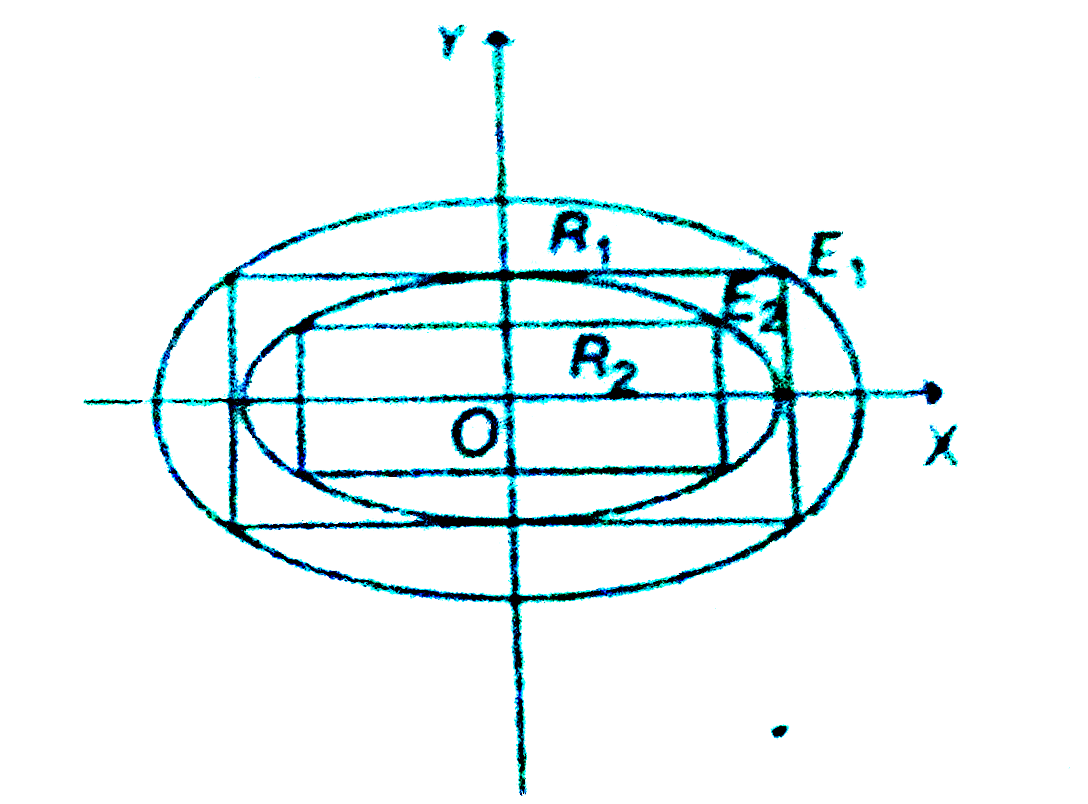 The area of `R_1` will be maximum, if `theta=(pi)/(4)` and maximum area is 12 square units and length of sides of rectangle `R_1` are `2a COS theta =sqrt(2)a=3sqrt(2)=` length of major axis of ellipse `E_1` and `2bsintheta=sqrt(2)b=2sqrt(2)=` length of minor axis of ellipse `E_2`. So, `E_2 : (x^2)/((a)/(sqrt(2)))^2+(y^2)/((b)/(sqrt(2)))^2=1`and maxsimum area of rectangle `R_2=2((a)/(sqrt(2)))((b)/(sqrt(2)))` So, `E_n=(x^2)/(((a)/((sqrt(2))^(n-1)))^2)+(y^2)/(((b)/((sqrt(2))^(n-1)))^2)=1`, and maximum area of rectangle `R_n=2((a)/(sqrt(2))^(n-1))((b)/(sqrt(2))^(n-1))` Now option (a), Since, eccentricity of ellipse `E_n=e_(n)=sqrt(1((b_n)^2)/(a_n)^2)` `sqrt(1-(((b)/((sqrt(2))^(n-1)))^2)/(((a)/((sqrt(2))^(n-1)))^(2)))=sqrt(1-(b^2)/(a^2))=sqrt(1-(4)/(5))=sqrt(5)/(3)` is independent of `pi`,so eccentricity of `E_18 and E_19` are equal. Option (b), Distance between focus and centre of `E_9=e.a_9` `=(a)/((sqrt(2)^8))(2)=(3)/(2^4)xx(sqrt(5))/(3)=(sqrt(5))/(16)"unit"`. Option (c), `because sum_(n=1)^(n)("area of" R_n)lt ("area of" R_1)+("ara of" R_2)+.....oo` `lt 2ab+2(ab)/(2)+2(ab)/(2^2)+......` `lt 2ab (1+(1)/(2)+(1)/(2^2)+......)` `lt 12((1)/(1-1//2))` `rArr sum_(n=1)^(N)("area of"R_n) lt 24`, each of positive integer N. Option (d), Length of latusrectum `E_9=(2b_9^2)/(a_9)=(2b^2)/(a(sqrt(2))^8)` `=(2xx4)/(3xx16)=(1)/(6)" units"`. Hence, option (c) and (d) are correct. |
|
| 24. |
Findthe orderdegree, ( ifdefined) of thedifferentialequation . |
|
Answer» |
|
| 25. |
The area bounded by the curves y=logx,y=2^(x) and the lines x=(1)/(2),x=2 is |
|
Answer» |
|
| 27. |
The area enclosed between y^(2) = x and y=x is: |
|
Answer» |
|
| 28. |
If f: R rarr R be an injective mapping and p, q,r are non-zero distinct real quantities satisfying f(p/r) = f((p-q)/(q-r)) and f(q/r) = f(r/p). If the graph of g(x)= px^(2)+qx+r passes thorugh M(1,6) then find the value of q. |
| Answer» | |
| 29. |
Ifz and omega are two non-zero complex numbers such that |zomega| =1 and arg (z) - arg (omega) = (pi)/(2) then barz omega is equal to |
|
Answer» 1 |
|
| 30. |
vec(a)=hati+hatj+hatk,vec(b)=hati-hatj+hatk and vec( c )=hati+2hatj-hatk then the value of |{:(vec(a).vec(b),vec(a).vec(b),vec(a).vec( c )),(vec(b).vec(a),vec(b).vec(a),vec(b).vec( c )),(vec( c ).vec(a),vec( c ).vec(b),vec( c ).vec( c )):}| is ............. |
|
Answer» 2 |
|
| 31. |
From the top of a 64 metres high tower, a stone is thrown upward vertically with the velocity of 48m/s. The greatest height (in metres) attained by stone, assuming the value of the gravitational acceleration g- 32 m//s^(2), is |
|
Answer» 100 |
|
| 32. |
An urn contains 5 white and 3 red balls. 3 red balls are drawn from box with replacement. If X represents numbers of red balls then obtain its probability distribution. |
|
Answer» |
|
| 33. |
From a differential equation representing the given family of curves by eliminating the arbitrary constains a and b x/a + y/b = 1 |
|
Answer» Solution :GIVEN equation is x/a + y/b = 1......(i), DIFFERENTIATING (1), w.r.t. x we have `1/a + 1/b(dy)/(DX) = 0..(2) Differentiating (2) , w.r.t. x we have `1/b (d^2y)/(dx^2) = 0 ` `rArr (d^2y)/(dx^2) = 0`, which is the required differential equation. |
|
| 34. |
If m is a positive integer, then [(sqrt(3)+1)^(2m)]+1, where [x] denotes greatest integer lex, must be divisible by |
|
Answer» `2^(m)` `THEREFORE (I+f)+f'(sqrt(3)+1)^(2m)+(sqrt(3)-1)^(2m)impliesI+(f+f')=(4+2sqrt(3))^(m)+(4-2sqrt(3))^(m)` `impliesI+(f+f')=2^(m)[(2+sqrt(3))^(m)+(2-sqrt(3))^(m)]=I+(f+f')=2^(m)xx2[.^(m)C_(0)2^(m)+.^(m)C_(2)2^(m-2).3+.....]` `impliesI+(f+f')=2^(m+1)lambda" where " lambda in N implies f+f'in N implies f+f'=1` `therefore I+1=2^(m+1)lambdaimplies[(sqrt(3)+1)^(2m)]+1=2^(m+1)lambda` |
|
| 35. |
Find the Differential equation satisfying the family of curves y=ae^(3x)+be^(-2x),a and b are arbitrary constants. |
|
Answer» SOLUTION :`y = a e^(3X) + be^(-2X)`, `y_1 = 3ae^(3x) - 2be^(-2x)` `y_2 = 9ae^(3x) + 4be^(-2x)` `= 6ae^(3x) + 6be^(-2x) + 3ae^(3x) - 2be^(-2x)` `= 6Y + y_1` `y_2 - y_1 - 6y = 0`, which i the required differential EQUATION. |
|
| 36. |
Common chord of the circles x^2+y^2-4x-6y+9=0, x^2+y^2-6x-4y+4=0 is |
|
Answer» 2x-2y+5=0 |
|
| 37. |
In a cubicul hall ABCDPQRS with each side 10m, G is the centre of the walls BCRQ and T is the midpoint of the side AB, the angle of elevation of G at the Point T is |
|
Answer» |
|
| 39. |
Using elementary row transformations , find the inverse of [{:(4,5),(3,4):}] |
|
Answer» |
|
| 41. |
There are 3 defective bulbs, in a group of 10 bulbs. If X is the number of defective bulbs in a random draw of 3 bulbs, then find its mean and variance. |
|
Answer» |
|
| 42. |
Find the coefficient of x^(n) in the expansion of (x)/((2x+1)(x-2)) in powers of x specifying the interval in which the expansion is valid. |
|
Answer» |
|
| 43. |
There are 30 questions in a multiple - choice test. A student gets 1 mark for each unattempted question, 0 mark for each wrong answer and 4 marks for each corrent answer. A student answered x question correctly and scored 60. Then the number of possible value of x is |
|
Answer» 15 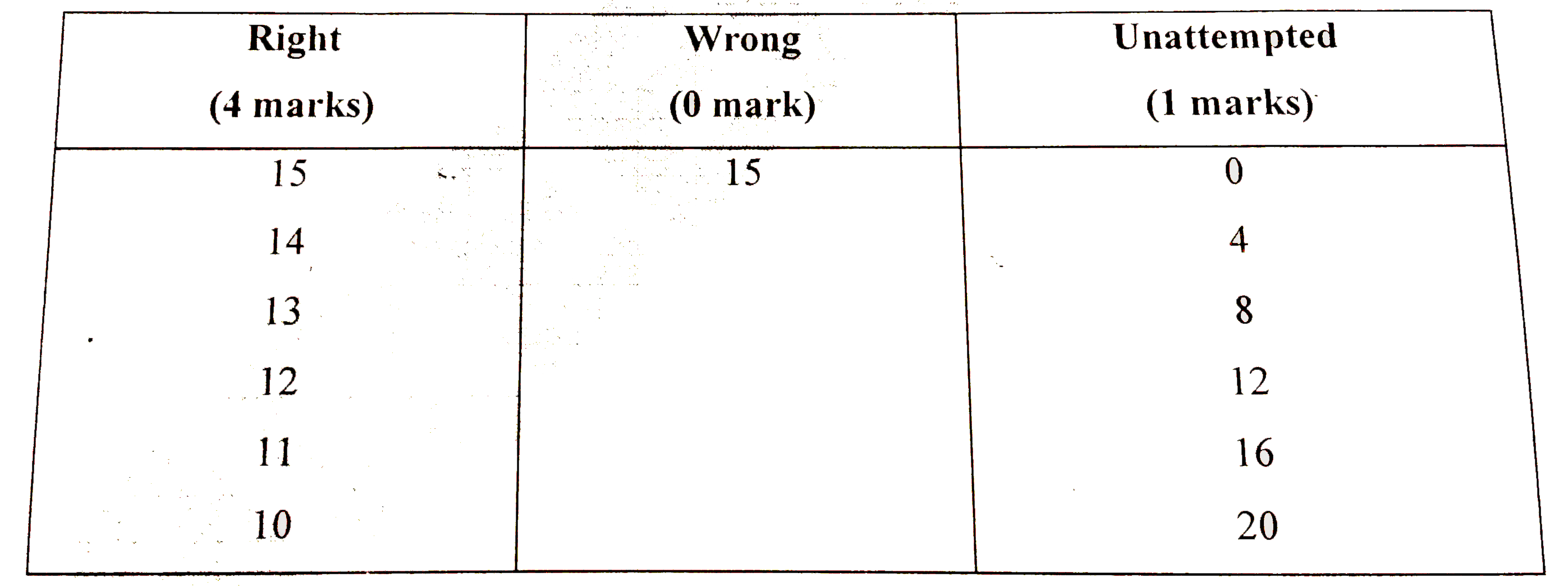 6 CASES. |
|
| 44. |
If ""^(n)C_(r) denotes the number of combinations of n things taken r things at a time, then the expression ""^(n)C_(r+1)+""^(n+1)C_(r)+2""^(n)C_(r) is |
|
Answer» `""^(n+2)C_(R+1)` |
|
| 46. |
For a vector bar(a),bar(a)xx vec( r )=bar(j) then bar(a).bar( r ) = …………. |
|
Answer» `-1` |
|
| 47. |
If A = (a_(ij))_(3xx3) where a_(ij) = cos (i+j) then |
|
Answer» A is symmetric |
|
| 48. |
In which of the following graphs is x =c point of inflection? |
|
Answer»
|
|


