

Saved Bookmarks
This section includes 7 InterviewSolutions, each offering curated multiple-choice questions to sharpen your Current Affairs knowledge and support exam preparation. Choose a topic below to get started.
| 1. |
If ax^2+2hxy+by^2+2gx+2fy+c=0 represents a pair of lines then prove that h^2geab,f^2gebc,g^2geac. |
|
Answer» |
|
| 2. |
Using elementary transformations, find the inverseof the matrices [(2,1),(4,2)] |
|
Answer» |
|
| 3. |
The mean and the median of 100 observation have been computed to be 60 and 70 respectively. Later it was discovred that three observations which have been recorded 18,28 and 98 are actually 80,26 and 38 respectively. If the mean and median are recalculated with equal observations, then |
|
Answer» MEDIAN will CHANGE but MEAN will not change |
|
| 4. |
int(x^(3)-1)/(1+sinx)dx= |
|
Answer» `x-logabs(x)+1/2logabs(x^(2)+1)+tan^(-1)x+c` |
|
| 5. |
There are three kinds of fruits in the market. How many ways are there to purchase 25 fruits from among them if each kind has at least 25 of its fruit available? |
|
Answer» |
|
| 6. |
Theroots of(1)/(x-1)_(1)/(x-2)=(1)/(x-3) are |
| Answer» Answer :A | |
| 7. |
A closed organ pipe of radiusr_(1) and an open organ pipe of radius r_(2) and having same length 'L' resonate when exited with a given tuning fork. Closed organ pipe and open organ pipe resonates in fundamental mode, then : |
|
Answer» `1.2 (r_(2)-r_(1)) =L` `implies (lambda)/4 = L+e` and for open organ pipe `(lambda)/2 = L + 2e_(2)` SO `4(L+e_(1))=2(L+2e_(2))` Now, `e_(1) = 0.6 r_(1)` and `e_(2) = 0.6 r_(2)` `2L = 4(e_(2)-e_(1))` `L = 2(e_(2)-e_(1))` `=2 xx 0.6 (r_(2)-r_(1))` `L = 1.2 (r_(2)-r_(1))`. |
|
| 8. |
Method of integration by parts : int (x tan^(-1)x)/((1+x^(2))^((3)/(2)))dx=..... |
|
Answer» `(x+TAN^(-1)x)/(SQRT(1+x^(2)))+C` |
|
| 9. |
If a, b, c, d be 3^(rd), 4^(th), 5^(th) and 6^(th) terms of the expansion of (p+q)^(n), where n is a positive integer prove that (b^(2)-ac)/(c^(2)-b)=(5a)/(3c). |
| Answer» SOLUTION :N/A | |
| 10. |
If A= [[1 ,-2, 2],[0, 2, -3],[3 ,-2, 4]], then A . adj A= |
|
Answer» `{:[(5,1,1),(1,5,1),(1,1,5)]:}` |
|
| 11. |
There are p copies each of n different subjects. Find the number of ways in which a nonempty selection can be made from them. Also find the number of ways in which at least one copy of each subject is selected. |
|
Answer» Solution :Number of WAYS of selection of zero or more copies of any subject =1+1+1+..+1 ((p+1) times) =p+1 So, total number of ways of selection of zero or more copies from all N subjects =(p+1)(p+1)..(p+1)(n times) `=(p+1)^(n)` But this INCLUDES one CASE when no book is selected. So, number of nonempty selections `=(p+1)^(n)-1` Now number of ways of selection of at least one copy of any subject =1+1+1+..+1(p times )=p So, number of ways in which at least one copy of each subject is selected `=pxxpxxpxx.xxp`(n times) `=p^(n)`. |
|
| 12. |
How many 9 digited numbers can be formed using 0, 1, 2 so that 0, 1, 2 must occur atleast once in each 9 digited number. |
|
Answer» |
|
| 13. |
An iron ball having 10 cm radius is covered equally with Ice. Ice is melted at the rate of 50 cm^(3)/min. when the thickness of ice is 5 cm, rate of decrease in radius is ………….. cm/min. |
|
Answer» `(1)/(36 pi)` |
|
| 14. |
Let l_(n)=int_(0)^(1)l_(n)=2^(n)int_(0)^(1)(1+x^(4))^(n)dx. If (k+1)l_(n)=2k(1+l_(n-1)) then the value of n is (k,ninN) ______ |
|
Answer» |
|
| 15. |
Equation of the tangent to the hyperbola 4x^(2)-9y^(2)=1 with eccentric angle pi//6 is |
|
Answer» `4x+3y=sqrt3` |
|
| 16. |
If A,B,C,D are angles of a cyclic quadrilateral, then cos A +cos B +cos C +cos D is equal to |
|
Answer» 0 |
|
| 17. |
f: R rarr (-1, 1) , f(x) = (10^(x)-10^(x))/(10^(x)+10^(-x)).If inverse of f^(-1) exists then find it . |
|
Answer» |
|
| 18. |
Which of the the solution is (x-5)/(x+3) lt -1 ? |
|
Answer» X LT -3 or x GT 5 |
|
| 19. |
A sample of 2 itmes is selected at random from a bag containing 5 items of which 2 are defective. Then mean of number of defective items is |
|
Answer» `(4)/(5)` |
|
| 20. |
A: int (1)/(3+4cosx)dx=(1)/(sqrt(7))log|(sqrt(7)+tan(x//2))/(sqrt(7)-tan(x//2))|+c R : If a lt b then int(dx)/(a+b cosx)= (1)/(sqrt(b^(2)-a^(2)))log|(sqrt(b+a)+sqrt(b-a)tan(x//2))/(sqrt(b+a)-sqrt(b-a)tan(x//2))|+c |
|
Answer» Both A and R are TRUE and R is the CORRECT EXPLANATION of A |
|
| 21. |
Let a,b,c epsilonR and alpha, beta,are the real roots of the equation ax^(2)+bx+c=0 and in a+b+clt0,a-b+clt0 andcgt0 then [alpha]+[beta] is equal to (where[.]denotes the greatest integer function). |
|
Answer» 0 `b/a=c/b=d/c=x""b^(2)=ac""2 LOG 6=LOGA+logc` `|(33,14,loga),(65,27,lobg),(97,40,logc)|to` apply `R_(1)toR_(1)+R_(3)-2R_(2)` `=0` |
|
| 22. |
On Z, a relation R is defined as follows: a,b in Z, aRb if 7 divides a -b The equivalence class containing -17 is |
|
Answer» {...,-17,-10,-3,4,11,...} |
|
| 23. |
The sidesAB,BC,CA of a DeltaABChave3,4and 5interiorpointsrespectivelyon them. Thenumberof triangles thatcan besonstructedusingthesepointsas verticesis |
|
Answer» 205 |
|
| 24. |
Let x, p in R, x + 1 gt 0, p ne 0, 1. Then |
|
Answer» <P>`(1 + X)^(p) gt 1 px "for" p gt 0` |
|
| 25. |
Find the particular solution of the differential equations (dy)/(dx)+ycotx=4cosec x xcancel=0 given that y=0 when x=pi/2 |
|
Answer» |
|
| 26. |
How many moles of P_(4) can be produced by reaction of 0.10 moles Ca_(5)(PO_4)_(3) F, 0.36 moles SiO_(2) and 0.90 moles C according to the following reaction? 4Ca_(5)(PO_4)_(3)F + 18SiO_(2) + 30 Cto 3P_(4) + 2CaF_(2) + 18CaSiO_(3)+30CO. |
|
Answer» <P>`0.060` `18 SiO_(2) overset("give")(rarr) 3P_(4)` `0.36 mol SiO_(2) to 3/18 xx 0.36 = 0.06 mol P_(4)`. |
|
| 27. |
The centre of the circle touching the y-axis at (0,3) and making an intercept 2 unit on positive x-axis is |
|
Answer» `(SQRT(10),3)` |
|
| 28. |
The number of common tangents to the circle x^(2)+y^(2)-4x-6y-12=0 and x^(2)y^(2)+6x+18y+26=0 is |
|
Answer» |
|
| 29. |
the value of thedeterminant |{:(.^(n)C_(r-1),,.^(n)C_(r),,(r+1)^(n+2)C_(r+1)),(.^(n)C_(r),,.^(n)C_(r+1),,(r+2)^(n+2)C_(r+2)),(.^(n)C_(r+1),,.^(n)C_(r+2),,(r+3)^(n+2)C_(r+3)):}| is |
|
Answer» `n^(2)+n-1)` Applying `C_(1) to C_(1)+C_(2) " and USING " .^(n)C_(r)=(n)/(r )^(n-1) C_(r+1) " in " C_(3)` we get ` Delta =|{:(.^(n+1)C_(r),,.^(n)C_(r),,(n+2)^(n+1)C_(r)),(.^(n+1)C_(r+1),,.^(n)C_(r+1),,(n+2)^(n+1)C_(r+1)),(.^(n+1)C_(r+2),,.^(n)C_(r+2),,(n+2)^(n+1)C_(r+2)):}|` `=(n+2) |{:(.^(n+1)C_(r),,.^(n)C_(r),,.^(n+1)C_(r)),(.^(n+1)C_(r+1),,.^(n)C_(r+1),,.^(n+1)C_(r+1)),(.^(n+1)C_(r+2),,.^(n)C_(r+2),,.^(n+1)C_(r+2)):}|` ( as `C_(1) " and " C_(3)`are identical ) |
|
| 30. |
The tangent at (3,4), (4,-3) to the circle x^(2)+y^(2)=25" are" |
|
Answer» coincident |
|
| 31. |
Prove that sin^2(18)^@ + cos^2(36)^@ = 3/4 |
| Answer» SOLUTION :`sin^2 18^@+cos^236^@=`((sqrt5-1)/4)^2+((sqrt5+1)/4)^2=((sqrt5-1)^2+(sqrt5+1))/16=3/4` | |
| 32. |
Integrationof rationalfunctions int(dx)/((x+1)(x+2)^(2)(x-3)^(3)) |
|
Answer» |
|
| 33. |
State with reason, "All citizens of india earning more than Rs.10,000/- per month " is set or not ? |
| Answer» SOLUTION :It is a SET, as it is WELL DEFINED. | |
| 34. |
If OA = 2hati + 2hatj+ hatk, OB = 2hati + 4hatj + 4hatkand the length of the internal bisector ofangle BOAof triangle AOB is k, then 9k^(2) = |
|
Answer» A225 |
|
| 35. |
Which of the following are True? (where [.] denotes greatest integer funstion) |
|
Answer» if `f(x)=[x],g(x)=|x-1|` then the VALUE of fog `(-7)/(4)+gof(-7)/(4)` is equal to 5 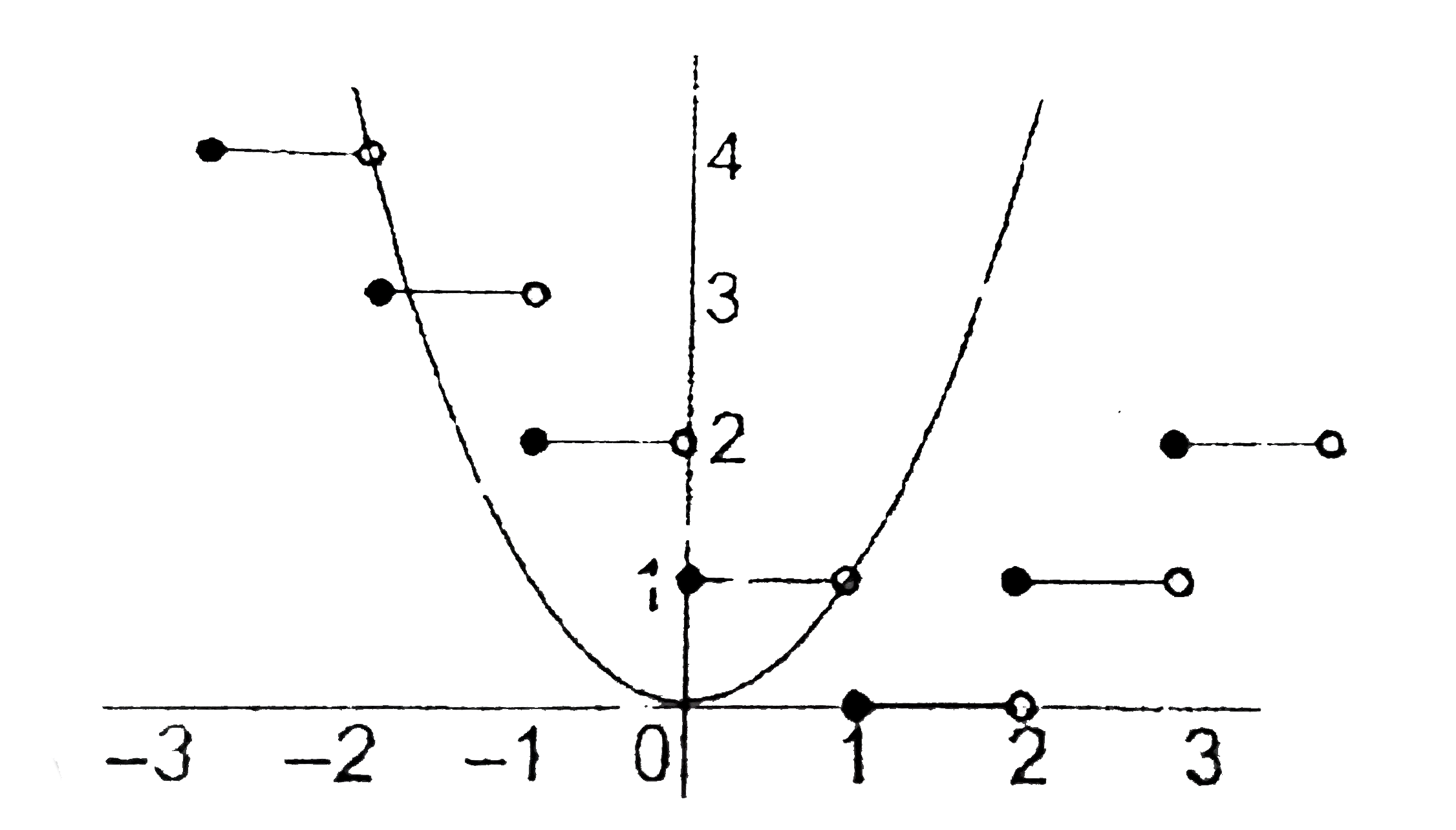 (A) fog `((-7)/(4))=f((11)/(4))=2` `gof((-7)/(4))=g(-2)=|-2-1|=3` (B) only ONE solution (C). `|f(x)|=|x|` `becausef(x)=x,|x|,-|x|` (D). `f(x)=x^(3)` `f^(-1)(x)=x^((1)/(3))` which is not differentiable at `x=0` |
|
| 37. |
A pair of dice is thrown and the random variable X is defined as the sum of numbers that appear on the two dice. Find the mean or expectation of X. |
|
Answer» |
|
| 39. |
An equatin of the family of circles passing through a given pair of points (x_(1), y _(1))and (x _(2), y _(2)) can be taken ad (x - x _(1)) (x -x _(2))+ (y - y_(1)) (y-y_(2))+ k |{:(x,y,1),(x_(1), y _(1), 1),(x_(2), y_(2), 1):}|=0, k being a real parameter. If a member of this family satisfies some other condition then that enables us to determine k and hence the number. Consider the set S of all possible circles that pass through (4,-3) and (-3,4) and thouch the line x +y -5 sqrt2=0. Then which of the following statements is correct ? |
|
Answer» S CONSISTS of exactly one circle, having radius 5 |
|
| 40. |
Find the coordinates of the focus, the axis, the equation of the directrix and the lengths of the latus rectum of the following parabolas i. x^2 = 6y "" ii. x^2 + 16y = 0 iii. y^2 = 10x "" iv. y^2 = -8x. |
|
Answer» |
|
| 41. |
An equatin of the family of circles passing through a given pair of points (x_(1), y _(1))and (x _(2), y _(2)) can be taken ad (x - x _(1)) (x -x _(2))+ (y - y_(1)) (y-y_(2))+ k |{:(x,y,1),(x_(1), y _(1), 1),(x_(2), y_(2), 1):}|=0, k being a real parameter. If a member of this family satisfies some other condition then that enables us to determine k and hence the number. The number of values of lamda in R for which there exists exactly one circle passing through the point (2, -3) and (lamda, 2 lamda -1) and touching the line 16x-2y + 27=0, is |
|
Answer» 0 |
|
| 42. |
Construct a 2xx2 matrix, A=[a_(ij)], whose elements are given by: (i) a_(ij)=((i+j)^(2))/(2) (ii) a_(ij)=(i)/(j) (iii) a_(ij)=((i+2j)^(2))/(2) |
|
Answer» |
|
| 43. |
hati *(hatj xx hatk) +hatj(hatk xx hati) +hatk (hati xx hatj) is : |
|
Answer» -3 |
|
| 44. |
Differentiate the functions with respect to x in Exerecises 1 to 8. cos x^(3). Sin^(2) (x^5). |
|
Answer» |
|
| 45. |
Find the eccentricity of the ellipse (i) (x^(2))/(16)+(y^(2))/(9)=1 (ii) (x^(2))/(64)+(y^(2))/(36)=1 (iii)25x^(2)+4y^(2)=100 |
|
Answer» |
|
| 46. |
Differentiate x^(sinx)+(sinx)^(cosx) w.r.t x. |
|
Answer» |
|
| 47. |
Let P be a point on the parabola, x^2=4y. If the distance of P from the centre of the circle, x^2+y^2+6x+8=0 is minimum, then the equation of the tangent to the parabola at P, is: |
|
Answer» `x+4y-2=0` |
|
| 48. |
If the straightline2x+3y-1=0, x+2y-1=0 and ax+by-1=0 form a triangle with origin as orthocentre, then (a,b) is equal to |
|
Answer» (6,4) |
|
| 49. |
If z+1/z=1 and z be any complex number,then the value of z^(99)+(1)/(z^(99)) is |
|
Answer» 1 |
|
| 50. |
Which of the following is not a negation of the statement p:sqrt(5) is rational ? |
|
Answer» It is not the CASE that `sqrt(5)` is rational |
|