

Saved Bookmarks
This section includes 7 InterviewSolutions, each offering curated multiple-choice questions to sharpen your Current Affairs knowledge and support exam preparation. Choose a topic below to get started.
| 1. |
Find the second order derivatives of the function log (log x). |
|
Answer» |
|
| 2. |
L.P.P. has constraints of |
|
Answer» ONE variables |
|
| 3. |
Number of ways of selecting 4 shoes from 10 pairs such that exactly onee correct pair is selected is |
|
Answer» ` .^(10)C_(1) .^(9)C_(2).2^(3)` |
|
| 4. |
Resolve (3x^(2)+1)/((x^(2)-3x+2)(2x+1)) into partial fractions. |
|
Answer» |
|
| 5. |
Identify the quantifiers of the following statements For every real number x, x^2 != x |
| Answer» SOLUTION :For EVERY | |
| 6. |
Let f(x) =g(x) |(x-1)(x-2)(x-3)^(2)(x-4)^(3)|, whereg(x)= x^(3)+bx^(2)+cx+d. if f(x)is differentiablefor all x in R and f' (3) + f'''(4)=0 thenthe value ofg(5) is ______. |
|
Answer» |
|
| 7. |
sin 10^(@) sin50^(@)sin 60^(@) sin 70^(@)=m " and tan "20^(@) tan 40^(@) tan60^(@) tan80^(@)= n, then (n)/(m)= |
|
Answer» `(3sqrt(3))/(16)` |
|
| 8. |
The solution of ydx - xdy = xydx is |
|
Answer» `(x)/(y) = C e^(x)` |
|
| 9. |
Consider the function f(x)={{:(xsin(pi)/(x),"for"xgt0),(0,"for"x=0):} Then, the number of points in (0,1) where the derivative f'(x) vanishes is |
|
Answer» 0 |
|
| 10. |
If thecorrect formof 2i^(4) +4i^(3) - i^(2) + 3i is a + ib , wheretheimaginarynumberI issuchthat i^(2) = - 1 . Whatis the value of ( a+b) ? |
|
Answer» |
|
| 11. |
If aN = {ax : x in N} " then " 3N cap 7N = |
|
Answer» `{3,6,9,12,..}` |
|
| 12. |
Differentiate: (2^(x))/(x) |
|
Answer» |
|
| 13. |
The tangent at a point P(theta) to the ellipse x^2/a^2+y^2/b^2=1 cuts the auxilliary circle at Q and R. If QR subtend a right angle atC (centre) then show that e=1/sqrt(1+sin^2 theta) |
|
Answer» |
|
| 14. |
The system of vector hat(i), hat(j), hat(k) is |
|
Answer» orthogonal |
|
| 15. |
{:(" "Lt),(n rarr oo):} ((1)/(sqrt(4n^(2)-1))+(1)/(sqrt(4n^(2)-2^(2)))+....+(1)/(sqrt(3n^(2))))= |
|
Answer» 0 |
|
| 16. |
If the vectors a=hati-hatj+2hatk, b=2hati+4hatj+hatk and c=lambdahati+hatj+mu hatk are mutually orthogonal, then (lambda, mu) is equal to |
|
Answer» `(-3, 2)` `a.B = 2 - 4 + 2 =0` `a .c = lambda - 1 + 2 mu = 0 "…."(i)` and `b .c = 2lambda + 4 +mu = 0 "….."(ii)` On solvingEqs. (i) and (ii), we get `mu = 2` and `lambda = - 3` `:. (lambda, mu) = (-3,2)` |
|
| 17. |
Evaluate the definite integrals int_(0)^(1)(dx)/(1+x^(2)) |
|
Answer» |
|
| 18. |
Find the equation of the common tangent of the following circles at their point of contact. x^2+y^2+10x-2y+22=0 x^2+y^2+2x-8y+8=0 |
|
Answer» |
|
| 19. |
The percentage error in measuring the side of a cube is 0.5, Then the percentage error in its volume is |
|
Answer» `1//2` |
|
| 20. |
Let C : x^(2) -3, D : y = kx^(2) be two parabolas and L_(1) : x a , L_(2) : x = 1 (a ne 0) be two straight lines. IF C and D intersect at apoint A on the lines L_(1) then the equation of the tangent line L at A to the parabola D is |
|
Answer» `2(a^(3) -3) x - AY + (a^(3) -3A) =0` |
|
| 21. |
For points P-=(x_1,y_1) and Q-=(x_2,y_2) of the coordinates plane, a new distance d(P,Q) is defined by d(P,Q) =|x_1-x_2|+|y_1-y_2|. Let O-=(0,0)and A-=(3,2). Consider the set of points P in the first quadrant which are equidistant (with respect to the new distance) from O and A. The locus of point P is |
|
Answer» one -one and onto function 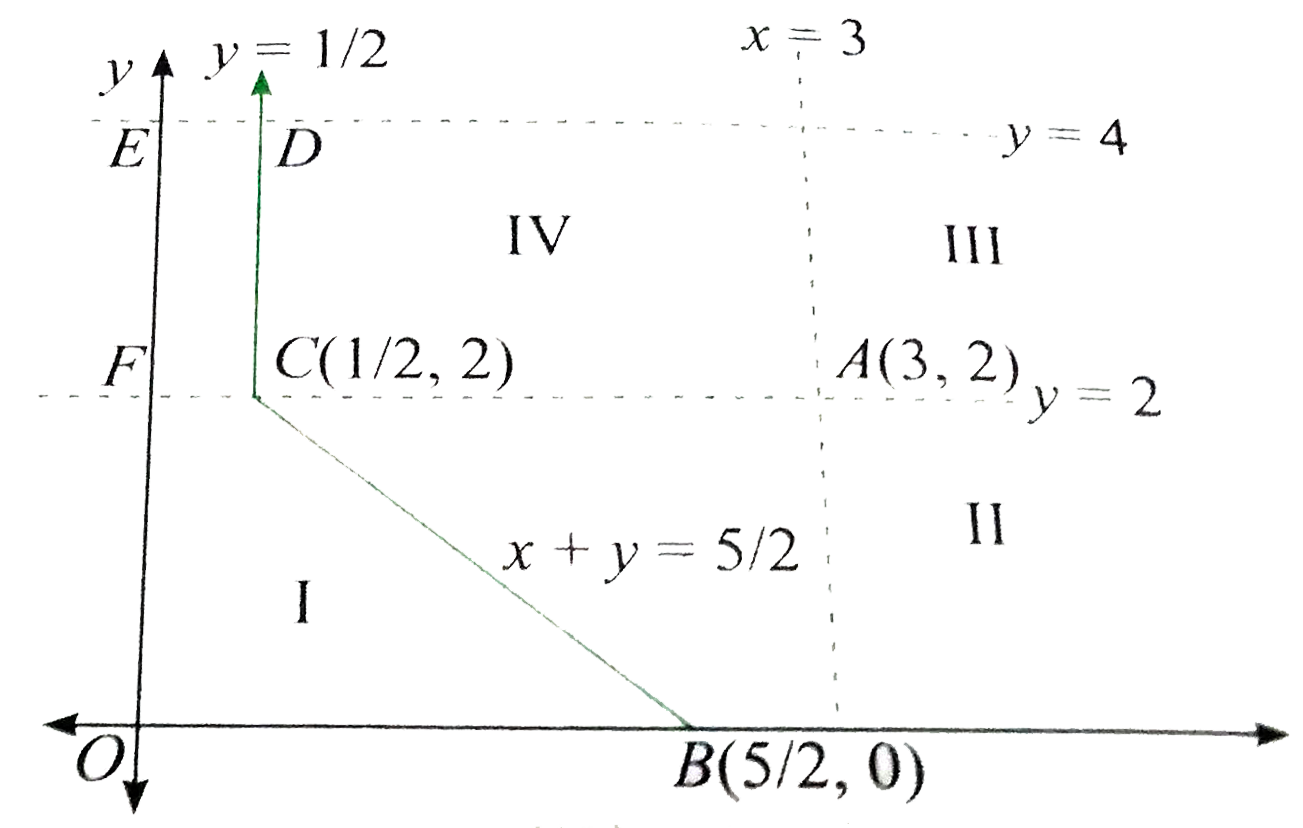 OBVIOUSLY, the LOCUS of P is a relation but not a function. |
|
| 22. |
f(x) = cot^(-1)x: R^(+) rarr (0,pi) and g(x) = 2x-x^(2): R rarrR then the range of f(g(x)) is ........... |
|
Answer» `(0,(PI)/2)` |
|
| 23. |
Find the area of a parallelogram whose adjacent sides are given by the vectors veca=3hati+hatj+4hatkandvecb=hati-hatj+hatk |
|
Answer» |
|
| 24. |
Find the area of the region enclosed by the given curves . y=sinx ,y=cosx , x=0 , x=(pi)/(2) |
|
Answer» |
|
| 26. |
Consider the function f(x) = |{:(a^(2)+x,,ab,,ac),(ab,,b^(2)+x,,bc),(ac,,bc,,c^(2)+x):}| which of thefollowingis true ? |
|
Answer» f(x) has one+vepoint of MAXIMA. Applying `C_(1) to C_(1)+bC_(2) +cC_(2)` and taking `a^(2) +b^(2)+c^(2)+x` COMMON we GET `Delta =(1)/(a)(a^(2)+b^(2)+c^(2)+x) |{:(a,,ab,,ac),(b,,b^(2)+x,,bc),(c,,bc,,c^(2)+x):}|` Applying `C_(2) to C_(2)-bC_(1) " and " C_(3) to C_(3)-cC_(1)` we get `Delta =(1)/(a)(a^(2)+b^(2)+c^(2)+x) |{:(a,,0,,0),(b,,x,,0),(c,,0,,x):}|` `=(1)/(a) (a^(2) +b^(2)+c^(2)+x) (ax^(2))` `=x^(2) (a^(2)+b^(2)+c^(2)+x)` Thus `Delta ` is divisib le by x and `x^(2)`. alsograph of f(x) is 
|
|
| 27. |
Evaluate the following integrals. int(1)/(3+2sinx+cosx)dx |
|
Answer» |
|
| 28. |
Evalaute intx^(_1//2)(2+3x^(1//3))^(-2)dx. |
|
Answer» Solution :`I=intx^(-1//2)(2+3x^(1//3))^(-2)dx` Let ` x=t^(6) " or " dx=6T^(5)dt` ` :. I=int t^(-3)(2+3t^(2))^(-2) *6t^(5) dt` `=6 int (t^(2))/((2+3t^(2))^(2))dt` `=(6)/(9)int (t ^(2)dt)/(((2)/(3)+t^(2))^(2))` Now, Let ` t=sqrt(((2)/(3)))TAN theta` ` :. dt =sqrt(((2)/(3)))SEC^(2) theta d theta` ` :. I=(6)/(9)int((2)/(3)tan^(2) theta *sqrt(((2)/(3)))sec^(2) theta d theta)/((4)/(9)sec^(4) theta)` `=sqrt((2)/(3))intsin^(2) theta d theta` `=(1)/(sqrt(6))int(1-cos 2 theta)d theta` `=(1)/(sqrt(6)){theta - (sin 2 theta)/(2)}+c` `=(1)/(sqrt(6)){theta - (tan theta)/(1+tan^(2)theta)}+c` `=(1)/(sqrt(6)){"tan"^(-1){sqrt((3)/(2))t}-(sqrt((3)/(2))*t)/(1+(3)/(2)t^(2))}+c` `=(1)/(sqrt(6)){"tan"^(-1){sqrt((3)/(2))x^(1//6)}-(sqrt(6)x^(1//6))/(2+3x^(1//3))}+c` |
|
| 29. |
Find the second order derivatives of the following functions: sin^(2) x |
|
Answer» |
|
| 30. |
Two lines are drawn at right angles one being a tangent to y^(2) = 12x and the other to x^(2) = 111116y. If the locus of their point of intersection is (x^(2)+y^(2))(lx+my)+(nx-3y)^(2)=0 then l+n-m is equal to |
|
Answer» `y = mx +(3)/(m),y = mx-4m^(2)` `m^(2)x- my +3=0,4m^(2)-mx+y=0` eliminating m we GET the LOCUS |
|
| 31. |
The shortest distance between the skew lines l_(1): barr=bara_(1)+lambdabarb_(1) and l_(2): barr= bara_(2)+mubarb_(2) is |
|
Answer» `((bara_(2)-bara_(1)).barb_(1)xxbarb_(2))/(|barb_(1)xxbarb_(2)|)` |
|
| 33. |
Professor Malingowski, a chemist and teacher at to communite college, is organizing his graduated cylinders in the hopes of keeping his office tidy and setting a good example for his students. He has beakers with diameters, in inches, of 1/2,3/4,4/5,1 and 5/4. With his original five cylinders, Professor Malingowski realizes that he is missing a cylinder necessary for his upcominglab demonstration for Thurday's class. He remembers that the cylinder the needs, when added to the original five, will create a median diameter value of 9/10 for the set of six total cylinders. He also knows that the measure of the sixth cylinder will exceed the value of the range of the current five cylinders by a width of anywhere from 1/4 inches to 1/2 inches, inclusive. Based on the above data, which is one possible value of y, the diameter of this missing sixth cylinder? |
|
Answer» |
|
| 34. |
State with reason whether the following functions have inverse h : {2, 3, 4, 5} rarr {7, 9, 11, 13} with h = {(2,7), (3,9), (4, 11), (5, 13)} |
|
Answer» SOLUTION :`h = {(2,7), (3,9), (4, 11), (5,13)}` YES, SINCE h is bijective `h^(-1)= {(7,2), (3,9), (11,4), (13,5)}` |
|
| 35. |
Integrate the following function : int(2x)/(sqrt(1-x^(2)-x^(4)))dx |
|
Answer» |
|
| 36. |
Find area of the triangle withh vertices at the point given in each of the following : (11,8),(3,2),(8,12) |
|
Answer» |
|
| 37. |
If adj [(1,0,2),(-1,1,-2),(0,2,1)]=[(5,a,-2),(1,1,0),(-2,-2,b)], then find a ,b |
|
Answer» |
|
| 38. |
a matrix H= [h_(ij)is used to keep track of three football players (numbered 1,2,and 3) in three matches 1^(st) ,2^(nd) and 3^(rd)Re(H_k) =number of matches in which both ))and k^(th)players or both did not play (if) jk it is 3) Img (h_(k) =( number of matches played byj^(th)player ) det (H) is |
|
Answer» complex with imaginary PART a multiple of 4 |
|
| 39. |
If f: [(2,oo) rarr R be the function defined by f(x) =x^(2) - 4x +5, then the range of f is ........... |
| Answer» SOLUTION :N/A | |
| 40. |
a matrix H= h_(ij)is used to keep track of three football players (numbered 1,2,and 3) in three matches 1^(st) ,2^(nd) and 3^(rd)Re(H_k) =number of matches in which both )and k^(th)players or both did not play (if) jk it is 3) Img (h_(k) =( number of matches played byj^(th)player ) Let P= [P_(ik) ]. P_(ik) =1if player played in k^(th) match and p_k)=-i otherwise(i=sqrt(-1) )then , |det(H) is equal to |
|
Answer» <P>|det (P) `|_3` |
|
| 41. |
In a bakery four types of biscuits are available. In how many ways a person can buy 10 biscuits if he decide to take atleast one biscuit of each variety? |
|
Answer» |
|
| 42. |
In 1919, H. S. Reed and R. H. Holland published a paper on the growth of sunflowers. Included in the paper were the table and graph above, which show the height h, in centimeters, of a sunflower t days after the sunflower begins to grow. Over which of the following time periods is the average growth rate of the sunflower least? |
|
Answer» Day 0 to Day 21 Alternate approach: The average growth rate of the sunflower over a certain time period is the slope of the line segment that joins the point on the graph at the beginning of the time period with the point on the graph at the end of the time period. Based on the graph, of the four time periods, the slope of the line segment is least between the sunflower’s height on day 63 and its height on day 84. Choices A, B, and C are incorrect. On the graph, the line segment from day 63 to 84 is less steep than each of the THREE other line segments representing other periods. Therefore, the average growth rate of the sunflower is the least from day 63 to 84. |
|
| 43. |
For a matrix , A = [{:(1, 0, 0),(2, 1, 0),(3,2,1):}] , if U_(1), U_(2) and U_(3) are 3xx 1column matrices satisfying AU_(1) = [{:(1),(0),(0):}], AU_(2) = [{:(2),(3),(0):}], AU_(3) = [{:(2),(3),(1):}] and U is a 3xx 3 matrix whose columns are U_(1) , U_(2) and U_(3) . then sum of the element of U^(-1) is |
|
Answer» 6 |
|
| 44. |
In 1919, H. S. Reed and R. H. Holland published a paper on the growth of sunflowers. Included in the paper were the table and graph above, which show the height h, in centimeters, of a sunflower t days after the sunflower begins to grow. The function h, defined by h(t) = at + b , where a and b are constants, models the height, in centimeters, of the sunflower after t days of growth during a time period in which the growth is approximately linear. What does a represent? |
|
Answer» The predicted NUMBER of centimeters the sunflower grows each day during the period Choice B is incorrect. In the given model, the beginning of the period corresponds to t = 0, and since h(0) = b, the predicted height, in centimeters, of the sunflower at the beginning of the period is represented by b, not by a. Choice C is incorrect. If the period of time modeled by the function is c days long, then the predicted height, in centimeters, of the sunflower at the end of the period is represented by ac + b, not by a. Choice D is incorrect. If the period of time modeled by the function is c days long, the predicted total increase in the height of the sunflower, in centimeters, during that period is represented by the difference h(c) − h(0) = (ac + b) − (a · 0 + b), which is equivalent to ac, not a. |
|
| 45. |
Let x+1/x=1 and a, b and c are distict positive integer such that (x^(a)+1/x^a)+(x^b+1/x^(b))+(x^(c) +1/x^(c))=0 Then the minimum value of (a+b+c) is |
|
Answer» 7 |
|
| 47. |
Integrate the following rational functions : int(1)/(6e^(2x)+5e^(x)+1)dx |
|
Answer» |
|
| 48. |
Product of perpendiculars from the foci of x^(2)/4-y^(2)/9=1" to "y=mx+sqrt(4m^2- 9) where m gt 3/2 is |
| Answer» Answer :D | |
| 49. |
If y=f(x) and x=g(y) are inverse of each other. Then g'(y) and g"(y) in terms of derivative of f(x) is |
|
Answer» `-(F"(X))/([f'(x)]^(3))` |
|
| 50. |
If overset(-)(a)=2hati-3hatj+5hatk, overset(-)(b)=3hati-4hatj+5hatk and overset(-)(c)=5hati-3hatj-2hatk, then the volume of the parallelopiped with co-terminus edges overset(-)(a)+overset(-)(b)+ overset(-)(c), overset(-)(c)+overset(-)(a) is |
|
Answer» 1 |
|