

Saved Bookmarks
This section includes 7 InterviewSolutions, each offering curated multiple-choice questions to sharpen your Current Affairs knowledge and support exam preparation. Choose a topic below to get started.
| 1. |
Determine P(E|F) Two coins are tossed once, where (i) E : tail appears on one coin, F : one coin shows head (ii) E : no tail appears, F : no head appears |
|
Answer» |
|
| 2. |
Compute the ""^9C_4 + ""^9C_5 |
|
Answer» SOLUTION :`""^9C_4 + ""^9C_5= (9!)/(4!5!)+(9!)/(5!4!)` ` = (9*8*7*6)/(4*3*2*1)xx2 =252` |
|
| 3. |
If OP = 21 and direction cosines of bar(OP) are(2)/(7),(6)/(7), (-3)/(7), then the co-ordinates of P are |
|
Answer» (6, 18, -9) |
|
| 4. |
int_(0)^(pi/2) (cos^(2)x dx)/(cos^(2)x+4 sin^(2)x) |
|
Answer» SOLUTION :`" LetI "= int_(0)^(pi//2) (cos^(2)x)/(cos^(2)x+4sin^(2)x)dx.....(1)` `=int_(0)^(pi//2) (cos^(2)x)/(4-3cos^(2)x)dx` `( :' sin^(2) x=1-cos^(2)x)` `=-(1)/(3)int_(0)^(pi//2) (4-3 cos^(2) x-4)/(4-3 cos^(2)x) dx` `=-(1)/(3) int_(0)^(pi//2) (1-(4)/(4-3 cos^(2)x))dx` `=-(1)/(3)[x]_(0)^(pi//2) +(4)/(3) int_(0)^(pi//2) (sec^(2)x)/(4sec^(2) x-3) dx` (Divide numeratornad denominator by `cos^(2)` x insecond integral) `=(pi)/(6)+(4)/(3) int_(0)^(pi//2) (sec^(2) x)/(4(1-tan^(2) x)-3)dx` `underset(" and" x=((pi)/(2)) rArrt=oo)underset("and" x=0 rArr t=0)("Let """ tan x=t)` `:. I= -(pi)/(6)+(4)/(3) int_(UU)^(oo) (DT)/(4(1+t^(2))-3)` `=-(pi)/(6)+(4)/(3) int_(0)^(oo) (dt)/(4t^(2)+1)` `=-(pi)/(6)+(4)/(3)xx(1)/(4) int_(0)^(oo)(dt)/(t^(2)+((1)/(2))^(2))` `=-(pi)/(6) +(1)/(3) .2 [tan^(-1) .((t)/(1))/((1)/(2))]_(0)^(oo)` `=-(pi)/(6)+(2)/(3) [tan^(-1) oo-tan^(-1) 0)` `=-(pi)/(6)+(2)/(3) ((pi)/(2)-0)=(pi)/(6)+(pi)/(3)=(pi)/(6)` |
|
| 5. |
int_(0)^(2pi) sin^(7) x dx= |
|
Answer» 0 |
|
| 6. |
If theta_(i)in [ 0, pi//6], I = 1, 2, 3, 4,5 and sin theta_(i)z^(4)+ sin theta_(2)z^(3)+ sin theta_(3) z^(2)+ sin theta_(4) z+ sin theta_(5) =2, then z satisfies. |
| Answer» Answer :A | |
| 7. |
Which sets are finite and which are infinite The set Z of integers |
| Answer» SOLUTION :"The SET Z of INTEGERS" is an INFINITE set. | |
| 8. |
If |bar(x).bar(y)|=cos alpha, then |bar(x)xx bar(y)| = ……………. |
|
Answer» `+-SIN ALPHA` |
|
| 9. |
Find the correct pair in the following statement :y = tan x is a periodic function with period pi Domain of cosecant function is R The periodof f = g pm hisl.c.m of periodof g , period of h "cosec"^(-1)x +sec^(-1) x = pi/4 |
|
Answer» (i) and (II) |
|
| 10. |
Corner points of the feasible region for an LPP are (0, 2), (3, 0), (6, 0), (6, 8) and (0, 5). Let F = 4x + 6y be the objective function. The Minimum value of F occurs at ……….. |
|
Answer» only (0, 2) |
|
| 11. |
If (z_(2))/(z_(1)) is pure imaginary, then abs((6z_(1)-8z_(2))/(4z_(2)+3z_(1)))= |
| Answer» Answer :C | |
| 12. |
Find the coordinates of the points on the ellipse 3x^(2)+y^(2)=37 at the normals are parallel to 5x-6y+3=0 . |
|
Answer» |
|
| 13. |
(i)Prove that (adj adjA)-|A|^(n-2)A (ii) Find the value of |adj adj adj A| in terms of |A| |
|
Answer» |
|
| 14. |
if x+y=1, then underset(r=0)overset(n)(sum)r^(2).^(n)C_(r)x^(r)y^(n-r) equals |
|
Answer» nxy |
|
| 15. |
Integrate the functions (sin^(-1)x)/(sqrt(1-x^(2))) |
| Answer» | |
| 16. |
Findproducts : [[1,2,3],[4,5,6],[7,8,9]][[0,0,0],[0,0,0],[0,0,0]] |
| Answer» SOLUTION :`[[1,2,3],[4,5,6],[7,8,9]][[0,0,0],[0,0,0],[0,0,0]]=[[0,0,0],[0,0,0],[0,0,0]]` | |
| 18. |
Statement 1: The slope of the tangent at any point P on a parabola , whose axis is the axis of x and vertex is at the origin , is inversely proportional to the ordinate of the point P Statement 2: The system of parabola y^(2) =4axsatisfies a differentialequation of degree 1 and order 1 |
|
Answer» A) Statement - 1 and statement 2 are both false |
|
| 20. |
The point of contact 8x-9y+5 = 0 with the ellipse 4x^(2)+9y^(2)=1 is |
|
Answer» `(2/5,1/5)` |
|
| 21. |
Find the principle value of the followingsec^(-1)(2/sqrt3) |
|
Answer» SOLUTION :`SEC(pi/6)=1/(COS(pi/6))=1/((sqrt3/2))=2/sqrt3`and `pi/6 in [0,pi]-{pi/2}` `therefore The principal value of `sec^(-1)(2/sqrt3)=pi/6` |
|
| 24. |
If 5 positive integers are taken at random and multiplied together. The probability that the last digit of the product is 2,4,6,8 is |
|
Answer» `(4^(5) - 2^(5))/(5^(5))` |
|
| 25. |
The value of int_(0)^(pi) (dx)/(1+5^(cosx)) is : |
|
Answer» `(PI)/(2)` |
|
| 26. |
int_(0)^(pi//2) (1)/(9 cos x + 12 sin x) dx= |
|
Answer» LN 6 |
|
| 27. |
If u=ax+by+cz, v=ay+bz+cx, w=ax+bx+cy, then the value of |{:(a,b,c),(b,c,a),(c,a,b):}|xx|{:(x,y,z),(y,z,x),(z,x,y):}| is |
|
Answer» `U^(2)+v^(2)+w^(2)-2uvw` `=|{:(u,v,w),(w,u,v),(v,w,u):}|` `=u(u^(2)-vw)-v(wu-v^(2))+w(w^(2)-uv)` `=u^(3)+v^(3)+w^(3)-3uvw` |
|
| 28. |
(i) If (ax+b)/((2x+3)^(2))=(1)/(2x+3)+(k)/((x^(2)+2)^(2)), then find the values of a, b. |
|
Answer» |
|
| 29. |
{:(" "Lt),(n rarr oo):} ((1+2^(4)+3^(4)+......+n^(4))/(n^(5)))-{:(" "Lt),(n rarr oo):} ((1+2^(3)+3^(3)+....+n^(3))/(n^(5)))= |
|
Answer» 0 |
|
| 30. |
Three contractorsA, B, C are bidding for the construction of a new office building. The probability that C will get the contractis half the B's probability of getting the same, again, the probabilitythat B will get the contract is (5)/(7)th of A's probabilityof getting the same. Find the probability of each to get the contract. (Assumethat one of the three contractors A, B, C will get the contract.) |
|
Answer» |
|
| 31. |
A unit vector normal to the plane through the points vecr, 2hatj and 3hatkis |
|
Answer» `6hati + 3hatj + 2HATK` |
|
| 32. |
If pi+theta is the eccentric angle of a point on the ellipse 16x^(2)+25y^(2) = 400 then the corresponding point on the auxiliary circle is |
|
Answer» `(-4 cos theta,-4 sin theta)` |
|
| 33. |
If (x^(2)-10x+13)/((x-1)(x^(2)-5x+6))=A/(x-1)+B/(x-2)+C/(x-3), then C = |
|
Answer» -1 |
|
| 34. |
Evaluate the following integrals. int(1)/(x^(2)sqrt(4+x^(2)))dx |
|
Answer» |
|
| 35. |
a,b and c are three unit vectors such that no two of them are collinear. If b=2 {axx(bxxc)} and alpha is the angle between a,c and beta is the angle between a,c and beta is the angle between a,b then cos (alpha+beta) = |
|
Answer» `(sqrt(3))/(2)` |
|
| 36. |
Draw the graph of [y] = sin x, x in [0,2pi] where [*] denotes the greatest integer function |
|
Answer» Solution :We have [y] = sin x This is satisfied by INTERGRAL values of sin x only. So sin x = -1, 0, 1 When `sin x = -1, x = (4n - 1)(pi)/(2), n in Z` And `[y] = -1 therefore - 1 le y lt 0` When `sin x = 1, x (4n + 1)(pi)/(2), n in Z` And `[y] = 1 therefore 1 le y lt 2` When `sin x = 0, x = npi, n in Z` And `[y] = 0 therefore 0 le y lt 1` Hence the graph of the function is as shown in the following figure. 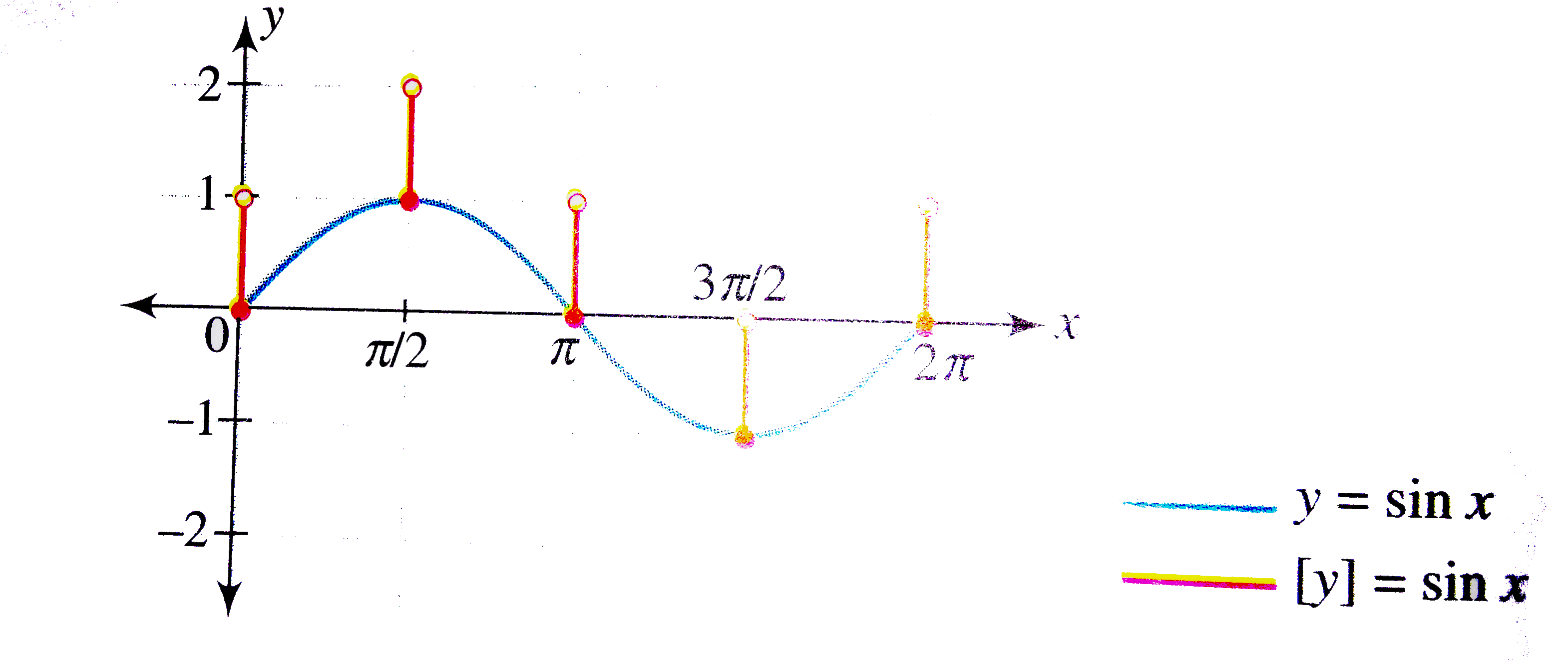 Drawing the graph of `g(x) = f(x) sin x` We have `g(x) = f(x) sin x`. Since `-1 le sin x le 1`, we have `-f(x) le f(x) sin x le f(x)`. Thus the graph of `g(x) = f(x)` sin x lies between th graphs of `y = f(x)` and y = -f(x). So the draw the graph of y = g(x), we first draw the graph of y = f(x) and y = -f(x) and PLOT the points of the graph for quadrant angles, i.e. `x = ... -pi, -pi//2, 0, pi//2, pi, 3pi//2, 2pi...` `g(pi//2) = f(pi//2) " sin " (pi//2) = f(pi//2),` thus the POINT `(pi//2, f(pi//2))` lies on the graph of y = f(x) `g(3pi//2) = f(3pi//2) " sin " (3pi//2) = -f(3pi//2),` thus the point `(3pi//2, - f(3pi//2))` lies on the graph of y = -f(x). Similarly, for `x = 5pi//2, 9pi//2, ...` points of y = g(x) lie on the graph of y = f(x), and for `x = 3pi//2, 7pi//2, ...` points of y = g(x) lie on the graph of y = -f(x). |
|
| 37. |
Find the equation of the circle passing through (-1,0) and touching x+ y-7 = 0 at (3,4) |
|
Answer» |
|
| 38. |
Let vec(a), vec(b), vec(c) be the position vectors of points A, B, C respectively. Under which one of the following conditions are the points A, B, C collinear? |
|
Answer» `VEC(a)xxvec(b)=vec(0)` `(vec(a)xxvec(b))+(vec(b)xxvec(c))+(vec(c)xxvec(a))=vec(0)` |
|
| 39. |
IF y = e ^(m sin ^(-1)x)) and (1- x ^(2))(d ^(2) y )/( dx ^(2)) - x (dy)/(dx) - ky =0, then k is equal to |
|
Answer» `m^(2)` |
|
| 40. |
Find the radical centre of circles x^(2)+y^(2)+3x+2y+1=0,x^(2)+y^(2)-x+6y+5=0andx^(2)+y^(2)+5x-8y+15=0. Also find the equation of the circle cutting them orthogonally. |
|
Answer» |
|
| 41. |
int_(-5)^(5)|x+2|dx is equal to |
|
Answer» 1)29 |
|
| 42. |
f(x) = 1/(1-x^2) and g(x)= x, the fog(x) is |
|
Answer» `cos^2theta` |
|
| 43. |
IFint e^(2x ) f'(x) dx = g(x),then int(e^(2x ) f(x)+ e^(2x )f'(x))dx= |
|
Answer» `1/2 [e^2xf(x)- G(x) ]+C` |
|
| 44. |
The value ofsum_(r=0)^(10) (-1)^(r).4^(10-r)""^(30)C_(r)""^(30-r)C_(10-r) is equal to |
|
Answer» `.^(30)C_(10) xx 2^(10)` ` = underset(r=0)overset(10)sum(-1)^(r)..4^(10-r).(30!)/((30-r)!r!) .((30-r)!)/(20!(10-r)!)` `= (30!)/(20!)underset(r=0)overset(10)sum(-1)^(r).4^(10-r).(1)/(r!(10-r)!)` `= (30!)/(10! xx 20!)underset(r=0)overset(10)sum(-1)^(r).4^(10-r).(10!)/(r!(10-r)!)` `= .^(30)C_(10)underset(r=0)overset(10)sum(-1)^(r).4^(10-r)..^(10)C_(r)` `= .^(30)C_(10)(4-1)^(10)` `= .^(30)C_(10).3^(10)` |
|
| 45. |
Let veca, vecb, vecc be three vectors of magntiude 3, 4, 5 respectively, satisfying | [[veca, vecb, vecc]] |=60. If (veca+2vecb+3vecc).((vecaxxvecc)xxvecb+vecb)=lambdathen lambda is equal to |
|
Answer» 16 |
|
| 46. |
Thesum oftheseries(3)/(4.8)- (3.5)/(4.8.12) +(3.5.7)/(4.8.12.16) - … isequalto |
|
Answer» `sqrt((3)/(2)) - (3)/(4) ` ` (3)/(4.8)- (3.5)/(4.8.12) +(3.5.7)/(4.8.12.16)- …. ` `=(3)/(2!4^2) - (3.5)/(4^3. 3!) + (3.5.7)/(4^4 4 ! )- … ` `( 1 +x ) ^n = 1+ (nx ) /(1!)+ ( n (n - 1 ))/(2!)x ^2 +(n(n - 1 ) (n - 2))/(3!)x ^ 3+ (n(n -1) (n - 2 ) (n - 3 ))/(4!) x ^ 4 +... ` On comparingtheaboveexpansion, weget `thereforen(n -1 ) x^ 2= (3)/(4^ 2 ) ""...(2)` `n ( n - 1 ) (n - 2 ) x ^3 = ( -3 (5))/(4^3)"" ...(3) ` ` n(n - 1)(n - 2 ) (n - 3 ) x ^ 4= ((3) (5)(7))/(4 ^ 4 ) "" `...(4) `(3)div(2) , (4) div (3) ` `rArr(n - 2 ) x =(-5 ) /(4) "" ...(5)` ` rArr(n - 3 ) x = ( -7) /(4 ) "" `...(6) `(5)- (6) ` ` x = (-5 )/(4 )+(7)/(4) ` `x =(1 )/(2) ` ` (n-2 ) x= ( -5 )/(4 ) ` ` (n -2 )(1)/(2)= (-5)/(4) ` ` (n - 2 )= ( -5)/(2) ` `rArrn =(- 1 ) /(2) ` `THEREFORE(1 + x ) ^n= 1+(nx ) /(1! )+ (n (n - 1 ))/(2! ) x ^ 2+(n(n - 1 ) (n - 2 ))/( 3 ! )x ^ 3 +... ` `(1 +(1)/(2)) ^(- (1)/(2)) = 1+ ((-(1)/(2) )(1/2))/(1!) ` ` + ((-(1)/(2))(-1/2 - 1))/(2!) ((1)/(2)) ^ 2 + ... ` ` sqrt(2/3)= 1 -(1 )/(4)+ (3 )/(4.8)- (3.5 )/(4.8.12)+ (3.5.7)/(4.8.12.16) - ... ` `therefore(3)/(4.8)- (3.5)/(4.8.12) + (3.5.7)/(4.8.12.16) - ... = sqrt(2/3)- (3)/(4) ` |
|
| 47. |
A parallelogram is cut by two set of n parallel lines, parallel to the sides of the parallelo-gram. The number of parallelograms formed is |
|
Answer» `(""^(N +2)C_(2))(""^(n+2)C_(2))` |
|
| 48. |
(i) b tan ^(-1)(x/a+tan^(-1)"(x)/a) (ii) (sin ^(-1)x)^(2)-(cos^(-1)x)^2 |
|
Answer» (II) `pi/sqrt(1-x^2)` |
|
| 49. |
Find the mean deviation from the mean of the following data using step deviation method (##VIK_MAT_IIA_QB_C08_SLV_013_Q01.png" width="80%"> |
|
Answer» |
|