

Saved Bookmarks
This section includes 7 InterviewSolutions, each offering curated multiple-choice questions to sharpen your Current Affairs knowledge and support exam preparation. Choose a topic below to get started.
| 1. |
Let [{:(sin^4theta,,-1,-sin^2theta,),(1+cos^2theta,,,cos^4theta,):}]=alphaI+betaM^-1, where alpha=(theta) and beta=beta(theta) are real numbers, and I is then 2xx2 identify matrix. If alpha is the minimum of the set {alpha(theta):thetain[0,2pi)}and beta is the minimum of the set {beta(theta):thetain[0,2pi)}, then the value of alpha^**+beta^** is |
|
Answer» `-(17)/(16)` `M=[{:(sintheta,,-1,-,sin^2theta),(1+cos^2theta,,cos^4theta,,):}]=alphaI+betaM^-1`, where `alpha=alpha(THETA) and beta =beta(theta)` are REAL NUMBER andI is the `2xx2` identify matrix. Now, det `(M)=|M|=sin^4theta cos^4theta +1sin^2theta +cos^2theta +sin^2theta cos^2theta =sin^4theta cos^4theta+sin^2theta+2` `and [{:(sintheta,,-1,-,sin^2theta),(1+cos^2theta,,cos^4theta,,):}]=[{:(alpha,0),(0,alpha):}]+(beta)/(|M|)(adj M)[because M^-1=(adjM)/(|M|)]` `rArr beta =-|M|` and `alpha =sin^4theta+cos^4theta` `rArr alpha=alpha (theta) =1-(1)/(2)sin^2(2theta)`, and `beta =beta(theta) =- {(sin^2theta cos ^2theta +(1)/(2))^2+(7)/(4)}=-{((sin^2(2theta))/(4)+(1)/(2))^2+(7)/(4)}` Now, `alpha^**=.^alphamin=(1)/(2)and beta^**=.^betamin=-(37)/(16)` `because alpha` is a minimum at `sin^2(2theta) =1and beta` is minimum at `sin^2(2theta)=1` So, `alpha^**=(1)/(2)-(37)/(16)=-(29)/(16)`. |
|
| 2. |
If f(x) =ax^(2) +b, b ne 0, x le 1 =bx^(2) +ax + c, x gt 1 , then f(x) is continous and differentiable at x=1, if |
|
Answer» C=0, a=2b |
|
| 3. |
If L and L' are the ends of the latus rectum of the parabola x^(2)=6y find the equations of OL and OL' where 'O' is the origin.Also find the angle between them. |
|
Answer» |
|
| 4. |
If the foot of the perpendicular drawn from the origin to a plane is (1,2,3), then a point on the plane is |
|
Answer» (3,2,1) |
|
| 5. |
Let f(x) = max (x, x^(3)) AA x in R. Calculate the area bounded by the curves y = f(x) and the x-axis between the ordinates x = - 1 and x = 1 |
|
Answer» |
|
| 6. |
The value of int_1^2(g(x) -f(x))dx is- |
|
Answer» 2 |
|
| 7. |
If the x-axis divides the area of the rigion bounded by the parabolas y= 4-x-^(2) and y^(2) -x^(2)-xin the ratio of a: b, then ab is equal to |
|
Answer» |
|
| 8. |
If a,b,care distinctpositivenumbersthen the3expression( b+c-a) (c+a-b)(a+b-c)-abcis |
|
Answer» positive |
|
| 9. |
A circle whose diameter is major aixs of ellipe (x^(2))/(a^(2))+(y^(2))/(b^(2))=1 (agtbgt0) meets axis at point P. Ifthe orthocentre of DeltaPF_(1)F_(2)lies on ellipse where F_(1)and F_(2) are foci of ellipse , then find the eccenricity of theellipse |
|
Answer» Slope of altitude `S B,m_(1)=(b)/(ae)` Slope of `SA,m_(2)=(a)/(ae)` SINCE `m_(1)xxm_(2)=1`, we have 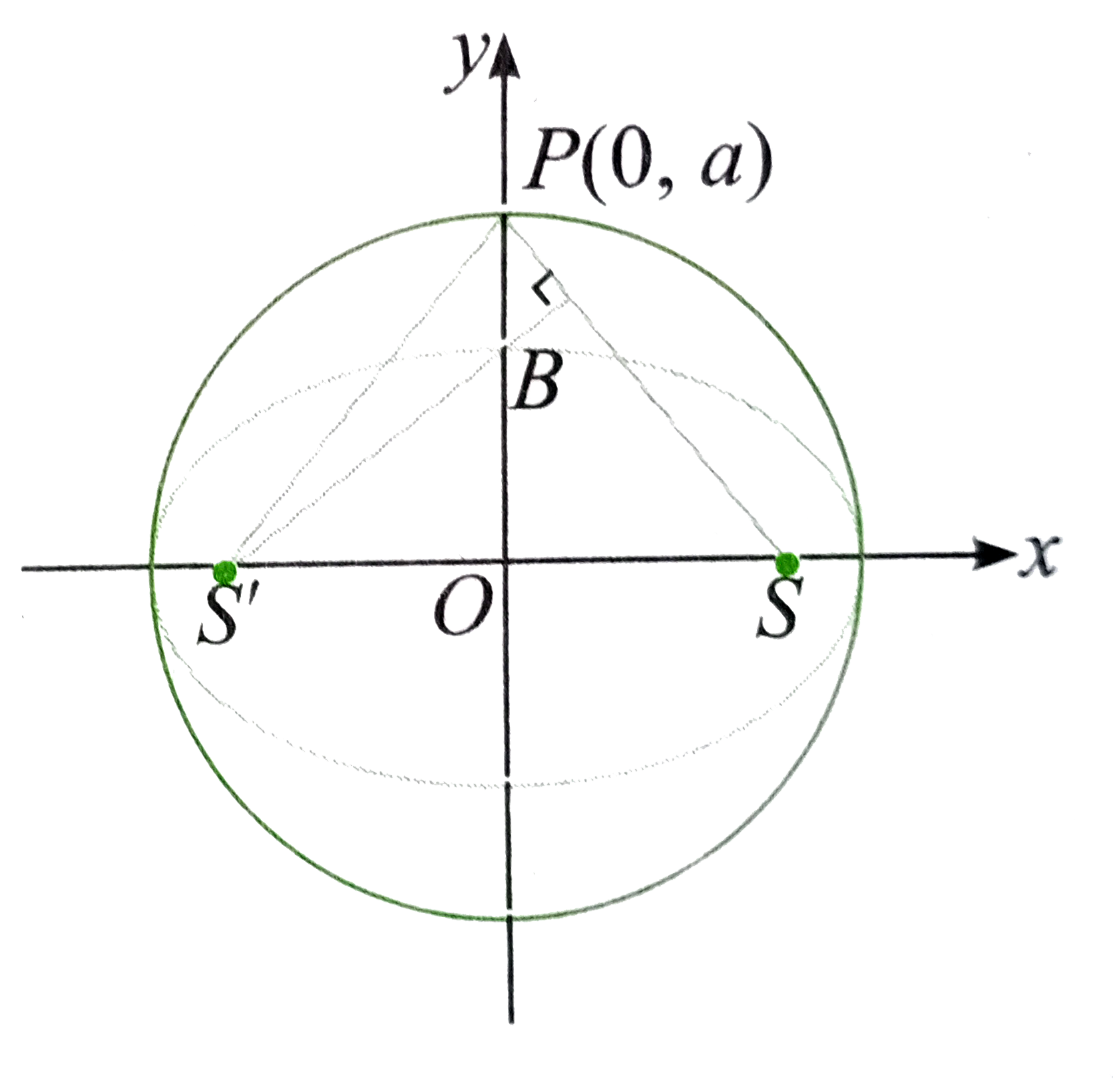 `(b)/(be)((1)/(-e))=-1` `RARR 1-e^(2)=e^(4)` `rArre^(4)+e^(2)-1==0` `rArre^(2)=(sqrt(5)-1)/(2)` `rArre=sqrt((sqrt(5)-1)/(2))` |
|
| 10. |
Let f (x) = {{:( x ^(2) - 3x + 2 "," , x lt 2 ), ( x ^(3) - 6x ^(2) + 9x + 2 "," , xge 2 ):}Then |
|
Answer» `LIM _( X to 2) f (x) ` does not exist |
|
| 11. |
"Two curves "C_(1)equiv[f(y)]^(2//3)+[f(x)]^(1//3)=0 and C_(2)equiv[f(y)]^(2//3)+[f(x)]^(2//3)=12," satisfying the relation "(x-y)f(x+y)-(x+y)f(x-y)=4xy(x^(2)-y^(2)) The area bounded by C_(1) and C_(2) is |
|
Answer» `2pi-sqrt(3)` SQ. units `(x-y)F(x+y)-(x+y)f(x-y)=4zy(x^(2)-y^(2))` `=(x^(2)-y^(2))[(x+y)^(2)-(x-y)^(2)]` `=(x-y)(x+y)^(3)-(x+y)(x-y)^(3)` `rArr""f(x+y)=(x+y)^(3)RARRF(x)=x^(3),f(y)=y^(3)` Now equations of given curves are `y^(2)+x=0"...(1)"` `x^(2)+y^(2)=12"...(2)"` 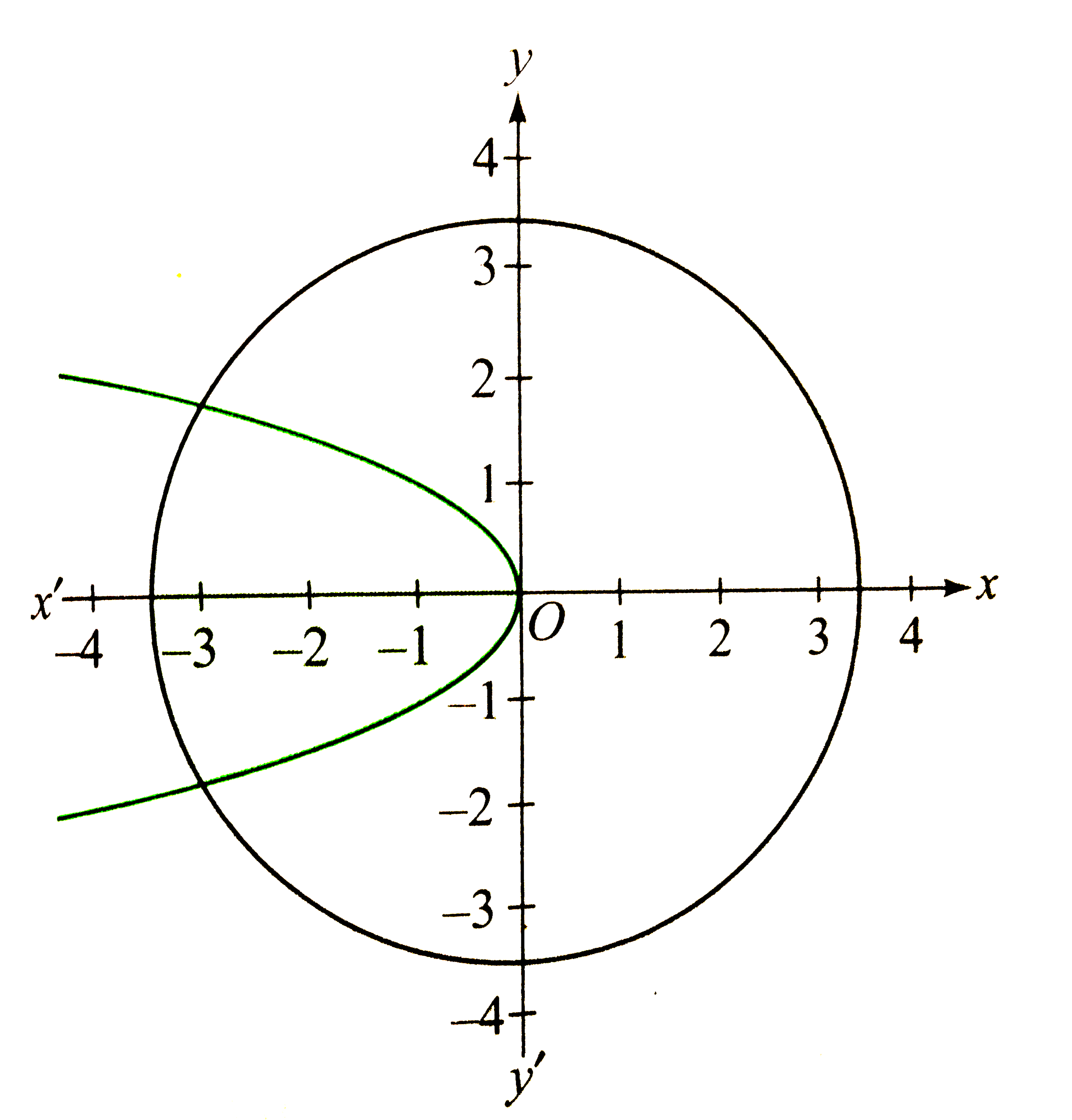 Solving equations (1) and (2), we get `x=-3,y = pm sqrt(3)` The area bounded by curves `A=2[|underset(-2sqrt(3))overset(-3)intdx|+|underset(-3)overset(0)intsqrt(-x)dx|]` `I_(1)=2overset(-3)underset(-2sqrt(3))intsqrt(12-x^(2))dx=2overset(-pi//3)underset(-pi//2)int12 cos ^(2) theta d""theta` `=12[overset(-pi//3)underset(-pi//2)INT(1+cos 2theta)d""theta]` `=12[theta+(SIN theta)/(2)]_(-pi//2)^(-pi//3)=12[-(pi)/(3)-(sqrt(3))/(4)+(pi)/(2)]` `=12[(pi)/(6)-(sqrt(3))/(4)]=2pi-3sqrt(3).` `I_(2)=2overset(0)underset(-3)intsqrt(-x)dx=(2[(-x)^(3//2)]_(-3)^(0))/(-3//2)=-(4)/(3)[10-3^(3//2)]=4sqrt(3).` `A=2pi-3sqrt(3)+4sqrt(3)=2pi+sqrt(3)` sq. units. |
|
| 12. |
"Two curves "C_(1)equiv[f(y)]^(2//3)+[f(x)]^(1//3)=0 and C_(2)equiv[f(y)]^(2//3)+[f(x)]^(2//3)=12," satisfying the relation "(x-y)f(x+y)-(x+y)f(x-y)=4xy(x^(2)-y^(2)) The area bounded by C_(1) and x+y+2=0 is |
|
Answer» `5//2` sq. units 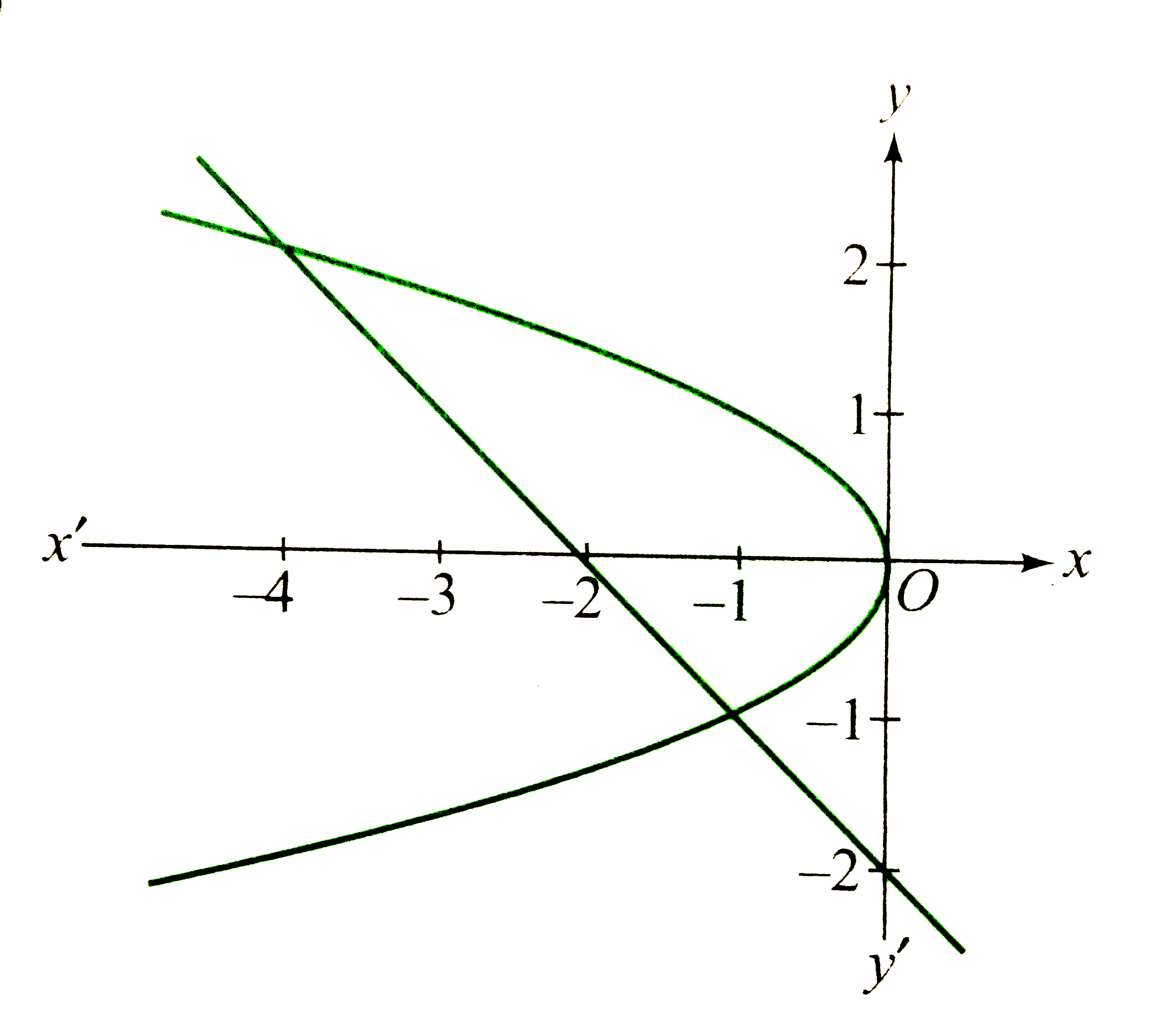 `"Required area "=OVERSET(2)underset(-1)int(-y^(2)-(-y-2))DY` `=[(y^(2))/(2)+2Y-(y^(3))/(3)]_(1)^(2)` `=[(4)/(2)+4-(8)/(3)-((1)/(2)-2+(1)/(3))]` `=9//2` sq. units. |
|
| 13. |
"Two curves "C_(1)equiv[f(y)]^(2//3)+[f(x)]^(1//3)=0 and C_(2)equiv[f(y)]^(2//3)+[f(x)]^(2//3)=12," satisfying the relation "(x-y)f(x+y)-(x+y)f(x-y)=4xy(x^(2)-y^(2)) The area bounded by the curve C_(2) and |x|+|y|=sqrt(12) is |
|
Answer» `12pi-24` SQ. units `=12pi-24` sq. units. 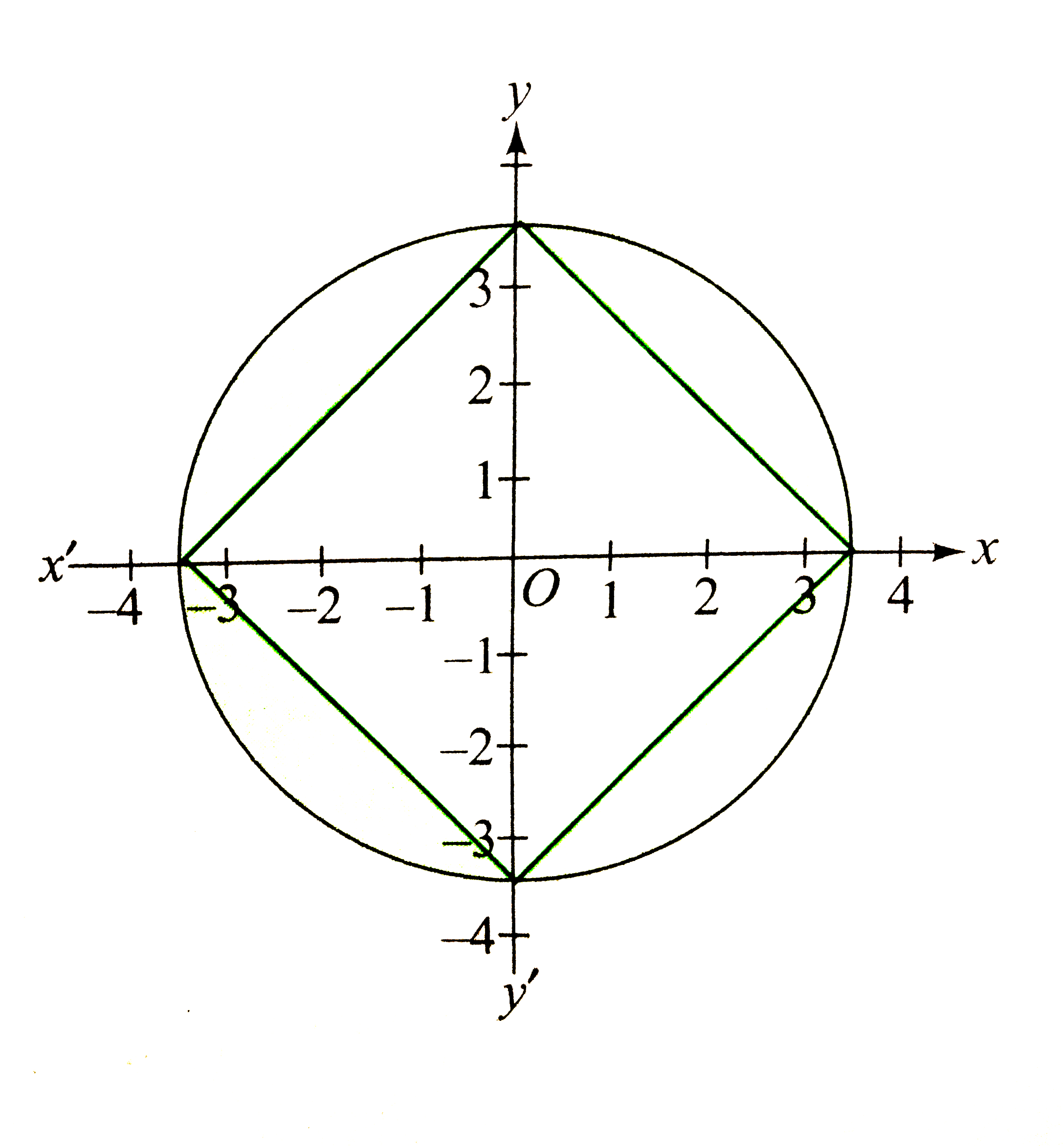
|
|
| 14. |
Determine the sign of the expression i) x^(2)+x+1 ii) -x^(2)+x-1 for x in R. |
|
Answer» |
|
| 15. |
If the sum of the distance from a variable point P to the given points A(1,0) and B(0,1) is 2, then the locus of P is |
|
Answer» `3x^(2) +3Y^(2)-4x - 4Y = 0 ` |
|
| 16. |
If lim_(xto oo){(x^2+1)/(x+1)-(ax+b)}to oo, then |
|
Answer» `a in (1,oo)` `lim_(n to oo) {(X^2+1)/(x+1)-ax-b}=oo` `rArr lim_(x to oo) (x^2(1-a)-x(a+b)+1-b)/(x+1)=oo` The limit of the given expression will be infinity, if degree of numberator is more than that of denominaotor. `THEREFORE 1-a gt 0rArr alt 1`. HENCE, `a in (- oo,1)` can assume any real value. |
|
| 17. |
The vector equation of the line passing through (2,3,4) and parallel to Z-axis is |
|
Answer» `BARR=(2hati+3hatj+4hatk)+lambdahatk` |
|
| 18. |
Ify = tan^(-1) ((sqrt(1+x^(2)) -sqrt(1-x^(2)))/(sqrt(1+x^(2)) + sqrt(1-x^(2)))) then dy/dx = |
|
Answer» `(X^(2))/(SQRT(1-x^(4))` |
|
| 19. |
Thetransformedequationwithintegerco-effcientswhoserootsaremultipledby someconstantof thoseofx^4 -1/2 x^3 +3/4x^2 -5/4 x+(1)/(16 )=0 is |
|
Answer» `y^4 -y^3+3y^2 - 10y+1=0` |
|
| 20. |
Prove that the following functions do not have maxima or minima h(x)=x^3+x^2+x+1 |
| Answer» SOLUTION :`h(x)=3x^2+2x+1ne0` for any REAL x `therefore` The discreminant of `3x^2+2x+1=0` is `4-4xx3xx1=-8lt0)thereforeh(x)` does.t have MAXIMA or MINIMA | |
| 21. |
Evaluate the following integrals. int((1+logx)^n)/(x)dx |
|
Answer» |
|
| 22. |
If a,b in R^(+) then find Lim_(nrarroo)sum_(k=1)^(n) ( n)/((k+an)(k+bn)) is equal to |
|
Answer» `(1)/(a-b) LN'(b(b+1))/(a(a+1))` if `a ne b` |
|
| 23. |
int (x dx)/(1-x cotx)=..... |
|
Answer» `LOG(cosx-X sinx)+C` |
|
| 24. |
If D=|{:(,a^(2)+1,ab,ac),(,ba,b^(2)+1,bc),(,ca,cb,c^(2)+1):}| then D= |
|
Answer» `1+a^(2)+B^(2)+C^(2)` |
|
| 25. |
Obtain the differental equations of the family of parabolas having their focus at the origin and the axis along the x-axis. |
|
Answer» |
|
| 26. |
The non-zero vectors a, b and c are related by a = 8b and c = - 7b. Then the angle between a and c is |
|
Answer» Solution :Since, a = 8B and c = - 7b `therefore` a is PARALLEL to b and c is anti-parallel to b. `implies `a and c are anti-parallel `implies` ANGLE between a and c is `pi`. |
|
| 27. |
If the letters of the 'AJANTA' are permutated in all possible ways and the words thus formed are arranged in dictionary order. Find the rank of 'JANATA' |
|
Answer» |
|
| 28. |
If x+y=1, then sum_(r=6)^(n) r ^n C_r x^r . Y^(n-r)= |
|
Answer» 1 |
|
| 29. |
A manufacturer has three machines A,B and C installed in his factory. Machines A and B are capable of being operated for atmost 12 hours whereas machine C must be operated for atleast 5 hours a day. He produces only two items X and Y each requiring the use of all the three machines. The number of hours required for producing 1 unit of each of X and Y on three machines are given in the following table: He makes a profit of Rs. 600 and Rs. 400 on each item of X and Y respectively. How many of each item should he produce so as to maximize his profit assuming that he can sell all the items that he produced? |
|
Answer» |
|
| 30. |
Equation of the plane containing the lines. r=i+2j-k+lambda(i+2j-k) and r=i+2j-k+mu(i+j-3k) is |
|
Answer» `R.(7i-4j-k)=0` |
|
| 32. |
If alpha+beta=gamma.then cos^(2)alpha+cos^(2)beta+cos^(2)gamma-2 cos alpha cos beta cos gamma= |
| Answer» ANSWER :A | |
| 33. |
sec(x+y)= xy |
|
Answer» On differentiatingboth sidesw.r.t. we get ` (d)/(DX) sec (x+y) = d/(dx) (xy)` `RARR sec (x+y).tan(x+y).(d)/(dx)(x+y)=x.d/dx y+y.(d)/(dx) x` `rArr sec(x+y). tan(x+y).(1+(DY)/(dx)) = x '(dy)(dx) +y` `rArr sec(x+y)tan(x+y)+sec(x+y).tan(x+y).(dy)/(dx)=x'(dy)/(dx) + y` `rArr (dy)/(dx) [sec (x+y).tan(x+y)-x] = y - sec(x+y).tan(x+y)` `:. (dy)/(dx) = (y-sec(x+y).tan(x+y))/(sec(x+y).tan(x+y)-x)` |
|
| 34. |
The sum (2^(1))/(4^(1) - 1) + (2^(2))/(4^(2) - 1) + (2^(4))/(4^(4) - 1) + (2^(8))/(4^(8) - 1) +... oo is equal to |
|
Answer» `sum((1)/(2^(2^(k))-1)-(1)/(4^(2^(k))-1))=sum((1)/(2^(2(2^(k-1))))-(1)/(4^(2^(k))-1))` `= sum_(k=0)^(oo)((1)/(4^(2^(k))-1)-(1)/(4^(2^(k))-1))` `= ((1)/(4^(2^(1))-1)-(1)/(4^(2^(0))-1))+((1)/(4^(2^(0))-1)-(1)/(4^(2^())-1))+((1)/(4^(2^(1))-1)-(1)/(4^(2^(2))-1))`.....{X}+{-x}={{:(0 if x in I), (1 if x !in I):}` `= (1)/(4^(-2^(1))-1) = (1)/(2-1) = 1` |
|
| 35. |
Let vec(alpha)=hat(i)+hat(j)+hat(k),vec(beta)=hat(i)-hat(j)-hat(k)andvec(gamma)=-hat(i)+hat(j)-hat(k) be three vectors. A vector vec(delta), in the plane of vec(alpha)andvec(beta), whose projection on vec(gamma)" is "(1)/sqrt(3), is given by |
|
Answer» `-hat(i)-3HAT(J)-3hat(k)` |
|
| 36. |
Consider the following information regarding the number of men and women workers in three factories I,II and III : {:("""Men workers","Women workers",),(I,30,25),(II,25,31),(III,27,26):} Represent the above information in the form of a3xx2 matrix . What does the entry in the third row and second column represent ? |
|
Answer» |
|
| 37. |
A manufacturing company makes two types of teaching aids A and B of Matematics for class XII. Each type of A requires 9 labour hours of fabricating and 1 labour hour for finighing. Each type of B requires 12 labour orse for fabricating and 3 labour hours for finighsing. For fabricating and finishing, the maximum labour hours available per week are 180 and 30 respectively. The company makes a profit of Rs. 80 on ech piece of type A and Rs. 120 on each piece of type B. How many pieces of type A and type B should be manufactured per week to get a maximum profit? Make it as a LPP and solve graphically. What is the maximum profit per week ? |
|
Answer» Then, we have to MAXIMIZE `P=80x+120y` subject to the constraints `9x+12yle180implies3x+4yle60,""...(i)` `x+3yle30""...(ii)` and `x ge0,y ge0.`ltbegt We leave it to the reader to DRAW th graphs. For maximum profit, we shall have 12 pieces of type A and 6 PICES of type B, and the maximum profit is Rs. 1680. |
|
| 38. |
If veca=hati+6hatj+3hatk, vecb=3hati+2hatj+hatk and vec c=(alpha+1)hati+(beta-1)hatj+hatkare linearlydependentvectors and |vec c|=sqrt(6), then the possible value(s) of (alpha+beta) can be : |
|
Answer» 1 |
|
| 39. |
A coin is tossed 2n times. During the toss any person can't get head and tail with equal numbers. Its probability is ........ |
|
Answer» `((2N)!)/((N!)^(2))((1)/(2))^(2n)` |
|
| 40. |
Let a and b be natural numbers and let q and r be the quotient and remainder respectively when a^2+b^2 is divided by a + b . Determine the number q and r if q^2+ r = 2000. |
|
Answer» |
|
| 41. |
int (1)/(2 + 3 cos x) dx = |
|
Answer» `(1)/(sqrt(5))log |(sqrt(5) + TAN""(x)/(2))/(sqrt(5) -tan""(x)/(2)) |`+ c |
|
| 42. |
If the curves x^2+py^2=1 and qx^2+y^2=1 are orthogonal to each other, then |
|
Answer» `p-q=2` |
|
| 43. |
Integrate the function is (xcos^-1x)/sqrt(1-x^2) |
|
Answer» |
|
| 44. |
lim_(xto0) |x| |
|
Answer» Solution :We see that when `xto0, |x|to0` Let US establish this using `EPSILON-delta` technique. Let `epsilongt0` we seek a `deltagt0` DEPENDING on `epsilons.t. |x-0|epsilon implies||x|-0|let epsilon` Now `||x|-o|=||x||=|x|ltdelta` Choosing `epsilon=delta` we have `|x|topsoil implies||x|-0|ltepsilon` `therefore lim_(xto0)|x|=0` |
|
| 45. |
The value of Cos(tan^(-1)(3/4))is: |
|
Answer» `4/3` |
|
| 46. |
If the letters of the word 'QUESTION' are arranged at random. What is the probability that there are exactly two letters between Q and U. |
|
Answer» |
|
| 47. |
Find the values of (dy)/(dx), if y = x^(tanx)+sqrt((x^(2)+1)/(2)). |
|
Answer» Taking ` u=x^(tanx)` and `v = sqrt((x^(2)+1)/(2))` `logu = tanxlogx"...."(ii)` and `v^(2) = (x^(2)+1)/(2)"....."(III)` On differentiating Eq. (ii) w.r.t.x, we get `1/u.(du)/(dx)= tanx.(1)/(x)+logx.sec^(2)x` `rArr (du)/(dx)=u[(tanx)/(x)+logx.sec^(2)x]` `=x^(tanx)[(tanx)/(x)+logx.sec^(2)x]"....."(iv)` ALSO, differentiatingEq. ( ii) w.r.t.x, we get `2v.(dv)/(dx)=1/2(2x)rArr (dv)/(dx)= (1)/(4V).(2x)` `rArr (dv)/(dx) = (1)/(4.sqrt((x^(2)+1)/(2))).2x= (x.sqrt(2))/(2sqrt(x^(2)+1))` `rArr (dv)/(dx)=(x)/(sqrt(2(x^(2)+1)))"...."(v)` Now, `y=u+v` `:. (dy)/(dx)=(du)/(dx)+(dv)/(dx)` `=x^(tanx)[(tanx)/(x)+logx.sec^(2)x]+(x)/(sqrt(2(x^(2)+1)))` |
|
| 48. |
If (1+x)^n = C_0 + C_1x+ C_2 x^2 + ….....+ C_n x^n,then C_0+2. C_1 +3. C_2 +….+(n+1) . C_n= |
|
Answer» `2^n + n.2^(n-1)` |
|
| 49. |
Resolve into Partial Fractions (vi) (x^(2)+13x+15)/((2x+3)(x+3)^(2)) |
|
Answer» `(1)/(2x+3)-(1)/(x+3)+(5)/((x+3)^(2))` |
|
| 50. |
Prove that .^(n)C_(0) + .^(n)C_(5) + .^(n)C_(10) + "….." = (2^(n))/(5) (1+2cos^(n)'(pi)/(5)cos'(npi)/(5)+2cos'(pi)/(5)cos'(2npi)/(5)). |
|
Answer» Solution :Here JUMP in the series is `'5'`. So, we use fifth roots of unity. `(1+x)^(n) = .^(n)C_(0) + .^(n)C_(1)x + .^(n)C_(2)x^(2)+.^(n)C_(3)x^(3)+"..."+.^(n)Cx^(n)` Now, we put `x = 1, alpha, alpha^(2), alpha^(3), alpha^(4)` where `alpha = cos 'a(2pi)/(5)+ISIN'(2pi)/(5)`. Puttingthese values and then adding,we get `(1+1)^(n) + (1+alpha)^(n) + (1+alpha^(2))^(n) + (1+alpha^(3))^(n) +(1+alpha^(4))^(n)` `= 5(.^(n)C_(0) + .^(n)C_(10) + "....")` `:. 5(.^(n)C_(0)+.^(n)C_(5) +.^(n)C_(10)+".....")` `= 2^(n)+(1+alpha)^(n)+(1+bar(alpha))^(n)+(1+alpha^(2))^(n)+(1+bar(alpha^(2)))^(n)` `=2^(n)+2Re(1+cos'(2pi)/(5)+isin'(2pi)/(5))^(n)+2Re(1+cos'(4PI)/(5)+isin'(4pi)/(5))^(n)` `= 2^(n) + 2Re(2cos^(2) '(pi)/(5)i2sin'(pi)/(5)cos'(pi)/(5))^(n) + 2Re(2cos^(2)'(2pi)/(5)+i2sin'(2pi)/(5)cos'(2pi)/(5))^(n)` `=2^(n)+2xx2^(n)cos^(n)'(pi)/(5)cos'(npi)/(5)+2xx2^(n)cos^(n)'(2pi)/(5) cos'(2npi)/(5)` `:. (.^(n)C_(0)+.^(n)C_(5)+.^(n)C_(10)+"......")` ` = (2^(n))/(5)(1+2cos^(n)'(pi)/(5)cos'(npi)/(5)+2cos^(n)'(2pi)/(5)cos'(2npi)/(5))` |
|