

Saved Bookmarks
This section includes 7 InterviewSolutions, each offering curated multiple-choice questions to sharpen your Current Affairs knowledge and support exam preparation. Choose a topic below to get started.
| 1. |
Integrate the following functions: (cos2x+2 sin^2 x)/cos^2x |
|
Answer» SOLUTION :`(cos2x+2 sin^2x)/cos^2x)` `=(1-2sin^2x+2sin^2x)/cos^2x = sec^2x` THEREFORE `INT (cos2x+2sin^2x)/cos^2x) = tanx+c` |
|
| 2. |
Find the area of the region bounded by the curve y^(2) = 4xand line x=3. |
|
Answer» |
|
| 3. |
If A,B,C are mutually exclusive and exhaustive events such that P(A)=2P(B)=3P(C ) then P(BuuC)= |
|
Answer» `(6)/(11)` |
|
| 4. |
Consider the three vectors p, q, r such that p=hat(i)+hat(j)+hat(k) and q=hat(i)-hat(j)+hat(k) , ptimesr=q+cp and p*r=2 Q. If y is a vector satisfying (1+c)y=ptimes(qtimesr), then the vectors x, y and r |
|
Answer» are collinear |
|
| 5. |
Drawa rough sketch of thegivencurvey=1 +|x+1|,x =-3 , x =3 , y=0and findthe areaof theregionbounded by them , usingintegration |
|
Answer» |
|
| 6. |
Consider the function f(x) =(x^(3))/(4)-sin pi x+3 |
|
Answer» f(x) does not attain VALUE within the INTERVAL [-2,2] |
|
| 7. |
Write the absolute maximum and absolute minimum of the function f(x)=x/|x| in [-2, 2]. |
Answer» SOLUTION :
|
|
| 8. |
In triangle ABC, angle A gt pi/2. A A_(1) and A A_(2) are the medium and altitude, espectively. If angle B A A_(1)= angle A _(1) A A_(2)=angle A _(2) AC, then sin^(3)""A/3 . Cos ""A/3is equal to |
|
Answer» `(3A^(3))/(16b^(2)c)` |
|
| 11. |
If P(A) = 2/3, P(B) = 4/9 " and " P(AcapB)=4/5, then find the value of P(AcupB) " and " P(A'capB'). |
|
Answer» <P> SOLUTION :`P(ACUPB)=38/45 " and " P(A'capB')=7/45` |
|
| 12. |
Solve the following system of linear equation by matrix method. x-y+2z=1 2y-3z=1 and 3x-2y+4z=2. |
|
Answer» |
|
| 13. |
Integrate the following functions : intsqrt(4x^(2)-5)dx |
|
Answer» |
|
| 14. |
Prove that : int_(pi//4)^(3pi//4) (x)/(1+sin x)dx=pi(sqrt(2)-1) |
| Answer» | |
| 15. |
Find the equation of the circle passing through the points (3,4) (3,2) ,(1,4) |
|
Answer» |
|
| 16. |
A pair of fair dice are rolled till a sum of 2 or 3 is obtained. Find the probability of getting sum 2 before getting sum 3. |
|
Answer» |
|
| 18. |
From 5 apples, 4 mangoes & 3 bananas, in how many ways we can select atleast two fruits of each variety if fruits of same species are identical? |
|
Answer» |
|
| 19. |
Centres of circles touching both the axes and also the line 3x+4y-12=0 is |
|
Answer» (1,1), (6,6), (-2,2) and (3,-3) |
|
| 20. |
If hata, hatb are unit vectors and vec c is such that vec c=veca xx vec c +vecb, then the maximum value of[veca vecb vec c] is : |
| Answer» ANSWER :B | |
| 21. |
Which one of the following must equal p + q , if x - y = p and 2x + 3y = q ? |
| Answer» Answer :D | |
| 22. |
If A and B are mutually exclusive events, given that P(A)=3/5,P(B)=1/5, then P(A or B) is |
|
Answer» |
|
| 23. |
bar(d)=lambda(bar(a)xx bar(b))+mu(bar(b)xx bar( c ))+v(bar( c )xx bar(a)) and [bar(a)bar(b)bar( c )]=(1)/(8) then lambda+mu+v = ………….. |
|
Answer» `bar(d)*(bar(a)+bar(B)+bar( C ))` |
|
| 24. |
Find the angle between the linesvecr = (3 + lambda)hati + 2(1 + lambda)hatj + 2(1 – 2lambda)hatkand vecr=5hatj-2hatk+mu(3hati+2hatj-6hatk). |
|
Answer» |
|
| 25. |
which of the following lines are asymptotes for the graph of y=(3x^2-13x-10)/(x^2-4x-5) ? I. x=-1 II. x=5 III. Y=3 |
|
Answer» I only |
|
| 26. |
The minimum radius of the circle which contains the threecircles, x^(2)+y^(2)-4y-5=0,x^(2)+y^(2)+12x+4y+31=0 and x^(2)+y^(2)+6x+12y+36=0 is |
|
Answer» `(7)/(18)sqrt(900)+3` `S_(2)-=x^(2)+y^(2)+12x+4y+31=0` and `S_(3) -=x^(2)+y^(2)+6x+12y+36=0` `C_(1) -= (0,2),r_(1)=3` `C_(2) -= (-6,-2), r_(2)=3` `C_(3) -= (-3,-6) , r_(3)=3` 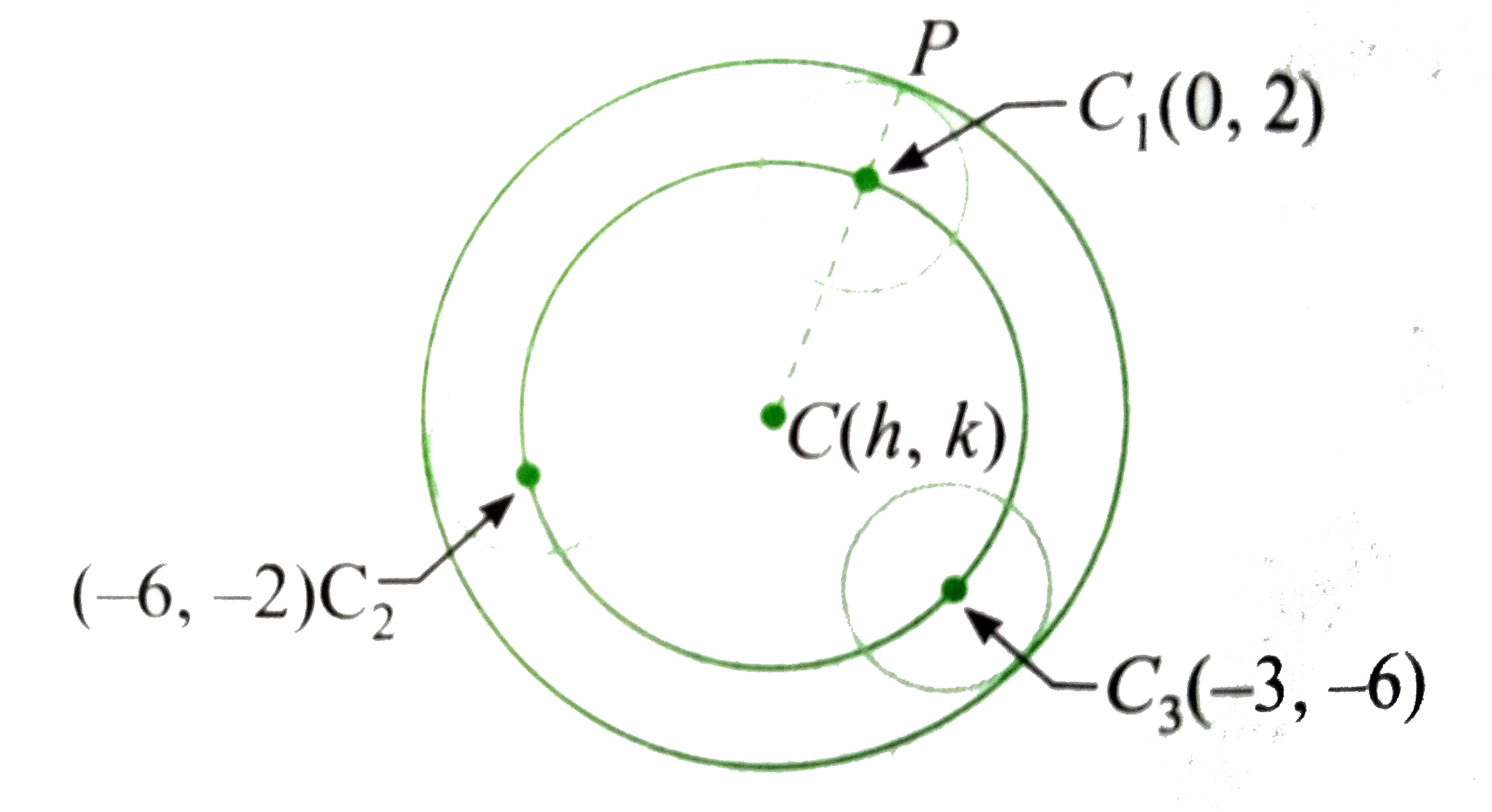 All circles have the same radius, THERADIUS of the CIRCLE touching all the circles is `CP=C C_(1)=C_(1)P+3` Let `C(h,k)` be the center of the required circle. Then, `C C_(1)= C C_(2) = C C_(3)`or `C C_(1)^(2) = C C_(2)^(2)= C C_(3)^(2)` or `(h-0)^(2)+(k-2)^(2)=(h+6)^(2)+(k+2)^(2)` `=(h+3)^(2)+(k+6)^(2)` or `-4k+4=12h+4k+40=6h+12k+45` or `3h+2k+9=0` and `6h-8k-5=0` Solving, we get `h=(-31)/(18),k=(-23)/(12)` `:. C C_(1)=sqrt((0+(31)/(18))^(2)+(2+(23)/(12))^(2))=(5)/(36)sqrt(949)` Now, `CP =C C_(1)+3=(5)/(36)sqrt(949)+3` |
|
| 27. |
For the vectors A(-1,-2,3) and B(1,2,-1) the direction cosines of vec(AB) are …………… |
|
Answer» `(1)/(3),(2)/(3),(-2)/(3)` |
|
| 28. |
Find the coefficient of x^(-7)" in "((2x^(2))/(3)-(5)/(4x^(5)))^(7) |
|
Answer» |
|
| 29. |
Distance from the point (-3,2,5) to the point where the line (x+3)/2= (y-2)/2=(z-5)/2 meets the plane x+y +2z = 3 is |
|
Answer» `7/18` |
|
| 30. |
Show that the function f(x)=|cosx| is a continuous function. |
| Answer» Solution :Write `g(X)=cosx`and`H(x)=|x|.` Then g and h are CONTINUOUS functions `therefore(hog)(x)=h(g(x))=h(cosx)=|cosx|` is a continuous function i.e.,f(x) is a continuous function. | |
| 31. |
Find the equation of all lines having slope 2 which are tangents to the curve y=(1)/(x-3), x ne 3. |
|
Answer» |
|
| 32. |
Compute the integrals :int_(1) ^(15) "arc tan " sqrt(sqrt(x) - 1)dx |
|
Answer» |
|
| 33. |
A point charge .................. |
|
Answer» `phi=Q/epsi_(0)` Now flux linked with the disc will be `phi_("disc")=Q/(2 epsi_(0)) (1- x/sqrt(x^(2)+R^(2)))` `phi_("total")=phi_("disc")+phi_("vessel")` `phi_("vessel")=Q/(2 epsi_(0)) (1+ x/sqrt(x^(2)+R^(2)))` |
|
| 34. |
There are 2n things out of which 'n' are alike and 'n' are different, the number of ways of selecting 'n' things is |
|
Answer» `""^(2N)C_(N)` |
|
| 35. |
A point charge ................. |
|
Answer» Hence `(KQ)/x+(Kq)/R=0` `(QR)/x=q` `i=(dq)/(dt)=+(QR)/x^(2) xx (dx)/(dt)` `i=(QRV)/x^(2)` |
|
| 36. |
A person gets Rs. 2 if head comes and loses Rs. 5 when a tail comes then how much money can he expect in the long run per game, when an unbiased coin in tossed twice. |
|
Answer» |
|
| 37. |
The volume of a cube is increasing at a rate of 8 cubie centimeters per second. How fast is the surface area increasing when the length of the edge is 12 cm? |
|
Answer» |
|
| 39. |
Write in the simplest form of tan^(-1)sqrt((1-cosx)/(1+cosx)),0ltxltpi |
|
Answer» |
|
| 40. |
The value of lim_(n to oo)((n!)/(n^(n))^(2n^(4+1))/(5n^(5)+1)) is equal |
|
Answer» e |
|
| 41. |
Indicate which of the following is a tautology . |
|
Answer» <P>`(~p VV Q) ~ (p vv ~q)` |
|
| 42. |
There are 25 girls and 15 boys in class XI and 30 boys and 20 girls in class XII. If a student chosen from a class, selected at random, happens to be a boy, find the probability that he has been chosen from class XII. |
|
Answer» <P> Solution :LET `E_1`= The student is choosen from class XI.`E_2` The student is choosen from class XII. A= The student is a boy.`P(E_1)=P(E_2)=1/2` `P(A//E_1)=15/40=3/8` P(A//E_2)=30/50=6/10` We WENT to find `P(E_2//A)`. By Baye.s theoren `P(E_2|A)=(P(E_2)P(A//E_2))/(P(E_1)P(A//E_1)+P(E_2)P(A//E_2))` `=(1/2cdot 6/10)/(1/2cdot3/8+1/2cdot6/10)=(6/10)/((15+24)/40)=24/39=8/13` |
|
| 43. |
AA|x|le1,cos^(-1)(-x)= |
|
Answer» `cos^(-1)(x)` |
|
| 44. |
If the position vectors of the vertices of Delta ABC are 3hati+hatj+2hatk, hati-2hatj+7hatk and -2hati+3hatj+5hatk, then the DeltaABC is |
|
Answer» right angled and isosceles `A(3hati+hatj+2hatk),B(hati-2hatj+7hatk)andC(-2hati+3hatj+5hatk)`. Now, `AB=(hati-2hatj+7hatk)-(3hati+hatj+2hatk)` `=-2hati-3hatj+5hatk` `THEREFORE |AB|=sqrt(4+9+25)=sqrt(38)` Similarly, `|BC|=|CA|=sqrt(38)` `therefore |AB|=|BC|=|CA|=sqrt(38)` HENCE, triangle is an equilateral triangle. |
|
| 45. |
Statement 1: If a circle S = 0 intersects a hyperbola xy =4at four points , Three of them are (2,2) , (4,1)and ( 6, 2//3)then coordinates of the fouth points are (1//4 , 16 ) Statement 2: If a circle S=0 intersects a hyperbola xy= c ^(2)att_1, t_2, t_3 , t_4thent_1.t_2.t_3.t_4=1.Then correct statement is |
|
Answer» Both the STATEMENT are TRUE and II is the CORRECT explanation of I |
|
| 46. |
If I_(n) = int Cot^(n)xdx then I_(4) + I_(6) = |
|
Answer» ` - (Cot^(5)x)/(5)` |
|
| 47. |
Evalute the following integrals int (x^(2) - 1)/(x^(4) + x^(2) + 1) dx |
|
Answer» |
|
| 48. |
[(1+ cos((pi)/(12))+ i sin ((pi )/(12)))/(1+ cos((pi)/(12))-i sin((pi)/(12)))^(72)] |
| Answer» ANSWER :C | |
| 49. |
Which of the following is a contradiction? |
|
Answer» <P>`(p ^^ Q) ^^ (~(p VV q))` |
|
| 50. |
Let veca,vecb,vecc be three mutually perpendicular vectors having same magnitude and vecr is a vector satisfying vecaxx((vecr-vecb)xxveca)+vecbxx((vecr-vecc)xxvecb)+veccxx((vecr-veca)xxvecb)=vec0, then vecr is equal to |
|
Answer» `1/3(veca+vecb+vecc)` |
|