

Saved Bookmarks
This section includes 7 InterviewSolutions, each offering curated multiple-choice questions to sharpen your Current Affairs knowledge and support exam preparation. Choose a topic below to get started.
| 1. |
Explain the similarties and differences of centripetal and centrifugal forces |
|
Answer» Solution :(i) bothforcesact on the sameobject (II)Bothforcesusethe sameformula FORMULA`f= m.a= (MV^(2))/( r ) =mrepsilon^(2)` bothforceactsalongthe radius  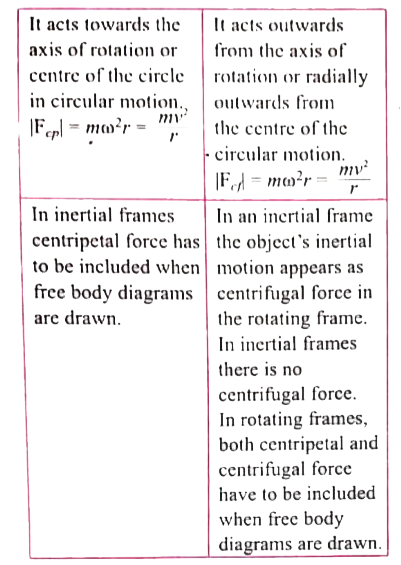
|
|
| 2. |
A ball is thrown vertically upwards from the top of a tower. Velocity at a point h m vertically below the point of projection is twice the downward velocity at a point .h. m vertically above the point of projection. The maximum height reached by the ball above the top of the tower is |
| Answer» ANSWER :D | |
| 3. |
A ball of mass .m., moving with uniform speed, collides elastically with another stationary ball. The incident ball will lose maximum kinetic energy when the.mass of the stationary ball is: |
|
Answer» Mg |
|
| 4. |
What is meant by circular motion? Give one example. |
| Answer» Solution :If the distance of a MOVING particle from.a certain fixed point ALWAYS REMAINS CONSTANT then the particle is said to be in circular motion. | |
| 5. |
When a spiral spring is stretched by a force, the resultant strain is .......... . |
|
Answer» VOLUME |
|
| 6. |
If h is Planck's constant and lambda is the wave length,h/(lambda) has the dimensions of |
|
Answer» Energy |
|
| 7. |
Match Column-I with Column-II : {:("Column-I","Column-II"),("(1) If A and B are moving perpendicular to each other than velocity of w.r.t. B.",(a)v_(rm)=v_r-v_m),("(2) Relative velocity of rain drop w.r.t to man",(b) v_(AB)=v_A+v_B),(,(c) v_(AB)=sqrt(v_(A)^2+v_(B)^2)):} |
|
Answer» |
|
| 8. |
Find the thickness of the wire. |
|
Answer» SOLUTION :EXCESS READING (ZERO error) = 0.03 mm It is GIVING 7.67 mm in which there is 0.03 mm excess reading, which has to be removed (subracted) so actual reading = 7.67 - 0.03 = 7.64 mm. |
|
| 9. |
A point traverses half a circle of radius R during theinterval tau.Calculate the following quantities averaged over that time (a)the mean velocity that is speed ltvgt , (b)the modulus of the mean vector lt v gt , ( c)the modulus of the average acceleration a if its tangential acceleration is constant. |
|
Answer» |
|
| 10. |
For a liquid in a vessel if force of Adhesion is more than force of cohesion a. shape of the meniscus is cancave upwards b. Shape of the menicus is convex upwards c. liquid level rises in the capilary tube d. liquid level drops in the capillary tube |
|
Answer» a,C are correct |
|
| 11. |
Five kg of air is heated at constant volume. The temperature of air increase from 300K to 340K. If the specific heat at constant volume is 0.169 kcal/kg K, find the amount of heat absorbed. |
|
Answer» Solution :`m=5kg,dT=340-300=40K` , `C_(v)=0.169 kcal/kg K`, PRINCIPAL specific heat at constant VOLUME `C_(v)=(DQ)/(mdT)` The amount of heat absorbed, `dQ=mC_(v)dT=5xx0.169xx40=33.8 kcal` . |
|
| 13. |
A bob of mass 200 gm is attached to a string of length 100 cm and is revolved at the rate of 2 revolutions per second. What is its angular momentum ? If after 10 s it makes only on revolutions per second calculate the mean torque. |
|
Answer» Solution :m = 200 gm = 0-200 kg,r = 100 cm = 1.00 m Initial angular velocity `=omega_(0) = 2pi xx 2` rad/s Angular MOMENTUM `=L =mvr = mr^(2) omega_(0)` `=0.2 xx 1^(2) xx 4pi` `=2.51` J.s perpendicular to the PLANE of the motion Torque = `("CHANGE of angular momentum")/("Time")` `tau = mr^(2) (domega)/(dt) = (0.2 xx 1^(2) xx (2pi xx 1))/10` =0.125 Nm. |
|
| 14. |
A glass tube of small bore is sealed at both ends,inside the tube a mercury thread is so confined that it divides the length of the tube in the ratio of 3:1 IF the temperature of the whole system is raised from 0^@C to 273^@C, them what will be the observed change in the pressure of air columns inside the tube? |
|
Answer» |
|
| 15. |
A body is swinging on a swing such that his lowest and highest positions are at heights of 2 and 4.5 m respectivel. His velocity at the lowest position is |
|
Answer» `2.5 ms^(-1)` |
|
| 16. |
Which of the following is incorrect regardingthe first law of thermodynamics? |
|
Answer» It introduces the CONCEPT of INTERNAL energy |
|
| 17. |
Give an example of (a) a physical quantity which has a unit but no dimensions (b) a physical quantity which has neither unit nor dimensions (c) a constant which has a unit (d) a constant which has no unit. |
|
Answer» Solution :PLANE angle `theta=(l)/(r)` RADIAN its unit is radian but `[theta]=M^(0)L^(0)T^(0)` (b) Strain `=(Deltal)/(l)=("Change in length")/("origianl length")` It has neither unit nor dimensions (C) GRAVITATIONAL constant. `[G]=6.67xx10^(-11)(N*m^(2))/(kg^(2))` (d) Reynold.s number is a constant which has no unit. |
|
| 18. |
Which of the following statements is correct ? (i) In the elastic collsions , the final K.E. is equal to the initial k.E. (ii) In an inelastic collision , the final K.E. may be smaller or greater than the initial K.E. (iii) In every collision ,momentum is conserved. (iv) In completely inelastic collision , colliding particles stick to each other and move with same velocity. There will be loss of K.E. |
|
Answer» `(i) ,(II)` |
|
| 19. |
The moment of inertia of a uniform disc about an axis passing through its centre and perpendicular to its plane is 1 kg m^2. It is rotating with an angular velocity 100 rad s^(-1) Another identical disc is gently placed on it so that their centres coincide. Now these two discs together continue to rotate about the same axis. Then the loss in kinetic energy in kilo joules is |
|
Answer» 2.5 `therefore L_i= L_f` where the subscripts represent INITIAL and final , or `I_(i) omega_(i) = I_(f) omega_(f)` SUBSTITUTING the GIVEN values , we get `therefore 1 xx 100 = 2 xx 1 xx omega_(f)` or `omega_(f) = 50 rad s^(-1) "" ... (i)` Initial KINETIC energy , `K_(i)= (1)/(2) I_(i) omega_(i)^(2) = (1)/(2) xx 1 xx (100)^(2) = 5 xx 10^(3) J` Final kinetic energy , `K_(f) = (1)/(2) I_(f) omega_(f)^(2) = (1)/(2) xx 2 xx 1 xx (50)^(2)` `=2 .5 xx 10^(3) J ""` (Using (i)) Loss in kinetic energy , `Delta K = K_(i) - K_(f) = 5 xx 10^(3)-2.5 xx 10^(3) J` `=2.5 xx 10^(3) J = 2.5 kJ` |
|
| 20. |
Choose the false statement : |
|
Answer» ELECTRIC current is a vector because it hasboth magnitude and direction |
|
| 21. |
The SI unit of latent heat is |
|
Answer» `Jkg^-1` |
|
| 22. |
A block of weight 200N is pulled along a rough horizontal surface at constant speed by a force of 100N acting at an angle 30^(@) above the horizontal. The coefficient of kinetic friction between the block and the surface is |
|
Answer» 0.43 |
|
| 24. |
A razor blade can be made to float on water. What force act on this blade? Is Archimedes principle applicable? |
|
Answer» Solution :When a RAZOR blade is MADE to float on water, THREE force act on the blade: (i) Weight a razor blade is made to float on water, downwards. (ii) Reaction on blade exerted by the liquid surface acting vertically upwards, (iii) Force of surface tension on circumference of the blade acting tangentially to the liquid surface. In this case as no portion of razor blade is IMMERSED in water , hence Archimedes Principe is not applicable. |
|
| 25. |
When a hot body heats up a cold body, is the temperature change of both the bodies the same? Explain the answer. |
| Answer» Solution :The change in TEMPERATURE of the two bodies WOULD differ. Heat LOST by the hot body or gained by the cold body is equal to the product of (1) mass (2) specific heat and (3) change in temperature. HENCE, the body having higher mass and higher specific heat will have less change in temperature for the same amount of heat transfer. | |
| 26. |
Choose the odd law from the following laws, equation and theorem. |
|
Answer» Stoke's LAW |
|
| 27. |
Two bodies of masses .m. and .9m. are placed at a distance .r.. The gravitational potential at a point on the line joining them, where gravitational field is zero, is (G is universal gravitational constant ) |
|
Answer» `(-14GM)/r` |
|
| 28. |
A man of mass m is on the floor of a lift. The lift moving up with acceleration 'a', then(a) the net unbalanced force on him is 'ma'(b) the normal reaction exerted by the floor on the man is m(g + a)(c ) the apparent weight greater than his true weight |
|
Answer» a, B, C are CORRECT |
|
| 29. |
If the function x=cos^(2)omegat+bsin^(2)omegat+csinomegatcosomegat represent a simple harmonic motion , then which of the foloowing options can be possible ? |
|
Answer» a=-b,c=2a `= a((1 + cos 2omegat)/(2)) + b((1-cos 2omegat)/(2)) + (1)/(2) c sin 2omegat` (a) : For `a = -b and c= 2a` `x = a cos^(2)omegat - a sin^(2)omegat + 2 a sin omegat cos omegat` ` = a(cos^(2)omegat _ sin^(2)omegat) + a SIN2 omegat` ` = a cos 2omegat + a sin 2omegat` ` = sqrt(2) a sin (2omegat + (PI)/(4))` This represents S.H.M. option (a) is true. (b) : `a= b , c --2b` ` x = b cos^(2)omegat + b sin^(2) omegat - 2b sin omegat cos omegat` ` = b-bsin 2omegat` ` = b(1-sin 2omegat)` ` = b(1-sin2omegat)` This represents S.H.M. of amplitude b. But EQUILIBRIUM occurs at b instead of zero. Option (b) is also true. (c ) a = b = c and `c ne 0` For a = b = 0 `x = (c)/(2) sin2omegat` This represents S.H.M. of option (b) is also true. (d) : a = b and c = 0 `therefore x = b cos^(2)omegat + b sin^(2) omegat = b` This does not represent S.H.M. |
|
| 30. |
The ratio of the displacement vector to the corresponding time interval is |
|
Answer» AVERAGE speed |
|
| 31. |
A body of mass 5 kg is initially at rest. By applying a force of 20 N at an angle of 60^(@) with horizontal the body is moved to a distance of 4 m. The kinetic energy acquired by the body is |
|
Answer» 80J |
|
| 32. |
Aacurate Celsius thermometer and a Fahrenheit thermometer register 60^(@) and 14^(@) respecti vet y when placed in the same constant temperature enclosure. What is the error in the Fahrenheit thermometer? |
| Answer» Answer :A | |
| 34. |
The lower end of a capillary tube of radius r is placed vertically in water. Then with the rise of water in the capillary through height 'h'. heat evolved is : (Take d= density of water ) |
|
Answer» `+ pi^2 r^2 HDG ` |
|
| 35. |
the temperature at which the r.m.s. velocity of H² becomes escape velocity from the earth is, |
|
Answer» 10059°C |
|
| 36. |
(A) : The correctness of an equation is verified using the principle of homogeneity. (B): All unit less quantities are dimensional less. |
|
Answer» Both A & B are true |
|
| 37. |
Two particles P and Q describe S.H.M of same amplitude a, same frequency f along the same straight line. The maximum distance between the two particles is asqrt(2). The phase difference between the particles is pi//N, where N is equal to ……….. |
|
Answer» |
|
| 38. |
A simple harmonic oscillator is of mass 0.1 kg. It is oscillating with a frequency of 5//piHz.If its amplitude of vibration is 5 cm find the force acting on the particle at its exreme position. |
|
Answer» 0.5 N |
|
| 39. |
Relation between torque and angular momentum is similar to the relation between |
|
Answer» ACCELARATION and velocity |
|
| 40. |
A piece of metal floats on mercury. The coefficient of volume expansion of the metal and mercury are y, and Y2 respectively. If the temperatures of both mercury and metal are increased by an amount Delta theta,by what fraction does the volume of metal submerged in mercury change ? |
| Answer» Solution :`(1 + gamma _(2) DELTA theta)/(1 + gamma _(1) Delta theta)` | |
| 41. |
In a plane projectile motion, the angle between instantaneous velocity vector and acceleration vertor can be anything between 0 or pi (excluding the limiting case). In plane-to-plane projectile motion, accleration vector is always pointing vertical downwards. (neglect air friction). |
|
Answer» Statement (I) is true, Statement (II) is true , statement (II) is the CORRECT EXPLANATION for Statement (I). |
|
| 42. |
Draw a graph of displacement varsus time as a function of time in simple harmonic motion. |
|
Answer» Solution :Here, PLOTS of the graph of x versus t, which gives the value of displacement as a continuous FUNCTION of time. This displacement is `x(t)= A cos (OMEGA t+ phi)`. Where `A, omega" and "phi` are constants and they determine the characteristics of SHM. Here, below graph of displacement as a continuous function of time for simple harmonic MOTION is shown in figure.  The meaning of standard symbols in equation `x(t)= A cos (omega t+phi)` of SHM are shown in below box. x(t) = Displacement x as a function of time t, A= amplitude, `omega` = ANGULAR frequency, `omega t+ phi` = Phase (time- dependent), `phi` = Phase constant. |
|
| 43. |
Find g on equator due to rotation of earth. |
|
Answer» SOLUTION :`implies g_(E) = G - ROMEGA^(2) coslamda` For equator `lamda=0` `:.g_(e) = g-R_(e)omega^(2)` |
|
| 44. |
The distances of two planets from the sun are 10^(12)m and 10^(10)mrespectively. The ratio of the time periods of these planets is |
|
Answer» `1000 : 1` |
|
| 45. |
Mass of an object is 2 kg and mass of another object is 4 kg. Size of both objects is identical. If both are fallen from 72 m height, then ...... of both objects will be same when they reach at I m height from ground. |
|
Answer» velocity |
|
| 46. |
When a satellite is going round the earth in a circular orbit of radius r and with a velocity V. It loses some of its energy. Then |
|
Answer» R and V both will INCREASE |
|
| 47. |
Consider the quantities : pressure, power energy, impulse, gravitational potential, electrical charge, temperature area. Out of these, the only vector quantities are |
|
Answer» IMPULSE, PRESSURE and area |
|
| 48. |
When temperature gradient is considered as positive and negative ? |
| Answer» Solution :If TEMPERATURE DIFFERENCE is taken from hot end at PERPENDICULAR DISTANCE then negative and if temperature difference is taken from cold end at perpendicular distance then it is taken as POSITIVE. | |
| 49. |
The volume V of a liquid crossing through a tube is related to the area of cross-section A, velocity v and times t as V alpha A^a v^b t^c which of the following is correct ( given a != 1 ) |
|
Answer» `a NE B ne C` |
|
| 50. |
A man standing on the edge of a roof of a 20 m tall building projects a ball of mass 100 g vertically up with a speed of 10 ms^(-1) and simultaneously throws another ball of same mass vertically down with the same speed. Find the kinetic energy of each ball when they reach the ground. (g=10 ms^(-2)) |
|
Answer» Solution :Both the two BALLS reach the ground with the same VELOCITY `h=20m, m=100 g=10^(-1)KG, U=10 ms^(-1)` `V^(2)-u^(2)=2gh` `v^(2)=u^(2)+2gh=10^(2)+2xx10xx20-500` K.E. of each ball `= (1)/(2)mv^(2)=(1)/(2)xx10^(-1)xx500=25 J` `therefore` K.E. of ball = 25 J. |
|