

Saved Bookmarks
This section includes 7 InterviewSolutions, each offering curated multiple-choice questions to sharpen your Current Affairs knowledge and support exam preparation. Choose a topic below to get started.
| 2. |
A particle is executing shm. What fraction of its energy is kinetic when the displacement is half the amplitude ? |
|
Answer» |
|
| 3. |
Let vec(a), vec(b) and vec(c ) be three vectors such that vec(a) + vec(b) + vec(c ) = 0. If |vec(a)|=3, |vec(b)|=4, |vec( c)|=5, then the value of [(vec(a).vec(b)) + (vec(b).vec( c)) + vec(c ) .vec(a))] is -5^(n) find n |
|
Answer» |
|
| 5. |
Assertion : The speed of a satellite is constant if the orbital path of the satellite is elliptical. Reason : Speed of a satellite is not constant if orbital path of the orbit is elliptical according to Kepler's laws of motion. Here, Areal velocity is constant. |
|
Answer» If both ASSERTION and REASON are CORRECT and reason is a correct EXPLANATION of the assertion. |
|
| 6. |
The coefficient of linear expansion alpha of material of a rod of length 1.5 m varies with absolute temperature T as alpha=a T-b T^(2) wherea=2.4xx10^(-8)//K^(2) and b=4.2xx10^(-12)//K^(3). If the rod is heated from 27^(0)C to127^(0)C, find the total linear expansion of the rod? |
|
Answer» |
|
| 7. |
A gas is compressed at a constant pressure of 50 N//m^(2), from a volume 10 m^(3) to a volume of 4 m^(3). 100 J of heat is added to the gas then its internal energy. |
|
Answer» INCREASES by 400J |
|
| 8. |
The position vector of a moving particle is given by vec(r ) = 3 hat(i) + 4t^(2) hat(j) - t^(3) hat(k) m |
|
Answer» It starts from X= +3m |
|
| 9. |
A' and 'B' are the two pegs seperated by 13 cm. A body of 169 Kgwt is suspended by thread of 17 cm connecting to A & B, such that the two segments of strings are |
|
Answer» 100 kgwt, 69 kgwt |
|
| 10. |
Periodic time of a simple pendulum suspended in stationary lift is T. Now when lift moves in upward direction with acceleration (g)/(3). Newperiodic time will be |
|
Answer» `SQRT(3T)` 
|
|
| 11. |
In an inelastic collision of two bodies, the quantities which do not change after the collision are the total kinetic energy/total linear momentum/total energy of the system of two bodies. |
| Answer» SOLUTION :TOTAL LINEAR momentum, and also total energy (if the system of two BODIES is isolated). | |
| 12. |
A body of mass 50kg starts from rest and slides down a smooth incilined plane.Find the force ..p.. applied at an angle 30^(@) to theinclined plane so that the body attains a velocity of 10ms^(-1) after sliding a distance of 7m. |
|
Answer» Solution :Work done by force P in displacing the block by 7m `W_(1) (Fcostheta)s=Pxx7xxcos30^(@)=(7sqrt(3))/(2)Pj` work done by gravity `W_(2)(mg sintheta)S=50xx9.8xx(1)/(2)xx7=1715j` USING work - energy theorem, `W = DELTA K.E.` `or W_(1) +W_(2)=(1)/(2)m(v_(f)^(2)-v_(i)^(2))` `or(7sqrt(3))/(2)P+1715=(1)/(2)xx50xx(10^(2)-0^(2))` `or6.06 + 1715 = 2500 therefore P=129.5N` |
|
| 13. |
A 40N force pulls a system of three masses on a horizontal frictionless surfacethevalue of tension T_(1)is |
|
Answer» 10 N 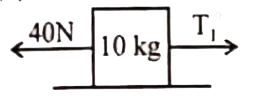 ACCELERATIONOF the system `"a"= ("Force" )/( "Totalmass" )` `= (40)/( 10 + 6 + 4)=(40)/(20) =2ms^(-2)` `F- T_(1)ma` `40 - T_(1) = 10 XX 2` `40 - T_(1)= 20` `:.T_(1)= 20 - 40 =20` `T_(1)= 20N` |
|
| 14. |
Density of a liquid 'A' is 0.5 g/c.c and that of liquid 'B' is 0.6 g/c.c. Heat capacity of 8 litres of 'A' is equal to that of 10 litres of 'B'. Thentheir specific heats ratio is |
|
Answer» `4:5` |
|
| 15. |
Calculate, the gravitational field at point O due to three massesm_(1),m_(2) and m_(3)whose positions are given by the following figure. If the masses m_(1) and m_(2)are equal what is the change in gravitational field at the point O? |
|
Answer» SOLUTION :Gravitationalfielddue to `m_(1)`at a point.O . is `vec(E)_(1) = (Gm_(1))/(a^(2)) hat(i)` Gravitational fielddue to `.m_(1)`at a point.O. is `vec(E)_(2) = - (Gm_(2))/(a^(2)) hat(i)` (Negativesignindicatesfieldacting along negativex DIRECTION ) Gravitational FIELD dueto `m_(3`at a point . O .is `vec(E)_(3) = (Gm_(3))/(a^(2)) hat(j)` `vec(E) = vec(E)_(1)+vec(E)_(2) +vec(E)_(3) = (Gm_(1))/(a^(2))hat(i)- (Gm_(2))/(a^(2)) hat(i) +(Gm_(3))/(a^(2)) hat(j)` `vec(E) = G/(a^(2)) [ (m_(1)-m_(2))hat(i) +m_(3)hat(j) ] ` If the MASSES `m_(1) =m_(2) , ` then `vec(E) = (Gm_(3))/(a^(2)) hat(j)` 
|
|
| 17. |
The escape velocity of a body on the earth's surface is v_e. A body is thrown up with a speed sqrt5v_e , Assuming that the sun and planet do not influlence the motion of the body , velocity of the bidy at infinite distance , is |
| Answer» Answer :D | |
| 18. |
(a) How much heat should be provided to ice of 720 g mass, lying at -10^@C to melt it to water at 0^@C ?(b) How much heat should be provided to water at 0^@C to increase its temperature to 100^@C ?(c) How much heat should be given to water at 100^@C to transform it completely into water ? (d) Totally, how much heat should be given to ice of 720 g at -10^@C to convert it completely into vapour ? (C"ice"=2220 "J kg"^(-1) K^(-1), C"water"=4190 "J kg"^(-1) K^(-1) ,LF=333 "kJ"/"kg", LV=2256 "kJ"/"kg") |
|
Answer» Solution :(a) The TEMPERATURE of ice will not increase until it melts completely. Thus the heat to be given to ice to carry its temperature from `T_i=-10^@C` to `T= 0^@C` (thereafter it will START to melt) is `Q_1=C_"ice"m(T_f-T_i)` where, `C_"ice"`=Specific heat of ice at `-10^@C` `=2220 "J"/"KgK"` `therefore Q_1=2220xx0.720 xx[0-(-10)]` =15984 J `therefore Q_1`= 15.98 kJ Until the ice melts completely, its temperature does not increase above `0^@ C`. Hence, the heat to be given to ice melt it completely is `Q_2=L_F m=(333 kJ//kg)(0.720 kg)` `thereforeQ_2`=239.8 kJ `therefore` Required total heat =`Q_1+Q_2` =15.98 + 239.8 =255.78 kJ (b)Now to increase the temperature of 0.720 kg water from `T_i = 0^@C` to `T_f = 100^@C`, therequired amount of heat is `Q_3=C_"water" m[T_f-T_i]` =4190 X 0.720 x (100-0) `Q_3`=301680 J `therefore Q_3` = 301.68 kJ (c) The heat to be given to water at `100^@C` to transform it completely into vapour is `Q_4=L_V m=2256xx0.720` =1624.32 kJ (d)The total amount of heat to be given to 720 gof ice at `-10^@C` to transform it completely into vapour is `Q=Q_1+Q_2+Q_3+Q_4` =15.98+239.8+301.68+1624.32 =2181.78 kJ |
|
| 19. |
Particles of masses m, 2m, 3m ... nm gram are placed on the same line at distance l, 2l, 3l, ..., nl cm from a fixed point. The distance of centre of mass of the particles from the fixed point in cm is |
|
Answer» `((2n+1)l)/(3)` |
|
| 20. |
A particle suspended by a thread of length 'l' is projected horizontally with a velocity sqrt(3gl) at the lowest point. The height from the bottom at which the tension in the string becomes zero is |
|
Answer» `(4L)/(3)` |
|
| 21. |
An object is falling freely under the gravitational force. Its velocity after travelling a distance his v. If v depends on gravitational accelertation g and distance h, then with the help of dimensional analysis, formula of v is ....... (k is constant) |
| Answer» SOLUTION :`v=kg^((1)/(2))h^((1)/(2))=v=K k SQRT(gh)` | |
| 22. |
A body constrained to move along the z-axis of a coordinate system is subject to a constant force F given by F = hati + 2hatj + 3hatk. What is the work done by this force in moving the body a distance of 4 m along the z-axis ? |
| Answer» ANSWER :A | |
| 23. |
Find the total flux due to charge q associated with the given hemisphericalsurface. |
| Answer» SOLUTION :(a) `(Q)/(2 in_(0)) ` (b) zero (C)`(q)/(in_(0))` (d) zero(e) zero | |
| 24. |
A spring balance reads W_(1) when a ball is suspended from it. A weighing machine reads W_(2) when a tank of liquid is kept on it. When the ball is immersed in the liquid, the spring balanced reads W_(3) and the weighing machine reads W_(4). |
|
Answer» `W_(1)gtW_(3)` |
|
| 25. |
Steam at 373 K is passed through a tube of radius 0.5 m and length 3m. If the thickness of the tube is 2 mm and K= 2 xx 10^(-4) in C.G.S. units find the rate of loss of heat in Js^(-1). Room temperature is 9^(@)C. |
|
Answer» |
|
| 26. |
Assertion: We cannot change the temperature of body without giving (or taking) heat to (or from) it. Reason: According to principle of conservation of energy, total energy of a system should remains conserved. |
|
Answer» Both ASSERTION and REASON are TRUE and the reason is the CORRECT EXPLANATION of the assertion. |
|
| 27. |
A rod of mass m and length l is hinged at one of its end A as shown in fig. A force F is applied at a distance x from A. The initial acceleration of centre of mass (a) varies with x as |
|
Answer»
|
|
| 28. |
A metal cylinder of radius R is placed on a wooden plank BD. The plank is kept horizontal suspended with the help of two identical string AB and CD each of length L. The temperature coefficient of linear expansion of the cylinder and the strings are a_1 and a_2 respectively. Angle q shown in the figure is 30^(@). It was found that with change in temperature the centre of the cylinder did not move. Find the ratio(alpha_(1))/(alpha_(2)), if it is know that L = 4R. Assume that change in value of theta is negligible for small temperature changes |
|
Answer» |
|
| 29. |
In the case of motion of a fluid in a tube where area of cross section is maximum a. velocity is maximum b. pressure is maximum c. Velocity is minimum d. pressure is minimum |
|
Answer» B,C are correct |
|
| 30. |
A body of mass 2 kg initially kg intially at rest moves under the action of an appliedhorizontal force of 7 N on a tablewith coefficientof kinetic friction = 0.1Computethe (a) work done by the applied force in 10 s. (b) work done by frictionin 10 s . work done by the net forceon the bodyin 10 s. (d) Change in kinetic energy of the body in 10 s and interpret your details . |
|
Answer» Solution :Frictional force , `f = muN =mu mg = 0.1 xx 2xx 9.8 = 1.96 N ` Neteffective force ` F = f = 7 - 1.96 = 5.04 N ` Acceleration of body under the NET force , `a = F/m =(5.04)/2 = 2.52 ms^(-2)` Distance covered in 10 s , `S =0+1/2 at^(2) [ :. u = 0 ] ` ` = 1/2 xx 2.52 xx10^(2)` ` = 126 m ` (a) work done by applied force , `W_(1)=(F)(s)` ` = 7 xx 126 = 882 J ` (b) Wrok done by friction , `W_(2) =-f(S)` ` = - 1.96 xx126 = - 246.96 = - 247 J ` (c ) Work done by net force= `5.04 xx126 = 635 J ` (d) CHANGE in the kinetic energy of the body. `DeltaK = DeltaW_(3)` = 635 J Interpretation : Work done by net force on the bod equal to the change in kinetic energy . |
|
| 31. |
A father and his seven years old son are facing each other on ice skates. With their hands, they push off against one another. Regarding the forces that act on them as a result of this and the acceleration they experience, which of the following is correct ? |
|
Answer» FATHER exerts more force on the son and EXPERIENCES LESS acceleration |
|
| 32. |
Describe Newton's formula for velocity of sound waves in air. |
|
Answer» Solution :Newton assumed that when sound propogates in air, the formation of compression and rarefaction takes place invery slow manner so that the process is isothermal in nature. That is, the heat produced during compression (pressure increases, volume (decreases), and heat lost during rarefaction (pressure decreases, volume increases) occur over a period of time such that the temperature of the medium remains constant. Therefore, by treating the air molecules to form an ideal gas, the changes in pressure and volume OBEY Boyle's law, MATHEMATICALLY PV= Constant................(1) Differentiating equation (1), we GET pdV + VdP=0 or, `P=-V(dP)/(dV)= B_(T)` .................(2) where, `B_(T)` is an isothermal bulk modulus of air. Substituting equation (2) in equation `v= sqrt(B/p)`, the speed of sound in air is `v_(T) = sqrt(B_(T)/rho) = sqrt(P/rho)`............(3) Since P is the pressure of air whose value at NTP (Normal Temperature and Pressure) is 76 cm of mrercury, we have `P=(0.76 xx 13.6 xx 10^(3) xx 9.8) Nm^(-2)` `rho = 1.293 kg m^(-3)`, here `rho` is density of air Then the speed of sound in air at Normal Temperature and Pressure (NTP) is `v_(T) = sqrt((0.76 xx 13.6 xx 10^(3) xx 9.8)/(1.293))` `=279.80 ms^(-1) ~~ 280 ms^(-1)` (theoretical value) But the speed of sound in air at `0^(@)` C is experimentally observed as `332 ms^(-1)` which is close upto `16%` more than theoretical value (Percentage error is `(332- 280)/332 xx 100% = 15.6%)` This error is not small. Laplace assumed that when the sound propagates through a medium, the particles oscillate very rapidly such that the compression and rarefraction occur very fast. Hence the exchange of heat produced due to compression and colling effect due to rarefraction do not take place, because, air( medium) is a bad conductor of heat. Since, temperature is no longer considered as a constant here, sound propogation is an adiabatic process. By adiabatic consideratios, the gas obey's Poisson law (not Boyle's law as Newton assumed), which is `PV^(Y)` = constant............(4) where, `lambda =C_(p)/C_(v)`, which is the ratio between specific heat at constant pressure and specific heat at constant volume. Differentiating equation (4) on both the SIDES, we get `V^(t)dP + P(lambdaV^(t-1) dV)=0` or `lambda P=-V(dP)/(dV) B_(A)`............(5) where, `B_(A)` is the adiabatic bulk modulus of air. Now, substituting equation (5) in equation `v= sqrt(B/rho)`, the speed of sound in air is `v_(A) = sqrt(B_(A)/rho) = sqrt((lambda P)/rho) = sqrt(lambda v_(T))`...........(6) `V_(A) = 331 ms^(-1)`. |
|
| 33. |
A simple pendulum 4 m long swing with an amplitude of 0.2 m. What is its acceleration at the ends of its path? (g = 10 m//s^(2)) |
|
Answer» Solution :`T= mgcostheta` `:. F_("net")= mgsintheta` and acceleration = gsintheta `= (10)(0.2)/(4)= 0.5 m//s^(2)` |
|
| 34. |
Diatomic gas at pressure .P. and volume .V.is compressed adiabatically to 1/32 times the orginal volume. Then the final pressure is |
|
Answer» <P>`P//32` |
|
| 35. |
Consider a system of two identical particles having mass m. If one of the particles of mass m is pushed towards the center of mass of the particles through a distance x, by what amount the other particle should move so as to keep the center of mass of particles at the original position? |
|
Answer» SOLUTION :Suppose the distance of mass `m_(1)` from the centre of mass C is `x_(1)` and that of `m_(2)` from C is `x_(2)` Suppose the `m_(2)` is MOVED through a distance d towards C so as keep the CENRE of mass at C. Then, `m_(1)x_(1)=m_(2)x_(2) ""`...(1) and `m_(1)(x_(1)-d)=m_(2)(x_(2)-d')""` ...(2) SUBTRACTING (2) and (1) `m_(1)x_(1)-m_(1)d - m_(1)x_(1)=m_(2)x_(2)-m_(2)d'-m_(2)x_(2)` `m_(1)d=m_(2)d'` `d'=(m_(1))/(m_(2))d` |
|
| 36. |
A space - ship is stationed on Mars. How much energy must be expended on the spaceship to rocket it out of the solar system? Mass of the spaceship = 1000 kg. Mass of thesun=2xx10^(30)kg. Mass of the Mars =6.4 xx10^(23) kg. Radius of Mars =3395Radius of the orbit of Mars = =2.28 xx10^(11)m, G = 6.67xx10^(-11)Nm^(2)kg^(-2). |
|
Answer» Solution :Let ,R be the radius of orbit of Mars and R. be the radius of the Mars. M be the mass of the SUN and M. be the mass of Mars. M be the mass of the Sun and M. be the mass of Mars. If m is the mass of the space - SHIP , then Potential energy of space - ship due to gravitational ATTRACTION of the Sun = -GMm/R Potential energy of space -ship to gravitational attraction of Mass - `GM.m//R.` Since the K.E. of space - ship is zero. therefore , total energy of space - ship `=-(GMm)/(R)-(GM.m)/(R.)=-Gm(M/R+(M.)/(R.))` `:.`Energy REQUIRED to rocket out the spaceship from the solar system = - (total energy of spaceship) `=-[-Gm(M/R+(M.)/(R.))]=Gm(M/R+(M.)/(R.))` `=-6.67 xx10^(-11) xx1000 xx[(2xx10^(30))/(2.28xx10^(11))+(6.4xx10^(23))/(3395xx10^3)]` `=6.67 xx10^(-8)[(20)/(2.28)+(6.4)/(33.95)]xx10^(18)J=5.98xx10^(11)J` |
|
| 37. |
A second pendulum is arranged in a lift . If th elift is moving up with an acceleration g//4. Its new time period will be |
| Answer» Answer :C | |
| 38. |
The correct order in which the dimensions of time decreases in· the following physical quantities. A) Power B) Modulus of elasticity C) Moment of inertia D) Angular momentum |
| Answer» Answer :D | |
| 39. |
(A) : A body slides down the plane and another body of same mass rolls down from the top of same inclined plane. Then the velocity of centre of mass is more for sliding body on reaching the bottom.(R ) : On reaching to the bottom of the plane, rolling body has both translational and rotational kinetic energies where as sliding body has only translational kinetic energy. |
|
Answer» Both (A) and (R ) are TRUE and (R ) is the correct explanation of (A) |
|
| 40. |
Two identical trains A and B move with equal actual speeds on parallel tracks along the equator. A moves east to west and B, from west to east. Which train will exert greater force on the tracks ? |
|
Answer» A |
|
| 41. |
The volume of a liquid at 10^(@) C is 50 c.c. Find its volume at 100^(@) C ? (gamma_(R) " of liquid is " 7 xx 10^(-4)//^(@) C). |
|
Answer» Solution :VOLUME of the liquid at `t_(2)" "^(0)C ` is `v_(2) = v_(1) [1 + gamma_(R) (t_(2)- t_(1)) ]` `= 50 [ 1+ 7 XX 10^(-4) xx (100 - 10) ] ` ` = 50[ 1 + 7 xx 10^(-4) xx 90 ] = 53.15 cm^(3)` `therefore v_(2)= 53.15 cm^(3)` Volume of liquid at `100^(0)C = 53.15 cm^(3)` |
|
| 42. |
A geostationary satellite orbits around the earth in a circular orbit which is at a height of 36000 kg from the surface of earth. Then the period of spy satellite orbiting a few hundred km above the earth's surface (R_("earth")= 6400 km) will approximately be |
|
Answer» `(1)/(2)HR` |
|
| 43. |
In the given figure the tension in the stiring OB is 30N. Find the weight .W. and the tension in the string OA. |
Answer» Solution :Let `T_(1) and T_(2)` be the TENSIONS in the strings OA and OB respectively  According to lani.s THEOREM `(T_(1))/(sin90^(0))=(T_(2))/(sin150^(0))=(W)/(sin120^(0))(T_(2)30N)` on SOLVING w = `30sqrt(3)N` and `T_(1)`=60N |
|
| 44. |
Root mean square speed of the molecules of ideal gas is V. If pressure is increased two times at constant temperature , then the rms speed will become: |
|
Answer» V |
|
| 45. |
Two solid spheres A and B made of the same material have radii r_(A) and r_(B) respectively . Both the spheres are cooled from the same temperature under the conditions valid for Newton's law of cooling . The ratio of the rate of change of temperature of A and B is |
|
Answer» `(r_A)/( r_B)` |
|
| 46. |
A ray is parallel to principal axis as shown in each situation of table -1. the focal length of mirror of lens in each situation of table-1 is f(h lt lt f). Match each situation in column I with the magnitude of deviation of incident ray produced in table-2. |
|
Answer» <P> |
|
| 47. |
A body of mass m is situated in a potential field U(x)= U_(0) (1-cos alpha x) when U_(0)" and "alpha are constants. Find the time period of small oscillations. |
|
Answer» Solution :Potential energy associated with field `U(x) = U_(0)[1-cos alpha x]` DIFFERENTIATE w.r.t. to x, `(dU(x))/(dx)= (d)/(dx)[U_(0)(1-cos alpha x)]` `therefore -F = -U_(0) alpha(-SIN alpha x)` `therefore F = -U_(0) alpha sin alpha x` If `alpha x` is very small, then `sin alpha x approx alpha x` `therefore F= -U_(0) alpha (alpha x)= -U_(0) alpha^(2) x"....."(1)` `therefore F propto (-x)""[therefore U_(0), alpha" are constant "]` For small oscillation motion is SHM, Standard form of FORCE EXERTED on BODY performing SHM `F= -m omega^(2) x""".........."(2)` Comparing equation (1) and (2) `m omega^(2) = U_(0) alpha^(2)` `therefore omega^(2) = (U_0)/(m_0)alpha^(2)` `therefore omega = sqrt((U_0)/(m)alpha^(2))` `therefore (2pi)/(T) = sqrt((U_0)/(m)alpha^(2))` `therefore T =2pi sqrt((m)/(U_(0)alpha^(2)))`. |
|
| 48. |
Two satellites of earth S_(1)andS_(2) are moving in the same orbit. If the mass of S_(1) is four times the mass of S_(2) then which one of the following statements is true? |
|
Answer» The potential energies of EARTH and satellite in both cases are equal. |
|
| 49. |
For a system to follow the law of conservation of linear momentum duringa collision, the condition is (a) total external force acting on the system is zero (b) total external force acting on the system is finite and time of collision is negligible (c ) total internal force acting on the system is zero |
| Answer» Answer :C | |


