

Saved Bookmarks
This section includes 7 InterviewSolutions, each offering curated multiple-choice questions to sharpen your Current Affairs knowledge and support exam preparation. Choose a topic below to get started.
| 1. |
In the above problem the direction of initial velocity with x-axis is: |
|
Answer» `TAN^(-1)(3//4)` `theta=tan^(-1)((4)/(3))` |
|
| 2. |
Derive an expansions for the work done in one cycle during adiabatic expansion. |
|
Answer» <P> Solution :Consider one MOLE of an ideal gas enclosed in a cylinder with PERFECTLY non conducting piston.`P_(1)` - initial pressure `V_(1)` - initial volume `T_(1)` - Initial temperature A - AREA of cross-section Force excited by the gas on the piston is `F=PxxA` where P - Pressure of the gas during expansion. |
|
| 3. |
The weight of a ballon is W_(1) when empty and W_(2) when filled with air. Both are weighed in air by the same sensitive spring balance and under identical conditions. |
|
Answer» `W_(1)ltW_(2)`, as the weight of air in the BALLOON is offset by the FORCE of buoyancy on it |
|
| 4. |
Assertion:Soft steel can be made red hot by continued hammering on it, but hard steel cannot. Reason: Energy transfer in case of soft iron is large as in hard steel. |
|
Answer» If both ASSERTION and reason are true and the reason is the correct explanation of the assertion. |
|
| 5. |
Copper of fixed volume V is drawn into wire of length I. When this wire is subjected to a constant force F, the extension produced in the wire is Deltall. Which of the following graphs is a straight line ? |
|
Answer» `Delta L` versus `1/l` `implies Delta l = (Fl )/( Ay)` But ` V =AL,so A = (V)/(l)` `therefore Delta l = (Fl ^(2))/( YV) PROP l ^(2), F, Y, V` are same `therefore` Graph will be `Delta l to l ^(2).` |
|
| 6. |
Given in Fig. 6.11 are examples of some potential energy functions in one dimension. The total energy of the particle is indicated by a cross on the ordinate axis. In which the particle cannot be found for the given energy. Also, indicate the minimum total energy the particle must have in each case. Think of simple physical contexts for which these potential energy shapes are relevant. |
|
Answer» Solution :(a) `x gt a , 0` (b) `-oo LT x lt oo, V_(1)` (C ) `x lt a, x gt b, -V_(1)` (d) `-b"/"2 lt x lt -a"/"2, a"/"2 lt x lt b"/"2, -V_(1)`. |
|
| 7. |
A truck starts from rest and accelerates uniformly at 2.0ms^(-2). At t = 10s, a stone is dropped by a person standing on the top of the trunk (6m high from the ground). What are the (a) velocity and (b) acceleration of the stone at t = 11s? (Neglect air resistance) |
|
Answer» 22.4 m/s at an ANGLE of `tan^(-1) 1/2` with the HORIZONTAL `10m//s^2` VERTICALLY downwards |
|
| 8. |
Turpentine oil is flowing through a tube of length 1 and radius r. The pressure difference between the two ends of the tube is p. The viscosity of oil is given by eta= (p(r^(2)-x^(2)))/(4vl) where , v is the velocity of oil at distance x from the axis of the tube. The dimensions of eta are |
|
Answer» `[M^(0)L^(0)T^(0)]` |
|
| 9. |
The absolute temperature (Kelvin scale) T1s related to the temperaturet_(c) on the Celsius scale by t_(c) = T - 273.15 Why do we have 273.15 in this relation, and not 273.16 ? |
| Answer» SOLUTION :TRIPLE -POINT is `0.01^(@) C ," not " 0 ^(@) C` . | |
| 10. |
A particle is moving along a horizontal circle Y under a centripetal force where (-c)/(r^(2))is a constant. Then, the total energy of the particle is |
|
Answer» `(-C)/(2R^(2))` |
|
| 11. |
A projectile of mass 30 kg is shot vertically upwards with an intial velocity of 10 m/s.After 5 s, it explodes into two fragments, one of which having a mass of 20 kg is travelling vertically with a velocity of 150m/s. What is the velocity of the other fragment at that instant? |
|
Answer» `-15 m//s` `V=u-gr=100-9.x5=51 m//s` The projectie explodes into TWO FRAGMENTS of masses 20kg and 30 kg APPLYING LAW ofconservationof linear momentum `20x150+30xV=(20+30)v` or `3000+30V=50x51` `or 30v=2550-3000` `V=(-450)/(30)15m//s` |
|
| 12. |
A student plucks at the centre of a stretched string and observes the wave pattern produced. put the above wave pattern pictorially label the nodes and the antinodes on the pattern. |
Answer» SOLUTION :
|
|
| 13. |
Define linear motion. Give example. |
| Answer» Solution :An object is said to be in linear motionif it MOVES in a STRAIGHT line . Eg: An ATHLETE running on a straight track. | |
| 14. |
Three spheres of different materials are in motion their radii, densities and speeds are as given {:("SI.NO","Radius","Density","Speed"),(1,r,d,v),(2,r//2,d,V//2),(3,2r,d//2,v):} If K_(1),K_(2),K_(3) are the kinetic energies of those three spheres respectively , those vlaues can be arranged in descending order as given below |
|
Answer» `K_(3),K_(2),K_(1)` |
|
| 15. |
If vec(A) = (2,-3,1) and vec(B) = (3,4,n) are mutually perpendicular then find the value of n . |
|
Answer» Solution :`VEC(A) bot vec(B)` ` :. vec(A) .vec(B) = 0 ` ` :. (2) (3) +(-3)(4) +(1)(N) = 0 ` ` :. n = 6 ` |
|
| 16. |
Dimensional formula of coefficient of viscosity is |
|
Answer» `ML^(-1)T` |
|
| 17. |
Two simple pendulums of lengths 100m and 121 m start swinging together. They will swing together again after |
|
Answer» the longer pendulum makes 10 oscillations |
|
| 18. |
Describe the Brownian motion. |
|
Answer» Solution :Brownian motion is DUE to the BOMBARDMENT of suspended particles by molecules of the surrounding fluid. But during 19th century people did not accept that every matter is made up of small atoms or molecules. In the year 1905, Einstein gave systematic theory of Brownian motion based on kinetic theory and he DEDUCED the average size of molecules. According to kinetic theory, any particle suspended in a liquid or gas is continuously bombarded from all the directions so that the mean free path is almost negligible. This leads to the motion of the particles in a RANDOM and zig-zag manner. But when we put our hand in water it causes no random motion because the mass of our hand is so large that the momentum transferred by the molecular collision is not enough to move our hand. Factors affecting Brownian Motion: (i) Brownian motion increases with increasing temperature. (ii) Brownian motion decreases with bigger particle size, HIGH viscosity and density of the liquid (or) gas. 
|
|
| 19. |
(A) : The division of a vector by another vector is not defined ( R) : The division of a vector by a direction is not possible. |
|
Answer» Both (A) and ( R) are ture and ( R) is the correct EXPLANATION of (A) |
|
| 20. |
For a constant initial speed and for constant angle of projection of a projectile the change dR in its horizontal range R due to a change dg in value of gravitational acceleration g is governed by the relation: |
|
Answer» `(dR)/(R)=(dg)/(G)` |
|
| 21. |
The acceleration due to gravity at a piece depends on the mass of the earth M, radius of the earth R and thegravitational constant G. Derive an expression for g? |
|
Answer» |
|
| 22. |
A person is travellingin a train moving due south with velocity 80 kmph his friend Q is travelling in a car moving due west with velocity 60 kmph. Q finds that his friend P is travelling with velocity |
|
Answer» 200 KMPH `tan^(-1)` (4/3) NE |
|
| 23. |
A speeding motorcyclist sees traffic jam ahead of him. He slows down to 36 km cdot H^(-1) . He finds that traffic has eased and a car moving ahead of him at 18 km cdot h^(-1)is honking at a frequency of 1392 Hz. If the speed of sound is 343 m cdot s^(-1), the frequency of the honk as heard by him will be |
|
Answer» 1332 HZ Speed of car, `u_(s)=18" km" cdot h^(-1)=5M cdot s^(-1)` Now, fundamental frequency of honk, v = 1392 Hz `therefore lambda. = (V+u_(s))/n=(343+5)/1392=0.25 m ` Hence, frequency of honk as heard by the cyclist `(V+V_(0))/(lambda.)=(343+10)/0.25=1412` Hz The option (c) is correct. |
|
| 24. |
A uniform rod of length l is pivoted at point A. It is struck by a horizontal force which delivers an impulse J at a distance x from point A as shwon in figure, impulse delivered by pivot is zero if x is equal to |
| Answer» Answer :C | |
| 25. |
A bullet moving with a velocity of 230 m/s is stopped by a block of wood. Calculate the rise in temperature of the bullet assuming that all the heat generated is retained by the bullet. Specific heat capacity of lead = 126 J/kg/K. |
| Answer» Solution :`(1//2)MV ^(2) = mcd T, dT = V ^(2) //2c = (230) ^(2) //2 xx 126 = 209.9K` | |
| 26. |
Give the vector representation of the moment of force. |
|
Answer» |
|
| 27. |
A uniform disc rolls without slipping on a rough horizontal surface with uniform angular velocity Point O is the centre of disc and P is a point on disc as shown. In each situation of Column-I a statement is given and the corresponding results are given in Column - II Match the statements in Column-I with the result in Column-II. {:("Colomn-I","Colomn-II"),("(A) The velocity of point P disc","(P) Change in magnitude with time"),("(B) The acceleration of point P on disc","(Q) Is always directed from that point (the point on disc given in column-I) towards centre of disc"),("(C) The tangential acceleration of point P in disc","(R) is always zero"),("(D) The acceleration of point on disc which is in contact with rough horizontal surface","(S) is non - zero and remains constant in magnitude"):} |
|
Answer» |
|
| 28. |
Two gases which are at pressure p_(1) volume V_(1) and temperature T_(1) and pressure p_(2) volume V_(2) and temperature T_(2), respectively are forced into a vessel of volume V at temperature T. Calculate pressure of the mixture. |
|
Answer» <P> |
|
| 29. |
Passage - I : Two skaters, each of mass 50kg, approach each other along parallelpathsseparataed by 3m. They have equal and oppsite velocities of 10"ms"^(-1), The first carries a long pole 3m long and the second skater grabs the end of it as he passes on the friction less surface and the two skaters are connected by the pole. The angular velocity of the after the skaters are connected is : |
|
Answer» `(22)/(3)" rad s"^(-1)` |
|
| 30. |
Passage - I : Two skaters, each of mass 50kg, approach each other along parallelpathsseparataed by 3m. They have equal and oppsite velocities of 10"ms"^(-1), The first carries a long pole 3m long and the second skater grabs the end of it as he passes on the friction less surface and the two skaters are connected by the pole. By pulling on the pole, the skaters reduce their distance apart to 1m. The angular velocity now is and the ratio of K.E. of system in above cases is ("KE"_(f))/("KE"_(i))= |
|
Answer» `45" rad s"^(-1)` ,7 |
|
| 31. |
A cord is wound around the circumference of wheel of radius r. The axis of the wheel is horizontal and MI is I. A weight mg is attached to the end of the cord and falls from rest. After falling through a distance h, the angular velocity of the wheel will be |
|
Answer» `sqrt((2gh)/(I+mr^(2)))` Decrease in GRAVITATIONAL potential energy = INCREASE in kinetic energy 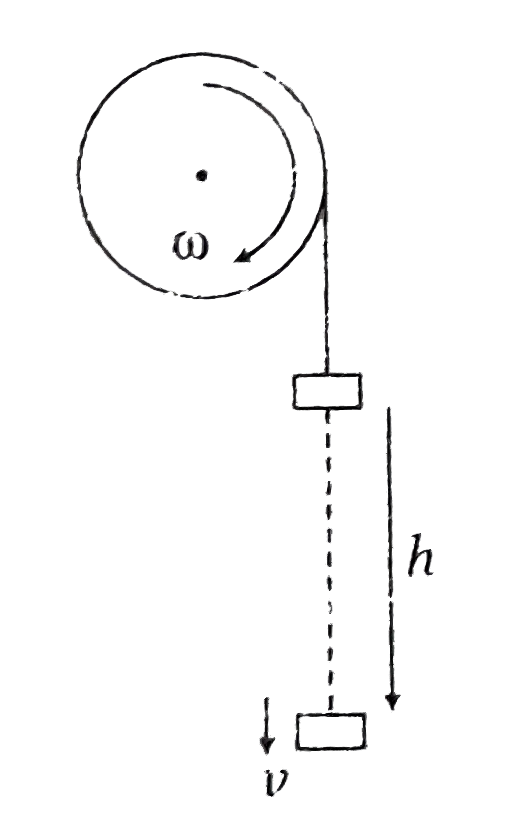 `:. mgh=(1)/(2)Iomega^(2)+(1)/(2)mv^(2)=(1)/(2)Iomega^(2)+(1)/(2)m(r omega)^(2)` `:.` Angular velocity, `omega=sqrt((2mgh)/(I+mr^(2)))`. |
|
| 32. |
A light string passing over a smooth light pulley connects two blocks of masses m_(1) and m_(2) (vertically). If the acceleration of the system is g//8, then the ratio of masses is |
|
Answer» `8:1` |
|
| 33. |
A solid sphere of uniform density and radius 4 units is located with its centre at the origin of coordinates , O. Two spheres of equal radii of 1 unit with their centres at A (-2,0,0) and B(2,0,0) respectively , are taken out of the solid sphere , leaving behind spherical cavities as shown in the figure . (a)The gravitational force due to this object at the origin is zero (b) The gravitational force at the point B(2,0,0) is zero (c) The gravitational potential is the same at all points of the circle y^2+z^2=36 (d)The gravitational potential is the same at all points on the circle y^2+z^2=4 |
|
Answer» only a & B are TRUE |
|
| 34. |
Explain why the shapes of high-speed vehicles are streamlined ? |
| Answer» SOLUTION :To REDUCE FRICTION of AIR. | |
| 35. |
The ratio of respective acceleration due to gravity on the surface of two planets having masses in the ratio x and density in the ratio y is |
|
Answer» `(X^(2))/(y)` |
|
| 36. |
A particle moves in a circle of radius 10 m. Its linear speed is given by v= 31 where is in second and v is in ms^(-1). (a)Find the centripetal and tangential acceleration at 1 = 2 s. (b) Calculate the angle between the resultant acceleration and the radius vector. |
|
Answer» SOLUTION :The linear speed at 1 = 2 s `V=3t=6ms^(-1)` The centripetal acceleration at t=2 s is `a_(c)=(v^(2))/(r)=((6)^(2))/(10)=3.6ms^(-2)` The tangential acceleration is `a_(t)=(dy)/(DT)=3ms^(-2)` The angle between the radius vector with resultant acceleration is given by `tantheta=(v^(3))/(r)=((6)^(2))/(10)=3.6ms^(-2)` `theta=tan^(-)(0.833)=0.69` radian In terms of degree `theta=0.69xx57.17^(@)~~40^(@)` |
|
| 37. |
A vessel of volume V=7.5 litres contains a mixture of ideal gases at temperature T=300K. There are n_(1)=0.1 mole of oxygen (M_(1)=32), n_(2)=0.2 mole of nitorgen (M_(2)=28) and n_(3)=0.3 mole of carbon dioxide (M_(3)=44). Assuming the gases to be ideal, find (a) the pressure of the mixture, (b) the man molar mass M of the mixture. |
|
Answer» |
|
| 38. |
The pressure (10^(5) Nm ^(-2))of air filled in a vessel is decreased adiabatically so as to increase its volume three times. Calculate the pressure of air. Given gamma-for air = 1.4 |
|
Answer» <P> Solution :`P _(2) =P_(1) (V _(1) //V_(2))^( GAMMA) = 10 ^(5) (1//3) ^(1.4) = 2. 148 XX 10 ^(4) Nm ^(-2)` |
|
| 39. |
In elastic collision law of conservation of momentum holds good if: |
|
Answer» time of collision is small |
|
| 40. |
A mass m is attached to a string passing through a small hole in a frictionless, horizontal surface. The mass is initially orbiting with a velocity v_(1)in a circle of radius r_(1)The string is then slowly pulled from below, decreasing the radius of the circles to r_2 (i) What is the speed of the mass when the radius is r_2 ? (ii) What is the tension in the string ? (iii) What is the work done in moving the mass m from r_(1) to r_(2)? |
|
Answer» `mv_(1)r_(1) = mv_(2)r_(2)` `v_(2) = (v_(1)r_(1))/r_(2)` The tension in the string is T `T = (mv_(2)^(2))/r_(2) =(mv_(1)^(2) r_(1)^(2))/r_(2)^(3)` The change in K.E. `=1/2 mv_(2)^(2) -1/2mv_(1)^(2)` `=1/2mv_(1)^(2)[(r_(1)^(2)-r_(2)^(2))/r_(2)^(2)]` The work done in moving the mass from `r_(1)`to `r_(2)`is equal to change in K.E. |
|
| 41. |
Statement -A : The net acceleration of a particle in circular motion is always along the radius of the circle towards the centre Statement -B : The velocity vector of a particle at a point is always along the tangent to the path of the particle at that point |
|
Answer» A only true |
|
| 42. |
What determines the natural frequency of a body? |
| Answer» SOLUTION :ELASTIC PROPERTIES of the MATERIAL of the BODY andDimensions of the body. | |
| 43. |
A body A is projected upwards with velocity v. Another body B of same mass is projected at an angle of 45^@. Both reach the same height. What is the ratio of their initial kinetic energies? |
|
Answer» 1/4 |
|
| 44. |
Figure shows the plot of the logarithm of the number 'N' of molecules whose free paths exceed a certain value x, versus x. It is a straight line with a slope 'm'. The mean free path lambda is |
|
Answer» `-2.303//m` |
|
| 45. |
Select the correct pair in the following situation An anthlete running in a race will continue to run even after reaching the finishing point it is due to |
|
Answer» inetia of REST and FORCE |
|
| 46. |
A cubical tank carrying a non viscous liquid (water, moves down a smooth inclined plane. When we open the say) hole made at the mid-point P of the face of the tank, it strikes the point Q of the inclined plane. Find the of the tank at the time of opening the valve. |
|
Answer» The actual velocity of the liquid `v=(v_(r)-v_(0))` 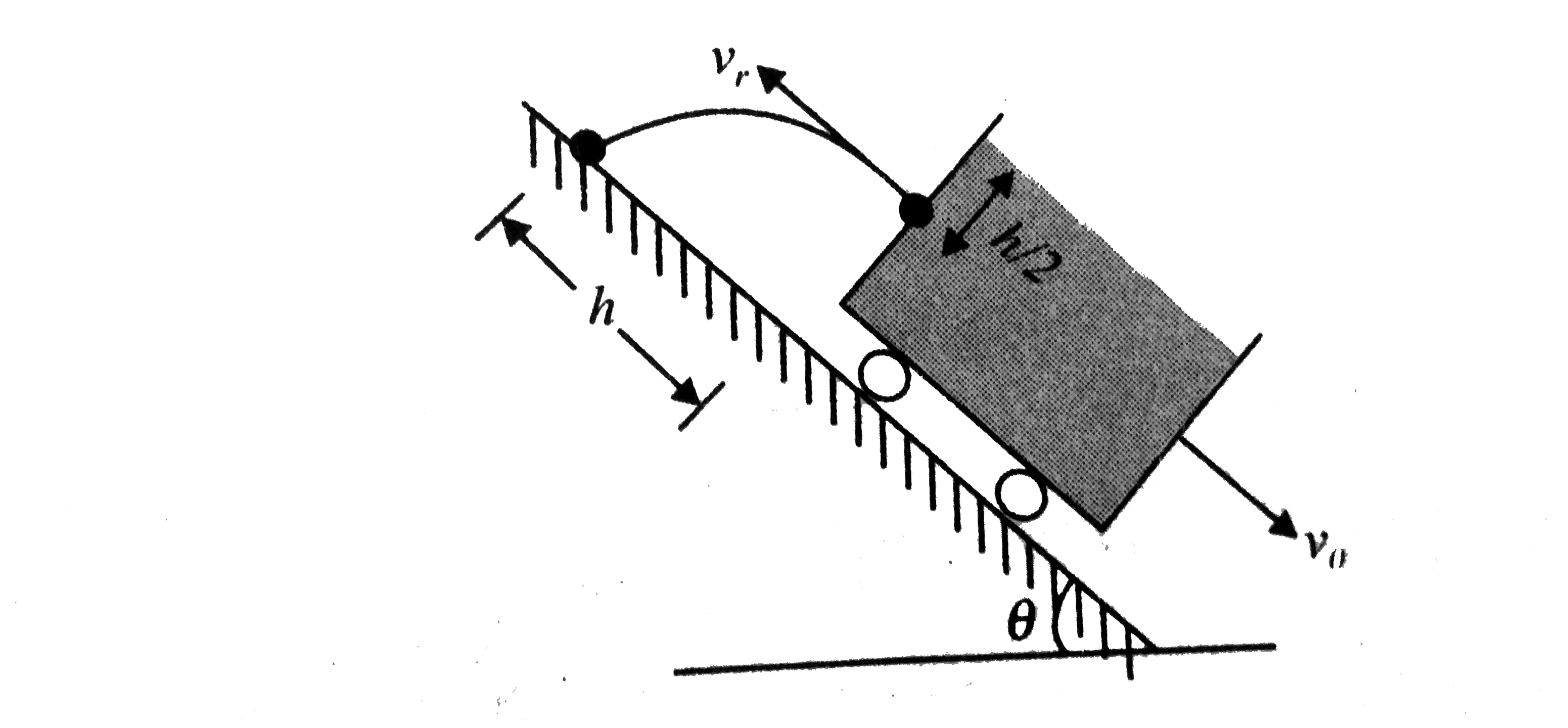 Then the time of flight `T=sqrt((2(h/2))/(gcostheta))=sqrt(h/(gcostheta))` `h=vt=1/2(gcostheta)T^(2)` putting `T`,and `v`, we have `v_(0)=h(1+(tantheta)/2)sqrt((gcostheta)/h)+sqrt(ghcostheta)` |
|
| 47. |
When a bicycle moves in the forward direction what is the direction of the frictional force in the rear and frontwheels |
| Answer» Solution :Whenwe pedala bicyclewe tryto PUSH the surfacebeackwardand thevelocityof point ofcontactin therearwheelis backwards. So thefrictionalforcepushes the rearwheelto moveforward .ifthe wheelslipsthenkineticfrictioncomesintoeffect. In ADDITION to staticfriction, therolling FRICTION alsoon bothwheelsinthe backwards DIRECTION . | |
| 48. |
The scalar product of two vectors will be maximum when theta is equal to |
| Answer» | |
| 49. |
The scalar product of two vectors will be maximum. When theta is equal to |
|
Answer» `0^(@)` |
|
| 50. |
A gas for which lambda=1.5is suddenlycompressed to 1/4 th of the initial volume. Then the ratio of the final to initial pressure is |
|
Answer» `1:16` |
|