

Saved Bookmarks
This section includes 7 InterviewSolutions, each offering curated multiple-choice questions to sharpen your Current Affairs knowledge and support exam preparation. Choose a topic below to get started.
| 1. |
An orbiting satellit.e will escape if ( a) its speed increases by 41.4% (b) its speed in the orbit is made sqrt(1.414) times that of its initial value (c) its kinetic energy increases by 100% (d) its kinetic energy is made sqrt2 times that of its initial value |
|
Answer» only a & B are CORRECT |
|
| 2. |
A spherical body of diameter D is falling in viscous medium. Its terminal velocity is proportional to |
|
Answer» `V_(i)propD^((1)/(2))` |
|
| 3. |
Assertion : Centripetal and centrifugal forces always cancle eachother Reason : The is because the two forces act on different bodies . |
|
Answer» If both, Assertion and Reason are true and the Reason is the CORRECT explanation of the Assertion |
|
| 4. |
The moon moves around the earth in a circular orbit and the earth moves around the sun in elliptical orbit then. (a) For the earth - moon system, the gravita tional attractions between them are the internal forces (b) The sun.s attraction on the earth and moon are external forces acting on the centre of mass of the system |
|
Answer» a is TRUE, B is FALSE |
|
| 5. |
A turning fork vibrating at 500Hz falls from rest accelerates at 10 m//s^(2). Velocity of the tuning fork when waves with a frequency of 475 Hz reach the release point is ( Take the speed of sound in air to be 340 m//s). |
|
Answer» `1.79 m//s` The apparent frequency received at the release point `v' = (v_(0) v)/( v + v_(s))` `V' = 475 HZ , v_(0) = 500 Hz , v = 340 m//s` `475 = (500 xx 340)/(340 + v_(s)) rArrv_(s) = 1.79 m//s` 
|
|
| 6. |
Among the following solids, the lowest coefficient of expansion is-for |
| Answer» ANSWER :D | |
| 7. |
If the force is proportional to square of velocity, the the dimensional of proportionality constant is |
|
Answer» `MLT^(0)` dimensionally, `K=(MLT^(-2))/(L^(2)T^(-2))=[ML^(-1)T^(0)]`. |
|
| 9. |
Reaction time : When a situation demands our immediate action, it takes some time before we really respond. Reaction time is the time a person takes to observe, think and act. For example, if a person is driving and suddenly a boy appears on the road, then the time elapsed before he slams the brakes of the car is the reaction time. Reaction time depends on complexity of the situation and on an individual. You can measure your reaction time by a simple experiment. Take a ruler and ask your friend to drop it vertically through the gap between your thumb and forefinger (Fig.). After you catch it, find the distance d travelled by the ruler. In a particular case, d was found to be 21.0 cm. Estimate reaction time. |
|
Answer» Solution :The ruler drops under free fall. THEREFORE, `upsilon_(0)=0`, and `a = – G = –9.8 ms^(-2)`. The distance travelled d and the reaction time `t_(R )` are related by `d=-(1)/(2)g t_(r )^(2)` Or,`t_(r )= sqrt((2d)/(g))s` GIVEN d = 21.0 cm and `g=9.8 ms^(-2)` the reaction time is `t_(r )=sqrt((2xx 0.21)/(9.8))s~= 0.2 s`. |
|
| 10. |
If the acceleration due to gravity on earth is 9.81 m//s^(2) and the radius of the earth is 6370km find the mass of the earth ? (G = 6.67 xx 10^(-11) Nm^(2)//kg^(2)) |
|
Answer» Solution :`G = 9.81 m//s^(2)`, `R = 6370 KM = 6.370 xx 10^(6)m`, `G = 6.67 xx 10^(-11) Nm^(2)//Kg^(2)`. `g =(GM)/(R^(2))`, mass of the earth `M = (gR^(2))/(G)` `= (9.81(6.37 xx 10^(6))^(2))/(6.67 xx 10^(-11)) = 5.97 xx 10^(-24)kg`. |
|
| 11. |
A refrigerator freezes 5 kg of water at 0^(@)C into ice at 0^(@)C in 20 minutes. If the room temp. is 20^(@)C, what minimum power is needed to accomplish this ? Given latent heat of ice =336xx10^(3)J//kg. |
|
Answer» `Q_(2)= 5xx336xx10^(3)J` , `T_(2)= 0^(@)C = (0+273)K=273K` `T_(1)= 20^(@)C= (20+273)K= 293K` COEFF. Of performance of refrigerator `Q_(2)/W= (T_(2))/(T_(1)-T_(2))=(273)/(293-273)` `:. W=(Q_(2)xx20)/(273)=(5xx336xx10^(3)xx20)/(273)` Minimum power needed , `P=W/t=(5xx336xx10^(3)xx20)/(273xx20xx60)= 102.5 "WATT"` |
|
| 12. |
In a projectile motion the velocity (a) is always perpendicular to the acceeleration (b) is not always perpendicular to the accleleration ( c) is perpendicular to the acceleration for one instant only (d) is perpendicular to the acceleration for two instants. |
|
Answer» a & B are CORRECT |
|
| 13. |
As shown in figure, a stick half of which is made of wood and other half of iron is pivoted as shown in fig. (a) It is pivoted at wooden end and force is applied to the other end of it at right angles to its length, (b) It is pivoted at iron end and the same force is applied to the other end at right angles to its length. Then angular acceleration produced is: |
|
Answer» More in CASE (B) than in (a) |
|
| 14. |
The dimensional formula for magnetic flux is |
|
Answer» `[ML^(2)T^(-2) A^(-1)]` |
|
| 15. |
Relative density of a liquid is 0.8. What its density in (i) C.G.S. system (ii) S.I. unit. |
|
Answer» |
|
| 16. |
A river is flowing with a speed of 1 km/hr. A swimmer wants to go to point C starting from A. He swims with a speed of 5km/hr. at an angle theta. W.r.t. the river flow. If AB=BC=400m at what angle with river tank shou ld swimmer swim? |
|
Answer» `37^(@)` `(5 cos theta+1)t=0.4` 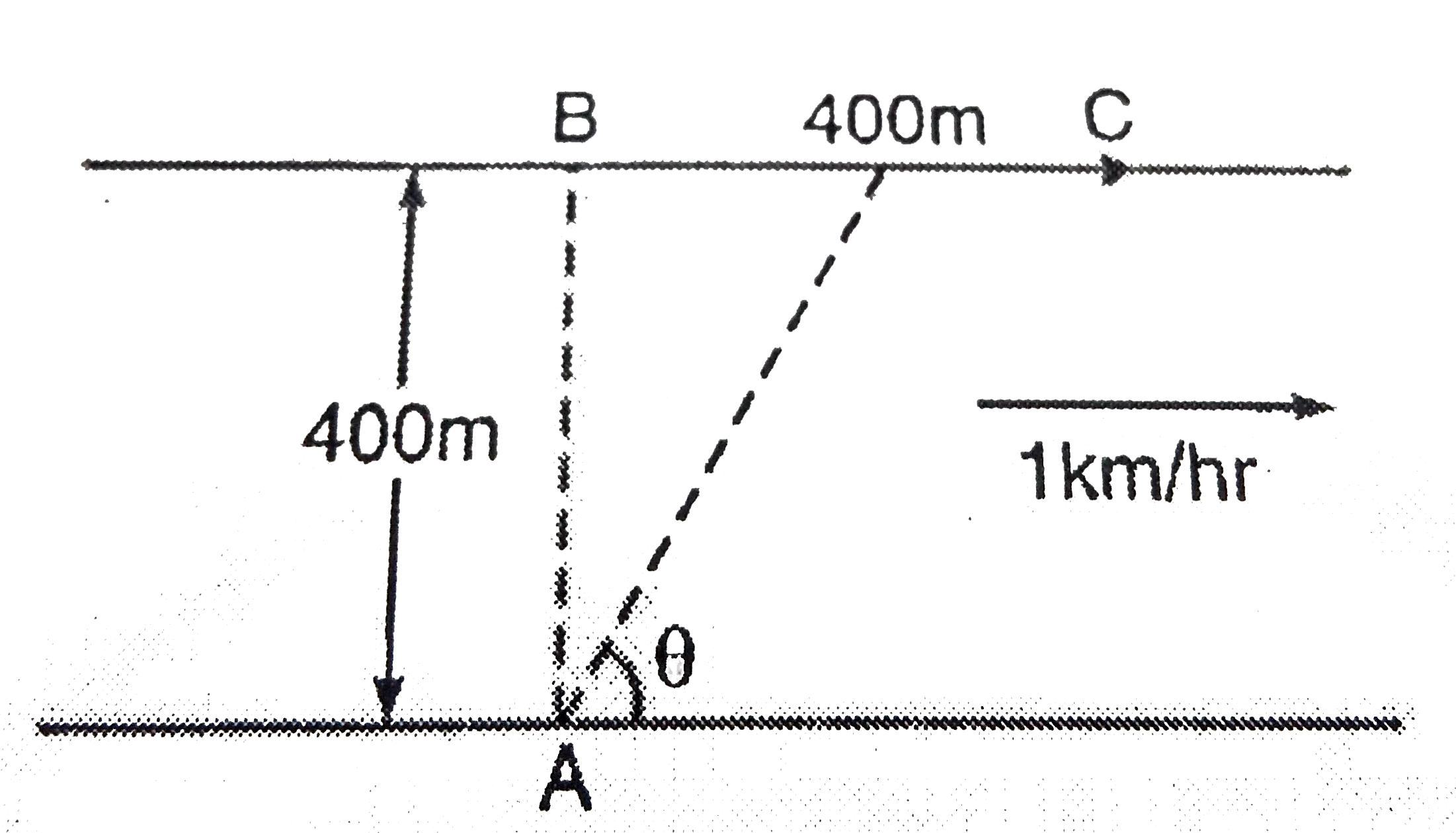
|
|
| 17. |
Suface area is |
|
Answer» Scalar |
|
| 18. |
When pressure on a gaseous medium is changed at constnat temperature, what will be effect on the speed of sound wave in it ? |
|
Answer» Solution :Speed of sound wave in a GASEOUS medium is, `v = SQRT ((gamma P )/(rho))` `therefore v = sqrt ((gamma P )/(M //V)) = sqrt (( gamma P V )/(M )) = sqrt ((gamma MU RT)/( mu M _(0))) = sqrt (( gamma RT)/(M _(0)))` `therefore ` At constant TEMPERATURE, `v=` constant `thereofre ` At constant temperaure, there will not be any effect of change in pressure on the velocity of sound wave in it. |
|
| 19. |
Moment of inertia of a body is a |
|
Answer» VARIABLE QUANTITY |
|
| 20. |
(A) : Water kept in an open vessel will quickly evaporate on the surface of the moon. (R ) : The temperature at the surface of the moon is much higher than boiling point of water. |
|
Answer» Both (A) and (R ) are TRUE and (R ) is the CORRECT explanation of (A) |
|
| 21. |
Four particles are fired with the same velocities at angles 250^@, 40^@, 55^@ and 70^@with the horizontal. The range of projectile will be largest for the one projected at angle |
|
Answer» Solution :`R=(u^2sin2 THETA)/(G)` In this case, `sin2theta` is the largest for ` theta = 40^@` , as compared to that for `theta = 25^@ , 55^@ , 70^@` . |
|
| 22. |
The ratio of the time taken by a solid sphere and that taken by a disc of the same mass and radius to roll down a rough inclined plane from rest, from the same height is |
|
Answer» `15:14` `(I)/(mR^(2))=(2)/(5)` for sphere and `(I)/(MR^(2))=(1)/(2)` for a disc `:.` For a solid sphere, `a_(1)=(5)/(7)g sin theta` and for a hollow sphere, `a_(2)=(2)/(3)g sin theta` From `s=(1)/(2)at^(2),t=sqrt((2s)/(a))or (t_(1))/(t_(2))=sqrt((a_(2))/(a_(1)))=sqrt((2//3)/(5//7))=sqrt((14)/(15))`. |
|
| 23. |
A rail track made of steel having length 410 mis clamped on a raillway line at its two ends ( Fig 11.3 ). On a summer day due to rise in temperature by 20^(@) C , it is deforned as shown in figure. Find x (displacement of the centre) if alpha_("steel") = 1.2 xx 10^(-5) //^(@)C |
|
Answer» SOLUTION :`x = SQRT(((L)/(2) + (Delta L)/(2))^(2) - ((L)/(2))^(2)) approx (1)/(2) sqrt(2L Delta L)` `Delta L = alpha L Delta t "" therefore x approx (L)/(2) sqrt(2 alpha Delta t)` |
|
| 24. |
{:(,"Column I",,"Column II"),(("A"),"Work",(p),["A"^(1//2)"T"^(-1)]),(("B"),"Moment of inertia",(q),["FA"^(1//2)]),(("C"),"Velocity",(r),["FA"^(1//2)"T"^(2)]):} |
|
Answer» `THEREFORE" "["L"]=["A"^(1//2)]` `["T"]=["T"]rArr["F"]=["MLT"^(-2)]` `therefore" "["M"]=["FL"^(-1)"T"^(2)]=["FA"^(1//2)"T"^(2)]` Now, `" "["W"]=["FL"]=["FA"^(1//2)]` `["I"]=["ML"^(2)]["FA"^(-1//2)"T"^(2)"A"]=["FA"^(1//2)"T"^(2)]` `["V"]=["LT"^(-1)]=["A"^(1//2)"T"^(-1)]` |
|
| 25. |
A solid cylinder of radius 5 cm and mass 0.5 kg rolls down an inclined plane (1 in 10). Calculate the acceleration and total energy of the cylinder after 10 S. |
|
Answer» SOLUTION :a = 0.653 `MS^(-2)` K.E. = 63.96J |
|
| 26. |
Find the external work done by the system in kcal, when 20 kcal of heat is supplied to the system the increase in th internal energy is 8400 J (J=4200J/kcal) |
|
Answer» 16 kcal |
|
| 27. |
An object moving with a speed of 6.25 m/s, is deaccelerated at a rate given bya= - 2.5 sqrt(v) , where v is the instantaneous speed. What is the time taken by the object to come to rest? |
|
Answer» SOLUTION :Initial velocity of the lift u = 0 , acceleration a = 2`"m.s"^(-2)` Let the RISE of the lift in 4 s be s and its velocity at that pointbe V. Hence from equation v = u+at we get, v = 0 + ` 2xx4 = 8 "m.s"^(-1)` Also from equation s = `ut + (1)/(2) at^(2)` we get, `s = 0 xx 4 + (1)/(2) xx 2 xx (4)^(2) = 16 `m `:.` The stone PIECE was dropped with an initial upward velocity of 8 `m.s"^(-1)` and was at a height of 16 m from the ground. If t is the time taken by the stone to REACH the ground then from equation h = `ut + (1)/(2) "gt"^(2)` , `16 = - 8t + (1)/(2) xx 9.8t^(2)` [`because` for the stone, u = - `8"m.s"^(-1)`, g = 9.8 `"m.s"^(-2)` , h = 16 m] or, `"" 4.9t^(2) - 8t-16 =0` or,`"" t=(8pmsqrt((8)^(2)-4xx4.9xx(-16)))/(2xx4.9)=(8 pm 19.4)/(9.8)` Since time cannot be negative, `t = (8 +19.4)/(9.8)` 2.8 s. |
|
| 28. |
The mean diameter of a thin brass rod is to be measured by vernier callipers. Why is a set of 100 measurements of the diameter expected to yield a more reliable estimate than a set of 5 measurements only ? |
|
Answer» SOLUTION :When physical quantity is measured RANDOM error is PRODUCED. This can be of both negative and positive type. By taking less NUMBER of OBSERVATION (let us say 5) and taking its average will produce less error. But by taking more number of observation both positive and negative error will be introduced addition of this error will give less resultant error. Dividing this by number of observation resultant error will decrease and measurement will become more accurate. |
|
| 29. |
The bulk modulus for an incompressible fluid is ……………….. . |
| Answer» Answer :C | |
| 30. |
The physical quantities not having same dimensions are |
|
Answer» TORQUE and work |
|
| 31. |
What happens when a capillary tube of insufficient length is dipped in a liquid? |
| Answer» Solution :When a capillary tube of insufficient length is dipped in a liquid, the radius of curvature of the meniscus increase so that hr = constant. That is PRESSURE on concave SIDE becomes equal to pressure EXERTED by liquid COLUMN so liquid does not OVERFLOW. | |
| 32. |
How will be linear momentum of a body change if its kinetic energy is doubled? |
|
Answer» SOLUTION :`P = SQRT (2mK)` `P = sqrt(2m(2K)) = sqrt2 xx sqrt(2mK)=sqrt2 P` Thus the linear momentum INCREASES to `sqrt2` times its INITIAL VALUE. |
|
| 33. |
Explain in detail the various types of errors. |
|
Answer» Solution :The uncertainty in a measurement is called an error. Random error, systematic error and GROSS error are the three possible errors. (i) Systematic errors: Systematic errors are reproducible inaccuracies that are consistently in the same DIRECTION. These occur often due to a problem that persists throughout the experiment. Systematic errors can be classified as follows (1) Instrumental errors: When an instrument is not calibrated properly at the time of manufacture, instrumental errors may arise. If a measurement is made with a meter scale whose end is worn out, the result obtained will have errors. These errors can be corrected by choosing the instrument carefully. (2) Imperfections in experimental technique or procedure: These errors arise due to the limitations in the experimental arrangement. As an example, while performing experiments with a calorimeter, if there is no proper insulation, there will be radiation losses. This results in errors and to overcome these, necessary correction has to be APPLIED (3) Personal errors: These errors are due to individuals performing the experiment, may be due to incorrect initial setting up of the experiment or carelessness of the individual making the observation due to improper precautions. (4) Errors due to external causes: The change in the external conditions during an experiment can cause error in measurement. For example, changes in temperature, humidity, or pressure during measurements may affect the result of the measurement. (5) Least count error: Least count is the smallest value that can be measured by the measuring instrument, and the error due to this measurement is least count error. The instrument.s resolution HENCE is the cause of this error. Least count error can be reduced by using a high precision instrument for the measurement. (ii) Random errors: Random errors may arise due to random and unpredictable variations in experimental conditions like pressure, temperature, voltage supply etc. Errors may also be due to personal errors by the observer who performs the experiment. Random errors are sometimes called chance error . When different readings are obtained by a person every time he repeats the experiment, personal error occurs. For example, consider the case of the thickness of a wire measured using a screw gauge. The readings taken may be different for different trials. In this case, a large number of measurements are made and then the arithmetic MEAN is taken. If n number of trial readings are taken in an experiment, and the readings are a, `a_1 , a_2 , a_3, ..........a_n` .The arithmetic mean is `a_m= (a_1 + a_2 + a_3 + ............ a_n)/(n)" or" a_m = 1/n sum_(i=1)^(i=n) a_i` |
|
| 35. |
A stationary railway platform on earth is |
|
Answer» an inertial frame of reference for an observer on earth |
|
| 36. |
The pair of physical quantities having the same dimensional formula |
|
Answer» ANGULAR MOMENTUM and torque |
|
| 37. |
A girl is standing on the top edge of an 18 m high building. She tosses a coin upwards with a speed of 7.0ms^(-1).How long does it take for the Coin to hit the ground ?How fast is the coin going just before it strikes the ground? (g=10ms^(-2)) |
| Answer» Answer :A | |
| 38. |
The kinetic energy of a satellite is 2MJ. What is the total energy of the satellite? |
|
Answer» `-2MJ` |
|
| 39. |
A small ball is projected from point P towards a vertical wall as shown in Fig. It hits the wall when its velocity is horizontal. Ball reaches point P after one bounce on the floor. The coefficient of restitution assuming it to be same for two collisions is n//2. All surfaces are smooth. Find the value of n. |
|
Answer» `uv/g=eu(v/g)+euxx2(EV)/gimpliese=1/2` `n=1` 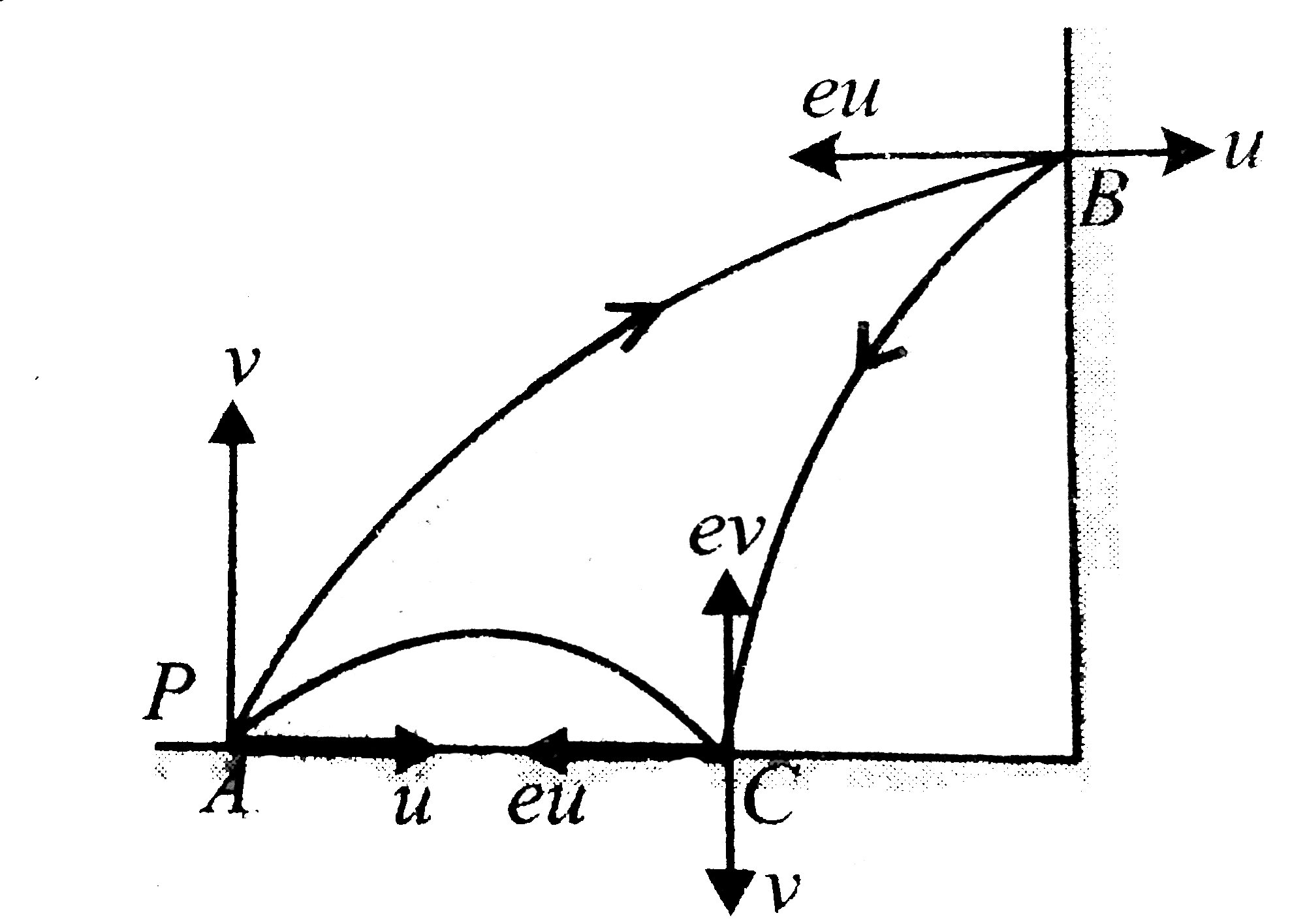
|
|
| 40. |
In the equation PV=RT,V stands for the volume of |
|
Answer» Any AMOUNT of gas |
|
| 41. |
A steel sphere of mass 100 gm moving with a velocity of 4 m/s collides with a dust particle elastically moving in the same direction with a velocity of 1 m/s. The velocity of the dust particle after the collision is (dust particle is of mass neglisiable) |
| Answer» Answer :B | |
| 42. |
A solid is suspended in a liquid. If the liquid is heated, the solid (assume the solid expansion is negligible) |
|
Answer» floats |
|
| 43. |
Find the ratio of escape velocities of two planets if values of g on two planets are 9.8m//s^(2) and 3.3 m//s^(2) and their radii are 6400km and 3400km respectively. |
|
Answer» Solution :The escape velocity in TIME of G and R is The RATIO of escape velocities `V_(e1)/V_(e2)=SQRT((g_1R_1)/(g_2R_2))` `V_(e1)/V_(e2)sqrt((9.8/(3.3))((6400)/(3400)))=(2.364)/1` `V_(e1):V_(e2)=2.3641.` |
|
| 44. |
A person supports a book between his finger and thumb as shown (the point of grip is assumed to be at the corner of the book). If the book has a weight of W then the person is producing a torque on the book of |
|
Answer» `W(a)/(2)` ANTICLOCKWISE |
|
| 45. |
The total mechanical energy of a spring-mass system in simple harmonic motion is E=1/2m omega^(2) A^(2). Suppose the oscillating particle is replaced by another particle of double the mass while the amplitude A remains the same, the new mechanical energy will |
| Answer» Answer :D | |
| 46. |
A brass wire 300 cm long when subjected to a force F produces an elongation .a.. Another wire of twice the diameter and of same length and material, when subjected to the same force F, produces an elongation .b.. What is the value of a/b ? |
|
Answer» |
|
| 47. |
The acceleration of a projectile relative to another projectile is |
|
Answer» `-G` |
|
| 48. |
In a SHM, when the displacement is one-half the amplitude, what fraction of the total energy is kinetic |
|
Answer» ZERO |
|
| 49. |
A uniform sphere of radius 0.25 m and mass 2 kg rotates about its diameter. What is the angular momentum when the angular speed is 5 rad/s ? |
| Answer» SOLUTION :`L = mr^(2)omega=2 xx 0.25^(2) xx 5 = 0.625 JS` | |
| 50. |
A 50 kg runner runs around the edge of a turn table mounted on frictionless bearings. With respect to earth the velocity of runner is 2m//s.The turntable is rotating in opposite direction with an angular velocity of magnitude 0.2 rad//s with respect to earth.The radius of turntable is 4m, and its moment of inertia is 1000 kg-m^(2). Find the final angular velocity of the system if runner comes to rest relative to turntable. |
|
Answer» |
|