

Saved Bookmarks
This section includes 7 InterviewSolutions, each offering curated multiple-choice questions to sharpen your Current Affairs knowledge and support exam preparation. Choose a topic below to get started.
| 1. |
Match list I with list II and select the correct answer by using the codes given below the lists. |
|
Answer» (B) Interatomic distance in a solid-angstrom. (C) Size of nucleus-fermi. (D) Wavelength of INFRARED laser-micron. |
|
| 2. |
Define co-efficient of restitution'? |
|
Answer» SOLUTION :The RATIO of VELOCITY of SEPARATION after collision to the velocity of APPROACH before collision i.e., e = velocity of separation (after collision))/(velocity of approach (before collision) = (v_2 - v_1)/(u_1 - u_2)` |
|
| 3. |
A force vec(F)= (4 hat(i) - 3hat(j) + 5hat(k))N moves a body from (3 hat(i) + 6hat(j) + 3hat(k))m " to " (a hat(i) -8hat(j) + 5hat(k))m. If the work done by the force is 8J, the value of 'a' is |
|
Answer» 6 |
|
| 4. |
Is it possible to double the length of a metallic wire by applying force over it ? |
| Answer» Solution :No, a wire STRETCHES UPTO ELASTIC limit, after that limit if wire is STRETCHED, it will break. | |
| 5. |
A block of mass m and a pan of equal mass are connected by a string going over a smooth light pulley. Initially the system is at rest when a particle of mass m falls on the pan and sticks to it. If the particle strikes the pan with a speed v, find the speed with which the system moves just after the collision. |
|
Answer» Solution :Let the REQUIRED speed be V. , Further, let `J _(1)=` imulse between PARTICLE and pan, `J _(2)=` impulse IMPARTED to the block and the pan by the string. Using impulse = change in momentum. For paticle, `J _(1) = mv - mV….(1),` For pan,` J _(1) - J _(2) = mV ....(2),` For block,` J _(2) = m V....(3)` SOLVING these three EQUATIONS, we get `V = (v)/(3)` |
|
| 6. |
Two balls are thrown up simultaneously from the top of a 400 m high tower with speed 10 m//s and 55 m//s. Sketch a graph showing the separation between the balls versus time. |
Answer» SOLUTION :Taking O as the origin, 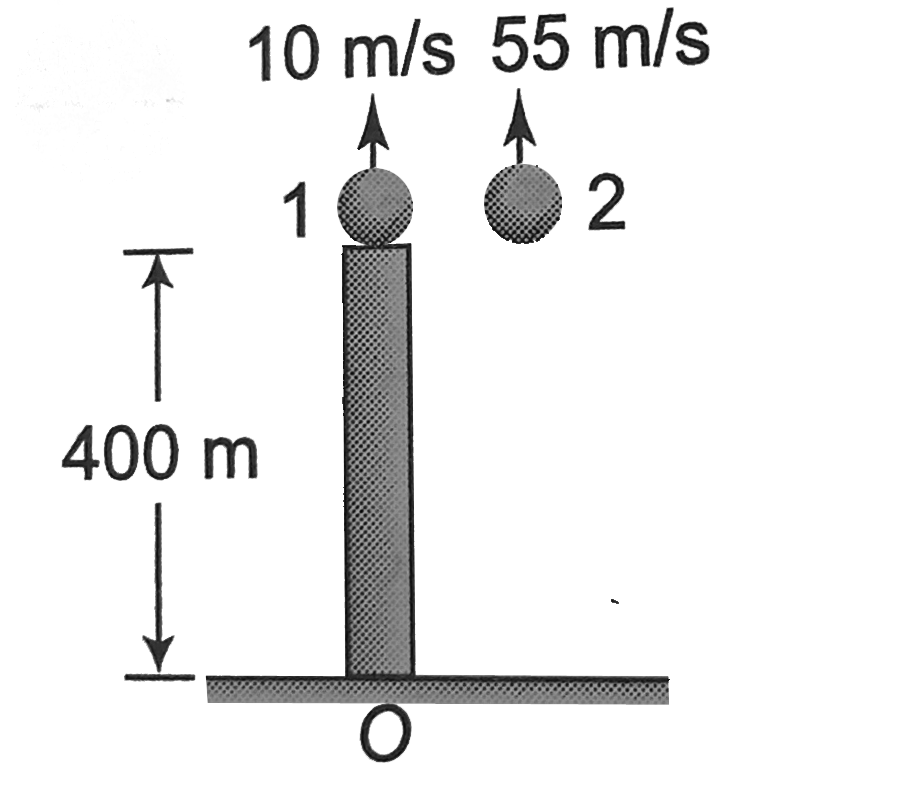 displacement of ball(1), `s_(1)=400+10t-1/2 g t^(2)` Displacement of ball (2), `s_(2)=400+55t-1/2 g t^(2)` Sepration between balls `s=s_(2)-s_(1)=45 t` The first ball strikes the ground. `s_(1)=0=400+10t-1/2 g t^(2)=400+10 t-5 t^(2)` `t^(2)-2t+80=0` `(t-10)(t+8)=0impliest=10s,-8 s` TIME cannot be negative, so `t=10 s`. The second ball strikes the ground. `s_(2)=0=400+55 t-1/2 g t^(2)=400+55 t-5 t^(2)` `t^(2)-11t+80=0` `(t-16)(t+5)=0 implies t=16s` from `t=0` to `t=10 s`, `s=s_(2)-s_(1)=45t` Shape: `y=45x` (inclined straight LINE with +ve slope) From `t= 10` to `16 s, s=s_(2)-0=400+55t-5 t^(2)` Shape:`y=400+55x-5x^(2)` (parabola, open downward) 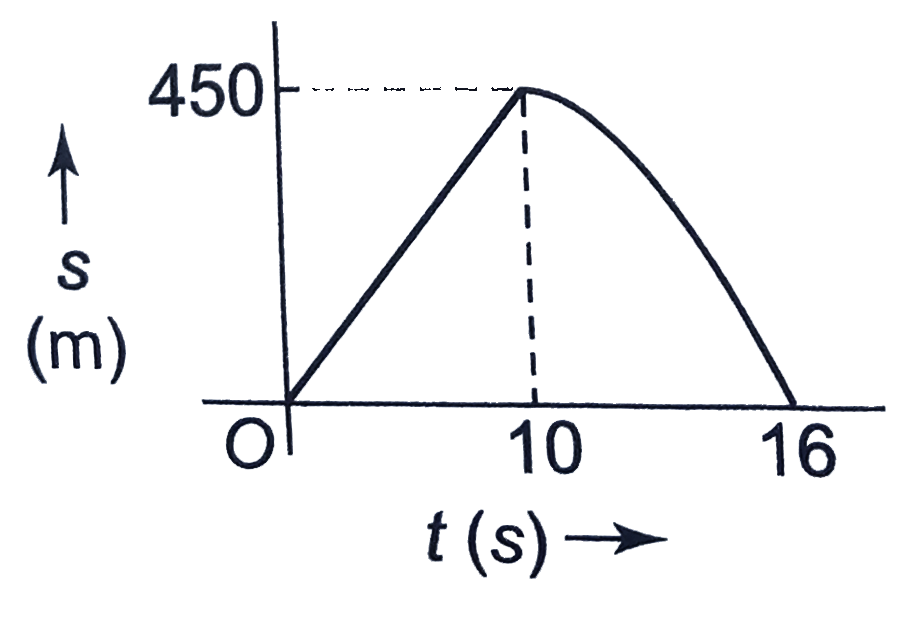
|
|
| 7. |
If units in two systems of measurements are in the ratio 2: 3, the ratio of the units of angular momentum in those two systems is |
| Answer» ANSWER :D | |
| 8. |
A rocket is fired with a speed upsilon=2sqrt(gR)near the earth.s surface and directed upwards. (a) Show that it will escape from the earth . (b) Show that in interested space its speed is upsilon=sqrt(2gR) |
|
Answer» Solution :(a) As PE of the ROCKET at the surface of earth of is `(-GMM//R)` and at `PROP` , zero , so energy required for escaping from earth. `=0-((GMm)/(R))=mgR["as " g=(GM)/R^2]` And is initial KE of the rocket `1/2mv^2 =2mgR`is greater than the energy required for escaping (=mgR) , the rocket will ESCAPE . (b) If `upsilon` is the velocity of the rocket in interstellar space (free from gravitational EFFECTS) then by conservation of energy. `1/2mn(2sqrt(gR))^2-1/2m(sqrt(2gR))=1/2"m"upsilon^2` `upsilon^2=4gR-2gR" or " upsilon=sqrt(2gR)` |
|
| 9. |
An object A is moving with 5m/s and B is moving with 20m/s in the same direction. (Positive x-axis). Find (a)velocity of B relative to A. (b) Velocity of A realtive to B. |
|
Answer» SOLUTION :(a)`vecV_(B)=20hat(i)"m/s" , vecV_(A)=5hat(i)"m/s",` `vecV_(B)-vecV_(A) = 15hat(i)`m/s `vecV_(B)=20hat(i)"m/s", vecV_(A)=5hat(i)`m/s, `vecV_(AB)=vecV_(A)-vec_(B)=-15hat(i)`m/s |
|
| 10. |
A body is executing simple harmonic motion. At a displacement x form mean position, its potential energy is E_1= 2J and at a displacement y from mean position, its potential energy is E_2 = 8J. The potential energy E at a displacement (x+y) from mean position is 6 times of joules. Thenis equal to |
|
Answer» |
|
| 11. |
Derive an expression for the total pressure at a depth 'h' below the liquid surface. |
|
Answer» <P> Solution :Let US consider a water sample of cross sectional area in the form of a cylinder. Let `h_(1)andh_(2)` be the depths from the air-water interface to level 1 and level 2 of the cylinder, respectively as shown in Figure(a). Let `F_(1)` be the force acting downwards on level 1 and `F_(2)` be the force acting upwards on level 2, such that,`F_(1)=P_(1)AandF_(2)=P_(2)A` Let us mass of the sample to be m and under equilibrium condition, the total upward force `(F_2)` is balanced by the total downward force `(F_(1)+mg)`, otherwise, the gravitational force will act downward which is being exactly balanced by the difference between the force `F_(2)=F_(1)``F_(2)-F_(1)=mg=F_(G)""...(1)` Where m is the mass of the water available in the sample element. Let `rho` be the DENSITY of the water then, the mass of water available in the sample element is `m=rhoV=rhoA(h_(2)-h_(1))` `V=A(h_(2)-h_(1))`  Hence, gravitational force, `F_(G)=rhoA(h_(2)-h_(1))g` On substituting the value of W in equation (1) `F_(2)=F_(1)+mg` `rArr""P_(2)A=P_(1)A+rhoA(h_(2)-h_(1))g` Cancelling out A on both sides, `P_(2)=P_(1)+rho(h_(2)-h_(1))g""...(2)`  If we choose the level 1 at the surface of the LIQUID (i.e, air-water interface) and the level 2 at a depth 'h' below the surface (as shown in Figure), then the value if `h_(1)` becomes zero `(h_(1)=0)` when `P_(1)` assumes the value of atmospheric pressure (say `P_(a)`). In addition, the pressure `(P_2)` at a depth becomes P. Substituting these values in equation, `P_(2)=P_(1)+rho(h_(2)-h_(1))g` we get`P=P_(a)+rhogh` Which means, the pressure at a depth h is greater than the pressure on the surface of the liquid, where `P_(a)` is the atmospheric pressure `=1.013xx10^(5)P_(a)`. If the atmospheric pressure is neglected then `P=rhogh` For a given liquid, `rho` is fixed and g is also constant, then the pressure due to the fluid column is directly proportional to vertical distance or height of the fluid column. |
|
| 12. |
A ballA moving with certain velocity collides with another body B of the same mass at rest If the coefficient of restitution is 2/3. The ratio of velocity of A and B after collision is |
| Answer» ANSWER :B | |
| 13. |
A ball strikes the floor vertically and rebounds with a co-efficient of restitution 0.6. If the mass of the ball is 0.01 kg and its velocity is 5 ms^(-1)just before it hits the ground, what is the velocity and momentum of the ball as it leaves the floor? |
|
Answer» |
|
| 14. |
Explain experimental determination of Young's modulus. |
Answer» Solution :A typical experimental arrangment to determine Young.s modulus of a MATERIAL of wire is shown as in figure. 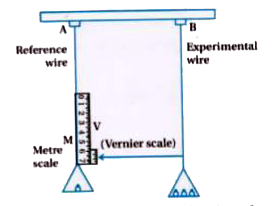 It consists of two long straight wires of same length and equal radius suspended side by side from a fixed rigid support. The wire A (reference wire) carries a millimeter main scale M and a pan to place a weight. The wire B (experimental wire) of uniform area of cross-section also carries a pan in which known weights can be placed A vernier scale V is attached to a pointer at the bottom of the experimental wire B and the main scale M is fixed to the reference wire A. The weights placed in the pan exert a downward force and stretch the experimental wire under a tensile stress. The elongation of the wire is measured by the vernier arrangement. The reference wire is used to compensate for any change in length that may occur due to change in room temperature, any change ir length of the reference wire will be accompanied by an equal change in experimental wire. Both the reference and experimental wires are given an initial small load to keep the wires straight and the vernier reading is noted. Now the experimental wire is gradually loaded with more weights to bring it under a tensile stress and the vernier reading is noted again. The difference between two vernier readings gives the elongation PRODUCED in the wire. LET r and L be the initial radius and length of the experimental wire RESPECTIVELY then the area of cross-section of wire would be `pir ^(2)`Let M be the mass that produced an elongation `DeltaL` in the wire, thus the applied force is equal to Mg where g is the acceleration due to gravity The Young.s modulus of the material of wire, `Y=(sigma )/(epsi ) = (F//A)/( Delta L//L) = (FL)/(ADelta L)` `= (Mg)/(pi r ^(2)) = (L)/(Delta L)` ` Y = (MgL)/(pi r ^(2) Delta L)` Y can be determined by PUTTING each of known velues in above equation. |
|
| 15. |
An infinite uniformly chargedsheet with surfacecharge densitysigma cuts through a spherical Gaussion surface of radius R at a distance x from its centre as shown. . Find the electric flux through the Gaussian surface. |
| Answer» SOLUTION :`(PI(R^2-x^2)SIGMA)/in_0` | |
| 16. |
A car starts from rest and travels a distance s with a uniform acceleration f, then it travels with uniform velocity for a time t, and at last comes to rest with a uniform retardation (f)/(2) . If the total distance travelled is 5s. Then |
|
Answer» s = ft |
|
| 17. |
A block of mass M rests on a rough horizontal surface as shown. Coefficient of friction between the block and the surface is mu. A force F=mg acting at angle theta with the vertical side of the block pulls it. In which of the following cases the block can be pulled along the surface? |
|
Answer» `tan theta ge mu` `=Mg-Mg cos theta=2 Mg sin^(2)"" (theta)/(2)` Further block can be PULLED if, `F sin theta ge mu N cos theta` `implies "" 2Mg sin""(theta)/(2).cos""( theta)/(2) ge 2 mu Mg sin^(2)""(theta)/(2) implies cot""(theta)/(2) ge mu` |
|
| 18. |
A uniform circular sheet has a radius r. A square sheet whose diagonal length is equal to radius of the plate is removed. The maximum distance of the centre of mass of the remaining plate from the centre of this original sheet is |
|
Answer» `(R )/(2(2pi-1))` |
|
| 19. |
When a liquid is heated in a vessel, it is found that g_(R) is less then g_(A) . This happeans when the vessel ...... On heating . |
|
Answer» EXPANDS |
|
| 20. |
What happens when a thermoflask containing some gas is shaken vigorously ? |
| Answer» Solution :in this CASE work is DONE on yhe system HENCE the temperature THEREFORE the internal energy of the GAS increases . | |
| 21. |
An object is allowed to fall freely from a cliff. When it travels a distance 'h', its velocity is v. Hence, in travelling further distance of ........ its velocity will become 2v. |
|
Answer» 4h  Equation for freely falling BODY, `v ^(2) -v _(0)^(2) =2gd` Here initial velocity `v _(0) = 0 and d =h` `THEREFORE v ^(2) =2gh` ` therefore h = (v ^(2))/(2g) ""…(1)` The velocity of an object at height h is `v _(0) = vand ` the velocity of an object at height h. will be 2v. `therefore (2v)^(2) -v ^(2) =2gh.` `therefore 4v ^(2) -v ^(2) = 2gh.` `therefore 3v ^(2) =2gh.` `therefore h . = (3v ^(2))/( 2g) ""...(2)` `therefore (h.)/(h) =3` [Taking the RATIO of equ. (2) and equ. (1)] `therefore h. =3h` |
|
| 22. |
The earth takes 24h to rotate once about its axis. How much time does the sun take to shift by 1^@ when viewed from the earth? |
|
Answer» SOLUTION :TIME taken for `360^@` shift =24h Time taken for `1^@` shift =`24//360h=4 `min |
|
| 23. |
A heat engine has an efficiency eta. Temperatures of source and sink are each decreased by 100K. Then, the efficiency of the engine |
| Answer» Answer :A | |
| 24. |
A thin circular ring of mass Mand radius r is rotating about its axis with constant angular velocity omega . Two objects each of mass m are attached gently to the opposite ends of a diameter of the ring . The ring now rotates with angular velocity given by |
|
Answer» `((M + 2m) OMEGA)/(2m)` `I_(1) omega_(1) = I_(2) omega_(2)` `IMPLIES omega_(2) = (I_(1) omega_(1))/(I_(2)) = (Mr^(2) omega)/(( M + 2m) r^(2)) = (M omega)/(( M + 2m))` |
|
| 25. |
Two resistors of resistances R_(1) = 150 pm 2 Ohm and R_(2) = 220 pm 6 Ohm are connected in parallel combination. Calculate the equivalent resistance. Hint: (1)/(R') = (1)/(R_(1)) + (1)/(R_(2)) |
|
Answer» SOLUTION :The equivalent resistance of a parallel combination `R. = (R_(1)R_(2))/(R_(1) + R_(2)) = (150 xx 220)/(150+220) = (33000)/(370) = 89.1` Ohm We know that, `(1)/(R.) = (1)/(R_(1)) + (1)/(R_(2))` `(DELTAR.)/((R.)^(2)) (DeltaR_(1))/(R_(1)^(2)) + (DeltaR_(2))/(R_(2)^(2))` `DeltaR. = (R.)^(2) (DeltaR_(1))/(R_(1)^(2)) + (R.)^(2) (DeltaR_(2))/(R_(2)^(2)) = ((R.)/(R_(1)))^(2) DELTA R_(1) + ((R.)/(R_(2)))^(2) DeltaR_(2)` Substituting the value, `DeltaR. = [(89.1)/(150)]^(2) xx 2 + [(89.1)/(220)]^(2) xx 6 = 0.070 + 0.098 = 0.168` `R. = 89.1 PM 0.168` Ohm |
|
| 26. |
One mole of a gas is put under a weightless piston of a vertical cylinder at temperature T. The space over the piston opens into atmosphere. How much work should be performed by some external force to increase isothermally the volume under the piston to twice the volume (neglect friction of piston) |
| Answer» SOLUTION :RT(I-In 2) | |
| 27. |
Block A is placed on cart B as shown in figure . If the coefficientof static and kinetic friction between the 20 kg block A and 100 kg cart Bare both essentially the same value of 0.5 : (g = 10 m//s^(2)) |
|
Answer» the blocks A and B will have a common acceleration if P = 60 N  `2P - f_(1)= 20 xx a"" ……(i) ` As `"" 2P = (120) xx a "" …..(ii) ` `a = (P)/(60)` `2P - (5)/(10)xx 200 = 20 xx (P)/(60)` `2P - (P)/(3) = 100` `(5P)/(3) = 100` `P = 60 N` |
|
| 28. |
The air in a pipe closed at one end is made to vibrate in its second overtone by a tuning fork of frequency 440 Hz. The speed of sound in a 330 m//s. End correction may be neglected . Let P_(0) denotes the mean pressure of any point in the pipe and Delta P_(0) the maximum amplitudes of pressure variation. a. Find the length L of the air column. b. What is the amplitude of pressure variation at the middle of the column c. What are maximum and minimum pressures at the open end of the pipe ? |
|
Answer» Solution :a. The fundamental frequency of the closed organ pipe ` = v// 4l`. In closed organ pipe only odd harmonics are present . SECOND overtone of pipe ` = 5 v// 4L` Given ` 5v//4L = 440` On solving , we get `L = ( 5 v)/( 4 XX 440) = ( 5 xx 330)/( 4 xx 440) = (15)/( 16) m = 0.9375 m = 93.75 cm` b. The equation of variation of pressure amplitude at any distance `x` from the node is `Delta P = Delta P_(0) cos kx` Pressure variation is maximum at a node and minimum (zero) at antinode. Distance of centre `C from N_(2) is LAMBDA//8)` `:. DeltaP = Delta P_(0) cos ( 2pi)/( lambda) xx (lambda)/( 8) = DeltaP_(0) (pi)/(4) = ( Delta P_(0))/( sqrt(2))` c. At antinode , the pressure variation is minimum (zero) , therefore at antinode remains equal to `P_(0)` (always). Therefore , at antinode `P_(MAX) = P_(min) = P_(0)`. 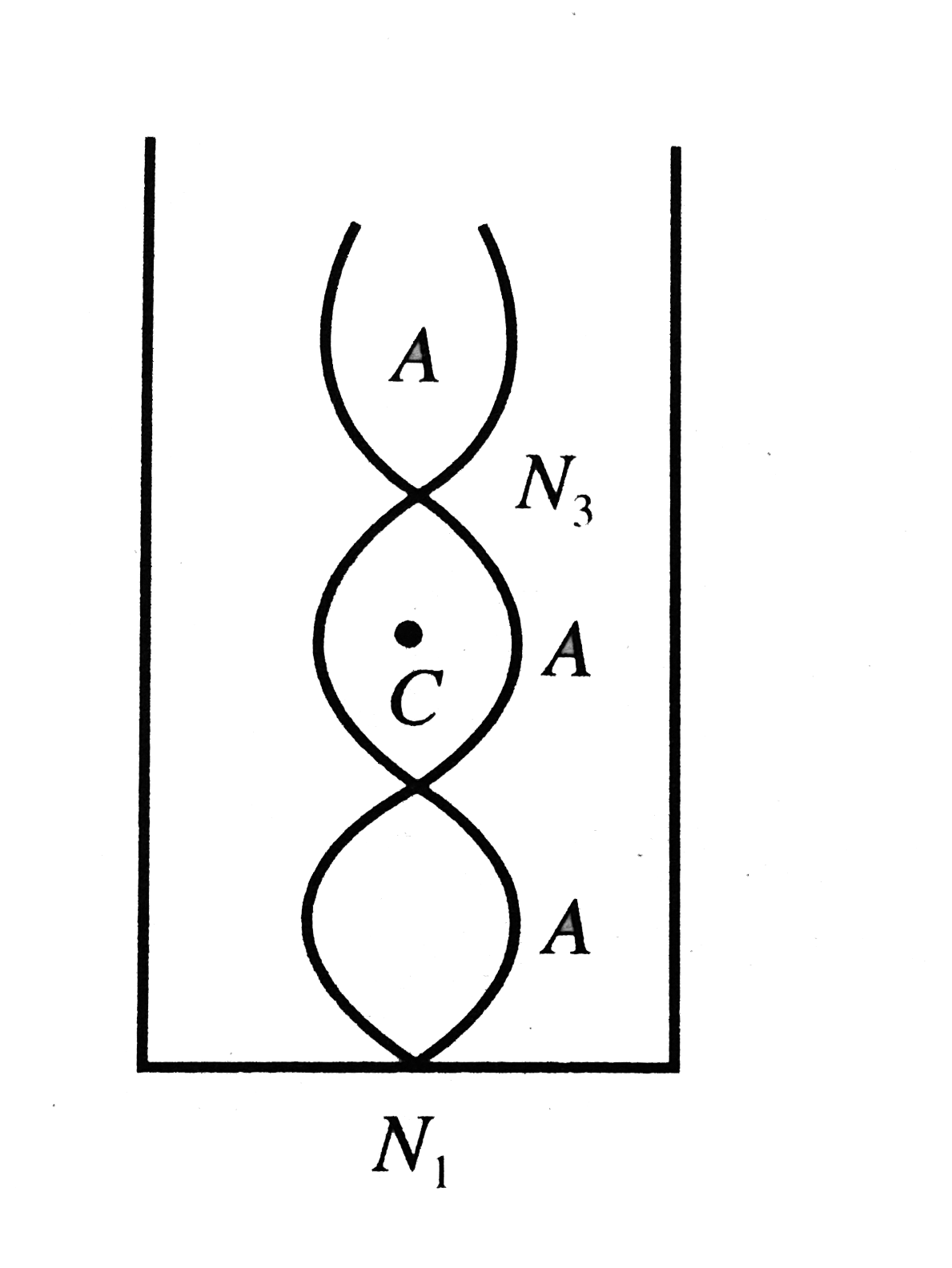
|
|
| 29. |
Let 'I' be the M.I. of uniform square plate about an axis AB that passes through its centre and is parallel to two of its sides. CD is a line in the plane of the plate that passes through the centre of the plate and makes an angle theta with AB. The M.I. of the plate about the axis CD is equal to |
|
Answer» I |
|
| 30. |
A shot is obtained by pouring molten lead through marrow holes into water from certain height. The falling lead solidfies and takes the form of small spheres, Explain the phenomenon. |
| Answer» Solution :The molten LEAD comes out of a narrow hole in the form of a fine stream. When it FALLS from a height into a vessel CONTAINING cold water, it BREAKS into sphereical drops due to thrust of water and surfaces tension. These are cooled on enteringthe water and thus solidify into SMALL spheres. | |
| 31. |
IfvecF=3hati-4hatj+5hatk "and" vecS=6hati+2hatj+5hatk, the find the work done. |
| Answer» SOLUTION :25Joules | |
| 32. |
An astronaut inside a small spaceship orbiting around the earth cannot detect gravity. If the space sattion orbiting around the earth has a larger size, can he hope to detect gravity? |
| Answer» Solution :Yes, if the size of space-station orbiting AROUND the earth is very LARGE, then the astronaut inside the spaceship will experience GRAVITATIONAL force and hence can DETECT GRAVITY. | |
| 33. |
Explain three states and change in states for matter. |
|
Answer» Solution :Matter normally exists in THREE STATES : solid liquid, and gas. A transition from one of these states to another is called a change of state. Two COMMON changes of states are solid to liquid and liquid to gas (and vice versa). These changes can occur when the exchange of HEAT takes place between the substance and its surroundings. |
|
| 34. |
The coefficient of performance of a Carnotrefrigerator working between 30^(@)C and 0^(@)C is |
|
Answer» 10 |
|
| 35. |
It is very commonly thought that the sciences and humanities are producing two cultures which are opposed to each other. Science is even accused of not being sympathetic to the well-being of society. All this is due to the debatable use made by some scientists of their discoveries. However, science has now become increasingly aware of its responsibility towards society. Consequently, many scientists are of the opinion that science should be defined in humanistic terms. According,I.I. Rabi defines science as follows : "Science is an adventure of the whole human race to learn to live in and perhaps to love the universe in which they are. To be a part of it is to understand it, to understand oneself, to begin to feel that there is a capacity within man far beyond that he felt he had, of an infinite extension of human possibilities - not just on the material side..." Rabi proposes that science be taught “with a certain historical understanding, with a certain philosophical understanding, with a social understanding and a human understanding". At the moment, we are dealing with physics and one might well ask if we can define physics also in humanistic terms. Gerald Halton provides us with a relevant definition of physics. According to him : "Physics is a sequence of related ideas whose pursuit provides one with the cumulative effect of an even higher vantage point and a more encompassing view of the working of nature. Physics is neither an isolated bloodless body of facts and theories with mere vocational usefulness, nor a glorious entertainment restricted to an elite of specalists. Rather students of physics may leave them unprepared for their own time. They can be neither participants nor even intelligent spectators in one of the great adventures”. It will be no exaggeration if we say that the fate of society is linked to physics as whatever is thought or discovered in physics immediately affects the society. Our intellegence lies in applyingphysics to solve the pressing problems that the society faces and not to annihilate it.According to I.I Rabi |
|
Answer» PHYSICS deals with theories with mere vocational usefulness |
|
| 36. |
A cable breaks if stretched by more than 2mm. It is cut into two equal parts. By how much either part can be stretched without breaking |
|
Answer» 0.25mm |
|
| 37. |
1 gcm^(-3).... Kgm^(-3) (Fill the gaps) |
|
Answer» Solution :`(1G)/(CM^(3))=(1(10^(-3)kg))/((10^(-2)m)^(3)) =(10^(-3)kg)/(10^(-6)m^(3))` `=10^(3) KGM^(-3)` |
|
| 38. |
How does the viscosity of water change with an increase in pressure? |
| Answer» SOLUTION :DECREASES | |
| 39. |
Explain degrees of freedom with examples. |
|
Answer» Solution :The degrees of freedom of the system are the minimum number of independent coordinates needed to SPECIFY the position and configuration of a thermo-dynamical system in space. Eg: (i)A PRACTICAL moving in space hasthree degrees of freedom. (ii) similarlypractice moving over a plan has two degrees of freedom. (iii) free practical moving along x-axis needs only one coordinate to specify it completely . So its degree of freedom is one. If we have a number of gas MOLECULES in the container , then the total number of degrees of freedom is F = 3N . But, if the system has kyon number of constraints ( restrictionsis motion ) then the degrees of freedom decreases and it is equal to f = 3N - q where N is the number of particles and q are constraints. |
|
| 40. |
In the above problem, what is the apparent weight of the block at the lower extreme position when it is oscillating with maximum amplitude ? |
|
Answer» |
|
| 41. |
Apaticle of mass m moves in the potential energy U shown above. Find the period of the motion when the particle has total energy E. |
|
Answer» |
|
| 42. |
The velocity of sound in air is 332 m/s.The frequency of the fundamental node of an open pipe 50 cm long will be |
|
Answer» 160 Hz |
|
| 43. |
The length of a second's pendulum on the surface of earth is 1 m. What will be the length of a second's pendulum on the moon? |
| Answer» Solution :`L prop g`so as MOON, LENGTH will be 1/6 m, | |
| 44. |
A shell is fired into air at an angle theta with the horizontal from the ground. On reaching the maximum height, |
|
Answer» its kinetic energy is not equal to zero |
|
| 45. |
A body falls for 5s from rest. If the acceleration due to gravity of earth ceases to act, the distance it travels in the next 3s is |
|
Answer» 73.5 m |
|
| 46. |
A block of mass 10kg pushed by a horizontal force F on a horizontal rough plane moves with an aceleration 5ms^(-2). When force is doubled, its acceleration becomes 18 ms^(-2). The coefficient of friction is (g=10 ms^(-2)). |
|
Answer» `0.8` |
|
| 47. |
The potential energy U between the two molecules as a function of the distance X b/w them is shown in figure. A,B and C are points for which X = 0.6Å, 1.2 Å and 1.8Å. At A, B and C force between the two molecules respectively |
|
Answer» ZERO, ATTRACTIVE, REPULSIVE |
|
| 48. |
A ball of mass m moving with constant horizontal velocity u strikes a stationary wedge of mass M on its inclined surface as shown in the figure. After collision, the ball starts moving up the inclined plane. The wedge is placed on frictionless horizontal surface. a. Calculate the velocity of wedge immediately after collision. b. Calculate the maximum height the ball can ascend on the wedge. |
|
Answer» `mu=Mv+m(V+v_0cosalpha)`….i 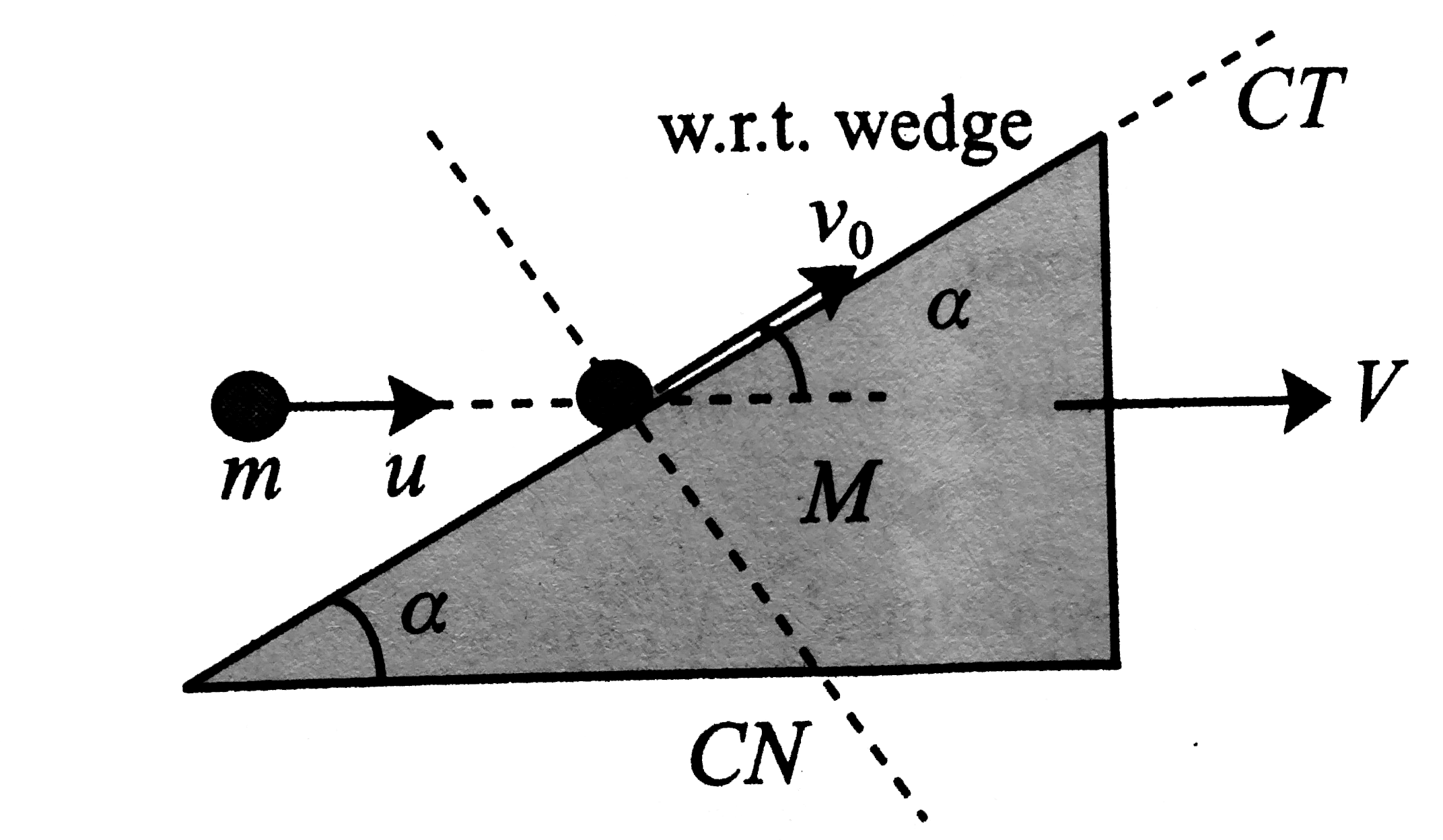 Velocity along CT remains, constant `ucosalpha=v_0+Vcosalpha`.......ii `vecv_b=(v_0cosalpha+V)HATI+(v_0sinalpha)hatj` From i and ii `"mu"=MV+mV+mcosalpha(ucosalpha-Vcosalpha)` `=(M+m)V+mucos^2alpha-mcos^2alpha` `implies V=("mu"sin^2alpha)/(M+msin^2alpha)` b. When the bal ASCENDS maximum HEIGHT, then ball will be at rest w.r.t. wedge and ther velocity will be same. Let their common velocity be `v'`. From conservationof momentum we cn FIND this common velocity as `'v'="mu"(M+m)`. From ii `v_(0)-(u-V)cosalpha`, put the value of `V` in this to get `v_(0)=(Mucosalpha)/(M+msin^(2)alpha)` Also, `v_(0)cosalpha+V=[(Mcos^(2)alpha+msin^(2)alpha)/(M+msin^(2)alpha)]u` To find maximum height From energy conservation `mgh+1/2(m+M)v^('2)` `=1/2MV^(2)+1/2m(v_(0)cosalpha+V)^(2)+1/2m(v_(0)sinalpha)^(2)` `2mgh+(m^(2)u^(2))/(M+m)=MV^(2)+m(v_(0)cosalpha+V)^(2)+m(v_(0)sinalpa)^(2)` `2mgh+(m^(2)u^(2))/(M+m)` `MM^(2) u^(2) sin^(4)alpha+m(Mcos^(2)alpha+msin^(2)alpha)^(2) u^(2)` `=(+mM^(2)u^(2)cos^(2)alphasin^(2)alpha)/((M+msin^(2)alpha)^(2))` Solve to get: `h=u^(2)/(2g) [(M^(2)cos^(2)alpha)/((M+m)(M+msin^(2)alpha))]` |
|
| 49. |
Vector vecAis 2 cm long and is 60° above the x - axis in the first quadrant, vector vecBis 2cm long and is 60° below the x - axis in the fourth quadrant. Find vecA + vecB |
|
Answer» 2CM ALONG POSITIVE y-axis |
|