

Saved Bookmarks
This section includes 7 InterviewSolutions, each offering curated multiple-choice questions to sharpen your Current Affairs knowledge and support exam preparation. Choose a topic below to get started.
| 1. |
Particles of masses m, 2m, 3m, ... , nm grams are placed on the same line at distances l, 2l, 3l, ..., nl cm from a fixed point. The distance of centre of mass of the particles from the fixed point in centimetres is |
|
Answer» `((2N + 1) l)/(3)` `= (m l (1 + 4 + 9 + … + n^2))/(m (1 + 2 + 3+ …+ n)) = ( l "" (n (n +1) ( 2n +1))/(6))/((n(n+1))/(2)) = (l (2n + 1))/(3)` |
|
| 2. |
A metal drill of rated power 1000 W drills a hole in a lead cube of mass 2kg at temperature 25^(@)C in 15.8s. The specific heat capacity of lead is 130 J//kg-^(@)C (a) If the efficiency of the drill be 75% what is the total heat generated by it? (b) Assuming, 60% of the heat generated by the drill is being absorbed by the cube, what is its rise in temperature after 10s of the operation of the drill ? (c) What is the final temperature of the lead ? |
|
Answer» |
|
| 3. |
A 50 kg girl is swinging on a swing from rest. Then the power delivered when moving with a velocity of 2m/sec upwards in a direction making an angle 60º with the vertical is |
|
Answer» 980W |
|
| 4. |
A curved section of a road in banked for a speed upsilon. If there is no friction between the road and the tyres than |
|
Answer» a car MOVING with speed `UPSILON` will not SLIP on the road |
|
| 5. |
If L = 2.01 m pm 0.01 m , what is 3 L ? |
|
Answer» SOLUTION :Here , we should equate 3L with `(L+ L+ L)` to FIND out the absolute error in 3L. THUS `3L = (3 XX 2.01) m pm 3 xx 0.01 m` ` = 6.03 m pm 0.03 m` |
|
| 6. |
A car of mass 1250 kg experiences a resistance of 750 N when it moves at 30 ms^(-1)If the engine can develop 30 KW at this speed, the maximum acceleration that the engine can produce is: |
|
Answer» `0.8 MS^(-2)` |
|
| 7. |
If vec(P)=2hat(i)+3hat(j)-4hat(k) and vec(Q)=5hat(i)+2hat(j)+4hat(k). Find the angle between the two vectors. |
|
Answer» `30^(@)` |
|
| 8. |
A 2 kg mass placed on a level table and is attached by a string passing over the edge of a table as illustrated in the diagram. (i) Calculate the magnitude of acceleration of the system. (ii) Calculate the tension in the string. |
|
Answer» Solution :From FBD in `m_(1)` `T-m_(1)a=0` `implies T-2a=0`……(i) FBD in `m_(2)` `m_(2)g-T=m_(2)a` `5g-T=5a` Putting T=2a from Eq. (i) 5g-2a=5a 7a=5g `a=(5)/(7)xx10=(50)/(7) MS^(-2)` Again Tension in the string `T=2a=2xx(50)/(7)=(10)/(7) N` |
|
| 9. |
Why do we have seasons on Earth? |
|
Answer» Solution :(a) If the orbits of the Moon and Earth lie on the same plane, during full Moon of every month, we can observe lunar eclipse. If this is so during new Moon we can observe sola eclipse. But Moon.s orbit is tilted `5^(@)` with respect to Earth.s orbit. Due to this `5^(@)` tilt, only during certain periods of the year, the Sun, Earth and Moon align in straight line LEADING to either lunar eclipse or solar eclipse DEPENDING on the alignment. (b) The common misconception is that .Earth revolves around the Sun, so when the Earth is very far away, it is winter and when the Earth is nearer, it is summer.. Actually, the SEASONS in the Earth arise due to the rotation of Earth around the Sun with `23.5^(@)` tilt. Due to this `23.5^(@)` tilt, when the northern PART of Earth is farther to the Sun, the southern part is nearer to the Sun. So when it is summer in the northern hemisphere, the southern hemisphere experience winter. |
|
| 10. |
A solid disc and a ring, both of radius 10 cm are placed on a horizontal table simultaneously, with initial angular speed equal to 10 π" rad s"^(-1). Which of the two will start to roll earlier ? The co-efficient of kinetic friction is µ_(k) = 0.2. |
|
Answer» Solution :Radii of the ring and the disc `R=10cm=0.1m` coefficient kinetic friction `mu_(K)=0.2` moment of inertia for ring `I=MR^(2)` moment of inertia for disc `I=(MR^(2))/(2)` initial angular velocity `omega_(0)=10pi" rads"^(-1)` `f=ma` `mu_(K)N=ma""[f=mu_(K)N]` `mu_(K)mg=ma""[because N=mg]` `therefore a-mu_(K)g""....(1)` and torque `tau=-Ialpha` `therefore Ialpha=-fR [because tau=fR]` `=-maR` `=-mu_(K)NR` `therefore Ialpha=-mu_(K)mgR""....(2)` Now in equation of motion `v=u+at,u=0` `therefore v=at` `therefore a=(v)/(t)""....(3)` From eqn. (1) and (3) `mu_(K)g=(v)/(t)` `therefore v=mu_(K)"gt rarr" for ring.....(4)"` and `v=mu_(K)"gt. "rarr" for disc....(5)"` From eqn. (2) `alpha=-(mu_(K)mgR)/(I)` From eqn. (2) `alpha=-(mu_(K)mgR)/(I)` `alpha=-(mu_(K)mgR)/(mR^(2))rarr` for ring `=-(mu_(K)g)/(R )` and `alpha=-(mu_(K)mgR)/(mR^(2))rarr` for ring `=-(2mu_(K)g^(2))/(R )` Now in rotational equation `omega=omega_(0)+alphat,` `omega=omega_(0)-(mu_(K)"gt")/(R )rarr` for ring and `omega=omega_(0)-(2mu_(K)"gt".)/(R )rarr` for disc Now `v=Romegararr` condition for rolling of a rigid body `therefore omega=omega_(0)-(mu_(K)"gt")/(R )` `therefore (v)/(R)=omega_(0)-(mu_(K)"gt")/(R)[because omega=(v)/(R)]` `mu_(K)"gt"=R[omega_(0)-(mu_(K)"gt")/(R)][because" From eqn. (4)"]` `mu_(K)"gt"+mu_(K)"gt = "Romega_(0)` `2mu_(K)"gt"=Romega_(0)` `therefore t=(Romega_(0))/(2mu_(K)g)` `therefore t=(0.1xx10pi)/(2xx0.2xx9.8)` `therefore t=0.8s rarr` for ring Now `omega=omega_(0)-(2mu_(K)"gt")/(R )` `therefore (v)/(R)=omega_(0)-(2mu_(K)"gt")/(R)` `therefore mu_(K)"gt".=R[omega_(0)-2mu_(K)"gt". [because" from eqn. (5)"]` `therefore mu_(K)"gt".+2mu_(K)"gt".=Romega_(0)` `therefore 3mu_(K)"gt".=Romega_(0)` `therefore t.=(Romega_(0))/(3mu_(K)g)` `=(0.1xx10pi)/(3xx0.2xx9.8)` `=0.53s rarr` for disc `therefore` Since, `t.lt t`, the disc will start rolling before the ring. |
|
| 11. |
A body of mass 10 kg about to slide down a plane inclined at an angle 20^(@) with the horizontal. What force along the plane if applied upwards will just make the body slide upwards? [ sin 20^(@) = 0.3420 ] |
|
Answer» |
|
| 12. |
A plate of area 100 cm^(2) is placed on the upper surface of castor oil, 2mm thick. Thaking the co-efficient of viscosity to be 200 poise. Calculate the horizontal force in N to be applied to move the plate with a velocity of 3cm/sec. |
|
Answer» |
|
| 13. |
When two capillary tubes of different diameters are dipped vertically in a liquid, the height of the liquid is: |
|
Answer» more in the TUBE of LARGE diameter |
|
| 14. |
When a gas is forced in a smaller volume without change in temperature, its pressure increases because its molecules. |
|
Answer» Strike the unit AREA of the CONTAINER WALLS more often |
|
| 15. |
You are on a picnic and you make tea for yourself and your friend. However, your friend has gone out to bring something for you. You observed that the fire (that you ignited for making tea) has heated two nearby blocks of stones – one of sand stone and other of granite – to 90^(@)C. Both blocks have nearly same mass but granite has higher specific heat than marble. To keep the tea hot for your friend you decided to place the tea pot on one of the stones. Which stone will you choose – granite or marble? |
|
Answer» |
|
| 16. |
When forces F_1, F_2, F_3are acting on a particle of mass m such that F_2 and F_3are mutually perpendicular, then the particle remains stationary, If the force F_1is now removed then acceleration of the particle is |
|
Answer» `F_1//m` |
|
| 17. |
The magnitude of scalar and vector products of two vectors are 483 and 144 respectively. What is the angle between the two vectors ? |
| Answer» Answer :C | |
| 18. |
In a spring gun, a spring of force constant 200N/mis compressed 0.15 m. When fired, 80% of the elastic potential energy stored in the spring is eventually converted into kinetic energy of a 0.1 kg uniform ball that is rolling without slipping at the base of a ramp. The ball continues to roll without slipping up the ramp with 90% of the kinetic energy at the bottom converted into an increase in gravitational potential energy at the instant it stops. (a) What is the speed of the ball's centre ofmass at the base of the ramp (b) At this position, what is the speed of a point at the top of the ball? (c ) What maximum vertical height up the ramp does the ball move? |
|
Answer» |
|
| 19. |
If g on the surface of the earth is 9.8m//s^2find its value at a height of 6400km. (Radius of the earth = 6400km) |
|
Answer» Solution :LET G at a HEIGHT h be `g_h"" g_h(g)/(1+h/R)^(2)` h = 6400 km , R `= 6400 km , g =9.8 m//s^2` `g_(h)= (9.8)/((1+(6400)/(6400))^2)=(9.8)/((1+1)^2)=(9.8)/4=2.45m//s^2` |
|
| 20. |
Two sinusoidal waves combining in a medium are described by the wave functions y_(1) = ( 3.0 cm) sin pi ( x + 0.60 t) y_(2) = ( 3.0 cm) sin pi ( x - 0.60 t) where x is in centimeters and t is in seconds . Determine the maximum transverse position of an element of the medium at (a)x = 0.250 cm , (b) x = 0.500 cm and (c ) x = 1.50 cm. (d) Find the three smallest values of x corresponding to antinodes. |
|
Answer» Solution :The answers for maximum transverse position must be between ` 6 cm and 0`. The anitodes are seperated by half a wavelength , which we except to be a COUPLE of centimetres . According to the WAVES in interference model , we write the function ` y_(1) + y_(2)` and start evaluating things. We get ` y = y_(1) + y_(2) = ( 6.0 cm) sin ( pi x) cos ( 0.60 pi t)` SINCE ` cos (0) = 1` , we can find the minimum value of `y` by SETTING ` t = 0` . `y_(MAX) (x) = y_(1) + y_(2) = ( 6.0 cm) sin (pi x)` (a) At `x = 0.250 cm , y_(max) = ( 6.0 cm) sin ( 0.250 pi) = 4.24 cm` (b) At ` x= 0.50 cm , y_(max) = ( 6.0 cm) sin ( 0.500 pi ) = 6.00 cm` ( c) At ` x= 1.50 cm , y _(max) = | ( 6.0 cm) sin (1.50 pi)| = + 6.00 cm` (d). The antinodes occur when ` x = n lambda //4 for n = 1 , 3 , 5 , .....` But ` k = 2 pi //lambda = pi , so lambda = 2.00 cm ` and ` x_(1)= lambda//4 = ( 2.00 cm)//4 = 0.500 cm` `x_(2) = 3 lambda //4 = 3 ( 2.00 cm )//4 = 1.50 cm` ` x_(3) = 5 lambda //4 = 5 ( 2.00 cm)//4 = 2.50 cm` Two of our answers in (d) can be read from the way the amplitude had its largest possiblr value in parts (b) and ( c ). Note again that an amplitude is defined to be always positive , as the maximum absolute value of wave function . |
|
| 21. |
The temperature at which the K.E. of a gas molecules is double its value at 27^(@)C is |
|
Answer» `54^(@)C` |
|
| 22. |
216 water droplets (radius of each is r) coalesce to form a large drop of water. If the energy released in this process increases the temperature of the water drop then what will be the rise in temperature? [s = specific heat, J = mechanical equivalent of heat, T = surface tension, rho = density of water, ] |
| Answer» SOLUTION :`(5T)/(2J R RHO s)` | |
| 23. |
A spring of force constant k is kept in the compressesd conditionbetween two blocksmassesm and M on the smoothsurface of a table as shown in figure .When the springis released , both the blocksmove in oppositedirections .Whenthe springattainsthe orginal (normal ) position . both blockslose the constactswith the spring . If x is the intialcompressionof the springfind the speeds of blockwhilegettingdetached from the spring . |
|
Answer» Solution :Suppose V and v be the velocity of the BLOCK of mass M and m respectively when they losethecontactwith spring. Here the initial momnetumis zero and finalmomentumis MV - mv Accordingto the lawof conservationof momentum ` MV - mv = 0 ` ` :. V = (mv)/M ` ` :. ` The potential energy stored in spring will be the intial ENERGYOF the system` = 1/2 kx^(2)` Final energy of the system` = 1/2 mv^(2) +1/2 Mv^(2)` (Neglecting FRICTIONAL forces ) ` :. 1/2 mv^(2)+1/2 Mv^(2)=1/2 kx^(2)` ` :. mv^(2) [1+m/M] =kx^(2)` ` :. mv^(2) [(M+m)/M] = kx^(2)` ` :. v^(2) = (KM)/(m(M+m)).x^(2)` ` :. v = x sqrt((kM)/(m(M+m)))` |
|
| 24. |
A body takes 1(1/3) times as much time to slide down a rough inclined plane as it takes to slide down an identical bust smooth inclined plane. If the angle of inclination is 45°, find the coefficient of friction. |
|
Answer» `1/16` |
|
| 25. |
The speed of the centre of a wheel rolling on a horizontal horizontal surface is v_(0). A point on the rimin level with the centre will be moving at a speed of speed of: |
|
Answer» ZERO |
|
| 26. |
The extensive state variable among the following are a) Pressure b) Volume c)Internal Energy d) Density |
|
Answer» a and B |
|
| 27. |
A horizontal force F is applied on a uniform sphere of radius r and weight W and as a result, the sphere slides over the horizontal table. If the coefficient of friction between the sphere and the table is mu, then show that h =r (1- (muW)/(F)). |
|
Answer» Solution :The point of contact between the table and the sphere is Q. Here, the FORCE of friction f acts along the surface of the table through the point Q opposite to the force F. The weight of the sphere W acts vertically DOWNWARDS through the CENTRE of the sphere. Since the sphere slides over the horizontal table it has no rotational motion. So, with respect to the centre O, `fxxr = F(r-h)` or, `mu WXXR =F(r-h)` `h= r(1-(MUW)/(F))`. 
|
|
| 28. |
The ratio C_(P)/C_(V)=gamma for a gas. Its molecular weight is M. Its specific heat capacity at constant pressure is |
|
Answer» `R/(gamma-1)` |
|
| 29. |
Write equation of relation between time period and frequency. |
Answer» Solution : From graph, initial velocity `= V _(0)` and distance travelled in time `t = X _(0).` For the graph `tan theta = (v_(0))/(x_(0)) = (v _(0) -v)/(x) ""…(1)` Where, v is velocity and x is displacement at any instant of time t. From EQ. (i) `v _(0) -v = (v _(0))/(x_(0)) x` `implies v = (-v _(0))/(x_(0)) x + v _(0) ""...(2)` We know that  Acceleration `a = (dv)/(DT) = (- v _(0))/( x _(0)) (dx)/(dt) + 0` `a = (-v_(0))/( x _(0)) (v)` `= (-v _(0))/( x _(0)) ((-v _(0))/( x _(0)) x + v _(0)) (because `From (2)) `= (v _(0) ^(2))/( x _(0) ^(2)) x - ( v _(0) ^(2))/( x _(0))` Graph of a versus x is given above. |
|
| 30. |
A bob of mass 0.1 kg hung from the ceiling of a room by a string 2 m long is set into oscillation.The speed of the bob at its mean position is 1 m s^(-1). What is the trajectory of the bob if the string is cut when the bob is (a) at one of its extreme positions, (b) at its mean position. |
| Answer» Solution :(a) At the extreme position, the speed of the bob is zero. If the string is cut, ITWILL fall vertically DOWNWARDS. (b) At the mean position, the bob has a HORIZONTAL velocity. If the string is cut, it will fall ALONG a PARABOLIC path. | |
| 31. |
Keeping the mass of earth as constant, if its radius is reduced to 1//4^(th) of its initial value, then the period of revolution of earth about its own axis and passing through the centre, in hours, is (Assure earth to be a solid sphere and its initial period of rotation as 24 hrs. |
|
Answer» `1.5` |
|
| 32. |
Which concept was givenby newton 's first law of motion ? |
| Answer» ANSWER :d | |
| 33. |
A man slides down on a telegraphic pole with an acceleration equal to one fourth of acceleration due to gravity. The frictional force between man and pole is equal to in terms of man's weight w : |
|
Answer» `(W)/(4)` |
|
| 34. |
A manometer reads the pressure of a gas in an enclosure as shown in figure (a) When a pump removes some of the gas , the manometer reads as in figure (b). The liquid used in the manometersis mercury and the atmospheric pressure is 76 cm of mercury. (a)Give the absolute andgauge pressure of the gas in the enclosure for cases (a) and (b) , inunits of cm of mercury. (b) How would the levels change in case (b) if 13.6 cm of water (immiscible with mercury)are poured into the right limb of the manometer ? (Ignore the small change in the volume of the gas). |
|
Answer» <P> Solution :Here atmosphericpressure`h_(1)=20`cm of mercury Absolute pressure (P) is large than `(P_(o))``thereforeP=P_(o)+h_(1)rhog` where `rho=` density of water `=76cm` ofHg +20 cm of Hg `=96cm` of Hg Now Gauge pressure = Absolute pressure - Atmospheric pressure `=96cm`Hg `-76cm`of Hg `=20 cm` of Hg From figure (b), pressure HEAD `h_(2)=-18cm` of Hg `THEREFORE` The absolute pressureon gas is less than the atmospheric pressure . `thereforeP=P_(o)+h_(2)rhog` `=76cm` of Hg +(-18cm) of Hg `=58` cm og Hg `therefore` Gauge pressure `=58cm` of Hg- 76 cm of Hg `=-18cm` of Hg This means at absolute pressure the height of means at absolute pressure the height of mercury is h. (b) When `13.6cm` ofwater is poured into the right LIMB of the monometer of figure (b) , then pressure , `rhogh=rho.gh.` `thereforeh.=(rhoh)/(rho.)=(1xx13.6)/(13.6)` `[becauserho` = density of mercury] `thereforeh=1cm` of Hg Mercury risesin left column such that the DIFFERENCE in the mercury levels in the two limbs , `=20cm-1cm` `=19cm` of Hg |
|
| 35. |
A uniform rope having mass m hangs vertically froma rigid support. A tranverse wave pulse is produced at the lower end. Which of the following plots shows the correct variation of speed v with height h from the lower end ? |
|
Answer»
|
|
| 36. |
A spring of force constant .k.is stretched by a small length .x.. The work done in stretching it further by a small length .y. is, |
|
Answer» `(1)/(2)k(X^(2)+y^(2))` |
|
| 37. |
In a cyclic process shown in the figure an ideal gas is adiabatically taken from B to A, the work done on the gas during the processB toAis 30 J, when the gas is taken fromA to Bthe heat absorbed by the gas is 20J. What is The change in internal energy of the gas in the process A to B. |
Answer» SOLUTION : `W_(BA) = -30J, Q_(BA)=0` `:.DeltaU_(BA)= -W_(BA)=30J` In a cyclic PROCESS `DeltaU=0` Now, `DeltaU_(AB)= -DeltaU_(BA)= -30J` |
|
| 38. |
A particle mass is tied to an ideal string and whirled in a vertical circle of radius L, where L is off-course the length of the string. If the ratio of the maximum to minimum tension in the string throughout the motion is 2 : 1, then the maximum possible speed of the partcle will be: |
|
Answer» `SQRT(11 gL)` |
|
| 39. |
At what temperature on the Fahrenheit scale will the reading be double of the reading on the Celsius scale? |
|
Answer» `340^(@)` F |
|
| 40. |
If the particle is moving along a straight line given by the relation x=2-3t+4t^(3) where s is in cms., and t in sec. Its average velocity during the third sec is |
|
Answer» 73 cm/s |
|
| 41. |
A boy sees a ball go up and then down through a window 2.45m high. If the total time that ball is in sight in 1s, the height above the window the ball rises is approximately |
|
Answer» 2.45m |
|
| 42. |
The angular momentum of rotating body is increased by 20%. What will be the increase in its rotational kinetic energy ? |
|
Answer» SOLUTION :Kinetic energy K.E. `= (L^(2))/(2I) "" E alpha L^(2)` `(E+Delta E)/(E )=((120)/(100))^(2)`(or) `(Delta E)/(E )=0.44` (or) `(Delta E)/(E ) xx100 =44%` |
|
| 43. |
Consider the previous problem, at what point must the rod be picked over a knife edge, so that the barbell remains horizontal. |
|
Answer» |
|
| 44. |
A body of mass 5 kg is suspended by a spring balance on an inclined plane as shown in figure. The spring balance measure |
|
Answer» 50 N |
|
| 45. |
A body is thrown with a velocit V_(0) at an angle theta_(0) with horizontal. The average power delivered by gravity during time t is -mg[V_(0)sin theta_(0)-("gt")/k] then find the value of k is |
|
Answer» |
|
| 46. |
A rod of nickel of length l is clamped at its midpoint . The rod is stuck and vibrations are set up in the rod . Find the general expression for the frequency of the longitudinal vibrations of the rod . Young's modulus and density of the rod is Y and rho , respectively. |
|
Answer» ` l = 2 lambda_(1)//4 and v = f lambda_(1)` ` V = sqrt ((Y)/( rho)) , l = (lambda_(1))/(rho) , l = (lambda_(1))/(2)` ` f_(1) = (v)/( lambda_(1)) = (1)/( 2 l) sqrt((Y)/(rho))` Case II ` l = 2 [ (lambda_(2))/(4) + ( lambda_(2))/(2)]` ` l = ( 3lambda_(2))/( 2)` Again ` f_(2) = (v)/( lambda_(2)) = (3)/( 2 l) sqrt((Y)/(rho))` Cae III `l = 2 ( 5lambda_(3))/( 4) , lambda_(3) = ( 2l )/(5)` `f_(3) = (v)/( lambda_(3)) = (5)/( 2 l) sqrt((Y)/(rho))` Comparing EXPRESSION `f_(1) , f_(2) , f_(3) `, we have `f_(N) = ( 2N - 1)/( 2l) sqrt((Y)/( rho)) ` , where `n = 1 , 2, 3, ..` 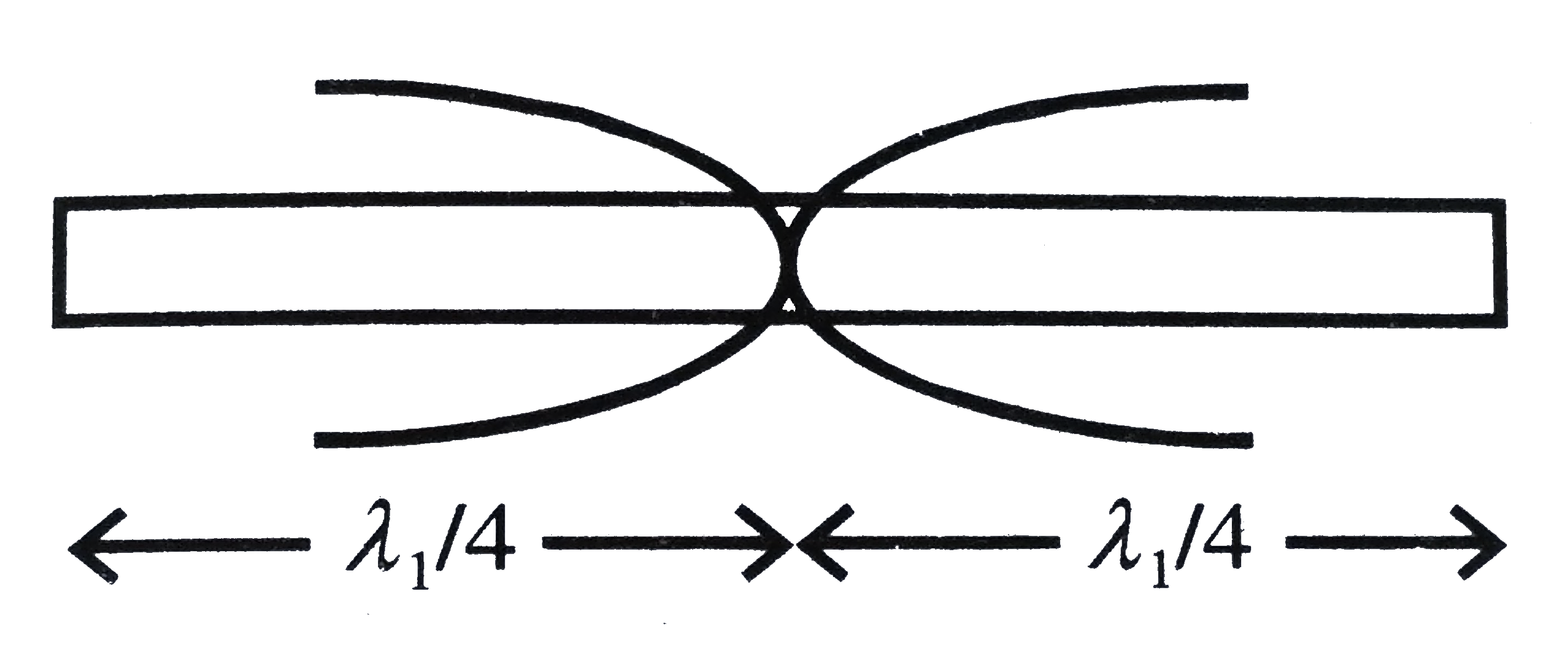 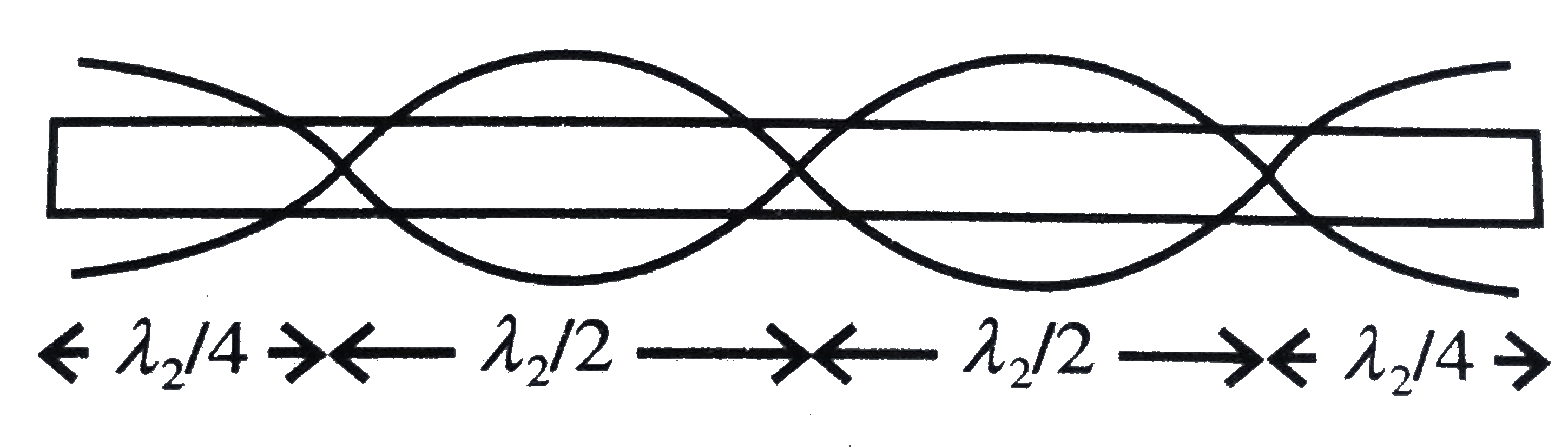
|
|
| 47. |
The figures given below show different processes (relating pressure P and volume V) for a given amount of an ideal gas. W is work done by the gas and DeltaQ is heat absorbed by the gas. |
|
Answer» |
|
| 48. |
The height of the water in a tank is H. The range of the liquid emerging out from a hole in the wall of the tank at a depth (3H)/4 from the upper surface of water, will be |
| Answer» ANSWER :D | |
| 49. |
A particle is placed at the origin and a force F = kx is acting on it (where k is a positive constant). If U (0) = 0, the graph of U(x) versus x will be (where U is the potential energy function) |
|
Answer»
|
|
| 50. |
Calculate the heat required to convert 3 kg of ice at -12" "^(@)C kept in a calorimeter to steam at 100" "^(@)C at atmospheric pressure. Given specific heat capacity of ice =2100" J kg"^(-1)K^(-1), specific heat capacity of water =4186" J kg"^(-1)K^(-1), latent heat of fusionn of ice =3.35xx10^(5)" J kg"^(-1) and latent heat of steam =2.256xx10^(6)" J kg"^(-1). |
|
Answer» Solution :Mass of ice `m=3` kg Specific heat of ice `S_("ice")=2100" Jkg"^(-1)K^(-1)` Specific heat of water `S_(W)=4186" Jkg"^(-1)K^(-1)` Latent heat of fusion of ice `L_(F"(ice)")=3.35xx10^(5)" Jkg"^(-1)` Latent heat of VAPORIZATION of steam `L_("heat")=2.256xx10^(6)" Jkg"^(-1)` `rArrQ_(1)=` heat required to rise temperature of ice from `-12^(@)C` to `0^(@)C` `="mS"_("ice")DeltaT_(1)` `=3xx2100xx[0-(-12)]` `=6300xx12` `:.Q_(1)=756000" J. . . (1)"` `rArr Q_(2)=` heat required to CONVERT ice of `0^(@)C` in to water `=mL_("ice")` `3xx3.35xx10^(5)` `:.Q_(2)=1005000 " J. . .(2)"` `rArrQ_(3)=` heat required to rise temperature of water from `0^(@)C` to `100^(@)C` `=mS_(W)DeltaT_(2)` `=3xx4186xx(100-0)` `:.Q_(3)=1255800" J. . .(3)"` `rArr Q_(4)` = heat required to convert water of `100^(@)C` in to steam `=mL_("steam")` `=3xx2.256xx10^(6)` `:.Q_(4)=" 6768000" J. . .(4)"` `rArrQ=` heat required to convert ice at `-12^(@)C` in to steam `:.Q=Q_(1)+Q_(2)+Q_(3)+Q_(4)` From equation (1), (2), (3) and (4) `Q=75600+1005000+1255800+6768000=9104400" J"` `:.Q~~9.1xx10^(6)J` |
|


