

Saved Bookmarks
This section includes 7 InterviewSolutions, each offering curated multiple-choice questions to sharpen your Current Affairs knowledge and support exam preparation. Choose a topic below to get started.
| 1. |
The flow of blood in largeartery of anesthetised dog is diverted through a venturi meter . Thewider part of the meter has a cross sectional area equal tothat of the artery. A=8mm^(2) . The narrower part has an areaa=4mm^(2). The narrower part has an area a=4mm^(2). The pressure drop in the artery is 24 Pa . What is the speed of the blood in the artery ? (1.60xx10^(3)kgm^(-3)) |
| Answer» SOLUTION :`v=0.075ms^(-1)` | |
| 2. |
A uniform 50 kg ABC is balanced in the vertical position. A 500 N horizontal force is suddently applied at B as shown in fig. If the coefficient of kinetic friction between pole and surface is 0.3. The initial acceleration of point A (g="10 m/s"^(2)) is. . . . . m//s^(2) |
|
Answer» |
|
| 3. |
A body covers 200 cm in the first 2 sec and 220 cm in the next 4 sec under constant acceleration. Then the velocity of the body after 7 sec is |
|
Answer» `-15cm//s` |
|
| 4. |
Dimensional formula for angular momentum is |
|
Answer» `ML^(2)T^(-1)` |
|
| 5. |
Distance between two bodies A and B is r. The gravitational force acting on them is inversely proportional to the square of distance. Gravitational force between them varies universally as the 4^(th) power of distance then find the accleration of body A. |
|
Answer» SOLUTION :`IMPLIES`According to inverse law of square of DISTANCE, the gravitational force between A and B is `F = G(m_Am_B)/r^2""...(1)` `implies` ACCELERATION of body `a_A=F/m_A=(Gm_B)/r^2....(2)` For second case : `F. =G(m_Am_B)/r^4` Acceleration of A `a._A=(F.)/m_A =(Gm_B)/r^4=1/r^2((Gm_B)/r^2)` `:. a._A=(a_A)/r^2` |
|
| 6. |
The kinetic friction |
| Answer» Solution :is constant | |
| 7. |
Rain drops filling under gravity do not acquire very high velocity. Why? |
| Answer» Solution :Due to VISCOUS force of airand buoyancy the AIR acquires a CONSTANT velocity called the TERMINAL velocity. | |
| 8. |
The SI unit of timerate of change of momentum is ……….. |
|
Answer» `MS^(-2)` RATE of changeof linearmomentumshowsforce |
|
| 9. |
Which of the follwong units could be associated with a vector quantity? |
|
Answer» NEWTON/metre |
|
| 10. |
Two particles having masses m and 2m are travelling along x-axis on a smooth surface with velocities u_(1) and u_(2), collide. If their velocities after collision are v_(1) and v_(2), then the ratio of velocities of their centre of mass before ans impact is |
|
Answer» `2:1` |
|
| 11. |
What are the two basic characteristics of a simple harmonic motion? |
|
Answer» Solution :The two basic characteristics of a simple harmonic motion : (i) Acceleration is directly proportional to displacement. (ii) The DIRECTION of acceleration is always TOWARDS the MEAN position, that is opposite to displacement. |
|
| 13. |
When a particle oscillates simple harmonically, its potential energy varies periodically. If the frequency of oscillation of the particle is n, the frequency of potential energy variation is……………… |
| Answer» Solution :2n | |
| 14. |
A drilling machine is used to drill a hole in a 10 kg metal block. Power of the drilling machine is 1 KW and it is used for 5 minutes. If 40% of the work done by the drilling machine is converted into heat in the metal block, the rise in its temperature is (Specific heat- 0.12 cal gm^(-1).^(@)C^(-1) and J=4.2 J/Cal) |
|
Answer» `20^(@) C` |
|
| 15. |
A simple pendulum of length 'l' has a bob of mass 'm'. If it is released when the string makes an angle 60^(@) with the vertical, the tension in the string at the lowest position is |
| Answer» Answer :C | |
| 16. |
A stone is suspended by a thread from a rigid support. Another thread is attached at the bottom of the stone. If the lower thread is pulled suddenly which thread - upper or lower - does break ? If the lower thread is pulled slowly which thread - upper or lower - does break? |
| Answer» Solution :LOWER THREAD since the applied force is not transmitted to the upper thread due to INERTIA. Upper thread since the force applied will be transmitted to the upper thread and the total force on it is the SUM of the applied force and the WEIGHT of the stone. | |
| 17. |
A stationary sound wave has a frequency 165 Hz.Distance between two consecutive nodes is(speed of the sound in air = 330 m/s) |
|
Answer» 2 m |
|
| 18. |
Consider a gas with density P and overset(-)(c) as the root mean square velocity of its molecules contained in a volume. If the system moves as a whole with velocity , then the pressure exerted by the gas is |
|
Answer» `(1)/(3)rho((OVERSET(-)(c))^(2))` |
|
| 19. |
A heavymass M resting on the ground is attached to a small mass m via massless inextensible string passing over a pulley.The string connected to M is loose.The smaller mass falls freely through a height h and the string becomes tight. Obtain the time from this instant when the heavier mass again makes contact with the ground. Also obtain the loss in K.E. when M is jerked in to motion. |
|
Answer» |
|
| 20. |
A soap film is on a rectangular wire ring ofsize 5cm xx 4cm. If the size of the film is changed to 5cm xx 5cm, then calculate the work done in this process. The suface tension of soap is 5xx10^(-2) "Nm"^(-1). |
|
Answer» |
|
| 21. |
What are processes involves in a Carnot engine? |
|
Answer» Solution :There are four PROCESSES involves in a CARNOT ENGINE: (i) source (ii) sink (III) insulating stand (iv) working SUBSTANCE |
|
| 22. |
Two bodies have their moments of inertia I and 2I, respectively about their axis of rotation. If their kinetic energies of rotation are equal, their angular velocity will be in the ratio |
|
Answer» `2:1` `K_(A)=` Kinetic energy of rotation for the body `A = (1//2)I omega_(A)^(2)` where, `omega_(A)` is ANGULAR speed of the body A `K_(B)`= Kinetic energy of rotation for the body `B = (1)/(2)(2I)omega_(B)^(2)` According to the question, `K_(A)=K_(B)` `rArr (1)/(2)I omega_(A)^(2)=(1)/(2)(2I)omega_(B)^(2)rArr omega_(A)^(2)=2 omega_(B)^(2)rArr((omega_(A))/(omega_(B)))^(2)=2` `rArr (omega_(A))/(omega_(B))=sqrt(2)rArr omega_(A):omega_(B)=sqrt(2):1`. |
|
| 23. |
Satellite orbitting the earth have finite life and sometimes debris of satellites fall to the earth. This is because |
|
Answer» the solar cells and batteries in satellites run out |
|
| 24. |
The slope of velocity-time graph gives |
|
Answer» velocity |
|
| 25. |
1 mm of a main scale is divided into 10 equal divisions. The least count of the callipers is 0.005 cm, then the vernier scale must have |
|
Answer» 10 divisions |
|
| 26. |
If I_(1),I_(2) and I_(3) are moments of inertia of a disc about its geometric axis, diameter and a tangent in its plane then |
|
Answer» `I_(1)gtI_(2)gtI_(3)` |
|
| 27. |
If the distance between the centres of the atoms of potassium and bromine in KBR molecules is 0.282xx10^(-9)m. The centre of mass of this two particle system from potassium is (mass of bromine = 80 u and of potassium = 39 u). |
|
Answer» `9.3xx10^(-2)NM` |
|
| 28. |
Quantity having units but no dimensions is |
|
Answer» INTENSITY of SOUND |
|
| 29. |
On each surface of a solid cube, a uniform pressure p is applied. Calculate the temperature rise of the solid cube so that its volume remains unaltered. Given, the coefficient of volume expansion of the material of the cube =gamma and its bulk modulus of elasticity = B. |
|
Answer» Solution :LET the initial volume of the cube be V and the change in volume DUE to the applied pressure be `DeltaV.` Hence, BULK modulus of elasticity, `"" B=p/((DeltaV)/V) " or, " DeltaV=(pV)/B.` `THEREFORE` Due to the pressure applied the present volume of the cube `=(V-DeltaV)`. Suppose with the rise in temperature by t, the reduced volume increases by `DeltaV` so that the cube regains its initial volume. `therefore "" DeltaV=(V-DeltaV)gammat=(V-(pV)/B)gammat=((B-p)/B)Vgammat` or, `"" (pV)/B=((B-p)/B)gammaVt " or, " t=p/((B-p)gamma).` |
|
| 30. |
Find the ratio of the orbital speeds to two satellites of the earth if the satellites are at height 6400 km and 19200 km. (Radius of the earth = 6400 km). |
|
Answer» SOLUTION :Orbital SPEED `V_(0) = sqrt((GM)/(R+h))` The ratio of the orbital speeds of two satellites around the earth is `(V_(01))/(V_(02)) = sqrt((R+h_(2))/(R+h_(1)))` Where `h_(1)` and `h_(2)` are the heights of the satellites In this problem `h_(1) = 6400 km, h_(2) = 19200 km, R = 6400 km`. `(V_(01))/(V_(02)) = sqrt((6400)/(12800)) = sqrt((25600)/(12800)) = (sqrt(2))/(1)` |
|
| 31. |
Spherical particles of pollen are shaken up in wate are allowed to settle. The depth of water is2 xx 10^(-2)m. What is the diameter of the largest paricle remaining in suspension for one hour later? Density of pollen = 1.8 xx 10^(3) kg m^(-3), vescosityof water = 1 xx 10^(-2) deca poise and density of water = 1xx 10^(3) kgm^(-3). |
|
Answer» SOLUTION :Terminal velocityof the spherical of pollen, falling through water is `upsilon=(2 (rho -rho_(0))gr^(2))/(9 eta)` ..(i) The paricle will not be reaching the BOTTOM in a time t if `upsilon LE d/t = (2 xx 10^(-2)m)/(1 hour) = (2 xx 10^(-2)M)/(60 xx 60S) = (10^(-4))/(18) ms^(-1)` from (i), ` R = [(9 eta upsilon)/(2(rho - rho_(0))g)]^(1//2)` `=[(9 xx 10^(-2) xx (10^(-4)//18))/(2[(1.8 xx 10^(3)-1 xx 10^(3))xx9.8])]^(1//2)` `=5.6 xx 10^(-6)m`. |
|
| 32. |
The rotational kinetic energy of a disc is 450 J and its moment of inertia is 100 kg m^2. What is its angular momentum ? |
|
Answer» Solution :Rotational `K.E = K = 450 J` Moment of INTERTIA `=I = 100 kg m^(2)` ANGULAR momentum = L = ? `L^(2) = 2I xx 1/2 IOMEGA^(2) = 2IK`. `L = sqrt(2lK) = sqrt(2 xx 100 xx 450) = 300 kg m^(2) s^(-1)` |
|
| 33. |
A circular disc A of radius r is made from an iron plate of thickness t and another circular disc B of radius 4r is made from an iron plate of thickness t/4. The relation between the moments of inertia I_(A) and I_(B) is |
|
Answer» `I_(A)gt I_(B)` |
|
| 34. |
If the rms speed of methane gas in the Jupiter's atmosphere is 471.8ms^(-1), show that the surface temperature of Jupiter is sub-zero. |
|
Answer» Solution :RMS speed of methane gas `(nu_(rms))=471.8ms^(-1)` MOLAR mass of methane gas (M) 16.04 g PER mol `M=16.04xx10^(-3)kg/mol` Gsa constant `R=8.31 J mol^(-1)K^(-1)` `nu_(rms)=sqrt((3RT)/M)` `(nu_(rms))^(2)=(3RT)/M` `T=((nu_(rms))^(2)xxM)/(3R)=((471.8)^(2)xx16.04xx10^(-3))/(3xx8.31)` `(3.57xx10^(-6)xx10^(-3))/(24.93)=0.143xx10^(3)` T=143K-273 `T=-130^(@)C` |
|
| 35. |
The period of a simple pendulum is found to increases by 50% when the length the pendulum is increases by 0.6m. Calculate the initial length and the initial period of oscillation at a place where g=9.8 m//s^(2). |
| Answer» SOLUTION :0.48 m, 1.391 s | |
| 36. |
Acceleration due to gravity increases/decreases with increasing altitude. |
| Answer» SOLUTION : DECREASES, | |
| 37. |
Give the expression for the velocity of longitudinal wave in an elastic medium along with the meaning of the symbols used. |
| Answer» SOLUTION :`V = sqrt((Y)/( rho ))` where Y = YOUNG's modulus and `'rho'` density of the material.For LIQUIDS, `v = sqrt((K)/( rho))` where K = Bulk modulus of the medium. | |
| 38. |
A satellie in vacuum |
|
Answer» is KEPT in orbit by solar energy |
|
| 39. |
A block of mass 4 kg is placed on a rough horizontal plane. A time dependent horzontal force F = kt acts on the block (k = 2 N/s). Find the frictional force between the block and the plane at t = 2 second and t = 5 second (mu = 0.2) |
|
Answer» SOLUTION :When t = 2 SEC F = 4N `f_(ms)=mu_(s)mg = 0.2xx4xx10=8N` `THEREFORE F lt f_(ms) therefore` friction = 4 N When t = 5 sec F = 2 (5) = 10 N `F gt f "" therefore` friction = 8 N. |
|
| 40. |
At an angle theta with horizontal a particle is projected from surface of the earth of radius R with considerable velocity V_(0) to attain a maximum height .h. Then |
|
Answer» the speed of the particle at the maximum height `(RV_(0) cos theta)/((R + h))` |
|
| 41. |
Two balls are dropped to the ground from different heights. One ball is dropped 2 sec after the other but they both strike the ground at the same time. If the first ball takes 5 sec to reach the ground then the diffeence in initial heights is: |
|
Answer» 20M `H_(2)=(1)/(2)xxg(3)^(2)` |
|
| 42. |
Two identical springs of spring constant k are attached to a block of mass m and to fixed supports as shown in Fig. 14.14. Show that when the mass is displaced from its equilibrium position on either side, it executes a simple harmonic motion. Find the period of oscillations. |
Answer» Solution :Let the mass be displaced by a small distance x to the right side of the equilibrium POSITION, as shown in Fig. 14.15. Under this situation the spring on the left side gets 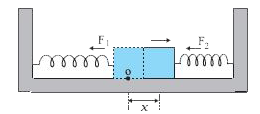 ELONGATED by a length equal to x and that on the right side gets compressed by the same length. The forces acting on the mass are then, `F_(1)=-kx` (force exerted by the spring on the left side, trying to pull the mass towards the mean position) `F_(2)=-kx` (force exerted by the spring on the right side, trying to push the mass towards the mean position) The net force, F, acting on the mass is then given by, `F=-2kx` Hence the force acting on the mass is proportional to the displacement and is DIRECTED towards the mean position, therefore, the MOTION EXECUTED by the mass is simple harmonic. The time period of oscillations is, `T=2pisqrt(m/(2k))` |
|
| 43. |
A body performing SHO with total energy of 100 J. In below column-I kinetic energy at difinite time and in column-II potential energy at that time is shown. Match them appropriately. . |
| Answer» SOLUTION :`IMPLIES A-ii, B-i` | |
| 44. |
The sign of work done by a force on a body is importantto understand.State carefully if the following quantities are positiveor negative : (a) work doneby a manin liftinga bucketout ofa wellby meansof a ropetiedto the bucket. (b) work done by gravitationalforce in the abovecase , (c ) work doneby friction on a bodysidingdown an inclined plane , (d ) workdone byan applied force on a bodymovingon a roughhorizontalplane wothuniform velocity . (d) work doneby the resistiveforceof air on a vibrating pendulum in bringingit to rest . |
|
Answer» Solution :We know that work`W = Fd cos theta` , where `theta ` is the angle between `vec(F ) and vec(d)` . (a) Here , DISPLACEMENT of a BUCKET is in the directionof force exterted on bucket so `theta = 0^(@)` ` :. Cos 0^(@) =1 "" : W = Fd cos 0^(@) =Fd ` ` :. ` Work is positive . (b) Work done is negative ,because gravitational force is in the downward and displacementof bucketis upwarddirection so , `theta = 180^(@)` ` :.W = Fd cos 180^(@)` ` :. W = - Fd "" [ :. cos 180^(@) =-1]` (c ) Work doneis negative , because force offriction is acting against the displacemnt so `theta = 180^(@)` ` :. W = fd cos 180^(@)` ` :.W = Fd ` (e) Work doneis negative , because the RESISTIVE force of air OPPOSES the motion so , `theta = 180^(@)` ` :. W - Fd cos 180^(@)` ` :. W = - Fd ` |
|
| 45. |
A cylinder of mass 10 kg and radius 15 cm is rolling perfectly on a plane of inclination30o. The co- efficient of static friction µ_(s) = 0.25. (a) How much is the force of friction acting on the cylinder ? (b) What is the work done against friction during rolling ? (c) If the inclination θ of the plane is increased, at what value of θ does the cylinder begin to skid, and not roll perfectly ? |
|
Answer» Solution :Mass of cylinder `m=10kg` Radius of cylinder `r=15cm=0.15m` Angle of inclination `theta=30^(@)` Coefficient of STATIC friction `mu_(S)=0.25` (a) Frictional force exerted on the cylinder PARALLEL to the surface of slope `f=(1)/(3)mgsintheta` `=(1)/(3)xx10xx9.8xxsin30^(@)` `=(1)/(3)xx10xx9.8xx(1)/(2)` `=16.3N` (b) Frictional force exerted on the cylinder perpendicular to the surface of slope = work done against friction force during ROLLING `W=frcos90^(@)` `W=0` (c ) Condition of rolling without SLIDING `mu=(1)/(3)tantheta` `THEREFORE tantheta=3mu` `=3xx0.25` `=0.75` `therefore theta=36^(@)54` `therefore theta~~37^(@)` |
|
| 46. |
Given below are some examples of wave motion. State in each case if the wave motion is transverse , longitudinal or a combination of both: (a) Motion of a kink in a longitudinal spring produced by displacing one end of the spring sideways. (b) Waves produced in a cylinder containing a liquid by moving its piston back and forth. (c) Waves produced by a motorboat sailing in water. (d) Ultrasonoic waves in air produced by a vibrating quartz crystal. |
|
Answer» SOLUTION :(a) TRANSVERSE and LONGITUDINAL (B) Longitudinal (C ) Transverse and longitudinal (d) Longitudinal |
|
| 47. |
Briefly explain how isa vehicle able to go round a leveled curved track determine the maximum speed with which the vehicle can negotiate this curved track safely |
|
Answer» Solution :Whena vehicletravelsin curvedpaththeremust be acentripetalforceactingon itthatisprovided by thefrictionalforcebetweenthereforces actingon thevehiclewhenitmovesare asshownin the figure . They are `(i)`Gravitationalforce (mg)actingdownwards (II)NORMALFORCE(mg)actingupwards (III)Frictionalforce `(F_(s))` actinghoriozontallyinwardsalongthe road Supposethe ROADIS horizontalthen thenormalforceandgravitationalforce areexectlyequaland opposite. Thecentripetalforceisprovidedby theforceof staticfriction`F_(s)` betweenthe tyreand surfaceofthe roadthatactstowardsthe centreof the d circular track 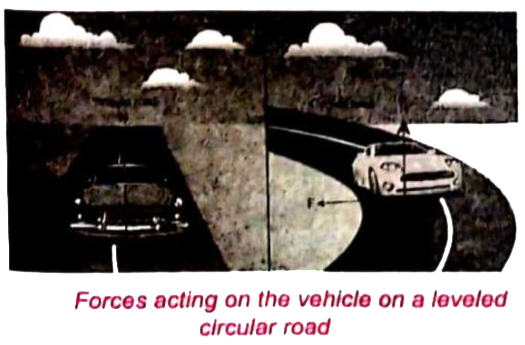 `(mv^(2))/(r ) = F_(s)` As we havealreadyseenin theprevioussectionthe staticfrictioncan beincreasefrom zeroto amaximum value `F_(s) gtmu_(s) mg` For withoutskinddingif `(mv^(2))/(r ) lemu_(s) mg.` or `mu_(s) ge(v^(2))/( RG ) " or" sqrt(mu_(s) rg ) le v ` (safeturn) Necessarycentripetalforce to bendthe caron theroadprovidedby thestaticfriction |
|
| 48. |
Sphere of mass M and radius R is kept on a rough horizontal floor. A small particle of mass m, moving horizontally with velocity, collides with the sphere and sticks to it. Line of motion of particle before collision is at a heighth above the floor. Assume that mase of sphere is very large in comparison to particle so that we may assume that centre of mass of the combined system remains at the centre of the sphere after the collision. At what height h above the floor, particle should hit the sphere so that it may start pure rolling after the collision. |
|
Answer» `(5R)/(7)` `u=R omega` `rArr (m u)/(M)=R (5 m u(h-R))/(MR^(2))` `rArr 1=(5(h-R))/(2R)` `rArr 2R= 5(h-R)` `rArr h=(7R)/(5)` Hence option (d) is CORRECT. |
|
| 49. |
Sphere of mass M and radius R is kept on a rough horizontal floor. A small particle of mass m, moving horizontally with velocity, collides with the sphere and sticks to it. Line of motion of particle before collision is at a heighth above the floor. Assume that mase of sphere is very large in comparison to particle so that we may assume that centre of mass of the combined system remains at the centre of the sphere after the collision. Angular velocity of the sphere just after the collision is |
|
Answer» `(5"mu")/(2MR)` `L_(1)=L_(2)` `m u(h-R)=[(2)/(5)MR^(2)+mR^(2)] omega` `omega=(m u(h-R))/((2)/(5) MR^(2)+mR^(2))=(m u(h-R))/(((2)/(5)M+m)R^(2))` SINCE `M gt gt m` so we can neglect m in the denominator in COMPARISON to M. `omega~~(5 m u)(h-R))/(2MR^(2))` Hence option (B) is corrrect. |
|