

Saved Bookmarks
This section includes 7 InterviewSolutions, each offering curated multiple-choice questions to sharpen your Current Affairs knowledge and support exam preparation. Choose a topic below to get started.
| 1. |
The lengths of smooth & rough inclined planes of inclination 45^(@) is same. Times of sliding of a body on two surfaces is t_(1),t_(2) and mu=0.75, then t_(1),t_(2) |
|
Answer» `2:1` |
|
| 2. |
A solid cylinder of mass 50kg and radius 0.5m is tree to rotate about the horizontal axis. A massless string is wound round the cylinder with one end attached to it and other hanging freely. Tension in the string required to produce an angular acceleration of 2 radion 2s^(-2) is |
|
Answer» 50N |
|
| 3. |
Define Poisson's ratio. |
|
Answer» Solution :Poisson.s RATIO, which is defined as the ratio of RELATIVE contraction (lateral strain) to relative expansion (longitudinal strain) . It si DENOTED by the symbol `mu`, Poisson .s ratio `,mu =("Lateral strain")/("Longitudinal strain")` |
|
| 4. |
Escape velocity of a planet is 20kms^-1. Find the orbital velocity of the smallest possible orbit. |
| Answer» SOLUTION :`v_e` = SQRT2 XX v_o` i.e., `20xx10^3` = sqrt2 v_o` or `v_o` = `10sqrt2 xx 10^3ms^-1` | |
| 5. |
If you compare the gravitational force on the earth due to the sun to that due to the moon, you would find that the Sun’s pull is greater than the moon’s pull. (you can check this yourself using the data available in the succeeding exercises). However, the tidal effect of the moon’s pull is greater than the tidal effect of sun. Why ? |
| Answer» Solution :TIDAL effect DEPENDS inversely on the CUBE of the distance unlike force, which depends inversely on the SQUARE of the distance. | |
| 6. |
A geostationary satellite orbits the earth at a height of nearly 36,000 km from the surface of earth . What is the potential due to earth.s gravity at the site of this satellite ? (Take the potential energy at infinity to be zero). Mass of the earth =6.0xx10^24 kg, radius = 6400 km, G=6.67xx10^(-11) Nm^2//kg^2 |
|
Answer» Solution :Gravititional potential at height h from the SURFACE of EARTH is `V=-(GM)/(R+h)` `=(-6.67xx10^(-11) XX (6xx10^24))/((6.4xx10^6+36xx10^6))=-9.4xx10^6` J/kg. |
|
| 7. |
A particle moves with uniform velocity which of the following statements about the motion of the particle is true ? |
|
Answer» Its speed is zero |
|
| 8. |
Two masses m_(1) and m_(2) are placed on a smooth horizontal surface and are connected by a string of negligible mass. A horizontal force F is applied on the mass m_(2) as shown in the figure. The tension in the string is |
|
Answer» `((m_(1))/(m_(1)+m_(2)))F` |
|
| 9. |
A batsman deflects a ball by an angle of 45^@without changing its initial speed which is equal to 54 km/h.What is the impulse imparted to the ball ?(Mass of the ball is 0.15 kg.) |
|
Answer» Solution : Impulse is DIRECTED along the bisector of the INITIAL and final directions.Its MAGNITUDE is ` 0.15 xx 2 xx 15 xx cos 22.5^@= 4.2 KG ms^(-1)` |
|
| 10. |
The molar heat capacity of a certain substance varies with temperature according to the given equation C = 27.2 + (4xx10^(-3))T. The heat necessary to change the temperature of 2 mol of the substance from 300 K to 700 K is |
|
Answer» `3.46 xx10^(4)J` |
|
| 11. |
A particle is subjected to two simple harmonic motions in the same direction having equal amplitudes and equal frequency. If the resulting amplitude is equal ot the amplitude of individual motions, the phase difference between them is |
| Answer» Answer :B | |
| 12. |
If the error in the measurement of radius of a sphere is 2%, then the error in the determination of volume of the sphere will be |
| Answer» Answer :C | |
| 13. |
Assertion: In case of collision of gas molecules in a given amount of gas, total kinetic energy is conserved. Reason: All collisions of the gas molecules in a given amount of gas are elastic. |
|
Answer» If both assertion and reason are true and reason is the CORRECT EXPLANATION OS assertion. |
|
| 14. |
AOB is a frictionless parabolic track in vertical plane. The equation of parabolic track can beexpressed as y = (3)/(2H) x^(2) for co-ordinate systemshown in the figure. The end B of the tracklies at y = (H)/(2). When a uniform small ring isreleased on the track at A it was found to attain a maximum height of h_(1), above the ground after leaving the track at B. There is another track DEF which is in form of an arc of a circle of radius H subtending an angle an angle of 150^(@) at the centre. The radius of the track at D is horizontal. The same ring is released on this track at point Dand it rolls without sliding. The ring leaves the track at F and attains a maximum height of h_(2)above the ground. Find theratio (h_(1))/(h_(2)). |
|
Answer» |
|
| 15. |
A thin double convex lens is cut into tow equal pieces A and B by a plane containing principal axis . The piece B is further cut into two more pieces C and D by another plane perpendicular to the lens principal axis. If the focal power of the original lens is P, then those of A and C are |
|
Answer» <P>`P,P/4` |
|
| 16. |
Three ringseachof massM and radiusR are arranged as shown in the figure . The momentof inertia of the systemabout AB is (NAR_NEET_PHY_XI_P2_C07_E11_036_Q01.png" width="80%"> |
|
Answer» `3 MR^(2)` ` = (MR^(2))/2 + 3MR^(2) = (7MR^(2))/2 ` |
|
| 17. |
A person in a lift which descends down with an acceleration of 1.8m//s^(2) drops a stone from a height of 2 m. The time of descent is |
|
Answer» `SQRT(2)` SEC |
|
| 18. |
Find the power of the an electric motor if it lifts 200 kg of water in 5 minutes from a well of 120 m depth. |
|
Answer» SOLUTION :Mass of water m = 200 kg , Depth of well = height lifted = 120 m Time `t = 5 xx 60` sec = 300 sec , POWER `= ("Work done against gravitational FORCE")/("time")` Power `= (mgh)/(t) = (200 xx 9.8 xx 120)/(5 xx 60) = 784 W` |
|
| 19. |
Calorimeters are made of which of the followings? |
|
Answer» glass |
|
| 20. |
A stone is dropped along the centre of a deep vertical mine shaft. Assume no air resistance but consider the earth's rotation. Will the stone continue along the centre of the shaft? If not, describe the motion. |
| Answer» Solution :DUE to the rotation of the earth fro m west to EAST the STONE will deviate SLIGHTLY to the east. | |
| 21. |
A particle falls from rest from thehighest point ofa vertical circle of radius r, along a chord without any friction . Show thatthe time taken by the particle to come down is independent of the chord's length. Find the time in terms of r and g . |
|
Answer» Solution :Let the chord ALONG which the partical falls be CD [Fig.2.67] . CDmakes an angle `theta` with the vertical diameteras shown. CD =2r `cos theta`. The component of acceleration DUE togravity along CD =g`cos theta` . Let the time taken by this PARTICLE to fall from rest along CD be t .  Hence, from the equation `s=ut+1/2 at^2`, `2r cos theta =0+1/2g cos theta*t^2` `or, t^2 =(4R)/(g) or, t=2sqrt(r/g)`. The time is INDEPENDENT of `theta`, and hence onthelengthof the chord CD. |
|
| 22. |
A temperature scale has its markings 0^(@) and 100^(@) corresponding to temperature of -40^(@) C and 160^(@) C respectively. The reading of 40^(@) shown by the thermometer correspondonds to temperature of (linear expansivity of zinc and silver are 32 xx 10^(-6)//°C and 19xx 10^(-6)//°C respectively ) |
|
Answer» 30.77 m |
|
| 23. |
A particle of mass m is at rest in a train moving with constant velocity with respect to ground. Now the particle is accelerated by a constant force F_(0)acting along the direction of motion of train for time t_(0). A girl in the train and a boy on the ground measure thework done by this force. Which of the following are incorrect? |
|
Answer» Both will MEASURE the same work |
|
| 24. |
The radius of gyration of a hollow sphere about a tangent is |
|
Answer» `R SQRT(7//5)` |
|
| 25. |
A bolt of mass 0.3 kg falls from the ceiling of an elevator moving down with an uniform speed of 7 ms^(-1). It hits the floor of the elevator (length of the elevator = 3m) and does not rebound. What is the heat produced by the impact? Would your answer be different if the elevator were stationary? |
| Answer» SOLUTION :`=8.82 J` for both CASES. | |
| 26. |
If two springs of force constants 7 "Nm"^(-1) and 9 "Nm"^(-1)are connected in series and is fixed to a body of mass 100 g. Find the period of oscillation. |
|
Answer» |
|
| 27. |
A wheel rotating at an angular speed of 20 rads^(-1), is brought to rest by a constant. torque in 4s. If the M.I is 0.2 kg m^(2) the work done in first 2s is |
|
Answer» 50J |
|
| 28. |
What is the difference between scalar and vector? Give examples. |
Answer» SOLUTION :
|
|
| 29. |
A loop of mass M with two identical rings of mass m at its top hangs from a ceiling by an inextensible string. If the rings gently pushed horizontally in opposite directions, find the angular distance covered by each ring when the tension in the string vanishes for once during their motion. |
Answer» Solution :Suppose the string slakens that means its tension T becomes zero when the rings slide through and angle `theta` with vertical as shown in figure. The SPEEDS of the rings at the angular position `theta` can be given by conserving its energy between the position 1 and 2 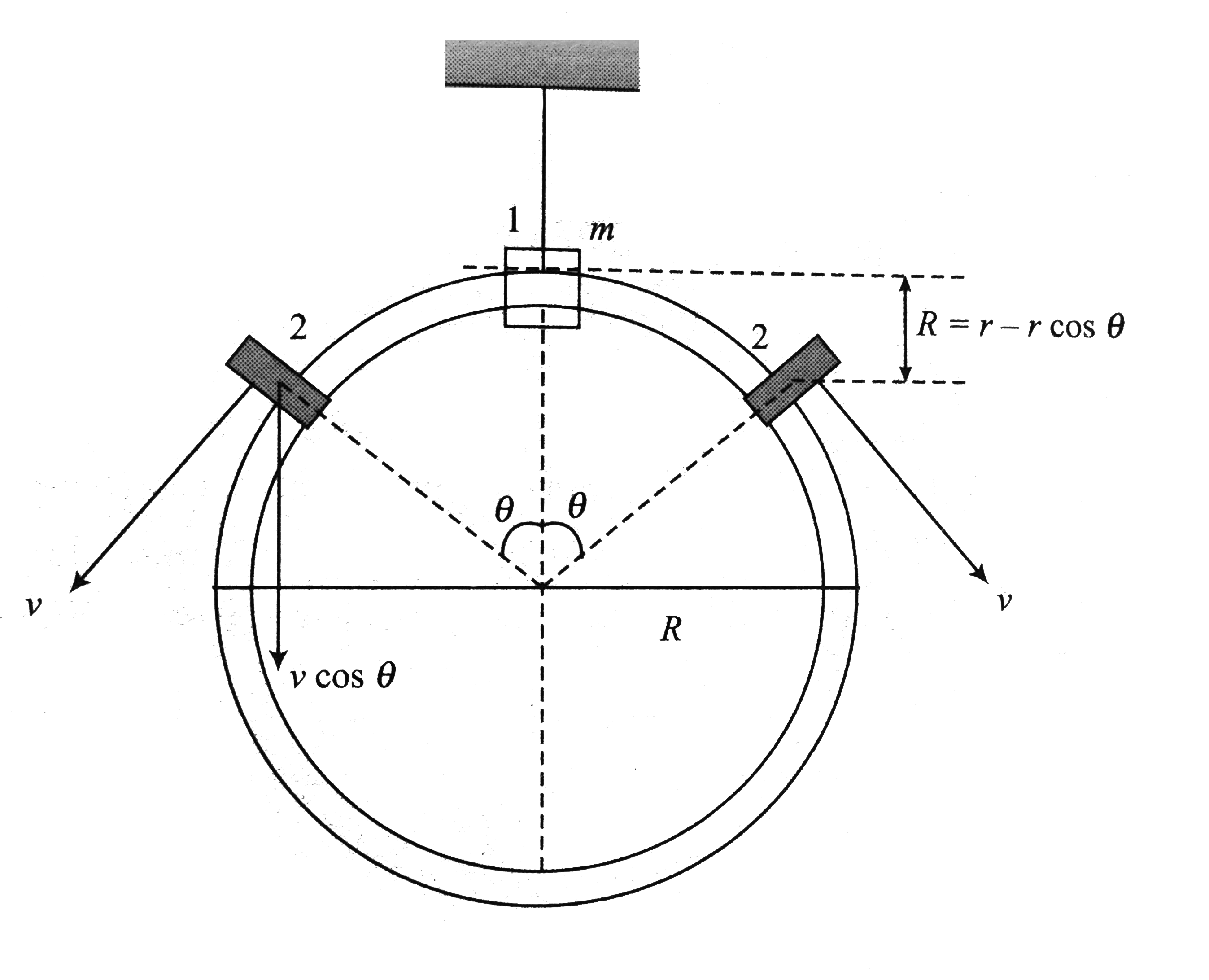 `impliesDeltaPE=DeltaKE` `impliesmgh=1/2mv^2` `impliesmg[r-rcostheta]=1/2mv^2` `impliesv=sqrt(2gr(1-costheta))` (i) Referring figure, RESOLVING the force acting on the ring radially we obtain 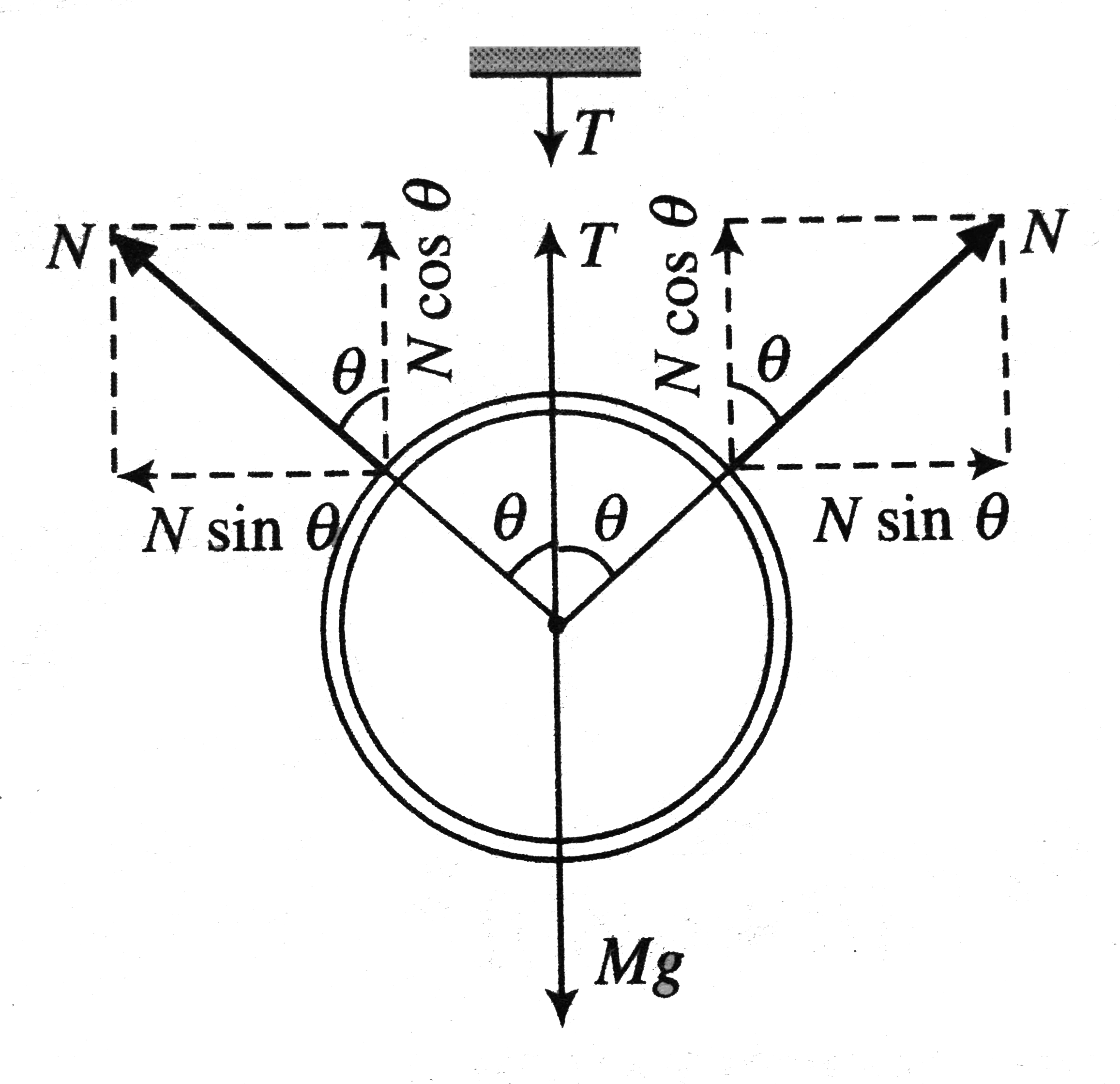 `F_(cp)=mg cos theta+N` where N is the contacting force between the hoop and the rings. `ma_r=mgcostheta+N` `implies(mv^2)/(r)=mgcostheta+N` `impliesN=(mv^2)/(r)-mgcostheta` (ii) Resolving the forces acting on the hoop for its equilibrium (REFER figure we obtain) 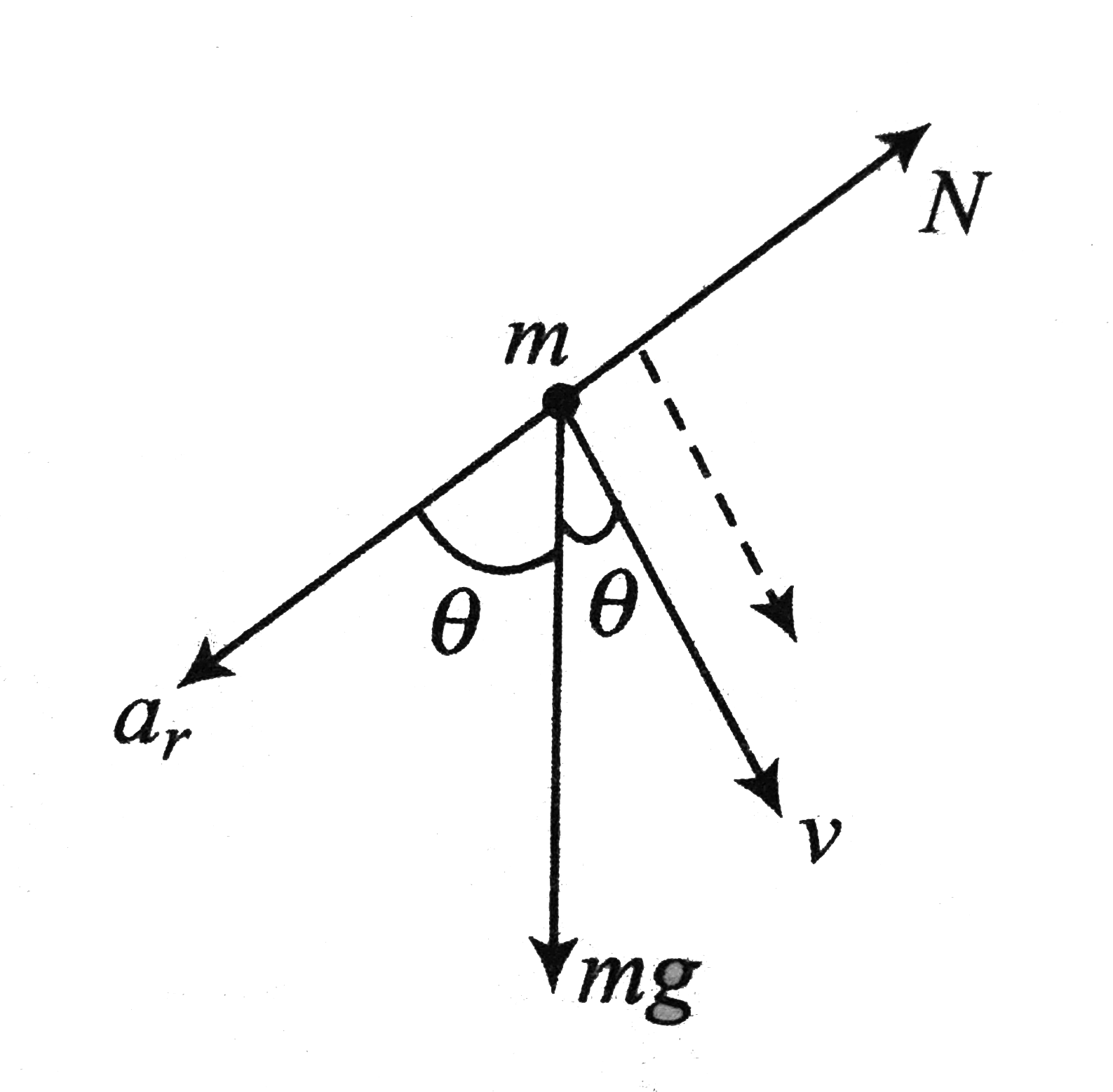 `F_x=Nsintheta-Nsintheta=0` and `F_y=2Ncostheta+T-Mg=0` `implies2Ncostheta+T-Mg=0`, SINCE the string SLACKENS, `T=0impliesN=(Mg)/(2costheta)` (iii) Using Eqs (ii) and (iii), `(Mg)/(2 cos theta)=(mv^2)/(r)-mg cos theta` (iv) Using Eqs (i) and (iv), `(Mg)/(2 cos theta)=m/r{2gr(1-costheta)}-mg cos theta` `implies 3cos^2theta-2cos theta+(M)/(2m)=0` (v) `implies cos theta=1/3[1+-sqrt((1-(3//2)(M//m))]` If `M/mle2/3`, if `M/mgt2/3` `cos theta` in imaginary, which means the string cannot be slakened. If `M/m=2/3`, the quadratic equation (v) has one root, which means the string is slacken at `theta=cos^-1(1//3)`. |
|
| 30. |
If two rods of length L and 2L having coefficients of linear expansion alpha and 2 alpha respectively are connected so that total length becomes 3L, the average coefficient of linear expansion of the composite rod equals : |
|
Answer» `(3)/(2) ALPHA` |
|
| 31. |
A particle of mass 100 gm is thrown vertically upwards with a speed of 5 m/s. The work done by the force of gravity during the time the particle goes up is (g=10ms^(-2)) |
|
Answer» `-0.5J` |
|
| 32. |
On a certain day, rain was falling vertically with a speed of 35ms^(-1) . A wind started blowing after sometime with a speed of 12ms^(-1)in east to west direction . In whichdirection should boy waiting at a bus stop hold his umbrella ? |
|
Answer» Solution :In the FIGURE , Velocity of rain, `grad _(r) = vec(OA)= 12 MS^(-1)`(vertically downwards) Velocity of wind . `grad_(w) = vec(OB) = 12 ms^(-1) `,east to west The MAGNITUDE of the resultant velocity is `V = SQRT(V_(R)^(2)+ V_(w)^(2)) = sqrt(35^(2) + 12^(2))` `= 37 ms^(-1)` Let the resultant velocity `vec(V) = (vec(OC))` make an angle `theta`with the vertical , them `TAN theta = (AC)/(OA) = (V_(w))/(V_(R)) = (12)/(35) = 0 . 343` ` :. theta = tgan^(-1) (0.343) = 19^(@)` Hence the boy should hold umbrella bending it towards east making an angle of about `19^(@)`with the vertical . 
|
|
| 33. |
The mass of sunis 2.0xx10^(30)kgand its radius is 7.0xx10^(8)m. Find the mass density? |
|
Answer» |
|
| 34. |
A particle projected from a poin A with velocityu sqrt(2) at an angle 45^(@) with horizontal. It strikes the plane BC at right angle Change is velocity is .......... |
|
Answer» U |
|
| 35. |
A particle projected from a poin A with velocityu sqrt(2) at an angle 45^(@) with horizontal. It strikes the plane BC at right angle The velocity with which it strikes the plane is........... |
|
Answer» `(u)/(SQRT(3))` |
|
| 36. |
A particle projected from a poin A with velocityu sqrt(2) at an angle 45^(@) with horizontal. It strikes the plane BC at right angle Time taken for the collision is......... |
|
Answer» `((sqrt(3)+1)U)/(g)` |
|
| 37. |
The buoyant force is equal to |
|
Answer» WEIGHT of the BODY |
|
| 38. |
Displacement versus time curve for a particle executing SHM is shown in figure. Idendify the points marked at which (i) velocity of the oscillator is zero, (ii) speed of the oscillator is maximum. |
|
Answer» Solution :In displacement time graph of SHM, the crest and troughs represents maximum displacement and velocity of the OSCILLATOR is zero. HENCE (i) At points A, C, E and G velocity is zero. (II) At mean position speed is maximum. Hence at points B, D, F and H speed is maximum. |
|
| 39. |
A train standing in a station-yard, blows a whistle of frequency 400Hz in still air. The wind starts blowing in the direction from the yard to the station with a speed of 10 ms^(-1). What are the frequency wavelength and speed of sound for an observer standing on the station's platform? Is the situation exactly identical the case when the air is still and the observer runs towards the yard at a speed of 10 ms^(-1) ? The speed of sound in still air can be taken as 340 ms^(-1) |
Answer» SOLUTION : According to formula `(f _(L))/(V.v _(L)) = (f _(S))/(v .+ v _(S))` Here v.= resultant velocity of sound, `v +v_(W) = 340 + 10=350 m//s` `therefore (f _(L))/(350 +0) = (f_(S))/(350 +0) implies f _(L) =f _(S) = 400 Hz` (This is so because here in this cae, there is no relative motion between source and listener). Now, we have the formua, `v. =f _(S) lamda . implies lamda. = (v.)/(f_(S)) = (350)/(400) =0.875m`  According to formula, `(f._(L))/(v +v _(L)) = (f _(S))/(v + v _(S))` `therefore (f._(L))/(340 + 10) = (400)/(340 + 0) implies f._(L) = (350 XX 400)/(340)` `therefore f._(L) =411.76 Hz` Now, here in this case, `c = f _(S) lamda implies lamda = (v)/(f _(S)) = (340)/(400) = 0.85 m` THUS, SITUATIONS (i) and (ii) are different. They are not equivalent. |
|
| 40. |
A sphere of mass 2 kg moving with a velocity collides elastically with another sphere which is at rest. If after the collision, the first sphere moves in the same direction with its velocity reduced to one third of its initial velocity, find the mass of the second sphere. |
|
Answer» SOLUTION :Here`m _(1) = 2 kg, u _(1) = u _(1), u _(2) = 0, V _(1) = (1)/(3) u _(1)` In elastic collision `v _(1) = (( m _(1) - m_(2))/( m _(1) + m _(2))) u _(1) + ( ( 2 m _(2))/( m _(1) + m _(2))) u _(2) = (( 2- m _(2))/( 2 + m _(2))) u _(1) + (( 2m _(2))/( 2+ m _(2))) xx 0` Buy `v _(1) = (1)/(3) u _(t) therefore (1)/(3) u _(1) = ((2- m _(2)) u _(1))/( 2 + m _(2)) , 2 + m _(2) = 6 - 3m _(2) = 6 - 3m _(2) , 4m_(2) = 4 or m _(2) = 1 kg` |
|
| 41. |
A ball is projected vertically up from ground. Boy A standing at the window of first floor of a nearby building observes that the time interval between the ball crossing him while going up and the ball crossing him while going down is t_(1). Another boy B standing on the second floor notices that time interval between the ball passing him twice (during up motion and down motion) is t_(2). (a)Calculate the height difference (h) between the boy B and A. (b)Assume that the height of boy A from the point of projection of the ball is also equal to h and calculate the speed with which the ball was projected. |
|
Answer» |
|
| 42. |
If 'g' is acceleration due to gravity on the earth and R is radius of the earth and angular speed of rotation of the earth about its axis is made to be sqrt((2g)/(5R)), then weight of a body at the equator decreases by |
|
Answer» 0.6 |
|
| 43. |
Calculate the force required to increase by 1% length of a rod of cross -sectional area 10^(-3)m [Y = 1.2*10^(12) Nm^2] |
| Answer» SOLUTION :1.2*10^4N | |
| 44. |
If a number of small droplets of water each of radius r coalesce to form a single drop of radius R, then the rise of temperature is : (J = mechanical equivalent of heat, d= density of water, T= surface tension of water) |
|
Answer» `( 3 Td)/( J) ((1)/( R) - (1)/( r) )` |
|
| 45. |
If it takes 5 minutes to fill a 15 litre bucket from a water tap of diameter ( 2) /( sqrtpi) cm then the Reynolds number for the flow is (density of water =10^(3) "kg/m"^(3) and viscosity of water = 10^(-3) Pa.s) close to: |
|
Answer» 1100 |
|
| 46. |
A child applies a force vecF parallel to the x-axis to a block moving on a horizontal surface. As the child controls the speed of the block, the x-component of the force varies with the x-coordinate of the block as shown in figure. Then The work done by the force F when the block moves from x=4 to x=6m is |
|
Answer» 2J |
|
| 47. |
A child applies a force vecF parallel to the x-axis to a block moving on a horizontal surface. As the child controls the speed of the block, the x-component of the force varies with the x-coordinate of the block as shown in figure. Then The workdone by the force F when the block moves from x=0 to x=3m |
|
Answer» 2J |
|
| 48. |
A block of mass 2 kg is placed on the floor. The co-efficient of static friction is 0.4. The force of friction between the block and floor is |
|
Answer» 2.8 N |
|
| 49. |
A particle of mass 'm' is suspended from a ceiling through a string of length 'L'. If the particle moves in a horizontal circle of radius 'r' as shown in the figure, then the speed of the particle is |
|
Answer» `r SQRT((G)/(sqrt(L^(2)-r^(2))))` |
|
| 50. |
A chain of 100 links is 1m long and has a mass of 2kg. With the ends fastened together it is set rotating at 3000 rpm, in a horizontal plane. The centripetal force on each link is |
|
Answer» 3.14N |
|