Saved Bookmarks
This section includes 7 InterviewSolutions, each offering curated multiple-choice questions to sharpen your Current Affairs knowledge and support exam preparation. Choose a topic below to get started.
| 1. |
There are three forces F_(1), F_(2)and F_(3)acting on a body , all acting on a point P on the body The body is found to moves with unifrom speed (a) Show that the forces are coplaner. (b) Show that the torque acting on the body about any point due to these three forces is zero . |
|
Answer» SOLUTION :(a) As the is moving with unifrom speed its acceleration ` a = 0 ` ` :. vec (F_(1)) + vec (F_(2)) + vec (F_(3)) = 0 ` The three forces are passing through a point `P` as shown in If ` vec(F_(1)), + vec (F_(2)) ` lie in one plane say `A` , their resultant lies in plane `A` Since ` vec(F_(3)) = - (vec(F_(1)) + vec(F_(2)))` ,THEREFORE `vec(F_(3)` must also lin in plane A Hence `vec (F_(1)) , vec(F_(2)) vec (F_(3))` are COPLANER forces (b) Since all the forces pass through same point `P` therefore, torque acting on the body about `P` due to the these three forces is ZERO . About any other point say o torque `= vec(OP) xx (vec(F_(1)) +vec(F_(2))vec (F_(3)))` As `vec(F_(1)) + vec(F_(2)) + vec(F_(3)) = 0` therefore , torque about point O = zero  . |
|
| 2. |
Consider a cycle followed by an engine 1 to 2 is isothermal 2 to 3 is adiabatic 3 to 1 is adiabatic such a process does not exist because a) heat is completely converted to mechanical energy in such a process, which is not possible b) mechanical energy is completely converted to heat in this process, which is not possible c) curves representing two adiabatic processes don't intersect d) curves representing an adiabatic process and an isothermal process don't intersect |
|
Answer» Only a, B are CORRECT |
|
| 3. |
(a) Algebraic sum of moments of masses about cenre of mass is zero(b) For small bodies centre of mass coincides with centre of gravity (c ) Position of centre of mass depends on co-ordinate system(d) Position of centre of mass is independent of mass distribution |
|
Answer» a and B are CORRECT |
|
| 4. |
Two containers of equal volume contain the same gas at pressures P_(1) and P_(2) and absolute temperatures T_(1) and T_(2) respectively. On joining the vessels, the gas reaches a common pressure Panda common temperature T. Find the value P/T. |
|
Answer» Solution :Number of moles before JOINING = Number of mo]es after joining the vessels. `n_(1) + n_(2) = n_(1)^(1) n_(2)^(1)` i.e., `(P_(1)V)/(RT_(1)) + (P_(2)V)/(RT_(2)) = (PV)/(RT) + (PV)/(RT) ` (or) `(P_(2)V)/(RT_(1)) + (P_(2)V)/(RT_(2)) = (2PV)/(RT) ` `rArr (P_(1))/(T_(1)) + (P_(2))/(T_(2)) = (2P)/(T) "" therefore (P)/(T)= (1)/(2) [ (P_(1))/(T_(1)) + (P_(2))/(T_(2)) ] ` |
|
| 5. |
Particles of masses m, 2m, 3m,...... nm grams are placed on the same line at distances I, 21, 31, .... nl cm from a fixed point. The distance of centre of mass of the particles from the fixed point in centimetre is |
|
Answer» `((2n+1)L)/(3)` |
|
| 6. |
The viscous force acting on a lead ball travelling down in a liquid column with a velocity v is F. If another lead ball of double the mass travels down in the same liquid with a velocity 2v then the viscous force acting on it is |
| Answer» ANSWER :A | |
| 7. |
A body is projected with velocity u making an angle thetawith the horizontal. Its velocity whe it is perpendicular to the initial velocity vector is |
|
Answer» `u sin THETA` |
|
| 8. |
A particle is moving along positive x direction and experiences a constant acceleration of4 m//s^(2)in negative x direction. At time t = 3 second its velocity was observed to be 10 m//s in positive x direction. (a) Find the distance travelled by the particle in the interval t = 0 to t = 3 s. Also find distance travelled in the interval t = 0 to t = 7.5 s.. (b) Plot the displacement – time graph for the interval t = 0 to 7.5 s. |
|
Answer» (B) `(##IJA_PHY_V01_C02_E01_065_A01##)` |
|
| 9. |
A piece of ice is floating in water taken in a container. What will happen to the level of water when the ice just melts. |
|
Answer» Solution :Let Mg of ice be FLOATING in water of density 1G/`cm^(3)` Then from the law of FLOATATION,`M=Vrho_(ice)=V_("im" rho "water")` `therefore V_(im)Mcm^(3)to` (Volume of water displaced)…..(i) Now, if the entire ice melts, water formed will have same mass M but the volume `V_("formed")=(M)/(rho_("water"))=Mcm^(3)` ......(ii) From (i) and (ii) volume of water displaced is equal to volume of water formed due to melting of ice. Therefore, the level of water remains UNCHANGED. |
|
| 10. |
A student measured the diameter of a small steel ball using a screw gauge of least count 0.001 cm. The main scale reading is 5 mm and zero of circular scale division coincides with 25 divisions above the reference level. If screw gauge has a zero error of - 0.004 cm, the correct diameter of the ball is |
|
Answer» `0.529 cm` `=(0.5+25xx0.001+0.004) cm` `=(0.5+0.025+0.004) cm` `:.` Diameter `=0.5289 cm` |
|
| 11. |
Vertices of a triangle are given by hat(i) + 3hat(j) + 2hat(k), 2hat(i) - hat(j) + hat(k) and -hat(i) + 2hat(j) + 3hat(k), then the area of triangle is sqrt((107)/(2n)) (in units). Find the value of n= |
|
Answer» |
|
| 12. |
Consider Example 8, taking the coefficient of friction, mu, to be 0.5 and calculate the maximm compression of the spring. |
|
Answer» SOLUTION :In presence of friction, both the spring force and the frictionless force act so as to oppose the compression of the spring as shown in fig. We invke the work-energy theorem, rather than the conservation of mechanical energy. The CHANGE in kinetic energy is  `DeltaK = K_(f)-K_(i)=0-1/2mv^(2)` The work done by the net force is `W=-1/2kx_(m)^(2)-mumgx_(m)` Equating we have `1/2mv^(2) = 1/2kx_(m)^(2)+mumgx_(m)` Now, `mumg=0.5 xx 10^(3) xx 10=5 xx 10^(3)`N (taking g=10.0 `mso^(-2))`. After rearranging the above equation we obtain the following quadratic equation in the unknown `x_(m)` `kx_(m)^(2) + 2mumgx_(m)-mv^(2)=0` `x_(m) = (-mumg+ [mu^(2)m^(2)g^(2)+mkv^(2)]^(1//2))/k` where we take the positive square root since `x_(m)`is positive. Putting in numerical values we obtain. `X_(m) = 1.35m` Which, as expected, is less than the result If the two forces on the body consist of a conservation force `F_(c)` and a non-conservative force `F_(NC)`. the conservation of mechanical energy formula will have to be modified. By the WE theorem. `(F_(c) + F_(nc))Deltax = DeltaK` ltrbgt But, `F_(c)Deltax= -DeltaV` Hence, `DELTA(K+V)=F_(nc)Deltax` `DeltaE = F_(nc)Deltax` where E is the total mechanical energy. Over the path this assumes the form. `E_(f) -E_(i) = W_(nc)` Where `W_(nc)` is the total work done by the non-conservative forcer over the path. Note that the unlike the conservative force. `W_(nc)` depends on the particular path i to f. |
|
| 13. |
Define a radian. |
| Answer» Solution :ONE radian is the ANGLE subtended at the CENTER of a circle by an are that is equal in LENGTH to the radius of the circle. | |
| 14. |
The isothermal Bulk modulus of an ideal gas at pressure P is |
| Answer» ANSWER :A | |
| 15. |
A cyclist moves along a curved road with a velocity v. The road is banked for speed v. The angle of banking is theta. Which of the following statements in not true ? |
|
Answer» The cyclist will lean away from the VERTICAL at an angle `theta`. |
|
| 16. |
The velocity of a particle under going SHM at the mean positon is 2ms^(-1). Find the velocity of the particle at the point where the displacement form the mean position is equal to half the amplitude |
|
Answer» `1.234 MS^(-1)` |
|
| 17. |
At a distance of 3cm from the mean position, the acceleration of a particle performing S.H.M is 12cm//"sec"^(2) The periodic time of the particle is |
|
Answer» 3.14sec |
|
| 18. |
The pair of scalar quantities having the same dimensions is |
|
Answer» MOMENT of FORCE and Torque |
|
| 19. |
A copper block of mass 1 kg slides down on a rough inclined plane of inclination 37^(@)Cat a constant speed. Find the increase in the temperature of the block as it slides down through 60cm assuming that the loss in mechanical energy goes into the copper block as thermal energy. (Specific heat of copper =420J kg^(-1)K^(-1), g=10ms^(-2)) |
|
Answer» `6.6xx10^(-3)""^(@)C` |
|
| 21. |
A straight piece of wire 5 cm long is placed horizontally on the surface of water and gently pulled up. It is found that a force of 7xx10^(-3)N in addition to weight of wire is required for that purpose, the surface tension of water is |
|
Answer» `7XX10^(-2)N//m` |
|
| 22. |
A body is moving down along inclined plane of angle of inclination q. The coefficient of friction between the body and the plane varies as m = 0.5x, where x is the distance moved down the plane. The body will have the maximum velocity when it has travelled a distance x given by |
|
Answer» `x = 2 TAN theta ` |
|
| 23. |
A compound slab is made up two slabs. If thermal conductivity of their material are k_(1) and k_(2) respectively of their cross-sectional areas are the same, the equivalent thermal conductivity of the slab is. . . . . (consider series connection) |
|
Answer» `(2k_(1)k_(2))/(k_(1)+k_(2))` `(1)/(k_(1))+(1)/(k_(2))=2/k` `rArrk=(2k_(1)k_(2))/(k_(1)+k_(2))` Thermal resistance of compound slab, `R_(H)=(L)/(kA)` As the thickness of both SLABS is same,  `L_(1)=L_(2)=L` As the cross SECTION of both slabs is same, `A_(1)=A_(2)=A` For series resistance connection, `R_(H)=(R_(H))_(a)+(R_(H))_(2)` Equivalent resistance `R_(H)=(2L)/(kA)`, [total length of slab = 2L] `(R_(H))_(1)=(L)/(k_(1)A)` and `(R_(H))_(2)=(L)/(k_(2)A)` `:.(2L)/(kA)=(L)/(k_(1)A)+(L)/(k_(2)A)` `:.2/k=(k_(2)+k_(1))/(k_(1)k_(2))` `:.k=(2k_(1)k_(2))/(k_(1)+k_(2))` |
|
| 24. |
A Carnot engine operates with source at 500 K and sink at 375 K. Engine consumes 600 kcal of heat per cycle. The heat rejected to sink per cycle is |
|
Answer» 250 kcal `ETA = 1 - (T_(2))/(T_(1)) = 1 - (375)/(500) = (125)/(500) = 25%` Heat consumed per CYCLE `Q_(1) = 600` kcal `:.` Heat rejected to the sink `= Q_(1) - eta Q_(1) = 600 - 0.25 xx 600 = 450` kcal |
|
| 25. |
A satellite is revolving around a planet in a circular oribt of radius. .r. and has angular momentum L. IF is a taken into a higher orbit of radius .4r., the change in its angular momentum is |
|
Answer» L/4 |
|
| 26. |
A block of mass 1 kg is connected with a massless spring of force constant 100 N"/"m. At t=0, a constant force F= 10 N is applied on the block. The spring is in its natural length at t=0. The speed of particle at x=6 cm from mean position is : |
|
Answer» `4 CM"/"s` |
|
| 27. |
A transverse wave is represented by the equation y=y_0sin2pi(vt-x/lambda).The maximum particle velocity is equal to four times the wave velocity if |
|
Answer» `LAMBDA=(lambda y_0)/4` |
|
| 28. |
Figure shows the shape of a string , the pairs of points which are in opposite phase is |
|
Answer» `A` and `B` |
|
| 29. |
This figure shows a man of mass m standing at the end A to a trolley of mass M placed at rest on a smooth horizontal surface. The man starts moving towards the end B with a velocity u_(rel) with respect to the trolley. The length of the trolley is L. (a) Find the time taken by the man to reach the other end. (b) As the man walk on the trolley, find the velocity centre of mass of the system (man+trolley). (c) When the man reaches the end B, find the distance moves by the trolley with respect to ground. (d) Find the distance moved by the man with respect to ground. |
|
Answer» (B) zero (C) `(ML)/(m+M)` `(d) (ML)/(m+M)` |
|
| 30. |
A ball is dropped on to a floor. If the coefficient of restitution is 0.5, the percentage loss of energy of the ball on rebounding from the floor is |
| Answer» ANSWER :D | |
| 31. |
Describe the total degrees of freedom for monoatomic molecule, diatomic molecule and triatomic molecule. |
Answer» Solution : Monatomic molecule A monoatomic molecule by virtue of its nature has only three translational DEGREES of freedom. Therefore f = 3 Example: Helium, Neon, Argon Diatomic molecule :  (i) At normal temperature A molecule of a diatomic gas consists of two atoms bound to each other by a force of attraction. The center of MASS lies in the center of the diatomic molecule. So, the motion of the center of mass requires three translational degrees of freedom. In addition, the diatomic molecule can rotate about three mutually perpendicular axes. But the moment of inertia (about y-axis) in the figure). Therefore, it has only two rotational degrees of freedom. Therefore totally there are five degrees of freedom. f = 5 (II) At High Temperature At a very high temperature such as `5000K`, the diatomic molecules posses ADDITIONAL two degrees of freedom due to vibrational motion [one due to kinetic energy of vibration and the other is due to potential energy]. So totally there are seven degrees of freedom. f = 7 Examples: Hydrogen, Nitrogen, Oxygen. (iii) Triatomic molecules There are two cases. Linear triatomic molecule: In this TYPE, two atoms lie on either side of the central atom as shown in the figure. Linear triatomic molecule has three translational degrees of freedom. It has two rotational degrees of freedom because it is similar to diatomic molecule except there is an additional atom at the center. At normal temperature, linear triatomic molecule will have five degrees of freedom. At high temperature it has two additional vibrational it has two additional vibrational degrees of freedom. So a linear triatomic molecule has seven degrees of freedom. Example: Carbon dioxide. Non-linear triatomic molecule: In this case, the three atoms lie at the vertices of a triangle as shown in the figure. It has three translational degrees of freedom and three rotational degrees of freedom about three mutually orthogonal axes. The total degrees of freedom, f = 6 Example: Water, Sulphurdioxide. 
|
|
| 32. |
The motion of the center of mass of a system consists of many particles describes its |
|
Answer» ROTATIONAL MOTION |
|
| 33. |
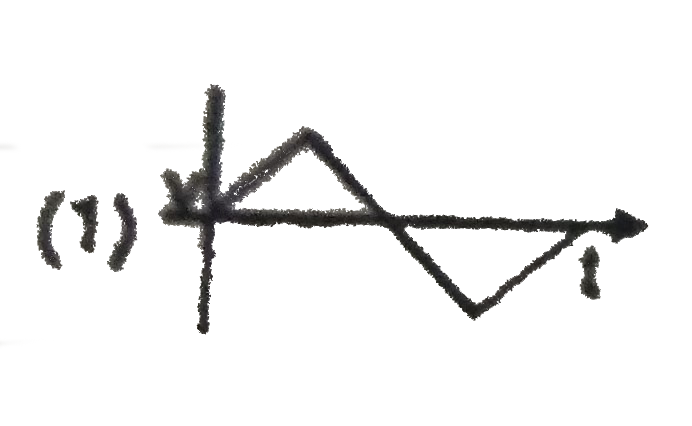
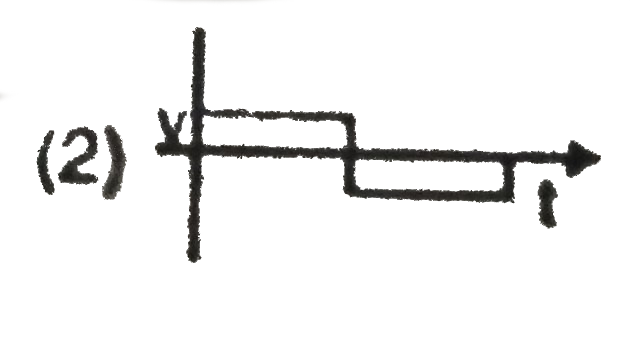
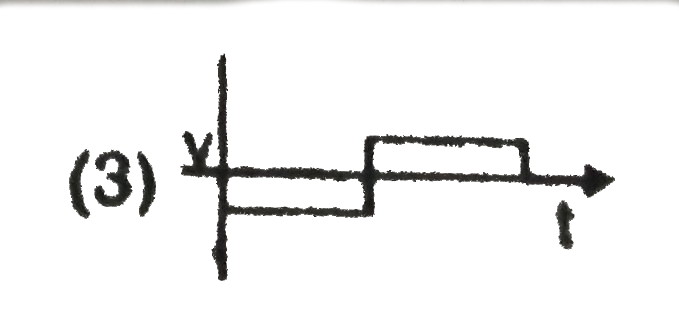
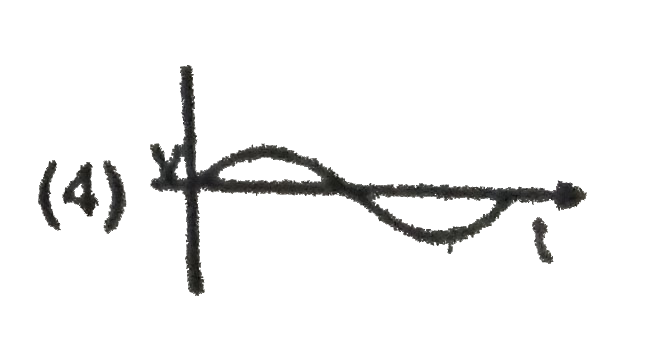
The graph between the current and the time for an inductance coil is shown below. Which of the following graph show the voltage-time variation- |
|
Answer»
|
|
| 34. |
A satellite takes 1/8 years to move round the earth in its permissible orbit of radius R. The period when it revolves roud the earth in an orbit of radius .2R. is |
|
Answer» `(1)/(2sqrt(2))` YEARS |
|
| 35. |
If heat is supplied to an ideal gas in an isothermal process |
|
Answer» The internal energy of the gas increases |
|
| 36. |
Two boys are standing at the two end-points A and B of a field where AB = a. The boy at B now starts running at a uniform speed v_(1) in a direction perpendicular to AB. Simultaneously, the boy at A also starts at a uniform speed v along a straight line and meets B after a time t. Find t. |
|
Answer» |
|
| 37. |
A piece of metal weighing 50 g is heated to a temperature of 1000°Cand quickly dropped into a clorimeter containing 200 g of water at 25°C .The water equivalent of the calorimeter is 10g and specific heat of the metal is 0.1.Calculate the rise in temperature of water. |
| Answer» SOLUTION :47.67°C | |
| 38. |
When there are no external forces, the shape of a small liquid drop is determined by |
|
Answer» SURFACE TENSION of the liquid |
|
| 39. |
A solid sphere of mass M and radius R lies concentrically inside a spherical shell of mass M and radius 2R. A particleof mass M is placed at a distance 4R from the common centre as shown in the figure.The total potential energy of the system of masses is |
|
Answer» `-(GM^(2))/(R )` |
|
| 40. |
A system is taken from state A to state B along two different paths 1 and 2. The heat absorbed and work done by the system along these two paths are Q_(1) and Q_(2), and W_(1) and W_(2) respectively. |
|
Answer» `Q_(1)=Q_(2)` |
|
| 41. |
Apply Newton's second law for an object at rest on Earth and analyse the result. |
Answer» Solution : The OBJECT is at rest with respect to EARTH (INERTIAL coordinate SYSTEM). There are two forces that act on the object. (i) Gravity acting downward (negative y-direction) (ii) Normal force by the surface of the Earth acting upward (positive y-direction) The FREE body diagram for this object is vec F_g = - mg hatj ` vecF = N hatj ` But there is no acceleration on the ball. So `veca = 0` . By applying Newton.s second law`(vecF_("net") = mvec a )`  Since `vec a = 0 , vecF_("net")=-mg hatj + N hatj ` `(-mg + N) hatj = 0` By comparing the components on both sides of the equation, we get ` - mg + N = 0` N = mg ` We can conclude that if the object is at rest, the magnitude of normal force is exactly equal to the magnitude of gravity. |
|
| 42. |
Convert newton into dyne |
|
Answer» Solution :Dimensional formula of force is `M^(1) L^(1) T^(-2)` IN = n dynes `rArr n= N`/dynes `therefore n_(2)= n_(1) [(M_(1))/(M_(2))]^(1) [(L_(1))/(L_(2))]^(1) [(T_(1))/(T_(2))]^(-2)` `rArr n= [(1kg)/(1g)] [(1M)/(1cm)]^(1) [(1S)/(1s)]^(-2) ((n_(2))/(n_(1))=n)` `rArr n= [(1000g)/(1g)] [(100cm)/(1cm)]^(1) [(1s)/(1s)]^(-2)` `rArr n= [1000] xx [100]^(1) xx [1]^(2) = 10^(7)` `therefore` 1 newton `= 10^(7)` dynes Alternate Method: `[F]= [MLT^(-2)]`, 1 newton =1 (kg) (m) `(s)^(-2)` `=1. (10^(3)g) (10^(2) CM) (s^(-2))= 10^(5) (g) (cm) (s)^(-2)` 1 newton `= 10^(5)` dynes |
|
| 43. |
A cyclist is riding with a speed of 27kmh^(-1). As he approaches a circular turn on the road of radius 80 m, he applies brakes and reduces his speed at the constant rate 0.5ms^(-2) . What is the magnitude and direction of the net acceleration of the cyclist on the circular turn? |
|
Answer» Solution :`a_(c)=(v^(2))/(r)=0.7ms^(-2)` `a_(T)=0.5ms^(-2)` `a=sqrt(a^(2)-a^(2))=0.86ms^(-2)` If `theta`is the angle between the NET ACCELERATION and the velocity of the CYCLIST, then `theta=TAN^(-1)((a_(c))/(a_(T)))=tan^(-1)(1.4)=54^(@)28.` |
|
| 44. |
(A) : A disc released from the top of a fixed inclined plane rolls down without slipping if the inclined plane is rought only.(R ) : Friction does no work in pure rolling. |
|
Answer» Both (A) and (R ) are TRUE and (R ) is the CORRECT EXPLANATION of (A) |
|
| 45. |
Force acting on a particle is )jˆ3 iˆ (2 N. Work done by this force is zero. when a particle is moved on the line 3y + kx = 5. Here value of k is: |
|
Answer» 2 |
|
| 46. |
A block of mass m is kept on an inclined plane of a lift moving down with acceleration of 2 ms^(-1).What should be the coefficient of friction to let the block move down with constant velocity relative to lift. |
|
Answer» `MU=(1)/(SQRT(3))`  LT brgt `implies"" mu=tan theta=tan 30^(@)=(1)/(sqrt(3))` |
|
| 47. |
In an experiment to find the thermal conductivity of rubber, a tube of length 10 cm with external radius 0.5 cm and internal radius 0.3 cm is immersed in 0.28 g of water at 30°C contained in a copper calorimeter of mass 0.20 kg and specific heat capacity 385 "JKg"^(-1) "K"^(-1). Through the tube, steam is passed for 10 minutes and the final maximum temperature of water and calorimeter is 42^(@) C. Calculate the thermal conductivity of rubber. Specific heat capacity of water = 4200 "JKg"^(-1) "K"^(-1). |
|
Answer» `= ((0.20 xx 385 div0.28 xx 4200 ) (42-030))/( 600) xx (2.303 xx log_(10) ((0.5)/( 0.3)) )/( 2 xx 3.14 xx 16 xx 10^(-2) [ 100- 36] )` `=0.199 "Wm"^(-1) "K"^(-1)` |
|
| 48. |
In a mechanical refrigerator, the lowtemperature coils are at a temperature of -23^(@)C and the compressed gas in the condenser has a temperature of 27^(@)C. The theoretical coefficient of performance is |
|
Answer» 5 |
|
| 49. |
The flow rate of water from a tap of diameter 1.25cm is 0.48 L/ min . Thecoefficient of viscosity of water is 10^(-3) Pa s . After sometime the flow rate is increased to 3L/min. Characyerise the flowfor both the flow rates . |
|
Answer» Solution :Diameter of CROSS section of TAP d= 1.25cm The volume of WATER flowing out per second (flux ) is , `Q=vA` `Q=vxx(pid^(2))/(4) ""[becausevxxpir^(2)]` `thereforev=(4Q)/(pid^(2))` Raynold.s NUMBER `R_(e)=(rhovd)/(eta)=(4rhoQ)/(pietad)` `=(4xx10^(3)xx0.48xx10^(3)xx10^(-6))/(3.14xx10^(-3)xx1.25xx10^(-2)xx60)` `=0.0081528xx10^(5)` `=815` `therefore` For steady flow `R_(e)lt1000` If `Q.=(3L)/(min)=(3xx10^(-3))/(60)=0.5xx10^(-4)(m^(3))/(s)` `thereforeR_(e).=(4rhoQ.)/(pietad)` `=(4xx10^(3)xx0.5xx10^(-4))/(3.14xx10^(-3)xx1.25xx10^(-2))` `=0.5095xx10^(4)` `R_(e)=5095` Hence , `R_(e)gt3000`flow will be turbulent. |
|
| 50. |
The readings corresponding to the ice point and steam point for a constant pressure gas thermometer are 500 cc, and 545 cc. If the reading corresponding to room temperature be 510 cc, find the room temperature. |
|
Answer» Solution :GIVEN : `V_(0) ` = 500 CC , `V_(100)` = 554cc.and `V_(t)` = 510 cc. USING , t = `[ (V_(t) - V_(0))/(V_(100) - V_(0)) ] xx 100^(@)` C ` t = [ (510 - 500)/(545 - 500) ] 100^(@) C = 22.22^(@)` C |
|